

How to Motivate a Sales Team When Sales Are Down - Diagnose First, Then Act
Your best rep missed quota last month. Not because she stopped working - she logged 40+ dials a day. But half hit voicemail, a quarter rang disconnected numbers, and the rest went to people who'd left the company six months ago. She's not unmotivated. She's demoralized by a system that wastes her effort.
She's not alone. Gallup's most recent global workplace report puts employee engagement at just 21%, and replacing a single sales rep often costs $100K-$200K once you factor in recruiting, onboarding, and a 3-6 month ramp. When revenue is slipping, guessing wrong about "motivation" gets expensive fast.
The Fast Answer
Most motivation advice is backwards. It tries to add energy before removing friction.
Diagnose first. Treat the slump like a systems problem, not a personality problem. Fix the root cause - coaching fixes skills, clean data fixes wasted effort, rest fixes burnout. Remove demotivators before adding motivators. If the process is broken, a contest just spotlights the break.
Diagnose Before You Motivate
Here's a simple rule: lagging indicators tell you that you have a problem; leading indicators tell you where it lives.
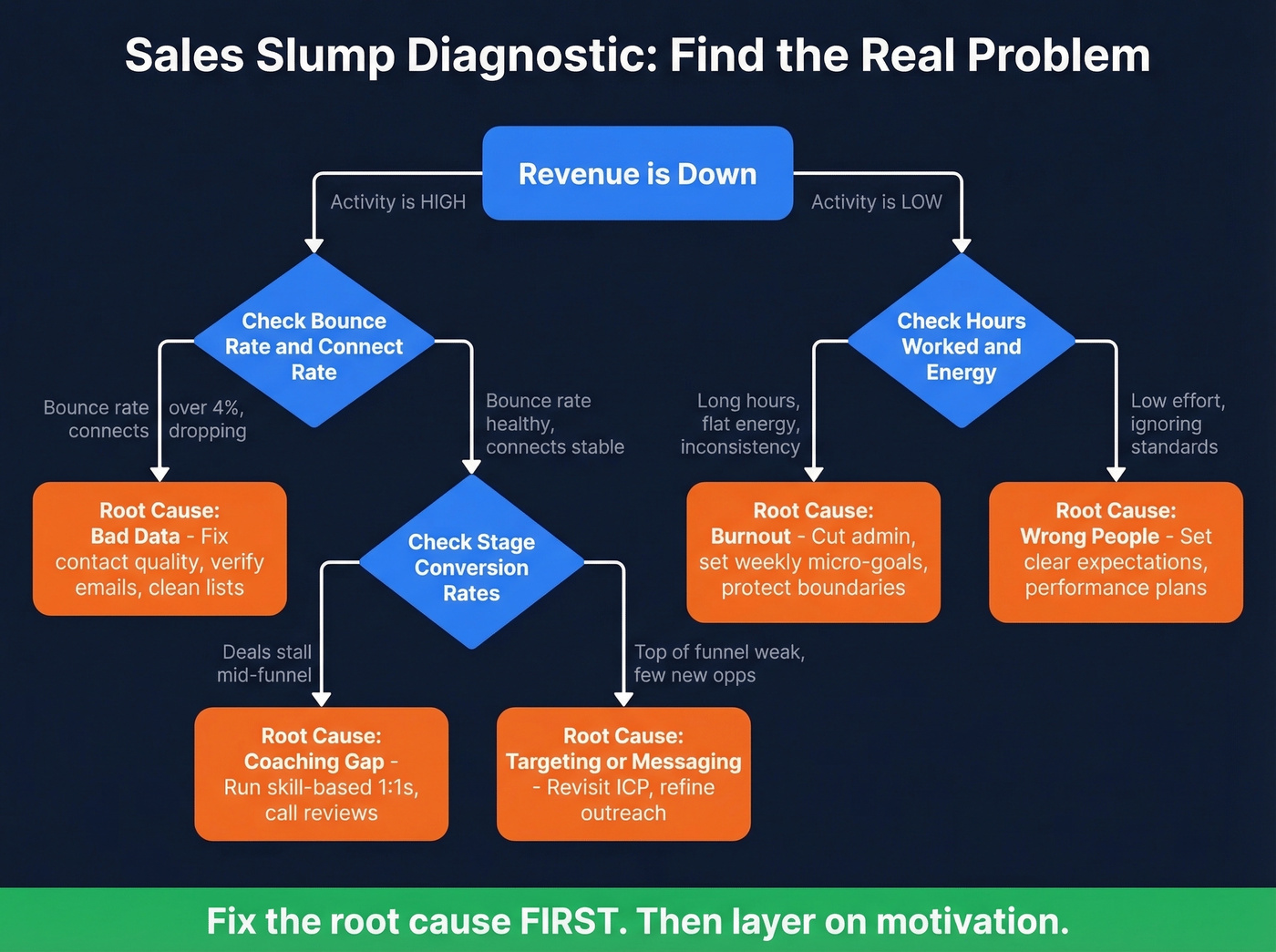
Use five activity buckets to pinpoint the leak: volume and mix, reach and coverage, engagement and conversion, cadence and timeliness, and hygiene and efficiency. If activity is high but conversion is falling, you don't have a "work ethic" issue - you have a targeting, messaging, or data issue. If activity itself is dropping, you're staring at burnout or disengagement.
| Symptom | Leading Indicator | Likely Root Cause |
|---|---|---|
| Low revenue, high activity | Conversion rate dropping | Messaging, targeting, data |
| Low revenue, low activity | Calls/emails per day down | Burnout, disengagement |
| Pipeline shrinking | New opps created declining | Prospecting process, data |
| Deals stalling mid-funnel | Stage velocity declining | Coaching, qualification |
One more reality check: a big chunk of "motivation problems" are actually manager problems. Gallup's research shows 70% of team engagement is attributable to the manager. If your team is flat, look at what your calendar rewards - coaching and enablement, or interrogation and reporting.
The Tactical Playbook
1. Coaching: Make It Skill-Based
The fastest turnarounds we've seen come from one shift: managers stop asking "Where's the deal?" and start asking "What's blocking you?" That's real coaching.
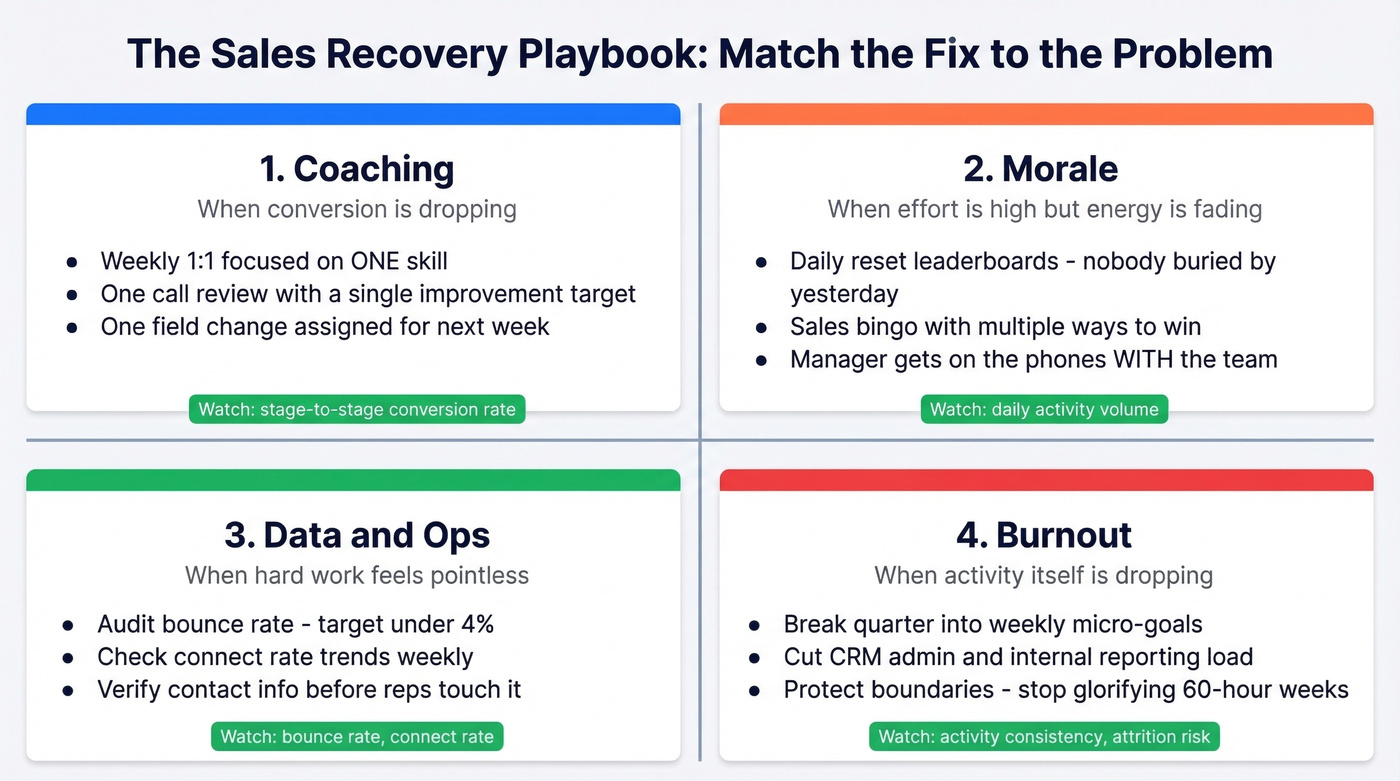
A practical cadence that works: run a weekly 1:1 focused on one skill - discovery, objection handling, multithreading, negotiation. Add one call review with a single improvement target, not a laundry list. Then assign one field change for the next week, whether that's a new opener, a tighter ICP filter, or a different close. HBR's research on sales performance makes the point bluntly: coaching outperforms almost every other productivity investment when it's consistent and specific.
Skip coaching-first if conversion is healthy and pipeline is thin. That's not a skill gap - it's a top-of-funnel or data problem. If you need a reset, start with sales prospecting techniques that rebuild pipeline fast.
2. Morale: Run Contests That Reward Effort
If your contest only rewards "top revenue wins," you're motivating the same two killers every month and quietly telling everyone else they don't matter. That's how you lose solid B-players.
Use formats that reward controllable behaviors. A daily reset leaderboard tracking dials, connects, and demos booked with small prizes keeps the whole team in the game because nobody's buried by yesterday's results. Sales bingo with multiple ways to win - new opp, follow-up sent, referral asked, meeting set - works well too.
But here's the practitioner move that beats any SPIF: get on the phones with them. We've watched a founder do a two-hour prospecting block alongside the team and change the mood in a single afternoon. It signals "we're in this together" without a single motivational poster.
Skip contests when the team is already grinding hard and still losing. Layering "fun" on top of exhaustion reads as disrespect.
3. Data and Ops: Fix the Wasted Effort Spiral
When revenue is declining, bad data is the most demoralizing problem because it makes hard work feel pointless. Disconnected numbers, bounced emails, stale titles - prospecting turns into a slot machine.
Do a quick audit: check your bounce rate (aim for under 4%), connect rate trend, percentage of leads missing direct contact info, and time lost to manual research per rep per day. If data is the issue, clean it before you touch comp, territories, or coaching. If you need options, compare data enrichment services and build a repeatable lead generation workflow.
Prospeo is our go-to for this exact problem: 98% verified email accuracy, a 7-day refresh cycle, and 125M+ verified mobile numbers so reps reach real people instead of dead ends. One customer, Meritt, saw bounce rates drop from 35% to under 4% and connect rates triple after switching from a stale database. That kind of fix restores rep confidence faster than any motivational speech.

Skip a data overhaul if your bounce rate is already low and connect rates are stable. In that case, look at messaging, offer, or qualification. For benchmarks, use a sales conversion rate breakdown by stage.
4. Burnout: Reduce Load, Don't Add Hype
Burnout doesn't need hype. It needs relief.
If activity is dropping and energy is flat, do three things immediately. Break the quarter into weekly wins - weekly targets create momentum while quarterly targets create dread. Cut admin ruthlessly; if reps spend a third of their day on CRM hygiene and internal reporting, you're taxing the very activity you're demanding. And protect boundaries, because a team running 60-hour weeks in a slump isn't heroic - it's unstable.
Let's be honest: if your answer to a slump is "work more hours," you're not leading. You're panicking. Fix the system so normal effort produces results again. If you want a systems-first approach, borrow from sales leadership and track pipeline health weekly.

Bad data is the fastest way to kill rep morale. When half your dials hit voicemail and emails bounce, no contest or pep talk will fix the slump. Prospeo delivers 98% verified email accuracy, 125M+ verified mobiles, and a 7-day refresh cycle - so every rep's effort connects to a real person. Meritt cut bounce rates from 35% to under 4% and tripled connect rates.
Stop motivating reps through a broken system. Fix the data first.
What Not to Do
Don't throw money at a broken process. A VP of Sales on r/sales described nine months of ops failures, a mid-year GTM change, and a slower market - and leadership's answer was to double commission. That doesn't remove blockers. It just adds pressure.
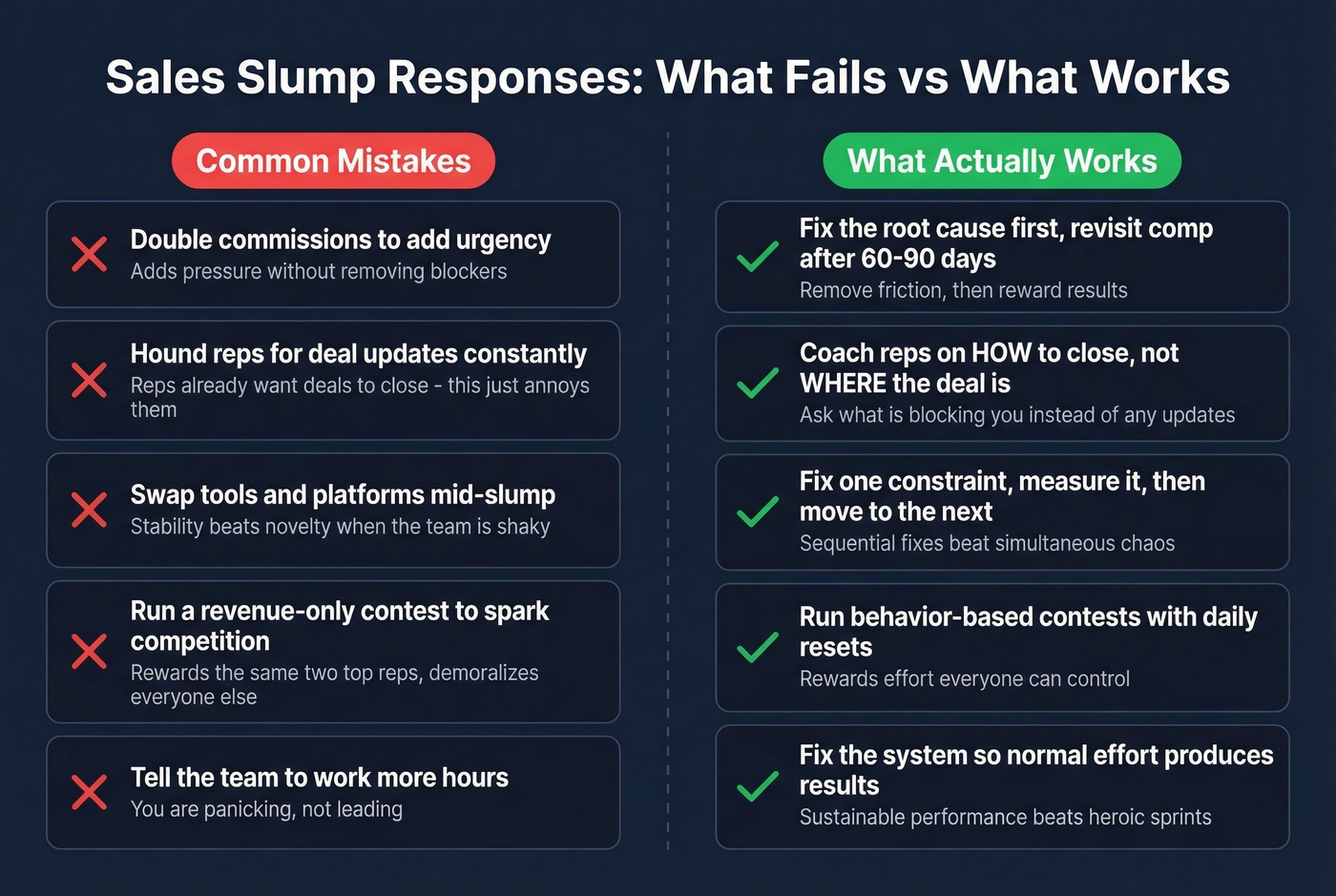
Don't hound reps for deal status. Another r/sales thread called constant "any updates?" check-ins "obnoxious and pointless." They're right. Reps already want deals to close. Your job is to help them close, not narrate the CRM. If you need better structure, tighten your sales process optimization instead of adding more check-ins.
Don't thrash tools mid-slump. Stability beats novelty when the team is already shaky. Fix one constraint, measure, then move to the next.
Sometimes It's the People
Sometimes the real issue isn't motivation, coaching, data, or burnout. Sometimes you have the wrong team.
I've seen managers inherit groups where a chunk of reps were comfortable collecting base salary, ignoring activity standards, and dragging the culture down. The turnaround wasn't a better contest - it was clear expectations, documented performance plans, and replacing chronic underperformers. Harsh? Yes. Also fair to the reps who are actually trying. If you're protecting passengers, you're punishing drivers. If you're rebuilding, a structured 30-60-90 day plan for sales reps helps reset standards without chaos.
Before you restructure comp plans or launch another SPIF, audit your data. If reps waste hours on disconnected numbers and outdated titles, you're taxing morale with every dial. Prospeo's 300M+ verified profiles refresh every 7 days - not every 6 weeks - so your team prospects with confidence instead of frustration. At $0.01 per email, it costs less than one wasted rep-hour.
Replace the slot machine with a system that rewards effort.
Slump Recovery Checklist
| Root Cause | Action | Metric to Watch |
|---|---|---|
| Coaching gap | Weekly 1:1 skill sessions + call review | Stage-to-stage conversion |
| Low morale | Short behavior-based contests + manager participation | Daily activity volume |
| Bad data | Audit contact data, target under 4% bounce, clean lists | Bounce rate, connect rate |
| Burnout | Weekly micro-goals; cut CRM/admin load | Activity consistency, attrition risk |
| Wrong people | Performance plans; replace chronic underperformers | Quota attainment post-change |
There's no motivational speech that fixes a structural problem. Figuring out how to motivate a sales team when sales are down means diagnosing first, matching the fix to the root cause, and removing the demotivators that make effort feel pointless. Start with the stuff that wastes your reps' time. Nothing kills motivation like doing everything right and getting nowhere.
FAQ
Why do sales teams lose motivation during a slump?
Reps lose motivation when effort stops producing results - not when they stop caring. Bad data, unclear ICP, stalled deals, and excessive admin create a "wasted effort" loop that erodes confidence. Fixing the system usually restores energy faster than any pep talk.
Should I increase commissions to motivate struggling reps?
Almost never as a first move. Higher commissions on a broken process just add pressure without removing blockers. Fix the root cause first - data quality, coaching gaps, or territory imbalance - then revisit comp if performance still lags after 60-90 days.
How do I tell if it's a data problem or a skills problem?
Check conversion rates at each funnel stage. If reps are making 40+ touches daily but bounce rates exceed 4% or connect rates are cratering, that's data. If they're reaching prospects but deals stall after discovery, that's coaching. The diagnostic table above walks through the full breakdown.
How quickly can a demoralized sales team recover?
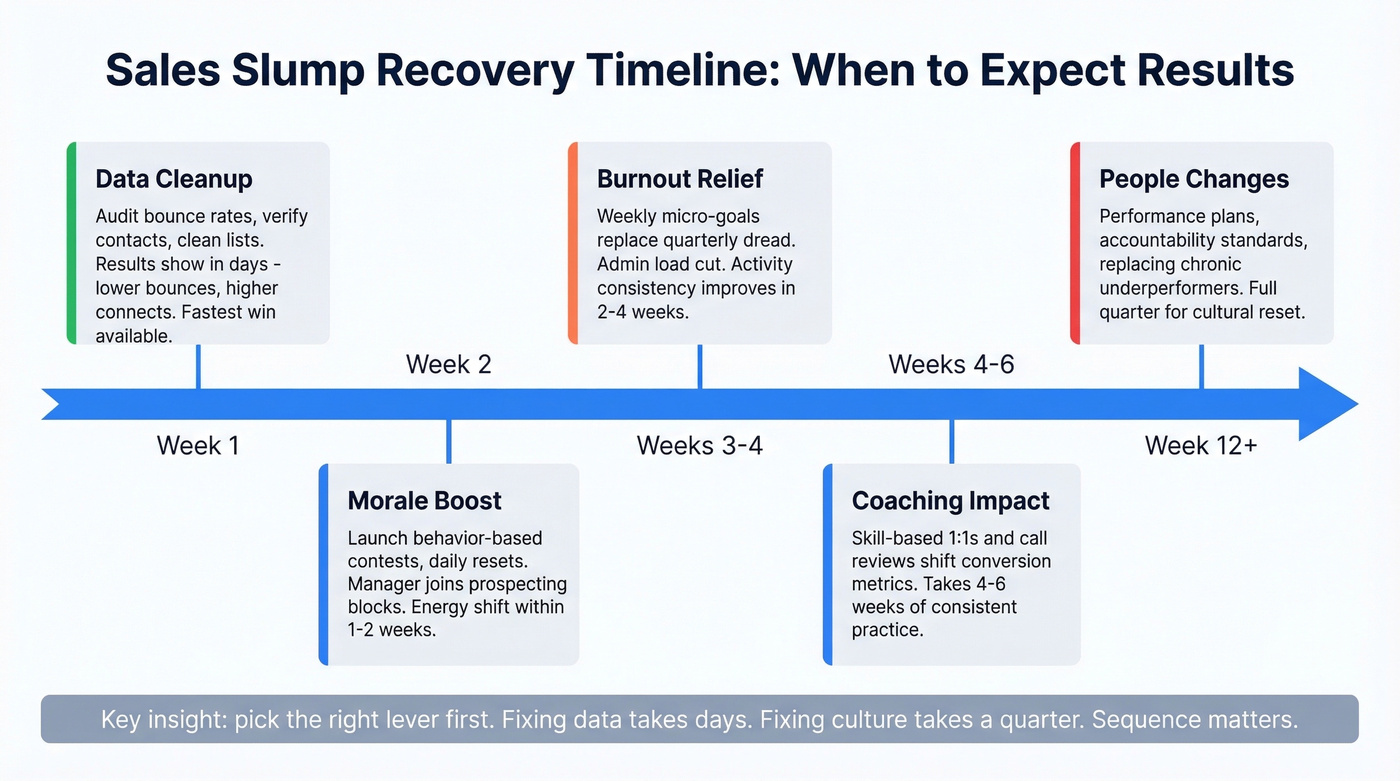
Most teams see measurable improvement within 2-4 weeks once you remove the primary friction point. Data cleanups show results in days through lower bounce rates and higher connects. Coaching takes 4-6 weeks to shift conversion metrics. Cultural changes around accountability take a full quarter. The key is picking the right lever first - Gallup's engagement research confirms that manager behavior is the single biggest variable.