

How to Politely Ask Someone to Reply to Your Email - 15+ Templates That Actually Work
You sent the proposal Tuesday. It's Friday. Nothing. You've checked your sent folder twice, refreshed your inbox three times, and you're mentally drafting a follow-up that somehow sounds both casual and desperate.
You're far from alone. 48% of sales reps never send a second message, which means the other 52% are agonizing over exactly the same thing you are right now. We've spent years testing follow-up sequences across thousands of outbound campaigns, and the patterns are clear: the right phrasing, timing, and structure make the difference between a reply and radio silence. Below you'll find every example, template, and tactic you need.
The Follow-Up Formula
Here's the structure that works across every follow-up email. Memorize it, then adapt it.
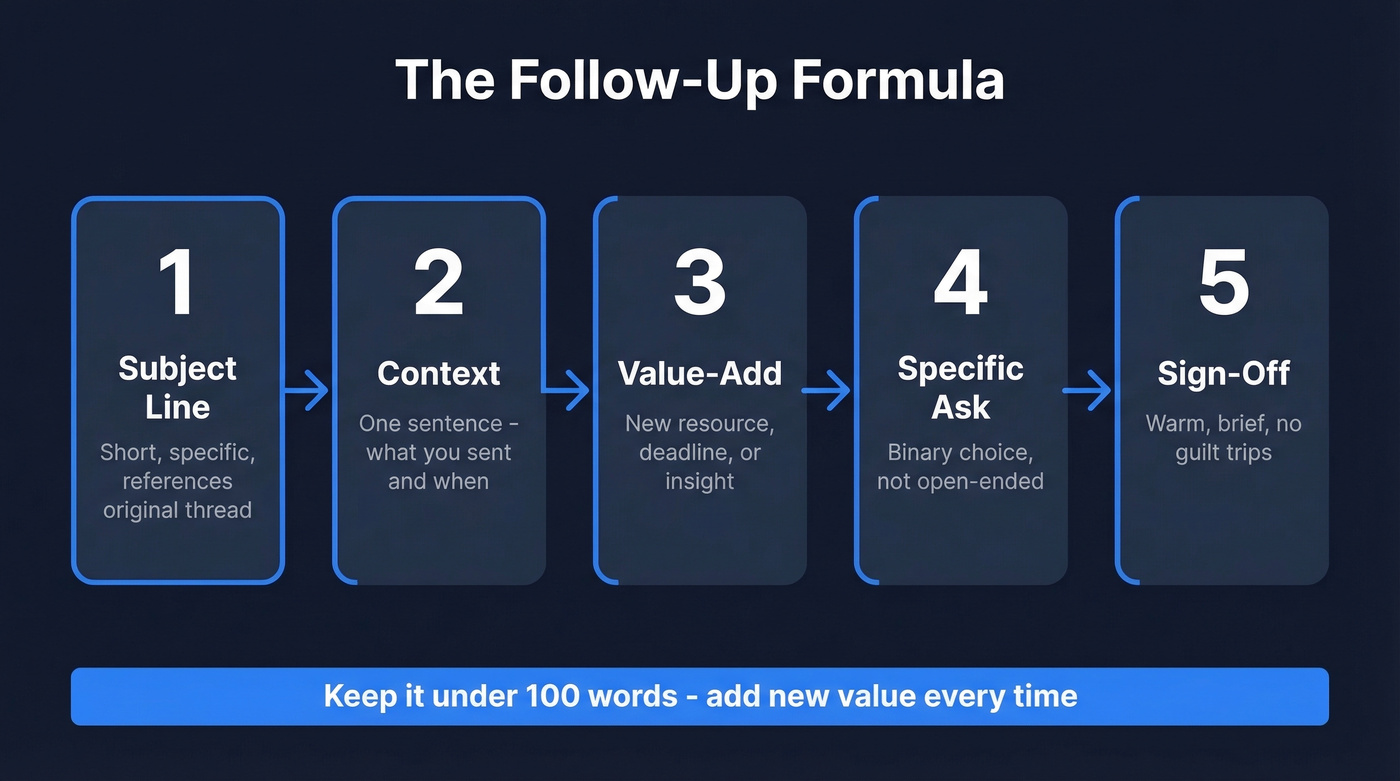
- Subject line - short, specific, references the original thread
- Context - one sentence reminding them what you sent and when
- Value-add - something new (a resource, a deadline, a relevant insight)
- Specific ask - not "let me know your thoughts" but "can you confirm by Thursday?"
- Sign-off - warm, brief, no guilt trips
The single most important rule: add new value every time. A follow-up that just says "bumping this" is noise. A follow-up that includes a case study, a deadline, or a new angle gives the recipient a reason to engage.
Keep your follow-up under 100 words. Most of the templates below are around 40-80 words - short enough to read on a phone screen in under 10 seconds. And give them an easy out. Instead of "let me know your thoughts," try "Would Option A or Option B work better?" Binary choices get faster replies than open-ended questions. If you're wondering how to ask for a quick response in an email, this binary-choice technique is the single most effective tactic we've found.
The numbers back it up. A Backlinko study of 12 million emails found that a single follow-up lifts reply rates by 65.8%. Follow-ups generate 42% of all campaign replies. Skip the second email and you're leaving almost half your responses on the table.
If you just want copy-paste templates, jump to the template bank.
What the Data Says About Follow-Ups
Belkins analyzed 16.5 million cold emails across 93 business domains from Jan-Dec 2024. The peak reply rate from a single email? 8.4%. That's the ceiling for most outbound campaigns without follow-ups.
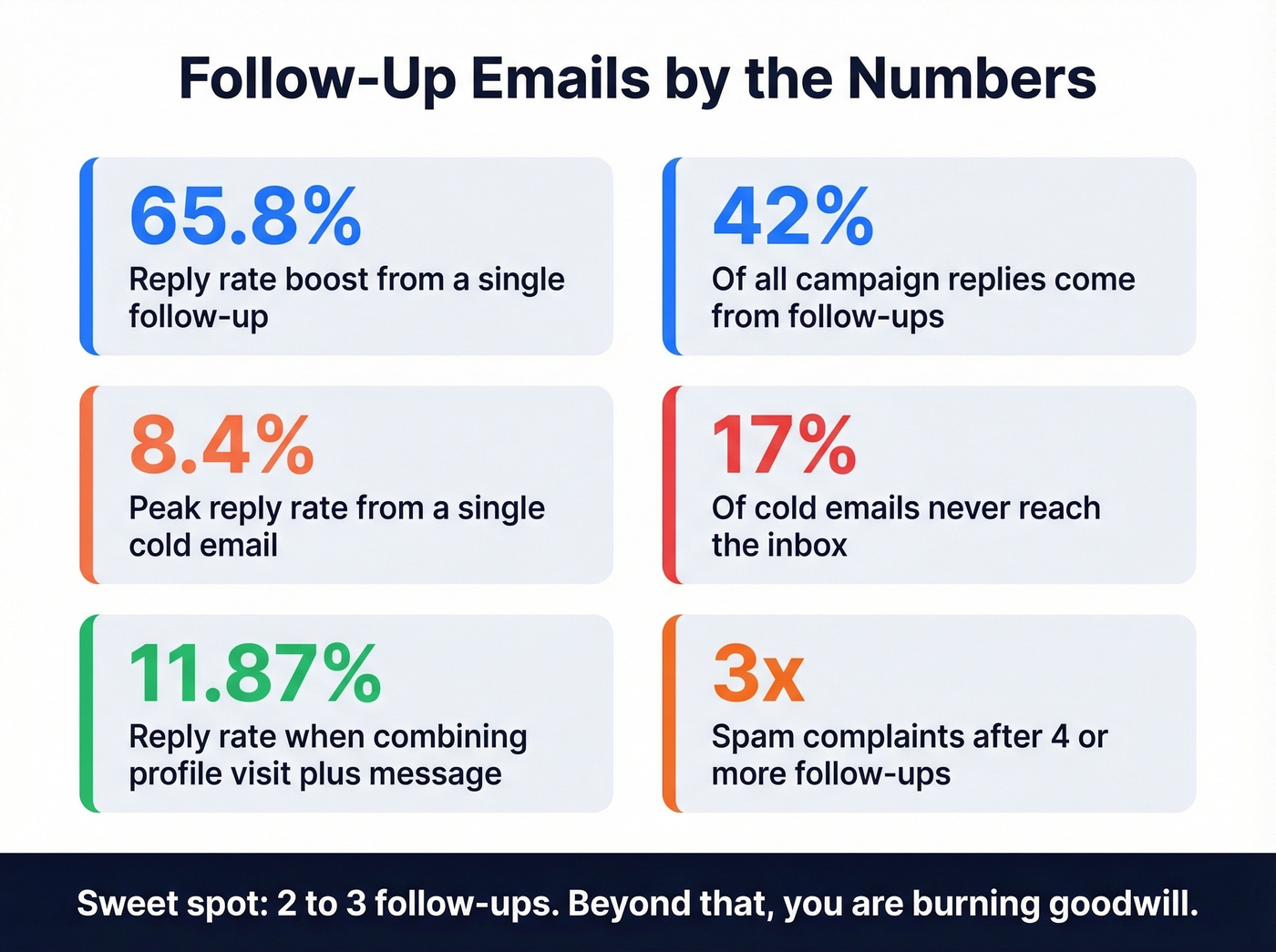
Adding follow-ups helps - up to a point. After four or more emails in a sequence, unsubscribe rates and spam complaints more than triple. There's a cliff, and most teams drive right off it.
The average cold email reply rate across platforms sits around 3.43%, and roughly 17% of cold emails never even reach the inbox. So before you blame your wording, consider that the email might not have arrived at all. Belkins also found that combining a profile visit with a message hit an 11.87% reply rate - higher than any email-only sequence. If your follow-ups aren't landing, switching channels entirely can outperform sending a fifth email to the same inbox.
Two to three follow-ups is the sweet spot. Beyond that, you're burning goodwill.
Subject Lines That Get Opened
A third of recipients decide whether to open or delete based on the subject line alone. Worse, 69-70% mark an email as spam based on nothing more than the subject line. Cold email open rates dropped from 36% in 2023 to 27.7% in 2024. Your subject line is doing more heavy lifting than ever.
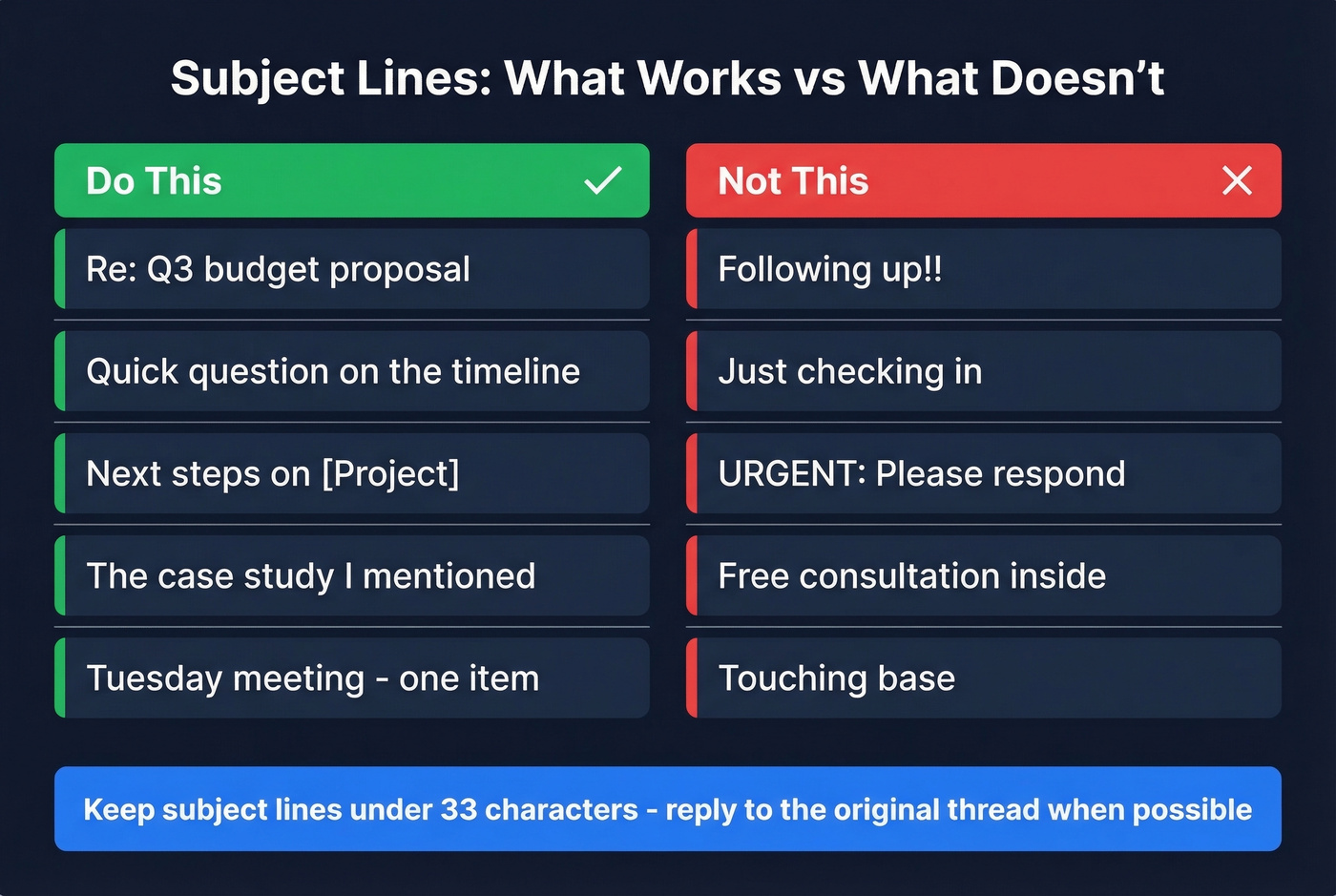
Keep it under 33 characters so it doesn't get truncated on mobile. Reference the original topic. Avoid spam triggers.
| Good Subject Line | Bad Subject Line | Why |
|---|---|---|
| Re: Q3 budget proposal | Following up!! | Vague, punctuation spam |
| Quick question on the timeline | Just checking in 😊 | No substance, emoji risk |
| Next steps on [Project] | URGENT: Please respond | ALL CAPS, pressure |
| The case study I mentioned | Free consultation inside | Spam trigger word |
| Tuesday's meeting - one item | Touching base | Cliche, zero value |
"Re:" thread replies often perform best because they signal an existing conversation. When in doubt, reply to your original email thread rather than starting a new one.
15+ Polite Follow-Up Templates by Scenario
Every template below is 40-80 words, ready to customize. That range is long enough to add value, short enough to read on a phone.
No Response to Initial Email (Warm)
Hi [Name], I wanted to circle back on the email I sent [day]. I know inboxes get buried - no worries. I've attached a quick one-pager that summarizes the key points in case that's easier to review. Would [specific day] work for a 15-minute call?
Warm relationship, friendly tone, no pressure.
No Response to Initial Email (Direct)
Hi [Name], following up on my [date] email about [topic]. I've since pulled together some benchmarks that might be relevant to your team's [specific goal]. Happy to share those on a quick call. Does Thursday or Friday afternoon work on your end?
Cold or semi-cold outreach where you need a concrete reason to reply. If you're building a full outbound motion, pair these with proven sales prospecting techniques.
No Response to Initial Email (Formal)
Dear [Name], I'm writing to follow up on my correspondence of [date] regarding [topic]. I understand competing priorities may have delayed your review. I've attached an updated summary for your convenience and would welcome the opportunity to discuss at your earliest availability. Please let me know a suitable time.
Use this for senior executives, government contacts, or any context where formality signals respect rather than stiffness. When the stakes and the seniority are both high, this is the right approach.
Following Up With Your Boss
Hi [Name], just a heads-up that I'll need your sign-off on [item] by [deadline] to keep [project] on track. I've attached the summary with the key decision points highlighted. If you'd prefer, I can walk you through it in 5 minutes - just let me know when works.
Anchor to the project timeline. It removes the awkwardness of nudging upward.
Following Up With a Client
Hi [Name], wanted to share a quick update since my last email. We've seen [specific result or insight] with a similar account, and I think it's directly relevant to what you're working on. Worth a 10-minute conversation? I'm flexible this week.
This only works when you can offer something new - a result, a resource, an insight. For more scenarios, see our sales follow-up templates.
After Sending a Proposal or Quote
Here's what not to send: "Hi, just checking if you got my quote?" That sounds desperate and adds zero value. Lead with proof instead:
Hi [Name], I wanted to follow up on the proposal I sent [date]. Since then, [Client X] used a similar approach and saw [specific result]. I've attached that case study in case it helps your team evaluate. Happy to answer any questions or adjust the scope.
The case study does the selling. You're not asking "did you read it?" - you're giving them a new reason to care.
After a Meeting
Hi [Name], thanks again for [meeting]. To recap, we discussed [key point 1] and [key point 2]. The next step we agreed on was [action item] by [date]. I'll have [deliverable] ready on my end - just confirming that timeline still works for you.
Send within 24 hours. The recap format makes it easy for them to reply with a simple "confirmed." If you want more post-call options, use these sales meeting follow-up email frameworks.
Overdue Invoice or Payment
Hi [Name], I hope you're well. I wanted to flag that invoice #[number], sent on [date] for [amount], is now [X days] past due. Could you confirm when we can expect payment? If there's an issue on your end, I'm happy to discuss. I've reattached the invoice for convenience.
You're stating facts, not making accusations. The reattached invoice removes any "I can't find it" excuse, and the open-ended closer gives them a face-saving way to explain a delay.
After a Job Interview
Hi [Name], thank you again for the conversation on [date] - I especially enjoyed discussing [specific topic]. I'm very enthusiastic about the [role] and would love to be part of [company initiative they mentioned]. Do you have an updated timeline for next steps?
Send 24-48 hours after the interview. Reference something specific from the conversation to stand out from every other candidate who sent a generic "thanks for your time."
Recruiter Follow-Up
Hi [Name], I'm finalizing my schedule for next week and wanted to check if [proposed date/time] still works for our conversation. If that doesn't fit, I have availability on [alternative]. Looking forward to connecting.
This scheduling-anchor tactic frames the follow-up as logistical, not needy. You're not asking "did you forget me?" - you're asking "which slot works?"
Networking Introduction
Hi [Name], [Mutual contact] suggested I reach out - they mentioned you're doing interesting work in [area]. I'd love to hear your perspective on [specific topic]. Would you be open to a 15-minute coffee chat or call sometime in the next couple of weeks?
Lean on the mutual connection early. It's the single strongest reason for a stranger to reply.
Request for Information or Approval
Hi [Name], I need [specific information/approval] by [date] to keep [project or deliverable] moving forward. I've outlined exactly what's needed in the attached doc - it should take about 5 minutes to review. Could you take a look before end of day [date]?
Deadlines work. Anchor to the project timeline, not your impatience - that's how you request sign-off without sounding demanding.
Low-Friction Binary Choice
Sometimes the reason people don't reply is that your email requires too much thinking. Strip it down:
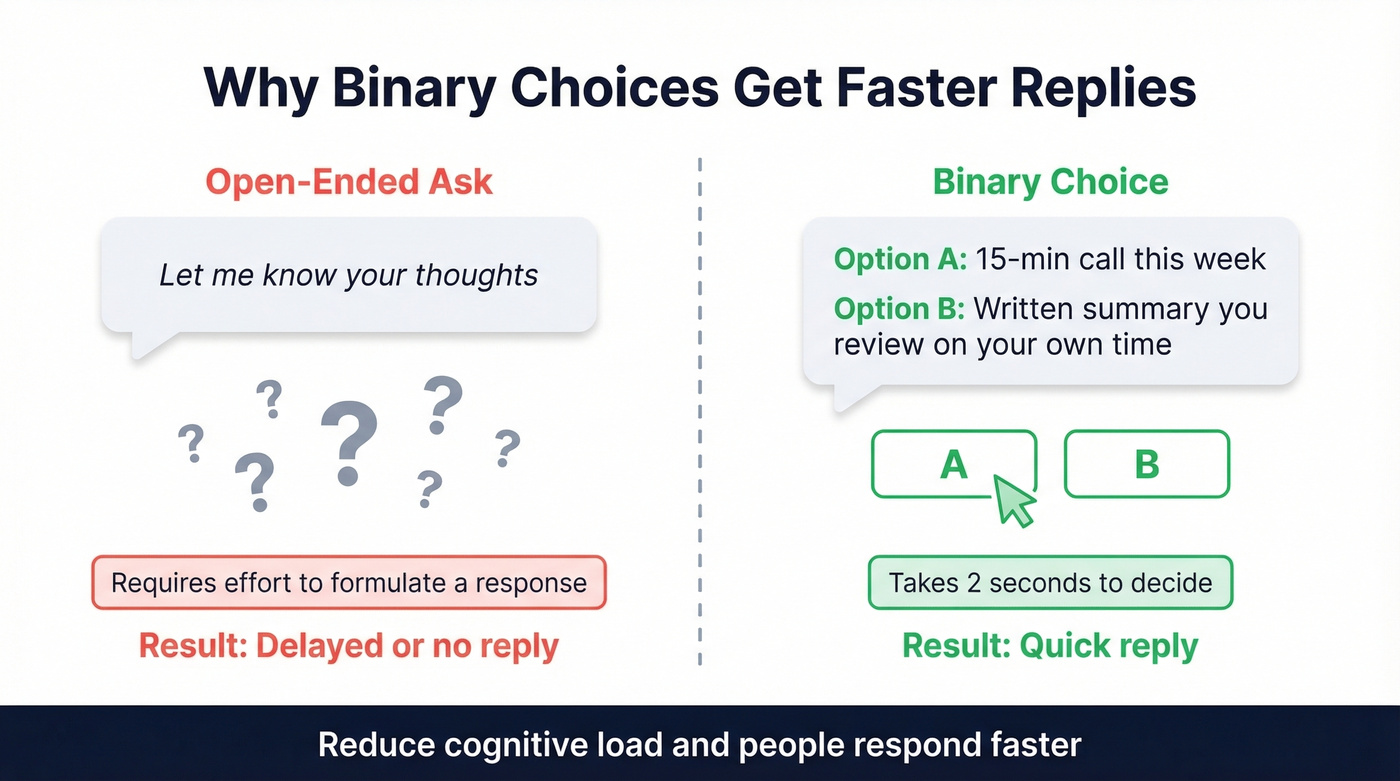
Hi [Name], circling back on [topic]. To make this easy - would you prefer (A) a 15-minute call this week, or (B) I send over a written summary you can review on your own time? Either works for me.
This format often outperforms open-ended follow-ups. When you reduce the cognitive load, people respond faster - it's the quickest path to getting a reply from prospects juggling dozens of threads.
Following Up After a Referral
Hi [Name], [Referrer] recommended I get in touch - they thought there might be a good fit between [your offering/expertise] and [their current initiative]. I'd love to learn more about what you're working on. Would a brief call next week make sense, or is email better?
Different from a cold networking intro. The referral carries weight - use the referrer's name in the first sentence.
Vendor or Supplier Follow-Up
Hi [Name], checking in on the [order/quote/delivery] from [date]. Could you confirm the current status and expected timeline? We're planning around a [date] deadline on our end.
Keep it transactional. Vendors appreciate brevity.
The Breakup Email
This is the most underused template in outbound - and it often generates replies even when earlier follow-ups didn't. The psychology is simple: removing pressure creates space for the recipient to re-engage on their own terms.
Hi [Name], I've reached out a few times about [topic] and haven't heard back - totally understand if the timing isn't right. I'll close this out on my end, but if things change down the road, I'd be happy to pick the conversation back up. Wishing you and the team all the best.
It's graceful, it removes pressure, and counterintuitively, it often generates the reply that four previous emails couldn't. The consensus on r/sales is that breakup emails are the highest-converting message in most sequences - people respond when they feel the window closing.

17% of cold emails never reach the inbox. Your perfectly crafted follow-up is worthless if the email address is wrong. Prospeo's 5-step verification delivers 98% email accuracy - so your polite nudge actually lands.
Stop following up with dead inboxes. Start with verified contacts.
Phrases That Backfire (and What to Say Instead)
| Phrase | Problem | Better Alternative |
|---|---|---|
| "Just following up" | No new info, no reason to reply | "Following up with [new resource/update]" |
| "Kindly" | Reads as condescending | Drop it entirely - just be direct |
| "Touching base" | Cliche filler, zero value | State the specific reason you're writing |
| "Circling back" | Same problem | "Wanted to share [something new]" |
| "ASAP" | Pressure without context | "By [specific date] if possible" |
| "I hope this finds you well" | Delays the point | Lead with the ask or the value |
| "Per my last email" | Passive-aggressive | "Building on what I sent [date]" |
| "Please respond to this email" | Demanding, zero value-add | "Could you confirm by [date]?" |
Every one of these phrases fails for the same reason: they're about you, not the recipient. The best follow-ups give the reader something - a deadline, a resource, a reason - not just a reminder that you exist. If you need alternatives to "checking in," see how to say just checking in professionally.
One phrase worth testing: closing with "thanks in advance" can subtly boost your response rate because it presupposes the recipient will help, creating a small psychological commitment. Just don't pair it with a vague ask - the specificity of your request matters more than any sign-off.
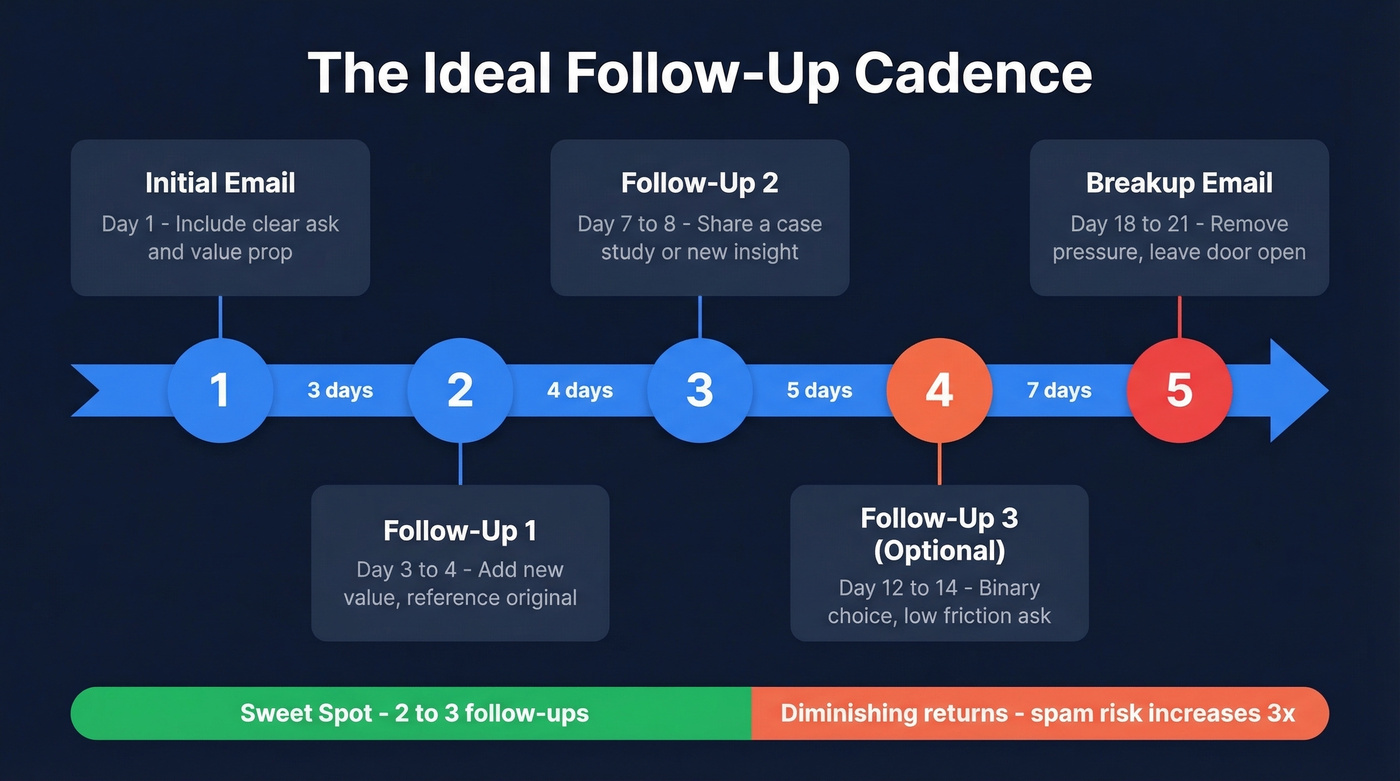
The Ideal Follow-Up Cadence
Send too early and you seem impatient. Wait too long and they've forgotten the original thread. Here's the cadence that balances persistence with professionalism, based on Instantly's recommended framework:
- Day 1 - Initial email
- Day 3 - First follow-up (add new value, reference original)
- Day 6 - Second follow-up (different angle or resource)
- Day 12 - Third follow-up (lighter touch, new context)
- Day 24 - Breakup email (graceful close, door open)
Send between 10 AM and 1 PM in the recipient's time zone - that's when engagement peaks for most B2B emails. If you want a deeper breakdown, see the best time to send cold emails.
Early touches should be 2-3 days apart. Later touches stretch to 4-7 days. If you still haven't heard back by the third follow-up, daily nudges won't help - they'll just annoy. Some frameworks recommend up to 8 emails in a sequence, but the Belkins data shows diminishing returns after 3 follow-ups. Small businesses (2-50 employees) start at a 9.2% reply rate, dip to 8% on the first follow-up, then bounce back to 8.4% on the second. Founders show a different pattern: 6.64% initial, a slight uptick to 6.94% after two follow-ups, then a steep drop to 3.01% by the fourth.
Five total emails - including the breakup - is the ceiling we'd recommend. If you're running sequences at scale, consider follow up email software to manage timing and personalization.
Following Up Across Cultures
If you're emailing internationally, your "polite" might be someone else's "rude." These norms aren't universal, but they're useful starting points from BubblesTranslation's cross-cultural guide.
| Country | Greeting Norm | Formality | Typical Response Time |
|---|---|---|---|
| Japan | Last name + "-san" | High | Moderate |
| Germany | Herr/Frau + surname | High | 1-3 days |
| China | Full name, formal | High | Same-day expected |
| Brazil | First name OK | Moderate | Several days |
| Nigeria | Formal salutation | High | Follow up within a week |
| India | Sir/Madam common | High | Varies widely |
Let's be honest about what this means in practice: if you're following up with someone in China and waiting a week, you've already lost the thread. If you're nudging a contact in Brazil after 48 hours, you'll come across as pushy. Adjust your cadence to the culture, not just your own comfort level. What reads as professional persistence in New York can feel aggressive in Sao Paulo.
Verify Before You Follow Up
Here's the thing most follow-up guides miss entirely: if your first email never arrived, no amount of wordsmithing on your fourth follow-up will save you. With 17% of cold emails never reaching the inbox, there's a real chance your beautifully crafted message is sitting in a void.
Before you spend 20 minutes on a second email, spend 20 seconds verifying the address is valid. Prospeo runs a 5-step verification process on every email - catch-all handling, spam-trap removal, honeypot filtering - and delivers 98% accuracy. The free tier gives you 75 email verifications per month, and paid plans run about $0.01 per email. If you want the broader playbook, start with our email deliverability guide.

In our experience, teams cut their bounce rates in half just by verifying addresses before sending. Fix the upstream data problem before optimizing downstream wording - the most polite follow-up in the world doesn't matter if it bounces. For benchmarks and fixes, see email bounce rate.
Still no reply after three follow-ups? The problem might not be your copy - it might be the contact. Prospeo gives you 300M+ verified profiles with direct dials, so you can pick up the phone when email goes silent.
Switch channels instantly with 125M+ verified mobile numbers.
FAQ
How do I politely ask someone to reply to my email?
Reference your original message, add something new (a resource, deadline, or insight), make a specific ask with a date, and keep the whole thing under 100 words. The template bank above has 15+ ready-to-use examples covering warm, cold, formal, and internal scenarios.
How long should I wait before following up?
Wait 3-5 business days for most professional contexts. Time-sensitive matters like expiring offers or scheduled meetings warrant a 48-hour follow-up. Post-interview, 24 hours is fine; for networking requests, 24 hours feels pushy. Adjust based on urgency and your relationship with the recipient.
How many follow-up emails is too many?
Two to three follow-ups is the sweet spot. Belkins' 16.5M-email study found that four or more emails in a sequence more than triples spam complaints. Cap your sequence at five total messages, with the last one being a breakup email that gracefully closes the loop.
Is it rude to follow up on an email?
No. 48% of reps never follow up at all, and 42% of replies come from follow-up messages. The rudeness isn't in following up; it's in following up with nothing new to say. Add value each time and you're being helpful, not annoying.
What free tools help ensure follow-ups actually arrive?
Prospeo's free tier lets you verify 75 email addresses per month with 98% accuracy, catching invalid addresses before you waste a follow-up on a dead inbox. For send-side deliverability, tools like Mail Tester and MXToolbox check your SPF/DKIM/DMARC configuration at no cost.