

How to Qualify Leads (Without Wasting Hours on Bad Prospects)
It's Thursday at 3pm. Your SDR has burned through 40 dials, left 12 voicemails, and had exactly one real conversation - with a marketing coordinator who "just wants to learn more" but has no budget, no authority, and no timeline. That's not prospecting. That's expensive cardio.
67% of lost sales result from inadequate lead qualification, and the math gets ugly fast: at a fully-loaded cost of ~$75/hr, spending just 15 minutes on each of 100 bad-fit leads costs your team $1,875 in wasted effort. Multiply that across five reps and you're lighting $9,375 on fire every month.
Knowing how to qualify leads is the difference between a team that closes and a team that's just busy. You don't need a better framework - you need better data and faster follow-up. The framework is table stakes. What follows is the operational stuff: a 100-point scoring rubric you can implement Monday morning, word-for-word discovery scripts, and a framework decision matrix based on your deal motion.
What Lead Qualification Actually Means
Lead qualification is the process of determining whether a prospect has the fit, intent, and capacity to become a customer. Simple in theory. In practice, it's where most sales orgs fall apart.
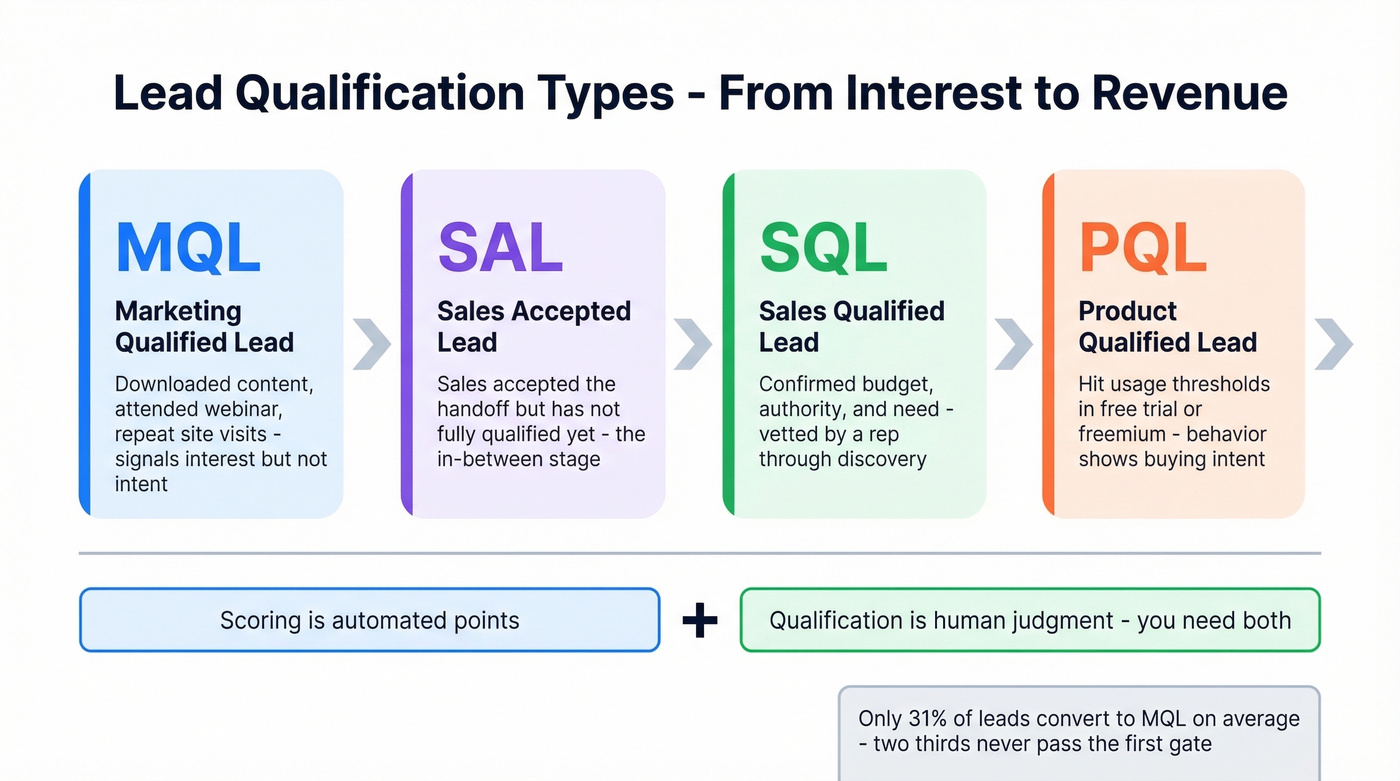
MQL (Marketing Qualified Lead): Engaged enough with your content to signal interest - downloading a whitepaper, attending a webinar, repeat site visits. SQL (Sales Qualified Lead): Vetted by a rep and confirmed as having real budget, authority, and need. PQL (Product Qualified Lead): Used your product through a free trial or freemium tier and hit usage thresholds that signal buying intent. SAL (Sales Accepted Lead): Sits between MQL and SQL - sales has accepted the handoff but hasn't fully qualified yet.
Here's the thing: scoring is automated points. Qualification is human judgment. You need both. The average lead-to-MQL conversion rate across industries is 31%, which means roughly two-thirds of your leads won't even make it past the first gate. That's normal - but the number swings wildly by industry and channel:
| Segment | Lead-to-MQL Rate |
|---|---|
| B2B SaaS | 39% |
| Cybersecurity | 39% |
| Construction | 17% |
| SEO (channel) | 41% |
| PPC (channel) | 29% |
| Client referrals (channel) | 56% |
If you're in SaaS and converting below 30%, your top-of-funnel targeting is off. If you're in construction and hitting 20%, you're actually outperforming. Context matters more than averages.
The goal isn't to qualify more leads. It's to qualify the right ones faster.
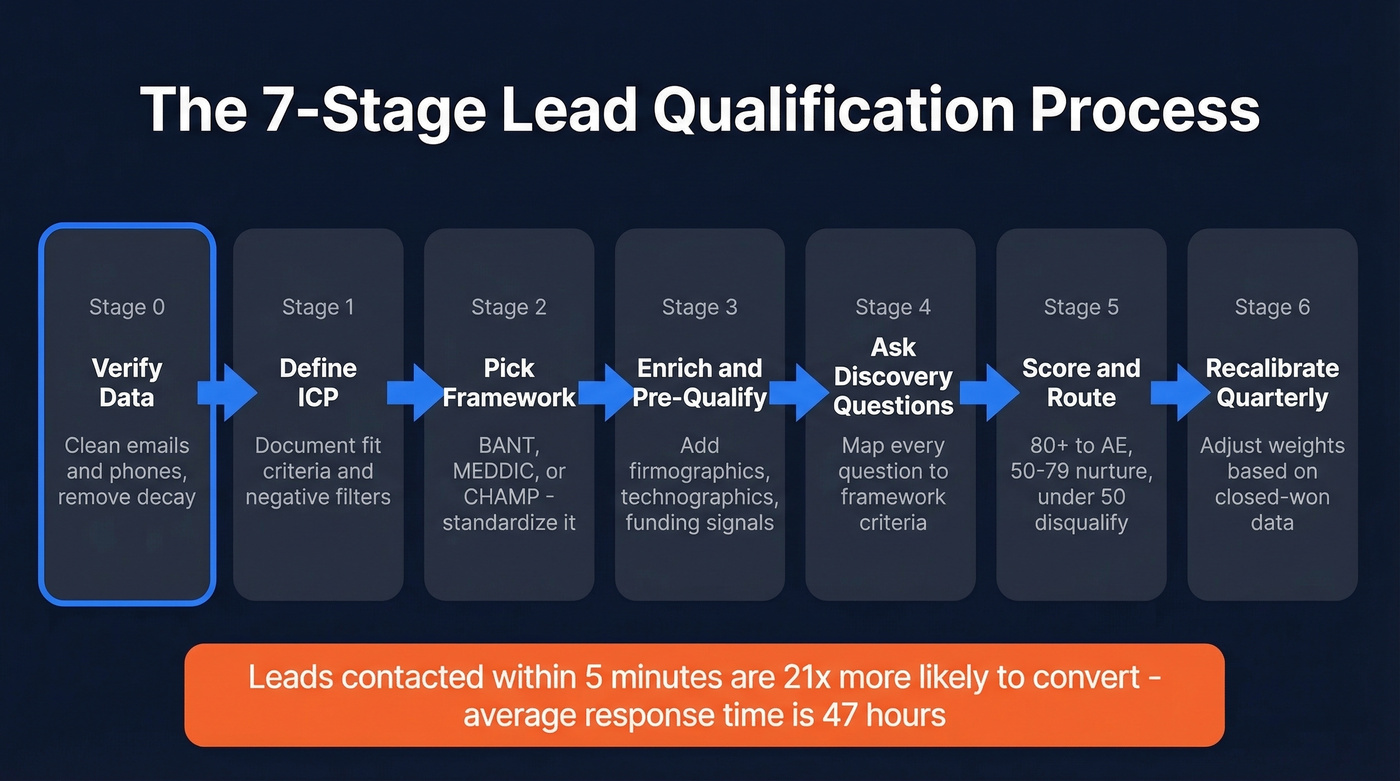
The 7-Stage Qualification Process
Step 0: Verify Your Data First
Before you score a single lead, verify your data. B2B contact data decays at 22.5% annually - and stale records quietly wreck reply rates, connect rates, and routing. Reps already spend only 28% of their week actually selling. Don't let bad data eat into what's left.
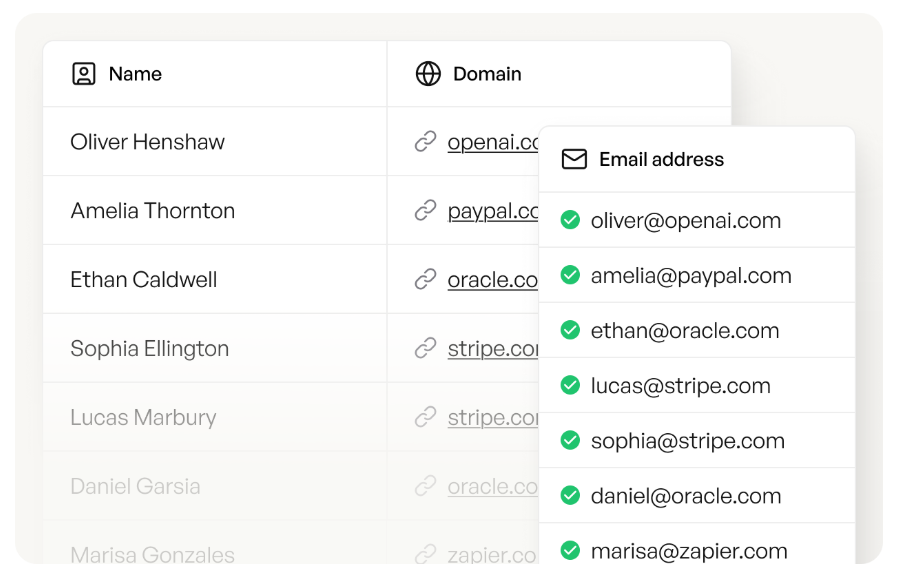
We use Prospeo for this step. Upload a CSV or connect your CRM and get verified emails and mobile numbers back - 83% of leads come back enriched, refreshed every 7 days, at roughly $0.01 per email. The alternative - having reps manually Google phone numbers and guess email formats - is how you end up with the Reddit horror stories about agencies spending hours researching leads only to discover they aren't ICP.
Step 1: Define Your ICP
If your ICP lives in a rep's head but not in a shared document, you don't have an ICP - you have opinions.
Write it down: industry, company size, revenue range, tech stack, geography, and the job titles you're targeting. Include negative ICP criteria too - the companies you explicitly don't want to sell to. A clear "no" list saves more time than a refined "yes" list. This document becomes the filter everything else runs through.
If you want a plug-and-play doc, start with an ICP template and adapt it to your deal motion.
Step 2: Pick a Framework
The short version: BANT for short sales cycles, MEDDIC for enterprise, CHAMP for mid-market consultative deals. Pick one and standardize it across the team. Consistency matters more than which framework you choose - more on this in the next section.
Step 3: Enrich and Pre-Qualify
Once you've verified contact data, enrich it with firmographics, technographics, headcount growth, and funding signals so reps aren't starting discovery calls from scratch. They walk in knowing the company's size, tech stack, and recent funding round before they ever pick up the phone. Enrichment turns a cold call into a warm conversation, and in our experience, it's the most overlooked step in the entire qualification process - yet it gives reps the biggest advantage before they even dial.
If you’re comparing vendors, see our breakdown of data enrichment options.
Step 4: Ask Discovery Questions
Scripts matter. We cover exact talk tracks below, but the principle is simple: ask questions that map to your framework's criteria. Don't freestyle. Every question should either confirm fit or surface a disqualification signal.
A good opener for any framework: "How have you been managing [pain point] up to this point?" It's open-ended enough to let the prospect talk but pointed enough to reveal real need.
If you need a bigger bank of prompts, use these discovery questions to standardize rep behavior.
Step 5: Score and Route
Assign points based on fit and behavior (see the scoring template below), then route leads based on score thresholds. Leads above 80 points go straight to an AE. Leads between 50-79 get nurtured. Below 50? Disqualify and move on.
If you’re formalizing this in your CRM, use a dedicated lead scoring model so routing rules stay consistent.
Use a scheduling tool like Calendly as a qualification gate. If a lead won't book a 15-minute call, they're telling you something.
Step 6: Recalibrate Quarterly
Your scoring model isn't a set-it-and-forget-it artifact. Review it quarterly against closed-won data. Which scores actually converted? Which "high-scoring" leads went dark? Adjust weights based on what's actually predicting revenue, not what felt right six months ago.
Here's the speed benchmark that should scare you: leads contacted within 5 minutes are 21x more likely to convert than those contacted after 30 minutes. The average lead response time? 47 hours. That gap is where deals die.
If you want to operationalize this, build a simple SLA and use sales follow-up templates so reps don’t reinvent the wheel.
Which Framework Fits Your Deal Motion
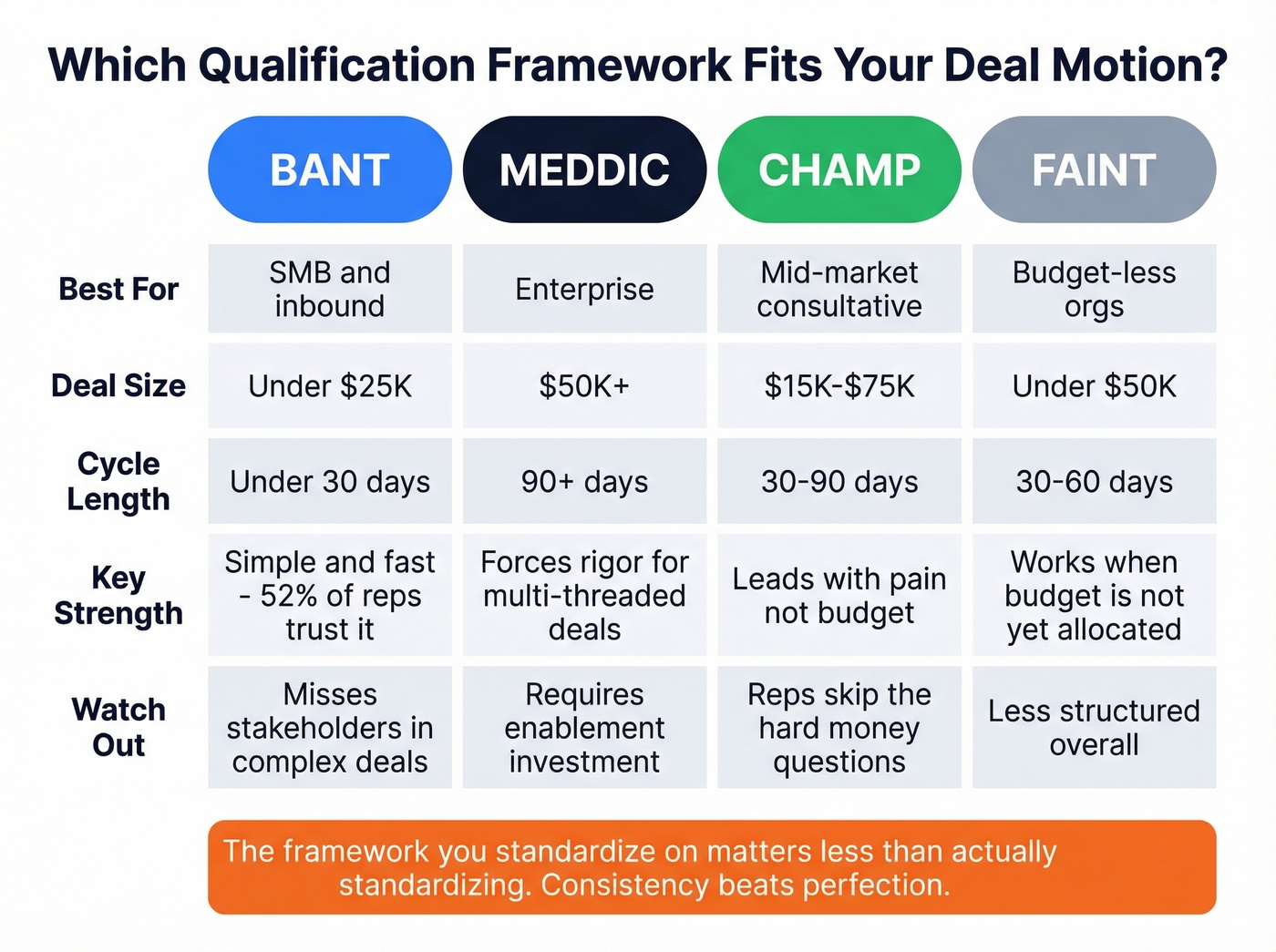
Sales trainers list BANT, MEDDIC, and CHAMP like they're interchangeable. They're not.
| Framework | Best For | Deal Size | Cycle Length | Weakness |
|---|---|---|---|---|
| BANT | SMB / inbound | Under $25K | Under 30 days | Misses stakeholders |
| MEDDIC | Enterprise | $50K+ | 90+ days | Requires enablement |
| CHAMP | Mid-market | $15-75K | 30-90 days | Reps skip hard Qs |
| FAINT | Budget-less orgs | Under $50K | 30-60 days | Less structured |
BANT - Budget, Authority, Need, Timeline - was created by IBM in the 1950s, and 52% of sales reps still trust it for reliability. It works beautifully for high-velocity inbound where deals close in under 30 days. But modern B2B purchases involve an average of ~7 stakeholders, and BANT doesn't account for political risk or multi-threaded decision-making.
Graduate to MEDDIC when your average deal crosses $50K and involves 3+ stakeholders. It's heavier - Metrics, Economic Buyer, Decision Criteria, Decision Process, Identify Pain, Champion - but it forces the rigor that enterprise deals demand. The tradeoff is real: it requires enablement investment and can slow deals if applied too rigidly to simpler transactions.
If you’re going deeper on this, use a dedicated MEDDIC qualification playbook to keep reps consistent.
CHAMP (Challenges, Authority, Money, Prioritization) works well for mid-market consultative sales because it leads with pain instead of budget. The risk is that reps use the "softer" structure as an excuse to avoid the hard questions about money and timeline.
Let's be honest: the framework you standardize on matters less than actually standardizing. A team running BANT consistently will outperform a team where every rep qualifies differently. If your average contract value sits below $10K, you probably don't need MEDDIC-level rigor - BANT with clean data and fast follow-up will beat a perfectly designed enterprise qualification process that nobody follows.

You just read that bad data costs teams $9,375/month in wasted effort. Prospeo enriches 83% of your leads with verified emails (98% accuracy) and direct dials - refreshed every 7 days, not every 6 weeks. At $0.01 per email, fixing Step 0 costs less than one bad-fit discovery call.
Qualify leads with data you can trust, not data you have to Google.
The 100-Point Scoring Template
Every guide tells you to "implement lead scoring" without showing the actual model. Here's one you can screenshot and drop into your CRM Monday morning - map these values to HubSpot's lead scoring properties or Salesforce's Einstein scoring fields and you're live.
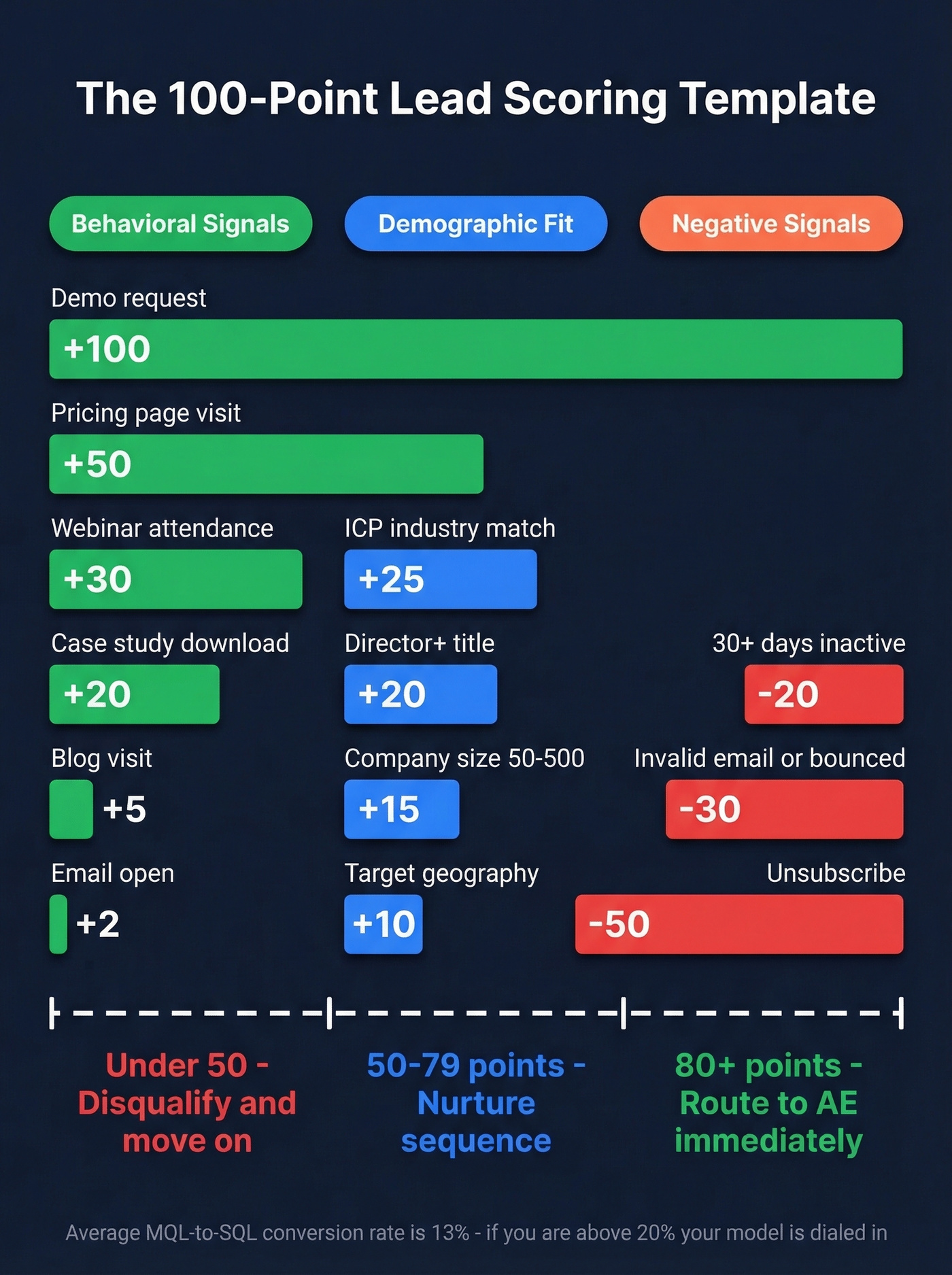
| Action / Attribute | Points | Category |
|---|---|---|
| Demo request | 100 | Behavioral |
| Pricing page visit | 50 | Behavioral |
| Webinar attendance | 30 | Behavioral |
| Case study download | 20 | Behavioral |
| Blog visit | 5 | Behavioral |
| Email open | 2 | Behavioral |
| ICP industry match | 25 | Demographic |
| Director+ title | 20 | Demographic |
| Company size 50-500 | 15 | Demographic |
| Target geography | 10 | Demographic |
| 30+ days inactive | -20 | Negative |
| Unsubscribe | -50 | Negative |
| Invalid email / bounced | -30 | Negative |
The 80/100 threshold for SQL status is a common starting point, but don't treat it as gospel. If your AEs are drowning in meetings, raise the threshold. If pipeline is thin, lower it and tighten later.
One case worth noting: Sponge.io tightened their title/seniority filters and lowered their activity threshold, which increased their MQL-to-meeting rate by 13%. Small calibrations compound. The average MQL-to-SQL conversion rate is 13% - if you're above 20%, your scoring model is dialed in. Below 10%? Something's broken. Use the industry benchmarks above to calibrate: a 13% conversion rate in construction is strong; in B2B SaaS, it's a red flag.
If you’re pressure-testing the rest of your funnel, track funnel metrics alongside scoring so you can see where leads actually stall.
Discovery Scripts That Work
Good qualification isn't about asking "do you have budget?" It's about earning the right to ask hard questions.
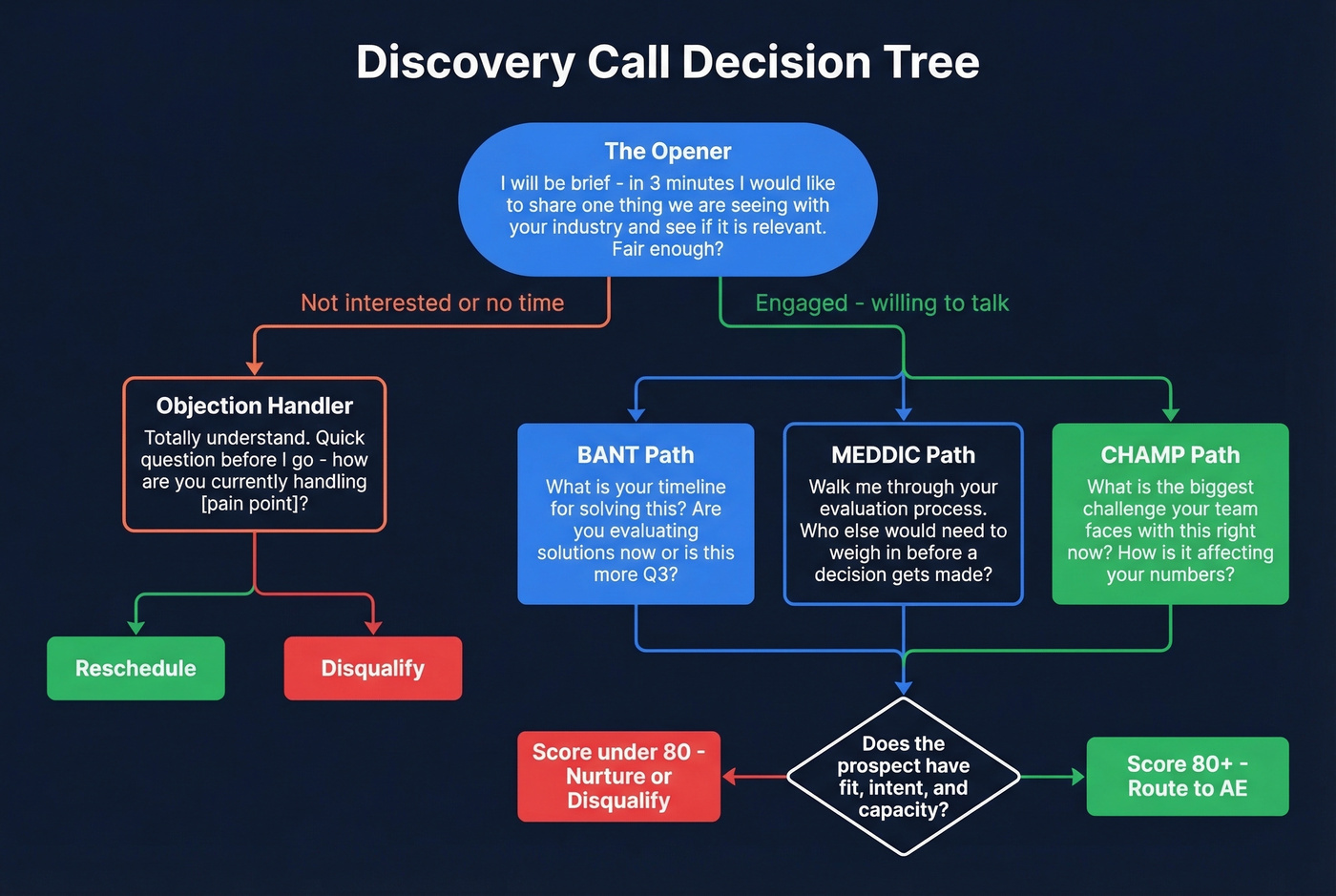
The Opener (Earning Time):
"Hi [Name], it's [Your Name] from [Company]. I'll be brief - in three minutes, I'd like to share one thing we're seeing with [industry/role] teams and see if it's relevant. Fair enough?"
BANT Discovery:
"What's your timeline for solving [pain point]? Are you evaluating solutions now, or is this more of a Q3 priority?"
MEDDIC Discovery:
"Walk me through your evaluation process. Who else would need to weigh in before a decision gets made?"
The "I Don't Have Time" Objection:
"Totally understand - you're busy. Let me ask one quick question: is [pain point] something your team is actively trying to solve this quarter? If yes, I'll send a 2-minute summary you can review on your own time. If not, I won't follow up."
This script does two things at once: it respects the prospect's time and qualifies them in a single question. If they say no, you've saved yourself a follow-up sequence.
Disqualification (The Hardest Script):
"Based on what you've shared, I don't think we're the right fit right now - and I'd rather be honest about that than waste your time. Here's why: [specific reason]. If [condition changes], let's reconnect."
Disqualifying well is a skill. It's also the fastest way to build trust with prospects who come back later with real budget.
Five Mistakes That Kill Pipeline
Picture this: it's Friday pipeline review. Your VP pulls up the forecast and sees 200 opportunities worth $4M. Sounds great - until you realize 60% of those opps haven't had activity in 30+ days. That's not a pipeline. That's a graveyard with optimistic labels.
1. No documented ICP. If it's not written down and shared, every rep qualifies against a different standard. Marketing sends what they think fits. Sales rejects half of it. The misalignment thread on r/b2bmarketing captures this perfectly: marketing sends leads that don't match ICP, sales wastes time on calls that go nowhere, and both teams blame each other.
2. No standardized framework. Rep A uses BANT. Rep B wings it. Rep C asks three questions and calls it qualified. Forecast accuracy drops, and nobody can diagnose why.
3. Rewarding pipeline volume over quality. When leadership celebrates "200 new opps this month" without asking about conversion rates, you're incentivizing bloat. Win rates drop because reps spread attention across too many low-quality opportunities instead of working the deals that actually close.
4. Never disqualifying. The hardest discipline in sales. If 60% of your pipeline goes dark, you aren't qualifying - you're collecting names. Skip this lesson and you'll keep wondering why your close rate stays flat despite "record pipeline."
5. Never recalibrating the scoring model. What predicted a closed-won deal 12 months ago is likely irrelevant today. Markets shift. Buyer behavior changes. Your model should too.
If you’re trying to make this visible in leadership reviews, monitor pipeline health so “graveyard pipeline” doesn’t sneak into forecasts.
When to Automate (and When Not To)
Manual qualification works until it doesn't. At 15-20 minutes per lead, the breaking point hits around 1,000 leads/month - beyond that, follow-up delays creep in, standards get inconsistent, and opportunities slip through. AI-enhanced qualification handles 15,000+ leads/month with 75-90% accuracy, compared to 60-70% for manual processes.
What to automate: enrichment, scoring, and routing. These are pattern-matching tasks that machines handle better and faster than humans ever will. What stays human: complex enterprise deals, relationship judgment, and the nuanced discovery conversations that close six-figure contracts. Our team has found that the biggest gains come from automating the data grunt work so reps can spend their limited selling time on actual selling.
If you’re building the stack, start with a shortlist of SDR tools that support enrichment + routing workflows.
For tooling, HubSpot's higher tiers typically start around ~$800+/mo, with Enterprise around ~$3,200/mo. Salesforce Einstein adds AI scoring at $50/user/mo. Prospeo's free tier handles 75 emails/month, with paid plans at ~$0.01/email - enough to keep your data clean without a five-figure commitment. Apollo runs $59-$149/user/month depending on plan and bundles enrichment with a sequencer if you want both in one tool.
The real question isn't "should we use AI?" It's "what should AI touch and what should humans own?" Automate the data work. Keep humans on the judgment calls.
Your scoring model is only as good as the data feeding it. Prospeo returns 50+ data points per contact - firmographics, technographics, headcount growth, funding signals - so reps pre-qualify before they ever pick up the phone. That's how teams book 26% more meetings than ZoomInfo users.
Turn cold dials into warm conversations with enriched, verified prospect data.
FAQ
What's the difference between MQL and SQL?
An MQL has engaged with marketing content enough to signal interest - think webinar signups or whitepaper downloads. An SQL has been vetted by a sales rep and confirmed as having budget, authority, need, and timeline. The gap between them is human judgment applied to behavioral data.
How many leads should an SDR qualify per day?
For high-velocity sales with deal sizes under $15K, target 20-30 leads per day. For enterprise motions with multi-threaded outreach and longer discovery calls, 8-12 is realistic. Pushing beyond these ranges typically degrades conversation quality.
Is BANT still relevant in 2026?
Yes - for SMB and inbound deals with cycles under 30 days, BANT remains effective and 52% of reps still rely on it. For enterprise deals involving 3+ stakeholders and $50K+ contracts, graduate to MEDDIC or CHAMP for better stakeholder mapping.
What's a good MQL-to-SQL conversion rate?
The benchmark is 13% across industries. Above 20% means your scoring model is dialed in. Below 10% signals misalignment between marketing and sales definitions of "qualified." B2B SaaS teams should aim for 15-25%.
How do I verify lead data before qualifying?
Use an enrichment tool to verify emails and enrich firmographics before routing to reps. Upload a CSV or connect your CRM and get clean, verified contact data back in minutes. Without this step, reps qualify against stale information - and no discovery skill can fix a list full of dead contacts.