

How to Re-Engage Prospects Who Went Silent
Great discovery call. Mutual excitement. "Let's circle back next Tuesday." Then - nothing.
If you're trying to figure out how to re-engage prospects who've gone dark, you're not alone. Winning back a ghosted deal costs 5-10x less than acquiring a new one, yet most reps either blast five identical "just checking in" emails or give up after one attempt. Both approaches waste pipeline you already paid to build.
Some popular advice says to send a single clever email and move on. That's lazy. One email isn't a system. A multi-channel cadence with conditional logic is - and the data backs it up.
What You Need (Quick Version)
- Verify your contact data first. Bounced emails kill sequences before they start.
- Build a 3-4 touch multi-channel cadence across email, phone, and social - not 14 identical emails.
- Every touch must deliver new value. "Just checking in" is the worst follow-up in sales (and there are better ways to say it than that - see just checking in).
Why Prospects Ghost
It's rarely about you. 58% of buyers say sales meetings aren't valuable, so when they ghost, they're protecting their calendar from another hour that doesn't move their priorities forward. B2B buying cycles now average 11.5 months with 10+ stakeholders, and 75% of B2B buyers take longer to commit than they did two years ago. As one r/sales thread put it: "They didn't reject you - they got buried."
The question isn't whether to follow up. It's how to do it without becoming noise (especially if your sales communication is starting to feel repetitive).
The Re-Engagement Numbers
A study of 16.5 million cold emails across 93 business domains found the highest reply rate (8.4%) came from the first email. Each additional email saw diminishing returns, and 4+ emails tripled unsubscribe rates along with spam complaint risk.
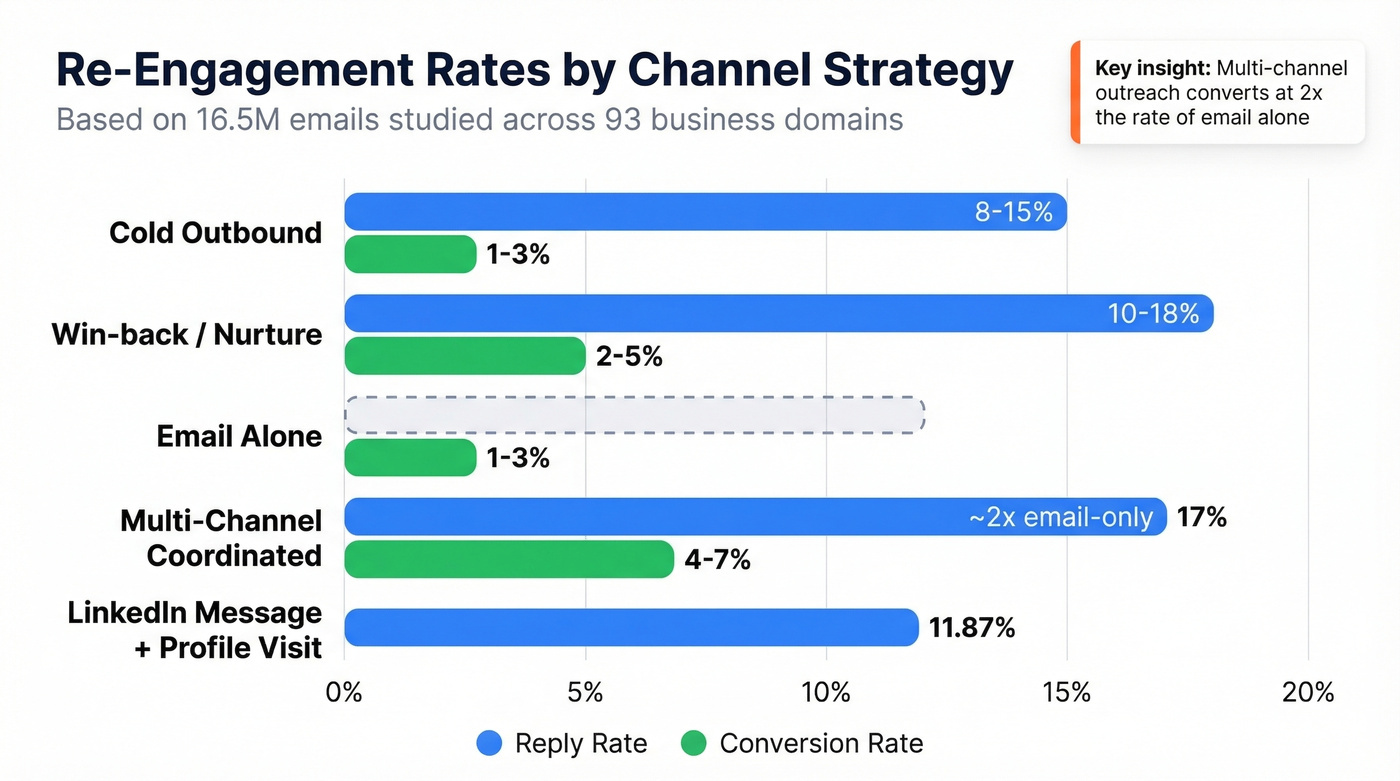
| Sequence Type | Reply Rate | Conversion |
|---|---|---|
| Cold outbound | 8-15% | 1-3% |
| Win-back / nurture | 10-18% | 2-5% |
| Email alone | - | 1-3% |
| Multi-channel coordinated | ~2x email-only | 4-7% |
| LinkedIn message + profile visit | 11.87% reply | - |
Fewer, better touches across multiple channels beat high-volume email blasts every time. 43% of buyers who accept meetings say it's fine to contact them five or more times - as long as each touch adds something new (more on how to do that in how to add value in sales).
Clean Your Data First
This is the step everyone skips. And it's the one that matters most.
If your bounce rate is high, the best template in the world won't help. Outreach benchmarks put average sequence bounce rate at 2.8% - if you're way above that, fix your list before you touch a single "ghost." We've seen teams pour hours into crafting the perfect re-engagement cadence only to watch half their emails bounce because contacts changed jobs three months ago.
Before you launch a re-engagement sequence, verify your list. Prospeo's 98% email accuracy on a 7-day refresh cycle catches bounces, spam traps, and job changes before they tank your sender reputation (if you need a deeper deliverability checklist, start with email deliverability and email bounce rate). Snyk's 50-person AE team cut their bounce rate from 35-40% to under 5% and saw AE-sourced pipeline jump 180% after switching to verified data.


Your re-engagement cadence is only as good as the data behind it. Snyk's 50-person AE team cut bounce rates from 35% to under 5% and grew pipeline 180% - simply by verifying contacts before sequencing. Prospeo's 98% email accuracy and 7-day refresh cycle catch job changes, spam traps, and dead addresses so every touch in your cadence actually lands.
Stop crafting perfect emails that bounce. Verify your list first.
Build Your Re-Engagement Cadence
The 21-Day Framework
Adapted from Outreach's multi-channel sequencing model:
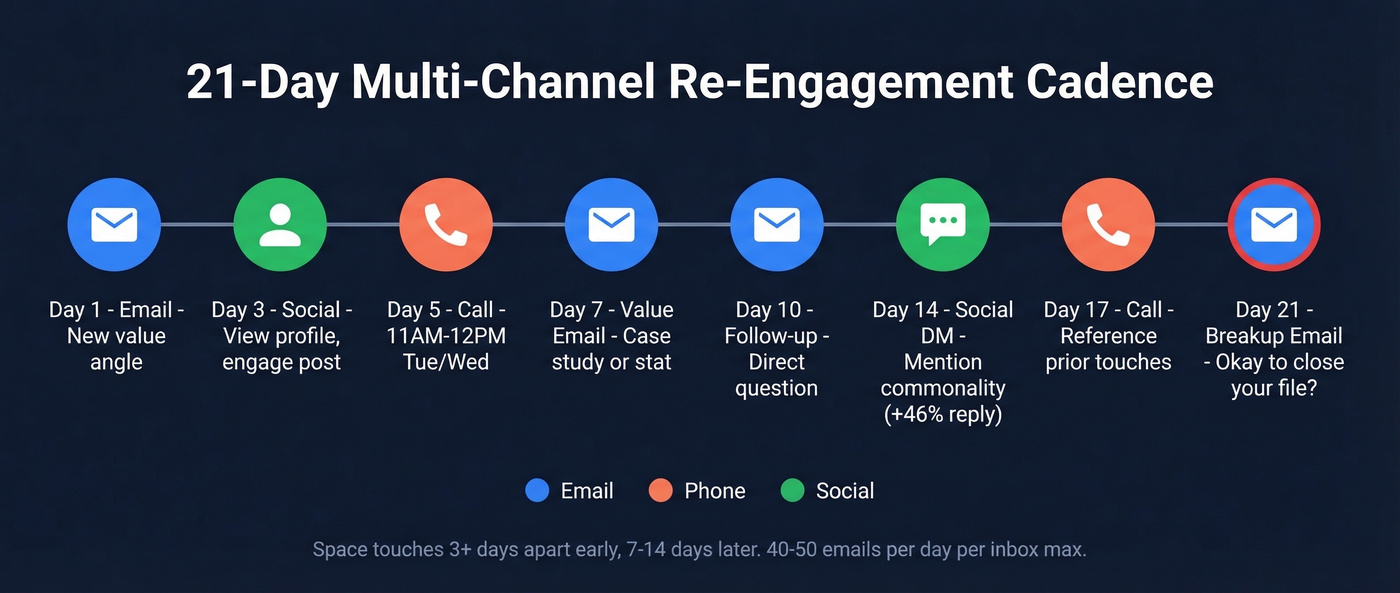
- Day 1: Email - new value angle, not a rehash of your last conversation
- Day 3: Social - view their profile (they get notified), engage with a recent post
- Day 5: Call - 11 AM-12 PM or 4-5 PM, Tuesday or Wednesday
- Day 7: Value email - case study, industry stat, or relevant insight
- Day 10: Follow-up email - reference the value piece, ask a direct question (if you want more options, pull from these sales follow-up templates)
- Day 14: Social message - mention one commonality like role, industry, or a mutual connection. Indicating a single commonality lifts InMail response rates by 46%.
- Day 17: Call - reference prior touchpoints
- Day 21: Breakup email
Prospects who open but don't reply are still engaging - stay on email with fresh angles. If they're not opening after 3 days, pivot to social. No traction on social after 7 days? Return to email with a new thread. Keep practical limits in mind: 40-50 emails per day per inbox and roughly 100-150 connection requests per week (see email velocity for safe sending limits).
Timing by Lead Temperature
Not every ghost deserves the same cadence.
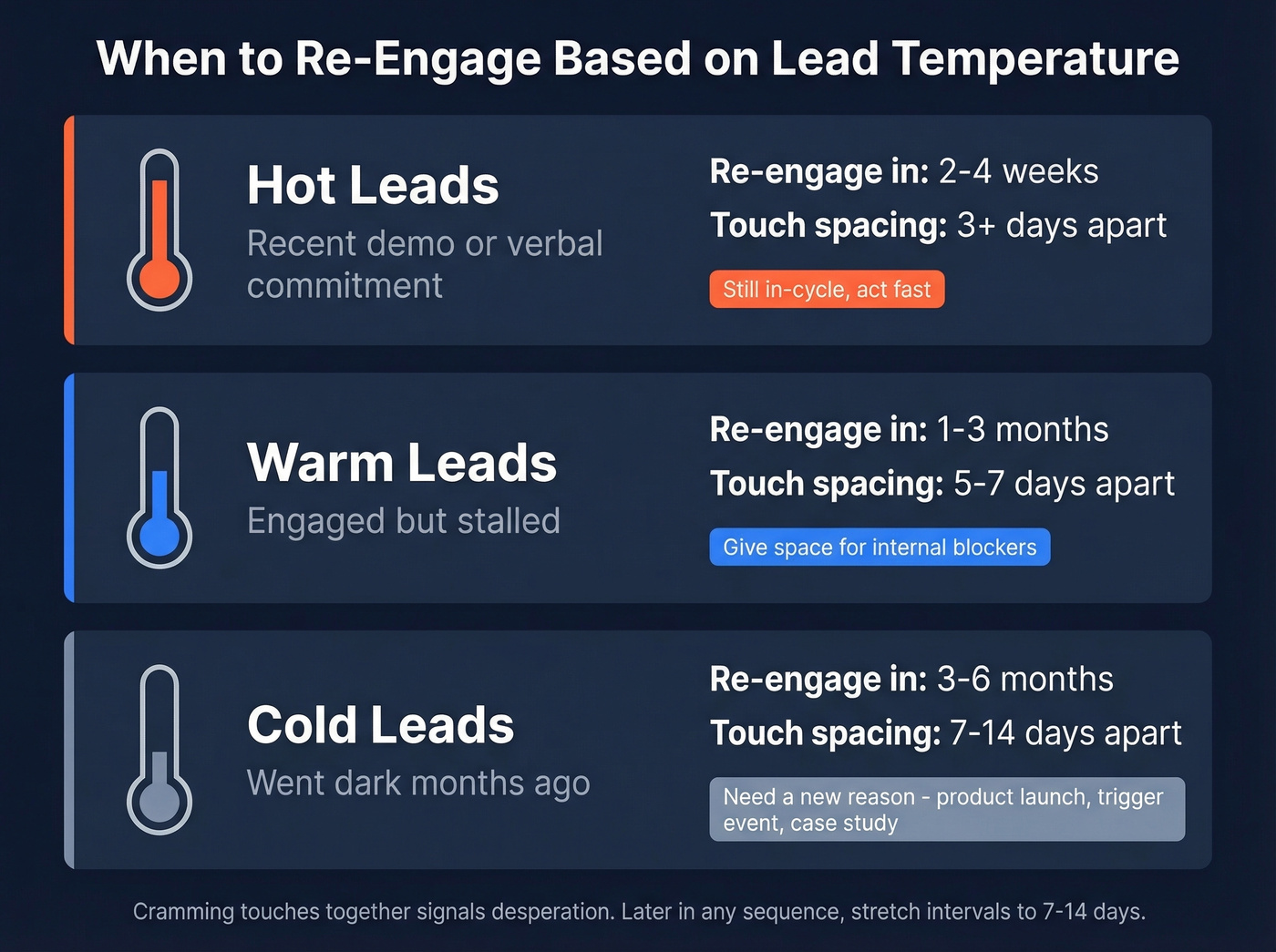
Hot leads with a recent demo or verbal commitment need re-engagement within 2-4 weeks - they're still in-cycle. Warm leads who engaged but stalled deserve 1-3 months of breathing room to resolve internal blockers. Cold leads who went dark months ago need 3-6 months and a genuinely new reason to reach out, like a product launch, a relevant case study, or a trigger event at their company (this is easier when you're identifying buying signals). Early in any sequence, space touches 3+ days apart. Later, stretch to 7-14 days. Cramming touches together signals desperation.
Re-Engagement Email Templates
The Assumption Email
This one comes straight from the r/sales playbook. In our experience, it outperforms every other template for mid-deal ghosts:
"Hey [Name], when a conversation goes quiet at this stage, it usually means [price / timing / internal pushback] became the blocker. Is that the case here?"
Direct, specific, and gives them an easy on-ramp to reply honestly.
The Value-Add Email
Send something genuinely useful - a relevant case study, an industry benchmark, a competitor move. One sentence of context, one link, one question. If you're forwarding the same deck from your last call, you're adding noise, not value.
The Breakup Email
"Okay to close your file?" flips the dynamic - you're the one walking away. Breakup emails routinely generate replies within 24 hours because nobody likes being written off. Give them an easy out: "If the timing isn't right, totally fine - just let me know."
The Event or Feedback Hook
Skip the pitch entirely. Invite them to a customer dinner, a webinar, or ask for product feedback on a feature relevant to their pain point. This works because it reframes the relationship from "seller chasing buyer" to "peer asking for input." I've seen a simple "We're redesigning how [feature] works - would love your take" reopen conversations that had been dead for months.
Mistakes That Kill Re-Engagement
Here's the thing: most re-engagement sequences fail for the same five reasons, and they're all avoidable.
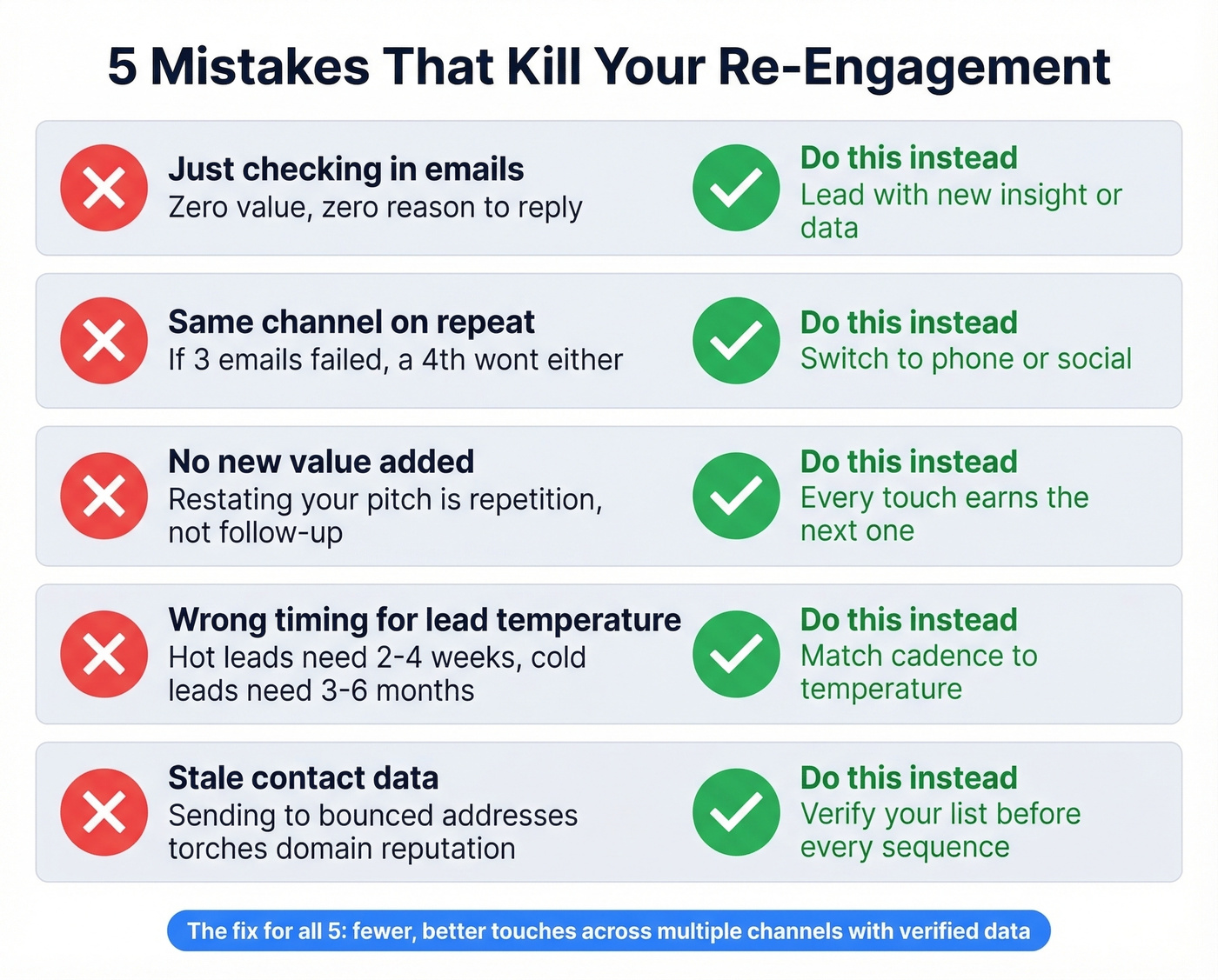
- "Just checking in" emails. Zero value, zero reason to reply. Delete these from your vocabulary.
- Same channel on repeat. If three emails didn't work, a fourth won't either. Switch to phone or social (a simple cold calling system helps you stay consistent without spamming).
- No new value. Restating your pitch isn't follow-up - it's repetition. Every touch needs to earn the next one.
- Wrong timing. Hot leads need 2-4 weeks. Cold leads need 3-6 months. Misjudging the gap kills your chances before you even write the subject line.
- Stale contact data. Verify your list before you burn a single touch. We've watched teams torch their domain reputation sending sequences to addresses that bounced six months ago.
Re-engaging ghosted prospects across email, phone, and LinkedIn only works when you have current contact data. Prospeo gives you verified emails, direct dials from 125M+ mobile numbers, and 50+ data points per contact - refreshed every 7 days, not every 6 weeks. At $0.01 per email, reviving dead pipeline costs less than your morning coffee.
Win back ghosted deals with data that's actually current.
When to Walk Away
Let's be honest: you don't need 14 tactics. You need 3-4 great touches across multiple channels, then the discipline to walk away.
The 16.5M-email study is clear - in the enterprise segment with 1,000+ employees, prospects ghost quickly and punish persistence. Reply rates peak at the second follow-up (6.94%) and drop to 3.01% by the fourth. The reps who recover the most pipeline aren't the ones who follow up the most. They're the ones who follow up the best, then move on to prospects who are actually ready to buy.
FAQ
How many follow-ups before giving up?
Two to four high-quality touches across multiple channels is the sweet spot. After the fourth follow-up, reply rates drop below 3% and unsubscribe rates triple according to the 16.5M-email Belkins study.
What's a good reply rate for win-back sequences?
Win-back sequences average 10-18% reply rates - roughly double cold outbound. If you're below 10%, audit your contact data freshness and messaging relevance before adding more volume.
Should I call or email a ghosted prospect?
Use both. Multi-channel outreach converts at 4-7% vs. 1-3% for email alone. Call between 11 AM-12 PM on Tuesday or Wednesday for the highest connect rates, then follow up with a value-driven email the next day.
How do I re-engage prospects who miss meetings?
Send a brief, no-guilt email within two hours acknowledging that schedules get hectic and offering two new time slots. If they don't respond within 48 hours, follow up with a social touch or a quick voicemail referencing the original agenda item - make it easy to rebook, not guilt-inducing.
What tools help keep re-engagement data clean?
Start with email verification to catch job changes and invalid addresses before they tank deliverability. For larger lists, pair verification with CRM enrichment to surface updated titles and direct dials so you're reaching the right person at the right number.