

How to Reduce Spam Score: The No-Panic Guide for 2026
Moz says 22%. Your coffee's getting cold. You're staring at a number that feels like a verdict, already drafting a plan to "fix" it before lunch. We see this all the time - someone spots a Moz score spike and assumes they've been penalized, when the reality is usually much less dramatic.
Here's the thing: there are two completely different metrics called "spam score," and most people panicking right now are worried about the wrong one. Let's sort this out in 30 minutes.
The Quick Version
Website spam score (Moz)? Google doesn't use it. Audit your backlinks, disavow genuinely toxic ones, fix obvious site-quality issues, and wait for Moz's quarterly update to reflect changes.
Email spam score? Fix authentication first (SPF, DKIM, DMARC), verify your list second, clean your copy third. That sequence is non-negotiable.
Two Types of Spam Score
Before you touch anything, figure out which one you're actually dealing with. These are completely different problems with completely different solutions.
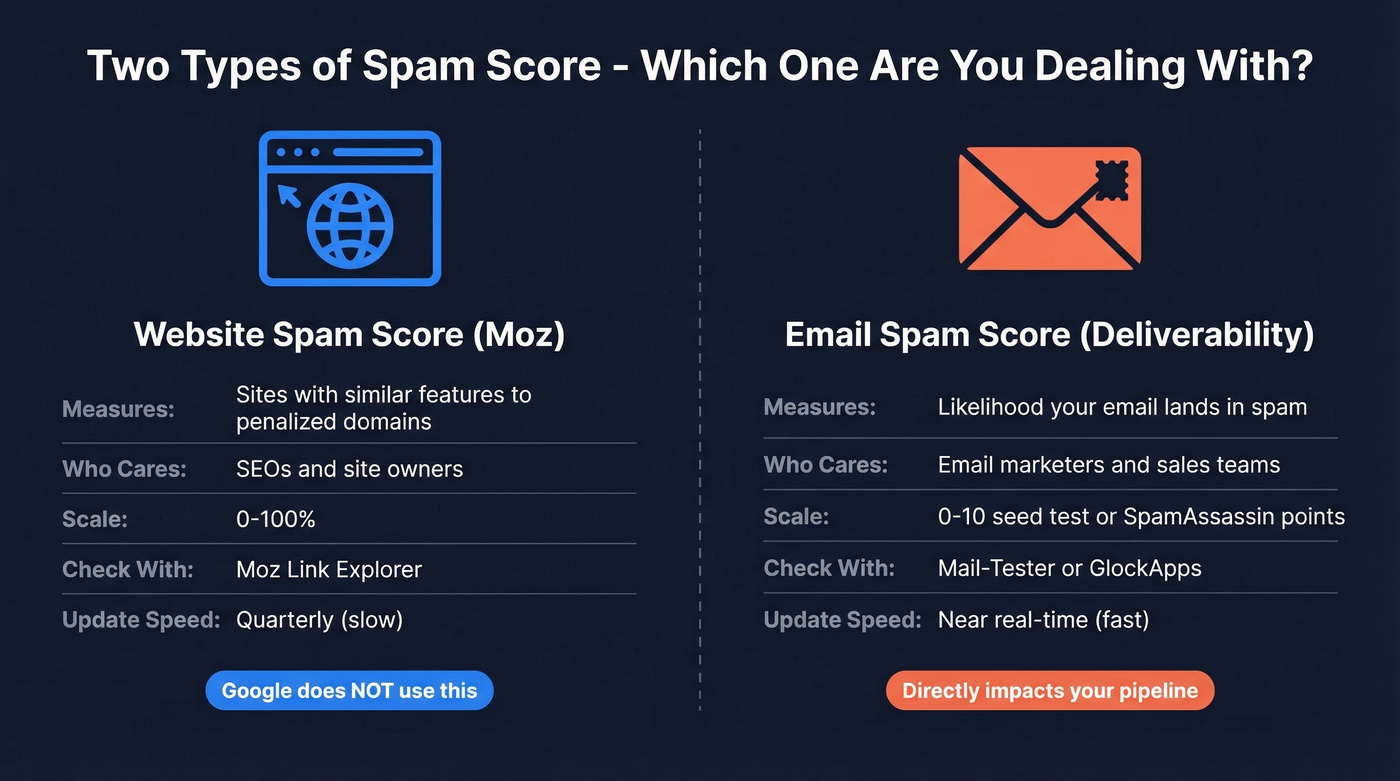
| Website (Moz) | Email (Deliverability) | |
|---|---|---|
| Measures | Percentage of sites with similar features that Google has penalized/banned | Likelihood your email lands in spam |
| Who cares | SEOs, site owners | Email marketers, sales teams |
| Scale | 0-100% | 0-10 (seed test) or SpamAssassin points |
| How to check | Moz Link Explorer | Mail-Tester, GlockApps |
| Update speed | Quarterly | Near real-time |
If you're running outbound email campaigns, skip ahead to the email section. If you're worried about your domain's SEO health, keep reading.
Website Spam Score (Moz)
What Moz Actually Measures
Moz Spam Score is a machine learning model trained on millions of penalized or banned sites. It uses 27 signals to estimate the percentage of sites with similar features that Google has penalized. That's it - a correlation metric, not a penalty indicator.
You can check yours by entering your domain at moz.com/link-explorer, though free access is limited. The threshold bands: 1-30% is Low, 31-60% is Medium, 61-100% is High. Moz updates these scores quarterly, so changes you make today won't show up until the next refresh.
Two limitations most people miss. First, Moz doesn't reveal which of the 27 signals your site triggered, so you're left auditing against the list yourself. Second, Moz can't see your Google disavow file - the GSC API doesn't expose it - so disavowed links can still count in their calculation.
Google Doesn't Use It
Google's John Mueller said it plainly: "The Moz spam score doesn't affect your backlinks" and "it's also not used by Google."
Google uses its own signals. Third-party metrics like Moz Spam Score and Domain Authority are useful directional tools, but they aren't ranking factors. You probably don't need to lower your Moz score at all. If your rankings are fine and there's no manual action in Google Search Console, a moderate number is noise. In Moz's own community Q&A, users report scores like 46% and 57% and panic - only to find their rankings haven't budged.
When to Act vs. Ignore
Act when all three are true:
- Score is above 60%
- You're seeing actual ranking drops
- Google Search Console shows a manual action
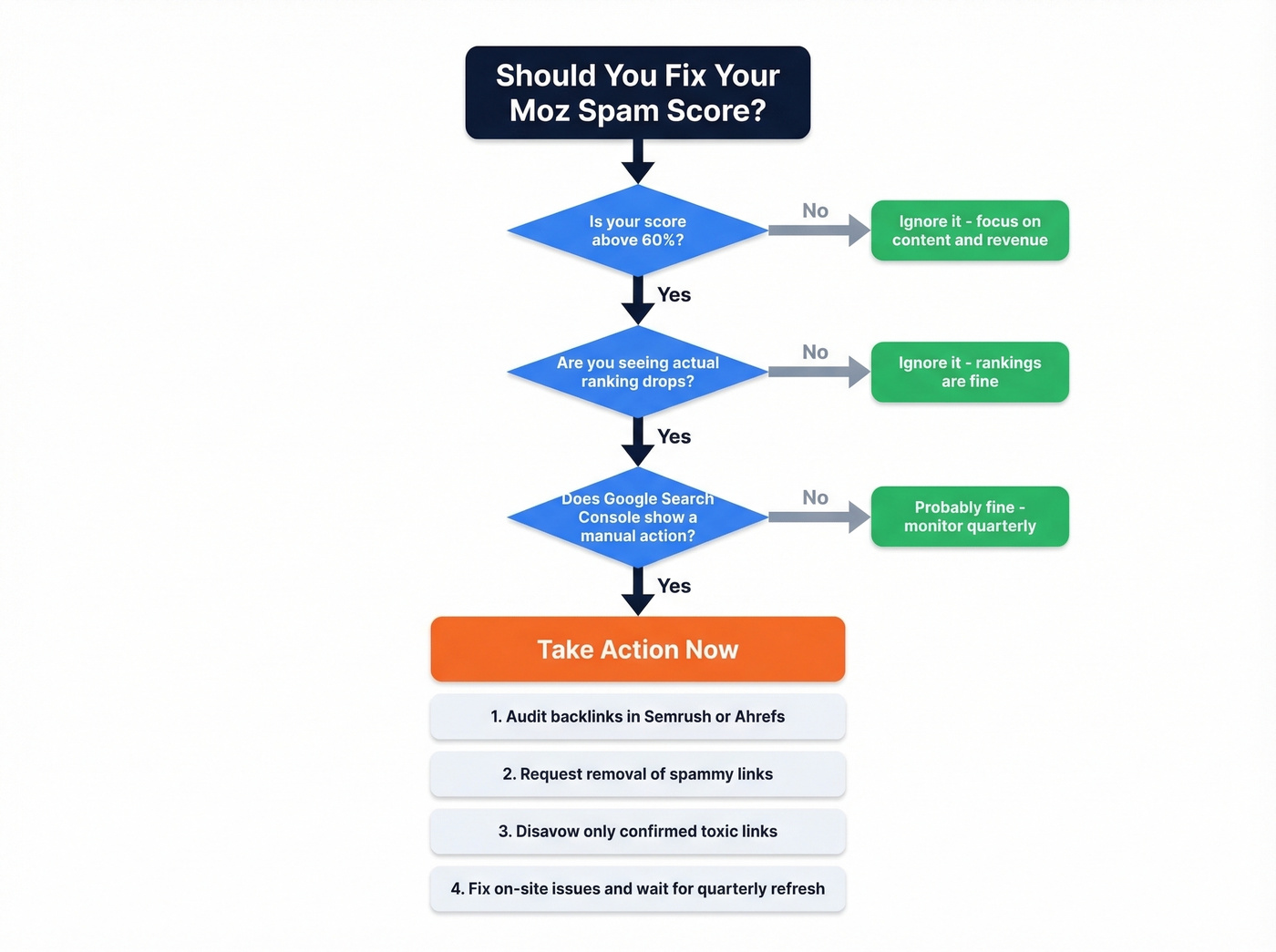
Ignore it when your score is moderate with no ranking impact, your site is healthy and growing, or you just bought a domain and the score reflects the previous owner's mess.
If you do need to act:
- Audit backlinks in Semrush or Ahrefs - look for patterns, not individual links
- Try to get genuinely spammy links removed through direct outreach first
- Disavow only confirmed toxic links via Google's Disavow Links tool - over-disavowing can hurt more than it helps
- Fix on-site signals: thin pages, missing HTTPS, low link diversity, keyword-stuffed meta tags, hidden text, messy internal linking
- Wait for the next quarterly refresh
Look, if your average deal size is modest and your rankings are stable, spending time on Moz Spam Score is the SEO equivalent of rearranging deck chairs. Focus on content and links that actually move revenue.

Most spam score problems start with bad data, not bad copy. Prospeo's 5-step email verification - with spam-trap removal, honeypot filtering, and catch-all handling - keeps bounce rates under 4% for 15,000+ companies. At $0.01 per verified email, fixing your list costs less than one lost deal.
Stop sending emails that destroy your sender reputation.
How to Reduce Email Spam Score
This is where the real damage happens. A bad deliverability score means your messages vanish into spam folders, your sender reputation degrades, and your pipeline dries up. Nearly half of all emails land in spam - and most of those failures are preventable.
How Email Spam Scoring Works
SpamAssassin - the engine behind most spam filtering - assigns a weighted sum of rule hits across content, headers, authentication, and reputation signals. Each rule adds or subtracts points, and the total determines your fate.
| Score Range | Risk Level |
|---|---|
| 0.0-2.9 | Low |
| 3.0-4.9 | Medium |
| 5.0-7.9 | High |
| 8.0+ | Critical |
Many servers flag emails around a threshold of 5.0. A negative SpamAssassin score just means your email passed more positive checks than negative ones. Seed-test tools use a different scale entirely: they send to test inboxes and calculate inbox deliveries divided by total sent, multiplied by 10, giving you a 0-10 score where higher is better.
Fix Authentication First
About 80% of email deliverability issues come from technical misconfigurations, not content. Authentication is the foundation - everything else is cosmetic until this is right.
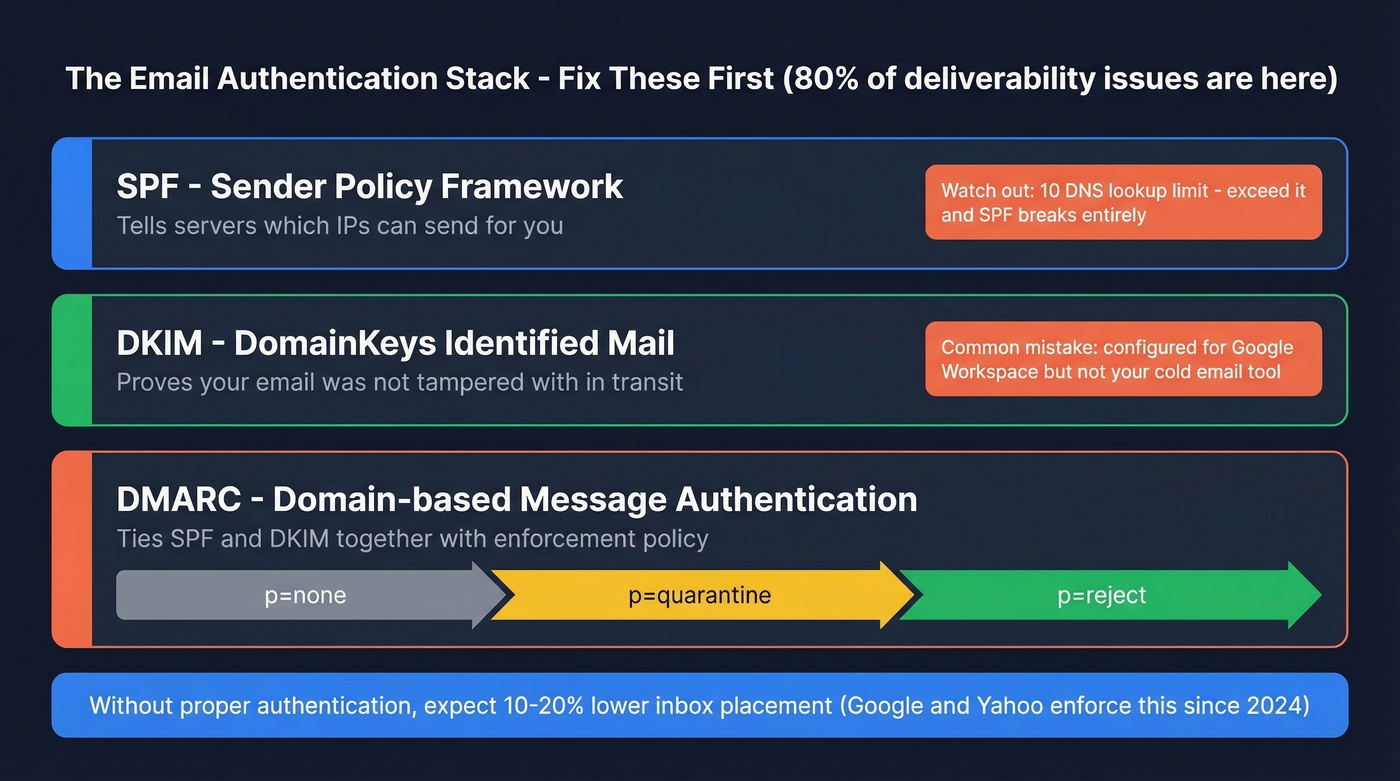
SPF tells receiving servers which IPs can send on your behalf:
v=spf1 include:_spf.google.com include:sendgrid.net -all
Use -all (hard fail) for outbound domains. The critical gotcha: SPF has a 10 DNS lookup limit. Exceed it and the record breaks entirely - treated as if you have no SPF at all. (If you want more examples, see SPF record syntax.)
DKIM proves your email wasn't tampered with in transit. Use 2048-bit keys and set up DKIM for every sending service separately. The most common failure we see is DKIM configured for Google Workspace but not for the cold email tool running alongside it. If you're troubleshooting, follow a quick checklist to verify DKIM is working.
selector._domainkey.yourdomain.com TXT "v=DKIM1; k=rsa; p=MIIBIjAN..."
DMARC ties SPF and DKIM together with an enforcement policy. Roll it out gradually:
_dmarc.yourdomain.com TXT "v=DMARC1; p=none; rua=mailto:dmarc@yourdomain.com; pct=100"
Progress from p=none to p=quarantine to p=reject over a few weeks. Use relaxed DMARC alignment if you're sending from subdomains. (More detail on DMARC alignment helps here.) Google and Yahoo's bulk sender requirements, enforced since 2024, made proper authentication non-optional - emails without it see 10-20% lower inbox placement.
One more thing: if you use link-tracking in your email tool, the tracking domain can create a visible-link vs. destination mismatch that triggers spam filters. Make sure your tracking domain aligns with your sending domain.
Verify Your List Before Sending
Here's the chain that kills deliverability: bad data leads to bounces, bounces damage sender reputation, damaged reputation lands you in spam. High bounce rates do more damage than copy tweaks ever will. (Benchmarks and fixes: email bounce rate.)

Prospeo's 5-step verification catches the stuff that wrecks domains - spam traps, honeypots, catch-all addresses, and plain invalid emails. Snyk took their bounce rate from 35-40% down to under 5%, and Meritt went from 35% to under 4%. Both saw immediate improvements in inbox placement.
Snyk's bounce rate dropped from 35-40% to under 5% after switching to Prospeo's verified data. Stack Optimize runs 94%+ deliverability across every client with zero domain flags. Your spam score won't fix itself if the emails underneath are bad - data refreshed every 7 days means you're never sending to dead addresses.
Clean data is the fastest way to lower your email spam score.
Clean Up Your Email Content
Modern spam filters are ML-based. They evaluate patterns, tone, and context - not just individual keywords. That said, certain phrases still raise flags, especially when stacked together.
| Trigger Phrase | Safer Alternative |
|---|---|
| 100% free | Complimentary |
| Act now | Get started today |
| Guaranteed | Proven results |
| No obligation | No commitment needed |
| Limited time offer | Available this month |
| Click here | See the details |
| Double your income | Grow your revenue |
| Risk-free | Try with confidence |
| Dear friend | Hi [First Name] |
Beyond individual words, watch your text-to-image ratio. Emails that are mostly images with minimal text look like spam to filters. Keep your HTML clean, use a plain-text fallback, and limit yourself to one or two relevant links per email. The goal is to look like a human wrote it - because ideally, one did. (If you need a deeper framework, use an email copywriting checklist.)
Lower Your Score in 30 Minutes
If you want a quick diagnostic, here's the workflow:
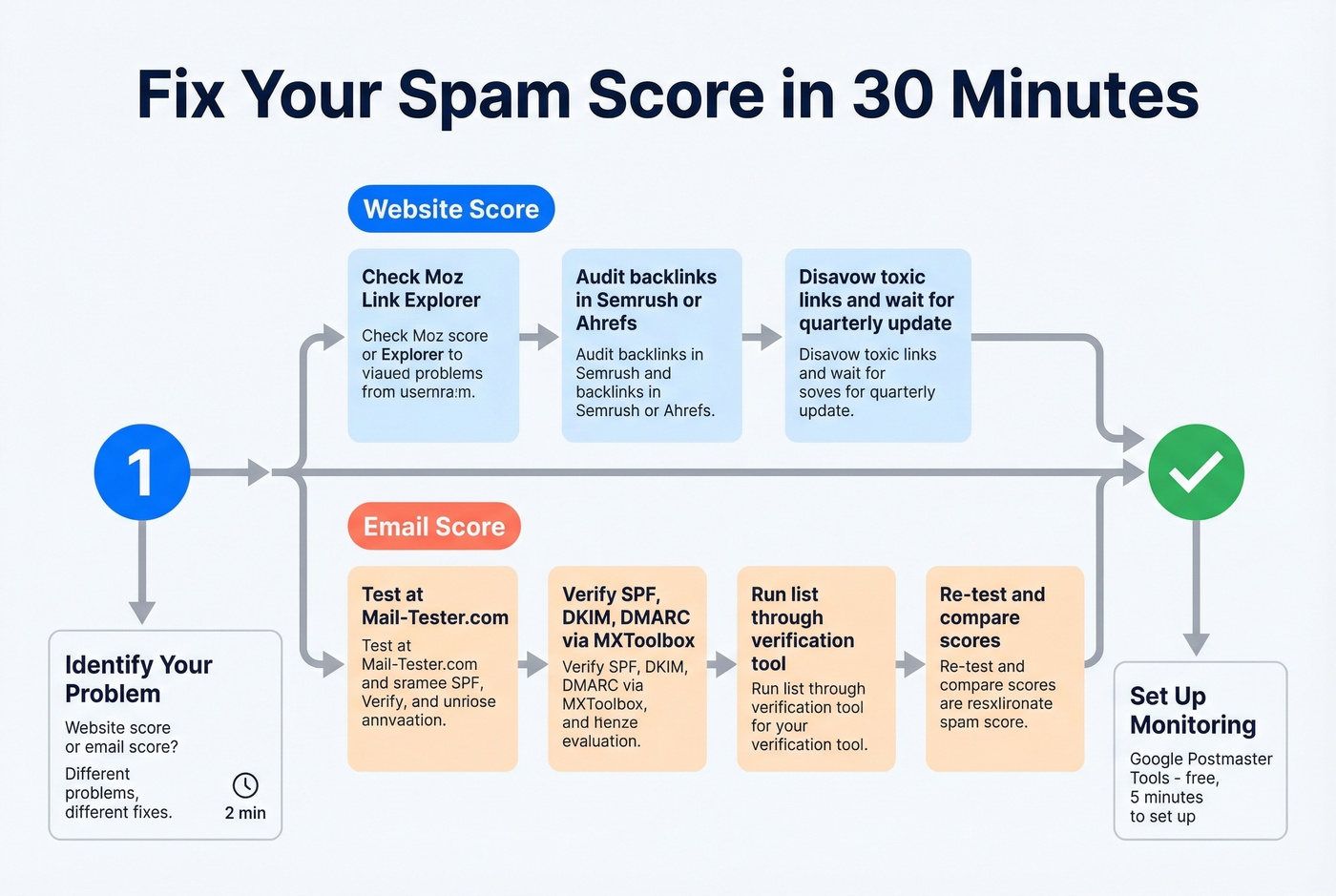
Identify which spam score you're dealing with. Website or email? Different problems, different fixes.
For website spam score: Check Moz Link Explorer then audit backlinks in Semrush or Ahrefs. Disavow confirmed toxic links via Google's Disavow Links tool and wait for the next quarterly update.
For email spam score: Send a test email to Mail-Tester, verify SPF/DKIM/DMARC via MXToolbox, run your list through a verification tool to catch spam traps and catch-all domains, then re-test. This single loop is the fastest way to improve inbox placement before your next campaign goes out.
Set up ongoing monitoring with Google Postmaster Tools. It shows Gmail-facing reputation and deliverability signals like spam rate and authentication performance. Free, takes five minutes to set up.
Best Tools to Check Spam Score
Website spam score tools:
| Tool | What It Does | Price |
|---|---|---|
| Moz Link Explorer | Spam Score + backlink audit | Free limited / ~$99/mo |
| Semrush | Backlink audit + toxicity scoring | ~$130/mo |
| Ahrefs | Backlink profile analysis | ~$99/mo |
| Google Search Console | Manual actions + links report | Free |
Email spam score and deliverability tools:
| Tool | What It Does | Price |
|---|---|---|
| Prospeo | List verification, spam-trap removal | Free tier / ~$0.01/email |
| Mail-Tester | SpamAssassin scoring + auth check | Free (basic) |
| GlockApps | Seed-test inbox placement | $59-129/mo |
| MXToolbox | Blacklist + SMTP diagnostics | Free basic |
| Folderly | Inbox placement + warmup | $79-120/mo |
| Google Postmaster Tools | Gmail reputation monitoring | Free |
| ZeroBounce | List verification | From $18/mo |
In our experience, start with the free tools. Mail-Tester and Google Postmaster Tools will surface the biggest issues quickly. Add a verification service and GlockApps for seed testing once you're running serious outbound volume. If you're scaling, a full email deliverability guide helps you avoid repeat issues.
FAQ
Does Moz Spam Score Affect Rankings?
No. Google's John Mueller confirmed Google doesn't use Moz Spam Score or any third-party metric as a ranking signal. It's a correlation model - useful for directional analysis but not something Google factors into search results.
How Long Does It Take to See Improvement?
Moz Spam Score updates quarterly, so expect a 1-3 month wait before changes appear. Email spam score can improve within days after fixing authentication records or cleaning your sending list. Re-test with Mail-Tester to confirm.
What's a Good Email Spam Score?
On SpamAssassin's scale, anything under 3.0 is low risk. On seed-test tools like Mail-Tester, aim for 8+/10. Many mail servers start flagging around the 5.0 threshold.
Can Email Verification Help Lower Spam Risk?
Absolutely. High bounce rates destroy sender reputation, which directly raises your spam risk. Snyk dropped their bounce rate from 35-40% to under 5% after running verification, and their inbox placement improved immediately. ZeroBounce and NeverBounce are other options worth considering.
Should I Disavow High Spam Score Links?
Only disavow links you've confirmed are genuinely spammy and that you can't get removed through direct outreach. Over-disavowing healthy links can hurt your backlink profile more than leaving moderate-score links alone.