

How to Research a Private Company When Nothing Is Public
Your boss wants a profile on a private company - revenue, ownership, key contacts - and you've got nothing. No 10-K. No investor deck. The company's website has a mission statement and a stock photo of people shaking hands.
Most guides on how to research a private company just list databases you don't have access to. This one gives you the actual workflow that gets you from zero to a usable company profile using mostly free tools.
What You Need (Quick Version)
Your approach depends on what you're actually trying to find:
- Need financials? Use the revenue-per-employee estimation method. It's the most reliable free approach, and we walk through it step by step below.
- Need ownership? Start with OpenCorporates and EDGAR full-text search. State registries often show registered agents and sometimes members or officers, but usually not beneficial owners. If you're doing a deeper ownership dig, a business owner lookup workflow helps you avoid dead ends.
Why Private Companies Are So Hard to Research
Private companies have no obligation to disclose financials. Unless they've filed a Form D with the SEC for raising capital under Regulation D, or they're required to register under the Exchange Act, there's often no SEC-style filing trail at all.
Ownership is even trickier. Delaware LLCs - the structure of choice for many private companies - can list a registered agent as the only visible layer. You search the Delaware Division of Corporations, find a registered agent address in Wilmington, and hit a dead end. This is a recurring frustration on Reddit, and for good reason: state entity searches often show members and managers, not beneficial owners or investors.
The good news: private companies still leave traces everywhere. You just need to know where to look.

You've mapped the company's revenue, ownership, and org structure. Now you need to actually reach someone. Prospeo gives you verified emails and direct dials for 300M+ professionals - with 98% email accuracy and 30+ filters to pinpoint the exact decision-makers at your target company.
Turn your private company research into booked meetings.
Step-by-Step Research Workflow
Start With the Company Itself
Before you touch any database, exhaust what the company publishes voluntarily. Check the website for press releases, leadership pages, case studies, and partner logos - all of which reveal structure and scale. Job postings are strategy signals: a company posting 15 engineering roles in a new city is expanding, while one hiring a VP of Finance after years without one is preparing for something. If you're turning this into a repeatable process, borrow a few ideas from competitive intelligence strategy playbooks.
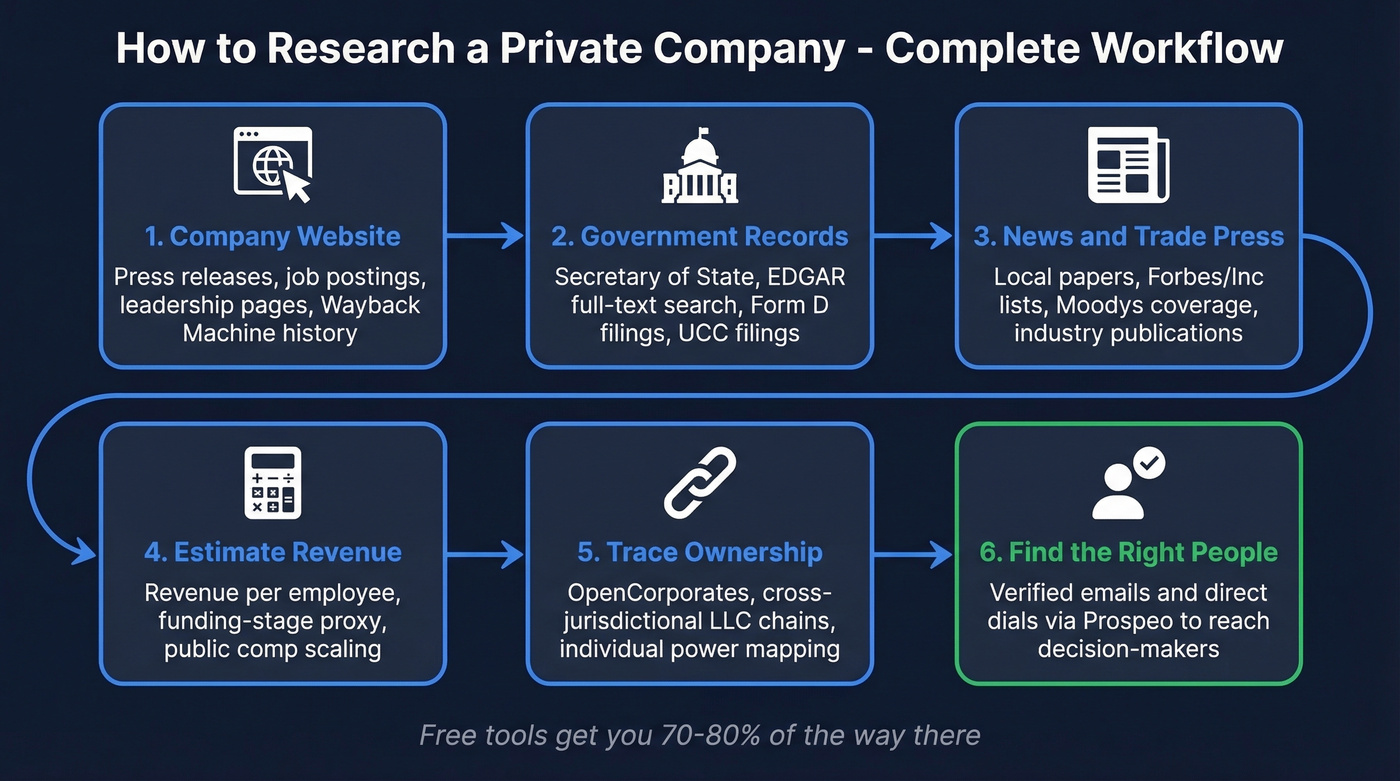
Run the company URL through web.archive.org to see how messaging shifted over time. A rebrand or pivot often signals a funding event or leadership change. And set up Google Alerts for the company name to catch local press or industry mentions you'd otherwise miss. For more systematic monitoring, you can also use how to track sales triggers tactics.
Check Government Records
State Secretary of State databases are the obvious starting point - search for the entity name to find articles of incorporation, registered agents, and sometimes officer names.
Go deeper with EDGAR full-text search. Even private companies appear in SEC filings when mentioned in public-company disclosures, supply agreements, or acquisition documents. Form D filings, required when raising capital under Regulation D, reveal capital raises and sometimes list executive officers. The Library of Congress research guide is a solid starting point for navigating federal sources.
The ProPublica PPP loan tracker reveals loan amounts and employee counts for companies that received pandemic-era funding. USPTO searches surface patents and trademarks that reveal R&D direction. For anything else, MuckRock streamlines FOIA requests.
Search News and Trade Press
Local newspapers and industry publications are goldmines. Financial publishers sometimes disclose revenue for large private firms - Moody's debt-rating coverage, for example, disclosed PetSmart's revenue around $7.5B back in 2021. Forbes and Inc. 5000 lists publish revenue figures for qualifying companies. Trade press often covers funding rounds and executive hires that the company itself never announces. If you're doing this for positioning, tie what you find back to B2B brand positioning.
Estimate Revenue
This is where most guides fail you. They say "it's hard" and move on. Let's fix that.
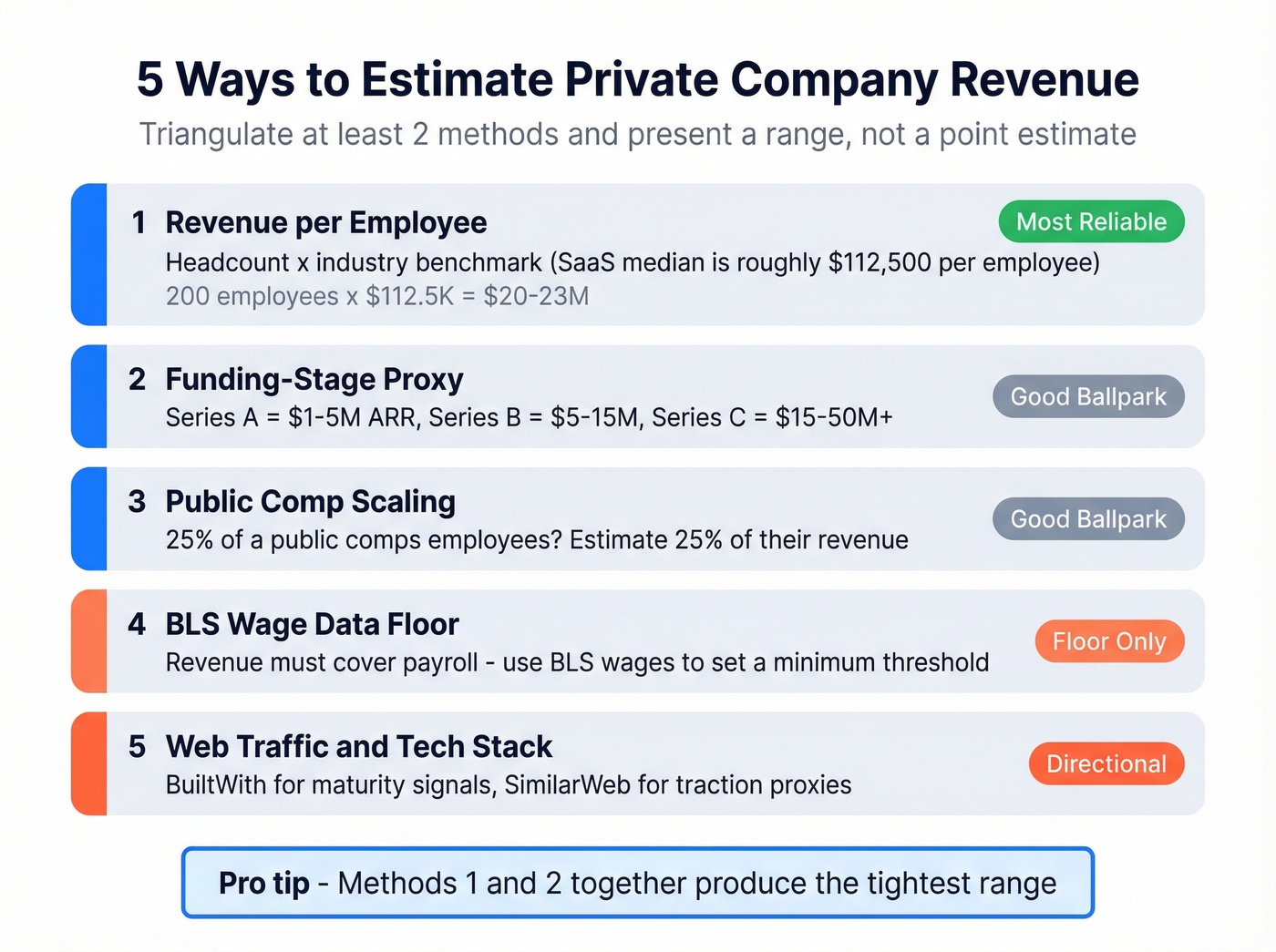
Method 1: Revenue per employee. Find the company's headcount from job boards, the company page, or Crunchbase, then multiply by an industry benchmark. The median SaaS revenue per employee is roughly $112,500. A 200-person SaaS company likely generates $20-23M in revenue.
Here's the thing: LinkedIn shows two different headcount numbers - an employee range and a count of profiles on the platform - and they often contradict each other. Healthcare and commercial services are underrepresented on the platform, so counts skew low for those sectors. PE practitioners on Reddit consistently report the same frustration: without PitchBook access, screening private companies by revenue feels like guesswork. This method closes that gap, even if it doesn't eliminate it entirely.
Method 2: Funding-stage proxy. As a rule of thumb, a Series A company has ~$1-5M ARR. Series B runs ~$5-15M. Series C is ~$15-50M+.
Method 3: Public comp scaling. Find a public company in the same space and scale by relative headcount. If your target has roughly 25% of the public comp's employees, estimate revenue at about 25% of the public comp's revenue.
Method 4: BLS wage data as a floor. A profitable company's revenue must cover its payroll. Use Bureau of Labor Statistics wage data for the relevant roles and geography to establish a minimum revenue threshold.
Method 5: Web traffic and tech stack proxies. BuiltWith reveals the company's tech stack, which signals maturity and spend. SimilarWeb or SEMrush traffic estimates serve as traction proxies for consumer-facing businesses.
In our experience, triangulating Methods 1 and 2 produces the tightest range. Present it as a range, not a point estimate. A $15-25M estimate is far more useful than a false-precision "$18.7M" pulled from a single source.
Trace Ownership
When you hit the Delaware LLC dead end - and you will - pivot your approach. Instead of tracing the entity chain, focus on the individuals. Search for the CEO, founders, or known executives in OpenCorporates to find other entities they're associated with. Cross-jurisdictional LLC chains often reveal connections that a single state search misses.
UCC filings are another underused resource. When a company takes on debt, the lender files a UCC-1 financing statement with the state. These filings reveal lending relationships and sometimes asset details that ownership records don't.
For disambiguation with common names, use unique identifiers like location, known associates, and professional history. Moody's research emphasizes this as a critical OSINT best practice: without proper entity resolution, you'll waste hours chasing the wrong John Smith.
Find the Right People
All of this research is useless if you can't reach anyone at the company. Private companies are the worst for this - no public org chart, no investor relations page, no "contact our team" form that actually goes somewhere useful.
This is where Prospeo's Chrome extension closes the gap. Paste a company URL and pull verified emails and direct dials for the people you need to reach. The 7-day data refresh cycle means you're working with current information, not quarter-old records. The free tier gives you 75 emails plus 100 Chrome extension credits per month - more than enough for targeted outreach to a handful of private companies. If you're building lists at scale, pair this with a lead generation workflow.
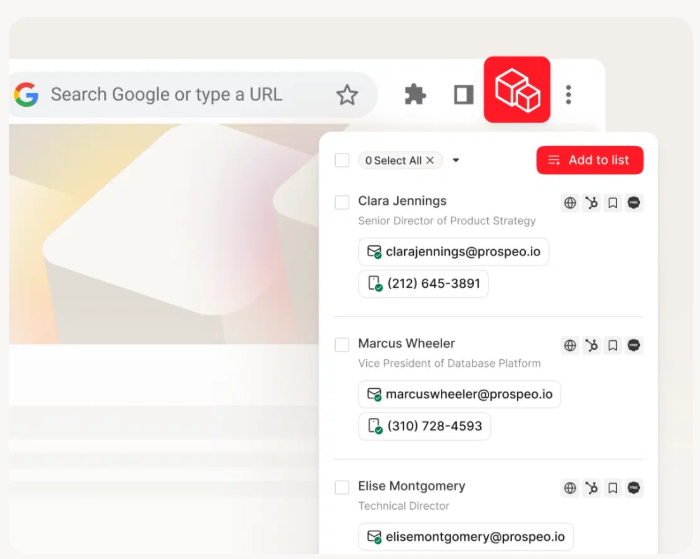
You can spend hours building a company profile, but if your outreach email bounces, none of it matters. (If that’s happening, fix it with an email deliverability guide and track your email bounce rate.)
Free vs. Paid Tools
Here's our honest take: you don't need PitchBook. The free workflow gets you 70-80% of the way there, and most teams researching private companies need a solid profile plus a way to reach decision-makers - not a $30K database subscription. Save the enterprise tools for when you're doing this daily or the deal size justifies the spend.
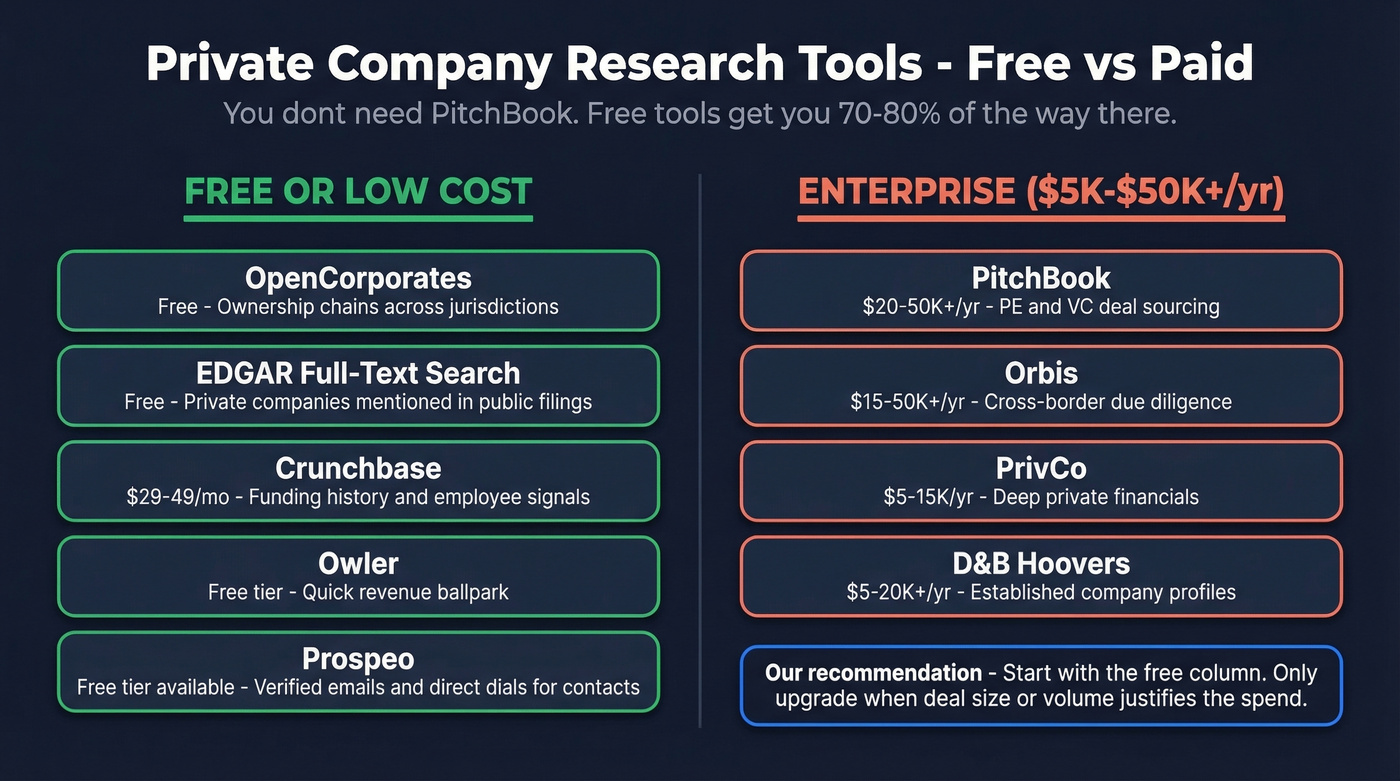
| Tool | Type | Price | Best For |
|---|---|---|---|
| OpenCorporates | Entity data | Free | Ownership chains across jurisdictions |
| Crunchbase | Company data | $29-$49/user/mo | Funding history, employee signals |
| Maltego Community | Link analysis | Free | Complex relationship mapping |
| Owler | Revenue estimates | Free tier | Quick revenue ballpark |
| D&B Hoovers | Company reports | ~$5K-$20K+/yr | Established company profiles |
| PrivCo | Financials | ~$5K-$15K/yr | Deep private financials |
| PitchBook | Deal data | ~$20K-$50K+/yr | PE/VC deal sourcing |
| Orbis | Global ownership | ~$15K-$50K+/yr | Cross-border diligence |
Skip PitchBook and Orbis unless you're in PE/VC or doing cross-border due diligence at scale. For most sales and BD teams, the free tools plus Prospeo for contacts cover the job. If you’re comparing data sources, start with best B2B company data providers.
Private companies don't publish org charts. But Prospeo's database covers 300M+ profiles with job titles, departments, and verified contact data - refreshed every 7 days. Find the CEO, VP of Finance, or whoever you need, even when the company website shows nothing but a stock photo.
Stop researching companies you can't reach. Start at $0.01 per email.
Dead Ends and Workarounds
Delaware LLC shell to registered agent dead end. We've hit this wall dozens of times. The workaround is always the same: pivot to individual power mapping. Research the known leaders personally - their other business filings, property records, and professional profiles often reveal the ownership structure the entity records hide.
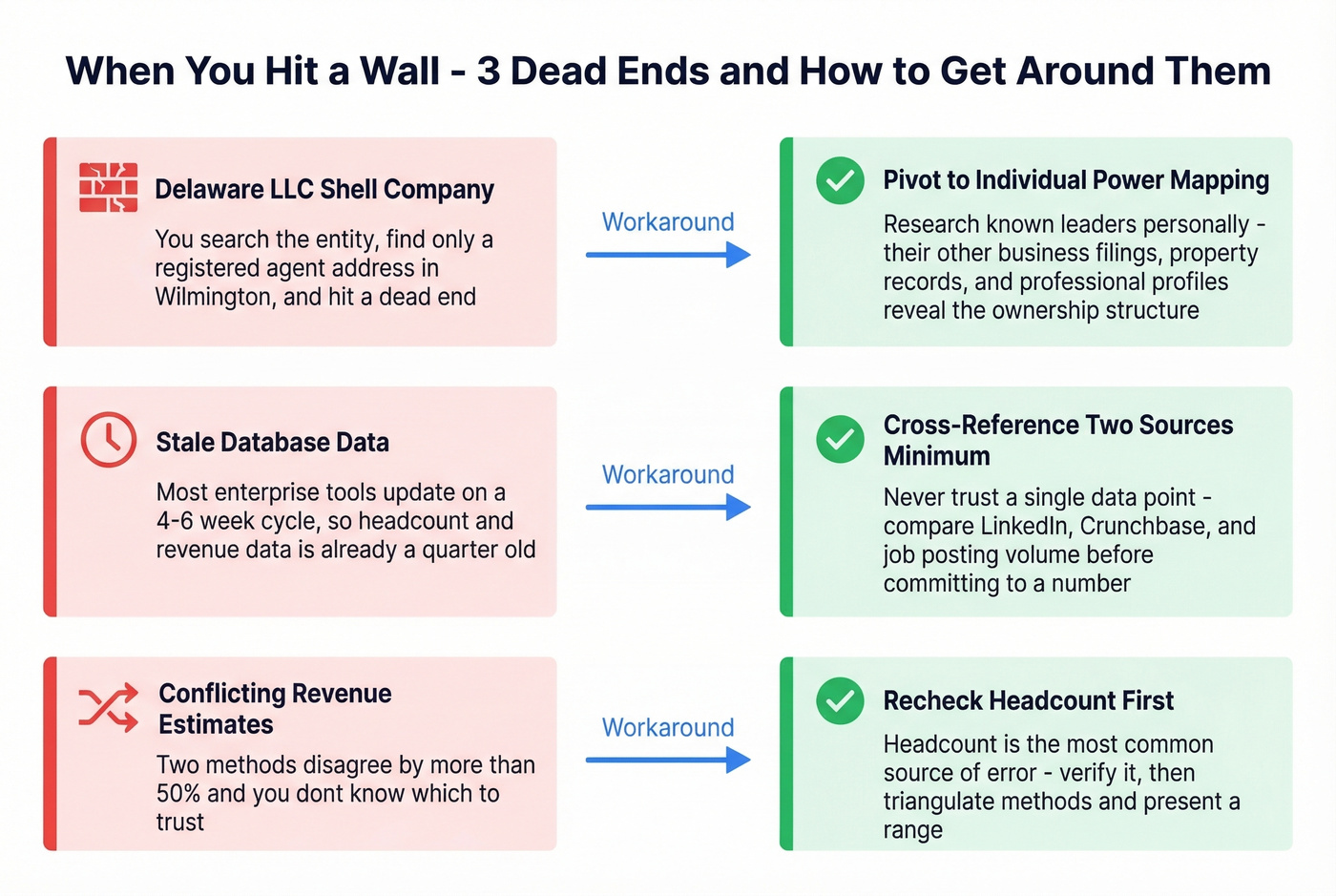
Stale database data. Cross-reference at least two sources before trusting any single data point. Most enterprise tools update on a 4-6 week cycle, which means the headcount number you're looking at is already a quarter old.
Conflicting revenue estimates. This is normal. Triangulate with two or three methods and present a range. If your methods disagree by more than 50%, one of your inputs is wrong - recheck headcount data first, since that's the most common source of error.
FAQ
Can You Find Private Company Financials?
No - private companies have no SEC disclosure obligation unless they've filed a Form D or must register under the Exchange Act. Use revenue-per-employee benchmarks, public comps, and funding-stage proxies to build a reliable range. Triangulating two methods typically narrows the estimate to within 20-30% of actual revenue.
What's the Best Free Tool for Private Company Research?
OpenCorporates is best for ownership and entity data across jurisdictions. Crunchbase's free tier covers funding history and employee signals. EDGAR full-text search catches any SEC mentions. Combine all three for a baseline covering structure, funding, and regulatory footprint.