

How to Sell Benefits, Not Features - The Complete Method Most Guides Skip
You're three slides into a product demo and the prospect's eyes have gone flat. You're talking about your 14-point integration architecture. They're thinking about lunch.
Theodore Levitt nailed this decades ago - people don't want a quarter-inch drill, they want a quarter-inch hole. That advice is correct, but it's dangerously incomplete. Most teams never learn how to sell benefits, not features in a way that actually converts. They stop at "sell benefits" without figuring out how to find the right benefit, when features are the stronger move, or why generic outcomes like "save time" are just as bad as listing specs. The real skill is learning to sell value, and that requires a method, not a slogan.
The Three Techniques That Cover 90%
- The "So what?" ladder. Take any feature, ask "So what?" two or three times, and you land on the outcome your buyer actually cares about.
- The "So what?" vs. "Yeah, right" diagnostic. This tells you when to lead with benefits and when features win instead - the core of choosing between value and features.
- Sell the after-state. Don't just name the benefit. Describe what the customer's day looks like after they buy.
The "So What?" Ladder
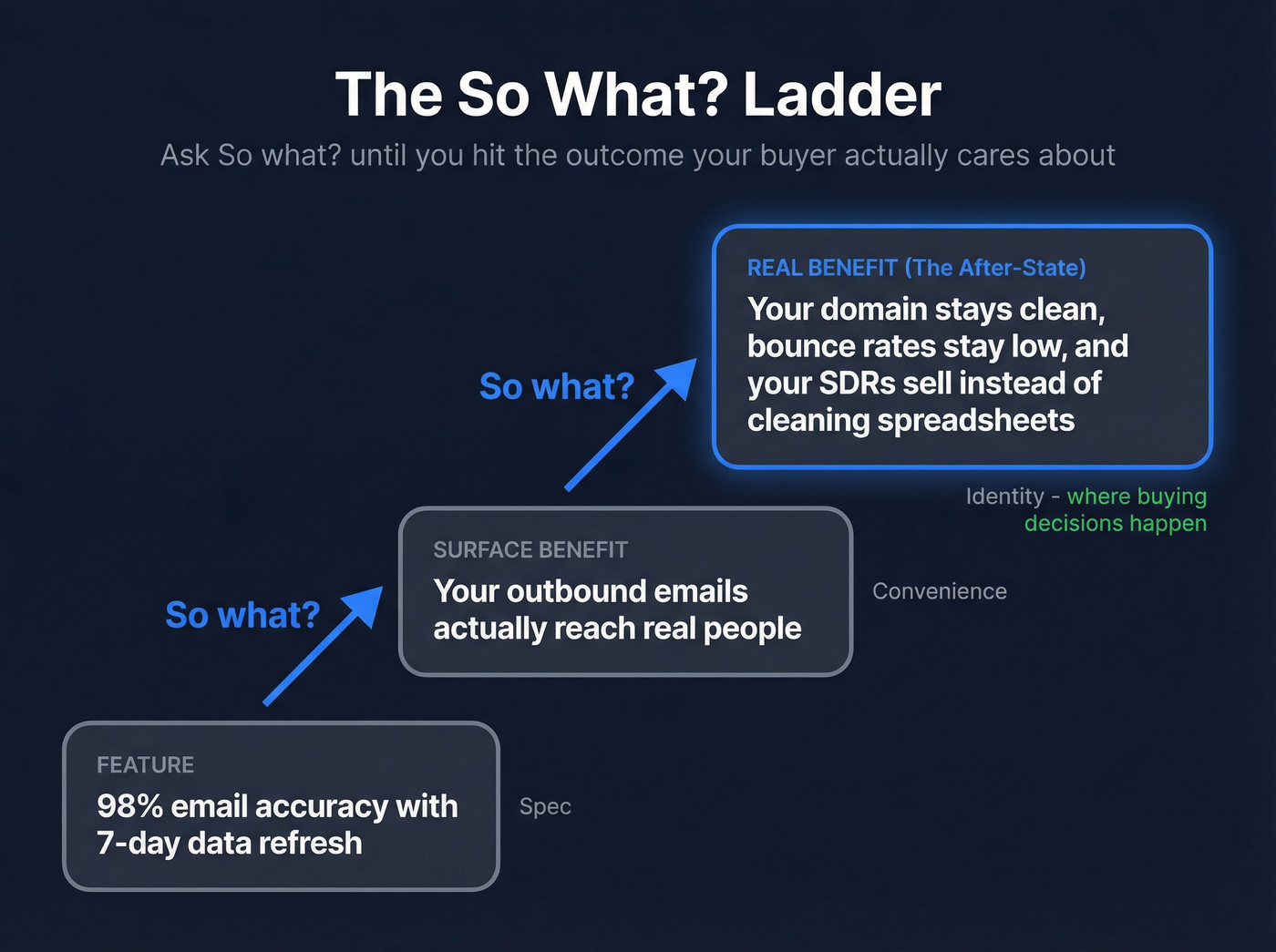
State a feature, then ask "So what?" Keep asking until you hit something that changes how someone works or lives. Two to three rounds gets you there - and in our experience, the third "So what?" is where the real benefit lives.
B2C example. Feature: "12-hour battery life." So what? "You can work all day without charging." So what? "You work from anywhere - the coffee shop, the airport, the park - without hunting for outlets." That last line is the benefit. The first line is just a spec.
B2B SaaS example. Feature: "98% email accuracy with a 7-day data refresh." So what? "Your outbound emails actually reach real people." So what? "Your domain stays clean, bounce rates stay low, and your SDRs sell instead of cleaning spreadsheets." That's the after-state, and it's what a VP of Sales actually buys.
Services example. Feature: "Automated task reminders." So what? "Your team never misses a deadline." So what? "Everyone stays aligned across time zones without a single Slack chase."
Notice the pattern: you're moving from surface convenience to identity. Surface benefits like "save time" are table stakes. Go deeper and you reach real outcomes. Go one more level and you hit identity - "I'm the kind of leader who runs a tight ship." That's where buying decisions actually happen.
The "So what?" ladder is the simplest way to highlight product value in sales conversations, decks, and landing pages alike - especially when you’re tightening up your sales presentations and product demo narrative.
When Features Beat Benefits
Here's the diagnostic from Conversion Rate Experts that every copywriter should memorize.
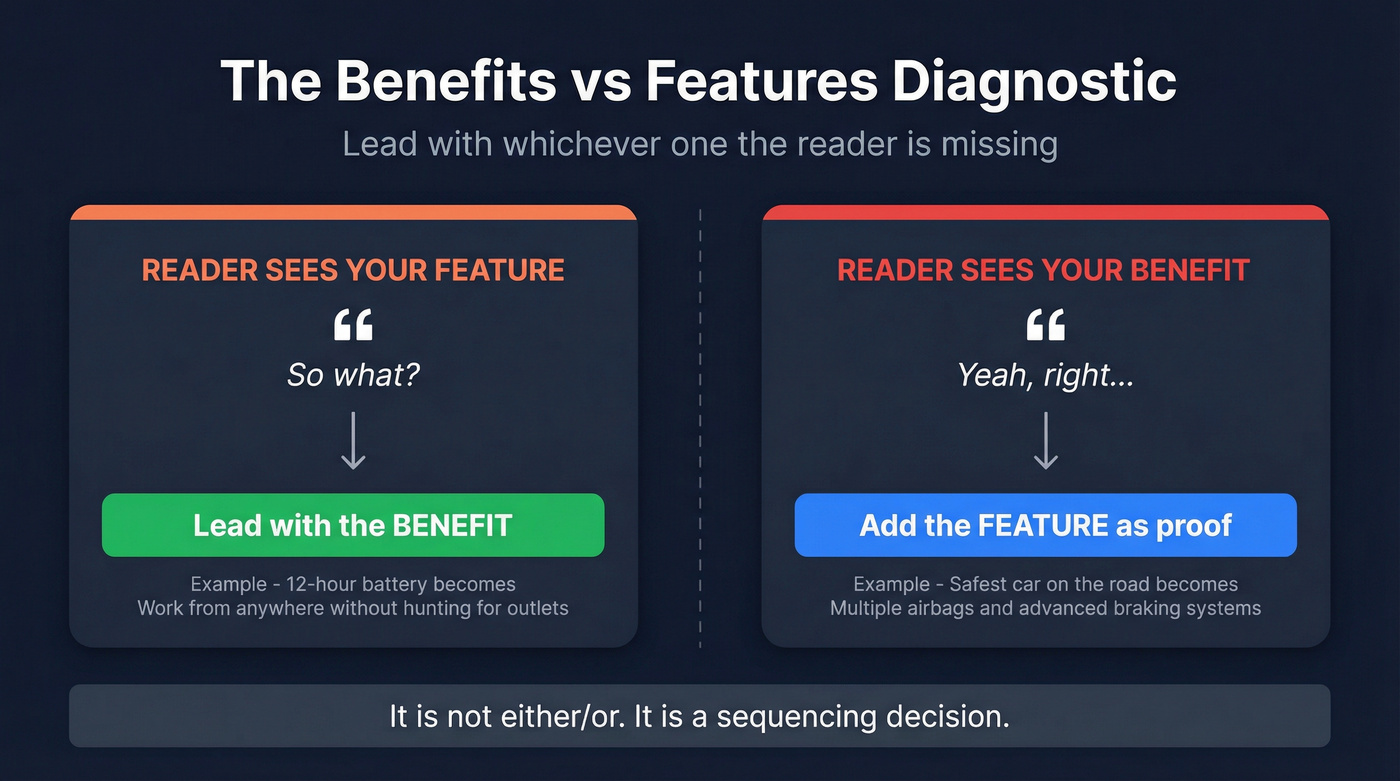
If a reader sees your feature and thinks "So what?" - you need to explain the benefit. If a reader sees your benefit and thinks "Yeah, right" - you need to add the feature as proof. "This car is the safest on the road" triggers skepticism. "This car has multiple airbags and advanced braking systems" makes the safety claim believable.
Benefits-only copy hurts credibility with technical and enterprise buyers - especially in enterprise deals where procurement and security teams want comparable proof. Developers want supported languages and security protocols. Procurement teams want specs they can compare. The rule isn't "always lead with benefits" - it's lead with whichever one the reader is missing.
Here's the stage-by-stage heuristic. Lead with outcomes and workflows at the awareness stage - that's when buyers care about the "why." Switch to features and specs at evaluation - that's when teams are comparing line items. In message tests, benefit-led positioning often lifts conversion rates by around 5-30%, but only when paired with feature proof for skeptical audiences. This isn't an either/or decision. It's a sequencing one - one of the core levers in B2B conversion rate optimization.
Let's be honest: if your average deal size is under five figures, you almost certainly don't need a massive feature comparison. You need one sharp benefit statement and a free trial. Stop over-engineering the pitch.
Sell the After-State
The step most teams skip isn't naming benefits - it's selling the workflow. The consensus on r/marketing is that most "benefit" copy is still too abstract. What does the customer's Tuesday morning look like after they buy?
Apple didn't say "5GB of storage" or even "store lots of music." They said "1,000 songs in your pocket." That's an after-state - a new daily reality.
Every SaaS homepage says "save time and increase revenue." That's not selling benefits. That's saying nothing. Generic outcomes are worse than specific features because they're undifferentiated. "Your reps book 26% more meetings because they're working from verified contact data" beats "increase sales productivity" every single time. We've seen teams rewrite a single homepage headline this way and get meaningful lifts in demo requests. Specificity is what makes value tangible.
If you want this to land in outbound too, pair the after-state with a tight cold email outreach structure and a clear next step.

You just learned the "So what?" ladder. Here's one already climbed for you: 98% email accuracy → your outbound actually reaches real people → your reps book 26% more meetings while your domain stays clean. That's Prospeo's after-state, used by 15,000+ companies.
Sell the outcome. Start with data that delivers one.
Pick Your Framework
| Framework | Structure | Best For | Example |
|---|---|---|---|
| FAB | Feature -> Advantage -> Benefit | Product pages, spec sheets | "7-day refresh -> current data -> no dead leads" |
| PAS | Problem -> Agitate -> Solution | Cold emails, ads | "Bouncing emails? Every bounce hurts your domain." |
| BAB | Before -> After -> Bridge | Case studies, landing pages | "35% bounce rate -> under 4% -> here's how" |
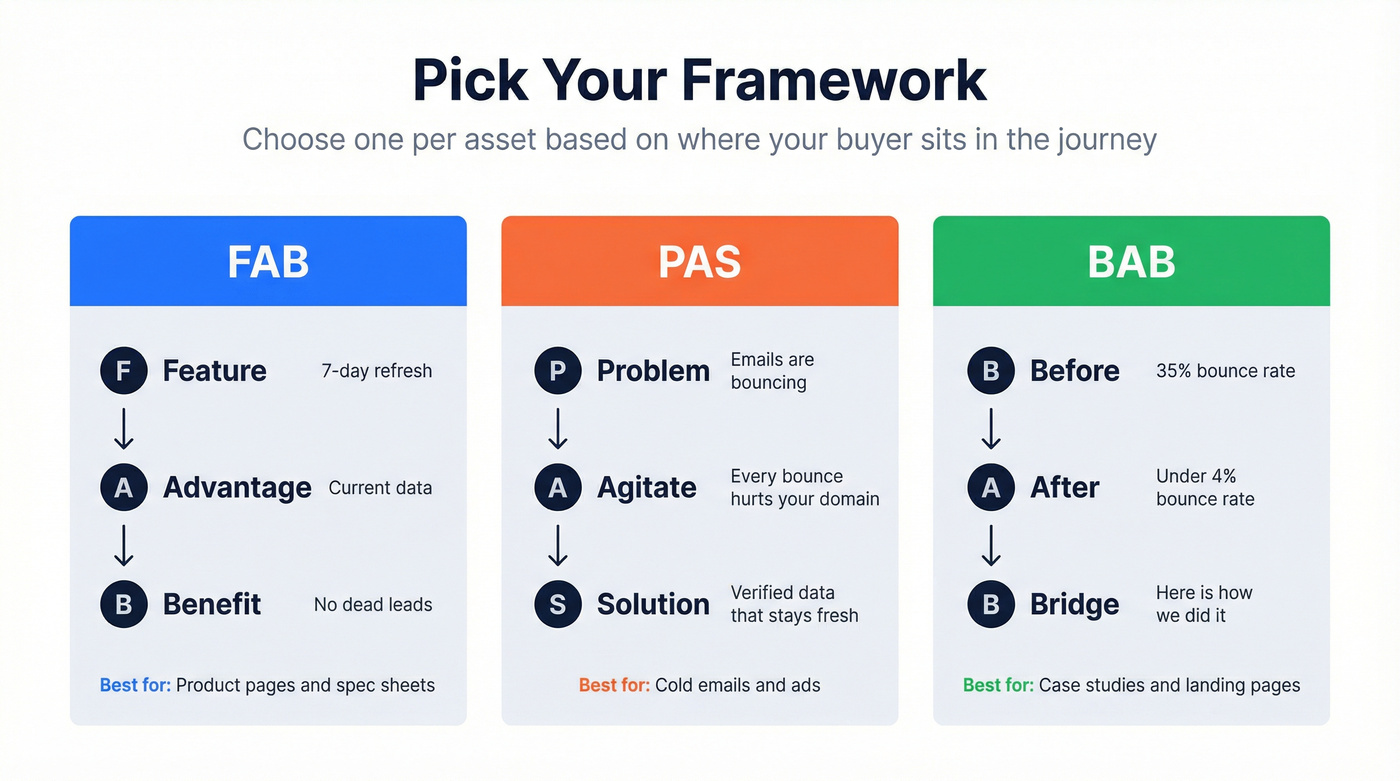
Pick one per asset. Don't mix them on the same page - it muddies the message. Each framework is a different lens for communicating product value, so choose the one that matches where your buyer sits in the journey - especially if you’re mapping it to your sales funnel stages and handoffs.
Why This Works (The Science Is Clear)
Research by Harvard professor Gerald Zaltman suggests 95% of purchasing decisions happen subconsciously. Kahneman's System 1 - the fast, emotional brain - makes the call before System 2 starts rationalizing. Benefits work because they speak to System 1. The emotions worth targeting: fear of falling behind, pride in running a sharp operation, trust, excitement, and belonging.
This is exactly why painting an outcome matters more than memorizing a spec sheet.
Quick self-audit for any page you've written: count how many sentences start with "we" or "our," then flip them to "you" and "your." That single edit moves copy from company-centric to benefit-centric in about 30 seconds - an easy win inside a broader value-based sales strategy.
Find the Right Benefits
The Jobs-to-Be-Done framework gives you a discovery checklist that actually works. For every feature on your page, map it against four dimensions before you write a single line of copy.
Use cases are what the buyer is trying to accomplish - automate outbound prospecting, for instance. Pain points are what's blocking them, like bad data burning their sender domain. KPIs are how their success gets measured, especially anything tied to comp: meetings booked, pipeline generated. Triggers are what made them look now, such as a competitor closing a round and scaling outbound.
This is where strong discovery matters: use a set of good discovery questions to pull out the real job, pain, and KPI - then write the benefit in the buyer’s words.
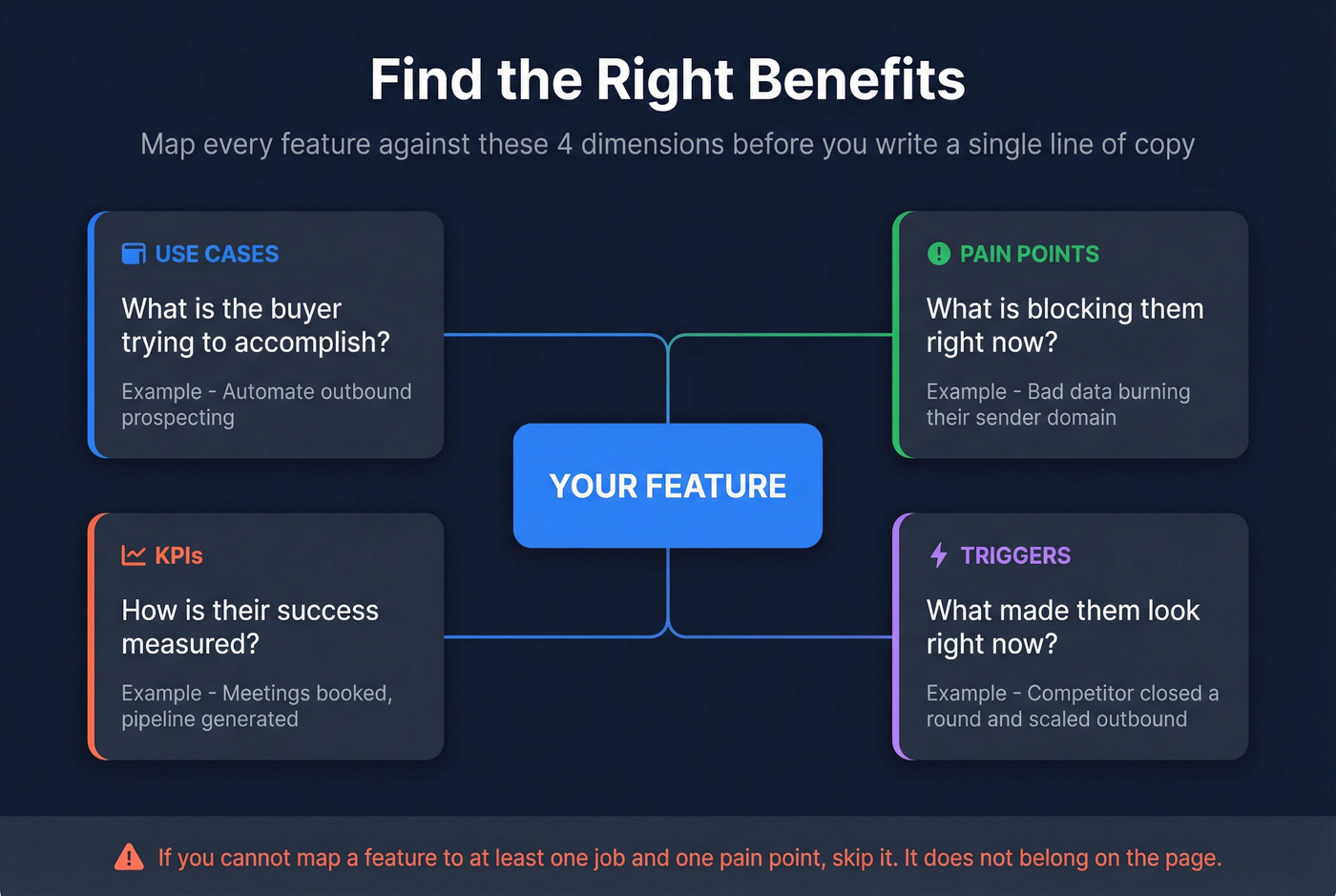
For B2B, start with JTBD. For B2C, start with emotion mapping. If you can't map a feature to at least one job and one pain point, skip it - the feature doesn't belong on the page.
Now Go Rewrite Your Worst Page
That's the whole method for how to sell benefits, not features and actually make it stick. The "So what?" ladder finds the benefit. The "Yeah, right" diagnostic tells you when to flip back to features. The after-state makes it real.
Look - I've watched teams spend weeks debating messaging frameworks when the fix was staring at them from their own homepage. Pick your single worst-performing page, run the "So what?" ladder on every feature listed there, and rewrite the headline around the third-level answer. You'll know within a week whether it moved the needle - especially if you track it with the right funnel metrics.
"35% bounce rate → under 4%." That's not a hypothetical BAB framework example - that's what Snyk's 50 AEs achieved with verified contact data refreshed every 7 days. Generic benefits don't close deals. Specific, provable ones do - at $0.01 per email.
Give your team the proof that makes "yeah, right" impossible.