

The 6 Sales Funnel Stages (With Benchmarks, KPIs, and Formulas)
A RevOps lead we work with ran a full pipeline audit last quarter. Conversion from SQL to close looked healthy - 24%, right in line with the 20-25% SQL-to-close benchmark range many B2B SaaS teams use. But pipeline was shrinking. The problem wasn't at the bottom. It was three sales funnel stages earlier, where MQLs were dying in evaluation because reps couldn't reach the right people with the right data.
Deals rarely fail at the decision stage. They usually fail earlier - and most teams don't instrument their funnel well enough to see where.
A recent r/SaaS thread nailed this: a marketer with five years of experience admitted they'd overcomplicated funnels for years before realizing the leaks almost always happen before the decision stage. That matches everything we've seen.
This guide gives you the six stages of a sales funnel, conversion benchmarks by industry, the formulas that actually matter, and the specific mistakes that silently drain your pipeline. If you already know the stages, skip straight to the benchmark table or the KPI section.
Quick version: The six stages are Awareness, Interest, Evaluation, Intent, Decision, and Retention. The one formula that governs everything is sales velocity: (Opportunities x Win Rate x Avg Deal Size) / Sales Cycle Length. And the single biggest invisible leak? Bad contact data at the top of funnel - it poisons every stage below it.
What Is a Sales Funnel?
A sales funnel maps how buyers move from first hearing about you to becoming a customer - and ideally, a repeat customer. Each stage narrows: more people enter the top than exit the bottom, and the conversion rates between stages tell you exactly where your go-to-market motion is healthy or broken.
Think of it as a diagnostic tool, not a diagram for a slide deck. The funnel exists so you can find the leak, not so you can draw a pretty picture.
One caveat: buyers don't always move linearly through these stages. A prospect might jump from Awareness straight to Intent after a referral, or loop back from Evaluation to Interest after a stakeholder raises a new concern. The stage model still works because it gives you measurable transitions to diagnose - even when the real journey zigzags.
Funnel vs Pipeline vs Marketing Funnel
These three terms get used interchangeably, and that's where confusion starts. They're related but measure different things, from different perspectives, owned by different teams.
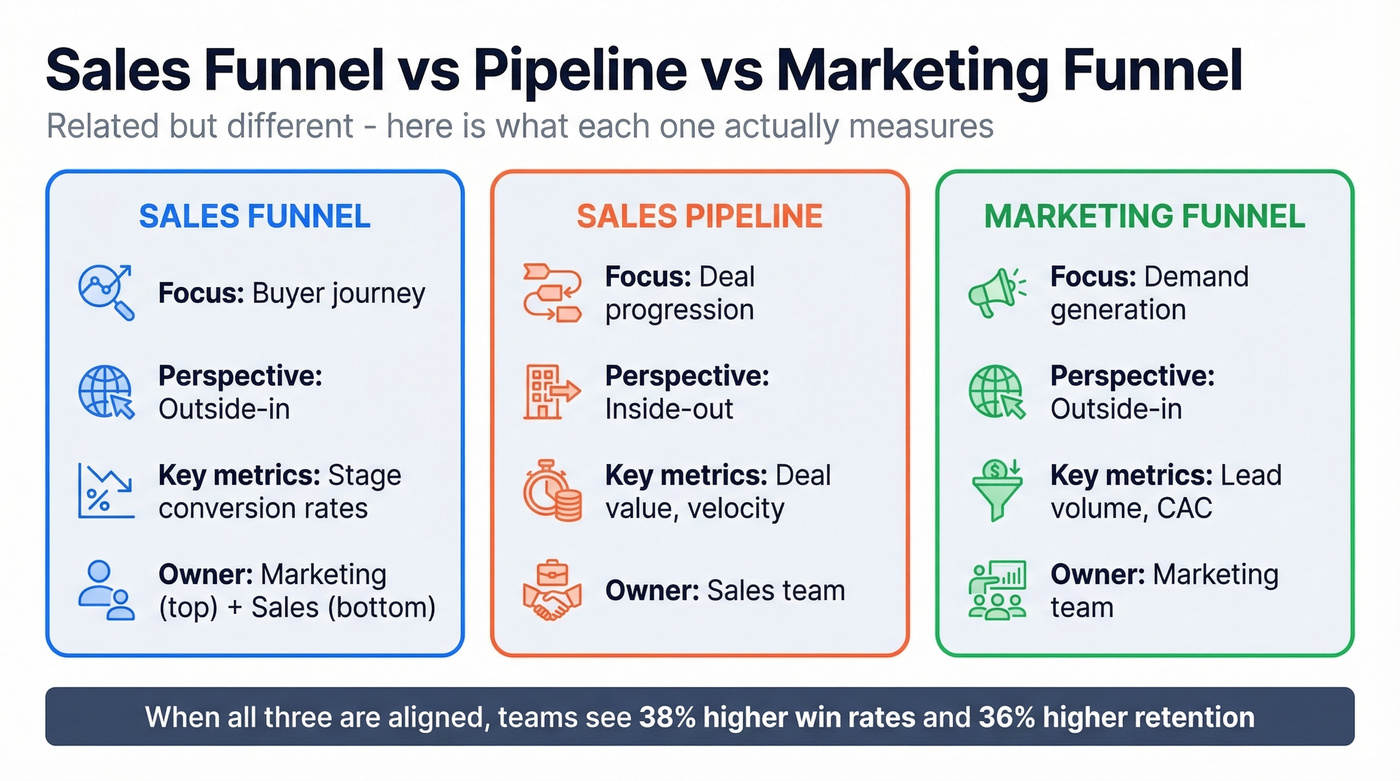
| Sales Funnel | Sales Pipeline | Marketing Funnel | |
|---|---|---|---|
| Focus | Buyer journey | Deal progression | Demand generation |
| Perspective | Outside-in | Inside-out | Outside-in |
| Key metrics | Stage conversion rates | Deal value, velocity | Lead volume, CAC |
| Owner | Marketing (top), Sales (bottom) | Sales | Marketing |
The funnel asks "how are buyers moving through our process?" The pipeline asks "how much revenue is in play and when will it close?" The marketing funnel asks "are we generating enough demand at the right cost?"
When these three are aligned, teams see 38% higher win rates and 36% higher retention. One practical concept worth borrowing from pipeline management: weighted pipeline value, where you assign a close probability to each stage. A $100K deal at the Intent stage with a 40% probability is worth $40K in your forecast. That math forces honesty about where deals actually stand.
The 6 Sales Funnel Stages Explained
Six stages is a practical default for many B2B teams. Three is too few to diagnose problems. Eight is too many to operationalize in a CRM without creating clutter. Here's what each stage covers:
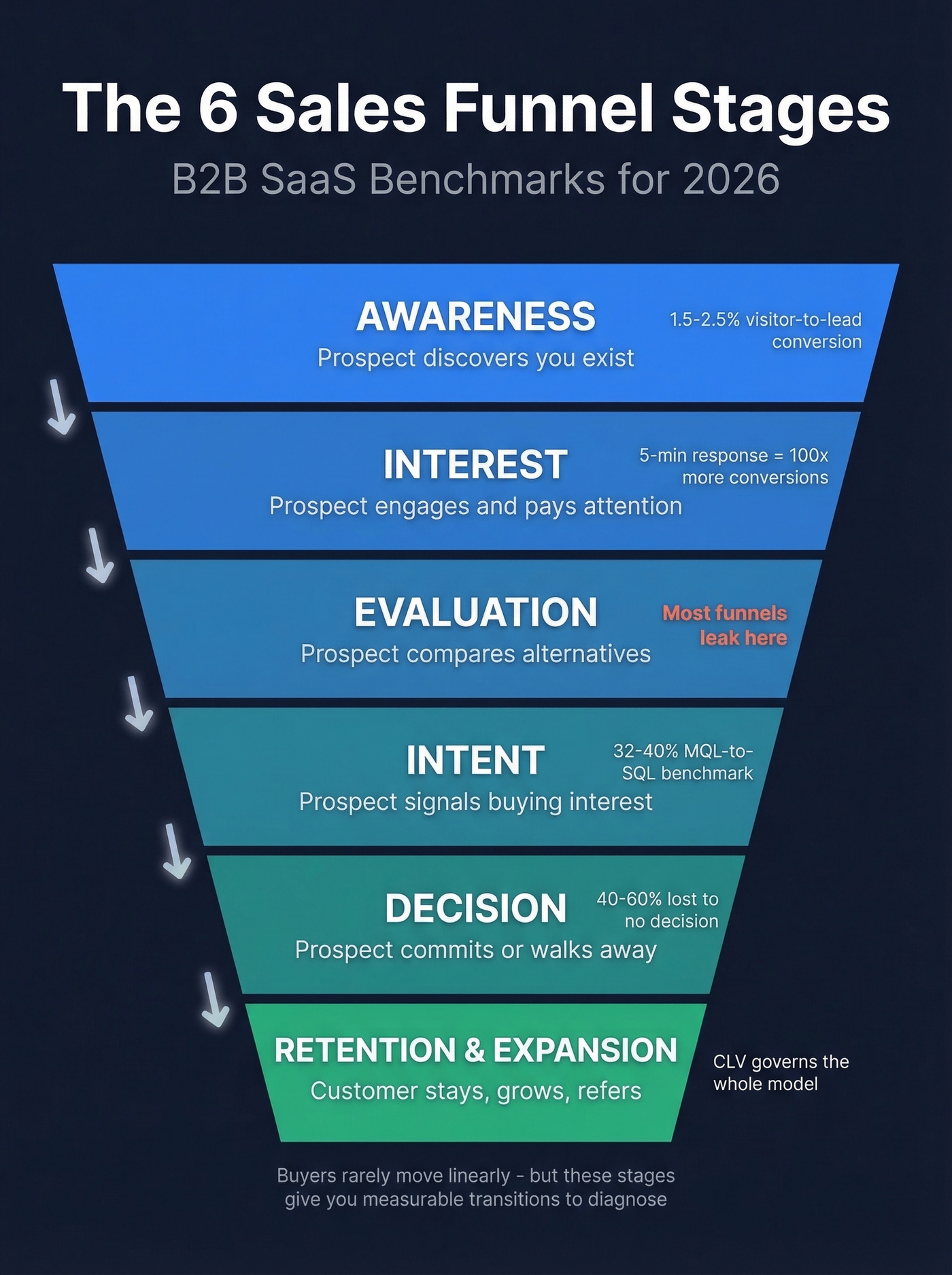
- Awareness - Prospect discovers you exist
- Interest - Prospect engages and pays attention
- Evaluation - Prospect compares you to alternatives
- Intent - Prospect signals they want to buy
- Decision - Prospect commits (or doesn't)
- Retention & Expansion - Customer stays, grows, and refers
Awareness
This is where prospects first encounter your brand - through content, ads, referrals, events, or outbound prospecting. The goal isn't to sell. It's to earn enough attention that someone engages.
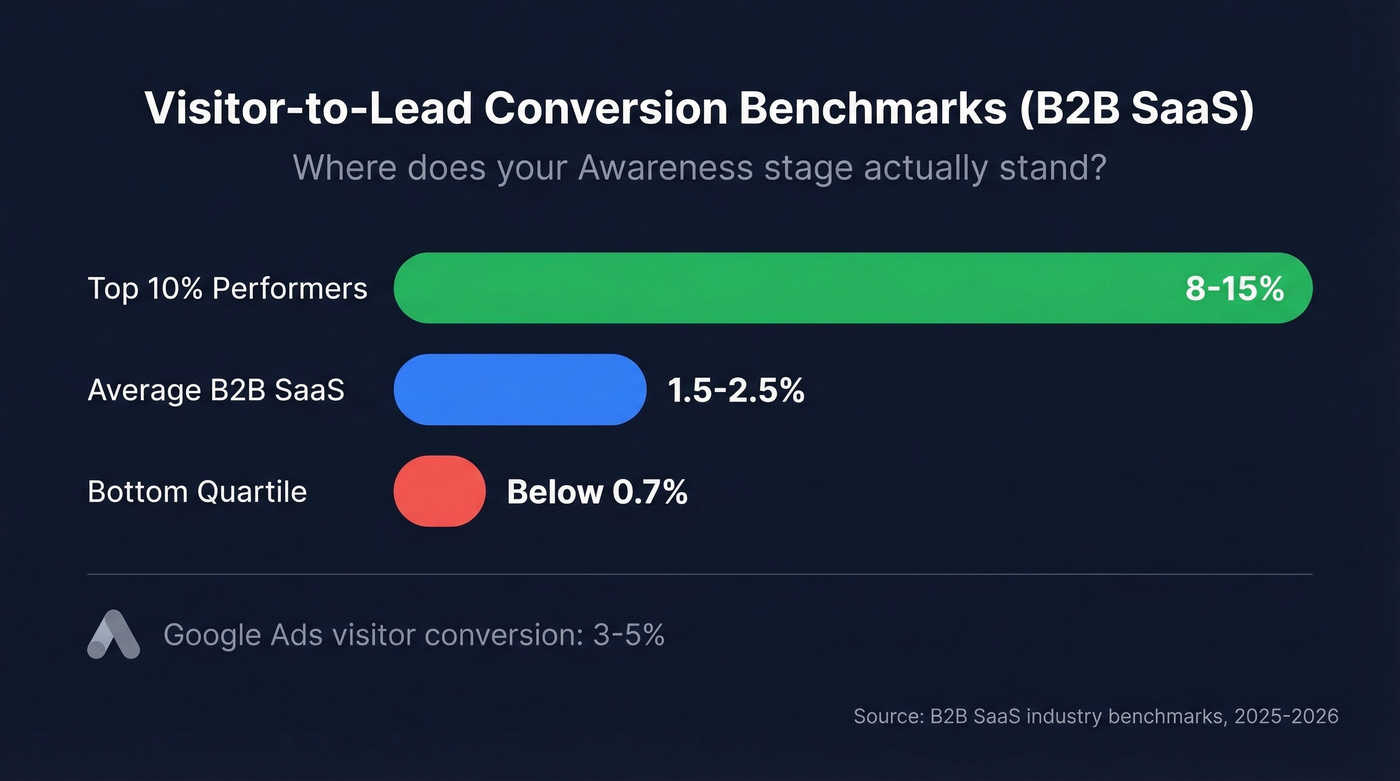
The numbers here are humbling. Average visitor-to-lead conversion runs 1.5-2.5% for B2B SaaS. Top 10% performers hit 8-15%. Bottom quartile sits below 0.7%. Channel matters enormously: Google Ads typically converts visitors at 3-5%.
As Ryan Reisert of CallBlitz puts it: "Your prospecting list is your strategy. Stick to it." A wide top of funnel feels productive but floods your pipeline with noise. Tighten your ICP first, then fill the funnel.
Exit criteria: the prospect has identified themselves - filled a form, downloaded content, replied to an outbound touch. They're no longer anonymous.
Interest
The prospect knows you exist and is paying attention. They're visiting your pricing page, reading case studies, opening emails. Your job is to respond fast and qualify.
Contacting leads within five minutes of their first engagement increases conversions by 100x compared to waiting 30 minutes. That stat sounds absurd, but it's one of the most replicated findings in sales research. Cognism runs a five-minute SLA on every inbound lead for exactly this reason.
Behavioral signals to watch: pricing page visits, multiple content downloads in a short window, return visits within 48 hours. These patterns separate casual browsers from people who are actively evaluating.
Evaluation
Here's the thing: this is where most funnels leak. The prospect is comparing you to alternatives, building a business case, and - in B2B - looping in other stakeholders. B2B buying committees often involve 4-10 decision-makers, each with different concerns: technical fit, budget, compliance, integration.
Your MOFU content does the heavy lifting here: case studies, competitive comparisons, ROI calculators, live demos. The mistake most teams make is treating evaluation as a single conversation with a single champion. It's not. It's a multi-threaded process where your champion needs ammunition to sell internally.
Single-channel outreach compounds the problem. Multi-channel approaches drive 287% higher response rates - yet most reps still rely on email alone at this stage. Phone, email, and social touches in sequence dramatically improve your odds of reaching the CFO or VP of Engineering who has veto power.
We've seen teams lose deals at this stage not because the product was wrong, but because they couldn't get verified contact information for the people who mattered. Data quality isn't just a top-of-funnel problem - it echoes through every stage below it.
Intent
The prospect has signaled they want to buy. Demo requests, proposal asks, contract reviews, pricing negotiations - these are intent signals that separate tire-kickers from real buyers.
MQL-to-SQL conversion benchmarks run 32-40% for B2B SaaS. If you're significantly below that range, your qualification criteria are either too loose (letting unqualified leads through) or too tight (killing good leads with bureaucratic scoring).
The behavioral exit criteria for moving to Decision: the prospect has confirmed budget, timeline, and decision-making authority. In BANT terms, at least three of four boxes are checked. In MEDDIC terms, you've identified the economic buyer and mapped the decision process.
Decision
This is the stage everyone obsesses over, but it's actually the least fixable. By the time a deal reaches Decision, the outcome is largely determined by what happened in Evaluation and Intent.
40-60% of qualified deals are lost to "no decision" - not to a competitor, but to inertia. The prospect decides to do nothing. Multi-threading across the buying committee is the best defense. If your deal depends on a single champion, you're one reorg away from a stalled opportunity.
Core activities at this stage: negotiation, objection handling, legal/procurement review, and final stakeholder alignment. Opportunity-to-close averages around 120 days for enterprise deals. SMB deals move faster - 30-45 days is typical.
Retention & Expansion
Post-purchase isn't an afterthought. It's a revenue stage.
The RingDNA lifecycle model extends the funnel past purchase into Reevaluation and Repurchase - and that framing is correct. Your existing customers are your cheapest pipeline. The governing metric here is customer lifetime value (CLV). If your CAC is $5,000 and your average CLV is $15,000, your funnel is working. If CLV is $6,000, you're running on thin margins and any increase in churn breaks the model.
Retention activities include onboarding, QBRs, usage monitoring, and expansion plays - upsell, cross-sell, seat expansion. The best B2B companies treat retention as a funnel stage with its own conversion rates and KPIs, not as a customer success afterthought.
Funnel Frameworks Compared
There's no shortage of funnel models. Here's how the major frameworks map to each other:
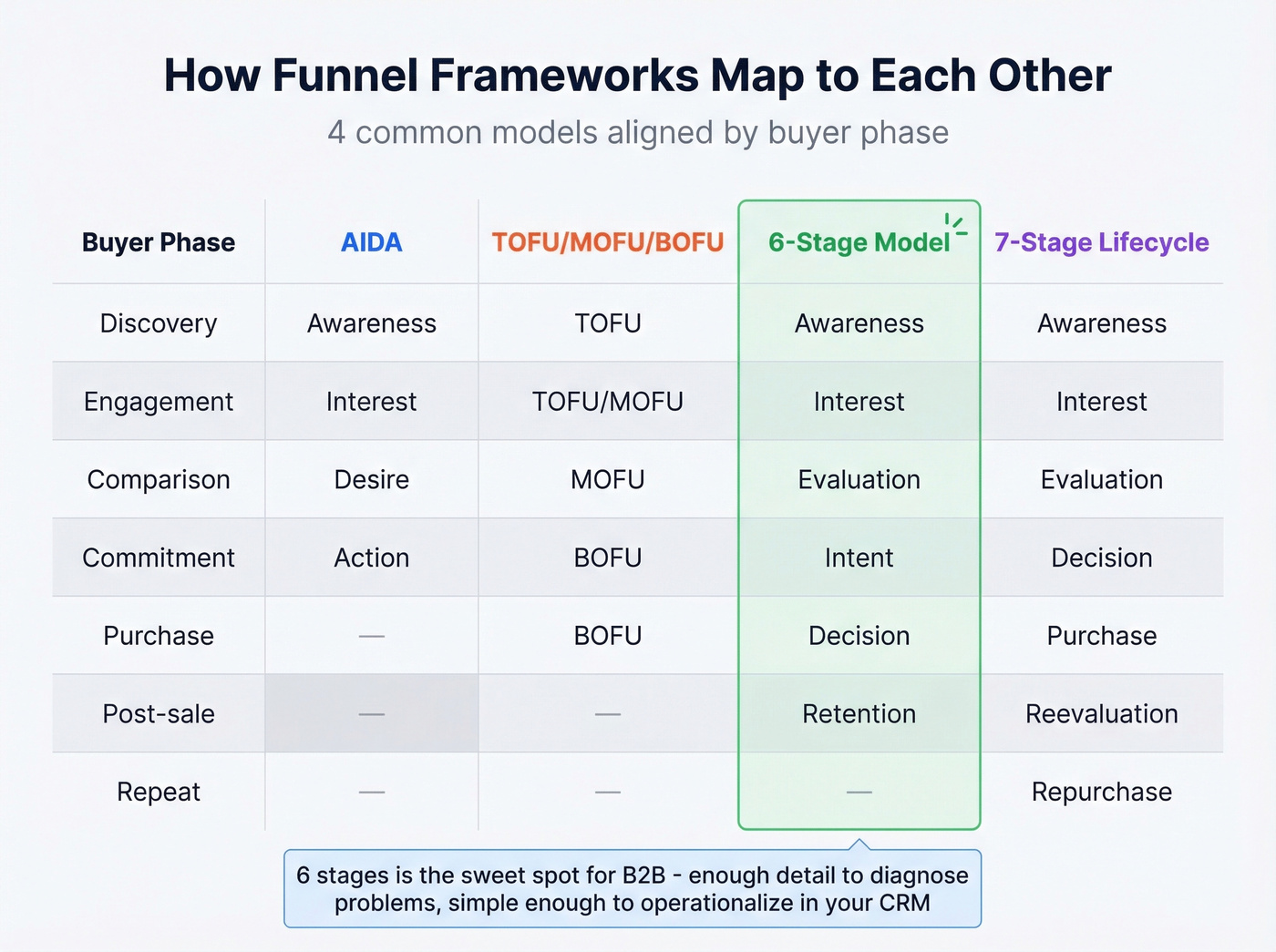
| Buyer Phase | AIDA | TOFU/MOFU/BOFU | 6-Stage (Ours) | 7-Stage Lifecycle |
|---|---|---|---|---|
| Discovery | Awareness | TOFU | Awareness | Awareness |
| Engagement | Interest | TOFU/MOFU | Interest | Interest |
| Comparison | Desire | MOFU | Evaluation | Evaluation |
| Commitment | Action | BOFU | Intent | Decision |
| Purchase | - | BOFU | Decision | Purchase |
| Post-sale | - | - | Retention | Reevaluation |
| Repeat | - | - | - | Repurchase |
Six stages is the sweet spot for B2B. AIDA is elegant but doesn't account for post-purchase (if you want the AIDA version, see our AIDA breakdown). The 3-stage model (Awareness, Consideration, Decision) is too compressed to diagnose where leads stall. A 7-stage lifecycle model is thorough but hard to operationalize in most CRMs without custom objects.
Some teams condense this further into 5 stages by merging Intent and Decision - that works for shorter sales cycles where those two phases happen in a single meeting.

You just read that most funnels leak at the Evaluation stage - when reps can't reach the 4-10 stakeholders who actually decide. Prospeo gives you 98% verified emails and 125M+ direct dials so your team can multi-thread every deal.
Stop losing deals because you couldn't reach the decision-maker.
B2B vs B2C Funnels
The structural differences between B2B and B2C funnels are significant enough that applying one model to the other will mislead you.
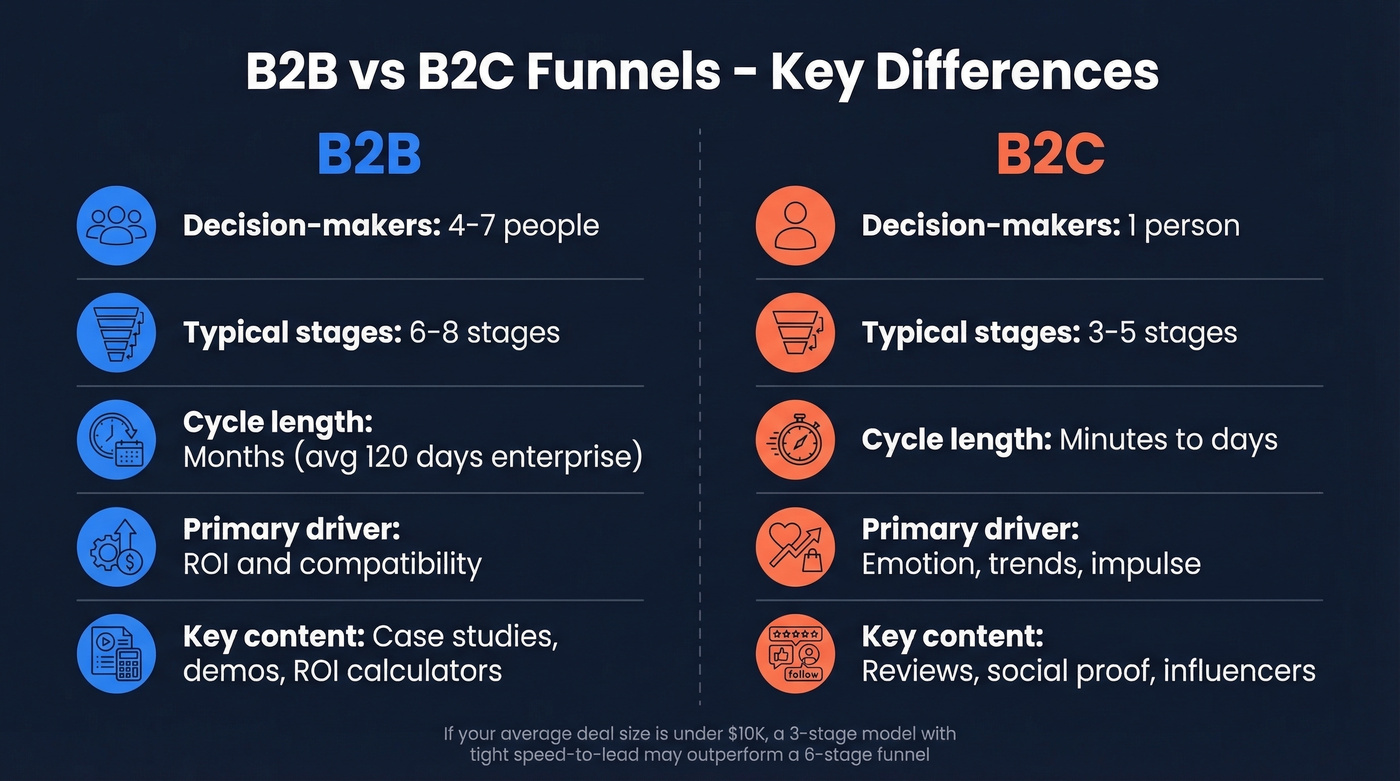
| Dimension | B2B | B2C |
|---|---|---|
| Decision-makers | 4-7 people | 1 person (or couple) |
| Typical stages | 6-8 | 3-5 |
| Cycle length | Months | Minutes to days |
| Primary driver | ROI, compatibility | Emotion, trends, impulse |
| Key content | Case studies, demos | Reviews, social proof |
B2B funnels are longer, involve more stakeholders, and require more touchpoints. A B2C eCommerce funnel might be Awareness, Consideration, Purchase with a 3-minute cycle. A B2B enterprise funnel might take 6 months with 15+ touchpoints across 5 stakeholders. The parts of a sales funnel are conceptually similar across both models, but the tactics, timing, and metrics are completely different.
If your average deal size is under $10K, you probably don't need a six-stage funnel. A three-stage model with tight speed-to-lead and clean data will outperform a beautifully instrumented six-stage funnel that nobody actually updates. Match your funnel complexity to your deal complexity.
Conversion Benchmarks by Stage
Here are stage-by-stage conversion benchmarks from First Page Sage's multi-year dataset spanning 2017-2026:
| Industry | Lead to MQL | MQL to SQL | SQL to Opp | SQL to Closed |
|---|---|---|---|---|
| B2B SaaS | 39% | 38% | 42% | 37% |
| Cybersecurity | 24% | 40% | 43% | 46% |
| eCommerce | 23% | 58% | 66% | 60% |
These are post-visitor rates - they don't include the visitor-to-lead conversion, which runs 1.5-2.5% on average.
Time-in-stage benchmarks add another dimension:
- Visitor to Lead: 1-3 days
- MQL to SQL: 8-15 days
- Opportunity to Close: ~120 days (enterprise) / 30-45 days (SMB)
If your MQL-to-SQL conversion is 25% when the benchmark is 38%, that's your leak. If leads are sitting in MQL status for 30 days when the benchmark is 8-15, you've got a qualification or routing problem. These numbers aren't targets - they're diagnostic baselines. Compare your actuals against them weekly.
KPIs and Formulas by Stage
Three metrics matter most: stage-to-stage conversion rate, time-in-stage, and sales velocity. Everything else is a vanity metric until these are healthy.
Sales velocity is the master formula:
(Number of Opportunities x Win Rate x Avg Deal Size) / Sales Cycle Length
This tells you how much revenue your funnel produces per day. Improve any of the four variables and velocity goes up. Shorten the cycle from 90 days to 60 and you've increased velocity by 50% without closing a single additional deal.
Stage conversion rate is straightforward:
(Leads exiting stage / Leads entering stage) x 100
Track this weekly for every transition. A sudden drop in one - say, Interest to Evaluation - tells you exactly where to investigate. Understanding performance at this level of granularity is what separates teams that grow from teams that guess.
For SaaS specifically, add these KPIs: trial-to-paid conversion, MQL-to-PQL (product-qualified lead), and PQL-to-SQL. These capture the product-led motion that traditional funnel models miss. CAC and CLV are the bookend metrics - CAC tells you what it costs to acquire a customer, CLV tells you what that customer is worth. If CAC exceeds CLV, your funnel is a money furnace regardless of how good your stage conversion rates look.
How to Build a Sales Funnel
You don't need a $30K platform to build a working funnel. Five steps.
1. Define your ICP and build your prospect list.
Your funnel is only as good as the data feeding it. Start by defining your ideal customer profile - industry, company size, job titles, geography - then build a list of verified contacts that match. Prospeo's B2B database gives you 300M+ professional profiles with 30+ search filters and 98% email accuracy via 5-step verification that eliminates bounces before they happen. All records refresh every 7 days. In our experience, bad data is the #1 invisible funnel leak - if your bounce rate is above 5%, you're not just losing those leads, you're damaging your domain reputation and poisoning deliverability for every future campaign.
2. Map stages with behavioral exit criteria.
Don't just name your stages - define what a lead must do to move from one to the next. "Downloaded a whitepaper" moves someone from Awareness to Interest. "Requested a demo" moves them from Evaluation to Intent. Without exit criteria, your CRM stages are just labels.
3. Assign content and tactics per stage.
TOFU gets blog posts, ads, and social content. MOFU gets case studies, comparisons, and demos. BOFU gets proposals, ROI calculators, and negotiation support. Map every asset to a stage so you can identify gaps.
4. Set up CRM tracking.
Use Salesforce or HubSpot to track stage transitions, time-in-stage, and conversion rates. Automate stage changes where possible based on behavioral triggers, not manual rep updates. Manual updates are always late and often wrong. If you're evaluating options, start with a few examples of a CRM to match your funnel complexity.
5. Measure weekly and iterate.
Pull a funnel report every Monday. Compare stage-to-stage conversion rates against your benchmarks. If a transition drops below baseline, investigate that week - not at the end of the quarter when it's too late. AI-assisted funnel tools are promising here, but most teams haven't earned the right to automate yet. Fix your stage definitions and data quality first - automation just amplifies whatever you feed it.
Bad contact data at the top of funnel poisons every stage below it. Prospeo refreshes 300M+ profiles every 7 days - not every 6 weeks - so your pipeline runs on data that's actually current. At $0.01 per email, fixing your funnel costs less than one lost deal.
Clean data in, higher conversion rates out. It's that simple.
Mistakes That Break Your Funnel
Seven mistakes we see repeatedly, each with measurable impact across every stage.
1. No behavioral exit criteria between stages. Without clear triggers for stage transitions, leads pile up in the wrong stage and your conversion metrics become meaningless. Define what action moves a lead forward - and what inaction moves them out.
2. Ignoring speed-to-lead. Contacting leads within 5 minutes increases conversion by 100x. Most teams respond in hours or days. Set an SLA and enforce it (and keep sales follow-up templates handy so reps don't stall).
3. Targeting too broad an audience. A wide top of funnel feels productive but floods your pipeline with unqualified leads. The result: up to 55% of leads get neglected due to poor qualification. Tighten your ICP before you scale outreach.
4. Not tracking stage-to-stage conversion weekly. Monthly or quarterly reviews catch problems too late. By the time you notice a 15% drop in MQL-to-SQL conversion, you've already lost a quarter's worth of pipeline. If you want a deeper tracking layer, use a dedicated funnel metrics checklist.
5. Treating retention as someone else's problem. Cart abandonment averages 70% across industries. Post-purchase churn is just as deadly in B2B. If you're not measuring retention as a funnel stage, you're ignoring your cheapest revenue source (see our churn analysis guide).
6. Relying on single-channel outreach. Multi-channel approaches drive 287% higher response rates than email alone. If your reps are only sending emails at the Evaluation stage, they're leaving meetings on the table. Layer in phone, social touches, and direct mail for high-value accounts. (For more, see sales prospecting techniques.)
7. Bad contact data causing invisible top-of-funnel leakage. If your email bounce rate is above 5%, you're losing leads before they ever enter the funnel - and destroying sender reputation in the process. Meritt cut bounce rates from 35% to under 4% and tripled pipeline just by switching to verified data. That's not a funnel optimization. It's a data fix (start with email bounce rate benchmarks and remediation).
FAQ
What are the stages of a sales funnel?
The six stages are Awareness, Interest, Evaluation, Intent, Decision, and Retention. Fewer stages make it hard to diagnose where leads drop off; more stages create CRM clutter without adding diagnostic value. Six is the sweet spot for most B2B teams.
What's the difference between a funnel and a pipeline?
A funnel tracks the buyer's journey and conversion rates from an outside-in perspective. A pipeline tracks the seller's deal progression and revenue forecast from the inside out. Both use stages, but they measure different things - marketing drives the funnel, sales owns the pipeline.
What is a good funnel conversion rate?
It varies by industry. B2B SaaS companies typically convert 39% of leads to MQLs and close 37% of SQLs. eCommerce closes around 60% of SQLs. Benchmark your stage-to-stage rates against industry data rather than chasing a single "good" number.
How do I find leaks in my funnel?
Compare your stage-to-stage conversion rates to industry benchmarks weekly. If a specific transition - say, MQL-to-SQL - is significantly below average, that's your leak. Also check time-in-stage: leads sitting too long usually signal a qualification or data quality problem.
What tools help build a sales funnel?
At minimum you need a CRM like HubSpot or Salesforce, a verified data platform like Prospeo for accurate contacts and intent signals, and analytics to track stage-to-stage conversion. You don't need expensive tech - you need clean data, clear stage definitions, and weekly measurement.