

Value-Based Sales Strategy: The Framework That Actually Sticks
A rep on r/sales shared a story that stuck with us: their prospect laughed at the canned discovery question - "What's keeping you up at night?" - called it scripted, and hung up. "Provide value" is the vaguest advice in sales. Everyone says it. Almost nobody explains what a value-based sales strategy actually looks like when it matters.
The whole framework in one line: value drivers → driver details → differentiators → discovery questions. The single biggest mistake? Prescription before diagnosis - you pitch before you understand the problem, and the deal dies.
The case for this approach is hard to argue with: 96% of buyers say a seller's focus on value is the #1 factor influencing their purchase decision.
What Value-Based Selling Actually Means
Value-based selling isn't feature selling with better vocabulary. It's tying every conversation to measurable business outcomes the buyer cares about - not the features you're proud of.
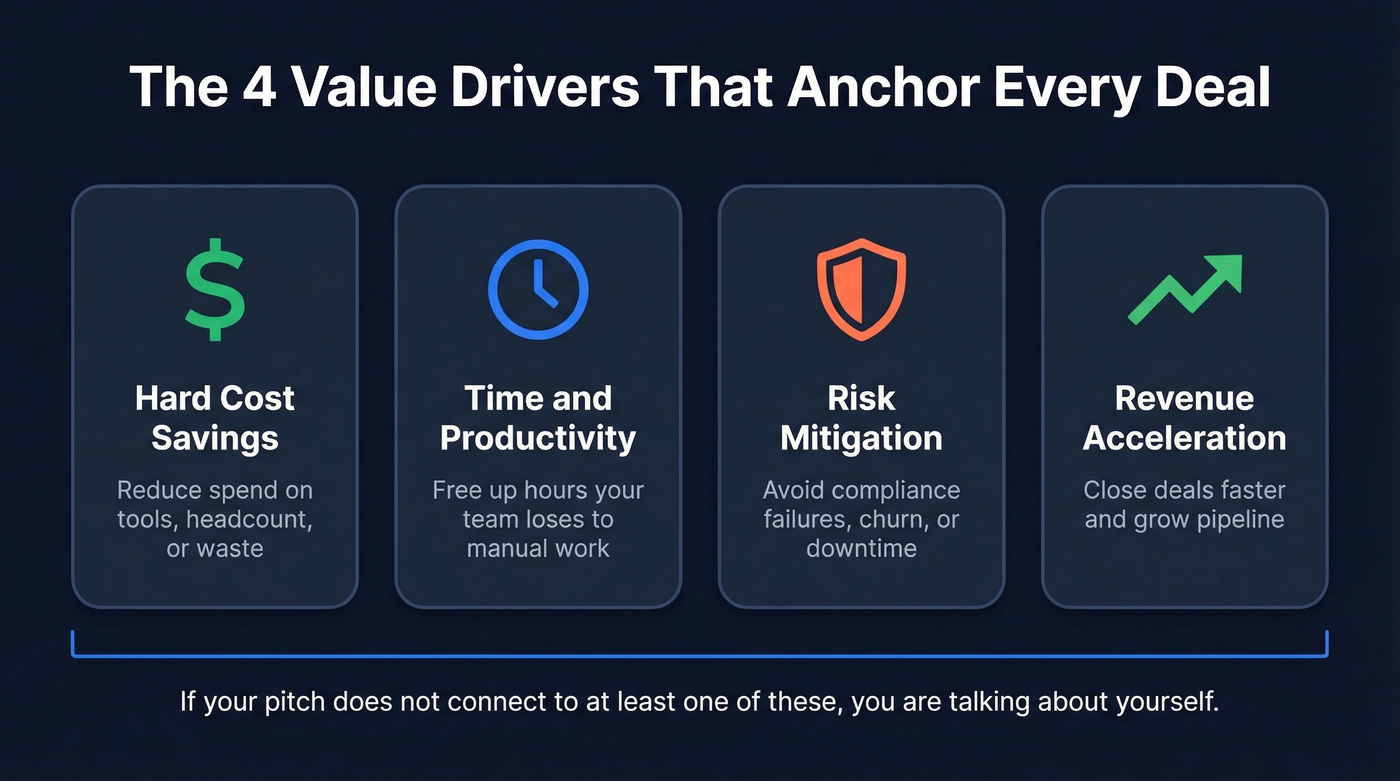
Four value drivers anchor every value conversation: hard cost savings, time/productivity savings, risk mitigation, and revenue acceleration. If your pitch doesn't connect to at least one, you're talking about yourself.
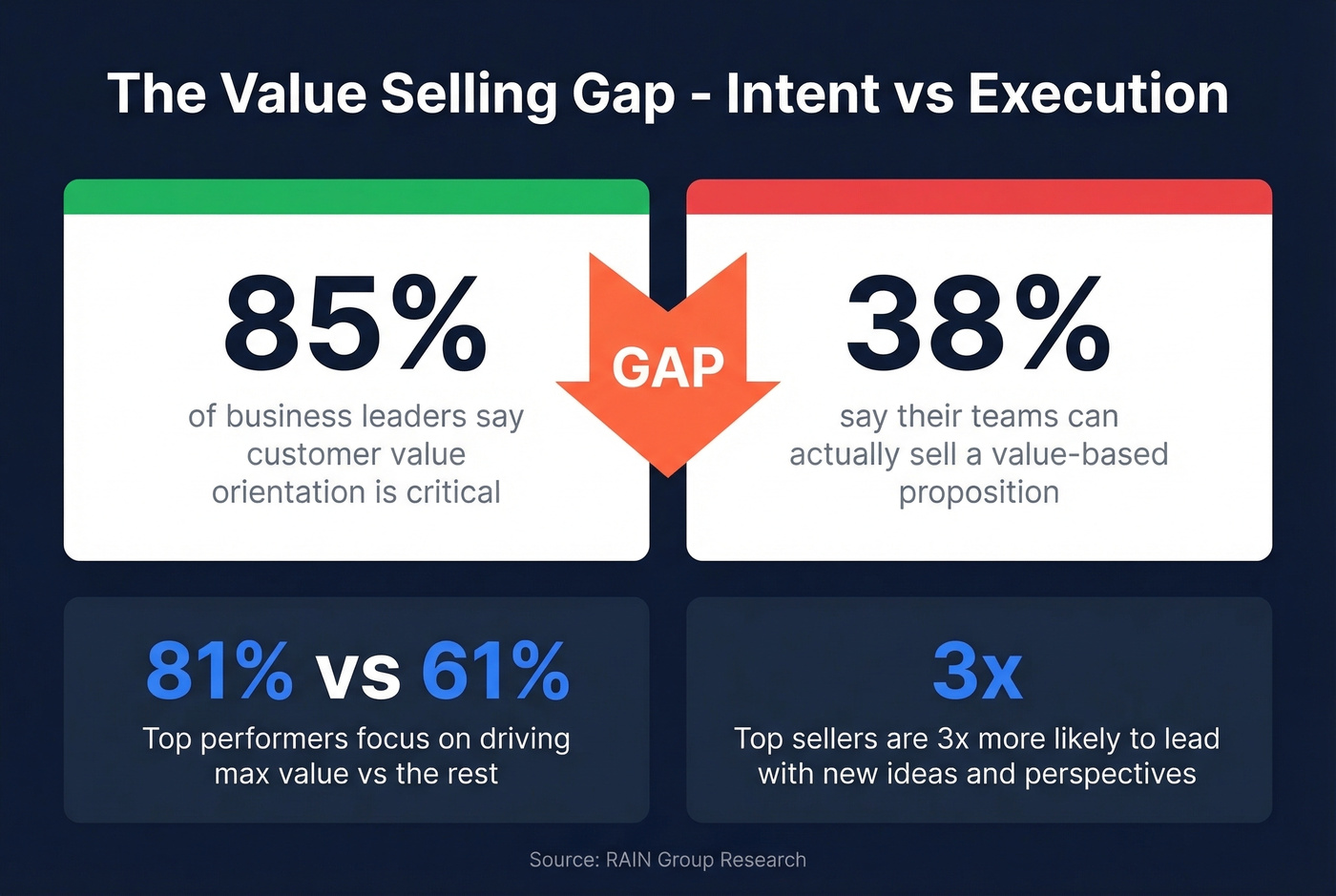
RAIN Group's research shows 81% of top-performing sales organizations focus on driving maximum value for buyers, compared to 61% of everyone else. Sales winners are also 3x more likely to bring new ideas and perspectives to buyers than second-place finishers. That gap - 81% vs. 61%, 3x more likely to lead with insight - is the difference between winning and losing deals consistently.
Why Most Value Selling Programs Collapse
Here's the pattern we've watched play out dozens of times. Your VP sends the team through a two-day workshop. Margins improve in Q1. Smaller gains next quarter. Within a year, half the team is back to leading with features and discounting on the first call.
MIT Sloan documented this exact lifecycle and diagnosed the root cause: most programs treat value as something the seller is entitled to capture - "we deserve a higher price because our product is better." That's backwards. Value is co-created with customers who play an active role in realizing outcomes.
The gap between intent and execution is staggering: 85% of business leaders say customer value orientation is critical, but only 38% say their teams can actually sell a value-based proposition. And those value calculators from the expensive training? They end up in what I call the value calculator graveyard - dismissed as "theoretical and complex" within months.
The 4-Part Value Framework
Stop training reps on what to say. Train them on what to uncover.
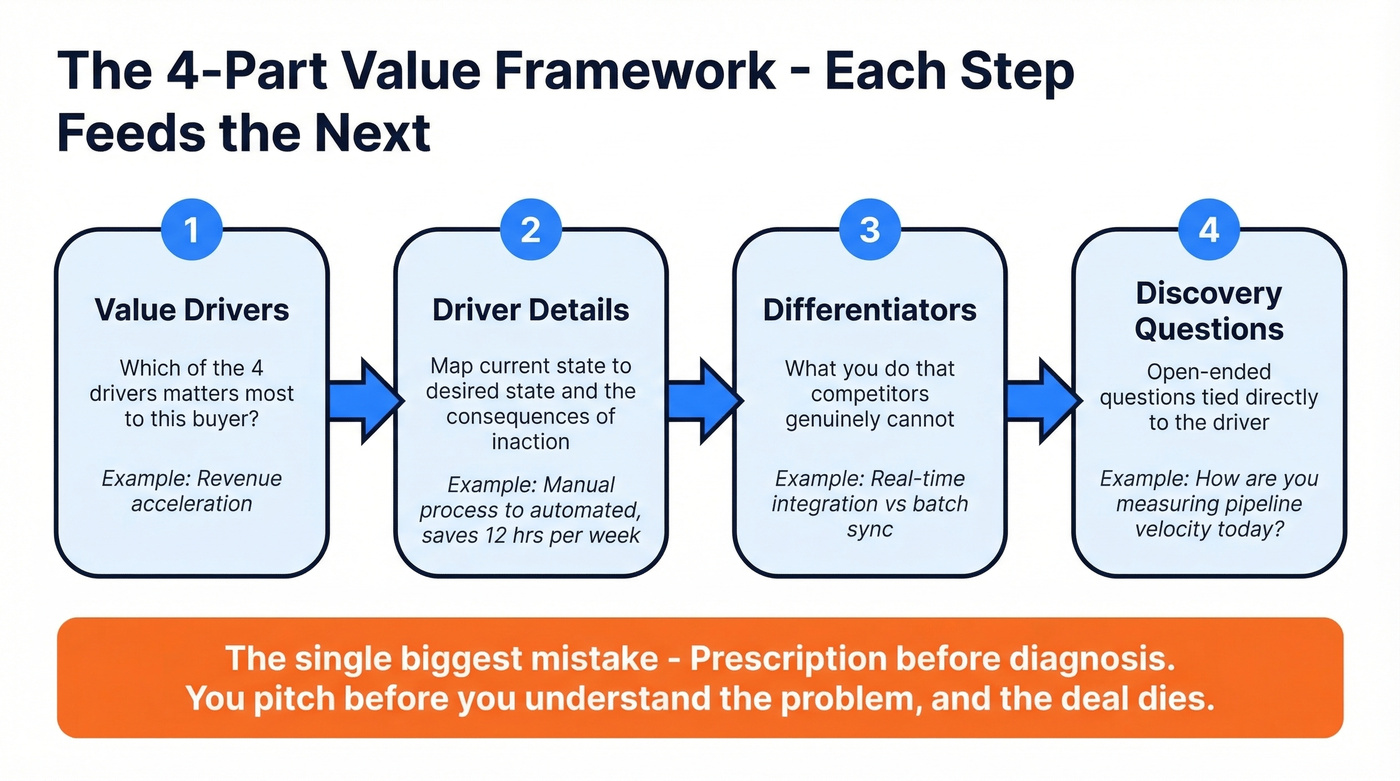
| Step | What It Covers | Example |
|---|---|---|
| Value Drivers | Which of the 4 drivers matters most | "Revenue acceleration" |
| Driver Details | Current state → desired state → consequences | "Manual process → automated → saves 12 hrs/week" |
| Differentiators | What you do that competitors can't | "Real-time integration vs batch sync" |
| Discovery Questions | Open-ended questions tied to the driver | "How are you measuring pipeline velocity today?" |
These steps give your team a repeatable structure that survives beyond the initial training high. The key is that each step feeds the next - you can't build a good discovery question without knowing which driver you're targeting, and you can't target a driver without understanding the buyer's current state first.
Three discovery questions worth stealing:
- Cost savings: "Walk me through what happens when [process] breaks down. What does that cost in a typical quarter?"
- Revenue acceleration: "If your team closed deals 20% faster, what would that mean for your Q3 number?"
- Risk mitigation: "What's the cost of doing nothing for another six months?"
These aren't clever tricks. They're diagnostic questions that force the buyer to quantify their own pain. If you want more prompts like these, pull from a dedicated library of discovery questions and adapt them to your value drivers.

A value-based sales strategy only works if your emails actually reach the buyer. Prospeo's 98% verified email accuracy and 7-day data refresh cycle mean your carefully crafted value messaging lands in real inboxes - not bounce logs.
Stop losing deals before discovery even starts.
Putting the Strategy Into Practice
An r/sales thread nailed two of the hardest moments in value selling: booking the meeting and following up. Every other step is downstream.
Booking the meeting. 74% of B2B buyers conduct more than half their research online before engaging sales. Your outreach needs to reference something specific - a trigger event, a hiring pattern, a tech stack gap. Generic "just checking in" emails don't cut it, and they definitely don't signal value. This only works if your contact data is accurate; if a third of your emails bounce, your value-based sales strategy dies before it starts. (If you’re tightening outbound, start with these tips for prospecting.)
Running discovery. Keep it to 15-30 minutes. Open with their goals, not your agenda. Map everything back to one of the four value drivers. Confirm the desired state before you mention your product. In our experience, the reps who resist the urge to pitch during discovery close at nearly double the rate of those who can't help themselves. This is also where a clean consultative sales process helps you stay diagnostic under pressure.
Following up. Summarize the value case in their language. "You mentioned pipeline velocity is costing you $X per quarter - here's how we close that gap" beats "Per our conversation, I wanted to share our solution overview." One sounds like a partner. The other sounds like a template. If follow-ups are where deals stall, use a proven closing the sale follow up structure.
Five Mistakes That Kill Value Deals
Look, most of these are obvious in hindsight - which is exactly why teams keep making them.
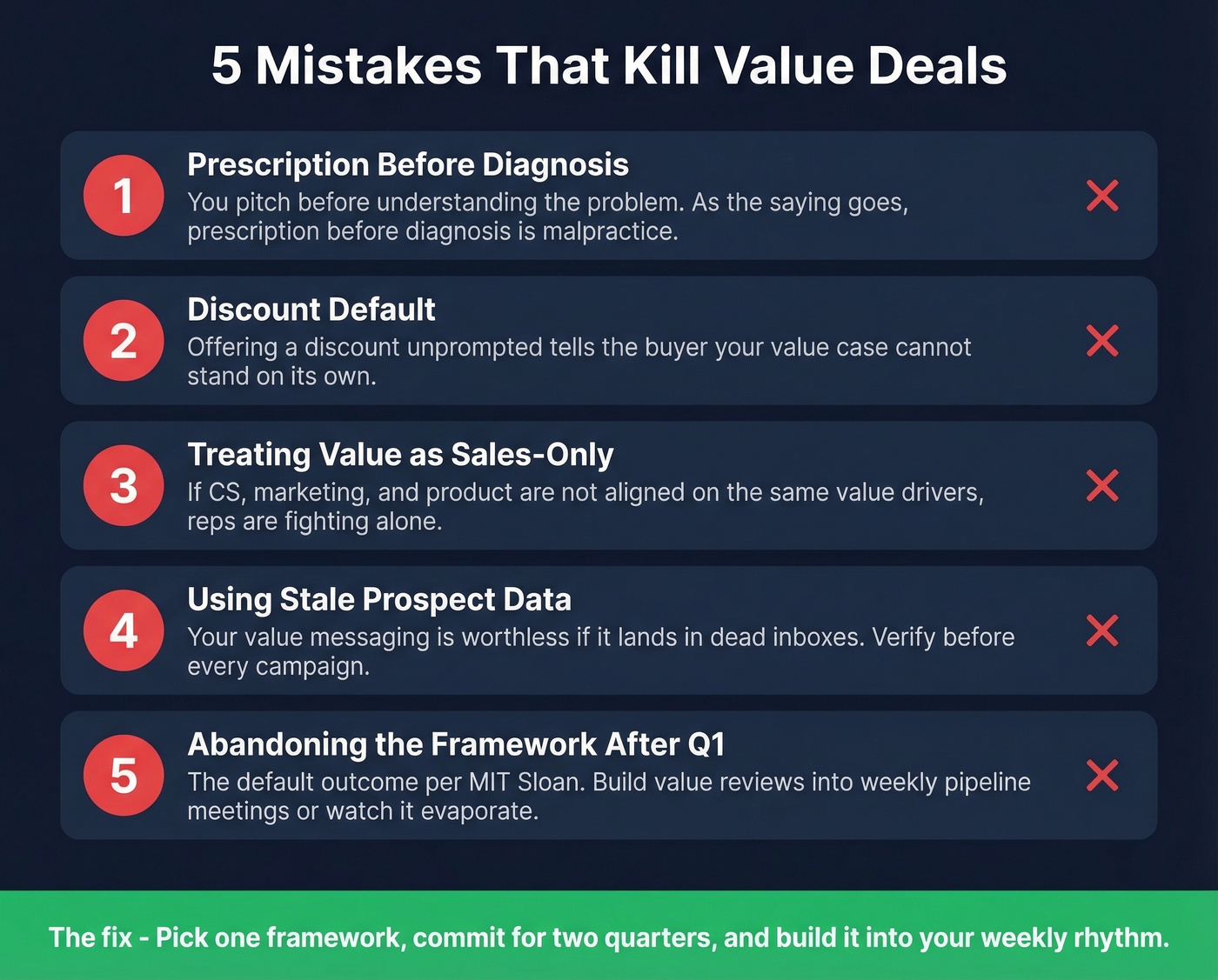
- Prescription before diagnosis. As GetAccept puts it, "prescription before diagnosis is malpractice." Pitch before you understand the problem, and the deal is already lost.
- Discount default. The moment you offer a discount unprompted, you've told the buyer your value case can't stand on its own. If you need language that holds the line, learn how to refuse a discount request politely.
- Treating value as sales-only. If CS, marketing, and product aren't aligned on the same value drivers, reps are fighting alone. This is the one that frustrates us most - we've seen teams nail discovery and then lose the deal because post-sale messaging contradicts everything the rep promised. (This is a classic deal execution failure, not a “sales skills” problem.)
- Using stale prospect data. Run your list through a verification tool before every campaign. Tools like Prospeo, which refreshes data every 7 days and verifies emails at 98% accuracy, exist specifically to solve this problem. If you’re diagnosing bounce issues, start with what a bounced email actually means.
- Abandoning the framework after Q1. MIT Sloan's research shows this is the default outcome. Build value reviews into weekly pipeline meetings or watch the methodology evaporate. A consistent pipeline reviews cadence is usually the difference.
What Results Actually Look Like
The average B2B win rate sits around 21%. Teams that commit to structured value frameworks blow past that.
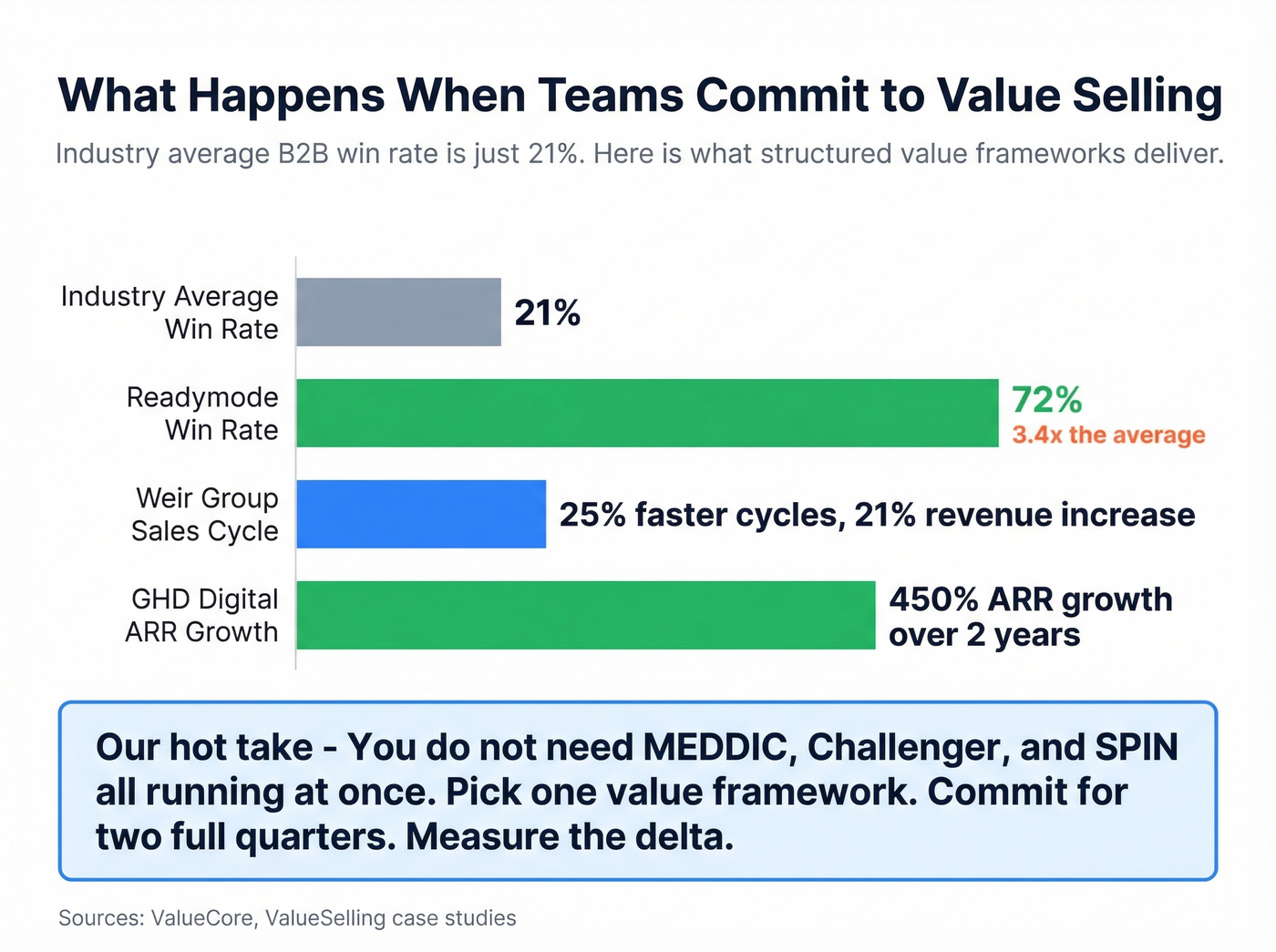
Teams using ValueSelling's framework report significant gains: GHD Digital saw 450% ARR growth over two years. Weir Group reported 25% faster sales cycles and a 21% revenue increase. Readymode hit a 72% win rate on sales-accepted opportunities - more than triple the industry average. If you want to benchmark your own performance, track your sales win rate and compare it to a realistic what is a good sales win rate target for your segment.
Here's our hot take: you don't need MEDDIC, Challenger, and SPIN all running simultaneously. If your average deal size is under $25K, a single value selling framework executed consistently will outperform three methodologies executed poorly. Pick one. Commit for two full quarters. Measure the delta. We've seen teams triple their win rate just by doing that, and the ones who fail almost always fail because they switched frameworks too early, not because the framework itself was wrong. (If you’re choosing what to standardize, compare common sales methodologies before you roll anything out.)
Let's be honest - the hardest part isn't learning the framework. It's the discipline to keep using it when quota pressure makes you want to revert to feature-dumping and discounting.
You nailed the value framework. You wrote discovery questions that diagnose real pain. Now don't waste it on stale data. Prospeo gives you 300M+ profiles with 30+ filters - buyer intent, tech stack, job changes - so every outreach references something specific.
Pair your value selling with data that actually connects you to decision-makers.
FAQ
How does value-based selling differ from consultative selling?
Consultative selling diagnoses needs. Value-based selling goes further - it quantifies the financial impact of solving those needs and ties every conversation to measurable outcomes like revenue gains or cost savings. Think of consultative selling as the diagnosis; value selling adds the prescription with a dollar sign attached.
What's the fastest way to start without formal training?
Use the 4-part framework on five real deals before rolling it out to the team. Identify the value driver, map current vs. desired state, clarify your differentiator, then build discovery questions. Five reps of deliberate practice beats a two-day workshop every time.
What tools support a value-based sales strategy?
Three categories matter: a CRM for pipeline tracking, a conversational intelligence tool like Gong for call analysis, and a verified data platform for accurate contact information. The data piece is non-negotiable - every touchpoint in a value-based approach needs to reach a real person, not a dead inbox.