

12 Tips for Prospecting Backed by 2026 Data (Not Recycled Advice)
Picture an SDR team making 200 dials a day. Thirty percent of the numbers are disconnected. The email sequence running alongside it bounces at 18%. That's not a prospecting problem - it's a data problem dressed up as an activity problem. Most tips for prospecting ignore this entirely and jump straight to "personalize more" or "call at the right time." None of that matters when your data is rotten.
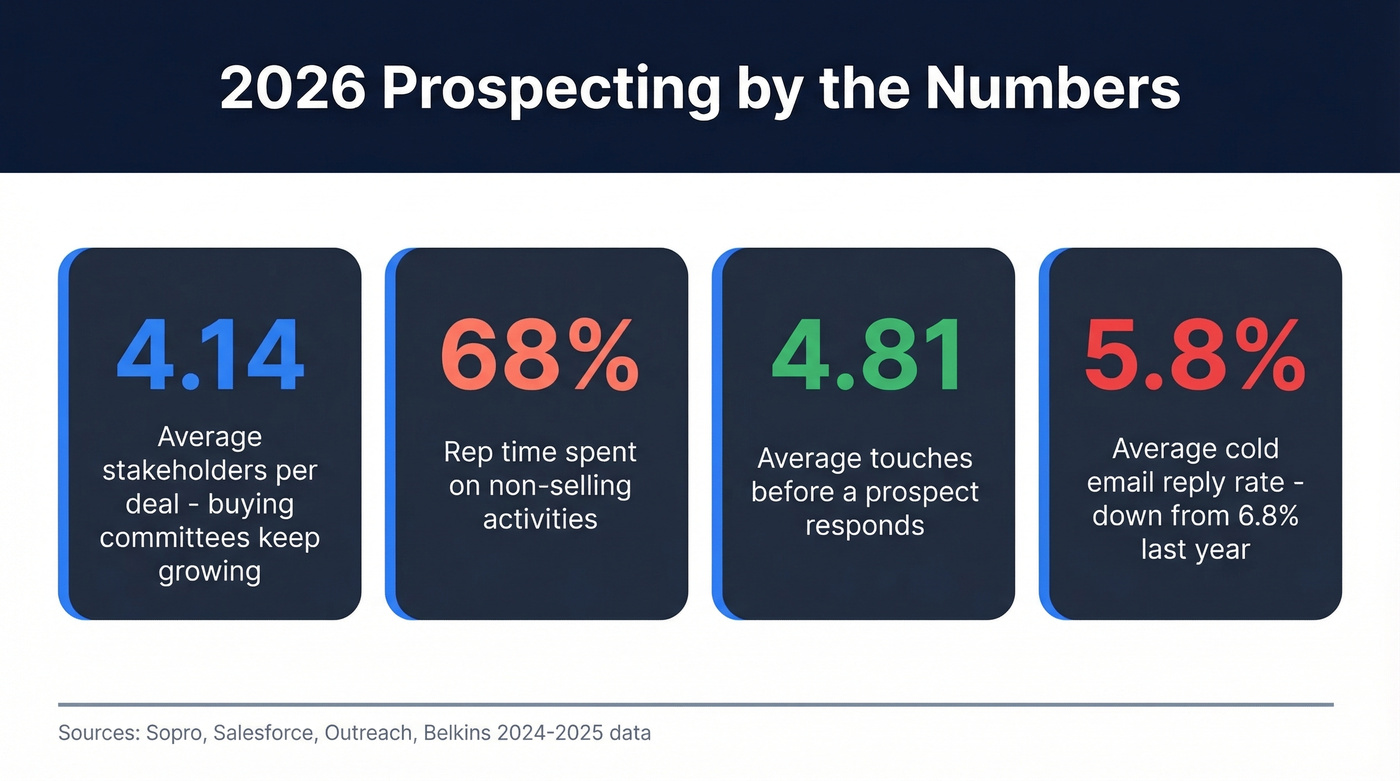
Decision-making units now average 4.14 stakeholders, and DMUs with five or more members have grown 180% in two years. The old playbook of more dials, more emails, more activity doesn't hold up when the buying committee keeps expanding and reps spend 68% of their time on non-selling activities. Here's what actually works now.
The Short Version
- Prospect on buying signals, not static lists. Only 3-5% of your market is actively buying. Signal stacking finds them.
- Verify contact data before any sequence. A bounce rate above 2% torches your domain reputation.
- Build a cadence of 8-12 touches across channels. The average response takes 4.81 touches. Single-channel outreach leaves money on the table.

Every tip on this list falls apart without verified data. Prospeo's 7-day refresh cycle and 98% email accuracy mean your cadences actually reach real inboxes - not bounced addresses that torch your domain. Meritt cut their bounce rate from 35% to under 4% and tripled pipeline to $300K/week.
Stop perfecting emails that land in the void.
12 Sales Prospecting Tips That Work Now
1. Prospect on Signals, Not Static Lists
Only 3-5% of your total addressable market is buying at any given moment. Another 7% is open to a conversation. That means roughly 90% of your outbound hits people who'll ignore you no matter how good your copy is.
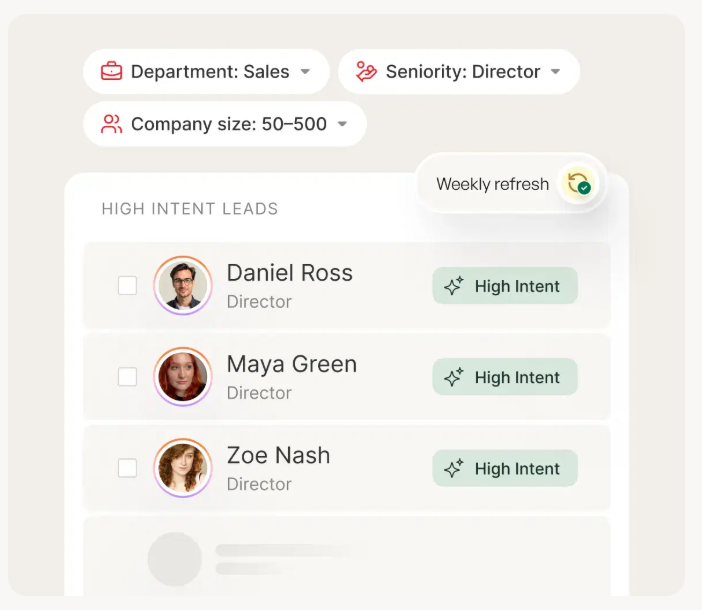
The fix is signal stacking. Instead of pulling a static list of "VP of Sales at SaaS companies with 50-200 employees," layer triggers: recent funding round + VP Sales hire + SDR job postings. Each signal alone is weak. Three stacked together mean something's happening. The consensus on r/SaaS is clear - spray-and-pray outbound is dead, and signal-based targeting is replacing it.
2. Write Emails That Get Replies
Across 16.5M cold emails analyzed by Belkins (Jan-Dec 2024 data), the average reply rate is 5.8% - down from 6.8% the year before. Emails sent to large, untargeted lists get 67% fewer replies per HubSpot's research. The bar keeps rising.
What moves the needle: keep emails to 6-8 sentences, which hits a 6.9% reply rate. Send on Thursday (6.87%) and avoid Monday (5.29%). Emailing 1-2 contacts per company yields a 7.8% reply rate, while blasting 10+ contacts at the same company drops you to 3.8%.
Here's a PAS framework that consistently outperforms generic templates:
Pain: "Noticed your team posted 3 SDR roles last month - scaling outbound is brutal when half your dials hit disconnected numbers." Agitate: "Most teams lose 20-30% of sequences to bad data before a single reply comes in." Solve: "We helped [similar company] cut bounce rates from 35% to under 4%. Worth 15 minutes?"
Stop tracking open rates. They're unreliable. Reply rate is the email metric that matters now. If you want a deeper playbook on sequencing and copy, see our sales prospecting techniques.
3. Master the Phone
Cold calling isn't dead, but the math is honest. Average dial-to-meeting conversion runs 2.3-2.5% - one meeting per 40-45 dials. Top teams push 5-8%+, but they've earned those numbers through better data and relentless practice.
Calling between 8-9 AM or 4-5 PM lifts connect rates 40-70% compared to random dial times. Plan for persistence: it takes 8+ attempts on average to reach a live prospect. Most reps give up after three. This is one of the simplest prospecting habits to build, yet most teams still ignore it. For a full system, use a dedicated cold calling system.
4. Build a Multi-Touch Cadence
The sweet spot is 8-12 touchpoints across channels over three weeks:
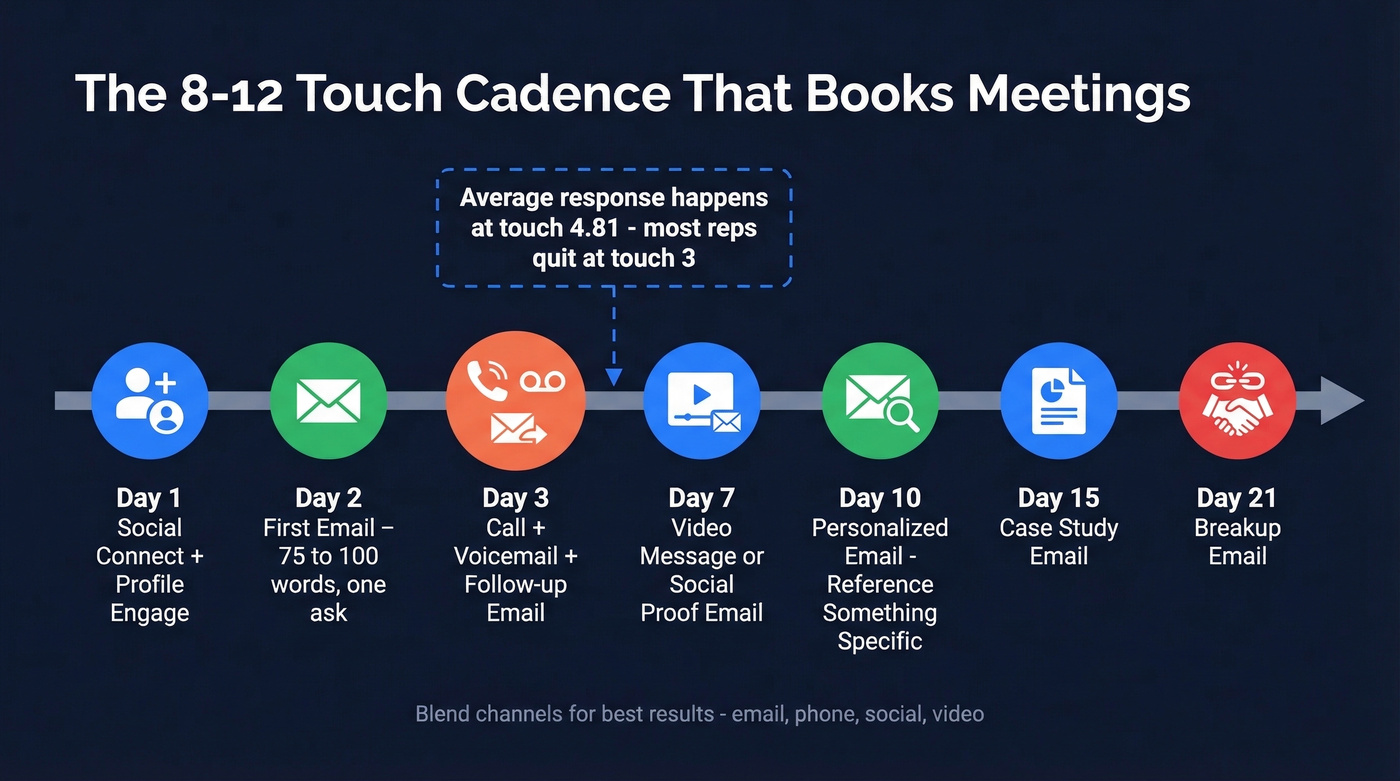
- Day 1: Social connection + profile engagement
- Day 2: First email (75-100 words, one ask)
- Day 3: Call + voicemail + follow-up email
- Day 7: Video message or social proof email
- Day 10: Personalized email referencing something specific
- Day 15: Case study email
- Day 21: Breakup email
The average response takes 4.81 touches regardless of lead temperature. If your cadence stops at three, you're quitting before most prospects would've responded. If you need ready-to-use copy, pull from these sales follow-up templates.
5. Use AI to Scale Research
54% of sales teams now use AI for personalized outbound, and 45% use it for account research. The practical wins: generating pre-call dossiers from public data, writing personalized first lines at scale, and summarizing 10-K filings into three bullet points a rep can reference in 30 seconds.
The teams getting this right aren't replacing reps with AI. They're giving each rep the research capacity of a full-time analyst - letting automation handle the grunt work so reps spend time on actual conversations. If you're building your toolset, start with a short list of SDR tools that cover research + outreach.
6. Multi-Thread Into Accounts
If you're emailing one person at a target account, you're gambling on a single thread. The average B2B buying committee has 4.14 stakeholders, and 7% of deals involve 10+ people.
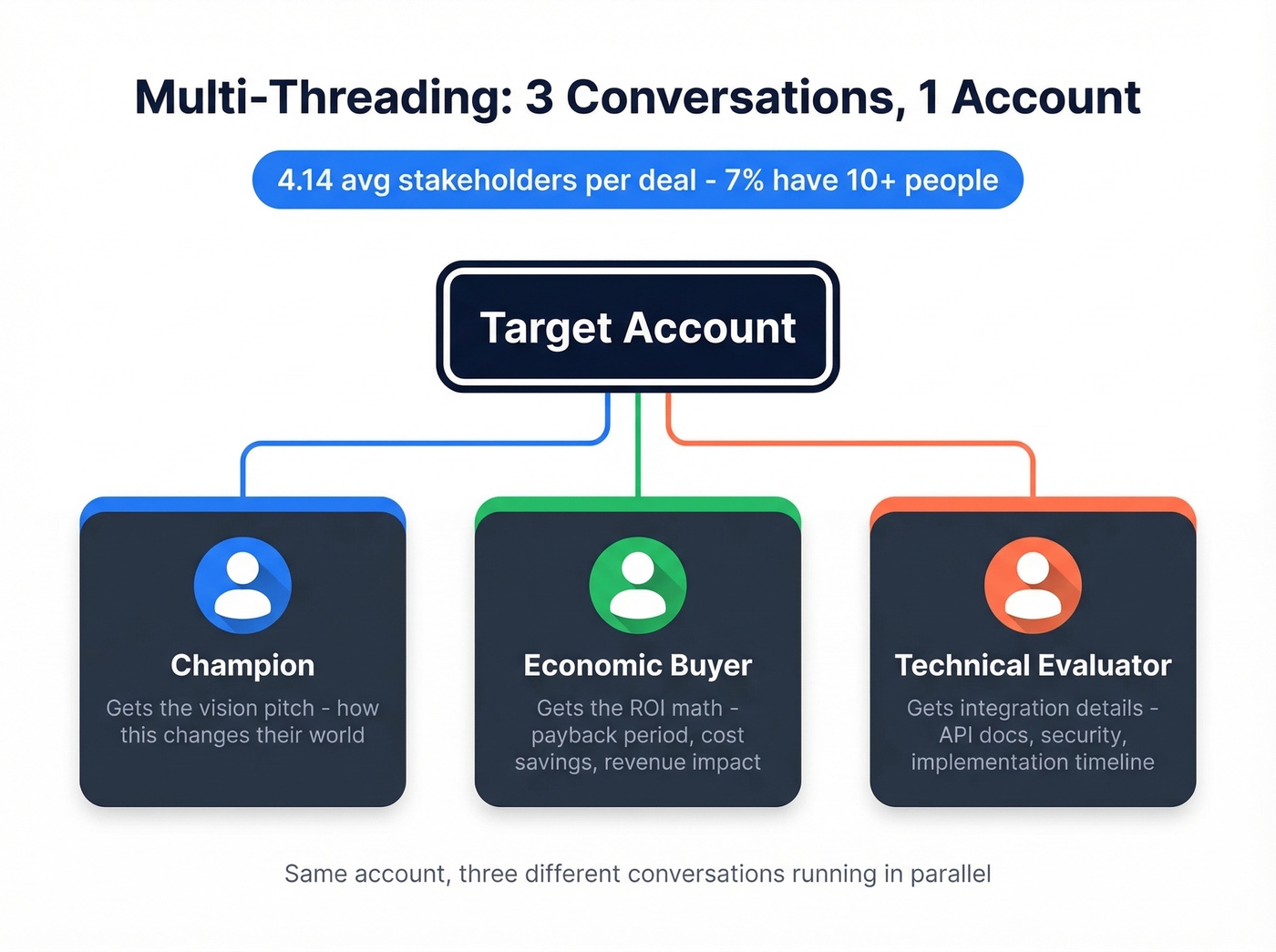
Multi-threading means reaching the economic buyer, the champion, and at least one technical evaluator simultaneously. The champion gets the vision pitch. The technical evaluator gets integration details. The economic buyer gets the ROI math. Same account, three different conversations running in parallel. Of all the B2B prospecting strategies we've tested, multi-threading consistently delivers the highest meeting-to-opportunity conversion. This approach pairs well with account-based selling best practices.
7. Verify Your Data First
Here's the thing: a bounce rate above 2% and a spam complaint rate above 0.01% will quietly destroy your sender reputation. Meritt learned this the hard way - their bounce rate sat at 35% before they fixed their data pipeline. After switching to verified contacts through Prospeo, bounces dropped under 4% and their sales pipeline tripled from $100K to $300K per week.
Skip verification if you enjoy explaining to your email ops team why your domain just got blacklisted. Otherwise, treat it as the first step in every campaign, not an afterthought. Upload a CSV, run it through a verification tool, and kill the dead addresses before they kill your deliverability. We've watched teams spend weeks perfecting email copy only to send it into a void of invalid addresses - that's the kind of waste that makes you want to flip a table. For benchmarks and fixes, see our guide to email bounce rate.
Multi-threading into 4+ stakeholders per account requires direct dials that actually connect. Prospeo delivers 125M+ verified mobile numbers with a 30% pickup rate - while the industry average sits at 11-12%. Stack intent signals across 15,000 Bombora topics to find the 3-5% of your market that's buying right now.
Reach every stakeholder on the buying committee, not just one.
8. Follow Up More Than You Think
43% of buyers who accept meetings say it's perfectly fine for sellers to contact them five or more times. Your fear of being annoying is costing you meetings.
Each follow-up needs to add value. Mentioning one commonality - a shared connection, same alma mater, mutual interest - lifts acceptance rates by 46%. Don't just bump the thread. Give them a reason to respond. If you want the data behind persistence, read about the importance of follow-up in sales.
9. Personalize With One Detail
58% of buyers say sales meetings aren't valuable. The bar for standing out is genuinely low.
You don't need a hand-written letter. You need one detail you couldn't know without actually researching the prospect. We've seen this work in practice: referencing a specific podcast appearance, a recent product launch, or a metric from their latest earnings call. "I noticed you hired three SDRs last month" beats "I help companies like yours" every single time. Personalization isn't about effort - it's about specificity. For more examples, see personalized outreach.
10. Protect Your Domain
This isn't optional. GDPR fines run up to EUR 20M or 4% of global annual revenue. Even if you're US-only, domain reputation is fragile.
Set up SPF, DKIM, and DMARC on every sending domain. Keep bounce rate under 2% and spam complaints under 0.01%. Use a separate domain for cold outreach - never your primary. Verify every list before it hits a sequence. If you're running outbound for clients, this goes triple: one bad list can torch a domain you spent months warming. For the full checklist, use our email deliverability guide.
11. Stop Measuring Opens
Open rates are a vanity metric in 2026. Most email clients block tracking pixels, Apple's Mail Privacy Protection inflates numbers, and turning off open-rate pixels actually produces a ~3% relative lift in response rates.
The metrics that matter: reply rate, meetings booked, and pipeline generated. If your dashboard still leads with open rate, you're optimizing for the wrong thing. If you still need to report it, start with what is a good email open rate.
12. Do the Prospecting Math
Let's be honest: if your average deal size is under $10K, you probably don't need a $30K/year data platform. But you absolutely need to reverse-engineer your activity from your quota.
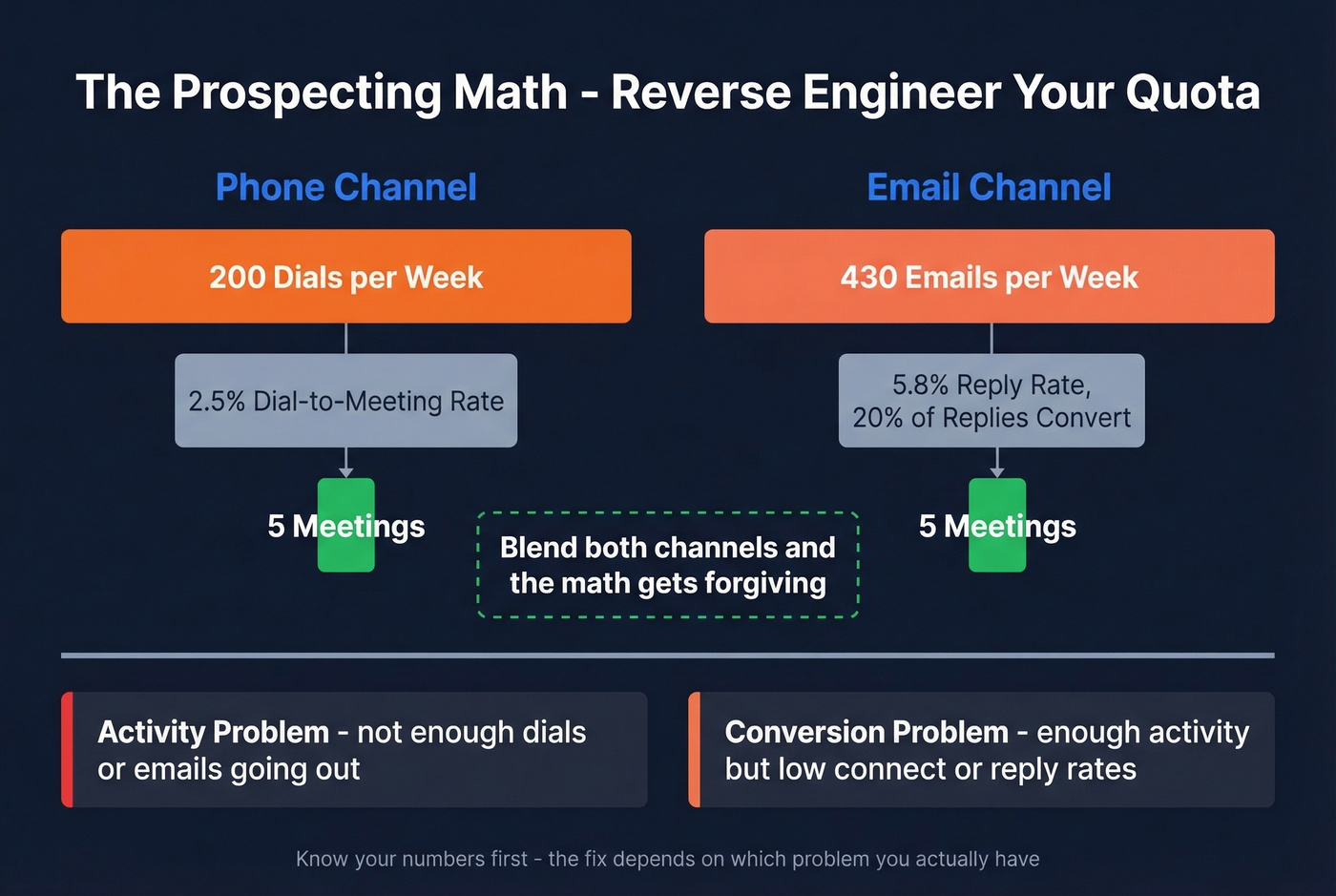
Say you need 5 meetings per week. At a 2.5% dial-to-meeting rate, that's 200 dials. Running email alongside at a 5.8% reply rate with ~20% of replies converting, you need ~430 emails per week for those same 5 meetings from email alone. Blend channels and the math gets forgiving - but you need to know your numbers first. The math tells you whether you have an activity problem or a conversion problem. They require very different fixes.
Building Your Prospecting Stack
You need 4-5 tools, not 10. The framework: CRM, intent signals, enrichment/verification, sequencing.
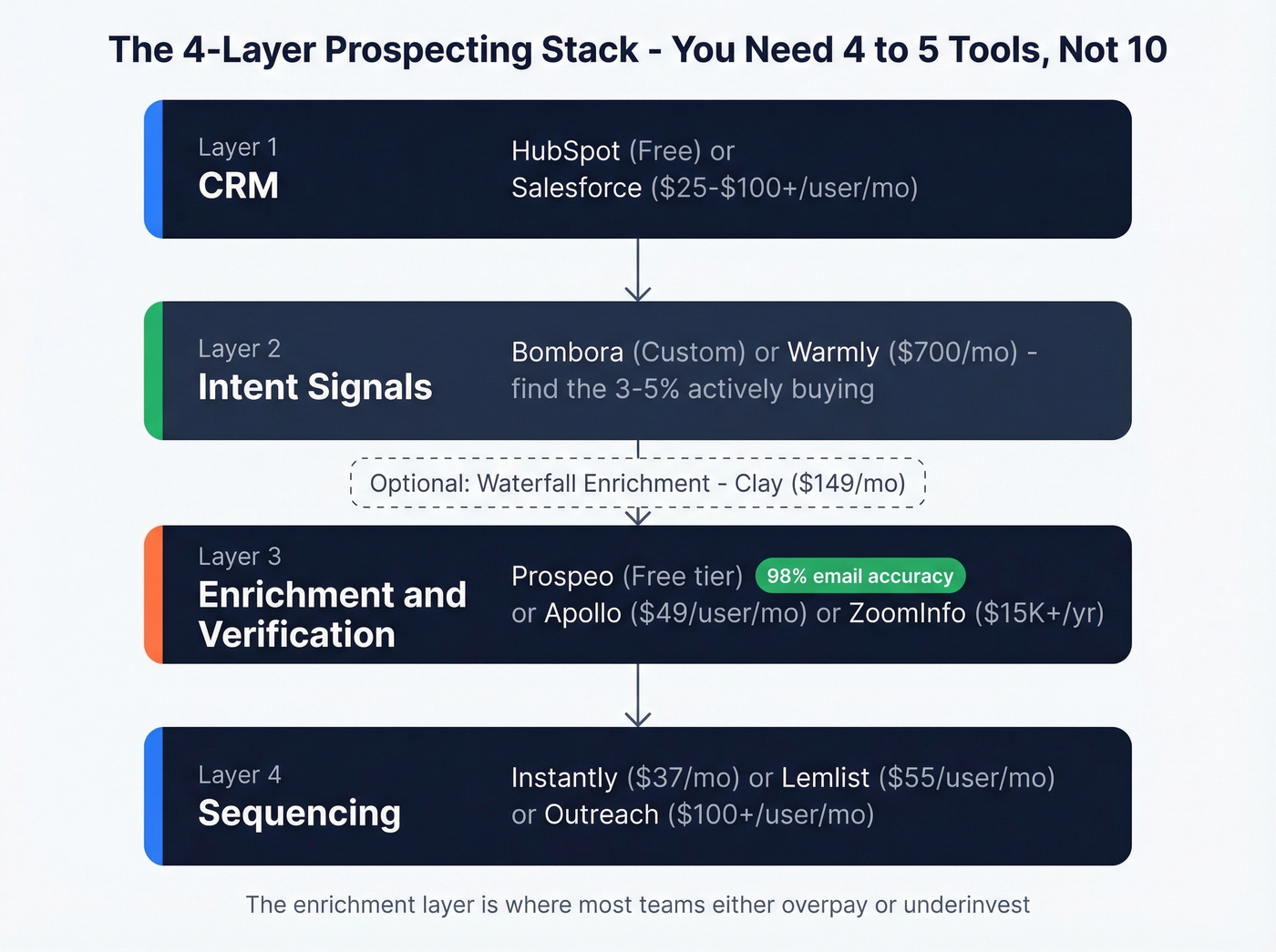
| Role | Tool | Starting Price |
|---|---|---|
| CRM | HubSpot / Salesforce | Free / ~$25-$100+/user/mo |
| Intent Signals | Bombora / Warmly | Custom / $700/mo |
| Enrichment & Verification | Prospeo / Apollo / ZoomInfo | Free tier / $49/user/mo / ~$15K/yr |
| Sequencing | Instantly / Lemlist / Outreach | $37/mo / $55/user/mo / ~$100/user/mo |
| Waterfall Enrichment | Clay | $149/mo |
The enrichment layer is where most teams either overpay or underinvest. ZoomInfo at $15-40K/year makes sense for larger sales orgs with dedicated ops teams. For most ICP-focused outbound teams, a self-serve platform at a fraction of the cost delivers better results - especially when intent data is included rather than sold as a pricey add-on. If you're comparing options, start with these data enrichment services.
One thing that matters more than any individual tool: make sure outbound activity syncs back to your CRM automatically. We've seen expensive databases create a mess of duplicate contacts in Salesforce fast. The best stack isn't the most expensive one - it's the one where data flows cleanly from search to sequence to CRM without manual cleanup. If you need implementation steps, follow this guide to connect outreach tool to CRM.
FAQ
How many touches to get a response?
The average is 4.81 touches across all lead temperatures. Plan for 8-12 touchpoints in your cadence - most prospects respond between touch five and eight, so stopping at three means quitting before the conversation starts.
What's a good cold email reply rate in 2026?
The benchmark is 5.8% across 16.5M emails analyzed. Above 7% means your targeting and copy are strong. Below 4% signals a list quality problem - verify your data before tweaking subject lines.
Is cold calling still effective?
Yes. Dial-to-meeting conversion runs 2.3-2.5%, with top teams hitting 5-8%+. Call between 8-9 AM or 4-5 PM local time for the best connect rates, and plan for 8+ attempts per prospect.
What's a free way to verify emails before outreach?
Prospeo's free tier includes 75 email verifications per month at 98% accuracy - enough to test a targeted list without risking your domain. Hunter offers 25 free searches but caps enrichment depth.
What's the best day to send cold emails?
Thursday wins at 6.87% reply rate. Monday is worst at 5.29%. For send times, 8-11 PM peaks at 6.52%, though the 7-11 AM window also performs well for B2B audiences.