

What Is a Good Sales Win Rate? Benchmarks That Actually Matter
A sales rep on r/sales posted that their company's win rate sits just over 4% - down from 22-28% at their previous role. Same rep, wildly different numbers. Your VP wants to know why your win rate is "below average," but average compared to what?
Here's the thing: the most-cited benchmark is 21% from HubSpot's Sales Trends Report. Another credible study says 47%. Both are correct. The difference isn't the data - it's the denominator.
The Quick Version
- The average B2B win rate is 21% (all opportunities) or 47% (proposal-stage only). The gap comes entirely from what you count as the denominator.
- Segment by deal size for useful numbers: under $10K ACV sits around 31% median, while $100K+ ACV drops to roughly 15%.
- If your win rate is above 50%, your pipeline is probably too narrow and you're leaving revenue on the table. Below 15%, audit your data quality and qualification process before retraining reps.
How Win Rate Is Calculated
The formula is simple:
Won Deals / Total Closed Opportunities x 100 = Win Rate %
The problem isn't the math. It's what "total closed opportunities" means. Some teams count every opportunity created. Others only count deals that reached the proposal stage. A few exclude "no decision" outcomes entirely, which is a bit like grading a test after throwing out every question you skipped. That single definitional choice can swing your sales conversion rate by 25+ percentage points.
Why Every Benchmark Looks Different
RAIN Group surveyed [472 sellers and sales executives](https://www.rainsalestraining.com/sales-research/top-performing-sales-organization) and reported an average win rate of 47%. That sounds high - until you realize they only count opportunities where a proposal or quote was delivered. HubSpot's 21% reflects a broader denominator. And if you exclude "no decision" outcomes, which represent 40-60% of enterprise pipeline, you can push win rates into the 50-60%+ range.
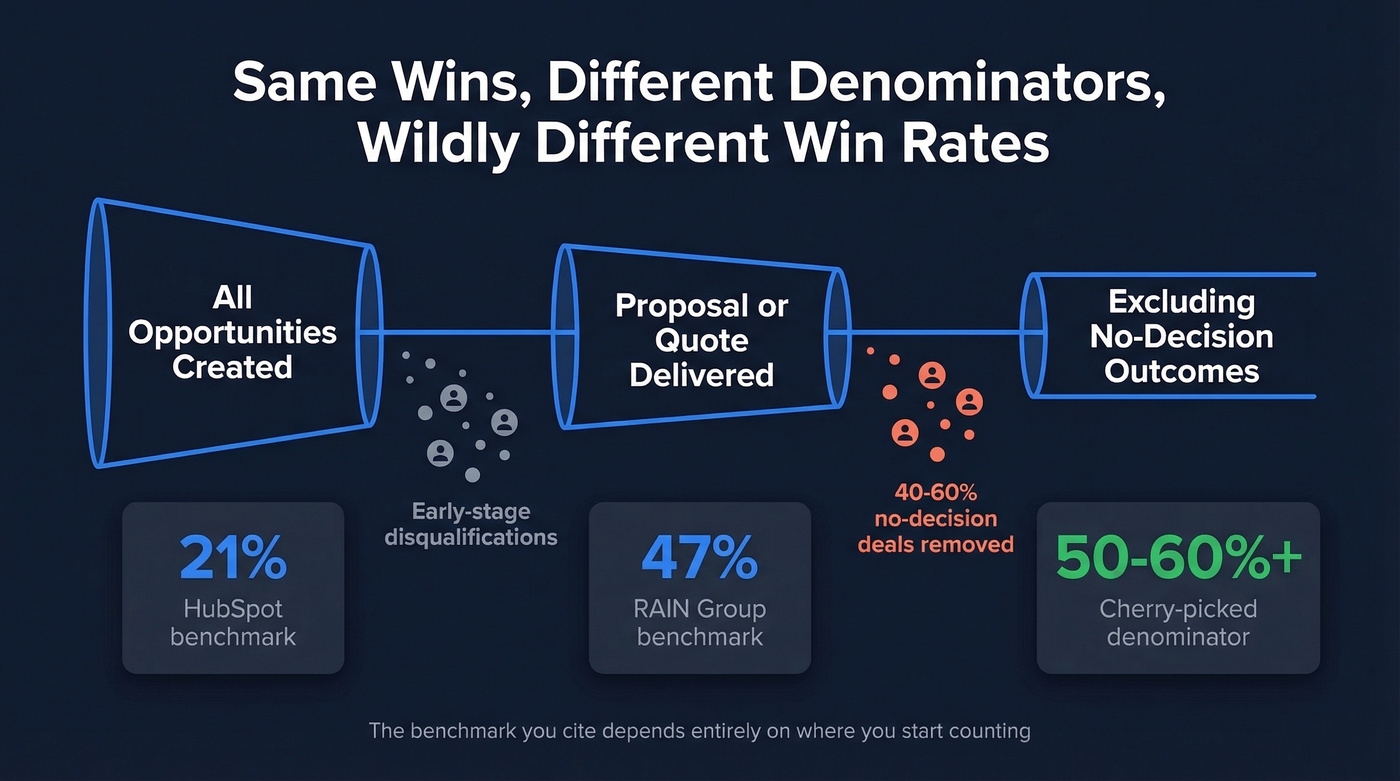
Even within RAIN Group's proposal-stage data, the spread is enormous: elite performers (top 7%) close around 75% while the bottom 80% close just 40%. We've found that teams obsessing over denominator consistency outperform those chasing a single benchmark number. The right question isn't "what's a good number?" It's "what's a good number for my deal size, measured at my stage definition?"

Bad contact data inflates your denominator with deals that were never real. Prospeo's 98% email accuracy and 7-day refresh cycle mean reps reach actual buyers - not dead inboxes. Teams using Prospeo book 26% more meetings than ZoomInfo users.
Clean up your pipeline denominator before you retrain a single rep.
B2B Win Rate Benchmarks by Segment
By Deal Size (ACV)
Deal size is the single biggest driver of win rate variance. An Optifai benchmark across 939 B2B SaaS companies breaks it down:
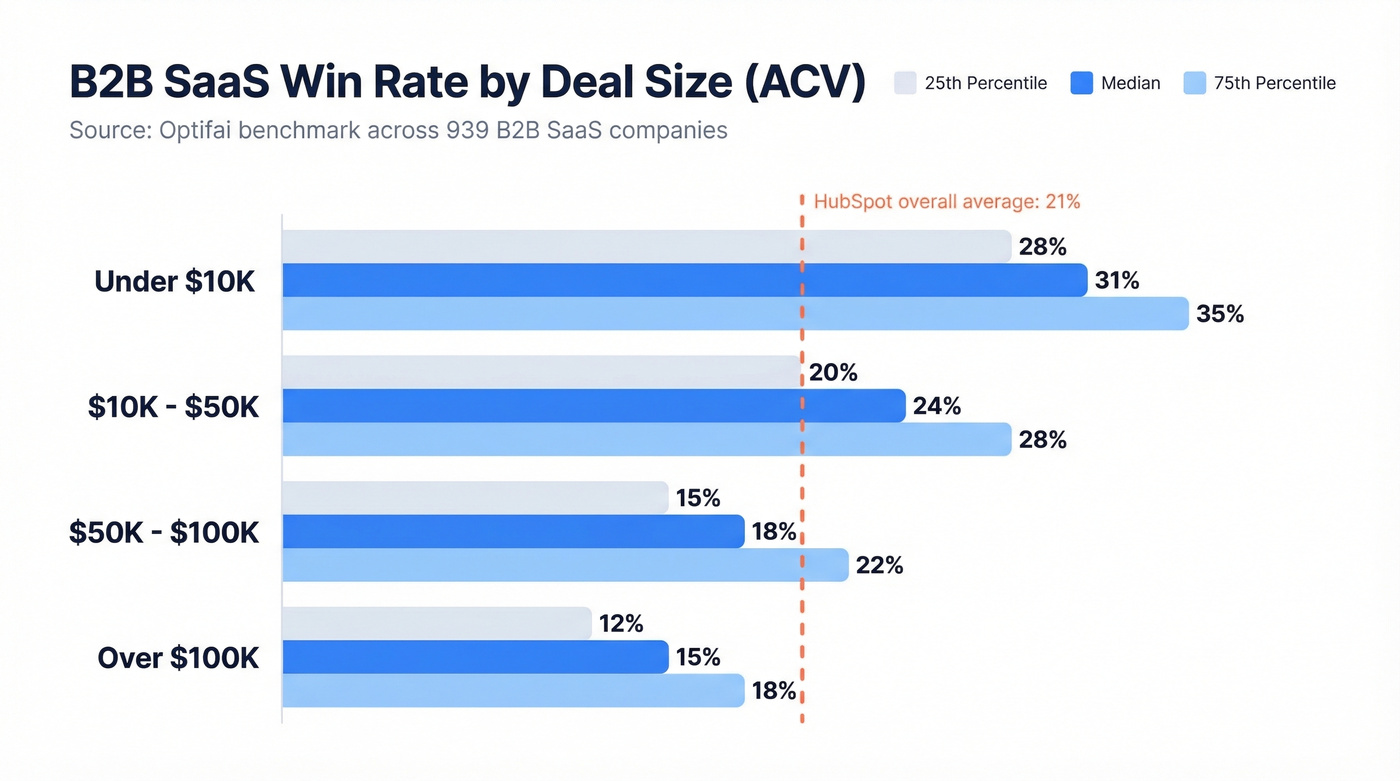
| ACV Range | 25th Percentile | Median | 75th Percentile |
|---|---|---|---|
| Under $10K | 28% | 31% | 35% |
| $10K-$50K | 20% | 24% | 28% |
| $50K-$100K | 15% | 18% | 22% |
| Over $100K | 12% | 15% | 18% |
If you're selling six-figure enterprise deals and comparing yourself to a PLG company closing $5K contracts, you're benchmarking against the wrong universe entirely.
By Company Size
Forecastio's analysis segments by the seller's company size:
| Segment | Average | Top Performers |
|---|---|---|
| Enterprise (1,000+) | 20-25% | 30%+ |
| Mid-market (100-999) | 25-35% | 40%+ |
| SMB (under 100) | 30-40% | 45%+ |
Smaller companies close at higher rates because they're typically selling simpler deals with fewer stakeholders and shorter cycles. No surprise there.
By Lead Source
Champify's 2025 data shows "known contact" deals - warm intros, former customers, existing relationships - close at a 37% win rate versus 19% for cold outreach. That's roughly a 2x differential from lead source alone. If your pipeline is 80%+ cold, your conversion rate will always look low relative to teams with strong inbound or referral channels.
If you're trying to fix cold performance, start with your sales prospecting techniques and your sales follow-up templates before you touch comp plans.
By Industry
These are directional, not definitive:
| Industry | Typical Win Rate |
|---|---|
| SaaS/Technology | ~22% |
| Professional Services | 25-30% |
| Financial Services | ~18% |
| Healthcare | ~20% |
| Real Estate/Construction | ~16% |
Win Rates Are Declining - Here's Why
Win rates aren't just varying by segment. They're dropping across the board. Outreach's 2026 data report shows the largest bracket of teams shifted from 31-40% win rates down to 21-25% year over year. Winning by Design tracked a similar decline - enterprise deals over $100K ACV fell from roughly 26% to 17%.
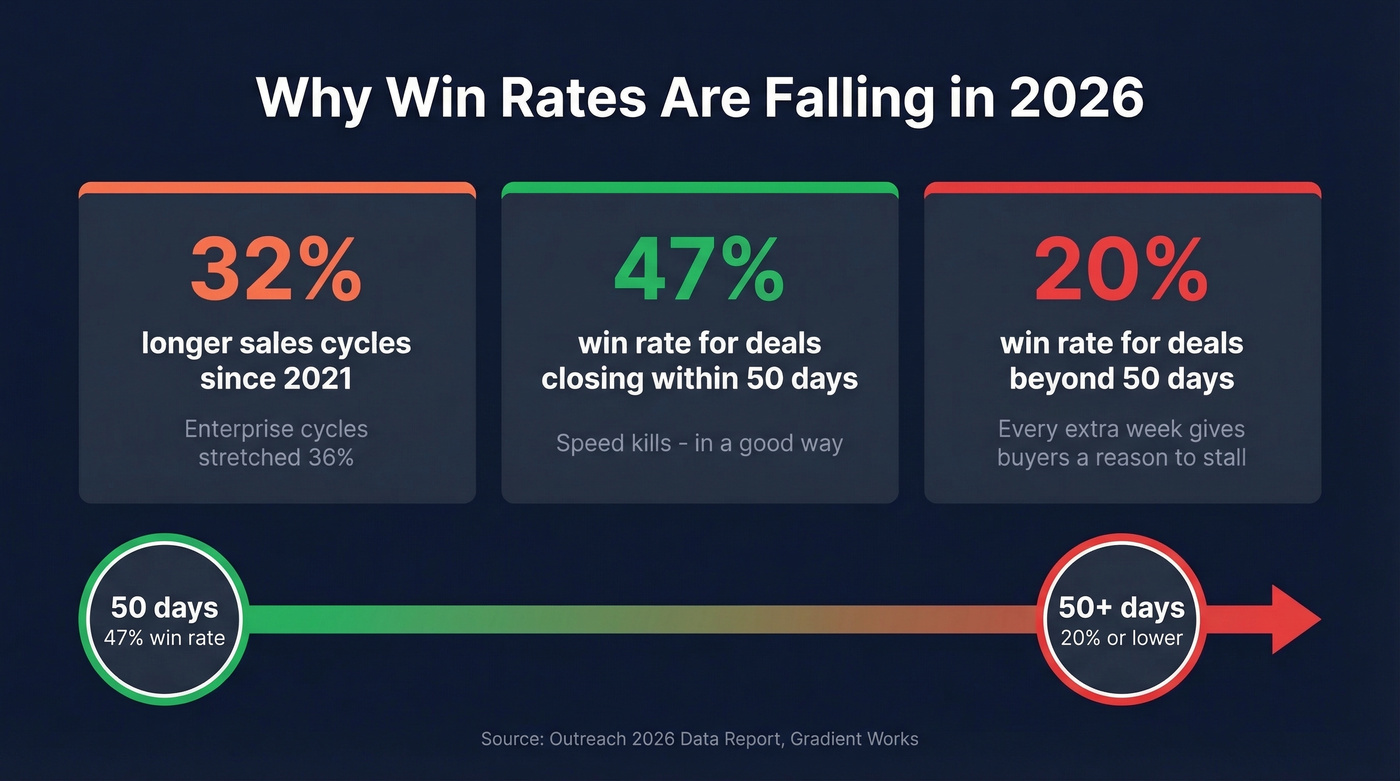
The culprit is cycle length. Sales cycles have lengthened 32% since 2021, with enterprise cycles stretching 36%. Outreach's data shows deals closing within 50 days carry a 47% win rate. Beyond 50 days, that drops to 20% or lower.
Every week a deal drags is a week the buyer finds a reason to stall.
How to Improve Your Win Rate
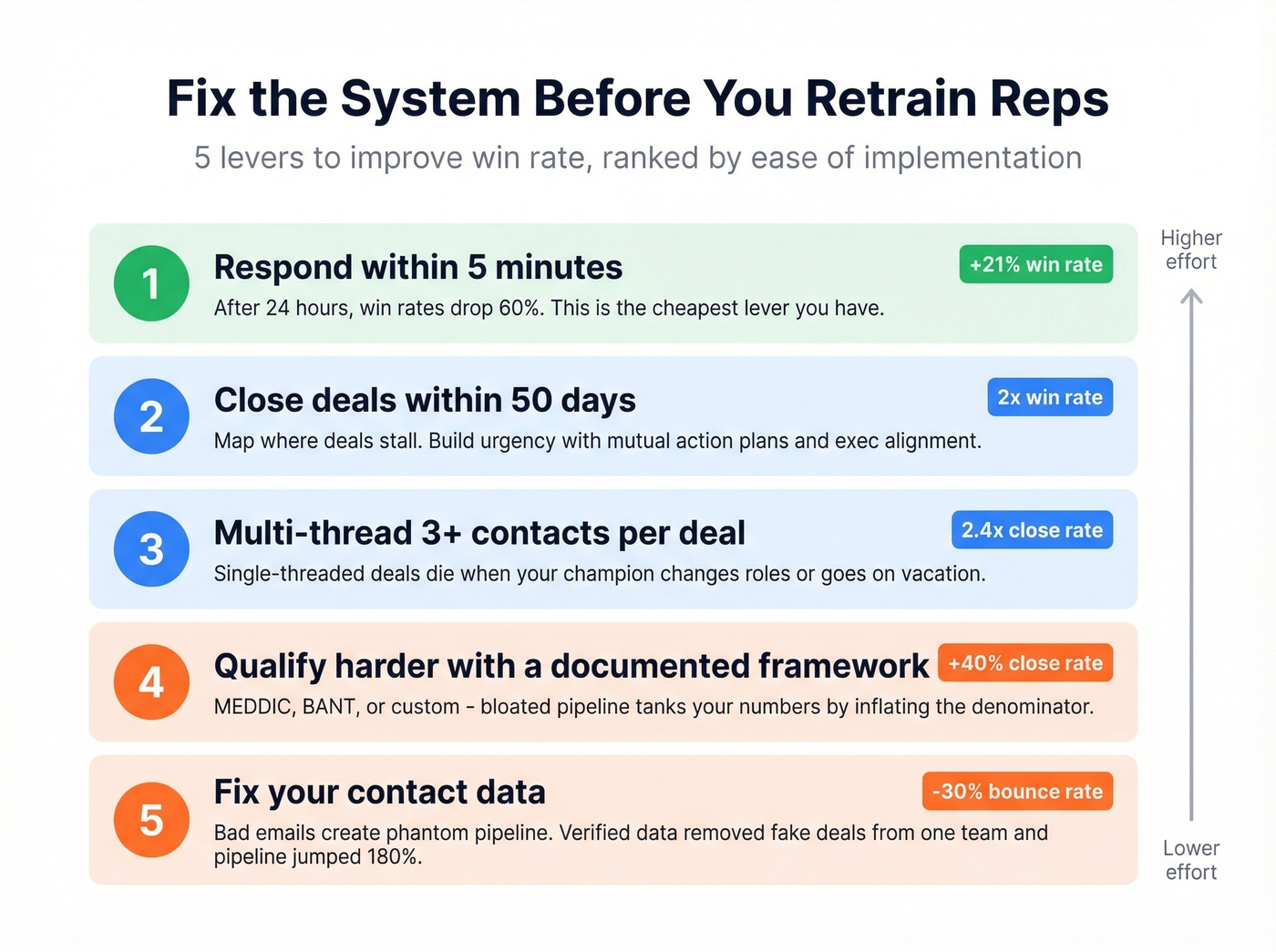
Let's be honest: most teams try to fix win rates by retraining reps. That's the last thing you should do. Fix the system inputs first - speed, data quality, threading, qualification - and rep performance follows.
Respond Faster
In the Optifai benchmark data, responding within 5 minutes of an inbound lead correlates with 21% higher win rates. After 24 hours, win rates drop 60%. Speed-to-lead is the cheapest lever you have, and it doesn't require a single training session.
If you want to operationalize this, track funnel metrics and pipeline health weekly - not quarterly.
Shorten Your Sales Cycle
The 50-day threshold is real. Deals that close within it win at more than double the rate of those that don't. Map where deals stall and build urgency into those stages - mutual action plans, executive alignment calls, whatever it takes to keep momentum.
For enterprise motions, it helps to align this with your sales process optimization work so stages reflect reality.
Multi-Thread Every Deal
Engaging 3+ contacts on the buying side correlates with a 2.4x higher close rate, and 3.1x higher for enterprise deals. Single-threaded deals die when your champion changes roles or goes on vacation. We've seen this kill pipeline over and over.
This is also where account-based selling tends to outperform spray-and-pray outbound.
Qualify Harder, Not Softer
Teams with documented qualification criteria - MEDDIC, BANT, or a custom framework - see 40% higher close rates. A bloated pipeline with unqualified opportunities doesn't just waste rep time. It tanks your numbers by inflating the denominator. If you're going to measure win rate, at least make sure the denominator represents real deals.
If you're using MEDDIC, keep a shared bank of MEDDIC discovery questions so reps qualify consistently.
Fix Your Contact Data
Bad emails and disconnected phone numbers create phantom pipeline. Reps log activities against contacts who never receive the outreach, and your denominator balloons with deals that were never real in the first place. One of our customers, Snyk, had 50 AEs prospecting 4-6 hours a week with bounce rates between 35-40%. After switching to Prospeo's verified data, bounces dropped under 5% and AE-sourced pipeline jumped 180%. That's not a training fix - it's an infrastructure fix.
If you're diagnosing this, start by monitoring your email bounce rate and tightening your email deliverability basics.
Multi-threading 3+ contacts per deal drives a 2.4x higher close rate - but only if those contacts are real. Prospeo gives you verified emails and direct dials for every stakeholder on the buying committee, across 300M+ profiles at $0.01 per email.
Stop single-threading deals with unverified contact data.
FAQ
What's a good win rate for SaaS?
Overall SaaS averages 20-30%. Teams selling under $10K ACV see around 31% median win rates, while $100K+ enterprise deals average roughly 15%. Top performers across all SaaS segments consistently hit 35%+.
What's the difference between win rate and close rate?
Win rate measures won deals against total opportunities that reached a decision point. Close rate sometimes includes all leads, not just qualified opportunities. The distinction matters when benchmarking because a broader denominator always produces a lower percentage.
Is a 50%+ win rate good?
Not necessarily. A very high win rate often signals cherry-picking or a pipeline that's too narrow. Teams celebrating 50%+ close rates frequently miss quota because they aren't working enough pipeline. Skip the vanity metric and aim for 25-40% with strong volume instead.
How does bad contact data affect win rates?
Stale emails and wrong phone numbers inflate your denominator with deals that were never real. Teams that switched to verified-data platforms saw bounce rates drop from 35%+ to under 4%, which removed phantom pipeline and gave them an accurate read on true conversion rates.