

How to Use AI for Sales Prospecting: Prompts, Tools, and the Workflow That Works
Your VP dropped "we need to use AI for prospecting" into the team Slack. No budget guidance, no tool recommendations - just a mandate.
Here's the reality: 75% of B2B organizations will use AI in at least one major sales function by the end of 2026. Early adopters are seeing 30%+ improvement in win rates, and sellers partnered with AI are 3.7x more likely to hit quota. If you're trying to figure out how to use AI for sales prospecting without drowning in hype, this playbook covers the exact workflow, prompts, and stack that separate real results from noise.
Stop Calling It "AI Prospecting"
Call it prospecting with better tools. The framework hasn't changed - ICP, list, qualify, outreach, follow-up. AI just makes the work dramatically faster, especially research and personalization.
You need three things:
- A sequencer. Lemlist, Instantly, or Outreach depending on your budget and volume.
- A set of prompts. ChatGPT works well for ICP research, email drafting, objection handling, and competitor analysis. The prompts below are copy-paste ready.
Here's the thing most vendors won't tell you: automating a broken process just helps you send bad emails faster. If your ICP is fuzzy and your data is stale, AI amplifies the problem. Fix the inputs first.
The 5-Step AI Prospecting Plan
Work through these in order. Skipping Step 2 is the most common reason AI prospecting fails.
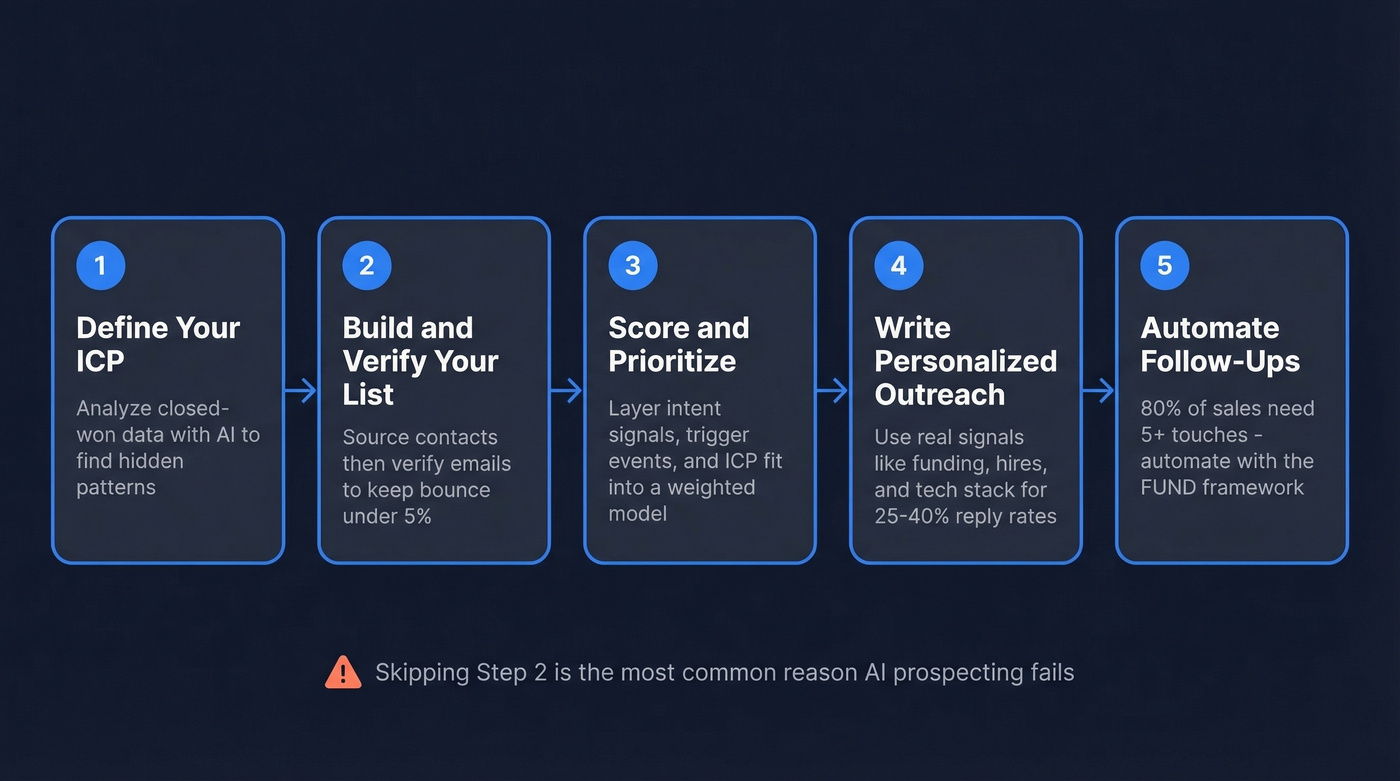
Step 1 - Define Your ICP With AI
Most teams think they know their ICP. Then you look at their closed-won data and realize 60% of their best customers share three traits nobody wrote down. Only 13% of leads convert to sales-qualified opportunities. Tightening your ICP is the single highest-leverage move before touching any outreach tool.
Export your last 12 months of closed-won deals from your CRM. Paste the data into ChatGPT:
Analyze this closed-won deal data. Identify the top 5 patterns across:
- Company size (headcount and revenue range)
- Industry vertical
- Job titles of the primary buyer and champion
- Tech stack signals
- Trigger events that preceded the deal

Output a one-paragraph ICP summary I can hand to an SDR, plus a
bulleted list of the 3 strongest qualifying criteria.
The output won't be perfect, but it'll surface patterns your team has been ignoring. Refine it with your sales leaders, then use it as the filter for every step that follows.
Step 2 - Build and Verify Your List
This is where most AI prospecting workflows quietly break. Teams grab a list from whatever database is cheapest, feed it into a sequencer, and wonder why bounce rates spike and their domain reputation tanks within a month. 74% of sales teams already using AI prioritize data hygiene for exactly this reason - AI amplifies whatever you feed it.
Skip this step if you're comfortable with high bounce rates and rebuilding domain reputation every quarter. (You shouldn't be.)

The proof is in the numbers. Snyk's team of 50 AEs went from 35-40% bounce rates to under 5% after switching to verified data, generating 200+ new opportunities per month. That's not an AI story - it's a data quality story.

Your AI prompts, scoring models, and sequencers are only as good as the data feeding them. Prospeo's 300M+ profiles refresh every 7 days - not every 6 weeks - so your AI workflows run on contacts that actually exist. 98% email accuracy. Under 4% bounce rates. The same data Snyk used to generate 200+ opportunities per month.
Stop letting stale data sabotage your AI prospecting stack.
Step 3 - Score and Prioritize Leads
A list of 5,000 contacts is useless without a ranking. High performers are 1.7x more likely to use prospecting agents for exactly this reason - they don't work lists alphabetically.
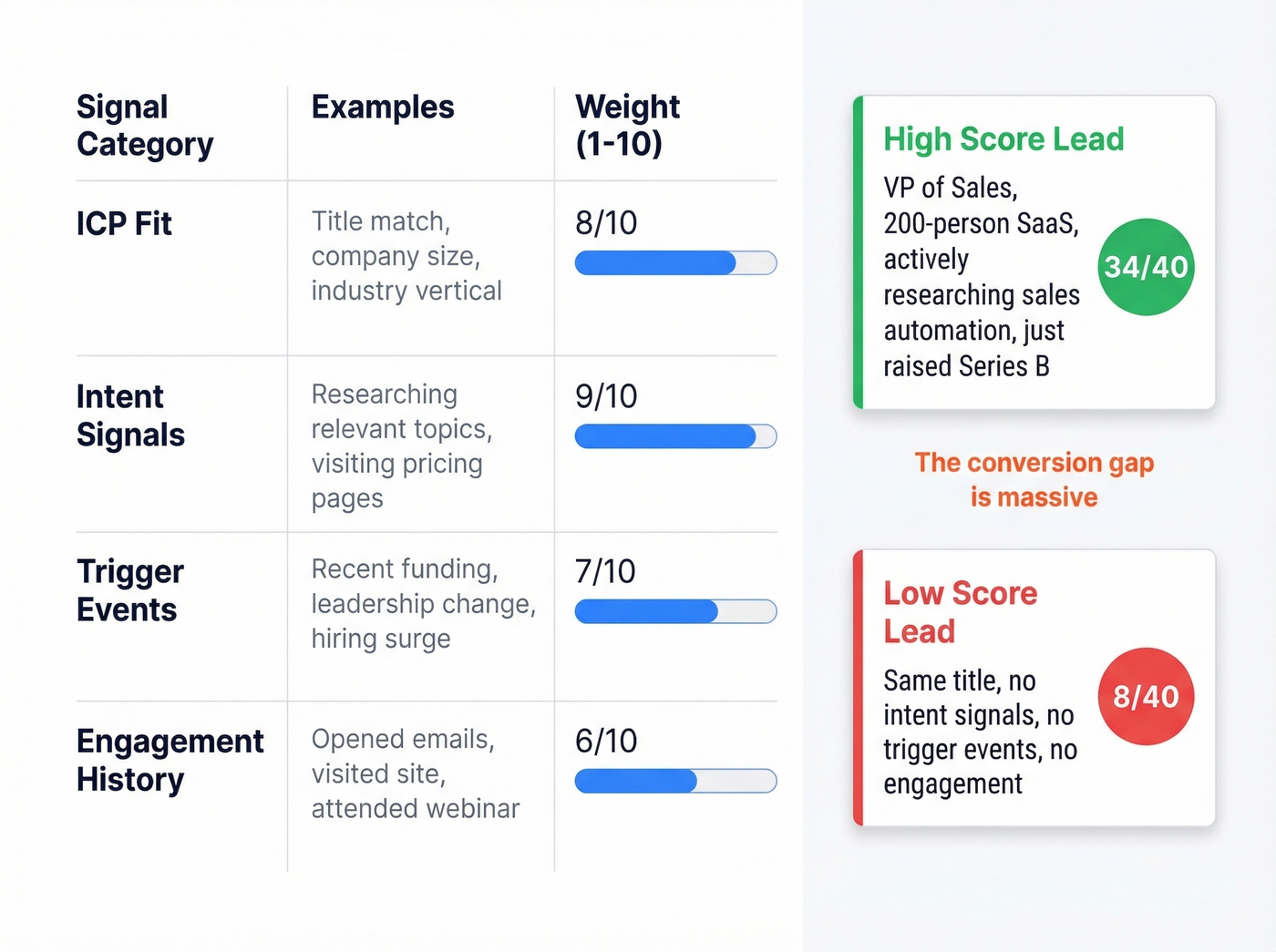
Layer intent data into your scoring. A VP of Sales at a 200-person SaaS company actively researching "sales automation platforms" scores dramatically higher than the same title at a company showing zero intent signals. We've tested scoring models with and without intent signals, and the conversion gap is massive - it's the difference between a warm lead and a cold guess.
Use this prompt to build a scoring rubric:
I sell [your product] to [your ICP]. Create a lead scoring model
using these signals, weighted 1-10:
- ICP fit (title, company size, industry)
- Intent signals (actively researching relevant topics)
- Trigger events (recent funding, leadership change, hiring surge)
- Engagement history (opened emails, visited site, attended webinar)

Output a scoring table I can apply in a spreadsheet or CRM.
Step 4 - Write Personalized Outreach
Generic outreach gets a 3.43% reply rate. AI-personalized outreach using real signals hits 18%. Stack multiple signals - funding plus a job change plus a tech stack match - and you're looking at 25-40% reply rates. 73% of B2B buyers actively avoid sellers who send irrelevant outreach, so the cost of generic messaging isn't just low replies. It's burned accounts you can never touch again.
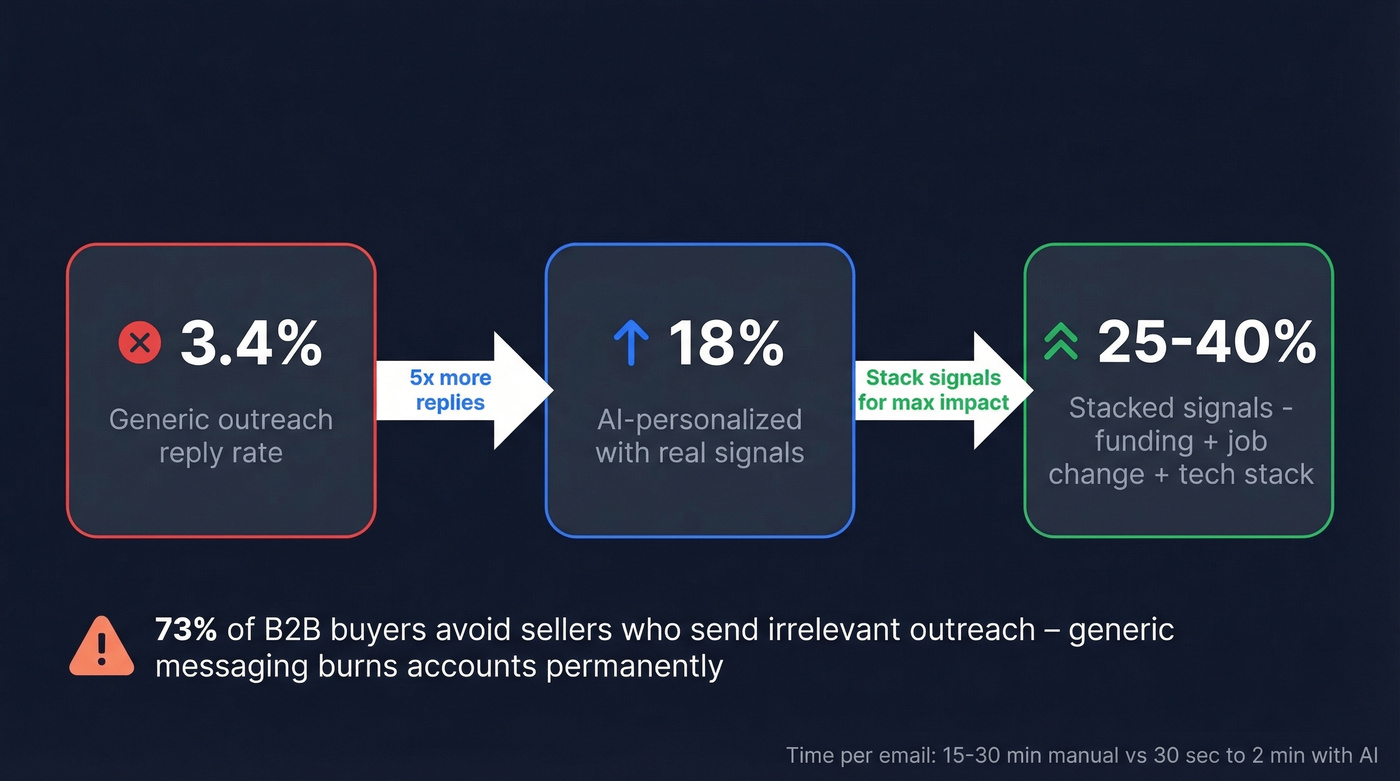
Personalization time collapses when you pair AI with real signals. Manual personalization takes 15-30 minutes per email; AI-assisted workflows get that down to 30 seconds to 2 minutes. This is where knowing how to apply AI to your prospecting process separates high-performing reps from everyone else. If you want a deeper system, use this alongside a personalized outbound email framework. Cold email hook prompt:
Write a cold email to [Name], [Title] at [Company]. Use this context:
- They just [trigger event: raised Series B / hired 3 new AEs / adopted Snowflake]
- Their likely pain point is [specific pain]
- Keep it under 125 words, grade 5 reading level
- Structure: noticed [event] → impact on their role → one question

No fluff. No "I hope this finds you well."
Pain-based outreach works differently. Think of it as a formula:
[Specific consequence of the pain] + [proof it's solvable] + [low-commitment CTA]. Example: "Your reps are spending 4 hours/day on manual list building - that's 20 hours/week not selling. Three teams your size cut that to 30 minutes. Worth a 10-min look?"
Step 5 - Automate Follow-Ups
44% of reps give up after one follow-up. 80% of sales require five or more touches. This is the easiest step to automate and the one most teams skip.
Use the FUND framework for trigger-based follow-ups: Funding context, Urgency signal, Name the decision maker, Differentiate your value. The post-funding buying window runs 90-120 days, with days 31-60 being the sweet spot - early enough that budgets aren't allocated, late enough that the chaos has settled.
Write a 3-email follow-up sequence for a prospect who opened my
initial email but didn't reply. Space them 3, 7, and 14 days apart.
- Email 1: Add one new data point or insight they'd find useful
- Email 2: Reference a competitor or peer who solved this problem
- Email 3: "Helpful exit"   -   offer value even if not interested

Keep each under 75 words. No guilt-tripping.
AI Prompts You Can Copy Right Now
Four more prompts you'll use constantly.
Objection handler:
My prospect said: "[paste their objection]." I sell [product] to
[ICP]. Write 3 response options:
1. A direct reframe addressing the objection head-on
2. A question that uncovers the real concern behind it
3. A social proof response referencing a similar company's results
Keep each under 50 words.
Competitor comparison - frame this as a before/after, not a feature checklist. Bad version: "We're better than [competitor] because of features X, Y, Z." Good version:
I'm competing against [competitor] for a deal with [prospect company].
Here's what I know about their evaluation criteria: [paste what you know].
Write a one-paragraph positioning statement that highlights where we
win without trash-talking the competitor. Focus on outcomes, not features.
Breakup email:
Write a final email to a prospect who hasn't responded to 4 previous
touches. Tone: genuinely helpful, zero guilt. Offer one specific
resource valuable even if they never buy. End with "no need to reply   -
just wanted to leave this with you."
Discovery call opener (first 60 seconds):
- Acknowledge why they took the meeting - one sentence, reference the trigger
- Set the agenda in one sentence
- Ask one question that gets them talking about their current process
No small talk. No "how's your day going." Prompt ChatGPT with the prospect's trigger event and title to generate a specific opener.
Step 3 says to layer intent data into your scoring - Prospeo tracks 15,000 intent topics via Bombora, combined with 30+ filters like technographics, funding events, headcount growth, and job changes. Stack those signals and your AI-personalized outreach hits the 25-40% reply rates this article describes. Teams using Prospeo book 35% more meetings than Apollo users.
Feed your AI real buyer signals, not guesswork.
The AI Prospecting Tool Stack
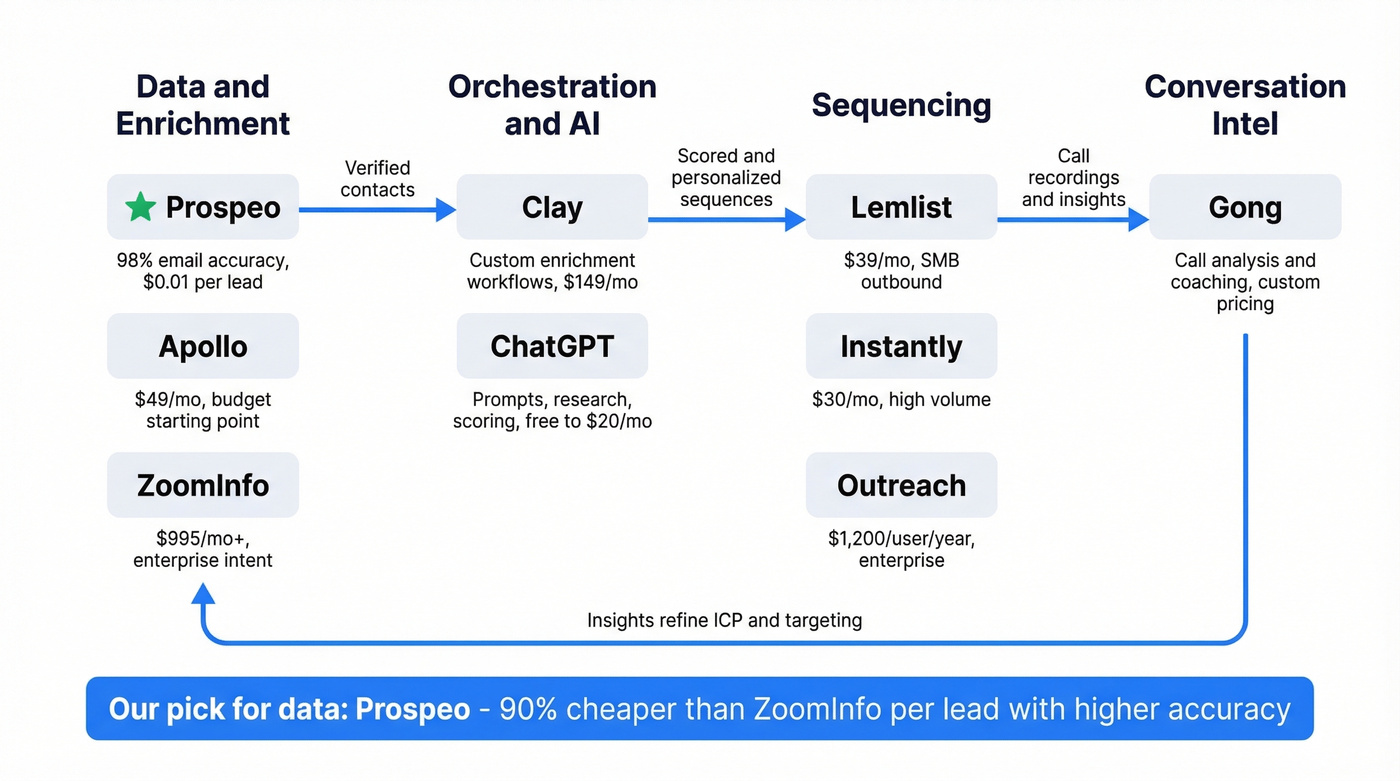
The AI sales tools market hit $3B in 2025 and is growing 13% annually. A fully loaded SDR costs roughly $139K/year. The math on AI-assisted prospecting isn't close.
| Category | Tool | Starting Price | Best For |
|---|---|---|---|
| Data & Enrichment ★ | Prospeo | Free (75/mo); ~$0.01/lead | Verified emails + mobiles, best accuracy |
| Data & Enrichment | Apollo | $49/mo | Budget-friendly starting point |
| Data & Enrichment | ZoomInfo | $995/mo+ | Enterprise intent + org charts |
| Data & Enrichment | Cognism | ~$588/mo | European data, GDPR-first |
| Sequencing | Lemlist | $39/mo | SMB outbound |
| Sequencing | Instantly | ~$30/mo | High-volume sending |
| Sequencing | Outreach | $1,200/user/year | Enterprise engagement |
| Orchestration | Clay | $149/mo | Custom enrichment workflows |
| Orchestration | ChatGPT | Free / $20/mo | Prompts + research |
| Conversation Intel | Gong | Custom | Call analysis + coaching |
Our pick for data and enrichment: Prospeo - 90% cheaper than ZoomInfo per lead with higher email accuracy (98% vs 87%). For teams that don't need ZoomInfo's org chart depth, it's the obvious data layer. If you're comparing providers, start with a ranked list of the best B2B database options.
Clay shows up as a practitioner favorite on r/sales and r/outbound for stitching together multiple data sources into enrichment workflows. If you're running 3+ data sources through a sequencer into a CRM, an orchestration layer like Clay or a native ecosystem play through Salesforce or HubSpot is worth the investment. For a deeper breakdown, see Clay list building.
Five Costly Mistakes
1. Thinking more is better. AI makes it trivially easy to blast 10x the emails. That's not prospecting - it's spam at scale.
2. Skipping data verification. One team we worked with was running 35% bounce rates before switching providers - pipeline tripled from $100K to $300K/week once bounce rates dropped below 4%. Verify before you send. Always. If you need a checklist, use an email verifier workflow.
3. Ignoring timing and context. Sending upbeat promos to a company going through layoffs. Aggressive follow-ups after a prospect signals disinterest. AI doesn't read the room - you have to.
4. Buying tools instead of fixing process. A $50K/year tool stack won't fix a broken workflow. If your ICP is wrong and your sequences are generic, you're just failing faster. Redesign the workflow first.
5. Forgetting deliverability. This one's so common it gets its own section.
Deliverability - The Step Everyone Skips
AI-generated outreach is worthless if it lands in spam. Three non-negotiables before you scale:
Warm up your domains gradually. Skip this and Gmail will bury you. We've seen teams spend months building AI outreach workflows, only to discover their deliverability collapses because nobody warmed up a single domain. Use a proper Gmail warm up plan.
Rotate sending accounts. Don't blast 500 emails from one address. Spread volume across multiple accounts and keep daily sends under 50 per inbox.
Verify your list before you send. Stack Optimize built to $1M ARR with 94%+ deliverability, bounce rates under 3%, and zero domain flags across all clients - by making verification the first step, not an afterthought. If you’re troubleshooting, run an email reputation check before scaling volume.

GDPR and Compliance
GDPR fines exceeded EUR 5.88B as of 2025, and enforcement is accelerating. If you're prospecting into the EU, these five items aren't optional:
- Document your legal basis. Legitimate interest is increasingly scrutinized for cold outreach. Know your justification and write it down.
- Respect Article 22. Prospects have the right not to be subject to purely automated decisions with significant effects. Build human review into your scoring workflow.
- Run a DPIA. Large-scale behavioral monitoring or profiling requires a Data Protection Impact Assessment under Article 35.
- Vet your vendors. Look for ISO 27001 certification, automated data deletion, and audit trails.
- Practice data minimization. AI systems love to collect everything. Collect what you need, delete what you don't. In 2026, this isn't a nice-to-have - it's an operational compliance obligation.
FAQ
How long until AI prospecting shows results?
Most teams see measurable reply-rate improvements within 2-4 weeks of implementing verified data plus AI-personalized outreach. Start with a 100-prospect pilot before scaling to validate your ICP, messaging, and data quality in a controlled environment.
Can I build an AI prospecting stack for free?
Yes. ChatGPT's free tier handles ICP research, email drafting, and competitor analysis. Pair it with Prospeo's free plan (75 verified emails/month) and a free-tier sequencer like Instantly, and you've got a working stack at $0 to prove the workflow before spending a dollar.
What's the biggest risk of AI-powered outreach?
Sending more bad emails faster. Generic AI outreach gets a 3.43% reply rate - barely better than spam. Without verified data and real personalization signals, AI just scales your mistakes. Fix data quality and ICP fit first.
Do I need an AI SDR agent or just tools?
Most teams don't need autonomous agents yet. Start with AI-assisted tools - a data provider, a sequencer, and ChatGPT prompts. Graduate to agents once your workflow, data quality, and scoring model are proven and consistently converting.
Which AI prospecting strategies drive the highest ROI?
The highest-impact strategies combine three elements: tight ICP definition using closed-won data analysis, verified contact data to protect deliverability, and signal-based personalization at scale. Teams that layer intent data and trigger events into scoring and outreach consistently outperform those relying on volume alone.