

How to Use Intent Data: The Skeptic's Playbook for 2026
"80% of it is just smoke and mirrors." That's not our line - it's a direct quote from a B2B marketer on r/b2bmarketing describing their experience with intent data. The B2B intent data market is estimated at $4.5B in 2026, growing at 15.9% CAGR - yet practitioner skepticism is loud across communities. If you're figuring out how to use intent data without burning budget on a platform you'll regret, start here.
The problem isn't the data. It's that most teams buy a $40K+ tool before they've built the activation workflow that makes signals useful.
What You Need (Quick Version)
Build your intent stack in layers, not all at once:
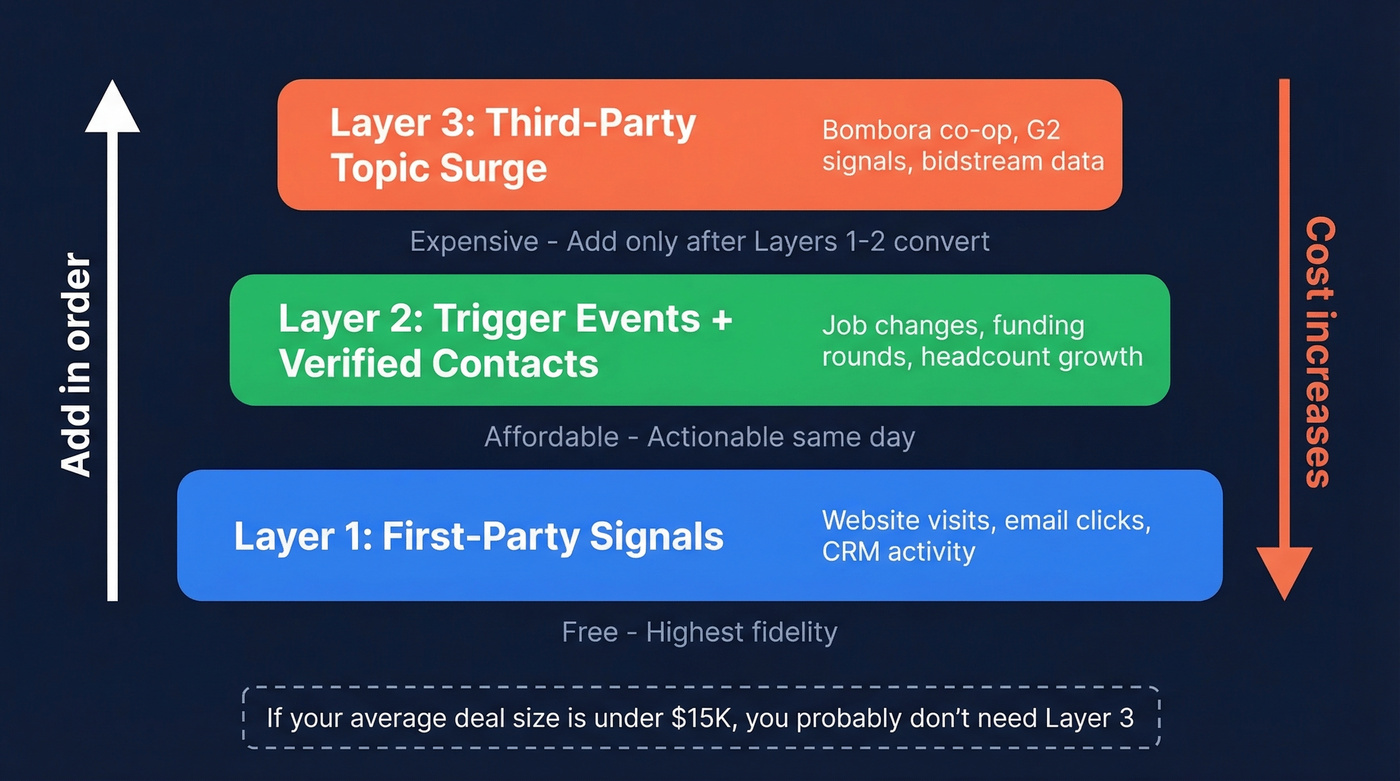
- First-party signals - website visits, email engagement, CRM activity. Free, highest fidelity.
- Trigger events + verified contacts - job changes, funding rounds, headcount growth. Affordable, actionable same-day.
- Third-party topic surge - Bombora co-op data, G2 review signals, bidstream. Add this only after layers 1-2 are converting.
If your average deal size is under $15K, you don't need a $50K platform. Build the activation workflow first. The tool is the last step.
What Intent Data Actually Is
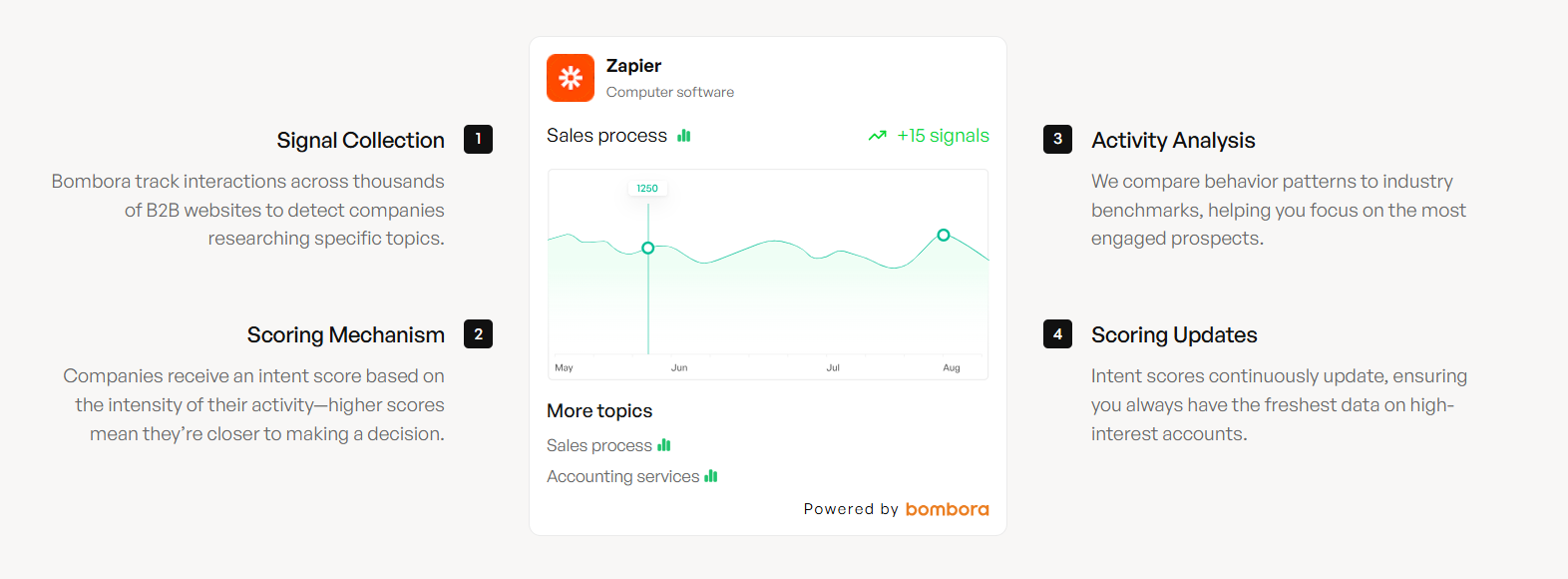
Intent data is any signal suggesting an account is actively researching a problem you solve. It breaks into three categories:
| Type | Sources | Strength | Limitation |
|---|---|---|---|
| First-party | Site visits, email clicks, CRM activity | Highest fidelity, free | Limited scale; misses off-site research |
| Second-party | Partner data, co-marketing, publishers | Contextual, consented | Hard to scale |
| Third-party | Bombora co-op, G2, bidstream, review sites | Broad coverage | Noisy, delayed, expensive |
First-party signals are your foundation: page visits, time-on-site, email engagement, and support/CRM interaction patterns. Third-party data fills the gap for off-site research, but it's also where most "smoke and mirrors" complaints come from - especially around generic black-box topic surges with zero context about what the account actually did.
One nuance worth calling out: monitor topics, not just keywords. NLP-based topic classification catches related research that exact-match keyword tracking misses entirely.
7 Practical Use Cases for Buyer Intent Signals
According to the most recent large-scale survey, [69% of teams](https://nrich.io/blog/state-of-intent-data-2023-2024-presentation-of-results) applying buyer intent signals use them for lead and account prioritization. That's just the starting point.
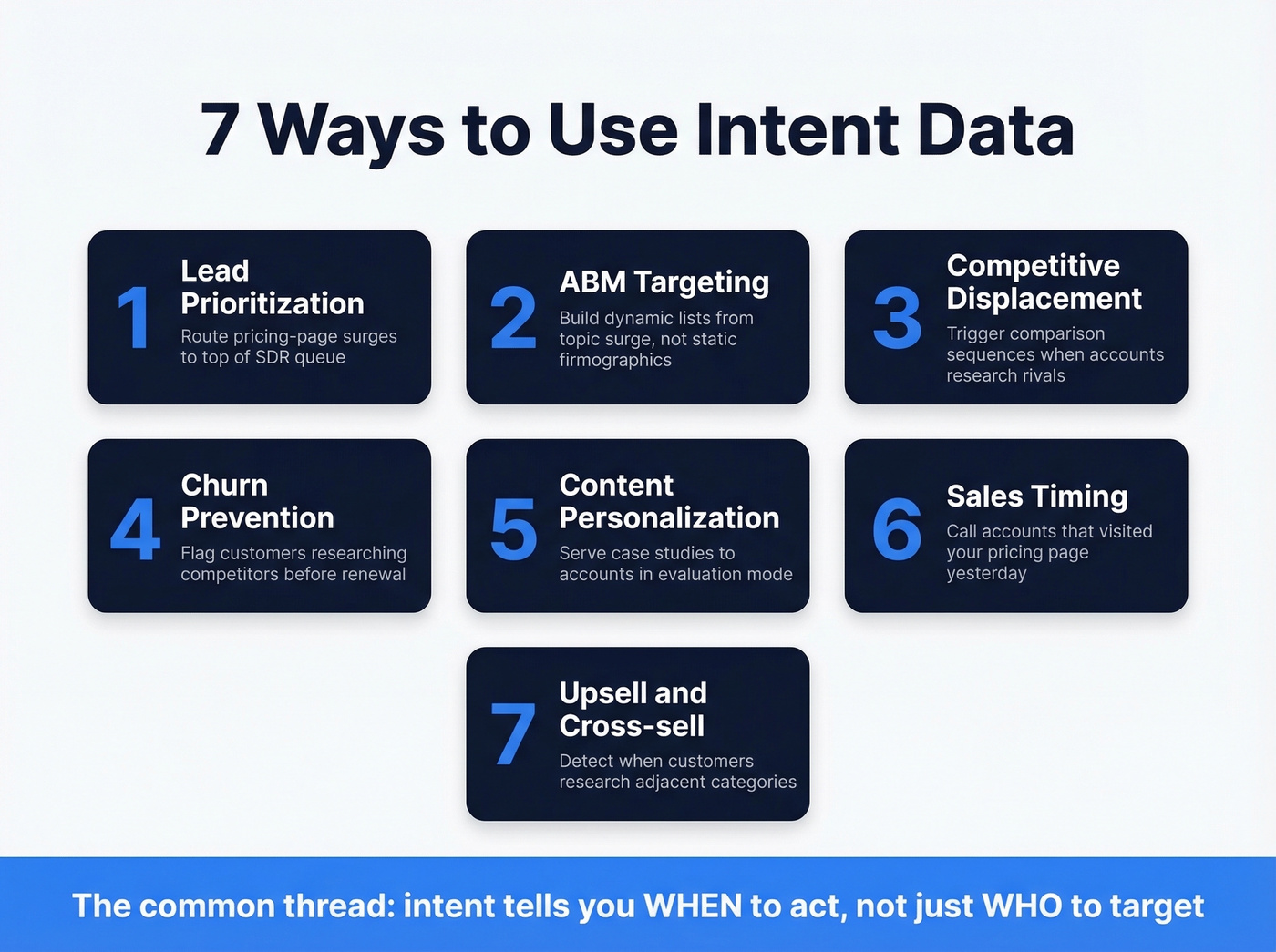
- Lead prioritization - Route accounts showing pricing-page surges to the top of your SDR queue.
- ABM targeting - Build dynamic account lists based on topic surge rather than static firmographics.
- Competitive displacement - When an account researches your competitor's category on G2, trigger a comparison-focused sequence.
- Churn prevention - Flag existing customers researching competitor solutions before renewal conversations. (If churn is a priority, pair this with a clear how to prevent churn workflow.)
- Content personalization - Serve case studies to accounts in evaluation mode, not awareness-stage blog posts.
- Sales timing - A rep calling an account that visited your pricing page yesterday has a fundamentally different conversation than one cold-calling from a static list.
- Upsell and cross-sell - Detect when a current customer researches adjacent product categories you also serve.
The common thread: intent signals tell you when to act, not just who to target. Without timing, it's just another list. We've seen teams that combine these signals with ideal customer profile fit and sub-24-hour SLAs hit a 10-30% lift in meeting rates - and teams that skip the SLA part see almost nothing.
How to Score Intent Signals
Without a scoring model, intent data is an expensive notification system. Start simple - assign point values by action type:
| Action | Points |
|---|---|
| Demo request | 50 |
| Pricing page visit | 40 |
| Whitepaper download | 30 |
| Blog visit | 5 |
Accounts scoring 80+ are hot. 40-79 are warm. Below 40, they're browsing. That's a workable starting model, but it ignores time.
A stronger framework scores across three dimensions:
- Recency: Within 7 days (high), 8-30 days (medium), 30+ days (low)
- Frequency: 3+ interactions (high), 2 (medium), 1 (low)
- Depth: Pricing/technical content (high), comparison content (medium), blog/awareness (low)
Flag an account as "hot" when it shows 3+ high-value interactions within 7 days. Temporal clustering matters more than raw volume - five blog visits over two months is noise, but a pricing page visit followed by a competitor comparison and a case study download in 48 hours is a buying signal.
For decay, use a 7-day half-life for high-intent signals and 14-30 days for mid-intent. Without decay, every account that ever visited your site eventually looks "in-market." That's how you end up chasing ghosts. (If you want to go deeper on modeling, see intent prediction.)

Your scoring model is only as good as the contacts you can reach. Prospeo pairs 15,000 Bombora intent topics with 143M+ verified emails and 125M+ mobile numbers - refreshed every 7 days, not 6 weeks. Identify the buying committee and reach out the same day the signal fires.
Stop letting hot intent signals decay while you hunt for contact data.
The Activation Workflow
Here's the thing: scoring is useless without a system that routes signals to the right person at the right time. This is what separates teams that see ROI from those that cancel after year one.
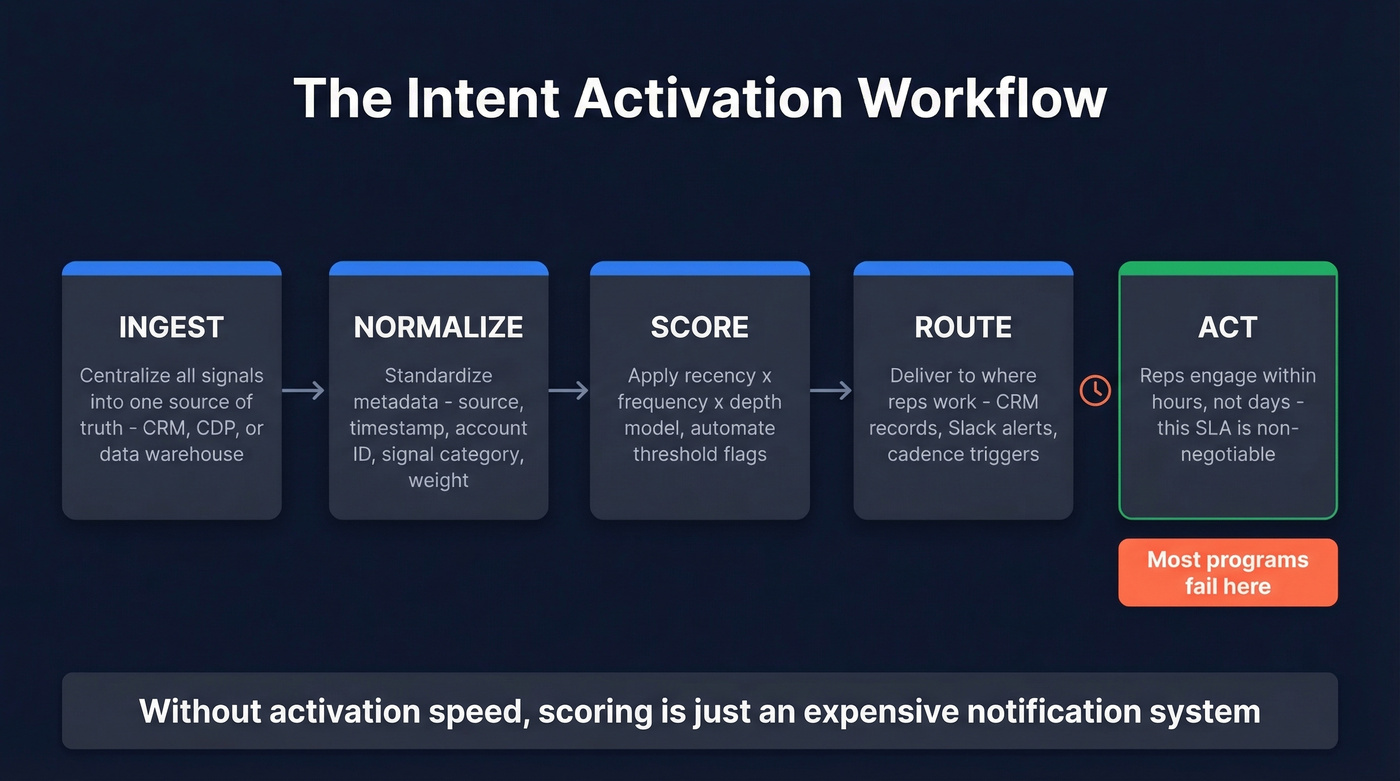
Five steps:
- Ingest - Centralize all signals into a single source of truth. Your CRM, CDP, or data warehouse works. (If you're evaluating tooling, start with CRM automation software basics.)
- Normalize - Standardize metadata: source, timestamp, account/contact ID, signal category, event type, weight.
- Score - Apply the recency x frequency x depth model. Automate threshold flags.
- Route - Deliver scored signals where reps actually work: CRM account records, Slack alerts, cadence triggers in Outreach or Salesloft, weekly roundup emails. This is also where lead-to-account matching prevents misroutes.
- Act - Reps engage within hours, not days. That SLA is non-negotiable.
Once you've identified hot accounts, you need verified contact data fast - before the signal decays. Prospeo tracks 15,000 intent topics and pairs them with 98%-accurate emails and 125M+ verified mobile numbers on a 7-day refresh cycle. The point is speed: identify the buying committee, get verified contacts, and reach out the same day.
One critical outreach rule: don't mention the data source. "I noticed your team is researching X" feels stalkerish. Lead with the pain point the signal implies. The data informs your timing and angle - it shouldn't be your opening line. If you need a system for this, use a sales outreach strategy that maps signals to angles.
Mistakes That Kill Intent Programs
The recurring complaints across community discussions boil down to five themes: "tools are too generic," "signals are outdated by the time I act," "I need 3-4 tools to get a complete picture," "AI tools require too much setup," and "outbound feels dead without timing." One practitioner on r/LeadGeneration who tested 6sense, ZoomInfo, and Bombora described being "mostly disappointed with the quality of data" - wanting "more context and coherence" than black-box scores provide.
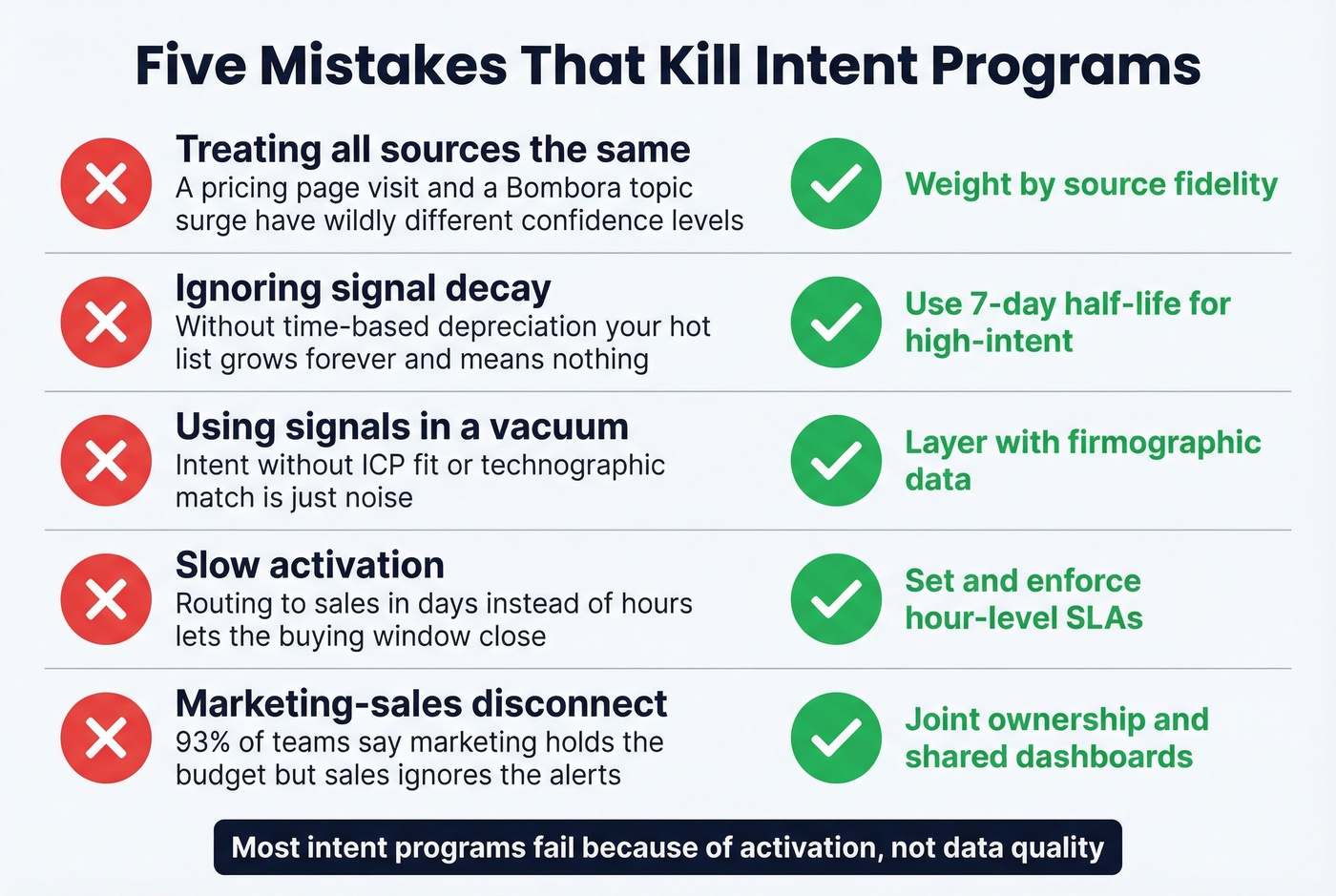
Those complaints map to specific, fixable mistakes:
Treating all sources the same. A pricing page visit and a Bombora topic surge have wildly different confidence levels. Weight them accordingly.
Ignoring decay. Without time-based depreciation, your "hot" list grows forever and means nothing.
Using signals in a vacuum. Intent without ICP fit, technographic match, or engagement history is just noise. Layer signals with firmographic and behavioral data (including technographics).
Slow activation. Route to sales within hours, not days. Set SLAs and enforce them. If the signal says they're researching "data enrichment," your email should address data quality - not your company's entire product suite.
Marketing-sales disconnect. 93% of teams say marketing holds the intent budget, but if sales doesn't trust the signals or know how to act on them, the program dies quietly. We've watched this happen at multiple companies - marketing buys the tool, sales ignores the alerts, and six months later the contract doesn't renew.
Real talk: most intent programs fail because of activation, not data quality. The data is usually fine. The workflow is usually broken.
What Intent Data Costs in 2026
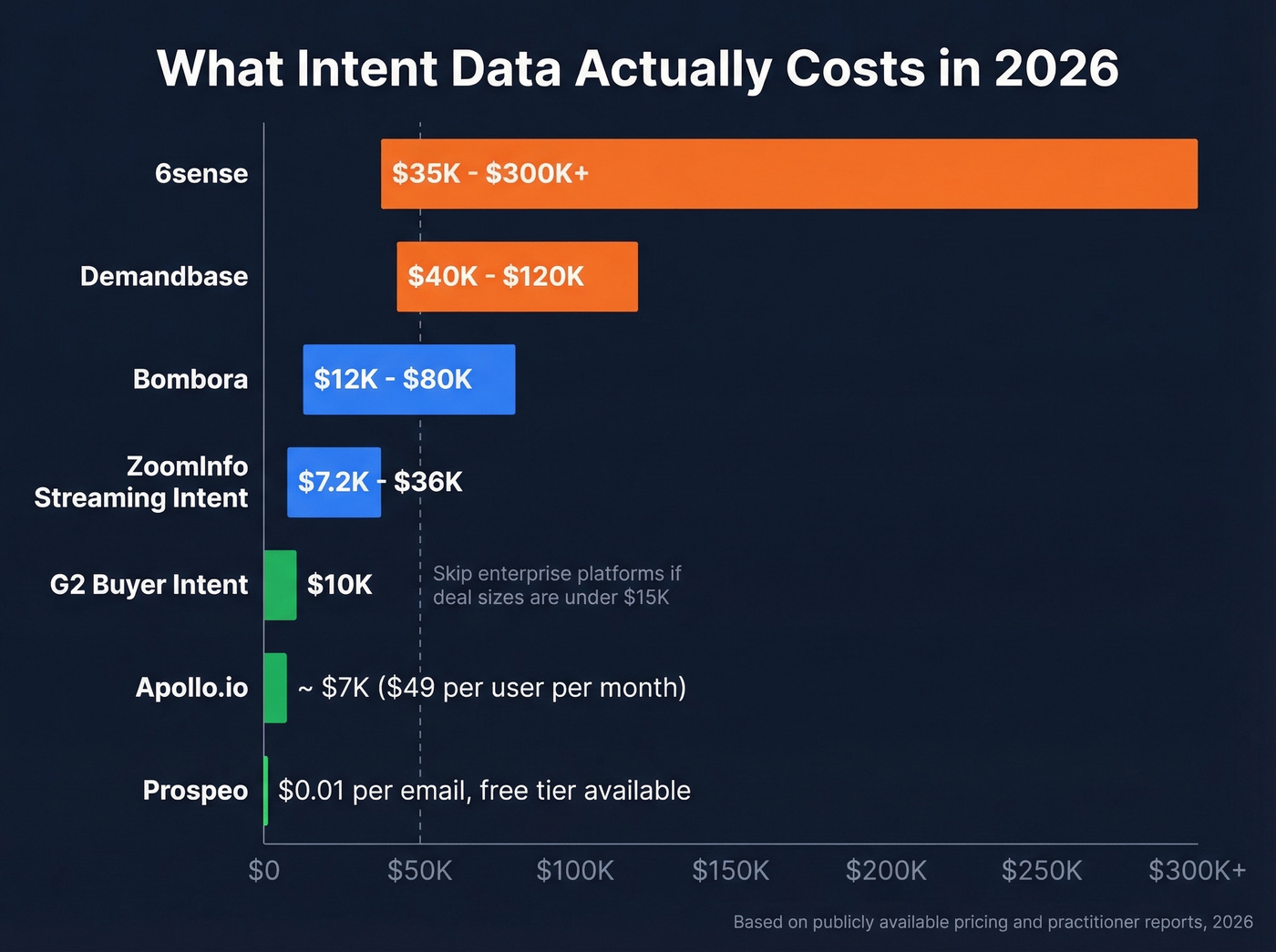
Most intent vendors don't publish full pricing. Here's what teams actually pay:
| Provider | Annual Cost | Best For |
|---|---|---|
| Bombora | $12K-$80K/yr | Broad topic coverage |
| 6sense | $35K-$300K+/yr | Enterprise ABM |
| Demandbase | $40K-$120K/yr | ABM + intent bundle |
| G2 Buyer Intent | ~$10K/yr | Review-site signals |
| ZoomInfo Streaming Intent | $7.2K-$36K/yr | ZoomInfo add-on |
| Apollo.io | $49/user/mo | Prospecting platform benchmark |
| Prospeo | ~$0.01/email, free tier | Teams under $20K deal size |
Skip the enterprise platforms if your deal sizes don't justify the spend. For teams running outbound at scale without six-figure budgets, starting with first-party signals plus an affordable contact data layer will get you 80% of the value at 10% of the cost. If you're comparing data sources, start with the best B2B database landscape.
Privacy and Compliance in 2026
Intent data collection is getting tighter. The 2026 regulatory landscape shifted meaningfully:
- Opt-out confirmation mandatory since Jan 1, 2026 - visible confirmation required when a user opts out
- Closing a consent popup doesn't equal consent - explicitly prohibited under new CCPA rules
- Global Privacy Control (GPC) enforcement is active - joint enforcement sweeps began in late 2025
- DELETE Act obligations for data brokers start Aug 1, 2026 - brokers must check the DROP platform every 45 days
- Dark patterns prohibited - opt-out steps must be equal to or fewer than opt-in steps
The practical implication: third-party signals built on bidstream and cookie tracking are getting squeezed. First-party and consented second-party signals become more valuable every quarter. Build your stack accordingly - teams relying on owned-channel signals will have a durable advantage as third-party sources erode. (For a deeper compliance lens, see B2B compliance.)
Most intent programs fail at step 5: acting fast enough. Prospeo delivers 98%-accurate emails at $0.01 each and verified direct dials with a 30% pickup rate - so your reps reach decision-makers within hours, not days. No annual contracts. No sales calls to get started.
Turn intent signals into booked meetings before the buying window closes.
FAQ
Is intent data worth it for small teams?
Skip the $40K+ platforms if your average deal is under $20K. Start with first-party signals (website visits, email clicks) and trigger events (funding, job changes), then add third-party topic surge only after your activation workflow converts consistently. Prospeo's free tier gives small teams intent signals paired with verified contacts - no contract required.
How fast do intent signals decay?
High-intent signals lose most value within 7 days; mid-intent signals stay relevant for 14-30 days. Set an SLA to act on hot signals within hours, not days. Apply a 7-day half-life to pricing-page visits and demo requests, and 14-30 days for content downloads.
What's the difference between intent data and trigger events?
Intent data tracks research behavior - topics searched, content consumed, competitor pages visited. Trigger events track business changes - funding rounds, new hires, tech stack shifts. Layer both for maximum signal confidence; either alone misses half the picture.
How should marketers use intent data?
Use buyer intent to inform campaign timing, audience segmentation, and content strategy - not just hand off raw signal lists to sales. The highest-performing teams dynamically adjust ad spend toward in-market accounts and personalize nurture sequences based on the specific topics an account is researching.