

How to Write a Meeting Request Email That Actually Gets a Reply
94 out of 100 cold meeting requests never get a response. That's not a guess - 16.5 million cold emails analyzed by Belkins showed an average reply rate of just 5.8%. But here's the part nobody talks about: a big chunk of those emails never even arrived. Bad addresses, full inboxes, spam filters. The invisible failure mode kills your meeting request before anyone reads it.
If you want to write a meeting request email that actually lands, start with the data - then follow the five steps below.
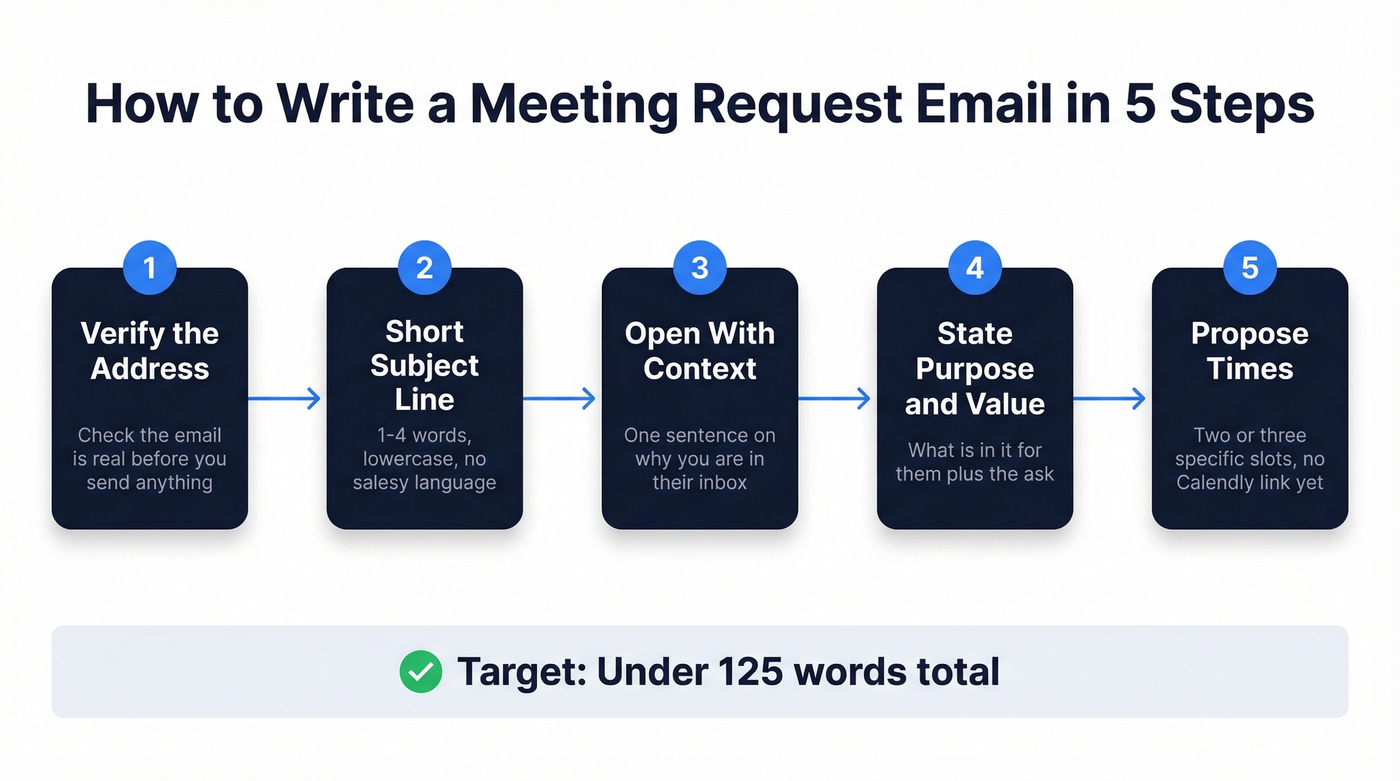
You don't need 25 templates. You need five and the discipline to keep each under 125 words:
- Keep it under 125 words. Emails in the 50-125 word range hit 50%+ response rates per Boomerang's 40M-email study.
- Subject line: 1-4 words, lowercase, zero salesy language. Gong's analysis of 85M emails found salesy phrasing cuts open rates by up to 17.9%. (If you need ideas, pull from proven subject line patterns.)
- Verify the email address before you hit send. Bad data is the #1 invisible reason meeting requests fail (and it’s why email deliverability work starts with list quality).
What the Data Says About Meeting Request Emails
Three large datasets tell a consistent story about what moves response rates.
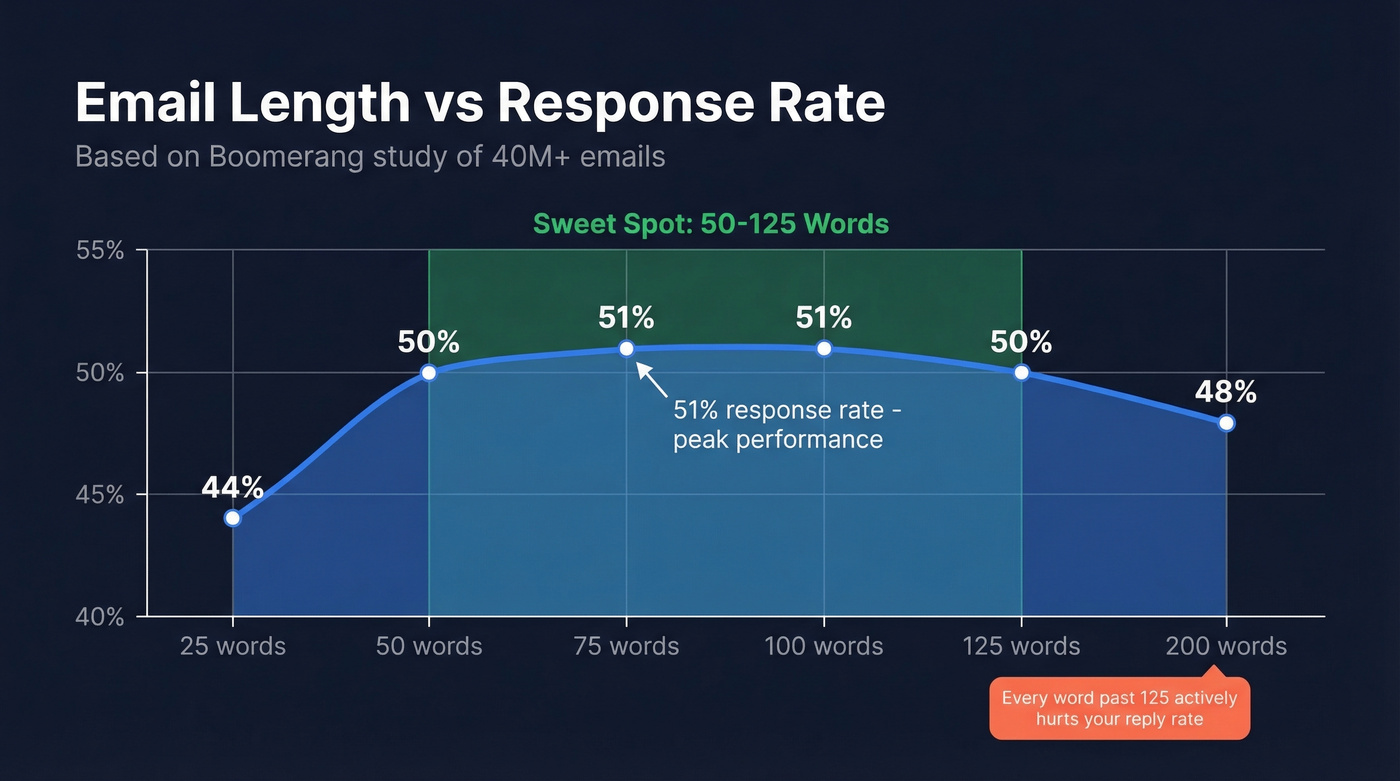
| Email Length | Response Rate |
|---|---|
| 25 words | 44% |
| 50 words | 50% |
| 75 words | 51% |
| 100 words | 51% |
| 125 words | 50% |
| 200 words | 48% |
That data comes from Boomerang's study of 40M+ emails. The sweet spot is 50-125 words. Go shorter and you lack context. Go longer and you're fighting diminishing returns.
Readability matters too. Emails written at a 3rd-grade reading level got a 36% response lift over college-level writing. That doesn't mean dumbing things down - it means short sentences, simple words, zero jargon (basic email copywriting rules still win).
Tone is interesting: slightly positive or slightly negative emails pulled 10-15% more responses than neutral ones. A little flattery works. Excessive flattery doesn't. And on subject lines, the 85M-email dataset is definitive - 1-4 words, all lowercase, no exclamation marks. Empty subject lines boost opens by roughly 30% but cut replies by 12%, so they're not worth the trade. If your subject line reads like marketing, it gets treated like marketing.
5 Steps to Write a Meeting Request Email
Step 1 - Verify the Address
Every meeting request guide assumes the email arrives. Dangerous assumption. One Prospeo customer, Meritt, went from a 35% bounce rate to under 4% after switching to verified data. Check the address before you send - the free tier covers 75 verifications per month, plenty for targeted outreach (here’s how to check if an email exists before you burn a send).
Step 2 - Write a Short Subject Line
Short, lowercase, boring-looking. That's the formula.
The data shows 1-4 words is ideal, and all-lowercase performs best. Think internal email, not marketing blast. Examples that work:
- "quick question"
- "intro - [company name]"
- "[first name]"
Skip anything with "exclusive," "limited time," or exclamation marks (more cold email subject line examples help when you’re stuck).
Step 3 - Open With Context
"I hope this finds you well" is five wasted words. Your opener should tell the recipient why you're in their inbox - in one sentence. Lead with a shared connection, a trigger event, or a specific observation: "Saw your team just opened a London office - that usually creates headaches for outbound data." (If you’re building a system around trigger events, use a simple sales triggers workflow.)
Step 4 - State Purpose and Value
One sentence that answers "what's in it for them." One sentence that asks for the meeting. That's it.
You're targeting under 125 words total, so every sentence beyond the essentials actively hurts your response rate. We've reviewed hundreds of meeting request emails across client campaigns, and the ones that try to cram in three value props always underperform the ones that nail a single, specific reason to talk (this is also why personalized outreach beats generic “spray and pray”).
Step 5 - Propose Times and Close
"When works for you?" forces a decision onto a busy person. Propose two or three specific slots instead: "Tuesday at 2pm or Thursday at 10am ET - either work?"
Don't send a Calendly link as your first move. Even after a positive reply, a scheduling link can make prospects disappear. Propose times first. Save the booking link for after they've confirmed interest.

Meritt cut their bounce rate from 35% to under 4% and tripled pipeline to $300K/week. Every meeting request you send to a bad address is a wasted email - and a hit to your domain reputation. Prospeo's 98% email accuracy means your carefully crafted 125-word email actually arrives.
Verify 75 emails free every month. No credit card required.
Best Time to Send
For personalized outreach, Siege Media's study of 85,000+ emails found Monday mornings between 6-9 AM PST perform best. You're catching people as they plan their week (for a deeper breakdown, see the best time to send playbook).
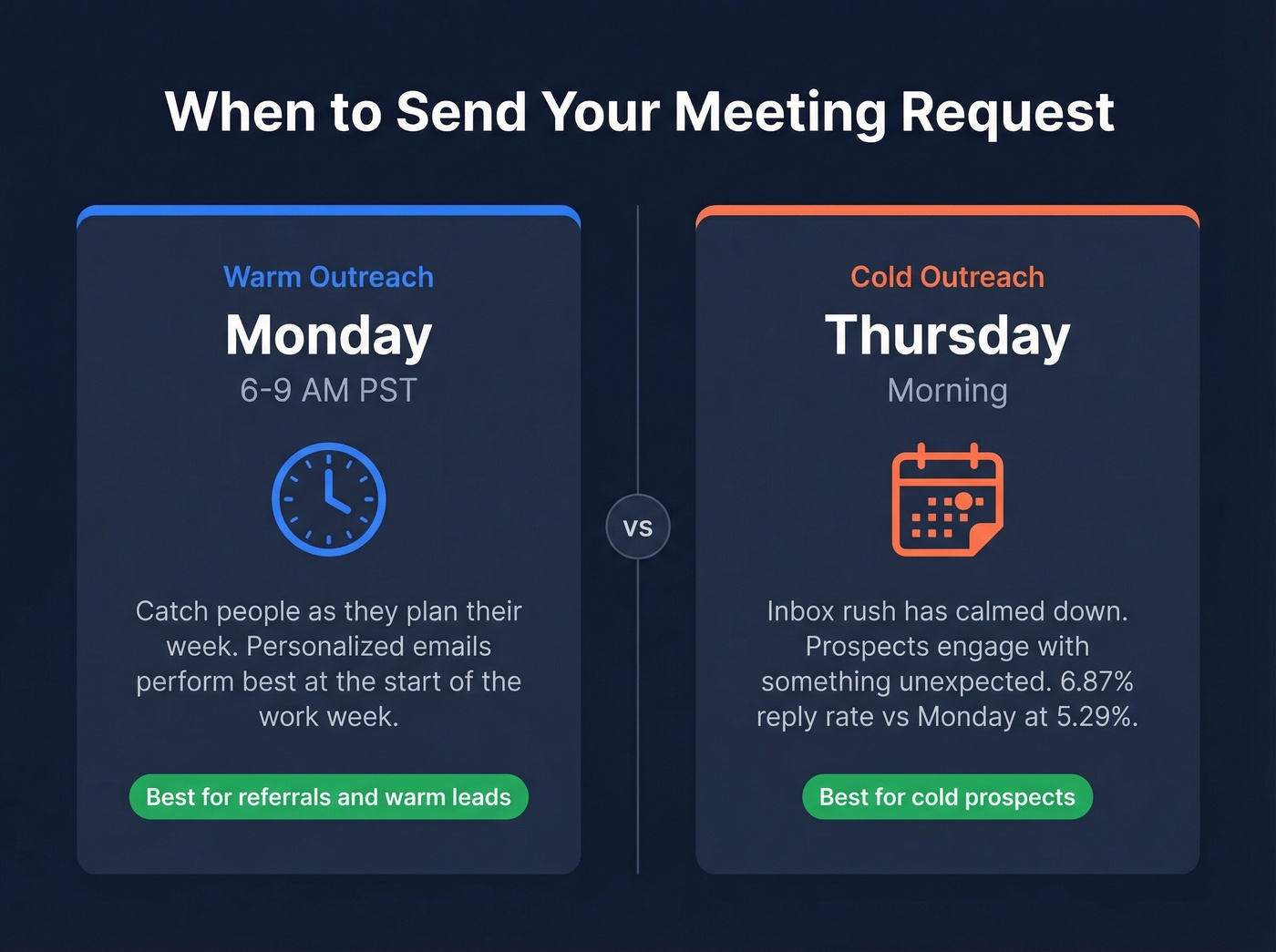
Cold outreach tells a different story. Thursday pulled a 6.87% reply rate versus Monday's 5.29%. We've tested both windows and the Thursday cold-email bump is real - by Thursday, the inbox rush has calmed and prospects engage with something unexpected.
Simple rule: warm-ish outreach goes Monday morning. Cold goes Thursday.
5 Meeting Request Email Templates
Each template stays under 125 words and follows the structure above. Steal them.
Cold Outreach
Subject: quick question
Hi [First Name], noticed [Company] just [trigger event]. We help similar teams [specific outcome] - typically [metric]. Worth 15 minutes? I'm free Tuesday at 2pm or Thursday at 10am ET.
Warm Introduction
Subject: [Mutual Contact] suggested we connect
Hi [First Name], [Mutual Contact] mentioned you're working on [initiative]. We helped [similar company] with [result]. Happy to share what worked - Wednesday at 11am or Friday at 3pm?
Internal Meeting
Subject: [Project] sync
Hi [First Name], need 30 minutes on [deliverable] before [deadline]. Agenda: [2-3 bullets]. Thursday at 1pm or Friday at 10am?
Executive-Level Request
Subject: [company name] + [their company]
[First Name] - [one sentence on business impact]. We solved this for [peer company]. 15 minutes - Tuesday at 9am ET?
Follow-Up After No Response
Subject: re: quick question
Hi [First Name], following up from [day]. Since then, [new insight]. Still happy to share how [outcome] - Tuesday or Thursday next week?
Follow-Up Strategy
Don't spray follow-ups. Spam complaint rates jump from 0.5% on the first email to 1.6% by the fourth. More emails doesn't mean more meetings - it means more damage to your domain (watch your email bounce rate and complaints together, not in isolation).
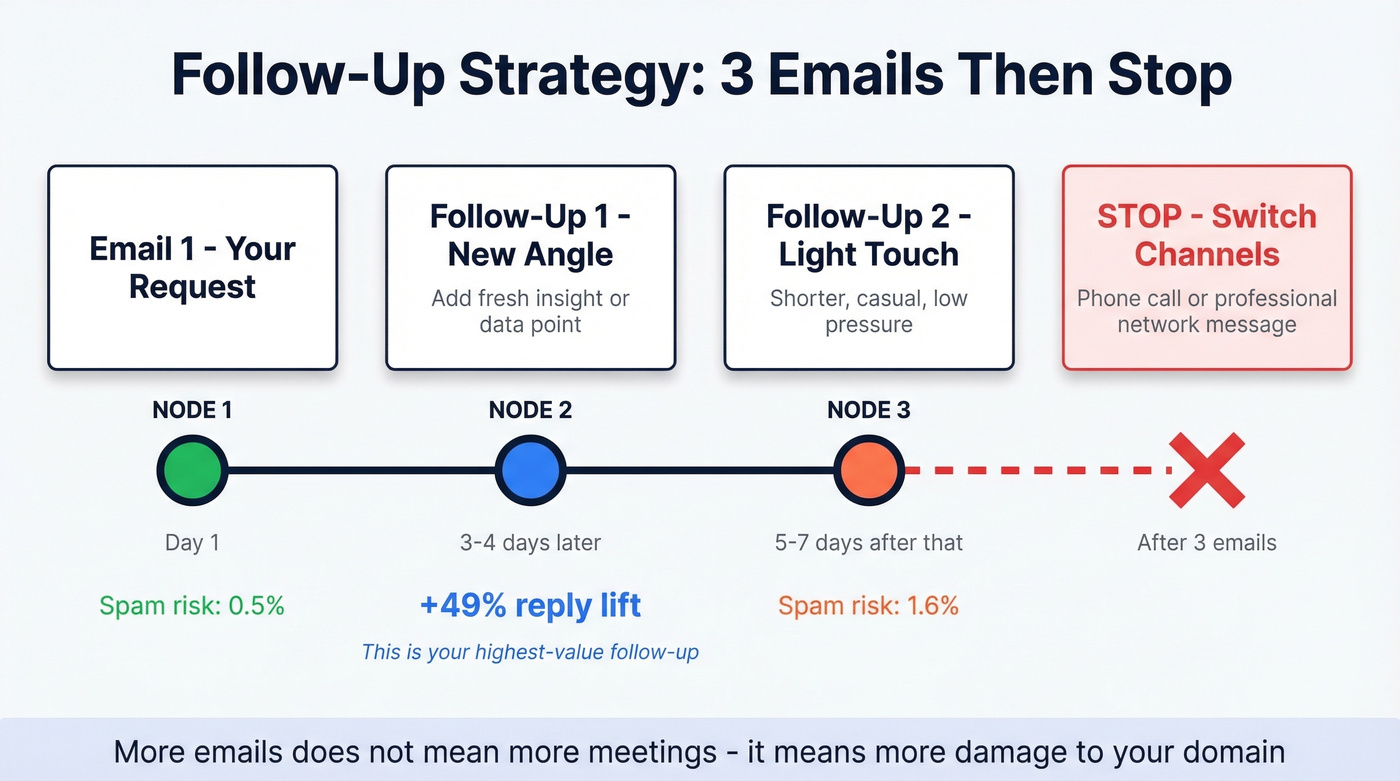
- Follow-up 1: 3-4 days later. Add a new angle. This first follow-up lifts replies by up to 49%.
- Follow-up 2: 5-7 days after that. Shorter, lighter touch.
- After that: Switch channels. Phone call or a message on a professional network.
Three emails total. Then move on or change the medium. In our experience, the third email rarely moves the needle - but it always moves your spam score. (If you want ready-to-send options, use these sales follow-up templates.)
Here's a strong opinion: if your average deal size is under $5k, you probably don't need a multi-touch, 7-email sequence for meeting requests. One great email and one follow-up will outperform a bloated cadence every time, and your domain reputation will thank you.
You just learned how to write a meeting request email that gets replies. Now make sure it reaches real inboxes. Prospeo gives you verified emails at $0.01 each, refreshed every 7 days - so your trigger-event opener hits the right person at the right address.
Stop perfecting emails that bounce. Fix the data first.
FAQ
How long should a meeting request email be?
50-125 words. Boomerang's 40M-email study found response rates peak above 50% in that range and drop beyond 125 words. Aim for 75-100 words as your default - enough context to be relevant, short enough to respect the reader's time.
What's the best subject line for a meeting request?
One to four words, all lowercase, zero salesy language. Salesy phrasing cuts open rates by up to 17.9%. Think "quick question" or just the recipient's first name - anything that looks like an internal message, not a pitch.
How do I make sure my meeting request email arrives?
Verify the recipient's address before sending. A 5-step verification process catches invalid addresses, spam traps, and catch-all domains. Even a free verification tool can save you from the silent failure of bouncing into the void.
Should I include a scheduling link in my first email?
No. Proposing two or three specific time slots gets higher response rates than dropping a Calendly link cold. Save the booking link for after the prospect confirms interest - it reduces friction at the decision point instead of adding it upfront.