

How to Write Email Sequences That Actually Get Replies
Most email sequences fail for one of three reasons: they're too long, too generic, or sent to addresses that bounce. We've watched teams agonize over subject lines for weeks while half their list is full of dead addresses - and then wonder why nothing converts.
This guide covers how to write email sequences that work, whether you're running cold outbound or marketing automation. Cold and marketing sequences follow different rules, so don't conflate them. Use PAS for cold outreach, AIDA for launches, BAB for onboarding. Start with 6 emails over 23 days, then adjust based on reply and click data. And verify your contact data before you hit send - bad data kills sequences before copy ever gets a chance.
What Is an Email Sequence?
An email sequence is a series of automated emails triggered by a specific action - a form fill, a trial signup, a cold list upload. Drip campaigns follow a static schedule (Day 0, Day 3, Day 7), while automation sequences adapt dynamically based on recipient behavior like opens, clicks, or cart abandonment. Most teams need both, and the writing rules differ for each.
Cold vs. Marketing Sequences: They're Not the Same
Here's where most guides fall apart. They treat all sequences identically. Cold outreach and marketing automation have different permission models, compliance requirements, infrastructure needs, and copy styles. Mixing them up is how you get your domain blacklisted.
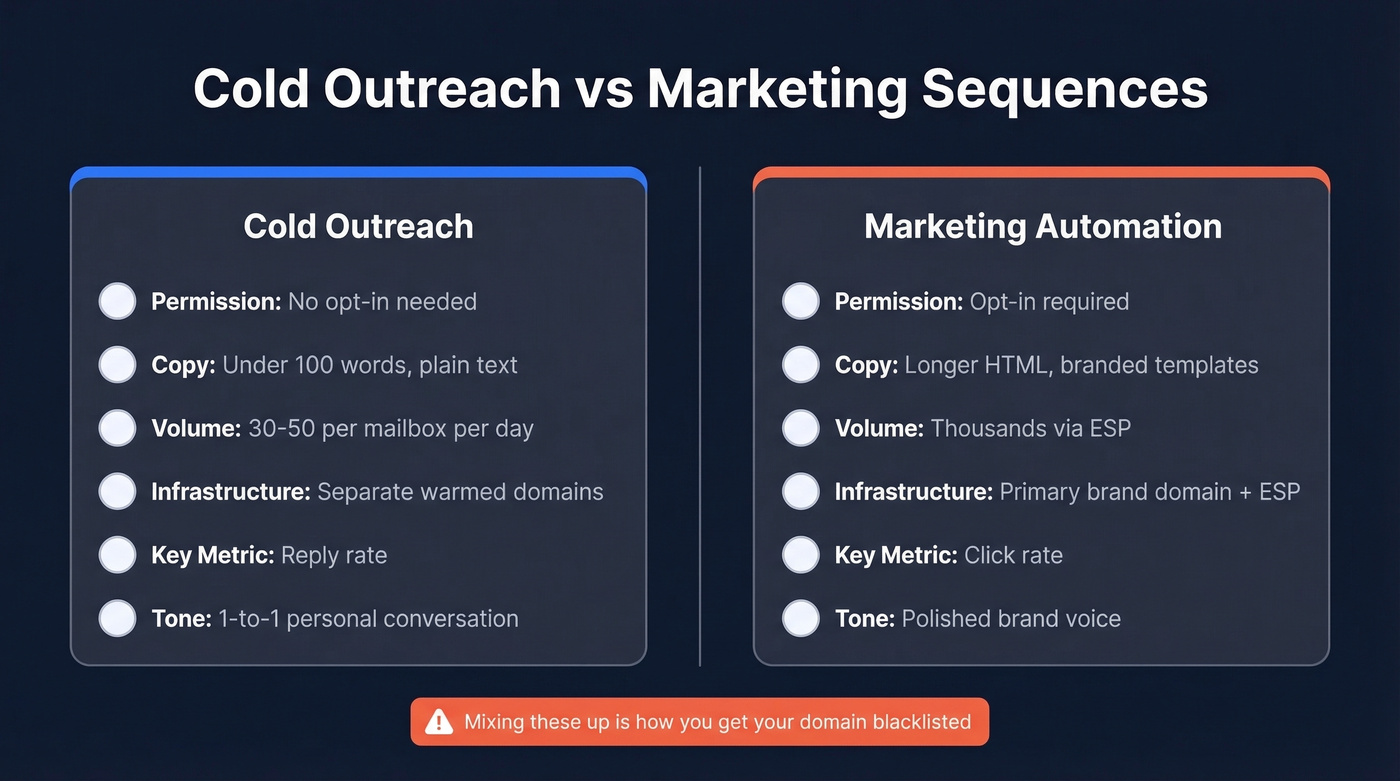
| Dimension | Cold Outreach | Marketing Automation |
|---|---|---|
| Permission | No opt-in | Opt-in required |
| Compliance | CAN-SPAM, GDPR, CASL | CAN-SPAM, GDPR, CASL |
| Infrastructure | Separate domains, warmed mailboxes | Primary brand domain + ESP |
| Copy style | <100 words, plain text, 1:1 tone | Longer HTML, branded templates |
| Volume | 30-50/mailbox/day | Thousands via ESP |
| Primary metric | Reply rate | Click rate |
US B2B cold email is generally legal under CAN-SPAM if you follow the rules. GDPR requires legitimate interest. CASL is very strict and essentially prohibits cold email without implied consent - if you're targeting Canada, know the rules before you start.
Look, if your average deal size is under $5k, you probably don't need a 9-email cold sequence with custom video thumbnails. A tight 5-email PAS cadence with verified data will outperform a bloated sequence every time.

You just mapped out a 6-email cadence. Now imagine 30% of those emails bouncing - that's your sender reputation destroyed before Email 2 even sends. Prospeo verifies emails with 98% accuracy on a 7-day refresh cycle, so every sequence you launch hits real inboxes. Start with 75 free verifications.
Fix your data before you rewrite your copy again.
Building an Effective Email Cadence
Define Your Goal and Audience
One sequence, one goal. A sequence that tries to book demos, promote a webinar, and nurture cold leads simultaneously will do none of those things well.
Start with the trigger: what action puts someone into this sequence? A trial signup triggers onboarding. A cold list upload triggers outreach. A webinar registration triggers a pre-event drip. The trigger defines the goal, and the goal shapes every email you write after it.
Pick a Framework
Three frameworks cover 90% of sequence emails. Match your subject line to the framework - curiosity for PAS, benefit for BAB, urgency for AIDA. The framework does the heavy lifting so your copy doesn't have to.
If you want a deeper breakdown of AIDA in practice, see the AIDA funnel guide.
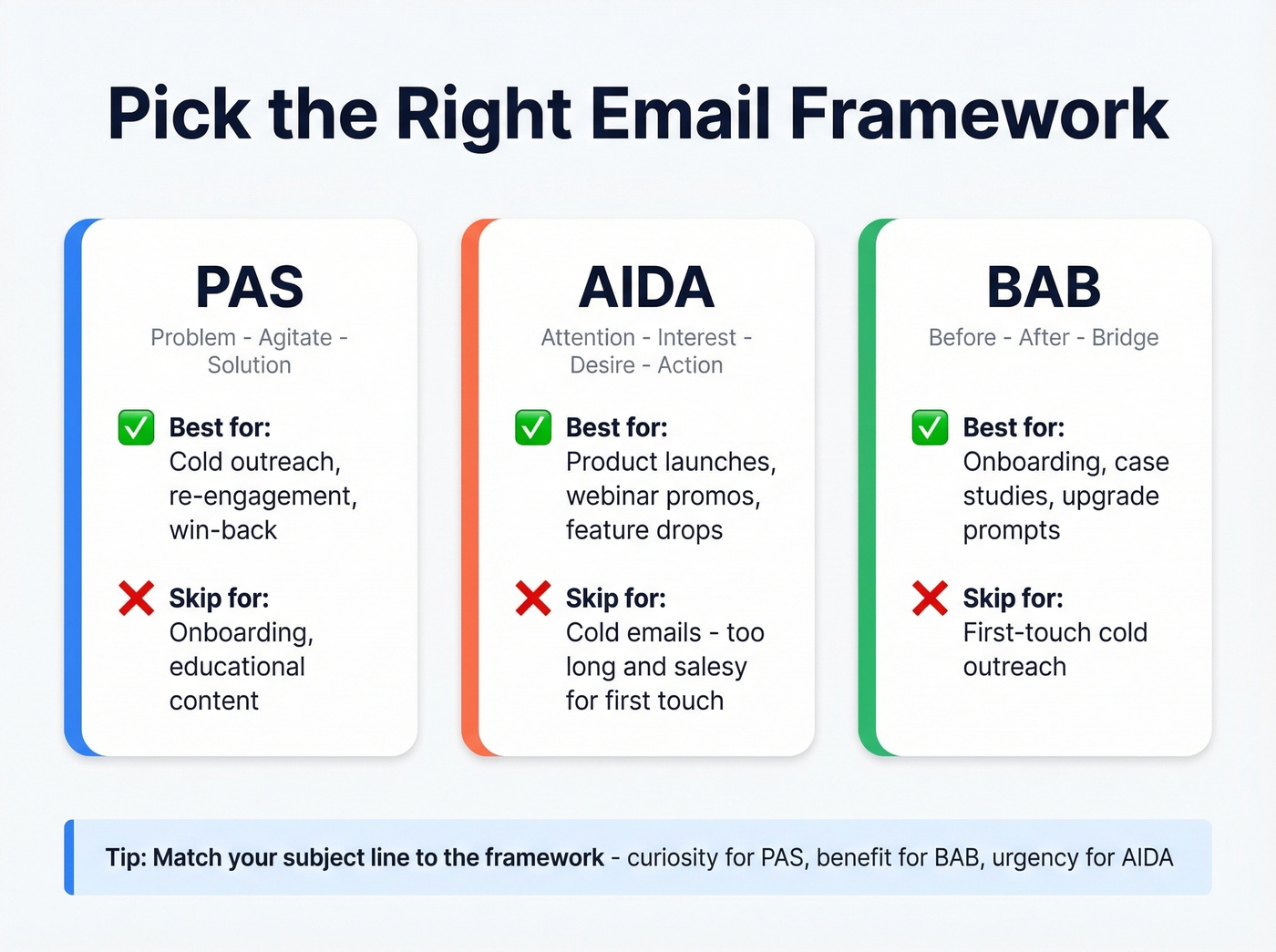
- PAS (Problem-Agitate-Solution): Best for cold outreach, re-engagement, and win-back campaigns. Skip for onboarding or educational content.
- AIDA (Attention-Interest-Desire-Action): Best for product launches, webinar promos, and feature announcements. Skip for cold emails - too long and too salesy for a first touch.
- BAB (Before-After-Bridge): Best for onboarding, case study emails, and upgrade prompts. Skip for first-touch cold outreach.
Here's a quick PAS cold email in action:
"Most SDR teams spend 4+ hours a day finding contact data that bounces 20% of the time. That's 20 hours a week wasted before a single conversation starts. We cut that to under an hour for teams like [similar company] - worth a quick chat?"
Three sentences. Under 60 words. Soft CTA. This kind of concise, framework-driven structure consistently outperforms longer, feature-heavy pitches because it respects the reader's time and leads with their problem, not your product. For more examples, compare with a full B2B cold email sequence build.
Map Your Cadence
Most replies don't come from the first email. Data from cold email platforms shows 4-7 step sequences generate roughly 3x the reply rate of 1-3 step sequences. The sweet spot is 5-9 emails over 2-4 weeks. Here's a proven 6-email, 23-day cadence you can steal:
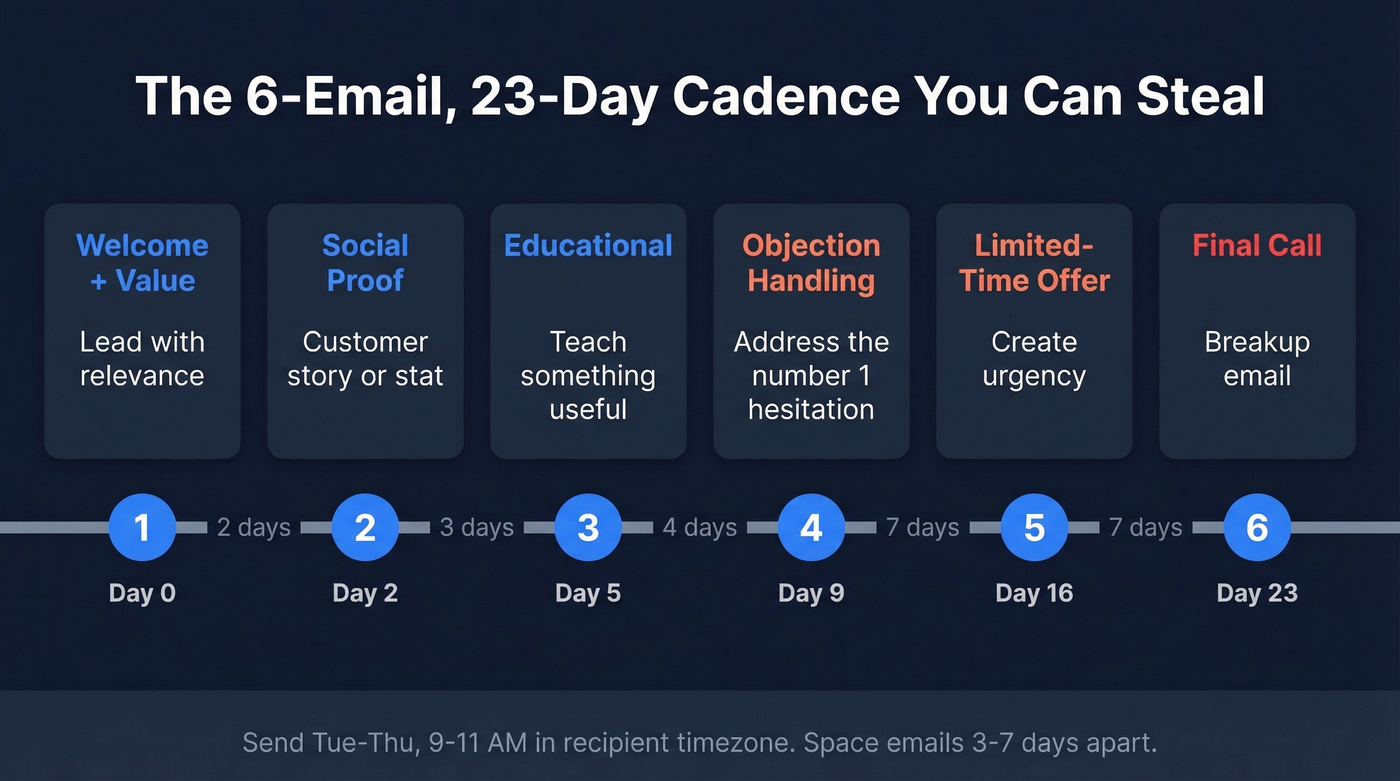
| Day | Purpose | Angle | |
|---|---|---|---|
| 1 | 0 | Welcome + value | Lead with relevance |
| 2 | 2 | Social proof | Customer story or stat |
| 3 | 5 | Educational | Teach something useful |
| 4 | 9 | Objection handling | Address the #1 hesitation |
| 5 | 16 | Limited-time offer | Create urgency |
| 6 | 23 | Final call | Breakup email |
Send Tuesday through Thursday, 9-11 AM in the recipient's timezone. Space emails 3-7 days apart. Don't quit after one send. If you need timing data, use this best time to send cold emails playbook.
Write Emails That Earn Replies
One email, one purpose. If you're asking for a meeting, don't also pitch a webinar and link to a case study. Repeat the same CTA a couple of times so it's easy to spot, but keep the goal singular.
Map each email to an emotional driver: belief, fear removal, financial justification, or trust. If your sequence doesn't address at least three of these across its emails, you're leaving replies on the table.
For cold emails, keep it under 100 words, plain text, soft CTA ("Worth a quick chat?"). Plain text emails often outperform designed templates - they bypass Gmail's Promotions tab and feel like a real person wrote them. No image-heavy designs. No three-paragraph intros about your company's founding story. Nobody cares. If you want ready-to-use copy, pull from these cold email follow-up templates.
For marketing emails, stick to one clear CTA, mobile-optimized layout, and don't cram three offers into one send. Benchmarks vary wildly by industry - software sequences average a 1.15% click rate while consulting hits 2.41%, according to Mailchimp's benchmark data. To tighten your CTA, use these email call to action rules.
A note on open rates: Apple Mail Privacy Protection inflates them significantly. Across 3.6M campaigns tracked through late 2025, the median open rate was 43.46% and the median click rate was 2.09%. Optimize for replies if you're doing cold, clicks if you're doing marketing. Opens are vanity.
Verify Your Data First
The best copy in the world bounces if the email address is wrong. Bounce rates above 1% damage your sender reputation, and once that's tanked, every subsequent email - even to valid addresses - lands in spam. Google flags senders with spam complaint rates above 0.3%, so monitor yours in Google Postmaster Tools. If you’re troubleshooting, start with email bounce rate benchmarks and fixes, then work through this email deliverability guide.
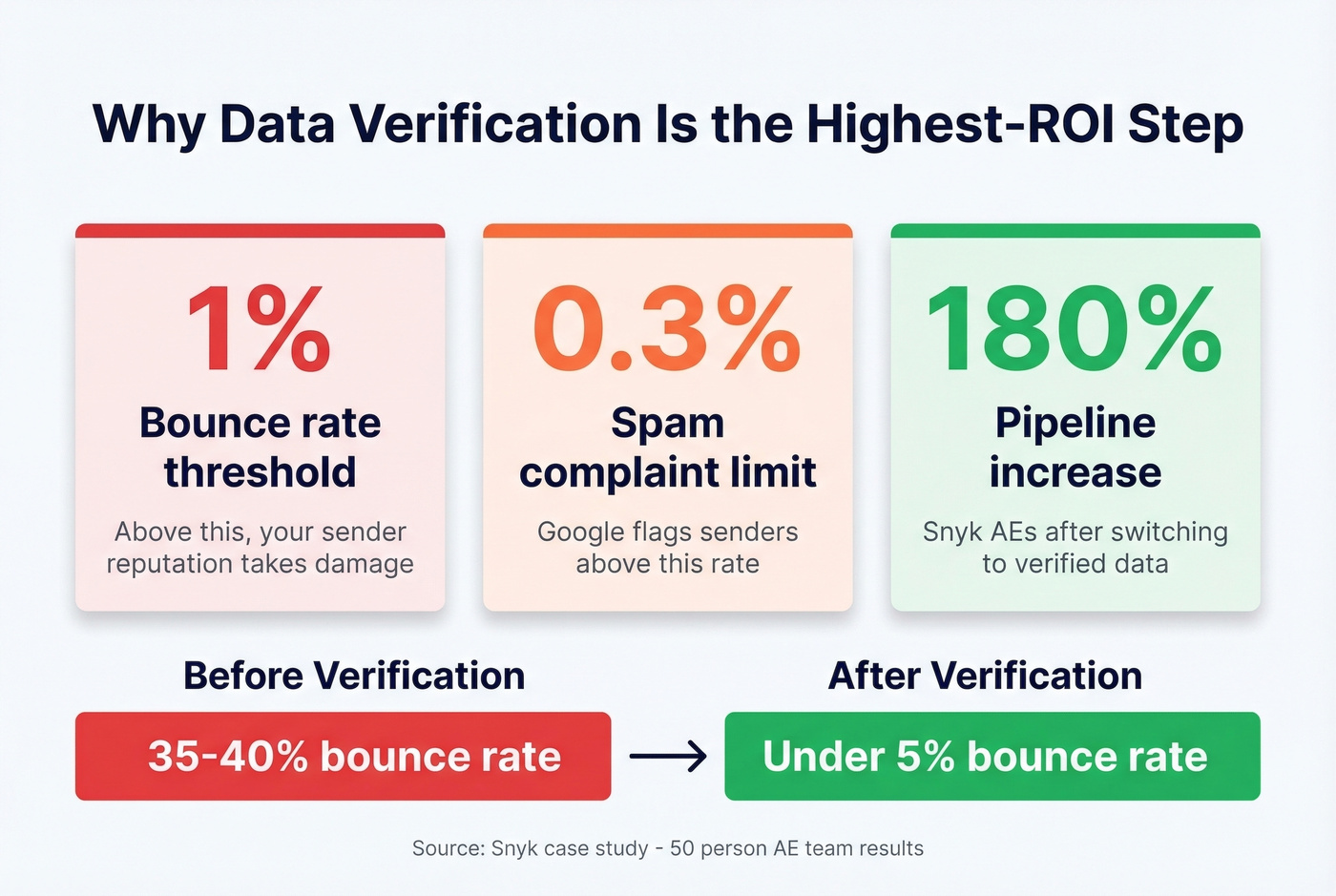
In our experience, data quality problems masquerade as copy problems constantly. We've seen teams rewrite sequences five times when the real issue was a 30% bounce rate. Snyk's 50-person AE team saw bounce rates drop from 35-40% to under 5% after switching to verified data, and AE-sourced pipeline jumped 180%. You can spend weeks perfecting your sequence copy, but none of it matters if half your list is dead addresses.
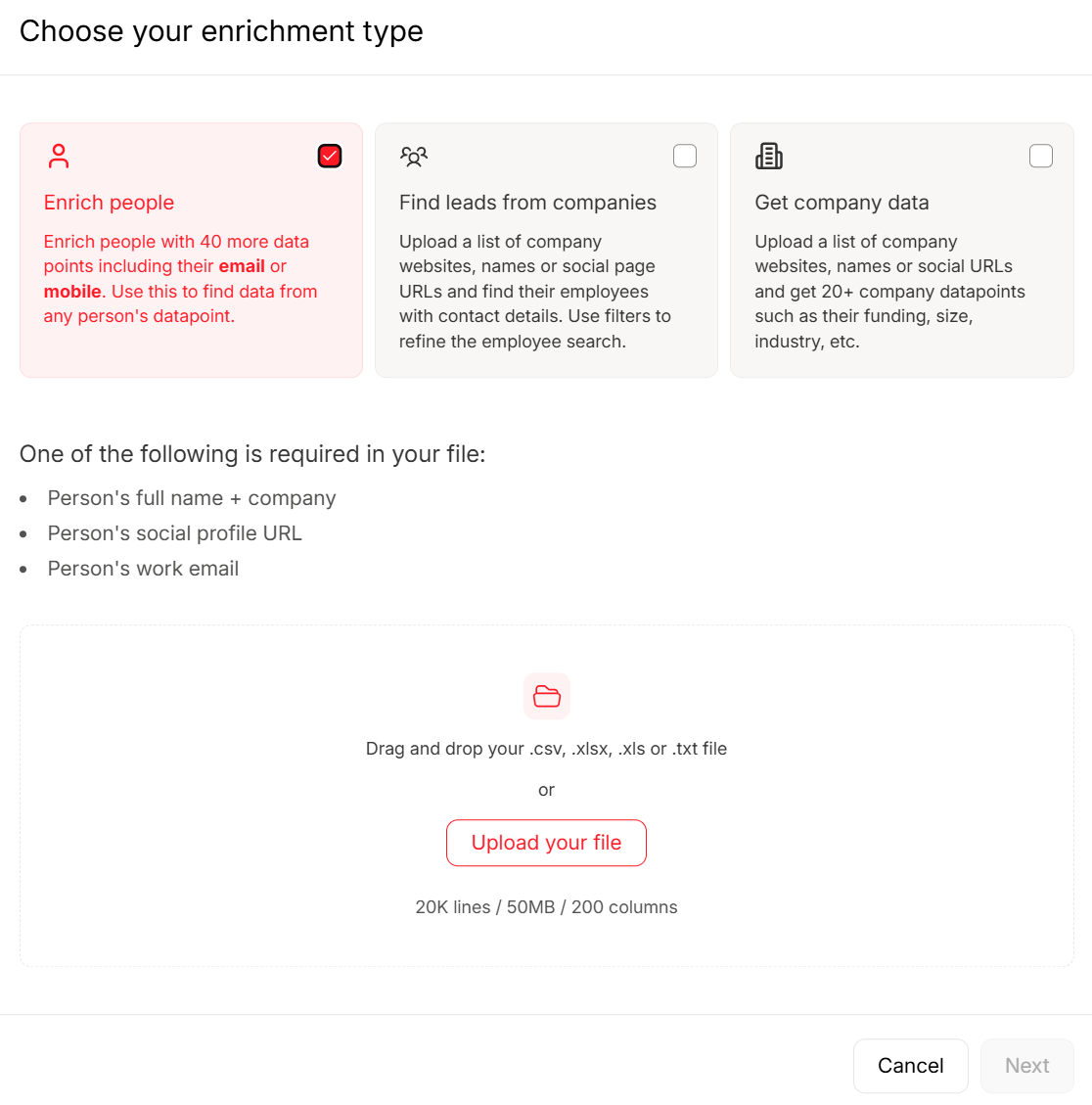
Tools like Prospeo verify emails in real time with 98% accuracy and refresh data every 7 days. The free tier gives you 75 email verifications per month - enough to test before you commit. Push clean contacts straight to your sequencer via native integrations with Instantly, Lemlist, Smartlead, or Outreach. If you’re comparing options, see these Bouncer alternatives for email verification.
Mistakes That Kill Conversion Rates
Cold email mistakes:
- Writing 300-word emails that read like press releases
- Sending one email and quitting - follow-ups are where most replies happen
- Using your primary domain for cold outreach
- Stuffing in multiple links and attachments, which tanks deliverability
- Sending to unverified lists
Marketing email mistakes:
- Skipping segmentation and blasting your entire list
- Ignoring mobile rendering - half your opens are on phones
- Cramming 3 CTAs into one email
- Never A/B testing subject lines (even small changes to subject lines can swing open rates by 20%+, per HubSpot's research)
- Skipping SPF/DKIM/DMARC authentication - this is table stakes in 2026
If you’re building a repeatable outbound motion, align this with your sales prospecting techniques and your sequence management process.
Let's be honest: most of these aren't exotic mistakes. They're basics that teams skip because they're in a rush to hit send. Slow down. Fix the foundation first.
Snyk's 50 AEs cut bounce rates from 35% to under 5% and grew pipeline 180% - not by rewriting sequences, but by switching to verified contact data. Prospeo gives you 143M+ verified emails at $0.01 each, with native integrations to Smartlead, Instantly, and Lemlist so clean data flows straight into your sequencer.
Stop optimizing copy on top of broken lists.
FAQ
How many emails should be in a sequence?
Start with five to nine emails spread over two to four weeks. A 6-email, 23-day cadence is a reliable baseline - trim the tail if engagement drops off after email 4. Sequences shorter than 4 emails leave 60%+ of potential replies on the table.
What's a good click rate for email sequences?
The median click rate across 3.6M campaigns tracked through late 2025 was 2.09%. Software sequences average 1.15% while consulting hits 2.41%. Ignore open rates - Apple Mail Privacy Protection inflates them. Clicks and replies are the metrics that matter.
Should I verify emails before launching a sequence?
Always. Bounce rates above 1% damage your sender reputation and tank deliverability for every subsequent send. The consensus on r/coldemail is pretty clear: verify first, sequence second. It's the single highest-ROI step most teams skip.
What separates sequences that convert from ones that flop?
Three things: relevance to the recipient, proper cadence timing, and clean data. Most underperforming sequences fail on at least one. Pick the right framework, verify your list, and A/B test subject lines - that combination turns mediocre drips into high-performing cadences.