

How to Write a Follow-Up Email That Actually Gets a Reply (+ Templates)
You sent a great email. Silence. You send a "just checking in" follow-up. More silence.
Here's the thing: the problem isn't that people ignore follow-ups - 42% of all cold email replies come from follow-up messages. The problem is most follow-ups say nothing new. They're filler dressed up as persistence. If you want to write a follow-up email template that actually works, stop copying generic scripts and start applying a framework you can personalize every time.
You don't need 57 templates. You need three frameworks and the discipline to adapt them.
What the Data Says
The average cold email reply rate is 2.09% across 2M+ emails. Only 14.1% of those replies are positive, which puts the effective "interested reply" rate at roughly 0.64%. That's brutal, but it also means the bar is low - a well-crafted follow-up can put you miles ahead of the noise.
| Metric | Cold Outbound | Warm Inbound / Warm Sequences | Elite Performers |
|---|---|---|---|
| Reply rate | ~2-3.5% | 20-30% | 10%+ |
| Meeting rate | 1-3% | 8-12% | 5%+ |
| Optimal length | <80 words | <80 words | <80 words |
| Best days | Tue-Wed | Tue-Thu | Tue-Wed |
| Sequence length | 4-7 steps | 2-3 steps | 4-7 steps |
The numbers that should shape every follow-up you write: informal tone drives 78% more positive replies than formal language. Directors reply 66% more than junior contacts. And the CTA "Want to see it in action?" pulls a 30.05% positive rate versus 8.59% for vague asks like "Mind if I send more info?"
That last stat alone should change how you end every email.
How to Write a Follow-Up Email in 5 Steps
1. Reference the original context. Don't make them dig through their inbox. One sentence: "I sent over the ROI breakdown for your Q3 pipeline last Tuesday." Done.
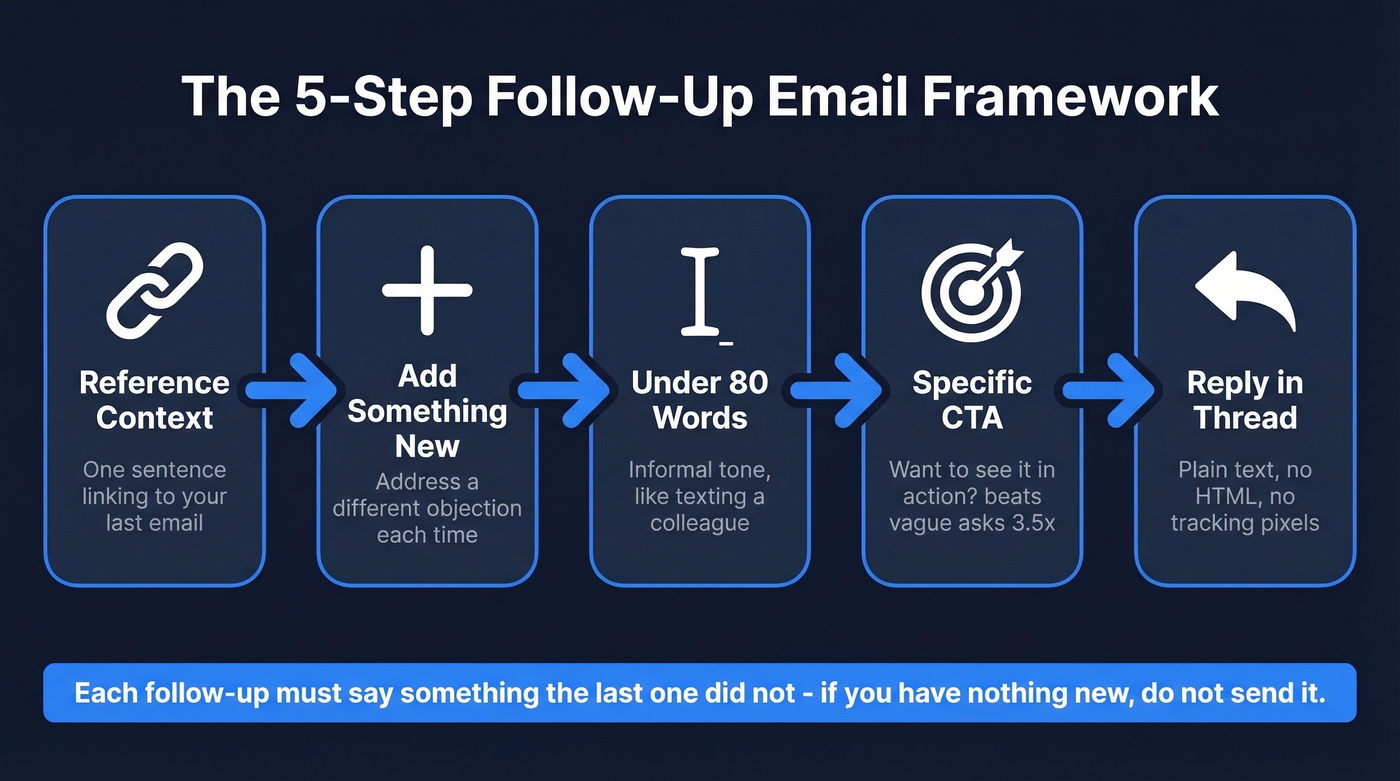
2. Add something new every time. This is where most follow-ups fail, and it's the hill we'll die on. Each message should address a different objection - need, cost, urgency, trust, or desire. If your first email pitched the product, your follow-up should share a case study or address a common hesitation. If you have nothing new to say, don't send it.
3. Keep it under 80 words, informal tone. Short and medium-length emails tie at ~8.8% positive rate. Long emails drop to 6.42%. Write like you're texting a colleague, not drafting a press release. The 80-word rule applies mainly to cold and sales follow-ups - interview and networking emails naturally run a bit longer, and that's fine.
4. Use a specific CTA. "Want to see it in action?" outperforms vague asks by 3.5x. Give them a concrete next step: a 15-minute call, a specific date, a link to book. (If you want more options, see these email call to action examples.)
5. Send as a reply to the original thread. Plain text, no HTML templates, no tracking pixels. It should look like a real person hitting "reply," because that's exactly what it is.
Once you internalize these five steps, the actual writing takes minutes. The thinking is what matters.
Subject Lines That Get Opens
A Belkins study of 5.5M emails found personalized subject lines hit 46% open rates versus 35% without - and a 133% lift in reply rates. Keep subject lines to 2-4 words. Question formats average 46% opens.
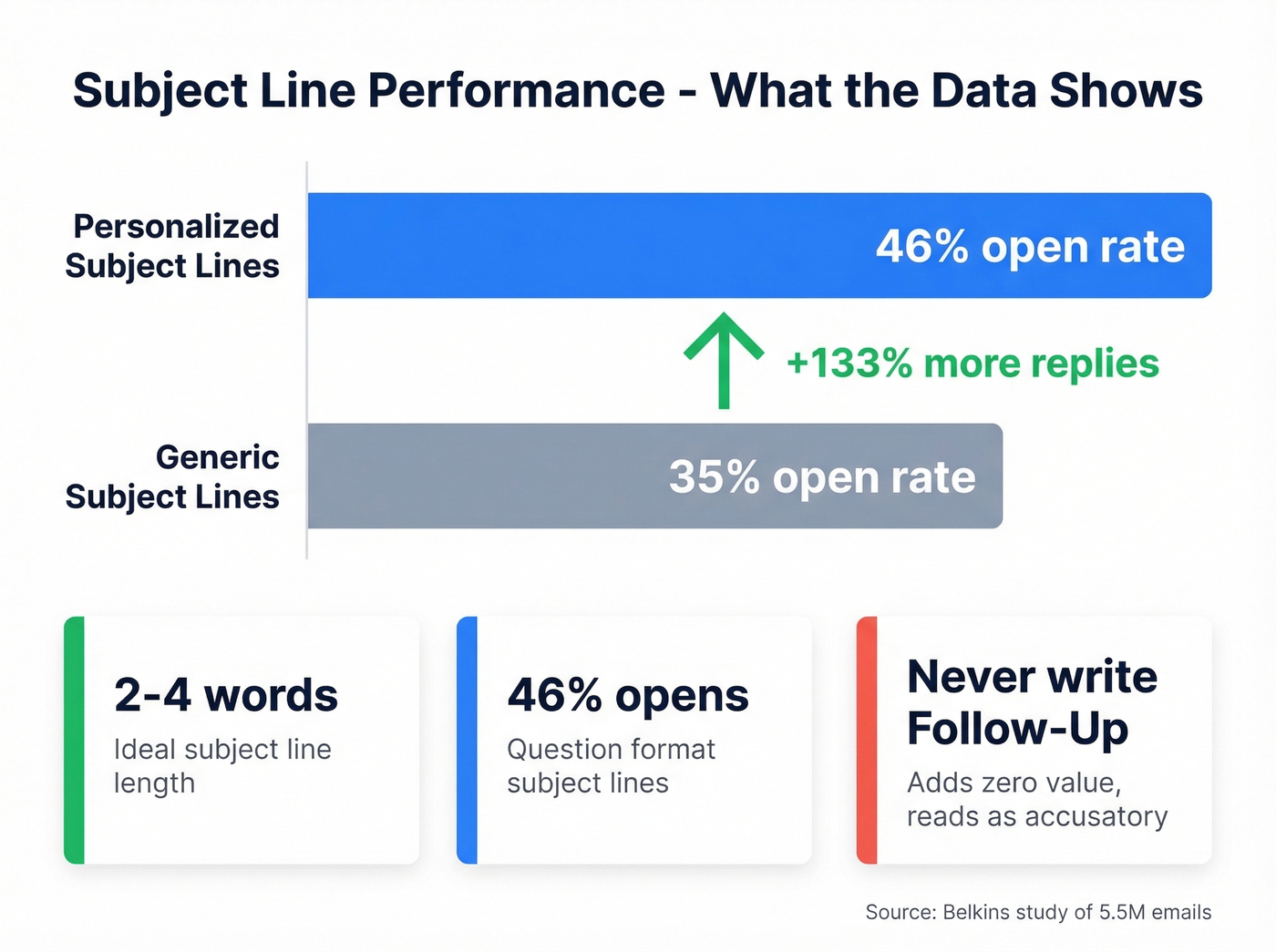
Don't put "follow-up" in your subject line. It adds zero value and reads as accusatory. Since you're replying to the original thread, the subject carries forward naturally anyway. If you need ideas, pull from these email subject line examples and subject lines that get opened.

A perfect follow-up sent to a bad email address is just wasted effort. Prospeo delivers 98% email accuracy with 5-step verification - so every follow-up you craft actually reaches the inbox. At $0.01 per email, bad data is no longer an excuse for silence.
Stop writing follow-ups to email addresses that don't exist.
10 Follow-Up Email Templates
Sales - No Response
Hi {{first_name}}, I shared some thoughts on {{specific topic}} last {{day}}. Since then, {{company}} published a case study showing {{relevant result}}. Worth 15 minutes to see if that applies to your team?
Sales - Post-Demo
{{first_name}}, thanks for the time on {{day}}. You mentioned {{specific pain point}} - I pulled together a quick breakdown of how we'd address that. Attached. Want to walk through it Thursday?
Sales - Break-Up
{{first_name}}, I've reached out a few times and haven't heard back - totally understand if the timing's off. If {{problem you solve}} becomes a priority, I'm here. Deleting the reminder on my end.
The break-up email is underrated. We've seen it pull replies weeks later because it removes pressure entirely - people respond when they don't feel cornered. (More options here: sales follow-up templates.)
Interview - Thank You
Hi {{interviewer_name}}, really enjoyed our conversation today. When you mentioned {{specific challenge}}, it resonated - that's exactly the kind of problem I tackled at {{previous company}} by {{brief approach}}. Looking forward to next steps.
Interview - No Response
Hi {{interviewer_name}}, following up on our conversation from {{date}}. I've been thinking about {{challenge they mentioned}} and had a few ideas I'd love to share. Is there a good time this week?
Networking Event
{{first_name}}, great meeting you at {{event}}. Your point about {{specific topic}} stuck with me - coffee or a quick call next week?
Invoice / Payment
Hi {{first_name}}, quick note that invoice #{{number}} from {{date}} is still outstanding. Let me know if anything's holding it up - happy to resend or adjust.
Partnership Request
{{first_name}}, I reached out last week about a potential partnership between {{your company}} and {{their company}}. I think there's strong overlap around {{specific area}}. Worth a 20-minute call?
Schedule-Finalizing
{{first_name}}, I'm finalizing my schedule for next week and wanted to see if {{specific date/time}} works. If not, I'm flexible - just let me know.
This framing works because it's practical, not needy. You're not "checking in" - you're making a logistical ask with a natural deadline.
Referral Request
{{first_name}}, I know you're connected to folks in {{industry/role}}. If any of them are dealing with {{specific problem}}, I'd appreciate an intro. Happy to return the favor.
Timing and Cadence
| Follow-Up # | Days After Previous | Notes |
|---|---|---|
| 1st | 2-3 days | Highest impact window |
| 2nd | 4 days | Add new angle |
| 3rd | 7 days | Case study or social proof |
| 4th+ | 14 days | Break-up or soft check-in |
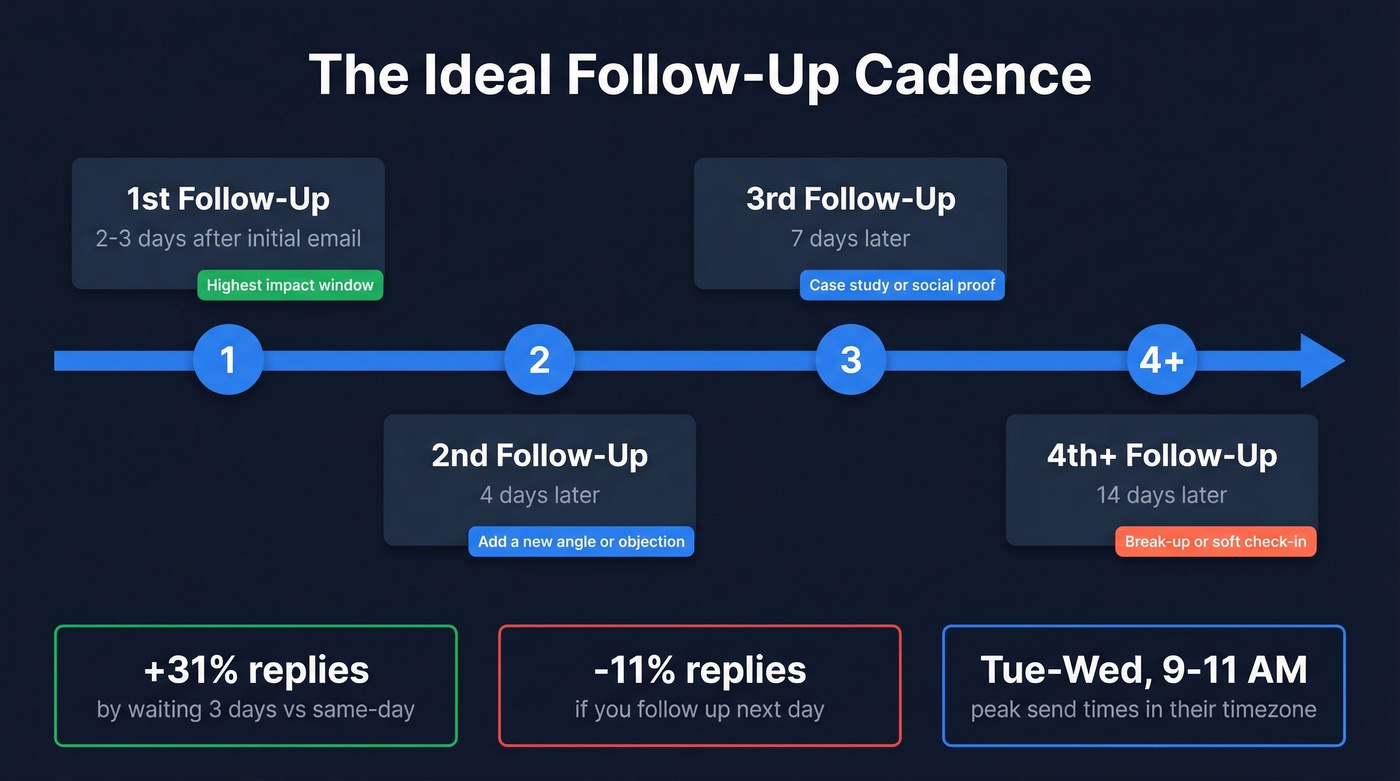
Waiting 3 days increases replies by 31% compared to same-day follow-ups - next-day follow-ups actually reduce replies by 11%. Tuesday and Wednesday are peak days. Send between 9-11 AM in the recipient's time zone. (For a deeper breakdown, see best time to send cold emails and when should i follow up on an email.)
We've seen the 3-day rule hold across hundreds of campaigns. The sweet spot is 4-7 touchpoints before diminishing returns set in. For warm sequences like post-demo or post-interview, two to three touches is plenty - anything beyond that starts feeling like pestering rather than persistence.
Deliverability: The Silent Follow-Up Killer
Your follow-up can be flawless and still fail if it never reaches the inbox. Let's be honest - most teams skip this part entirely, then wonder why their reply rates are in the gutter.
Here's what non-negotiable setup looks like:
- Authenticate your domain. SPF, DKIM, and DMARC - without them, you're flagged before anyone reads a word. Set up BIMI to display your logo in inboxes once authentication is in place. (If you’re troubleshooting, start with DMARC alignment and how to verify DKIM is working.)
- Cap at 20 emails/day per inbox. Use separate domains for outbound - never your primary domain. (More on safe sending limits: email velocity.)
- Warm up for 3 weeks minimum before launching any sequence.
- Don't track opens. Tracking pixels hurt deliverability. Measure replies instead. (Details: email tracking pixel.)
- Plain text only. No HTML templates, no heavy formatting, no image-heavy signatures.
- Verify every address before sending. The average bounce rate is 2.8% - roughly 3 dead addresses per 100 follow-ups quietly destroying your sender reputation. (Benchmarks + fixes: email bounce rate.)
That last point is where most teams slip. Prospeo's 5-step verification catches invalids, spam traps, and honeypots before they damage your domain - 98% email accuracy means your follow-ups actually land. One customer, Meritt, cut bounce rates from 35% to under 4% after verifying through Prospeo, and their pipeline tripled in the process.
Directors reply 66% more than junior contacts - but only if you have their real email. Prospeo's 300M+ verified profiles and 30+ filters let you target decision-makers by title, intent signals, and company growth. Pair the right follow-up with the right person.
Reach the decision-maker, not the gatekeeper's spam folder.
What Kills Replies
The single biggest reply killer, in our experience, isn't bad copy - it's sending a follow-up that says nothing the first email didn't. "Just following up" with no new information is the #1 sin, and it's shockingly common. The consensus on r/sales echoes this constantly: if you have nothing new to add, don't send it.
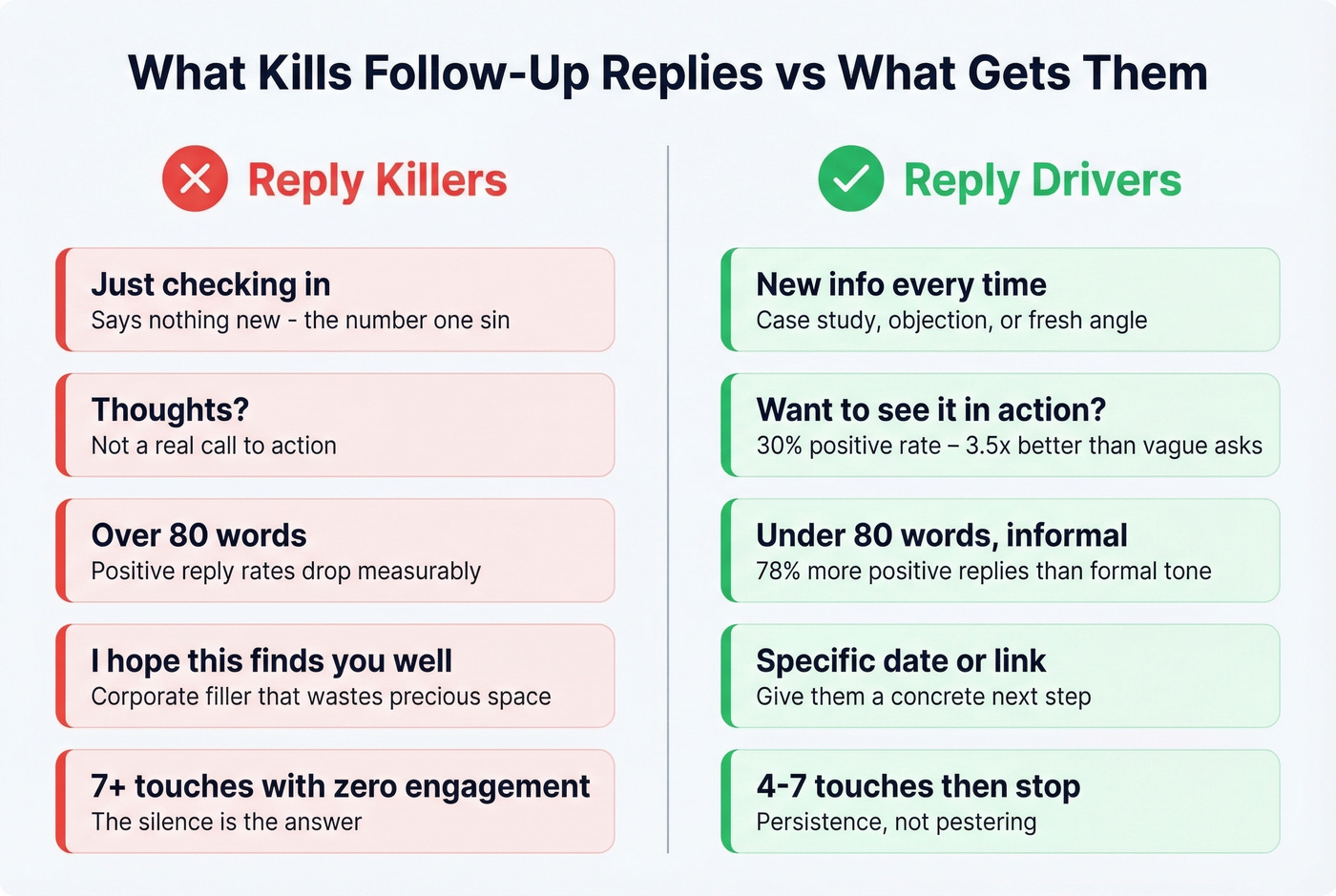
Right behind that: no clear CTA. "Thoughts?" isn't a call to action. Every follow-up needs a specific ask - a date, a link, a yes-or-no question.
And keep it short. Over 80 words and positive reply rates drop measurably. Drop the "I hope this email finds you well" and write like a human. According to Woodpecker's 2026 benchmarks, informal language drives 78% more positive replies than corporate tone.
Finally, know when to stop. If someone explicitly says no, respect it. If they've unsubscribed, you're done. Seven messages with zero engagement? The silence is the answer. Persistence is a virtue; pestering is a reputation killer.
Skip the seven-touch sequence if your deals typically close under $10K. Three well-timed, well-written follow-ups will outperform a bloated cadence every time. Most teams over-engineer their sequences and under-invest in making each individual email worth reading.
FAQ
How many follow-ups should I send?
Four to seven touchpoints is the sweet spot based on 2026 benchmark data. For warm follow-ups like post-demo or post-interview, two to three is enough. Beyond seven cold touches with zero engagement, you're hurting your sender reputation more than helping your pipeline.
What's a good follow-up reply rate?
The 2026 benchmark average cold email reply rate is 3.43%, with top performers exceeding 10%. For warm inbound and warm sequences, expect 20-30%. If you're below 2%, revisit your list quality and messaging before adding more touches.
Should I follow up after a job interview?
Yes, within 24 hours. Reference something specific the interviewer said, then connect it to your experience. This turns a generic thank-you into proof you were listening - and it's the easiest way to stand out from other candidates.
How do I keep follow-ups out of spam?
Authenticate your domain with SPF, DKIM, and DMARC. Send plain text, stay under 20 emails per day per inbox, and verify every address before sending. The free tier on Prospeo covers 75 verifications per month - enough to clean a small list before your next campaign.
Can I adapt one template for different situations?
Absolutely. The five-step framework - reference context, add new value, keep it short, use a specific CTA, and reply in the original thread - works for sales, interviews, networking, and invoices alike. Master those fundamentals and you can write a follow-up email template for any scenario in under five minutes.