

How to Write a Follow-Up Email That Clients Actually Answer
You sent the proposal three days ago. Radio silence. You've rewritten "just checking in" four times and deleted it each time. Sound familiar?
Knowing how to write a follow-up email to a client isn't really about finding the right words - it's about understanding why the silence happens and having a system for breaking through it. 40% of people have 50+ unread emails sitting in their inbox right now. Your message isn't being ignored. It's being buried.
The Quick Version
- Follow up once within 3-5 business days with a new reason to reply - not "just checking in."
- Keep subject lines to 2-4 personalized words.
- Three follow-ups is the ceiling. After that, close the loop or verify you've got the right email address in the first place.
Why Clients Go Silent
It's rarely personal. Four things explain most silence.
They're drowning. With 50+ unread emails at any given time, your follow-up competes with everything from board decks to lunch orders. Timing matters more than wording.
They're stuck internally. Your client might love the proposal but need sign-off from a VP who's traveling, a legal review that's backlogged, or budget approval that won't land until next quarter. Internal red tape stalls more deals than bad proposals ever will. One r/office thread captured it perfectly: a client who replies once a week while six people sit blocked waiting.
They haven't decided yet. Sometimes the honest answer is "I don't know," and people avoid saying that out loud. A follow-up that gives them a low-friction way to say "not yet" can unlock a reply.
Your email never arrived. Before you rewrite your follow-up for the fifth time, confirm the address is valid. We've seen teams burn weeks chasing contacts at dead addresses - Prospeo's real-time verification catches those before you waste the effort. (If you need a quick process, see how to check if an email exists.)
Timing and Structure
Not all follow-ups deserve the same cadence. Here's a simple framework adapted from Fyxer's cadence model:
| Situation | Wait Time | Example |
|---|---|---|
| Time-sensitive blocker | 24-48 hours | Scheduling, approvals |
| Standard follow-up | 3-5 business days | Post-meeting recap |
| Proposal or big decision | 1 week | Quotes, contracts |
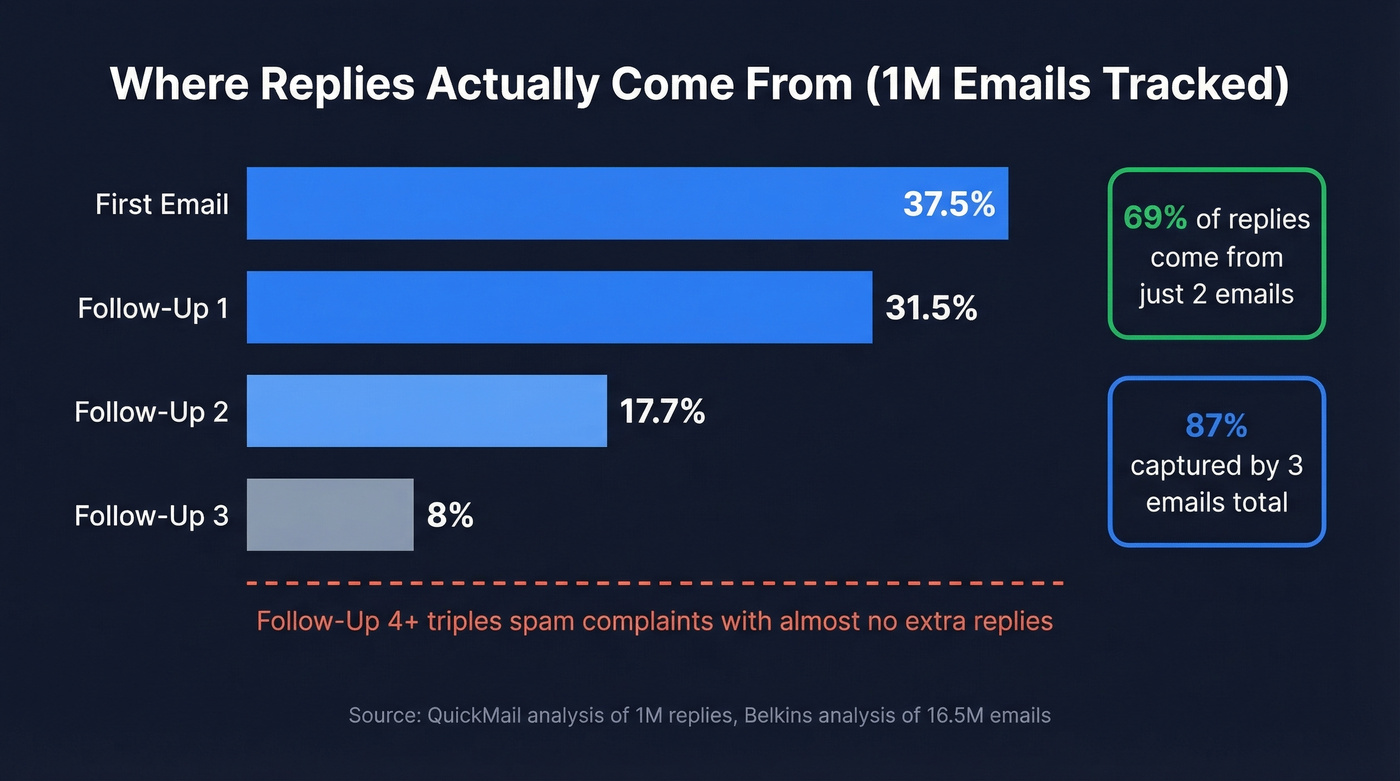
Based on 1 million replies tracked by QuickMail, replies cluster heavily in the first few touches: the first email accounts for 37.5% of replies, the first follow-up adds 31.5%, the second adds 17.7%, and the third adds 8%.
Here's the thing: sending a fourth email more than triples your unsubscribe and spam complaint rates. That's from an analysis of 16.5M cold emails across 93 domains. Two touches - your initial email plus one follow-up - capture roughly 69% of all replies. Three touches get you to about 87%. (If you're building a repeatable system, use a dedicated follow-up email software workflow.)
The "80% of sales require 5 follow-ups" stat everyone cites? It's unsourced and dangerous. The actual data from 16.5M emails tells a completely different story. If you're sending five follow-ups to clients, you're not being persistent - you're burning your domain. (More on protecting deliverability in our email deliverability guide.)
Subject Lines That Get Opened
A 5.5M-email study makes this clear. Personalized subject lines hit a 46% open rate versus 35% without, and reply rates jump from 3% to 7%. That's a 133% increase just from adding a name or company. (For more ideas, browse these email subject line examples.)
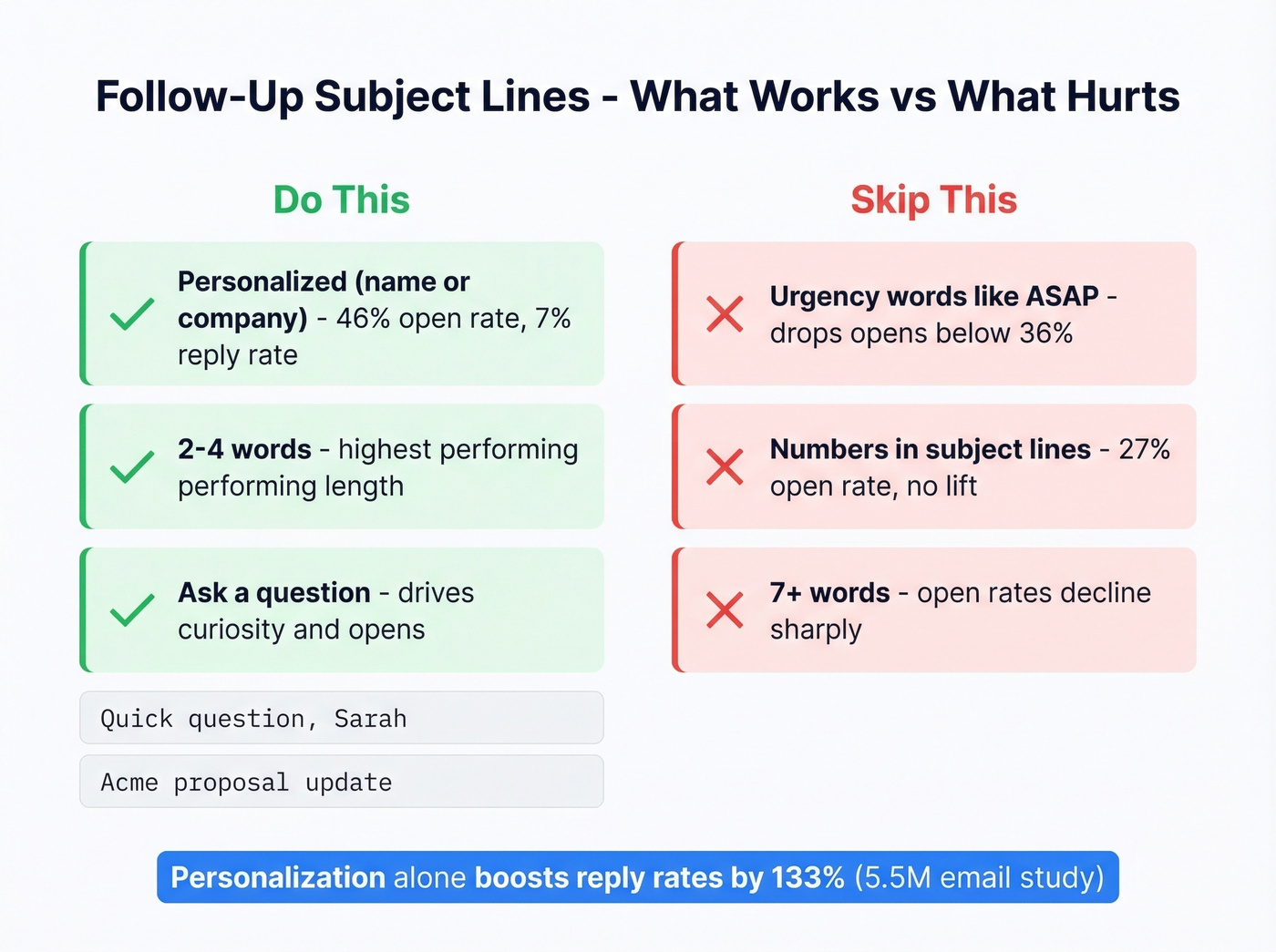
Do this: Keep it to 2-4 words. Ask a question. Include the client's name or project. "Quick question, Sarah" or "Acme proposal update" both work. In our experience, two-word subject lines outperform everything else.
Skip this if you're tempted by urgency words. "ASAP" and similar language drags opens below 36%. Numbers in subject lines don't help either - 27% open rate vs. 28% without. And anything over 7 words starts losing ground fast. (If you're optimizing systematically, use a subject line tester.)

Before you rewrite that follow-up a fifth time, make sure it's actually reaching someone. Teams waste weeks chasing contacts at invalid addresses. Prospeo's 5-step email verification catches dead addresses before you burn follow-ups - and your domain reputation - on contacts that never existed.
Verify your client's email is real before you follow up again.
Five Templates That Actually Work
Most template roundups are the same email with different adjectives. You need five - one for each scenario you'll actually encounter, each targeting a different reason the client hasn't replied. (If you want more variations, see our sales follow-up templates.)
After a Meeting (No Response)
This schedule-framing technique from r/sales works because it creates gentle urgency without pressure:
"Hi [Name], I'm finalizing my schedule for next week - does [date] still work for our next step? If timing shifted, no worries - just let me know."
You're not asking them to make a decision. You're asking them to confirm logistics. Much smaller ask. (More examples in our sales meeting follow-up email guide.)
After Sending a Proposal
Give them a binary choice - binary questions are far easier to answer than open-ended ones:
"Hi [Name], wanted to check in on the proposal from [date]. Want to move forward, or should I adjust anything?"
Waiting on Documents or Info
Be warm but specific. Vagueness invites procrastination, and a soft deadline keeps things moving without sounding like a demand:
"Hi [Name], I need [specific document] by [date] to keep us on track for [milestone]. Can you send it over, or should I loop in someone else on your team?"
Overdue Payment
Matter-of-fact tone. State the facts, state the consequence, ask the question:
"Hi [Name], Invoice #[X] is [Y] days past due. Can you confirm payment timing so I can update our records?"
The Breakup Email
The graceful exit:
"Hi [Name], I haven't heard back, so I'll assume the timing isn't right. I'm closing this out on my end - feel free to reach back anytime."
This one often gets the fastest reply because it signals the conversation is ending. People hate losing options more than they hate responding to emails.
Format Every Follow-Up Like This
Regardless of which template you choose, every follow-up should hit the same structural beats:
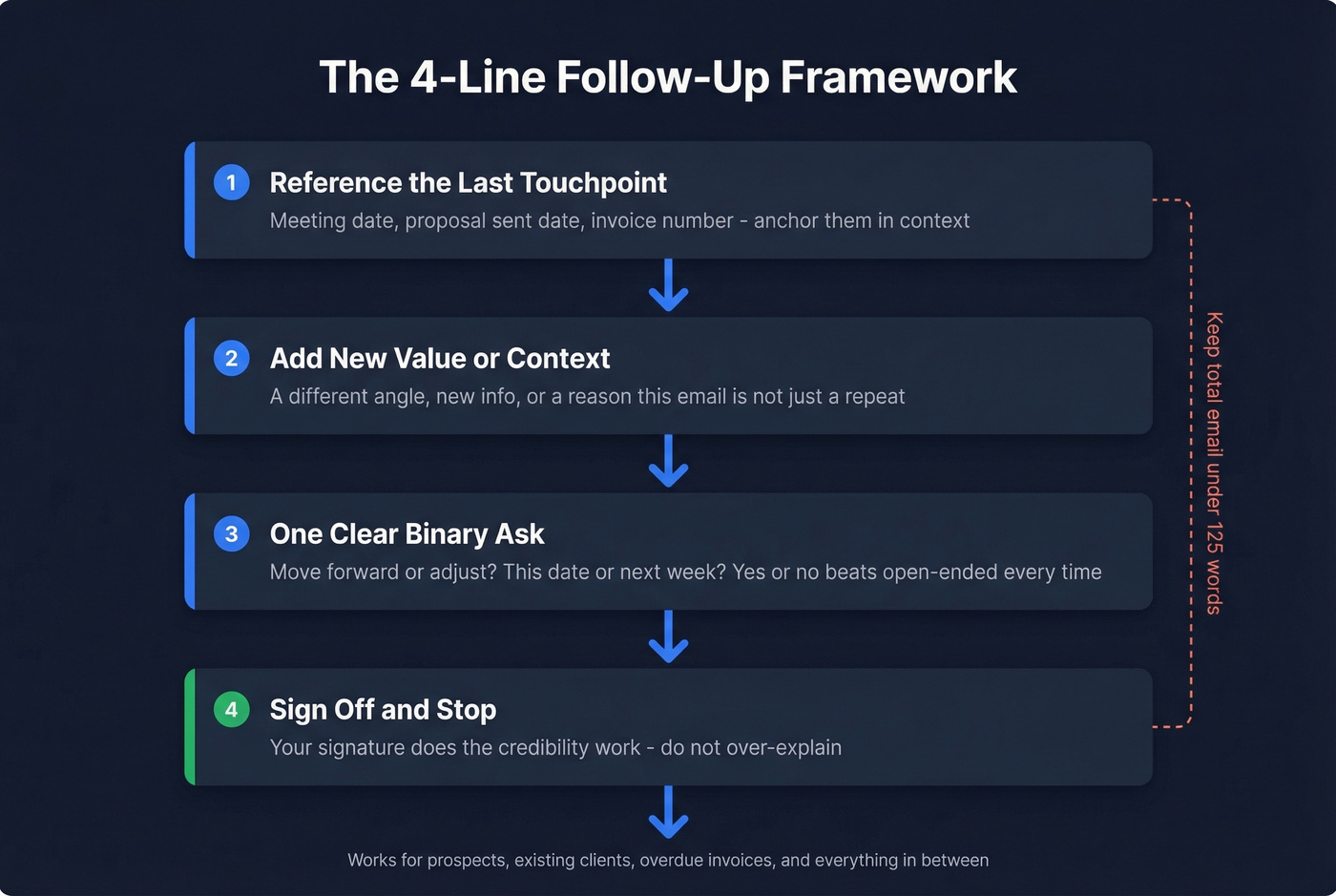
Line 1: Reference the previous touchpoint - meeting date, proposal, invoice number. Lines 2-3: Add new value or context, something that makes this email different from the last one. Line 4: One clear, specific ask. Binary questions outperform open-ended ones every time. Then sign off. Keep it short. Your signature block does the credibility work. (For more on writing emails that convert, see email copywriting.)
This format works whether you're nudging a prospect or chasing an overdue deliverable from an existing client.
Mistakes That Kill Reply Rates
"Just checking in" adds zero reason to reply. Each follow-up needs new value or a new angle - a different objection addressed, a new piece of context, something. (If you want alternatives, see how to say just checking in professionally.)
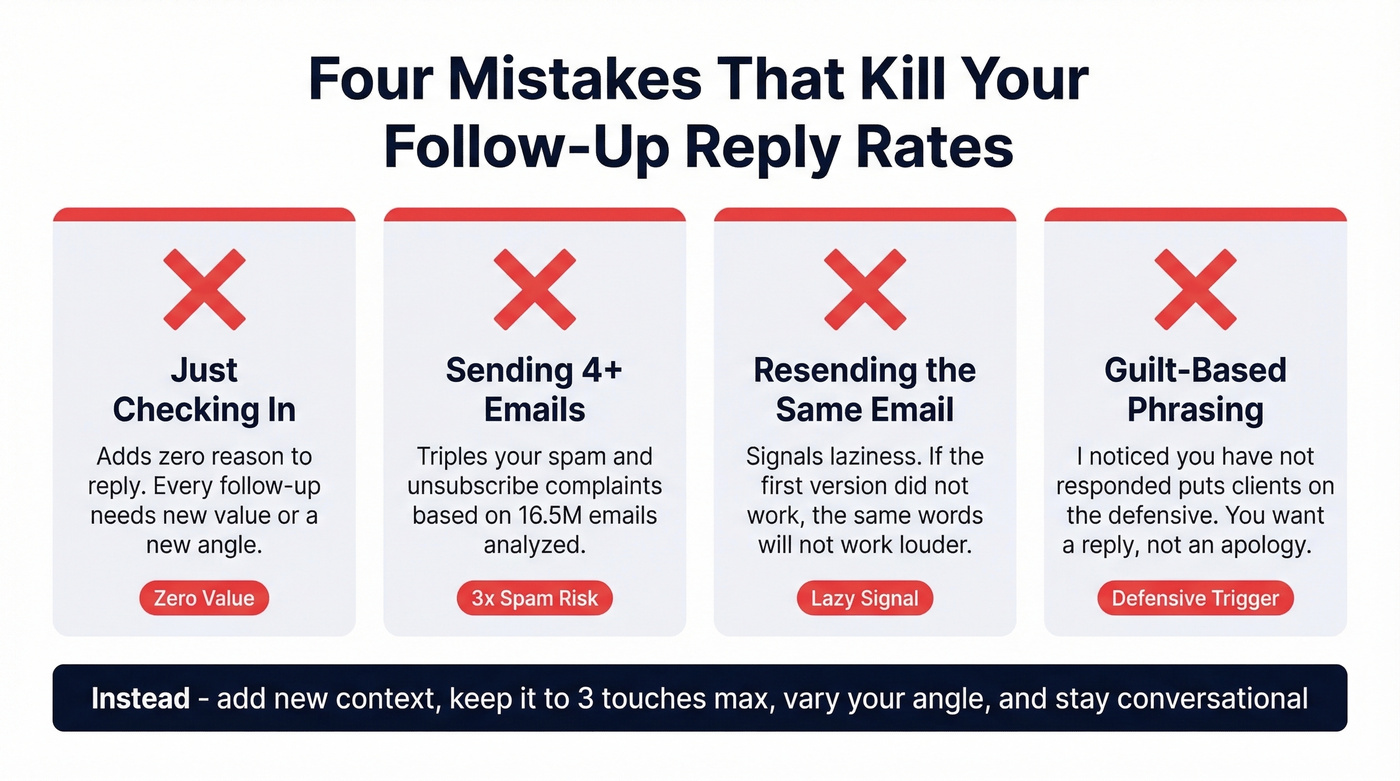
Sending 4+ emails triples spam and unsubscribe complaints. The data is unambiguous. (Track and reduce risk with email reputation tools.)
Resending the identical email signals laziness. If the first version didn't work, the same words won't work louder.
Guilt-based phrasing like "I noticed you haven't responded" puts the client on the defensive. You want a reply, not an apology.
When to Stop
Three follow-ups is the ceiling for client relationships. After that, the marginal return on another email gets tiny - and the risk to your domain reputation is real.
Company size matters too. SMBs tend to tolerate more follow-ups while enterprise contacts ghost after the first.
If three emails don't work, pick up the phone. For existing clients, a call is almost always the right escalation - it signals importance without the spam risk of another email in the thread. LinkedIn outreach is another strong option; data from the 16.5M-email study shows a message plus profile visit combo hits an 11.87% reply rate, higher than any email-only sequence.
Let's be honest: if you've sent three well-crafted follow-ups and heard nothing, the problem usually isn't your copy. It's either bad timing, a dead address, or a deal that was never real. Knowing when to walk away protects both your reputation and your sanity.
Three follow-ups is the ceiling. That means every send has to count - and it starts with knowing you have the right address. Prospeo delivers 98% email accuracy with real-time verification, so your carefully crafted follow-ups land in inboxes, not the void. At $0.01 per email, one verified contact costs less than the time you spend rewriting 'just checking in.'
Stop wasting follow-ups on bad data. Start with verified contacts.
FAQ
How long should a follow-up email be?
Under 125 words. Emails between 50-125 words get the highest reply rates across every major study we've seen. One clear ask, one reason to reply, nothing else.
How many follow-up emails is too many?
Three is the ceiling for most client relationships. A fourth email triples your spam complaint risk based on a 16.5M-email analysis - with almost no incremental replies to show for it.
What if my follow-up emails keep bouncing?
The email address is likely invalid or outdated. Verify deliverability before following up - tools like Prospeo check addresses in real time with 98% accuracy, and there's a free tier of 75 credits per month to start.
How do I follow up without sounding pushy?
Lead with new information or a genuine question rather than restating your original ask. Reference a specific detail from your last conversation, offer a binary choice ("move forward or adjust?"), and keep the tone conversational. The templates above are designed to add value with each touch.