

How to Improve Sales Calls in 2026 (Data-Backed)
Stop optimizing your script. Start optimizing your data.
Your SDR manager just pulled up the connect-rate dashboard and it's sitting at 6%. Half the team is demoralized, the other half is quietly updating their resumes. 84% of reps missed quota last year, and buyers only spend 17% of their time actually meeting with sellers - so every single call has to count. Most advice tells you to "do your research" without explaining what research to do or how long to spend doing it.
Here's what actually moves the needle.
Quick Wins
- Verify your contact data before dialing. Half the numbers in most CRMs are stale. Strip out dead numbers before a call block - they kill connect rates before technique even matters. (If you need a broader stack, start with these SDR tools.)
- Call Tuesday through Thursday, 10-11 AM or 2-4 PM. ZoomInfo's analysis of 1.4 million calls found Tuesday and Wednesday alone generated 44% of all demos. Friday is a dead day.
- Shut up. Target the 70/30 rule: your prospect talks 70%, you talk 30%. Every rep thinks they do this. Almost none actually do.
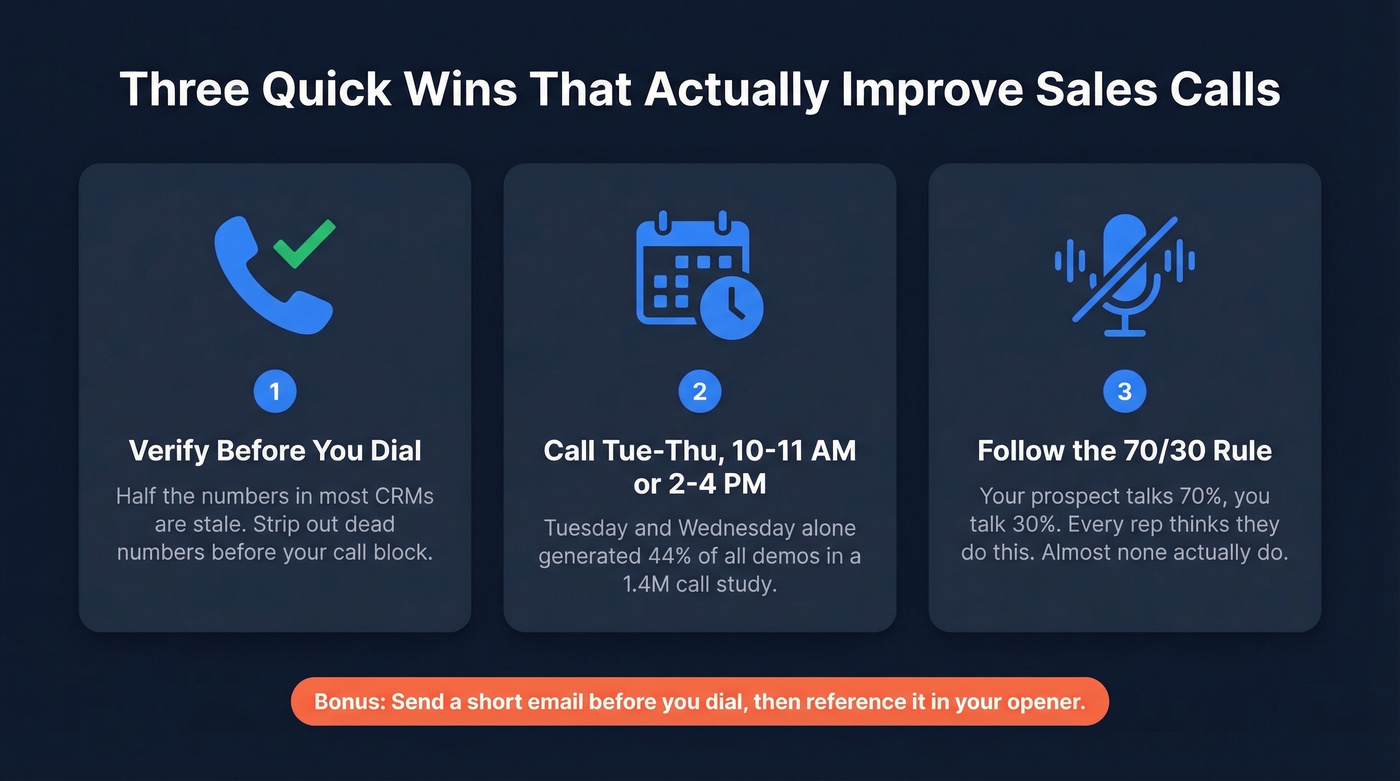
If you only change one thing, send a short email before you dial and reference it in your opener. It turns a cold call warm. (For examples, borrow a few sales prospecting techniques.)
2026 Sales Call Benchmarks
| Metric | Published Benchmark | Real-World Range |
|---|---|---|
| Connect rate | 16.6% connect rate | 6-12% |
| Call to meeting | 6.7% | 2-7% |
| Avg live call | Avg live call 93 seconds | - |
| Attempts to reach | 8 | 5-12 |
| Best days | Tue-Thu | - |
| Best times | 10-11 AM, 2-4 PM | - |
That 16.6% connect rate comes from published benchmark roundups. A sales ops leader running a 12-person SDR team on Reddit reported 6%. The gap is almost always a data quality problem - stale numbers, wrong direct dials, contacts who changed jobs months ago. Fix the inputs and the outputs follow. (If you’re rebuilding your data layer, compare data enrichment services.)

Before the Call
Spend 3-5 minutes on pre-call research. Check the prospect's role, spot a trigger event like new funding or a job change, and find something specific to reference. More than five minutes? You're procrastinating. This prep separates reps who wing it from reps who convert. (If you want a repeatable definition of “right fit,” use an ideal customer profile.)
The single best tactic we've seen is making your "cold" call not actually cold. The approach comes straight from r/sales: send a short email first - four or five sentences max - then open your call with:
"Hey [Name], just wanted to quickly follow up on the email I sent you Tuesday."
The prospect either asks what the email was about, which invites your pitch, or disqualifies fast. Either outcome beats "Is now a good time?" - an opener that lets them hang up guilt-free.
None of this matters if you're dialing dead numbers. The vast majority of cold calls go to voicemail, and mobile numbers in a typical CRM go stale fast. We've found that running lists through Prospeo's mobile finder before a call block - 125M+ verified mobiles with a 30% pickup rate, refreshed every 7 days - is the fastest way to separate live numbers from dead weight. (If you’re building a full outbound list, start with a sales prospecting database.)

Half your call block is wasted on stale numbers. Prospeo's mobile finder gives you 125M+ verified direct dials with a 30% pickup rate - refreshed every 7 days, not every 6 weeks. That's how teams go from a 6% connect rate to actually booking meetings.
Stop dialing dead numbers. Start connecting with real buyers.
How to Make Calls More Effective
The First 7 Seconds
Prospects form an opinion within 7 seconds. Your opener needs to break the pattern, not confirm you're another SDR reading a script. Three pattern interrupts that work:
- "If I told you this was a cold call, would you want to hang up?" Disarming honesty that breaks the script pattern.
- "I know I'm calling out of the blue - I'll be quick." Acknowledges the interruption before they can object.
- The email-reference opener from above, which anchors to something they've already seen.
Skip "How are you today?" Both words signal a sales call instantly. (If you want more ready-to-use openers, pull a few talk track examples.)
Picking the Right Discovery Framework
Not every deal needs the same qualification approach.
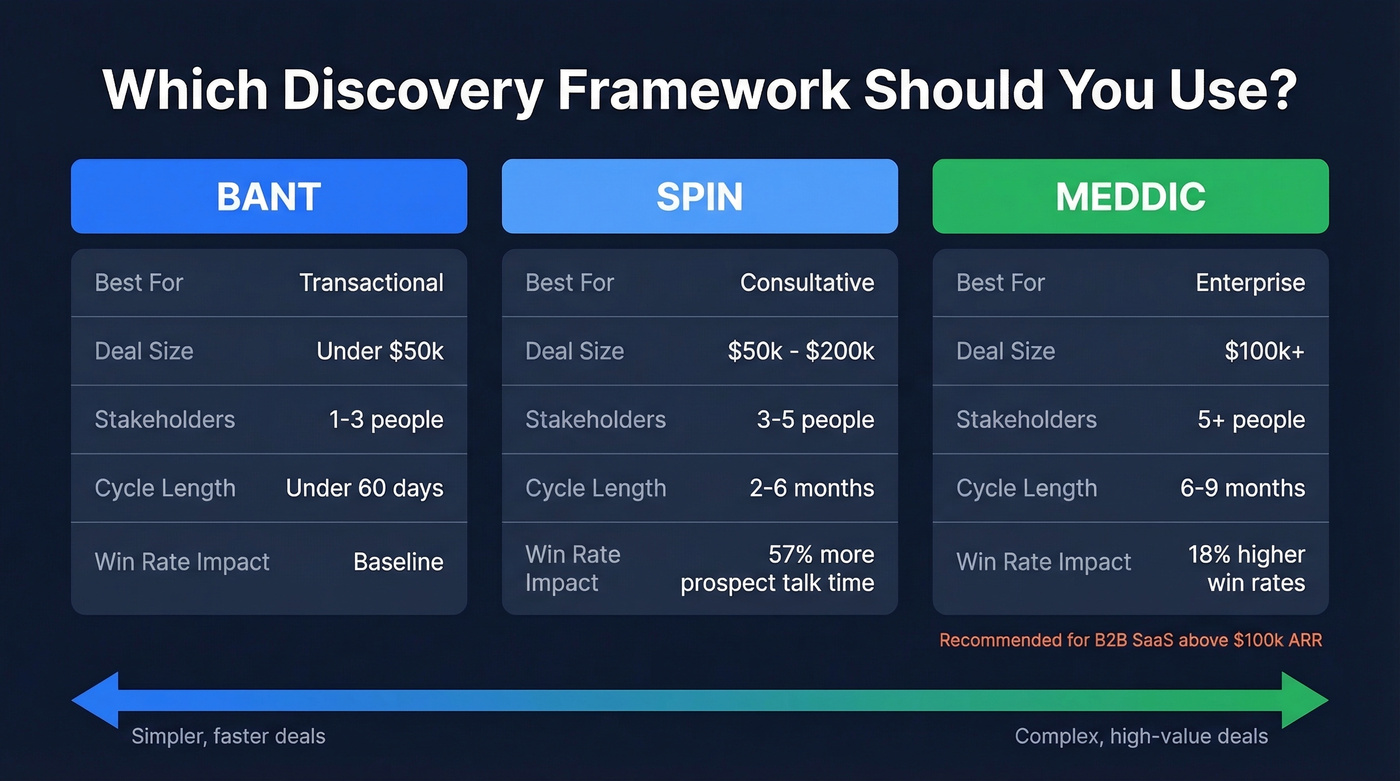
| Framework | Best For | Deal Size | Stakeholders | Cycle Length |
|---|---|---|---|---|
| BANT | Transactional | <$50k | 1-3 | <60 days |
| SPIN | Consultative | $50k-$200k | 3-5 | 2-6 months |
| MEDDIC | Enterprise | $100k+ | 5+ | 6-9 months |
For most B2B SaaS teams selling above $100k ARR, MEDDIC is the right call - full adoption drives 18% higher win rates. SPIN, developed from analysis of 35,000+ sales calls, remains the gold standard for mid-market consultative selling. Today's B2B buyers use roughly 10 different interaction channels during their journey, with an average of 7 people involved in each buying decision, so your discovery needs to account for that complexity. (If you want a tighter question set, use these discovery questions.)
Keep discovery calls to 15-30 minutes. SPIN practitioners get 57% higher prospect talk time in discovery, and that's where the real intel lives.
Objection Handling
"We're already using [competitor]."
"That makes sense. Quick question - are you seeing [specific pain point]? That's usually where [competitor] falls short, and it's exactly why [similar company] switched."
"Send me an email."
"Happy to. So I send you something relevant - what's the biggest challenge your team's dealing with on [topic] right now?"
The second one is sneaky. It turns a brush-off into a mini-discovery question. Even if they give you a one-sentence answer, you've got something to personalize the follow-up email around.
After the Call
Follow up within 5 minutes. Leads contacted in that window are 9x more likely to convert. Use the subject line "Thanks for the conversation today" - it makes recipients dramatically more likely to open and respond. Keep the email to 50-125 words. Recap one key pain point, restate your value prop in one sentence, and include a specific next step. (If you want plug-and-play copy, use these sales follow-up templates.)
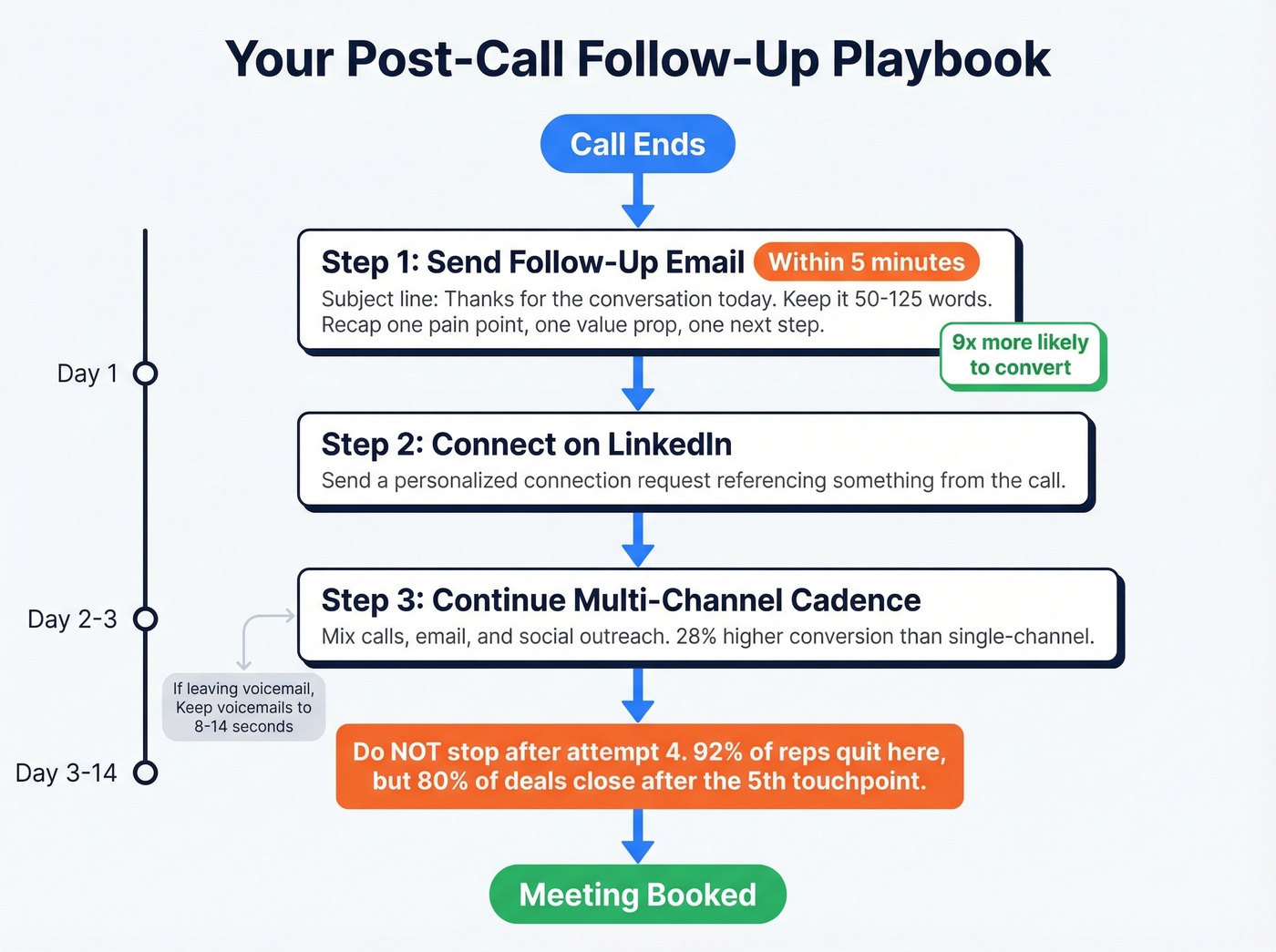
Then don't stop.
80% of deals require 5+ touchpoints, but 92% of reps quit after four. That's pipeline left on the table. Build a multi-channel cadence - call, email, and social outreach - which drives 28% higher conversion than single-channel outreach. If you hit voicemail, keep it to 8-14 seconds. (To systematize this, tighten your sequence management.)
Five Mistakes That Ruin Calls
Here's the thing: most sales call advice focuses on what to say. The real gains come from what happens before and after the call. Clean data and relentless follow-up will outperform a perfect script dialed into dead numbers every single time. (If you’re building a repeatable motion, start with a full cold calling system.)
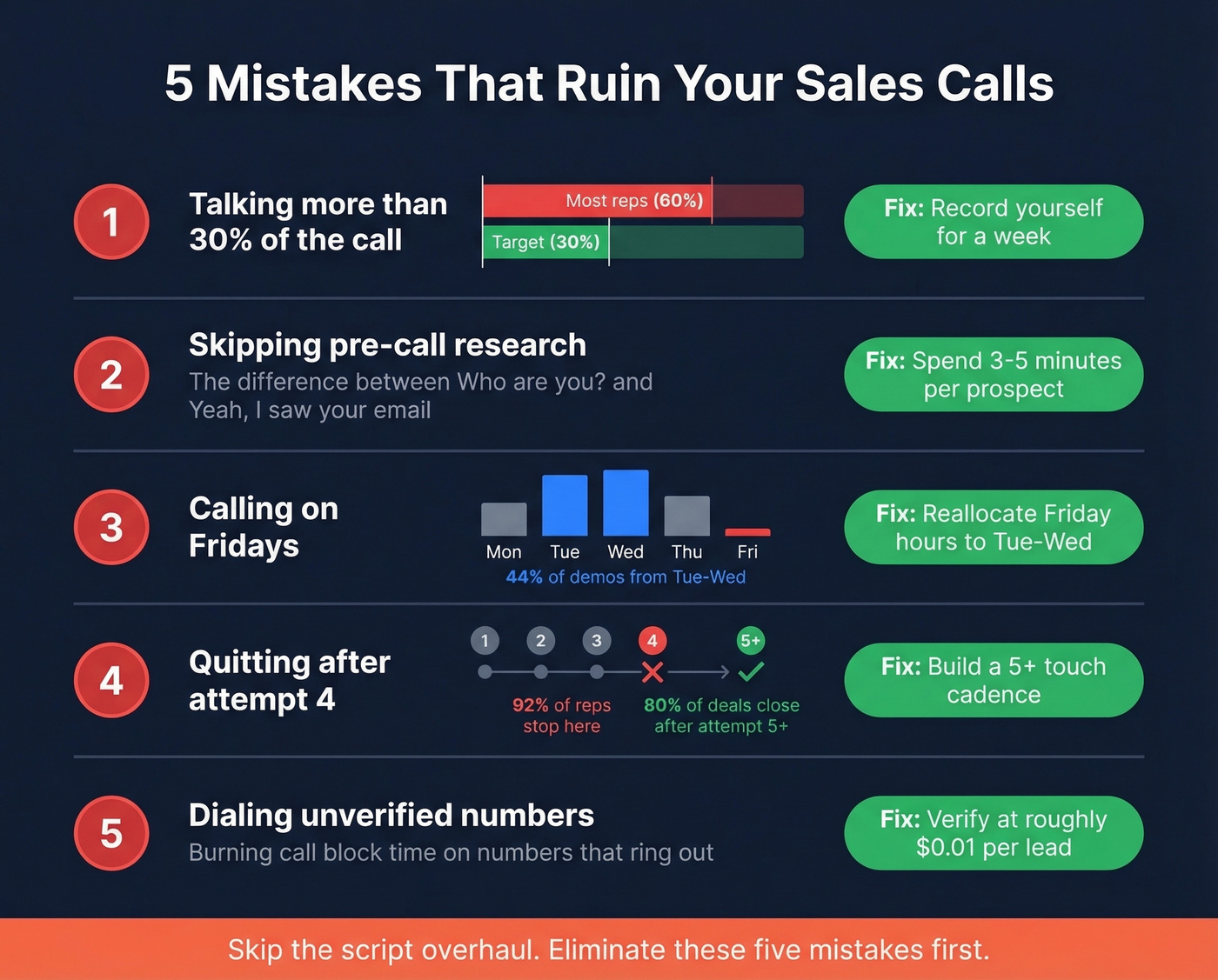
1. Talking more than 30% of the call. Record yourself for a week. Most reps overestimate their listen-to-talk ratio until they hear the tape. Review one call per day - it's the fastest coaching loop that exists.
2. Skipping pre-call research. Three minutes on a prospect's profile and recent company news is the difference between "Who are you?" and "Yeah, I saw your email."
3. Calling on Fridays. Friday performs worst across every metric in ZoomInfo's 1.4M-call dataset. Reallocate those hours to Tuesday or Wednesday.
4. Quitting after attempt four. 92% of reps stop here. 80% of deals close after the fifth touchpoint. Do the math.
5. Dialing unverified numbers. If you're burning an hour of call block time on numbers that ring out or bounce to generic voicemail, you're wasting your team's most expensive resource: their time. Run your list through a verification tool before you start dialing. At ~$0.01 per lead, there's no excuse for dialing blind.
Skip the script overhaul. Eliminating these five mistakes is the fastest way to improve sales calls without changing anything else about your process.
Pre-call research only works if you're calling the right person at the right number. Prospeo's 7-day data refresh catches job changes, new direct dials, and verified mobiles before your CRM does - so your reps spend call blocks selling, not leaving voicemails at numbers no one answers.
Clean data beats a perfect script. Every time.
FAQ
What's a realistic cold call connect rate in 2026?
Real-world SDR teams report 6-12%, despite published benchmarks claiming 16.6%. The gap is almost always data quality - stale numbers and outdated direct dials. Clean your list first, then optimize your script and timing.
How many follow-up attempts should I make?
At least five. 80% of deals close after the 5th touchpoint, but 92% of reps quit after four. Mix calls, email, and social outreach for 28% higher conversion than single-channel sequences.
What's the best day and time to make sales calls?
Tuesday through Thursday, with late morning (10-11 AM) and mid-afternoon (2-4 PM) consistently performing best. The 4-5 PM window also shows strong results. Tuesday and Wednesday alone generated 44% of all demos in ZoomInfo's 1.4M-call analysis. Skip Fridays entirely.
How do I improve sales calls if my team already follows a script?
Scripts give structure, but they don't fix bad data or weak follow-up. Start by verifying your call list, then layer in pre-call research and the email-first opener. These changes matter more than any script revision because they address the inputs - who you're calling and whether they'll pick up - not just the words you say once they do.