

How to Build a Combined Inbound and Outbound Marketing Strategy (With Budget Framework)
The inbound vs. outbound debate is a waste of time. Every company needs both, and the only real question is the ratio.
Companies using a hybrid approach see 2x faster revenue growth than single-channel strategies. Those running 3+ channels achieve up to 287% higher purchase rates than single-channel efforts. And strong omnichannel engagement drives 89% customer retention vs. 33% for weak performers. The data isn't subtle. Running inbound or outbound in isolation leaves money on the table.
The Quick Version
- Early-stage: Bias 70% outbound / 30% inbound. Outbound generates pipeline in 48 hours. Inbound takes 3-6 months to compound.
- Growth-stage: Shift to 50/50 as inbound content ranks and organic leads arrive consistently.
- Non-negotiable: Verify your outbound data before every campaign, respond to inbound leads within 5 minutes, and never send fewer than 5 outbound touches per prospect.
That's the skeleton. Let's put muscle on it.
Inbound vs. Outbound in 60 Seconds
| Dimension | Inbound | Outbound |
|---|---|---|
| Core tactics | SEO, content, social | Cold email, paid ads, calls |
| Time to pipeline | 3-6 months | 48 hours |
| CPL range | $135 avg | $346 avg |
| Lead quality | High intent, self-selected | Variable, rep-qualified |
| Scalability | Compounds over time | Linear with spend/effort |
Email conversion rates run about 2.8% for B2C and 2.4% for B2B. Cold email response rates hover around 4-5%. Inbound costs less per lead long-term, but outbound puts meetings on the calendar this week.
Budget Allocation Framework
This is the section no competitor article gives you. Everyone says "combine both strategies" and then stops short of telling you how to split the budget.

Industry benchmarks put combined Sales & Marketing spend at 30-50% of revenue, splitting roughly 30% marketing / 70% sales. PLG companies allocate 52% of their marketing budget to programs vs. 44% for sales-led orgs - and spend less on headcount (32% vs. 44%), freeing budget for tools and content. For inbound-heavy SaaS companies, that freed-up budget flows directly into content engines and product-led acquisition loops.
| Stage | Outbound | Inbound | Rationale |
|---|---|---|---|
| Early (pre-PMF) | 70% | 30% | Pipeline now; ICP validation |
| Growth ($1-10M) | 50% | 50% | Inbound compounds; outbound scales |
| Mature ($10M+) | 40% | 60% | Organic flywheel drives efficiency |
In our experience, the 50/50 split is where most growth-stage companies land - and where the marketing funnel starts generating compounding returns.
Here's the thing about inbound: it isn't cheaper. It's just slower to bill you. Three to six months of content creation, SEO tools, and writer costs pile up before a single lead arrives. Outbound has higher per-lead cost but delivers pipeline immediately. Compare time-to-revenue, not cost per lead.
The early-stage outbound bias isn't arbitrary. Inbound distribution is volatile - algorithm changes can tank organic traffic overnight. Unless your content is genuinely exceptional, new companies can't rely on inbound alone for pipeline. As one agency founder put it on r/sales: outbound without inbound is "knocking on doors with nothing to offer," but inbound without outbound is waiting by the phone.

Your hybrid strategy is only as strong as your outbound data. Prospeo gives you 300M+ profiles with 98% email accuracy, intent data across 15,000 topics, and a 7-day refresh cycle - so every cold email lands and every intent signal is fresh. Starting at $0.01 per email, no contracts.
Stop splitting budget on campaigns that bounce. Verify first, send second.
The Combined Playbook - 6 Tactics
Modern outbound isn't your 2015 cold call playbook. Enriched data and marketing automation have made it surgical. These are the integration points where the two channels actually reinforce each other.
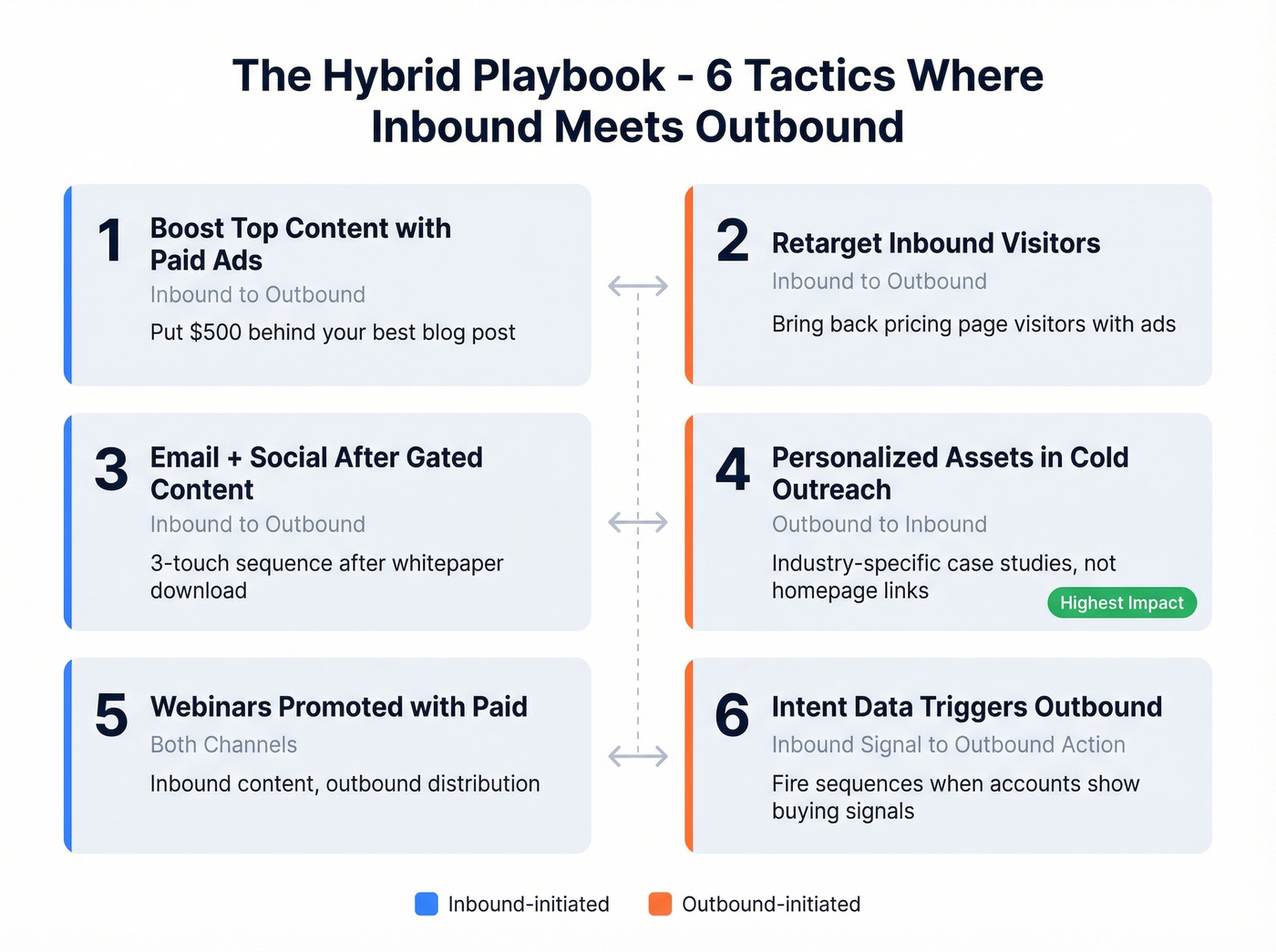
1. Promote top inbound content with paid ads. Your best-performing blog post already converts organic visitors. Put $500 behind it on paid social and accelerate what's working.
2. Retarget inbound visitors with outbound ads. Someone read your pricing page but didn't convert. Retargeting brings them back at a fraction of cost to acquire customer.
3. Layer email + social after gated content capture. A whitepaper download isn't a sales conversation. Follow up with a 3-touch email sequence and social engagement to book the meeting.
We've seen tactic #4 move the needle more than any other single change in outbound campaigns:
4. Pair cold outreach with personalized content assets. Don't send a cold email that links to your homepage. Build a one-pager or case study specific to the prospect's industry. 96% of marketers say personalized buyer journey experiences increase sales. That stat tracks with what we've seen firsthand - generic outbound gets ignored, but a cold email referencing a prospect's exact tech stack or recent funding round gets replies.
5. Host webinars promoted with paid. Webinars sit at the intersection - inbound content delivered through outbound distribution. The attendee list becomes your outbound target list.
6. Use intent data to trigger outbound to inbound-engaged accounts. When a target account starts researching your category, your outbound sequence fires instead of waiting for a form fill. Prospeo tracks buying signals across 15,000 intent topics via Bombora, giving your team the trigger to launch personalized sequences the moment interest spikes.

Operational SLAs That Matter
Respond to every inbound lead within 5 minutes. That 5-minute window drives 9x higher conversion. Set up automated routing and alerts - no lead should sit in a queue while a rep finishes lunch.
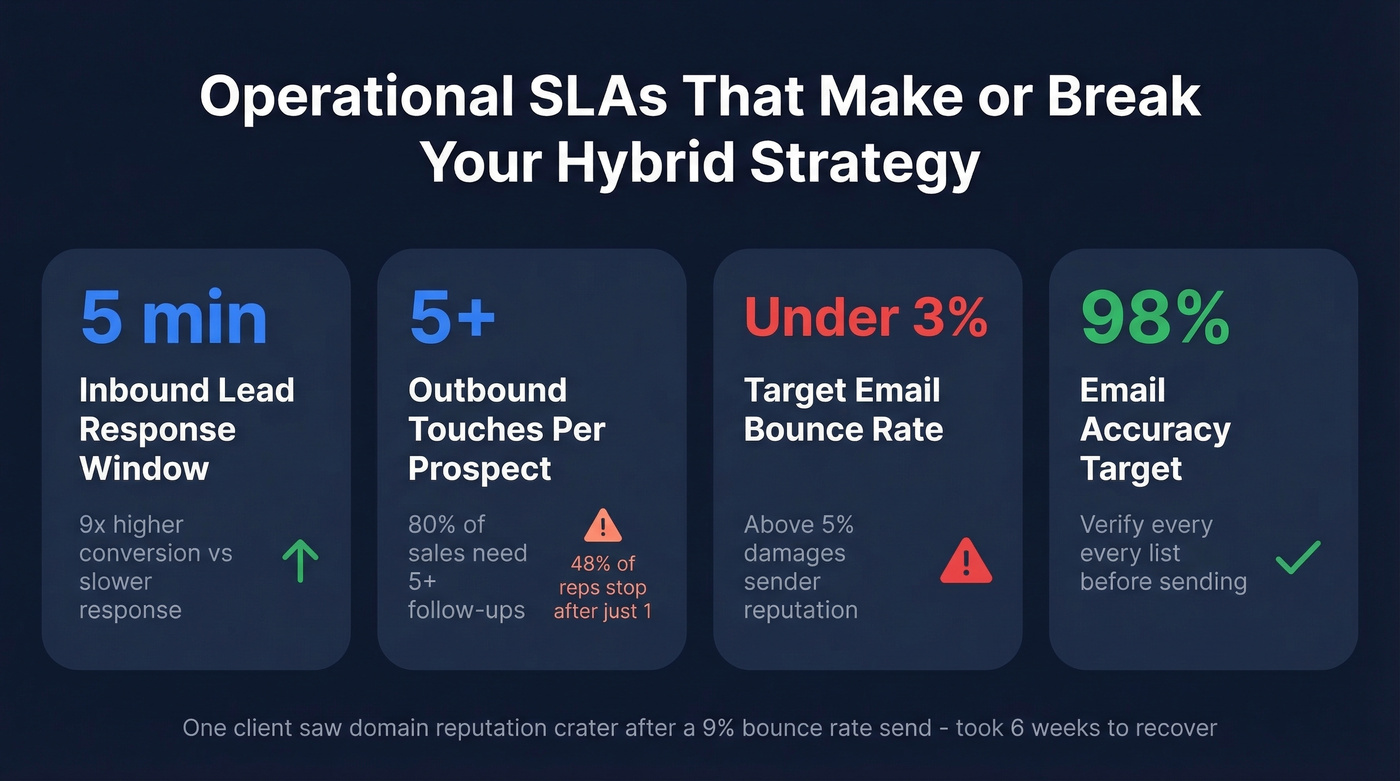
Send at least 5 outbound touches per prospect. 48% of reps stop after one touch, but 80% of sales require 5+ follow-ups. If you need copy you can deploy fast, keep a set of sales follow-up templates ready for each stage.
Now for what not to do. Don't send outbound traffic to your generic inbound website. A prospect who clicked a personalized cold email shouldn't land on a blog homepage. Build dedicated landing pages - the post-click experience mismatch is one of the most common failures practitioners flag on Reddit.
And skip the temptation to blast unverified lists. If more than 5% of your emails bounce, you're damaging your sender reputation for every future campaign. We watched one client's domain reputation crater after a single 12,000-email send with a 9% bounce rate. It took six weeks to recover. Verify first, send second. (If you're troubleshooting, start with email bounce rate benchmarks and root causes.)
Your 2026 Outbound Tool Stack
We've tested every tool on this list. What r/coldemail consistently flags as non-negotiable: deliverability infrastructure, inbox rotation, multichannel sequences, and CRM integrations. Expect 4-5% response rates on cold email - verified data and strong copy are the two levers that move that number.
| Tool | Starting Price | Best For |
|---|---|---|
| Prospeo | Free / ~$0.01/email | Verified contact data layer |
| Apollo | $49/mo | CRM + sequences |
| Instantly | $37.60/mo | Deliverability + scale |
| Lemlist | $63/mo | Multichannel outreach |
| Reply.io | $49/mo | AI-powered sequences |
These tools send the emails. Prospeo makes sure they reach real inboxes - 98% email accuracy with a 7-day data refresh cycle, which matters when you're running campaigns at scale and can't afford stale records torching your deliverability. Pair verified data with any sequencer above. The stack matters more than any single tool. If you're evaluating options, compare against other outbound lead generation tools and SDR tools based on your volume and workflow.
If your average deal size is under $10K, you probably don't need a $30K/year platform like ZoomInfo. A self-serve data layer plus a $50/month sequencer will outperform an enterprise suite your team barely uses.
Tactic #6 requires real intent data. Prospeo tracks 15,000 Bombora topics and pairs them with 30+ filters - technographics, funding, headcount growth - so your outbound fires the moment an account shows buying signals. 92% API match rate for enrichment workflows.
Turn inbound intent signals into outbound pipeline in 48 hours.
Mistakes That Kill a Hybrid Strategy
Message mismatch between channels. Your outbound ads promise a specific solution. Your inbound site talks about thought leadership. The prospect bounces because the experience doesn't connect. Audit your messaging quarterly across every touchpoint - if a cold email and a landing page feel like they came from different companies, you've got a problem.
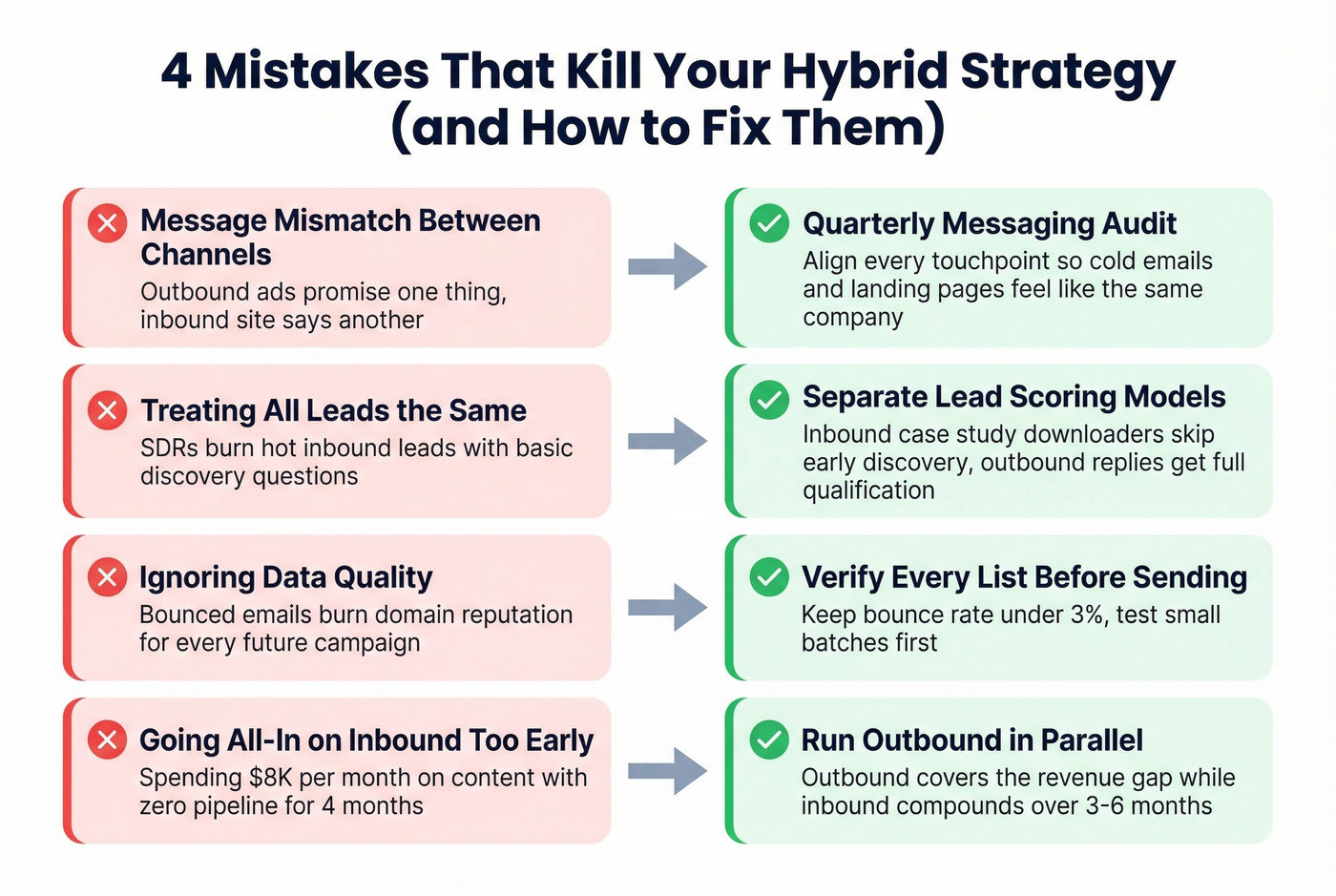
Treating inbound and outbound leads the same. An inbound lead who downloaded a case study is further along than a cold outbound reply. Your CRM handoff and lead scoring model need to reflect that. Skip this distinction and your SDRs will burn hot leads with discovery questions the prospect already answered on your website.
Ignoring data quality. Bounced emails don't just fail - they burn your domain reputation, making every future outbound campaign harder. Validate every list before it hits your sequence. If you need a process, use a dedicated email deliverability guide and a checklist for how to improve sender reputation.
Going all-in on inbound when you need pipeline now. We've watched this play out repeatedly: a Series A CEO approves $8K/month on content, waits four months, sees zero pipeline, and kills the program. Inbound compounds, but it doesn't produce on day one. Run outbound in parallel to cover the gap.
FAQ
How long before a combined strategy produces results?
Outbound generates responses within 48 hours. Inbound typically takes 3-6 months to produce consistent organic leads. Run both simultaneously - outbound covers the revenue gap while inbound compounds.
What's the right budget split?
Early-stage: 70/30 outbound-heavy. Growth-stage: 50/50. Mature companies with established organic traffic: 60/40 inbound-heavy. Total S&M typically runs 30-50% of revenue for B2B SaaS.
Does B2B inbound differ from B2C?
Significantly. B2B buying cycles are longer, involve multiple stakeholders, and rely on educational content like whitepapers and webinars rather than impulse-driven offers. B2B inbound should focus on thought leadership and gated assets that feed directly into outbound follow-up sequences.
How do I know if my outbound data is good enough?
If your bounce rate exceeds 5%, your data is costing you deliverability. Aim for under 3% to protect your sender reputation long-term. Test a small batch before scaling any new list.
Stop debating inbound vs. outbound. Build a combined inbound and outbound marketing strategy, measure what works, and shift budget accordingly.