

Inbound Sales in 2026: Benchmarks, Tech Stack, and the Mistakes Nobody Talks About
It's Monday morning. You open your CRM and see 47 new demo requests from the weekend. Feels great - until you realize your team didn't respond to a single one before Sunday night. By the time reps start dialing, 96% of those prospects have already researched your product, your competitors, and probably your pricing page. They came to you warm. Whether they stay warm depends entirely on what happens in the next five minutes.
That gap between inbound interest and actual revenue is where most teams bleed. Not because they lack leads, but because they mishandle the ones they have.
The Numbers at a Glance
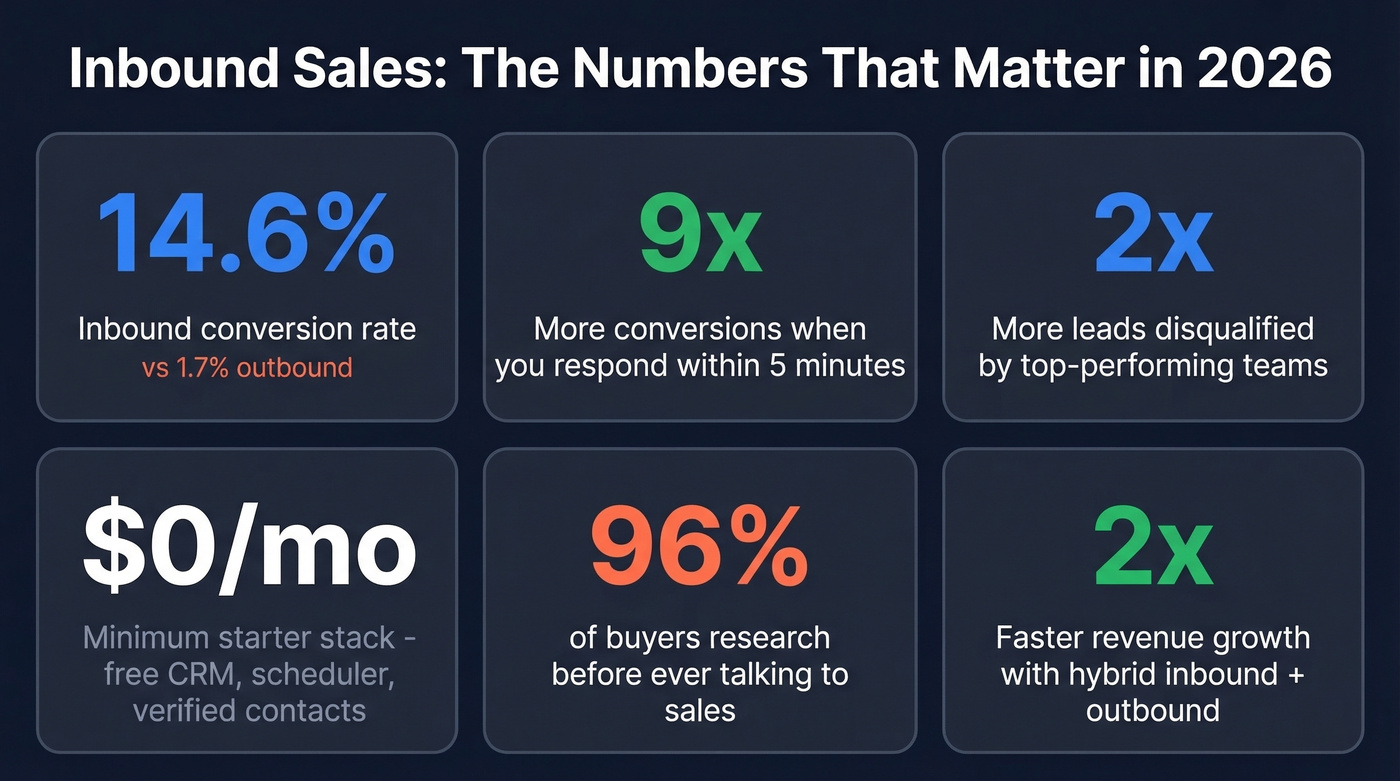
- Inbound converts at 14.6% vs. 1.7% outbound.
- Responding within five minutes increases conversion by up to 9x.
- Top inbound teams disqualify 2x more leads than bottom performers. Saying "no" faster is a competitive advantage.
- Your minimum stack: free CRM + scheduling tool + verified contact data. That's $0/month to start.
- 96% of buyers research before talking to sales - your content is your first impression, whether you like it or not.
- Pure inbound hits a ceiling. Hybrid inbound + outbound drives 2x faster revenue growth.
What Is Inbound Sales?
Inbound sales is the motion where the buyer comes to you. They've downloaded a whitepaper, requested a demo, signed up for a free trial, or filled out a contact form. The lead is marketing-generated, and the sales rep's job is to respond, qualify, and guide - not cold-prospect.
The traditional model treated this as a linear funnel: visitor to lead to MQL to SQL to closed-won. That still works as a mental model, but the reality in 2026 is messier. HubSpot's updated approach introduces the "Loop" concept - a continuous cycle that replaces a one-way funnel.
Reps handling inbound today aren't just managing form fills. They're responding to chatbot conversations, intent signals, product-qualified leads from free tiers, and re-engagement triggers from existing customers. The lead sources have multiplied, but the core principle hasn't changed: the buyer raised their hand first. Your job is to not fumble the handoff.
Outbound is you finding them; inbound is them finding you. Everything else - frameworks, tools, comp plans - flows from that difference.
Inbound vs. Outbound Sales
| Dimension | Inbound | Outbound |
|---|---|---|
| Lead source | Marketing-driven | Rep-driven |
| Conversion rate | ~14.6% | ~1.7% |
| Cost per lead | Up to 60% cheaper | Higher (SDR labor + tools) |
| Buyer intent | High (self-selected) | Low to medium |
| Rep skill emphasis | Qualification, discovery | Prospecting, persistence |
| Scalability | Content-dependent | Headcount-dependent |
| Best for | Established brand, SEO/content engine | New markets, ABM, upmarket |
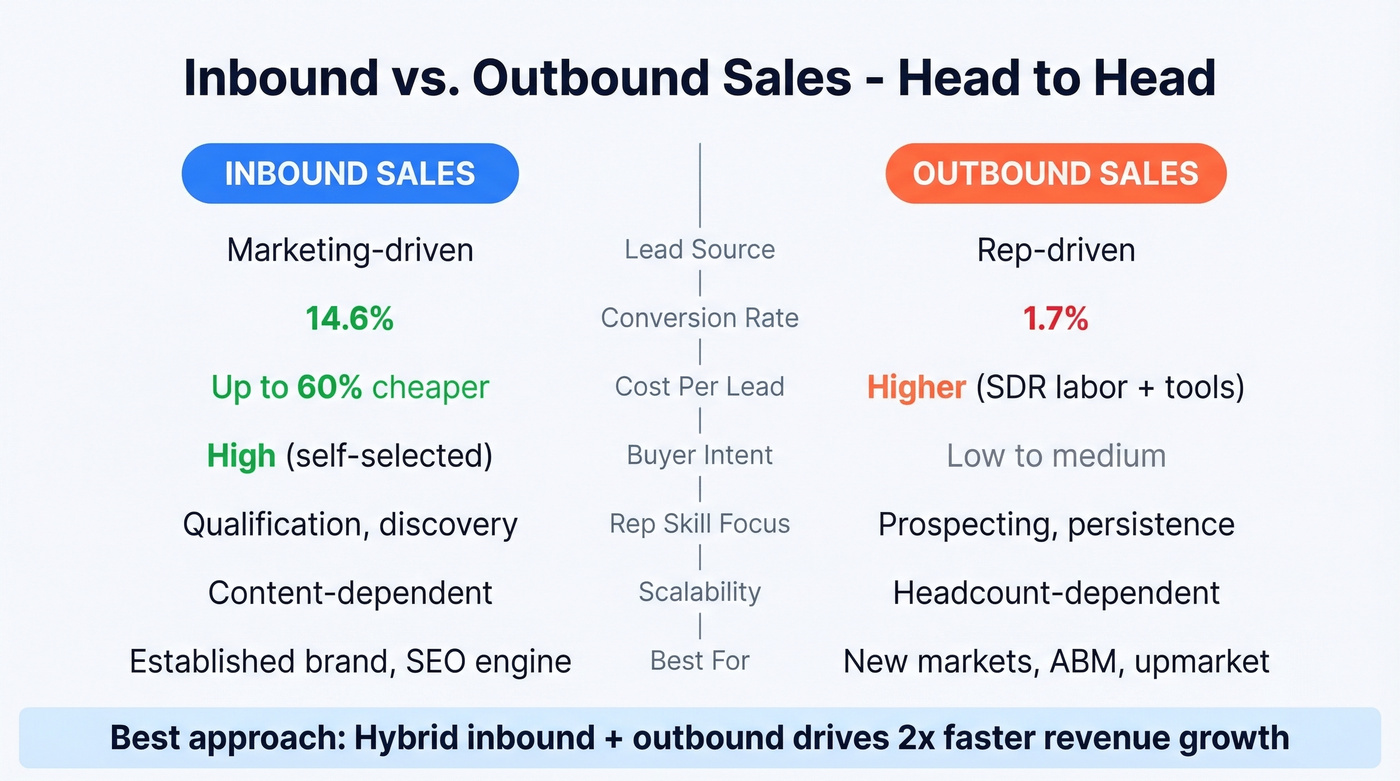
The numbers look like a blowout in inbound's favor, and they are - on conversion rate. But conversion rate isn't the whole story. Outbound lets you choose your ICP. Inbound gives you whoever shows up, and "whoever shows up" includes a lot of tire-kickers, students, and competitors snooping your pricing page.
Neither motion wins alone. Companies running a hybrid of inbound and outbound see 2x faster revenue growth compared to teams running either in isolation. Multichannel sequences - email, phone, and professional social touches - yield 40%+ better engagement than single-channel approaches. The best teams don't pick a side. They build both engines and let them feed each other.
Here's the thing: if your average deal size is under $10k and you're spending $50k+/year on outbound tooling while inbound leads sit unanswered for hours, you have your priorities backwards. Fix the inbound motion first. It's cheaper, it converts roughly 9x better, and it punishes neglect far more than outbound does.
The Inbound Sales Process
The 4-Step Framework
Most methodologies trace back to the four-stage model. It's table stakes, but it works:
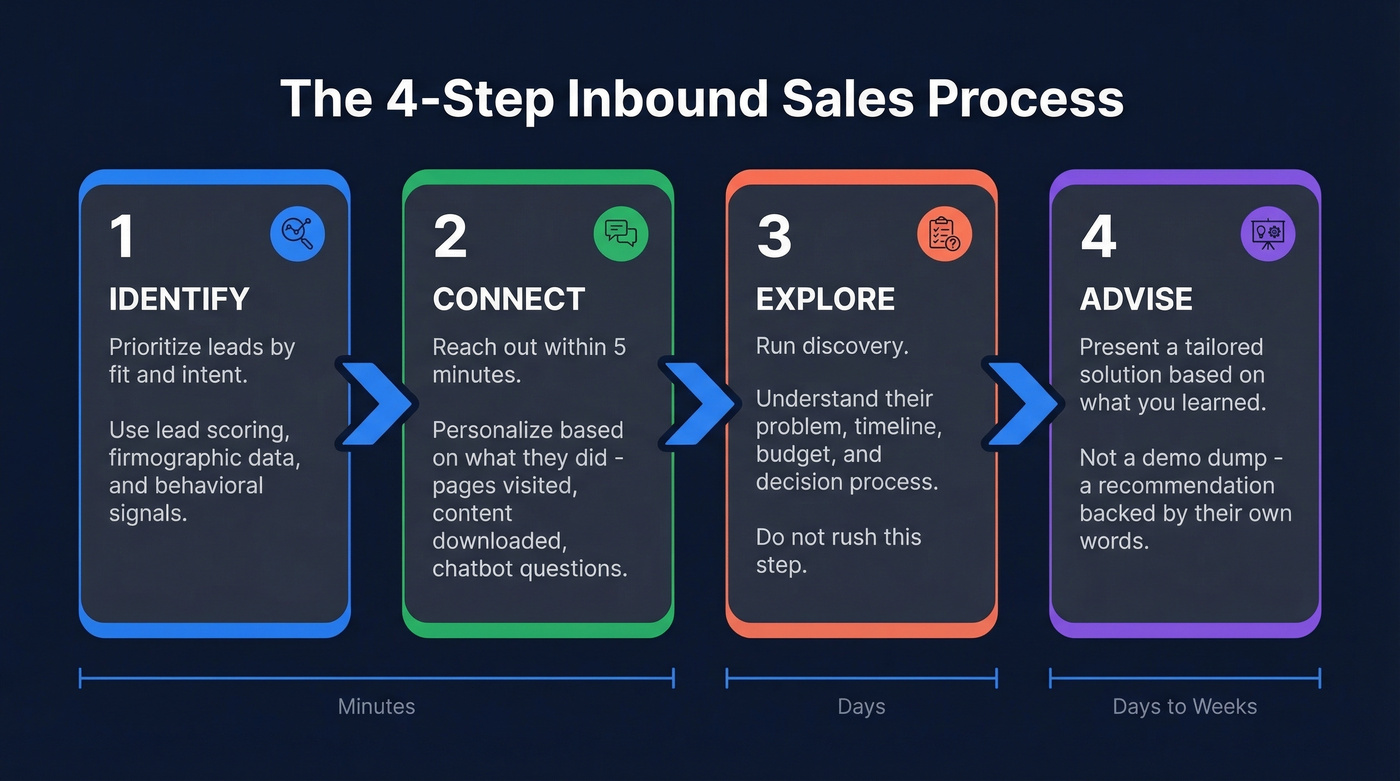
- Identify - Prioritize leads by fit and intent. Not every form fill deserves a call. Use lead scoring, firmographic data, and behavioral signals to separate real buyers from noise.
- Connect - Reach out within five minutes. Personalize the first touch based on what they did: which page they visited, what content they downloaded, what they asked the chatbot.
- Explore - This is the discovery call. Understand their problem, timeline, budget, and decision process. Most reps rush past this step. Don't. (If you want a tighter structure, use a discovery questions framework.)
- Advise - Present a tailored solution based on what you learned in Explore. This isn't a demo dump. It's a recommendation backed by the prospect's own words.
What a good Explore call actually looks like:
- First 2 minutes: Rapport + recap what brought them in. "I saw you requested a demo after reading our case study on X - what caught your eye?"
- Next 10 minutes: Discovery questions. What's broken today? What have you tried? Who else is involved in this decision? What does your timeline look like?
- Final 3 minutes: Align on next steps. "Based on what you've told me, here's what I'd recommend we cover in the next conversation."
Frameworks for Complex Deals
The four-step model works for straightforward B2B sales with short cycles. For enterprise deals with multiple stakeholders and six-plus-month timelines, you need more structure.
SPIN Selling was developed by Neil Rackham after studying 35,000+ sales calls across 20+ countries. The framework - Situation, Problem, Implication, Need-Payoff - is built for discovery-heavy conversations where the rep needs to uncover pain the buyer hasn't fully articulated. It's ideal for inbound leads who know they have a problem but can't define it yet.
Challenger Sale draws on research across 6,000 reps at 90 companies. The insight: top performers teach, tailor, and take control of the conversation. For buyer-initiated deals, this means not just answering the prospect's questions but reframing their understanding of the problem.
MEDDIC was developed at PTC in the 1990s and remains the gold standard for enterprise qualification. Metrics, Economic Buyer, Decision Criteria, Decision Process, Identify Pain, Champion. If your deals involve procurement committees and six-figure contracts, MEDDIC keeps you from wasting months on opportunities that were never going to close. (Related: MEDDIC sales qualification.)
Benchmarks That Matter
Visitor to Demo Request
Once you're above 25,000 monthly visitors, your visitor-to-demo-request rate typically falls under 1%. That sounds terrible until you run the math.
25,000 visitors at even a modest conversion rate can yield roughly 50 demo requests per month. At a 20% close rate with a $15,000 average deal size, that's $150,000 in new ARR per month from organic traffic alone. The percentage is small. The revenue isn't. Top-converting demo pages lean heavily on social proof: 76% display customer logos, 57% include testimonials, and 36% feature G2 or Capterra badges.
Mid-Funnel Conversion by Industry
Not all funnels convert the same. First Page Sage's benchmarks show meaningful differences by vertical:
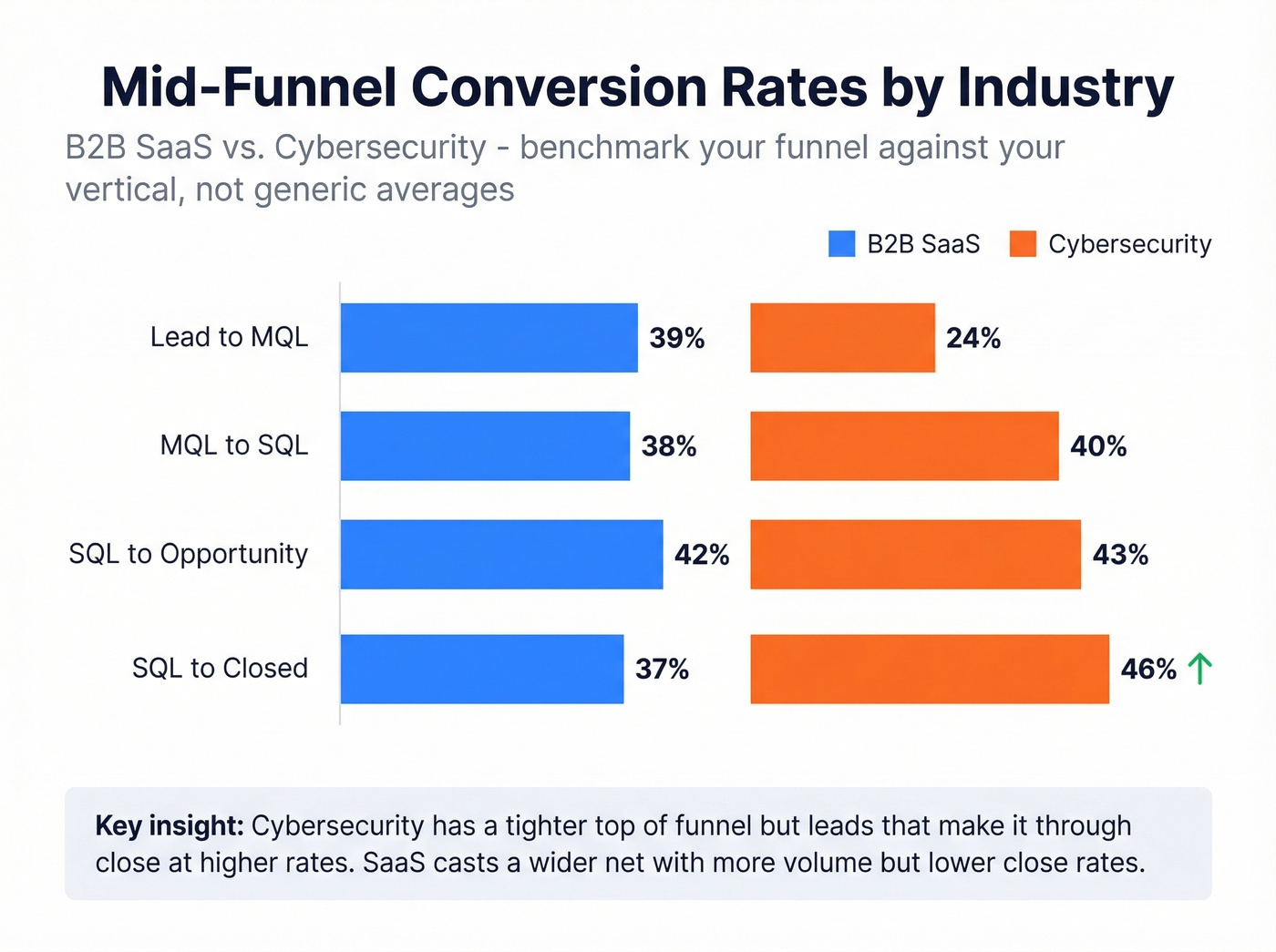
| Funnel Stage | B2B SaaS | Cybersecurity |
|---|---|---|
| Lead to MQL | 39% | 24% |
| MQL to SQL | 38% | 40% |
| SQL to Opportunity | 42% | 43% |
| SQL to Closed | 37% | 46% |
Cybersecurity has a tighter top of funnel - fewer leads qualify as MQLs - but the leads that do make it through close at a higher rate. SaaS casts a wider net with more volume but lower close rates. Neither is "better." Benchmark against your industry, not against a generic blog post.
Qualified to Booked Meeting Rate
This metric separates good teams from great ones. RevenueHero analyzed over 1 million inbound form submissions and found the median qualified-to-booked meeting rate is 62%. Top performers hit 88%.
The counterintuitive finding: top-quartile teams disqualify 37.7% of their inbound leads, compared to just 18.7% for bottom-quartile teams. The best teams say "no" twice as often. They're not losing leads - they're focusing time on the ones that actually close.
Another surprise from the data: form length barely matters. Teams using 2-field forms and teams using 13-field forms both converted at 76%+. The purpose of the fields matters more than the count. If every field helps you route and qualify, add them. If they're just collecting data for marketing's dashboard, cut them.
We've all seen the scenario: 200 MQLs come in this month, marketing celebrates, and sales closes three deals. The problem isn't lead volume. It's that nobody's disqualifying the 150 leads that were never going to buy.

You just read that responding within 5 minutes increases conversion 9x. But speed means nothing if you're dialing wrong numbers and bouncing emails. Prospeo delivers 98% email accuracy and 125M+ verified mobile numbers - so when an inbound lead raises their hand, your reps connect on the first try, not the fifth.
Stop fumbling warm leads with bad data. Start converting them.
The 5-Minute Rule
The single most impactful thing you can do with inbound leads is respond faster. The data is overwhelming and consistent.
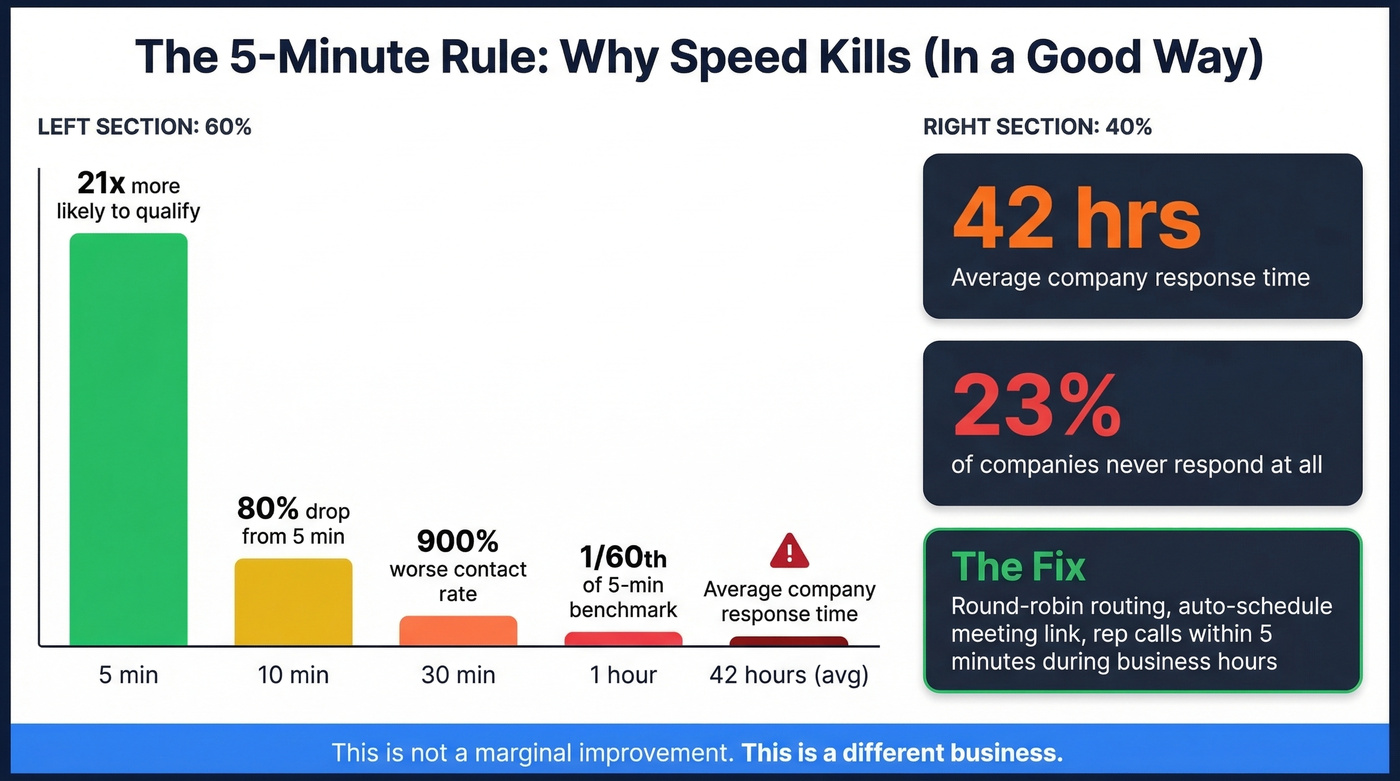
Contacting a lead within five minutes increases conversion makes you 21x more likely to qualify them compared to waiting 30 minutes. Contact rates increase by 900% at the five-minute mark versus ten minutes. Between five and ten minutes, the odds of qualifying that lead drop by 80%. After an hour, you're at roughly 1/60th of the five-minute benchmark.
The average company response time? 42 hours. And 23% of companies never respond at all.
Let that sink in. Nearly a quarter of inbound leads go completely unanswered.
A real-world example: Snyk's sales team of 50 AEs was dealing with bounce rates of 35-40% on their follow-up sequences. After implementing real-time email verification, bounce rates dropped below 5%, AE-sourced pipeline jumped 180%, and the team generated 200+ new opportunities per month. The fix wasn't more leads - it was making sure the leads they already had were reachable.
The tactical fix is simple. Set up instant routing with round-robin to available reps, auto-schedule a meeting link in the confirmation email, and have a rep call within five minutes during business hours. That's not a marginal improvement. That's a different business.
Mistakes That Kill Pipeline
1. Not disqualifying enough. Top-performing teams disqualify 37.7% of leads - roughly double the rate of bottom performers. If you're passing every form fill to an AE, you're wasting your most expensive resource on leads that won't close. Build a disqualification framework and enforce it.
2. Slow response time. 42-hour average response times are the norm, and they're killing pipeline. If you can't staff for five-minute response, at minimum automate a meeting-booking link in the confirmation email.
3. Misaligned comp plans. One Reddit poster described getting moved from 10% monthly commission on inbound deals to a quarterly bonus structure - $250 at 65% close rate, maxing out at $1,400. Under the old plan, closing 63% in a quarter earned $2,500. Under the new plan, the same performance earned $250. When you make inbound comp worse than outbound, your best reps will find outbound roles. Or leave. (More on comp math: OTE in Sales.)
4. Treating all leads the same. A VP who requested a demo after reading three case studies isn't the same as an intern who downloaded a whitepaper for a school project. Without lead scoring - even basic scoring by title, company size, and behavior - you're giving both the same five-minute call. One of those calls is a waste.
5. Giving up after one touch. 48% of reps stop after a single follow-up attempt, yet 80% of sales require five or more touches. A lead who doesn't pick up the phone on the first try isn't dead - they're busy. Build a multi-touch sequence that spans email, phone, and social over 7-10 days. (If you need copy, start with these sales follow-up templates.)
6. Ignoring contact data quality. If your bounce rate is above 5%, verify your lead list before your next outreach. Bad emails don't just waste rep time - they damage your sender reputation, which tanks deliverability for every future sequence. (See: email bounce rate and email deliverability.)
7. No hybrid motion. Pure inbound hits a ceiling. Your content can only rank for so many keywords. Your ads can only reach so many eyeballs. Companies combining inbound with targeted outbound see 2x faster revenue growth. If you're not supplementing with outbound to your best-fit accounts, you're capping your pipeline at whatever organic traffic delivers. (Related: account-based selling best practices.)
8. Pushing too fast. Reps who skip the Explore stage and jump straight to a demo dump are optimizing for activity metrics, not revenue. The prospect told you what they need in the form fill. Ask follow-up questions. Understand their timeline. Then advise. Skipping discovery is how you lose deals you should've won.
The Inbound Sales Tech Stack for 2026
| Category | Tool | Starting Price | Best For |
|---|---|---|---|
| CRM | HubSpot | Free / $9/user/mo | SMB, startups |
| CRM | Salesforce | $25/user/mo | Mid-market, enterprise |
| CRM | Pipedrive | $14/user/mo | Sales-first teams |
| CRM | Attio | $29/user/mo | Modern RevOps |
| Data & Verification | Clay | $134/mo | Workflow orchestration |
| Scheduling | Calendly | Free / ~$10/user/mo | Most teams |
| Scheduling | TidyCal | $29 lifetime | Budget-conscious |
| Conversational AI | Drift | $2,500+/mo | Enterprise chat |
| Conversational AI | Qualified.com | ~$1,000+/mo | Salesforce-centric teams |
| Automation | Zapier | Free / $19.99/mo | Glue between tools |
| Automation | Keap | $299/mo | All-in-one SMB |
Your follow-up is only as good as your contact data. We've seen teams burn their five-minute window chasing invalid addresses - Prospeo's real-time verification and 98% email accuracy rate prevent that. The Chrome extension lets reps enrich leads on the fly from any website or CRM, and native integrations with HubSpot, Salesforce, Lemlist, and Instantly keep your workflow clean.
If you're starting from zero: HubSpot CRM (free), Calendly (free), and a Prospeo free tier for verification. That's $0/month and covers 80% of what you need. Skip the expensive conversational AI tools until you're past the point where manual routing breaks - for most teams under 100 inbound leads per month, a well-configured form with instant scheduling handles the job.
Hybrid inbound + outbound drives 2x faster revenue growth. Prospeo's 300M+ profile database with 30+ filters - including buyer intent, technographics, and job changes - lets you build targeted outbound lists that complement your inbound engine. At $0.01 per email, it costs less than the leads you're already losing.
Build the outbound engine your inbound leads are begging for.
What's Changing in 2026
The org chart is shifting. Nearly half of inbound sales teams now report directly to marketing, according to Bridge Group research. That means reps are increasingly measured on marketing metrics - speed-to-lead SLAs, MQL acceptance rates - rather than pure revenue. Whether that's good or bad depends on your comp plan.
AI chatbots are moving from "nice to have" to expected infrastructure. 68% of customers expect real-time engagement, and conversational AI is driving 30%+ lifts in lead conversion for teams that implement it well. But a poorly configured chatbot that asks five qualifying questions before letting someone book a demo will hurt more than it helps.
On AI lead scoring, the consensus on r/SaaSSales is cautious. The concern is real: AI scoring that's miscalibrated doesn't just miss good leads - it burns through your list by targeting the wrong profiles. The technology is promising, but we're not at "set it and forget it" yet. Our take: use AI scoring as a prioritization layer, not a gatekeeper. Let it rank leads, but don't let it auto-disqualify without human review.
Careers and Comp
Inbound SDR roles pay reasonably well at the entry level. A recent Reddit post described an inbound cybersecurity SDR offer at CAD $70-75k base with $100-110k OTE. That's solid for a role that doesn't require cold calling, and it's roughly in line with B2B SaaS positions across North America.
The career path runs inbound SDR to AE to team lead to management. But inbound isn't easier than outbound - it's different. The leads are warmer, but the comp is often worse and the career ceiling can feel lower. Outbound reps who consistently hit quota tend to get promoted faster because the skill set - prospecting, resilience, pipeline generation - is harder to find.
Watch for comp plan red flags. If a company is shifting inbound comp from variable to fixed, they're telling you they view the role as a cost center, not a revenue driver. That's a signal about how they'll invest in your career development, too.
FAQ
What is inbound sales?
Inbound sales is a methodology where leads come to you through marketing channels - content, SEO, ads, webinars, chatbots - and reps respond to that expressed interest. Rather than cold-prospecting, reps qualify and guide buyers who've already started researching. 96% of buyers research before engaging a sales rep, making your content the real first touchpoint.
Which converts better - inbound or outbound?
Inbound converts at 14.6% compared to 1.7% for outbound, but the highest-performing teams run hybrid motions. Companies combining both channels see 2x faster revenue growth than those relying on either alone. Inbound brings volume and intent; outbound brings targeting and control.
What's a good inbound conversion rate?
The median qualified-to-booked meeting rate is 62%, with top performers hitting 88%. Visitor-to-demo-request typically falls under 1% at scale with 25,000+ monthly visitors. Industry matters significantly - B2B SaaS and cybersecurity have different funnel benchmarks at every stage from lead to closed-won.
What tools do inbound teams need to start?
At minimum: a CRM like HubSpot's free tier, a scheduling tool like Calendly, and an email verification solution for data quality. That trio costs $0/month and handles lead management, booking, and deliverability. Add conversational AI and workflow automation as volume scales past what manual routing can handle.
Is inbound sales easier than outbound?
Different, not easier. Inbound reps face SLA pressure - five-minute response windows are the standard - along with high lead-quality variance and often lower comp ceilings than outbound peers. The skill set emphasizes rapid qualification, discovery, and consultative selling rather than cold outreach and prospecting persistence.