

Inbound Sales Techniques: The Operator's Playbook for 2026
Your webinar pulled 400 registrants. Marketing's celebrating. Meanwhile, your reps are cherry-picking the ones with recognizable logos and ignoring the rest. Three days later, someone finally emails the VP of Engineering who filled out a demo request form on Tuesday. She's already in a trial with your competitor.
That's the reality most inbound sales techniques are supposed to prevent - and most fail at. 84% of reps missed quota last year, and roughly 30% of inbound leads never receive a single response. The leads aren't the problem. The follow-up is.
Here's the thing: most teams don't have a lead generation problem. They have a lead waste problem. If your team handles 200 inbound leads per month and 30% go uncontacted, that's 60 dead leads every cycle. Multiply by your average deal size and win rate, and you'll see the pipeline you're lighting on fire month after month.
Speed Is the Foundation
Every framework in this article is worthless if your first response takes 4 hours. A widely cited MIT/InsideSales benchmark shows that contacting a lead within 5 minutes makes you 21x more likely to qualify them than waiting 30 minutes. Responding within one minute drives a 391% increase in conversions.
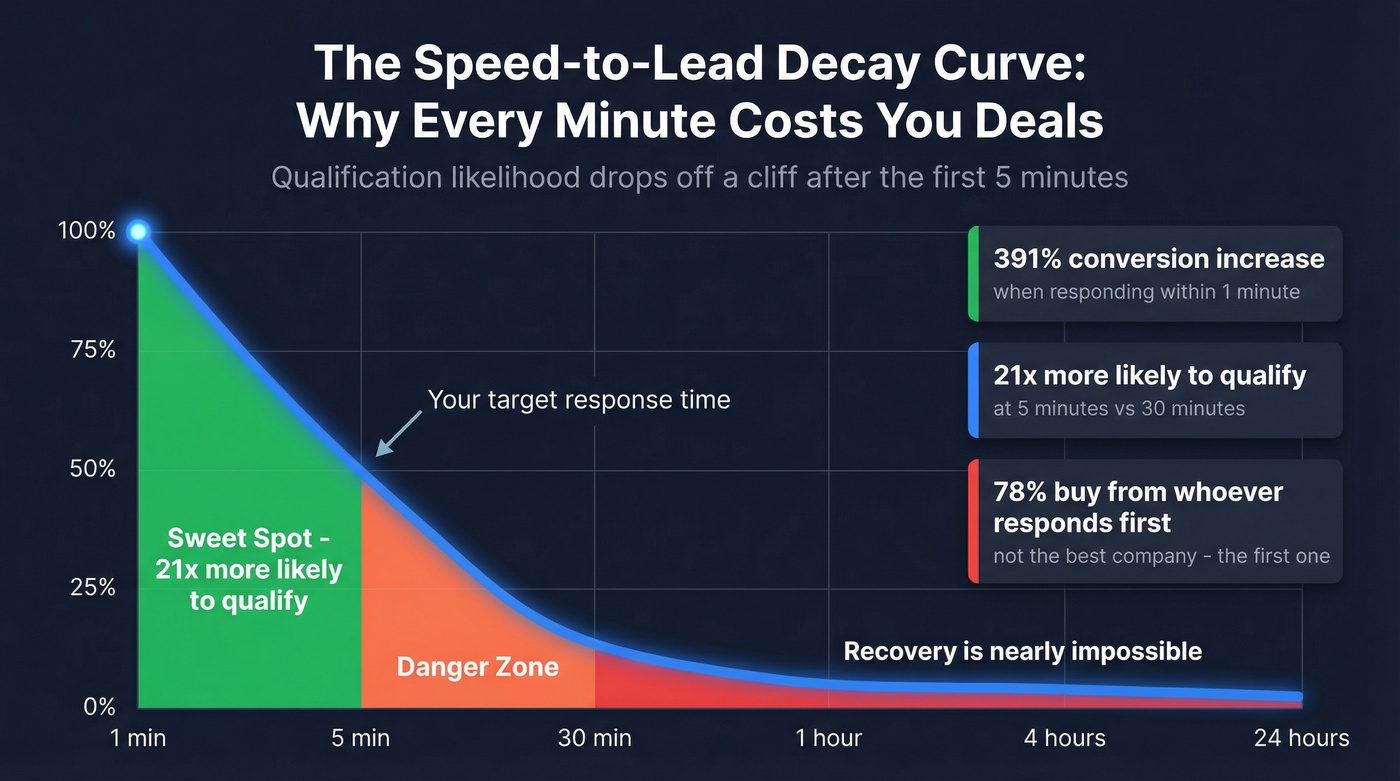
An HBR analysis of 2.24 million leads found that reaching out within one hour makes you roughly 7x more likely to qualify - and waiting 24+ hours makes you about 60x less likely compared to that first-hour window. The decay curve is brutal and non-linear.
78% of customers buy from the company that responds first. Not the best company. The first one.
| Lead Source | Target Response |
|---|---|
| Paid ads / demo requests | < 3 min (human) |
| Organic search | < 10 min |
| Referrals | < 30 min |
Qualify Fast, Disqualify Faster
Only about 25% of marketing-generated leads actually qualify for sales engagement. RevenueHero's analysis of 1M+ form submissions found that top-quartile teams disqualify 37.7% of inbound leads, compared to 18.7% for bottom-quartile teams. The best performers aren't better at closing. They're better at saying no.
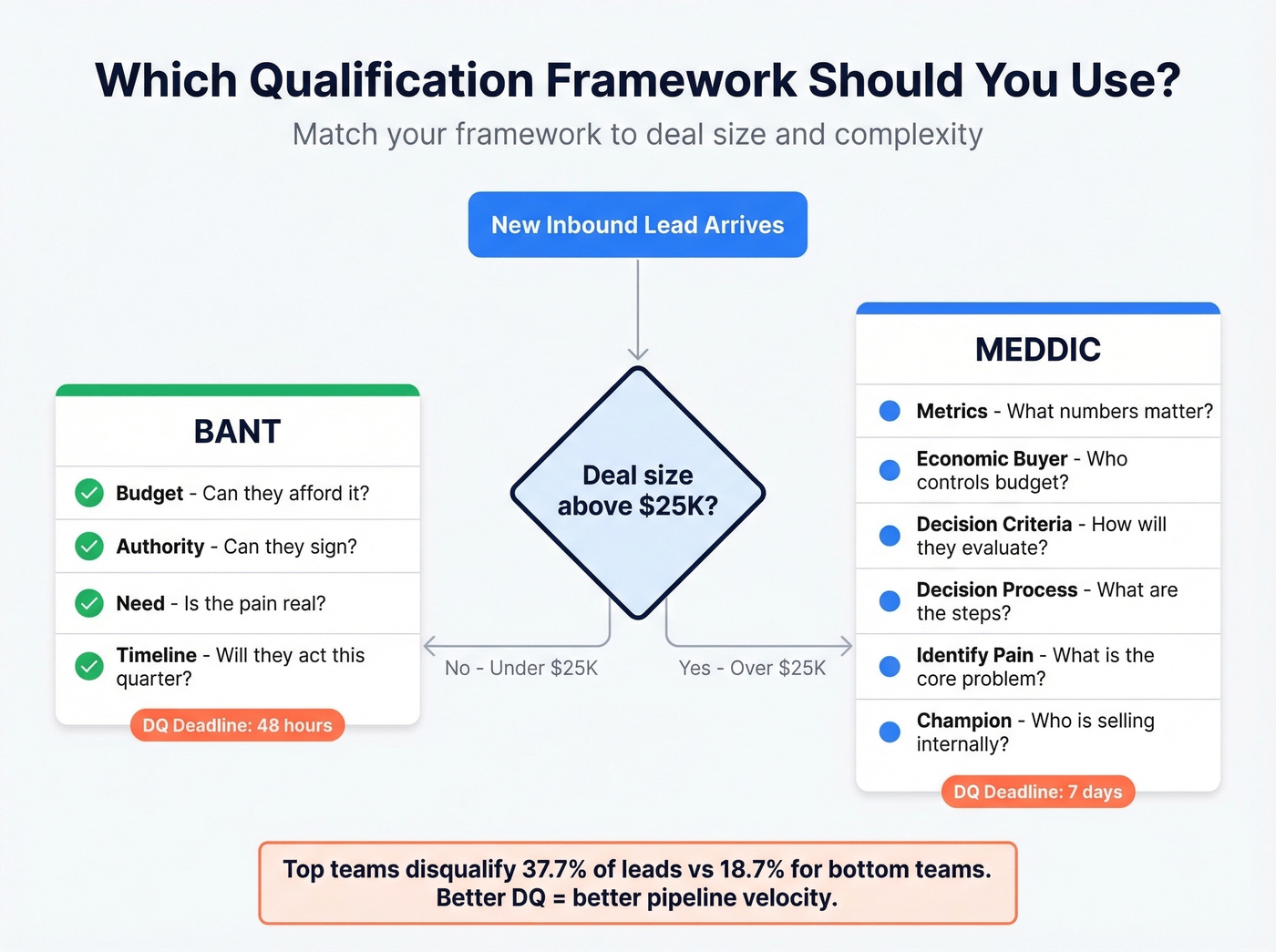
For deals under $25K, BANT gets you through triage fast. Above that threshold, escalate to MEDDIC. Set explicit time-to-disqualify KPIs: under 48 hours for transactional inbound, under 7 days for enterprise. We've seen teams that enforce DQ time limits improve pipeline velocity within a month - the dead weight clears out and reps focus on winnable deals.
Skip this step if you're running a product-led growth motion with a free tier and no sales touch. But if a human rep is involved at any point, DQ discipline is the single highest-leverage change you can make.
Discovery Questions That Work
Stop asking these on the first call: "What's your budget?" kills rapport. "Are you the decision-maker?" is alienating. "What keeps you up at night?" makes prospects cringe. We've listened to hundreds of recorded inbound calls, and the pattern is clear - reps who open with interrogation-style qualification questions get shorter calls and fewer second meetings.
Instead, start broad and narrow. Use silence after tough questions - let the prospect fill the gap. The prospect should be talking 70% of the time.
Process and pain: "Walk me through your current process for [problem area]." "Where does it break down?" "What does that cost you in time or missed opportunities each quarter?"
Success and stakeholders: "What would success look like 90 days from now?" "Who else is affected day-to-day?" "What's been tried before, and why didn't it stick?"
Save blockers and urgency questions for the final minutes. Ask what would need to be true for this to become a priority this quarter, whether a specific event or deadline is driving the timeline, what happens if nothing changes, and who else needs to sign off before a decision moves forward. These four questions surface deal-killing blockers before you've invested hours in a proposal nobody can approve.
If you want a deeper bank of prompts, use a dedicated discovery questions framework and tailor it to your ICP.
The Multi-Channel Follow-Up Cadence
77% of customers expect immediate interaction when they contact a company. Today's B2B buyers use an average of 10 interaction channels - up from 5 in 2016 - so a multi-channel cadence isn't optional. A structured 5-touch sequence over 10-14 days can pull 18-25% reply rates for SaaS. High-value leads warrant 8-12 touches with social and video added.
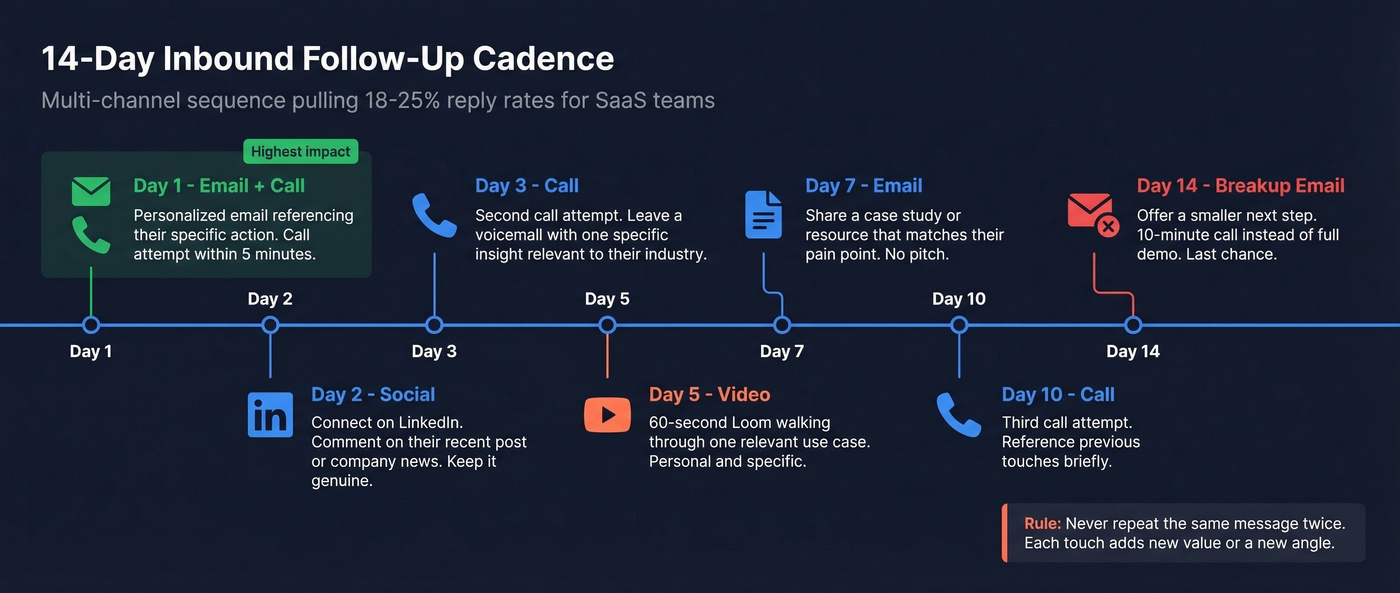
| Day | Channel | Action |
|---|---|---|
| 1 | Email + Call | Personalized email referencing their action; call attempt |
| 2 | Social | Connect + brief comment on their recent post or company news |
| 3 | Call | Second attempt, voicemail with one insight |
| 5 | Video | 60-second Loom walking through one relevant use case |
| 7 | Case study or relevant resource | |
| 10 | Call | Third attempt |
| 14 | Breakup with a smaller next step |
For high-intent signals like pricing page visits and demo requests, compress this into a burst cadence: first touch within minutes, then 3-4 more touches over the next 4 days. Each touch adds new value - a case study paragraph, a relevant FAQ answer, a smaller ask like a 10-minute call instead of a full demo. Never repeat the same message twice; that's not persistence, it's spam.
If you need copy you can ship today, start from proven sales follow-up templates and customize the first two lines.

Speed kills deals when paired with bad data. Your 5-minute follow-up means nothing if the email bounces. Prospeo delivers 98% accurate emails and 125M+ verified mobile numbers so your inbound cadence actually reaches the prospect who raised their hand.
Stop wasting inbound leads on undeliverable contact data.
Handling Objections on Inbound Calls
Morgan J. Ingram's 5-step framework fits inbound well: listen, ask open-ended questions, solve, confirm, move on. The key difference from outbound is that inbound prospects already raised their hand - they need confidence you can solve their problem, not convincing that the problem exists. If you're talking more than 30% of the time during objection handling, you're pitching, not listening.
When someone says "I don't have time right now," try: "Totally fair - can I get 30 seconds to share one thing, then we'll find a better time?" Deliver one sharp insight relevant to their form submission, then close with a specific day and time for a 15-minute call. Don't leave it open-ended. "How about Thursday at 2?" beats "When works for you?" every time.
To reduce pushback systematically, build a library of patterns and counters from sales communication data (not gut feel).
AI SDR Agents as a Speed Layer
If you're not using AI for initial inbound engagement in 2026, you're leaving speed on the table. Tools like Qualified's AI SDR "Piper" can greet website visitors, qualify basic intent, and route leads to reps in seconds instead of minutes. But treat AI agents as a speed layer, not a replacement for human discovery. The consensus on r/coldemail is that ultra-fast replies that feel robotic do more harm than good. Let AI handle the first 30 seconds of routing; let humans handle the first real conversation.
If you're evaluating tooling, compare categories like SDR tools and generative AI sales tools based on routing speed, handoff quality, and reporting.
Mistakes That Kill Inbound Deals
Slow response. 30% of inbound leads never get contacted at all. If your routing takes 20 minutes, fix it before you optimize anything else.
Premature demos. Jumping to a demo before qualifying is the inbound equivalent of proposing on a first date. You waste 30 minutes showing features that don't matter, and the prospect ghosts because they never felt heard. Our team has watched this pattern repeat across dozens of sales orgs - the fix is always the same: mandate a 15-minute discovery call before any demo gets scheduled.
If your team struggles here, standardize the handoff with a product demo checklist so discovery always precedes features.
Running a multi-channel inbound cadence across email, phone, and social? You need verified direct dials and emails that don't bounce. Prospeo's data refreshes every 7 days - not 6 weeks - so the contact info matches the person who just filled out your form.
Every touch in your cadence should land. Start with data that delivers.
Know Your Numbers
RevenueHero's 1M+ form-fill dataset gives us the clearest picture of what good looks like in 2026.
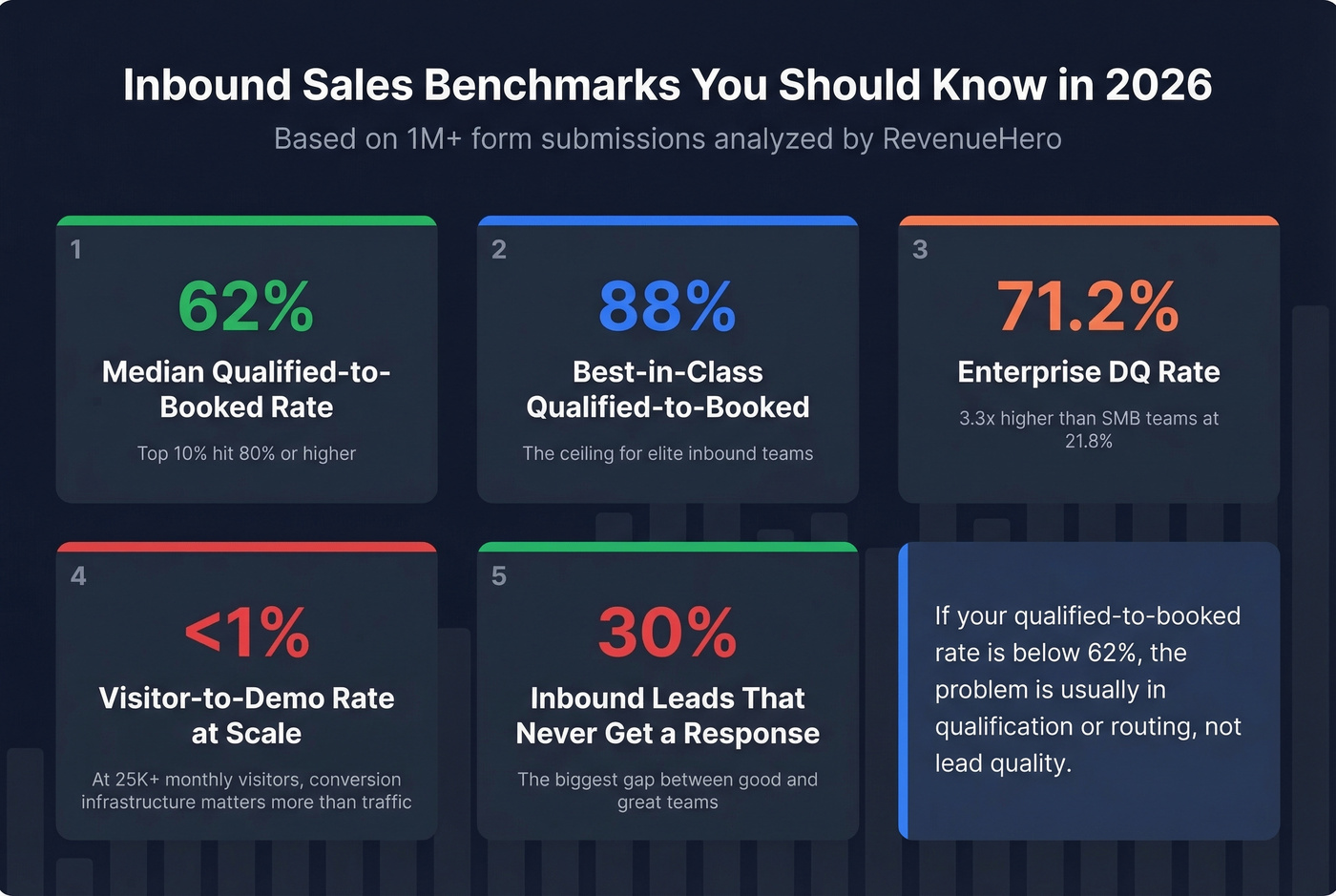
| Metric | Median | Top 10% | Best |
|---|---|---|---|
| Qualified-to-booked rate | 62% | ~80% | 88% |
| Enterprise DQ rate | 71.2% | - | - |
| SMB DQ rate | 21.8% | - | - |
Enterprise teams disqualify at about 3.3x the rate of SMB teams - that's not pickiness, it's discipline. "Book a Demo" as CTA copy outperforms "Request a Demo" and "Submit." And at scale with 25K+ visitors, visitor-to-demo rates drop below 1%, meaning your conversion infrastructure matters more than your traffic volume.
If you want to benchmark the rest of the funnel, track your sales conversion rate and overall funnel metrics alongside speed-to-lead.
Track these monthly. If your qualified-to-booked rate is below 62%, the problem is usually in qualification or routing - not lead quality.
Implement This Week
- Audit your average response time for demo requests. If it's over 5 minutes, fix routing first.
- Set a DQ time limit: 48 hours for transactional leads, 7 days for enterprise.
- Enrich your last 50 inbound leads and check how many emails would've bounced.
- Build a 7-touch cadence using the table above. Ship it by Friday.
The best inbound sales techniques aren't clever scripts or exotic closing moves. They're operational: respond fast, qualify ruthlessly, follow up across channels, and make sure your contact data doesn't sabotage the whole sequence before it starts. If you need help choosing vendors, start with a shortlist of data enrichment services.
FAQ
What's the difference between inbound and outbound sales?
Inbound responds to buyers who've already shown interest through actions like demo requests, content downloads, or pricing page visits. Outbound initiates contact cold. Inbound typically converts at 2-5x higher rates but still requires sub-5-minute response times and structured multi-channel follow-up to capture that advantage.
How fast should you respond to an inbound lead?
Under 5 minutes for demo and pricing requests. Contacting a lead within 5 minutes makes you 21x more likely to qualify them than waiting 30 minutes. After one hour, qualification likelihood drops by 7x.
Which inbound sales tactics have the biggest impact?
Speed-to-lead, structured multi-channel cadences, and rigorous disqualification consistently move the needle more than any single script or closing technique. Teams that layer these three together see qualified-to-booked rates above 80%.
How do you keep inbound lead data accurate?
Enrich and verify contact data before your first touch. Tools like Prospeo return 50+ verified data points per contact with a 98% email accuracy rate and a 7-day refresh cycle, so your cadence doesn't hit dead ends. CRM enrichment integrations can run automatically on new form fills, which means reps never have to think about it.