

How to Build an Inside Sales Model That Actually Scales
Only 51% of AEs hit quota - down from 66% just two years earlier. The org chart isn't the problem. The inside sales model is.
Here's how to pick the right one, staff it, and comp it so your team actually hits number.
What Inside Sales Actually Means
Inside sales means selling remotely - phone, email, video, social - without getting on a plane. It's not telemarketing. Inside reps run consultative, multi-touch sales cycles that can stretch weeks or months, and the approach now dominates B2B: 53.7% of the roughly 2.06M US sales reps work inside sales roles.
Inside vs. Outside Sales
The cost difference alone justifies remote selling for most deal sizes.
| Metric | Inside Sales | Outside Sales | Winner |
|---|---|---|---|
| Cost per interaction | ~$50 | ~$308 | Inside sales |
| First-year rep cost | $65K-$95K | $110K-$180K | Inside sales |
| Ramp time | 3-4 months | 6-9 months | Inside sales |
| Best-fit ACV | $5K-$50K | $50K-$500K+ | Depends on deal size |
| Daily activity volume | ~60 calls | ~5 visits | Inside sales |
| Qualified lead conversion | ~20% | ~40% | Outside sales |
Outside sales converts at roughly double the rate - but at about 6x the cost per interaction. For deals under $50K ACV, the math almost never favors field reps. The crossover sits around $50K ACV, and even there it depends on your vertical and buyer expectations.
Three Inside Sales Model Types
Assembly-Line Model
The classic SDR-to-AE-to-CSM handoff chain works best for early-stage teams with a repeatable motion. The average SDR-to-AE ratio is 1:2.4 and has held steady since 2018, with about 82% of SDR orgs aligning reps to AE territories.
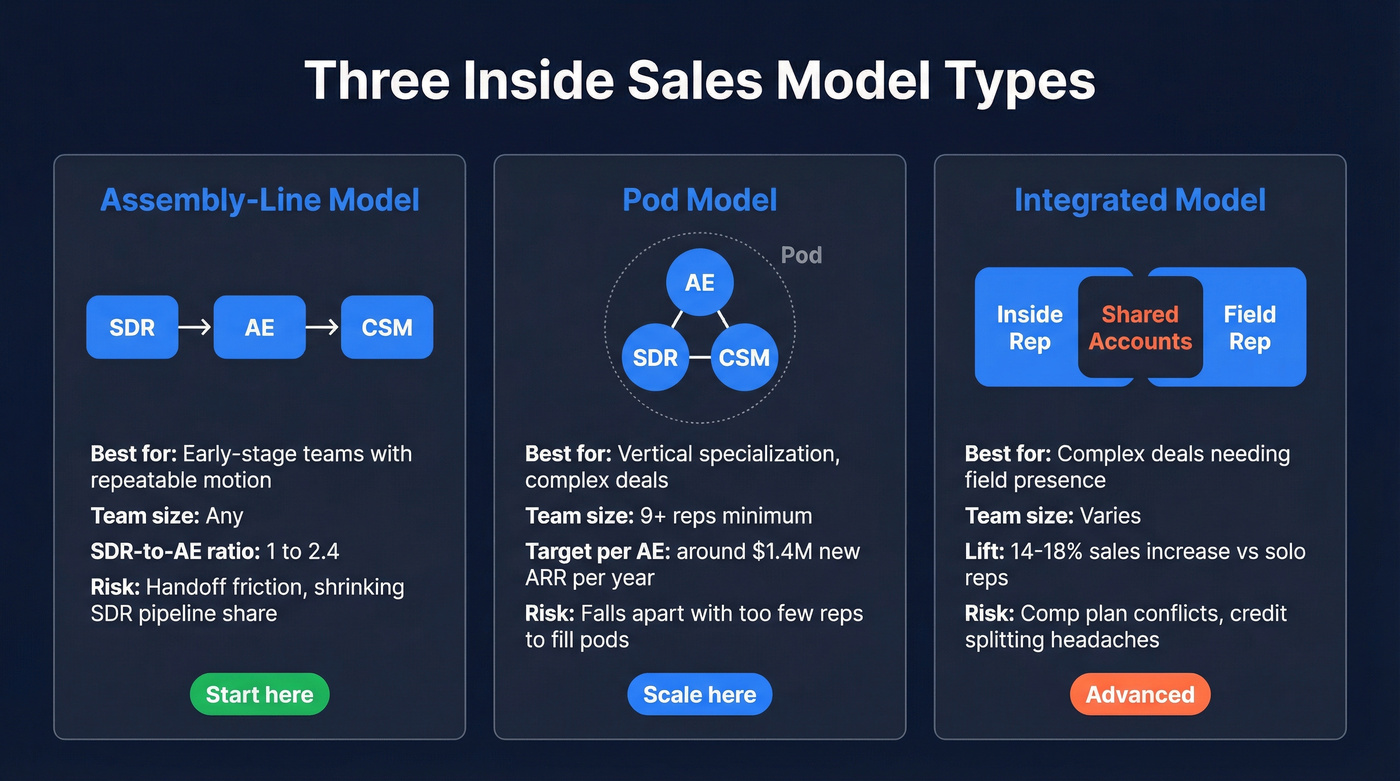
Here's the thing: this model's showing cracks. Quota attainment dropped to 51%, and marketing now sources 40% of pipeline, up from 33% in 2022. SDR-generated pipeline is shrinking as a share. If your marketing engine is strong, you need fewer SDRs than the ratio suggests - and we've seen teams cut their SDR headcount by a third without losing pipeline volume once they layered in intent data and better inbound routing.
Pod Model
This structure fits teams that need vertical specialization and tighter handoffs. A pod bundles an SDR, AE, and CSM into one cross-functional unit aligned by vertical or region. Per Winning by Design's framework, each AE needs roughly half an SDR and half a CSM, targeting about $1.4M in new ARR per year at $120K ACV.
Pods shine when deal complexity varies by segment. They fall apart when you don't have enough reps to fill a full pod - so skip this if you're under 9-10 people on the sales floor.
Integrated Model
Inside and outside reps share joint account ownership on complex deals where field presence matters. The inside rep handles follow-ups, scheduling, and smaller expansion deals while the field rep runs strategic meetings. In a test with a multibillion-dollar distributor, the integrated approach produced a 14-18% sales lift compared to reps working solo.
This is the hardest model to manage because comp plans get messy fast. Both reps want credit. If you go this route, define split rules before you hire.
Compensation by Role
| Role | OTE Range | Typical Split |
|---|---|---|
| SDR/BDR | $70K-$90K | 60/40 to 70/30 |
| Inside Sales Rep | $90K-$110K | 60/40 |
| Mid-Market AE | $120K-$160K | 50/50 |
| Enterprise AE | $180K-$250K+ | 50/50 |
| Sales Manager | $200K-$280K | 60/40 |
SDRs skew heavier on base because they don't control close rates. AEs at the mid-market and enterprise level typically run 50/50 splits - enough variable to motivate without creating desperation selling. Let's be honest: if your AE comp plan has a 70/30 variable-heavy split and your average deal takes 60+ days to close, you're going to churn reps before they ramp.

51% quota attainment isn't a rep problem - it's a data problem. Reps spend 60% of their time not selling, and bad contact data makes the other 40% even less productive. Prospeo gives inside sales teams 300M+ profiles with 98% email accuracy on a 7-day refresh cycle, so every dial and every send counts.
Stop burning your SDRs' time on bounced emails and dead numbers.
Benchmarks That Matter
- SDR ramp: 3.0 months - the lowest reading since 2010
- AE ramp: 5.7 months - up from 4.3 months in 2020
- Quota attainment: 51% of AEs hit quota, down from 66% in 2022
- SDR tenure: 1.9 years, near a decade high
- Marketing-sourced pipeline: 40% median, up from 33% in 2022
- Non-selling time: Reps spend 60% of their time on tasks that aren't selling
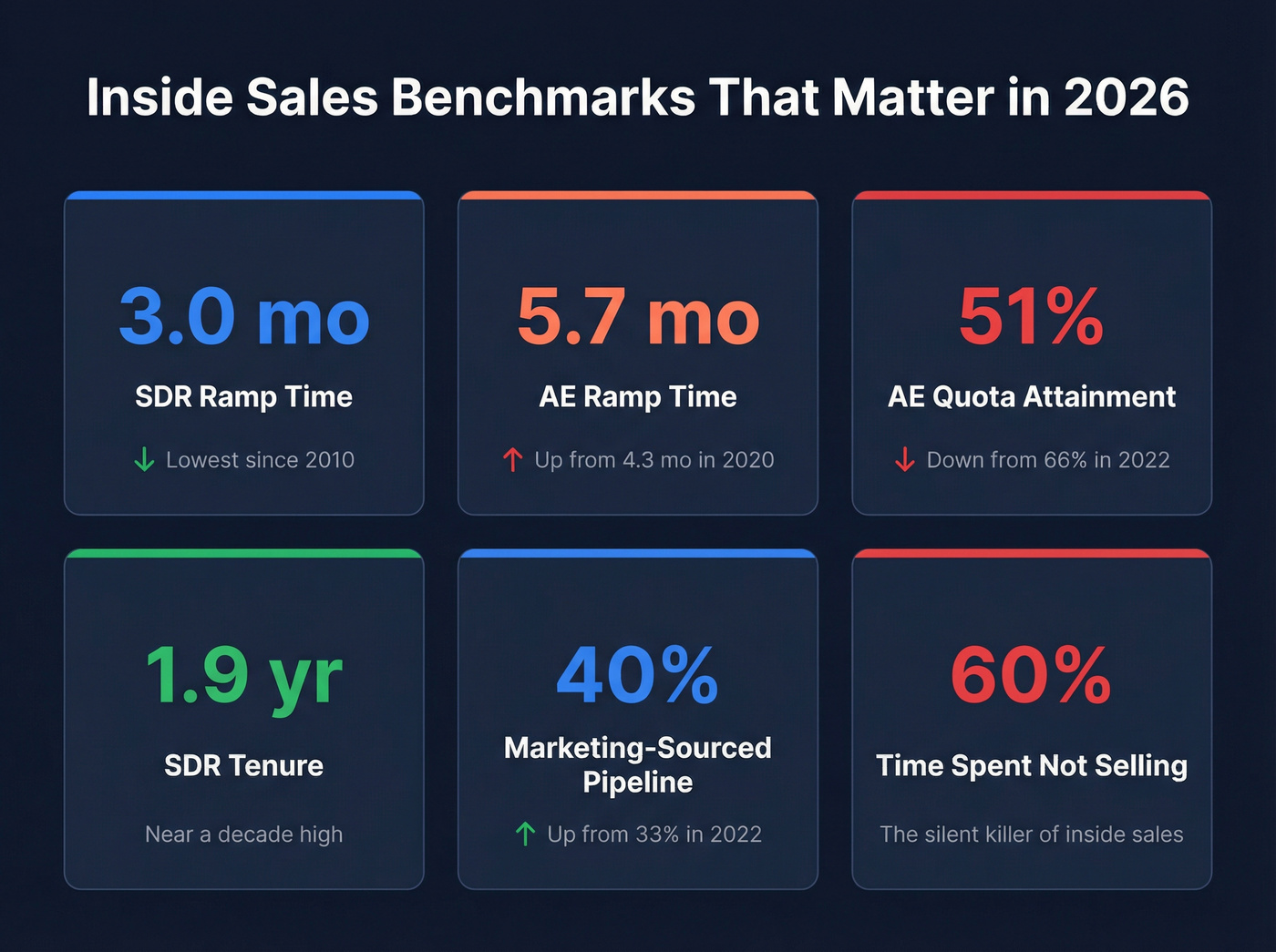
That last stat is the silent killer. Your model can be perfect on paper, but if reps burn most of their day on CRM hygiene and list building, none of the org design matters. This is why the tech stack section below deserves as much attention as the org chart.
The Right Tech Stack for Inside Sales
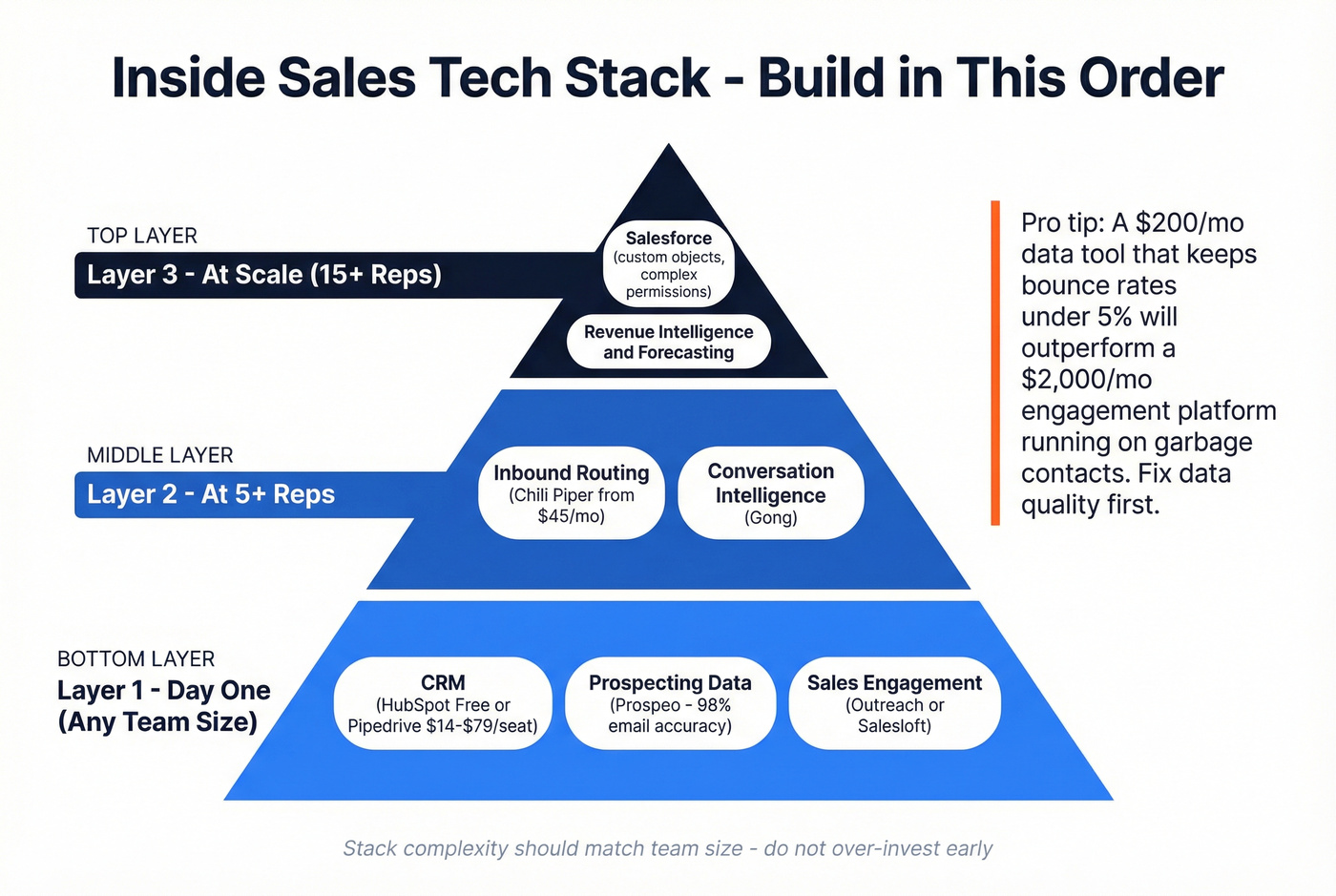
If your average deal is under $25K, you probably don't need Salesforce. Start with HubSpot's free tier or Pipedrive at $14-$79/seat/month. Salesforce makes sense when you need custom objects, complex permissions, and deep reporting - but we've watched too many 10-person teams spend six months configuring it when they should've been selling.
Prospecting and Data
This is where most inside sales teams quietly break. If 30% of your emails bounce, your SDRs are wasting a third of their outreach and torching your domain reputation in the process.
Snyk's 50-person AE team saw bounce rates drop from 35-40% to under 5% after switching to Prospeo for their prospecting data, which covers 300M+ professional profiles with 98% email accuracy on a 7-day data refresh cycle. AE-sourced pipeline jumped 180%, and the team now generates 200+ new opportunities per month. The free tier gives you 75 verified emails per month to test; paid plans start around $39/month with no contracts.

The consensus on r/sales is pretty clear: data quality is the single highest-ROI investment for outbound teams. A $200/month data tool that keeps bounce rates under 5% will outperform a $2,000/month engagement platform running on garbage contacts every time.
If you're rebuilding your outbound motion, start with sales prospecting techniques that match your segment, then lock in list hygiene with an email bounce rate benchmark and a real email deliverability guide.
Engagement and Intelligence
Outreach and Salesloft become non-negotiable once you have 3+ reps running sequences. Chili Piper starts at $45/month for inbound routing. In our experience, teams under 5 reps don't need Gong - invest that budget in better data instead.
Managing the Sales Cycle
Block prospecting calls in the morning when connect rates peak, stack demos in the afternoon, and reserve end-of-day for CRM updates and next-day prep. Simple. The goal is to reclaim as much of that 60% non-selling time as possible.
The inside sales cycle itself - from first touch to closed-won - typically runs 14 to 45 days for deals under $25K ACV and 45 to 90 days for mid-market. Tracking cycle length by segment reveals where deals stall and which stages need better enablement or automation. If your mid-market deals are averaging 90+ days, something's broken in discovery or you're selling to the wrong persona.
To tighten discovery and stop late-stage stalls, standardize your discovery questions and align early qualification to a framework like MEDDIC sales qualification.
Mistakes That Kill Your Model
Copying the assembly-line structure by default. Evaluate your ACV and team size first. A 6-person team doesn't need three handoff stages.
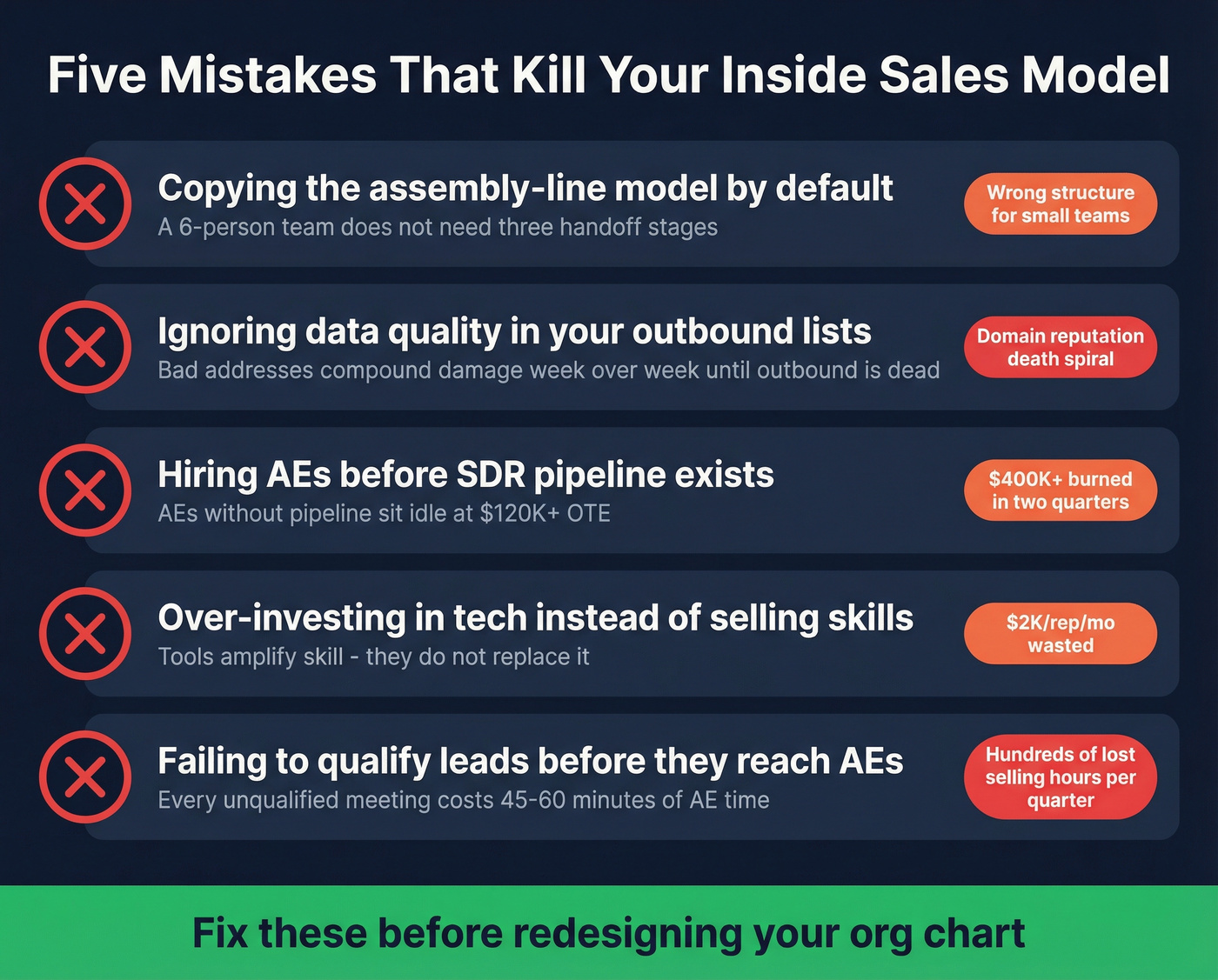
Ignoring data quality. Verify your lists before loading them into sequences. Bad addresses damage your sender domain, and that damage compounds week over week until your entire outbound channel is effectively dead.
If you're seeing deliverability decay, prioritize how to improve sender reputation and audit your email reputation tools before you scale volume.
Hiring AEs before SDR pipeline exists. AEs without pipeline sit idle at $120K+ OTE. Build the top of funnel first. We learned this one the hard way watching a client burn through $400K in AE salaries over two quarters with no pipe to work.
Over-investing in tech at the expense of selling conversations. We've seen teams spend $2K/rep/month on tools while reps still can't articulate the value prop in 30 seconds. Tools amplify skill - they don't replace it.
If your messaging isn't landing, tighten the basics with sample elevator pitches and keep a set of sales follow-up templates your whole team uses.
Failing to qualify leads early. Every unqualified meeting that reaches an AE costs 45-60 minutes of selling time. Multiply that across a team and you're looking at hundreds of lost selling hours per quarter.
The right inside sales model matches your ACV, team maturity, and pipeline sources. Pick the structure that fits, staff it with the benchmarks above, and invest in data quality before anything else. That's how you get quota attainment moving in the right direction.
Snyk's 50 AEs cut bounce rates from 35% to under 5% and grew AE-sourced pipeline 180% - because the inside sales model finally had data that matched the org design. Prospeo starts at $0.01/email with no contracts, so you can test it before your next SDR hire.
Fix your data before you fix your org chart.
FAQ
What's the difference between inside sales and telemarketing?
Inside sales involves consultative selling of complex products through multi-touch engagement over weeks or months. Telemarketing is scripted, transactional, and single-call. Inside reps need deep product knowledge and discovery skills; telemarketers optimize for call volume.
How many SDRs do I need per AE?
The industry benchmark is 1 SDR for every 2.4 AEs, steady since 2018. If marketing sources 40%+ of your pipeline, you likely need fewer SDRs than that ratio suggests.
What tools does an inside sales team need on day one?
Start with three: a CRM (HubSpot's free tier works), a prospecting data tool like Prospeo for verified emails and direct dials, and a sales engagement platform for sequencing. Add conversation intelligence and scheduling tools once you scale past 5 reps.
How does the inside sales economic model work?
It hinges on cost per acquisition relative to ACV. When your fully loaded rep cost - base plus variable plus tools plus management overhead - divided by closed deals stays well below your average contract value, the model scales. For most B2B SaaS companies, profitability kicks in once each rep generates at least 3-4x their total cost to employ.