

12 Inside Sales Strategies That Actually Move Pipeline in 2026
It's Monday morning and an SDR manager opens the weekly activity report. Two hundred calls logged. Forty emails sent per rep. Pipeline? Flat. The team isn't lazy - they're grinding harder than ever, but the contacts are stale, the cadence is guesswork, and nobody's qualifying before they pitch.
Average quota attainment hit 43% in Q4 2024. Only 25% of B2B reps made their number that year. Those aren't rounding errors - they're a structural failure. The reps aren't broken. The inside sales strategies feeding them are.
Here's the thing: reps spend just 28-30% of their time actually selling. The rest vanishes into admin, data cleanup, and chasing leads that were dead before the sequence even started. If you take three things from this article, make them a qualification framework, a structured multichannel cadence, and verified contact data so your reps stop burning touches on bad emails. Everything else is optimization on top of those three.
The Business Case for Inside Sales
Inside sales isn't just cheaper. It's structurally faster to deploy and far easier to scale.
| Metric | Inside Sales | Outside Sales |
|---|---|---|
| Cost per interaction | ~$50 | ~$308 |
| Ramp to productivity | 3-4 months | 6-9 months |
| Best-fit ACV band | $5K-$50K | $50K-$500K+ |
| Typical sales cycle | 2-8 weeks | 90-180+ days |
| Tech spend per rep/yr | $2-3K | $15-40K |
40% of high-growth teams now run hybrid models where inside reps qualify and outside reps close the highest-value deals. That's the smart play for most mid-market companies.
The ROI math is straightforward. An inside rep closing $300K in annual revenue at an $80K fully loaded cost delivers 3.75x ROI. A field rep closing $1M at $150K cost delivers 6.7x - higher per head, but you can hire three inside reps for the same budget and cover far more pipeline. Inside sales also reduces selling costs by 40-60% compared to field models. For deals under $50K, inside sales wins on unit economics every time.
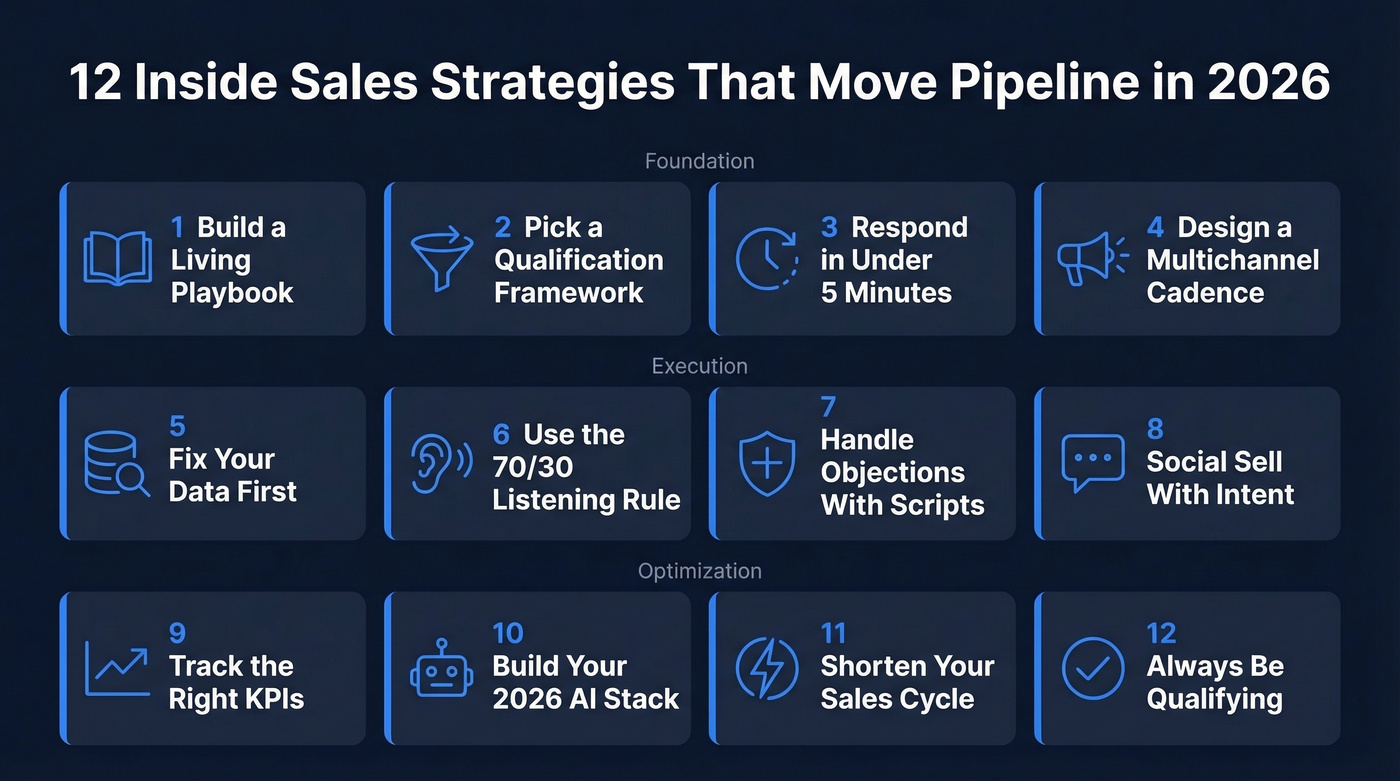
12 Strategies That Work
1. Build a Living Playbook
Most playbooks die the week after they're published. Sandler's philosophy nails it: speed beats perfection. Your playbook should be a living system - updated monthly, built around observable behaviors like discovery questions, objection phrasing, and follow-up cadences, not abstract theory.
Assign one person to own monthly revisions. Pull from call recordings, won/lost analyses, and rep feedback. We've seen teams treat playbook updates like a quarterly chore, and the result is always the same: reps stop referencing it within 60 days. A mediocre playbook that evolves beats a polished one that collects dust.
2. Pick a Qualification Framework
Three frameworks dominate B2B inside sales, and they're all backed by serious research:
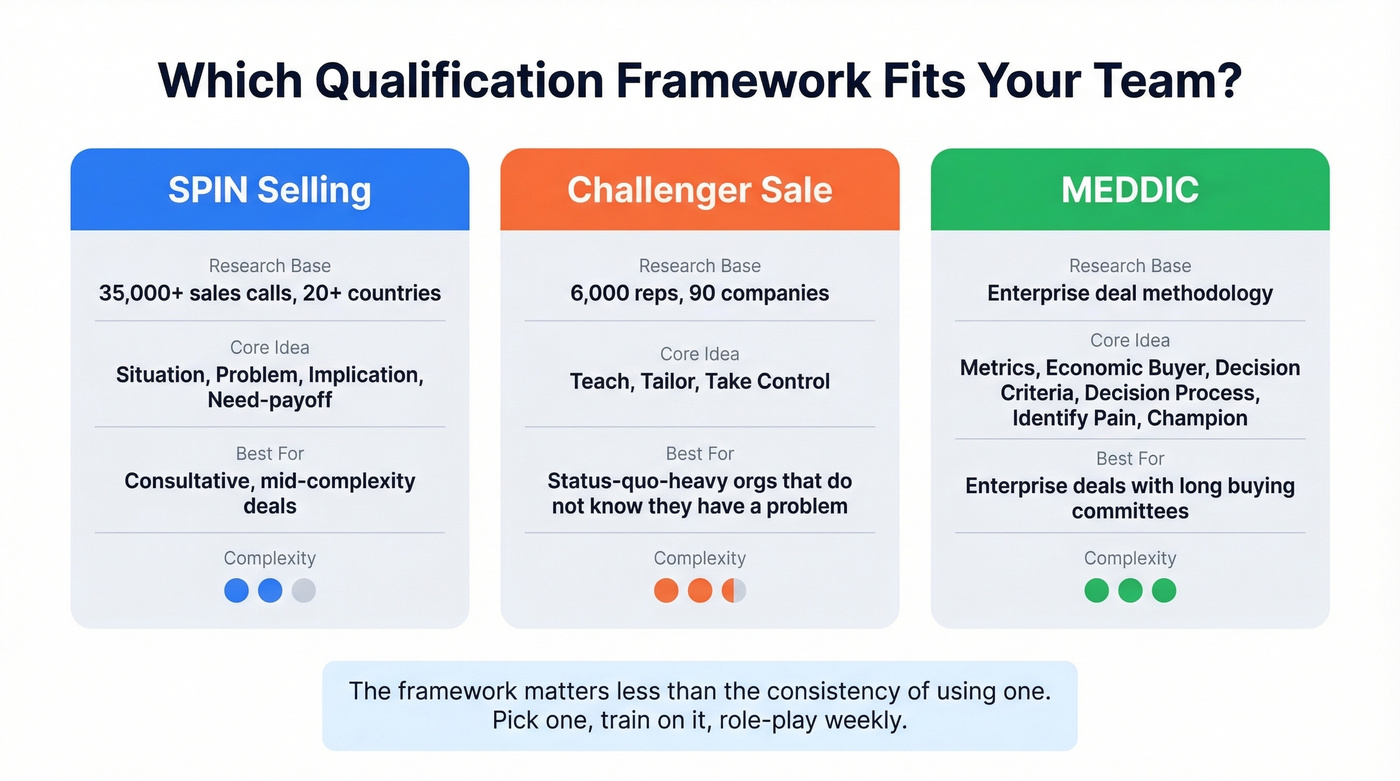
SPIN Selling - developed from 35,000+ sales calls across 20+ countries. Situation, Problem, Implication, Need-payoff. Best for consultative, mid-complexity deals.
Challenger Sale - built from studying 6,000 reps across 90 companies. Teach, tailor, take control. Best for selling into status-quo-heavy orgs where the prospect doesn't even know they have a problem yet.
MEDDIC - Metrics, Economic Buyer, Decision Criteria, Decision Process, Identify Pain, Champion. Best for enterprise deals with long buying committees (use these MEDDIC discovery questions to standardize call quality).
Pick one. Train on it. Role-play weekly. The framework matters less than the consistency of using one.
3. Respond in Under 5 Minutes
The average B2B lead response time is 42 hours. That's not a benchmark - that's operational neglect.
Contacting a lead within 5 minutes increases conversion up to 100x compared to waiting 30 minutes. The odds of qualifying that lead drop 21x between the 5- and 30-minute mark. Set up real-time routing. Use round-robin assignment. If your CRM can't alert a rep within 60 seconds of a form fill, fix that before you optimize anything else.
4. Design a Multichannel Cadence
Multichannel sequences drive up to 128% higher response rates than email-only outreach. Here's a baseline cadence we've refined over dozens of campaigns:
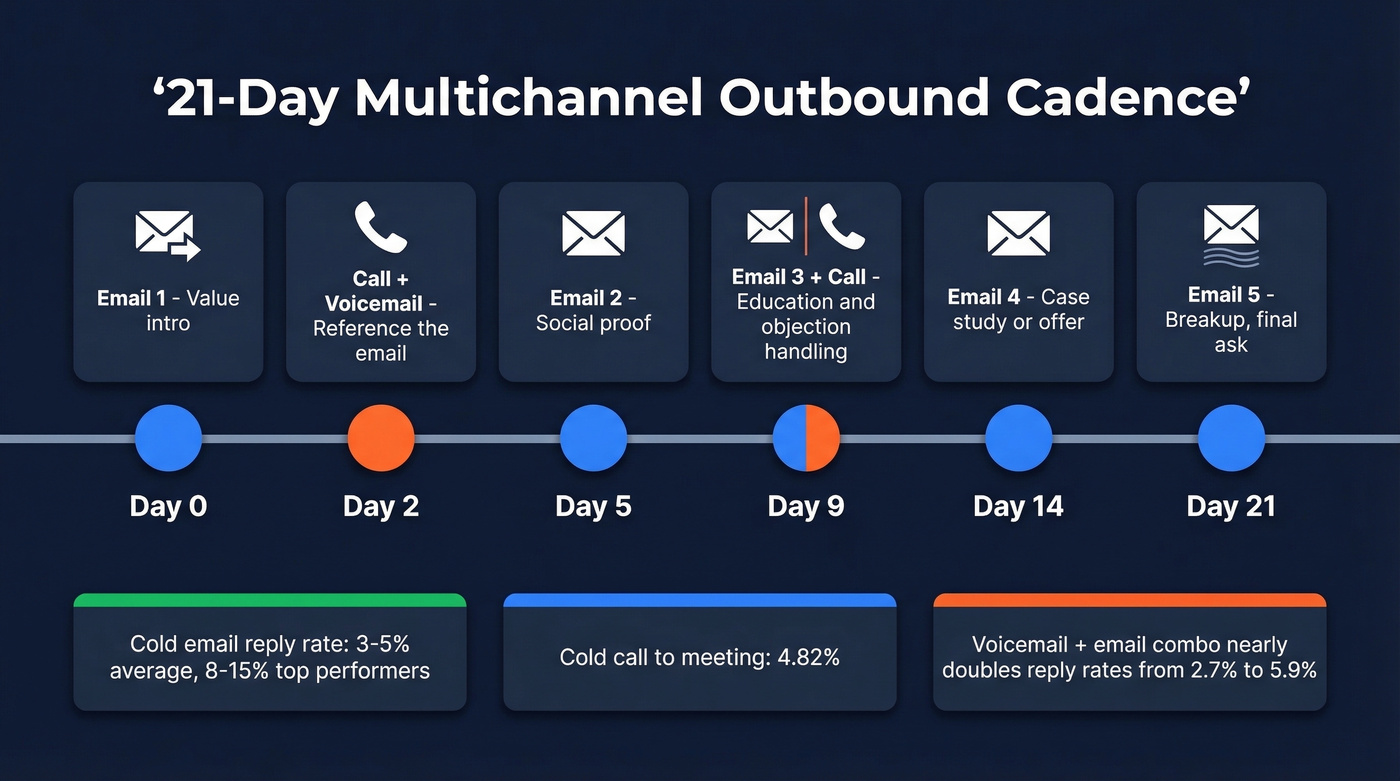
| Day | Channel | Intent |
|---|---|---|
| 0 | Email #1 | Value intro |
| 2 | Call + voicemail | Reference email |
| 5 | Email #2 | Social proof |
| 9 | Email #3 + call | Education / objection |
| 14 | Email #4 | Offer / case study |
| 21 | Email #5 | Breakup / final ask |
Cold email reply rates average 3-5%, with top performers hitting 8-15%. Cold call to meeting conversion runs about 4.82% based on Cognism's 2024 dataset.
A stat most teams miss: leaving 1-2 voicemails that reference a sent email lifts reply rates from 2.73% to 5.87%, per Gong's research. The voicemail-email combo is the single most underused tactic in outbound. It costs nothing extra and nearly doubles response rates. Aim for 10-15 touches over 14-21 days. If you need plug-and-play copy, keep a set of sales follow-up templates ready for each touch.
5. Fix Your Data Before Your Process
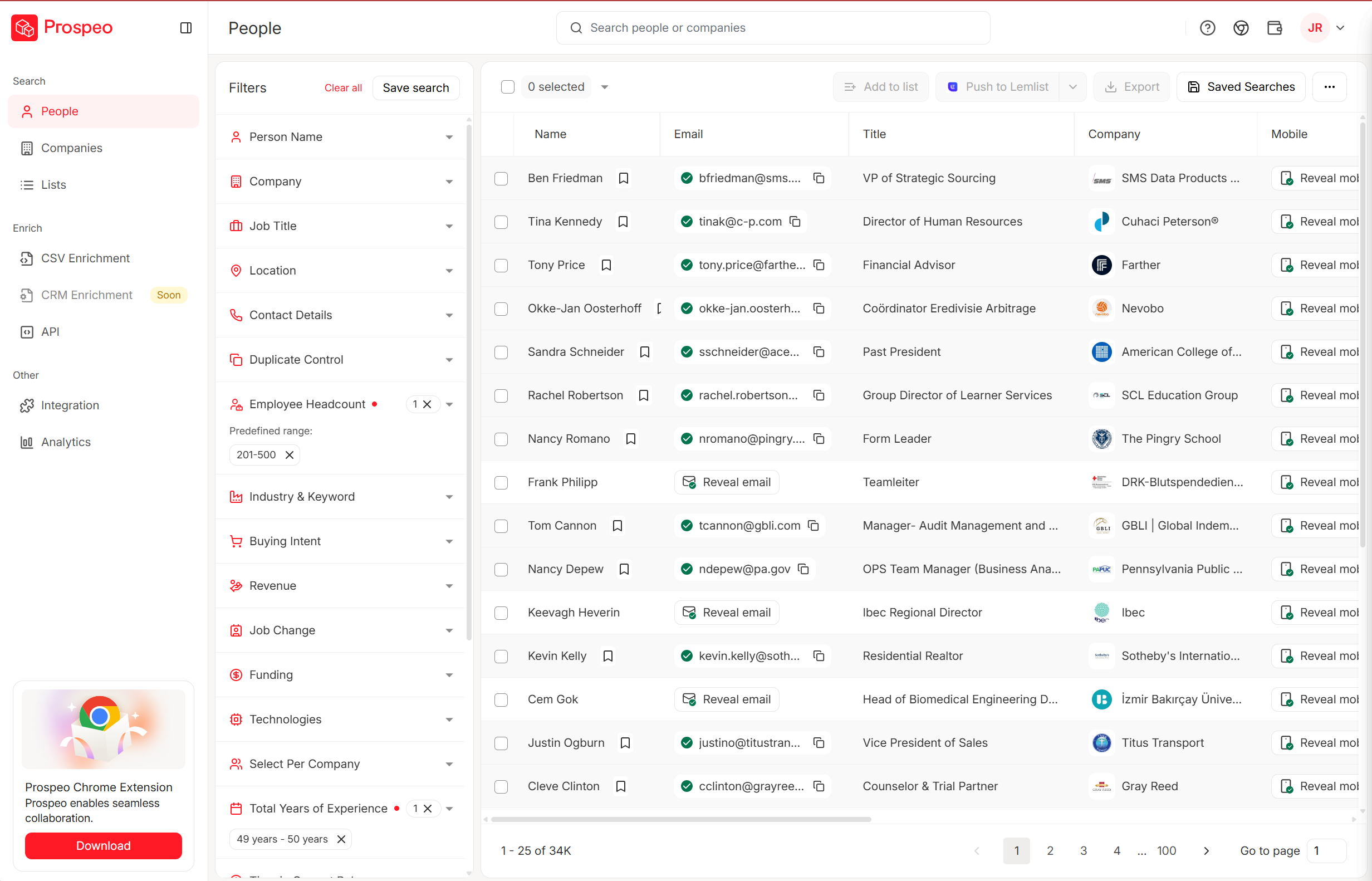
None of the strategies above matter if your reps are emailing dead addresses and calling disconnected numbers. Bounce rate above 5%? Data is the bottleneck - not your messaging, not your cadence, not your reps. (If you want the benchmarks and root causes, start with email bounce rate.)
Snyk's 50-person AE team learned this the hard way. They were running bounce rates of 35-40%. After switching to Prospeo, bounces dropped under 5%, AE-sourced pipeline jumped 180%, and they started generating 200+ new opportunities per month. Your cadence is only as good as the data feeding it.
6. Use the 70/30 Listening Rule
Top reps let the prospect talk 70% of the time. They talk 30%.
This isn't soft advice - it's the single highest-leverage behavior change for reps who "present" instead of "discover." Use silence strategically, especially after stating pricing. The instinct is to fill the gap with justification. Don't. Let the prospect process and respond. In our team's call reviews, the reps who consistently hold that silence close at nearly double the rate of those who rush to explain.
7. Handle Objections With Scripts
At least 50% of sales calls have no chance of closing. That's normal. What separates top reps is preparation, not improvisation. Cognism's 5-step framework works well: listen, ask open-ended questions, solve, confirm, move on. (To systematize this, build a team-wide sales communication standard.)
Here's a script for the most common objection - "I don't have time":
"I completely understand - I'll keep this to 30 seconds. [Deliver one-sentence value prop.] If that's relevant, can I get 15 minutes on your calendar this week? Does that sound fair?"
Build a library of 8-10 objection scripts. Role-play them weekly. The rep who's heard "we're already using a competitor" forty times in practice handles it ten times better on a live call.
8. Social Sell With Intent
Nearly 80% of reps who use social outsell peers who don't. But social selling isn't spray-and-pray connection requests. It's signal-based engagement: commenting on a prospect's post about a challenge you solve, reaching out after a job change, or referencing a funding round in your first message.
Track job changes, funding events, and content engagement as triggers - then act fast. (If you want a repeatable system, use a simple process for identifying buying signals.)
Let's be honest about a tactic that still works absurdly well: the "CEO forward email." You send a brief note to the CEO asking who handles X, then forward their reply to the actual buyer. It's uncomfortable, which is exactly why most reps won't do it. That's your edge.
9. Track the Right KPIs
Most teams track activity. The best teams track the ratio between activity and outcomes.
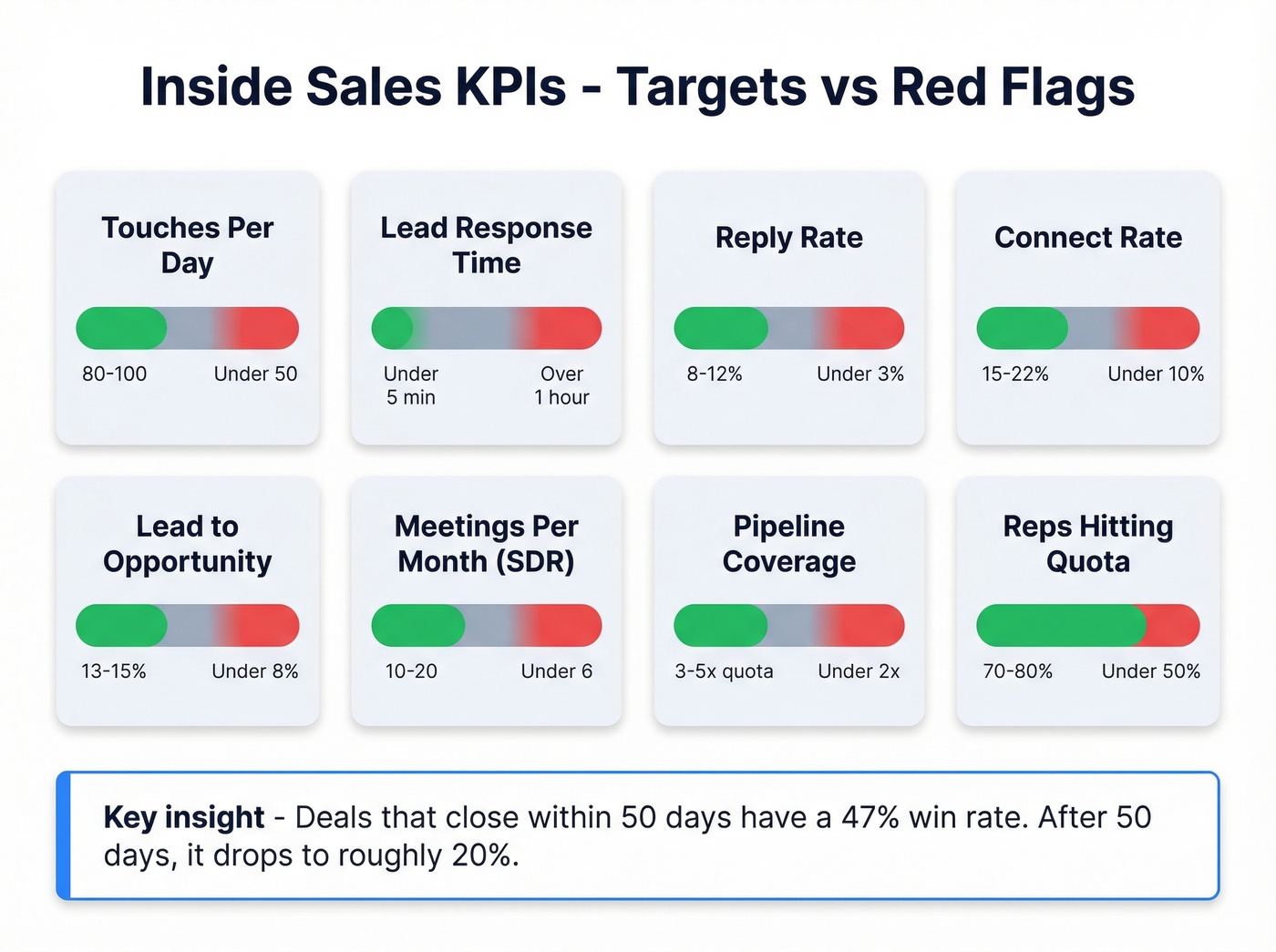
| Metric | Target | Red Flag |
|---|---|---|
| Touches/day | 80-100 | <50 |
| Lead response time | <5 min | >1 hour |
| Reply rate | 8-12% | <3% |
| Connect rate | 15-22% | <10% |
| Lead-to-opportunity | 13-15% | <8% |
| Meetings/month (SDR) | 10-20 | <6 |
| Pipeline coverage | 3-5x quota | <2x |
| Reps hitting quota | 70-80% | <50% |
One benchmark deserves special attention: opportunities closed within 50 days carry a 47% win rate. After 50 days, that drops to roughly 20%. If your average cycle is stretching past that mark, you've got a qualification or urgency problem - not a "closing skills" problem.
The consensus on r/sales is that the first 60 days in an inside sales role are about call volume discipline - 60-70 calls per day minimum before you earn the right to optimize. If your new hires aren't hitting that floor, the problem is usually bad data or poor tooling, not effort. (For onboarding structure, use a 30-60-90 day plan.)
10. Build Your 2026 AI Stack
56% of sales professionals now use AI daily, up from 24% in 2023. Sellers who effectively partner with AI are 3.7x more likely to meet quota, per Gartner. By 2028, 60% of B2B seller work will be executed through generative AI.
The minimum viable stack for 2026 maps to four jobs:
- Data - Prospeo for verified contacts and intent signals
- Sequencing - Outreach or Salesloft for multichannel execution, roughly $100-150/user/mo
- Conversation intelligence - Gong for call coaching and deal risk, roughly $100-150/user/mo
- Intent - Bombora or 6sense for in-market buyer signals, roughly $25-60K/year for mid-market
You don't need twelve tools. You need a CRM, a sequencer, and a verified data platform. Everything else is a nice-to-have until those three are working. If you're evaluating platforms, start with a shortlist of SDR tools.
11. Shorten Your Sales Cycle
Pipeline velocity is the metric that ties everything together:
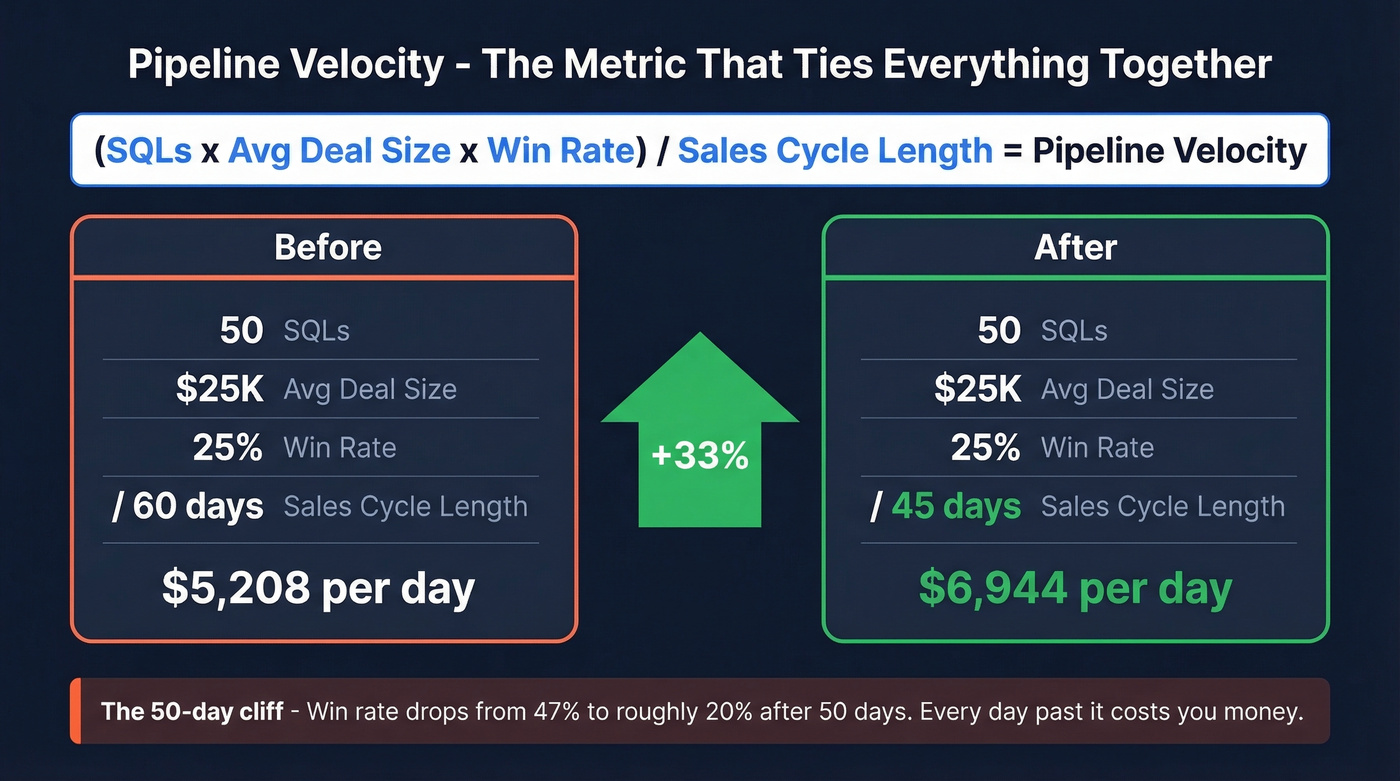
(SQLs x Avg Deal Size x Win Rate) / Sales Cycle Length = Pipeline Velocity
Say you have 50 SQLs, $25K average deal size, 25% win rate, and a 60-day cycle. That's $5,208/day in pipeline velocity. Cut the cycle to 45 days and velocity jumps to $6,944/day - a 33% increase without changing anything else. The 50-day win-rate cliff is your forcing function. Every day past it, your probability of closing drops.
12. Always Be Qualifying (Not Closing)
61% of B2B buyers prefer a rep-free buying experience. The old "Always Be Closing" mantra pushes prospects away.
The fastest path to more revenue is disqualifying bad-fit prospects earlier so your reps spend time on deals that can actually close. Skip this if your team is still rewarding reps for "staying in the deal" past the point of reason - that's how you end up with bloated pipelines and missed forecasts. ABQ beats ABC every time.

Snyk cut bounce rates from 35% to under 5% and added 200+ opportunities per month. Your multichannel cadence deserves data that actually connects - 300M+ profiles, 98% email accuracy, 7-day refresh cycle.
Stop burning touches on dead emails. Start every sequence with verified contacts.
Common Mistakes That Kill Deals
Feature dumping. Prospects don't care about your product's capabilities. They care about their problem. Lead with the problem, not the feature list.
Talking too much. If you're talking more than 30% of the call, you're presenting, not selling.
No follow-up structure. "I'll get back to you" is where deals go to die. Every call should end with a specific next step on the calendar - no exceptions.
Spending time with NINA. No Influence, No Authority. If your contact can't sign or champion internally, find someone who can. I've watched reps burn entire quarters nurturing a "champion" who turned out to be a coordinator with zero budget authority.
Not researching prospects. Five minutes on a company's website and recent news before a call is the bare minimum. It's also the thing most reps skip first when volume pressure hits.
Avoiding competitor questions. When a prospect asks about a competitor, don't dodge. Have battlecards ready. Confidence here builds trust faster than any case study.
Going solo. Not pulling in SEs, PMs, or executives when the deal calls for it is ego, not strategy.
The Minimum Viable Tech Stack
Stop adding tools. Start verifying the data in the tools you have.
| Category | Tools | Price Range |
|---|---|---|
| CRM | HubSpot (free) - Salesforce | $0-$300/user/mo |
| Sequencing | Outreach, Salesloft | ~$100-150/user/mo |
| Data platform | Prospeo | Free tier - ~$0.01/email |
| Conversation intel | Gong | ~$100-150/user/mo |
The data layer is where most teams hemorrhage money. ZoomInfo typically runs $15-40K/year depending on seats and modules. We've seen teams spend $40K on a data platform and still run 20%+ bounce rates because the verification methodology was the weak link, not the tool itself. Prospeo's 98% email accuracy on a 7-day refresh cycle - with catch-all handling, spam-trap removal, and self-serve pricing - means your sequences hit real inboxes instead of spam folders. (If deliverability is slipping, use an email deliverability guide to diagnose the real cause.)
Your reps spend 70% of their time not selling. Bad data makes it worse. Prospeo gives inside sales teams 143M+ verified emails and 125M+ direct dials so every touch in your cadence reaches a real buyer.
Give your reps pipeline, not busywork. Verified contacts from $0.01 each.
FAQ
What's the difference between inside sales and outside sales?
Inside sales reps sell remotely at roughly $50 per interaction, compared to $308 for field reps. Inside handles shorter cycles and lower ACVs ($5K-$50K), while outside tackles enterprise deals ($50K-$500K+) with longer ramp times.
How many calls should an inside sales rep make per day?
For high-volume prospecting, 80-100 calls per day is the benchmark. For research-heavy accounts, 30-50 is appropriate. Below 50 in a high-volume role signals poor tooling or bad data - fix your contact verification before blaming rep effort.
What's a good cold email reply rate?
8-12% is strong for targeted B2B outreach. Below 3% signals a data quality or messaging problem. Top performers hit 15% by combining tight ICP targeting with verified addresses.
How do I fix a high email bounce rate?
Switch to a data provider with real-time verification and a refresh cycle measured in days, not weeks. If you're bouncing above 5%, your domain reputation degrades with every send - no amount of copywriting fixes that. Aim for 98%+ accuracy before scaling volume.
What makes inside sales strategies effective in 2026?
Teams hitting quota consistently combine three things: a repeatable qualification framework, a multichannel cadence with 10-15 touches, and verified contact data that keeps bounce rates under 5%. Layer in AI-assisted prioritization and sub-5-minute lead response, and you've got the foundation every high-performing org is built on.