

How to Write an Introduction by Email That Actually Gets a Reply
You just spent 20 minutes crafting the perfect introduction by email to a VP of Sales. You researched her company, personalized the opening, nailed the CTA. You hit send. It bounces.
That's not a writing problem - it's a targeting problem, and it's where most introductory emails die before they ever get read.
Email still reaches 4.6 billion users globally and returns $36-$40 for every $1 spent. The channel isn't dying. But the bar for getting a reply from a stranger has never been higher. B2B cold email benchmarks put the average response rate around 4.0%, and the average campaign open rate across 183,000+ brands sits at 31%. Your intro email needs to be sharper, shorter, and better targeted than whatever your competitors are sending.
The Quick Checklist
Before you read another word:
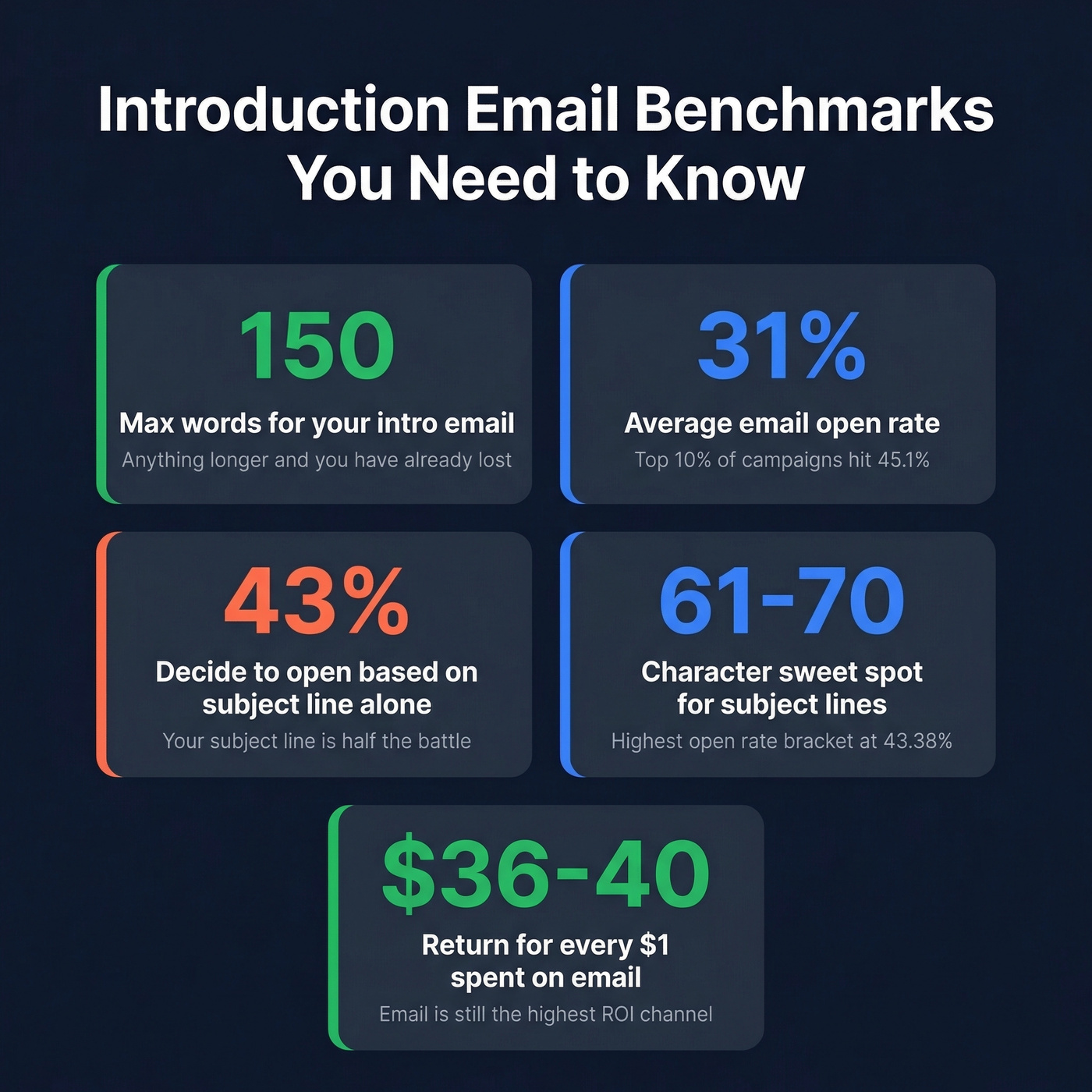
- Keep it under 150 words. Nobody reads a novel from a stranger.
- Lead with the recipient's problem, not your biography.
- One clear, low-friction CTA - a 15-minute call, a specific question, a link. Pick one. (If you need help tightening the ask, see CTA best practices.)
- Personalized subject line, 61-70 characters. That's the sweet spot for opens. For more ideas, swipe from these subject line examples.
- Verify the email address before you send. A perfect email to a dead address is wasted effort. If you're troubleshooting bounces, start with bounce rate basics.
That's the framework. Everything below expands on it.
What Makes a Great Introduction Email
A strong email introduction has six parts. Get the order wrong and even great writing falls flat.
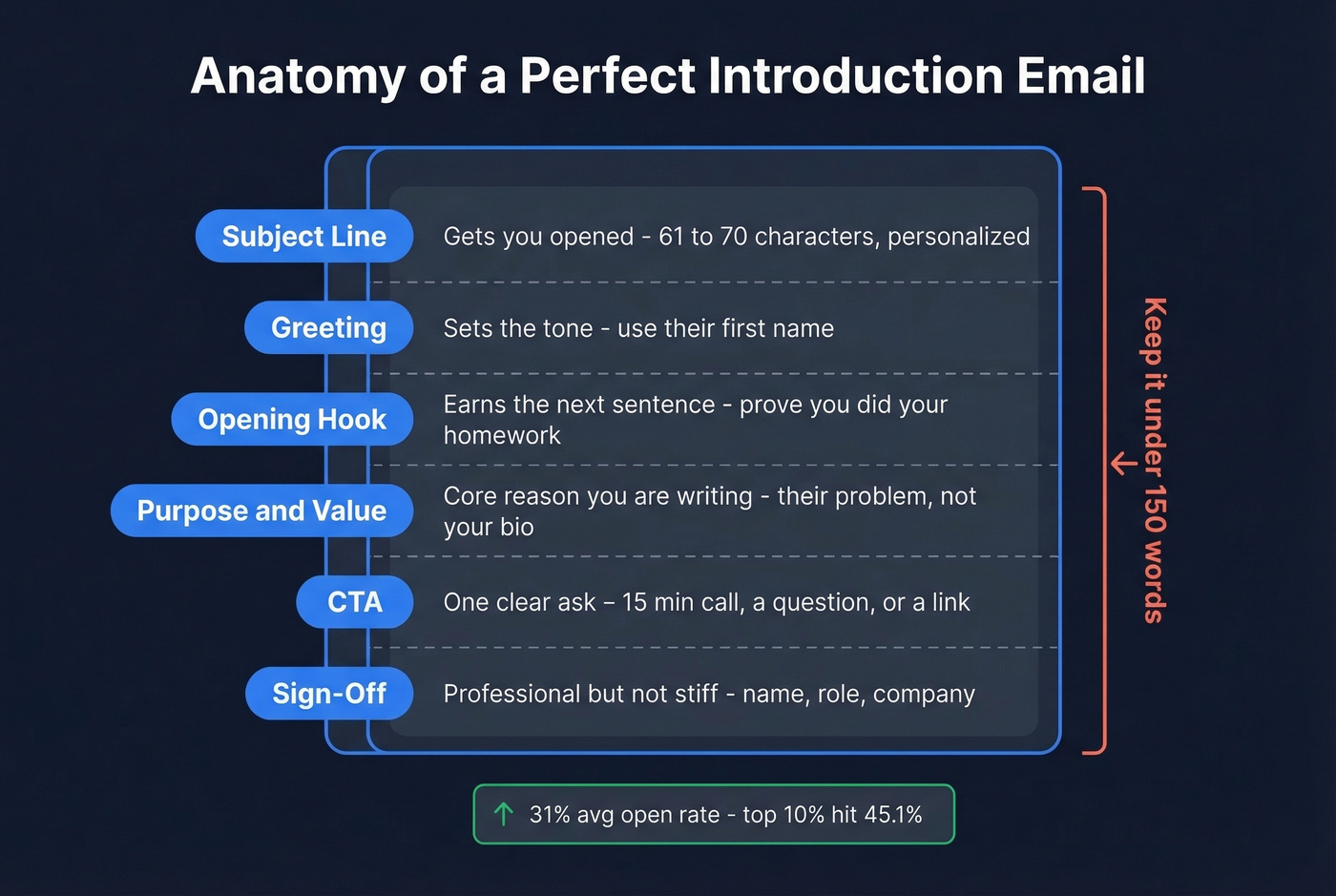
The anatomy runs like this: subject line gets you opened, greeting sets the tone, opening hook earns you the next sentence by proving you've done your homework, purpose and value delivers the core reason you're writing, CTA tells them exactly what to do next, and sign-off keeps it professional without being stiff.
The 150-word rule isn't arbitrary. Fyxer's research recommends aiming for 50-150 words, and the consensus on r/emailmarketingnow is blunt: "Nobody wants a novel from a stranger." If your intro email crosses 150 words, you've already lost.
Benchmarks to know: 31% average open rate across email campaigns (top 10% hit 45.1%). B2B cold email response rates average 4.0%. And 43% of people decide whether to open based on the subject line alone.
Subject Lines That Get Opened
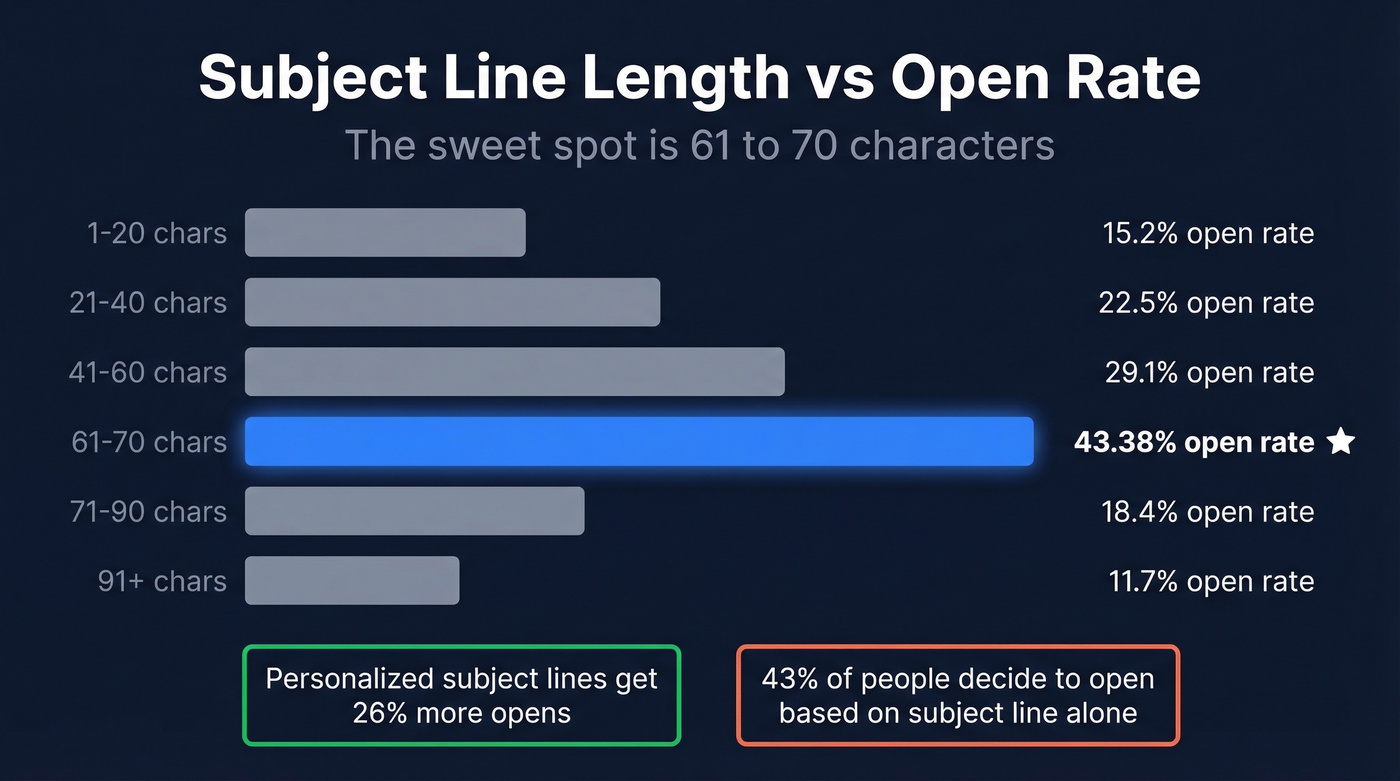
Subject lines between 61-70 characters hit a 43.38% open rate - the highest of any length bracket. Personalized subject lines get opened 26% more often than generic ones. These aren't small differences.
Here are subject lines that work across scenarios:
- Networking: "Quick question about [their recent project/talk]"
- Sales: "[First name], idea for [specific problem you solve]"
- Job inquiry: "Application: [Role] - [your key differentiator in 3 words]"
- Partnership: "[Their company] + [your company] - potential fit?"
- Warm intro: "Intro: [Name A] (Company X) <> [Name B] (Company Y)"
- Post-event: "Great meeting you at [event] - following up on [topic]"
- Re-introduction: "[First name], it's been a while - quick update"
- Internal: "New on the team - excited to work with [department]"
Personalized lines referencing a real trigger event consistently outperform clever wordplay. When you're A/B testing, run proper tests with 250+ contacts per variant. And measure positive reply rate, not opens. Opens are directionally useful but inflated by Apple Mail Privacy Protection. Replies are what actually matter.
12 Introduction Email Templates
Let's be honest - the email that gets replies isn't the cleverest. It's the one sent to the right person, at the right time, about their actual problem. A good template just saves you from starting at a blank screen. Here are twelve, one for every common scenario.
Self-Introduction (Networking)
Subject: Quick question about [their work/project]
Hi [Name], I'm [Your Name], [role] at [Company]. I came across your [article/talk/post] and it resonated - especially [specific detail]. Would you be open to a 15-minute call next week?
Lead with their work, not yours. The specific detail is what separates this from the hundred other "I'd love to connect" emails they got this week.
Sales / Cold Outreach
Most sales intros fail because they pitch too early. Open the door, don't walk through it:
Subject: [Name], idea for [their specific challenge]
Hi [Name], I noticed [Company] recently [specific trigger - new hire, funding round, product launch]. Teams in your space often run into [specific problem]. We've helped [similar company] solve that - worth 15 minutes?
If you're building a full outreach flow, this B2B cold email sequence guide pairs well with the template above.
Job Application
Here's the bad version most people send, followed by what actually works:
❌ "Dear Hiring Manager, I am writing to express my interest in the [Role] position. I believe my skills and experience make me a strong candidate..."
✅ "Hi [Name], I'm [Your Name], a [specialty] with [X years] in [industry]. I saw the [Role] opening - my background in [specific skill] aligns with what you're building. I've attached my resume. Would you have 10 minutes this week?"
The second version is direct, specific, and respects their time.
Freelancer to Potential Client
Subject: [Their company] - [service you offer] idea
Hi [Name], I'm [Your Name], a freelance [specialty]. I've worked with [similar client] on [type of project] and noticed [specific opportunity at their company]. My portfolio and rates are at [link]. Open to a quick call?
Have your portfolio and rates ready before you send. The worst outcome is getting a "yes" and scrambling.
Customer Success Onboarding
Subject: Your new point of contact at [Company]
Hi [Name], I'm [Your Name], your CSM at [Company]. I handle renewals, escalations, and making sure you get full value from [product]. Let's set up a 20-minute intro call to align on your priorities. What works this week?
Partnership Proposal
Subject: [Their company] + [Your company] - potential fit?
Hi [Name], I'm [Your Name] at [Company]. We work with [type of clients] on [what you do], and I see natural overlap with [their focus]. Would you be the right person to chat with, or could you point me to someone?
The "or point me to someone" line is underrated. It gives them an easy out that still moves you forward.
Making Introductions via Email
Subject: Intro: [Alice] (Company X) <> [Bob] (Company Y) - [topic]
Hi [Alice] and [Bob], I wanted to connect you two. [Alice], [Bob] is [brief context]. [Bob], [Alice] is [brief context]. I think you'd have a great conversation about [topic]. I'll drop to BCC - take it from here!
Only send this after getting permission from both parties. If someone asks you to make an intro on their behalf, ask them to draft the email for you - it reduces your effort and ensures the context is right.
Internal Team Introduction
Subject: New on the team - excited to work with [department]
Hi [Name/Team], I'm [Your Name], just joined as [Role] on [Department]. I'll be working on [specific area]. Previously at [Company] doing [relevant work]. Feel free to grab time on my calendar.
Post-Event Follow-Up
Reference something specific from the conversation. "It was great meeting you" alone isn't enough.
Subject: Great meeting you at [Event] - following up on [topic]
Hi [Name], I've been thinking about what you said at [Event] regarding [detail] - I'd love to continue that conversation. Free for a call next week?
Referral-Based Introduction
Subject: [Referrer's name] suggested we connect
Hi [Name], [Referrer] mentioned you'd be a great person to talk to about [topic]. I'm [Your Name], [role] at [Company]. [Referrer] thought there'd be overlap. Would you have 15 minutes this week?
The referrer's name does the heavy lifting. Put it in the subject line.
Investor / Fundraising Intro
Subject: [Company name] - [one-line value prop]
Hi [Name], I'm [Your Name], founder of [Company]. We're [one sentence on what you do and traction]. I'd love to share our deck and get your perspective. Would a 20-minute call work?
Investors get hundreds of these. Traction and a warm referral are the only things that cut through.
Re-Introduction After a Gap
Subject: [Name], it's been a while - quick update
Hi [Name], it's [Your Name] - we [context: worked together at X / met at Y]. I'm now at [Company] working on [what you do]. I'd love to catch up. Coffee or a quick call?
Acknowledge the gap honestly. Don't pretend it didn't happen.

You just read that the perfect introduction email dies when it bounces. Prospeo's 98% email accuracy and 7-day data refresh mean every intro you craft actually reaches a real inbox - not a dead address.
Stop writing perfect emails to wrong addresses. Verify first.
The 3-Touch Cold Sequence
One email isn't a strategy. Here's a three-touch framework that builds momentum without being annoying.
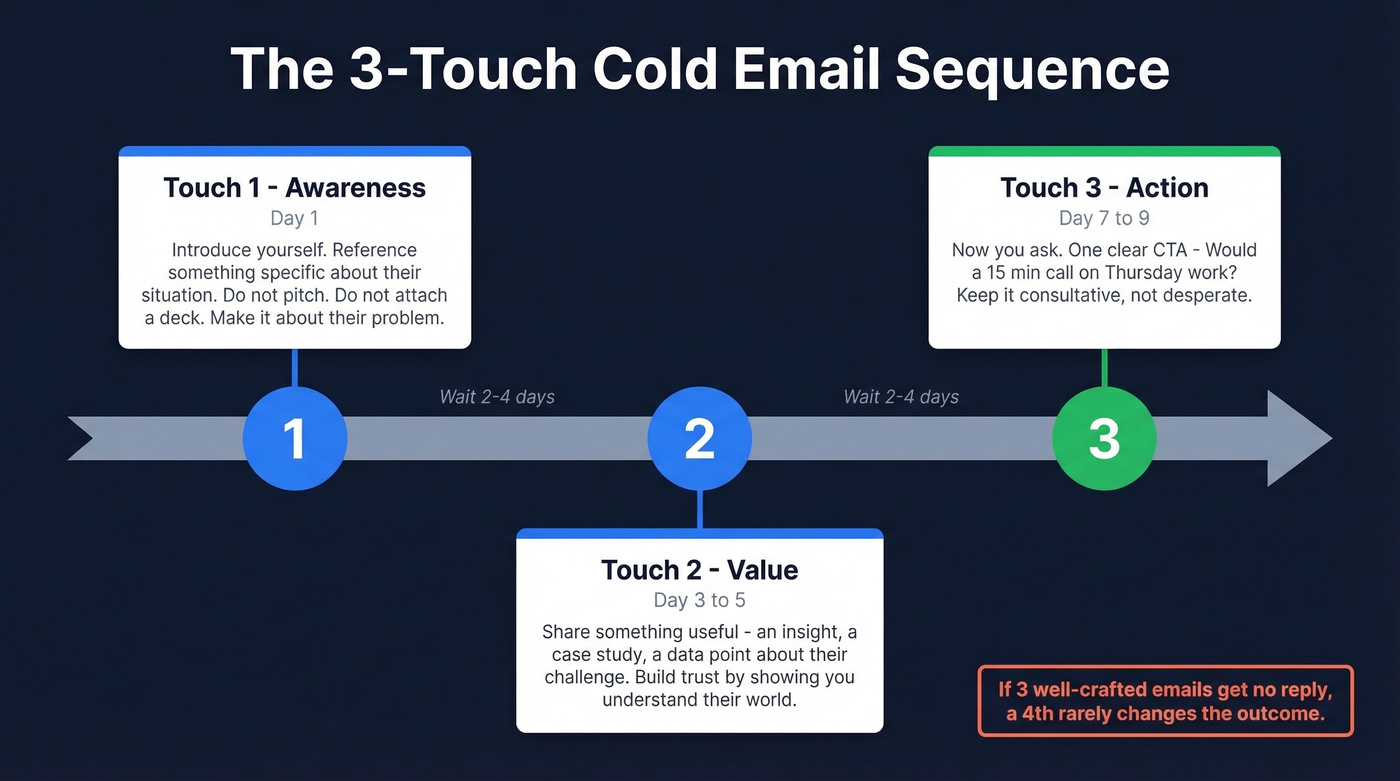
Touch 1 - Awareness (Day 1). Introduce yourself and reference something specific about their situation. Don't pitch. Don't attach a deck. Make it about their problem, not your solution.
Touch 2 - Value (Day 3-5). Share something useful: an insight, a relevant case study, a data point that relates to their challenge. You're building trust and showing that you understand their world.
Touch 3 - Action (Day 7-9). Now you ask. A clear, specific CTA: "Would a 15-minute call on Thursday work?" Keep the tone consultative, not desperate. If they haven't replied to three well-crafted emails, a fourth rarely changes the outcome.
Space follow-ups a few days apart. We've tested dozens of cadences - anything tighter feels aggressive, anything longer loses momentum. If you want ready-to-send follow-ups, use these sales follow-up templates.
The Double Opt-In Introduction
Forcing two people into an email thread without asking is the fastest way to burn social capital.
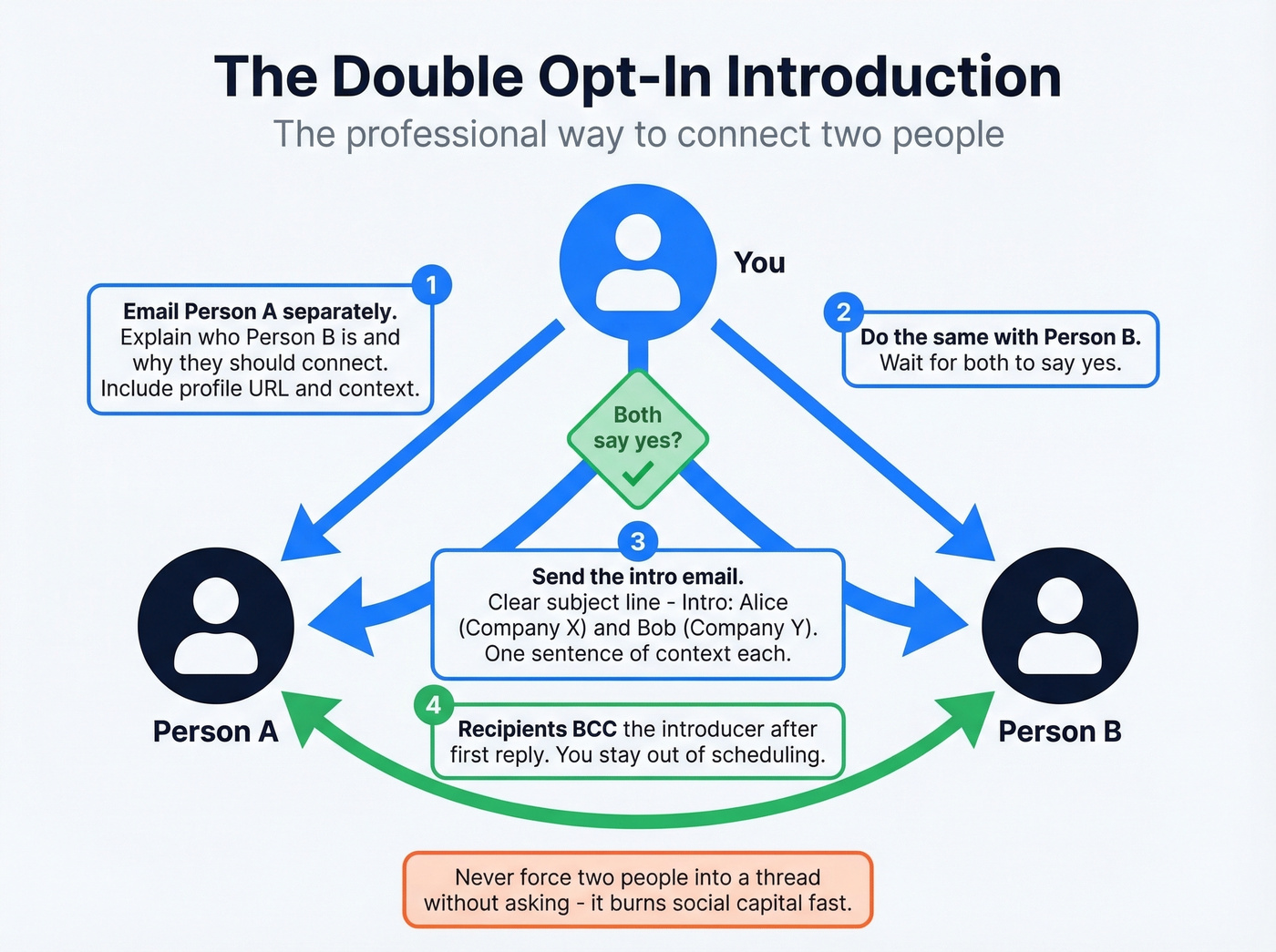
Step 1: Email Person A separately. Explain who Person B is, why you think they should connect, and what the ask would be. Include enough context - a profile URL, a few bullets on their background - so Person A can make an informed decision.
Step 2: Do the same with Person B. Wait for both to say yes.
Step 3: Send the intro email with a clear subject line: "Intro: Alice (Company X) <> Bob (Company Y) - [topic]." Give each person a one-sentence context line.
Step 4: The recipients should BCC the introducer after the first reply. This keeps you out of the scheduling back-and-forth while preserving credit. The Stanford Guide to introductions recommends this same approach - double opt-in is the standard among professionals who make a lot of introductions.
Mistakes That Kill Your Intro Email
We've seen teams send 500 emails and get 3 replies. Usually, the problem isn't the writing - it's one of these.
Too long. If your email is over 150 words, you're asking a stranger to invest time they haven't agreed to spend. Cut ruthlessly.
Self-focused opener. "We're a leading SaaS platform that helps companies optimize their..." - deleted. Lead with their problem.
Robotic greetings. "Dear Sir or Madam" is the email equivalent of a limp handshake. "I hope this email finds you well" is filler that signals you had nothing real to say. Reddit's r/emailmarketingnow cold email mistakes thread is clear: these openers trigger immediate deletes. Skip honorifics like Mr./Mrs. unless you're certain of the recipient's preference - "Hi [First Name]" sidesteps the issue entirely.
Too many links. One link, tops. Multiple links and attachments tank deliverability and make you look like spam. Every bounce chips away at your sender reputation, and enough bounces get your domain flagged - then even your emails to valid addresses land in junk. If you're diagnosing inboxing issues, start with an email deliverability guide.
No clear CTA. "Let me know if you'd like to chat sometime" isn't a CTA. "Would a 15-minute call on Thursday at 2pm work?" is.
Wrong email address. This is the most common and most preventable mistake. Sending a perfectly written intro to a dead address wastes everything - your time, your domain reputation, and your sequence slot. Run your list through verification first. Always. (If you're sourcing addresses, a name to email workflow helps.)
Ignoring compliance. In the EU, GDPR applies to processing personal data, including email addresses. For outbound, stick to professionally relevant outreach, use compliant data sources, and include a clear opt-out. If you're unsure where the line is, read up on buying email lists before you scale.
Here's the thing: most teams don't need better copywriting. They need better targeting. If you're selling a lower-ticket product, you're usually better off spending most of your time finding the right contacts than writing the perfect email to the wrong list.
Adjusting for International Recipients
A direct, first-name opener that books meetings in New York can get you ghosted in Tokyo. The high-context vs. low-context framework is the simplest way to think about this.
| Region | Formality | Opening Style | Key Tip |
|---|---|---|---|
| US / Canada | Moderate | Direct, purpose-first | First name is fine |
| Germany / N. Europe | High | Direct, structured | Use titles until invited otherwise |
| Japan / East Asia | Very High | Rapport-first, contextual | Lead with relationship signals |
| S. Europe / LatAm | Moderate-Warm | Warmer, relational | Personal touch is expected |
Avoid idioms and slang when writing to non-native English speakers. "Let's touch base" or "circle back" can confuse more than connect. Mind time zones too - sending at 3am in their local time signals that you didn't bother to check. Cultural missteps can slow down decision-making and erode trust before a relationship even starts.
Pre-Flight Checklist
Run through this before every introduction by email:
- Right contact identified (decision-maker, not gatekeeper)?
- Portfolio and rates ready (freelancers)?
- Subject line under 70 characters?
- Body under 150 words?
- One CTA, one link max?
- Proofread for recipient's name and company?
- Sent during recipient's business hours? (Use this best time to send cold emails playbook.)
Most introductory emails fail not because of bad writing, but because of bad targeting. The upstream work - finding the right person, verifying their address, timing your send - matters more than wordsmithing your opening line. We learned this the hard way after watching a client's 2,000-email campaign produce 11 replies, then tripling their response rate just by cleaning the list and tightening the ICP.
Great intro emails need the right person, the right trigger, and a verified address. Prospeo gives you all three - 300M+ profiles with 30+ filters like job changes, funding rounds, and buyer intent so every introduction lands.
Send introductions to decision-makers who actually exist.
FAQ
How long should an introduction email be?
Keep it between 50 and 150 words. Cold outreach should skew shorter - under 150 is the hard ceiling. If you can say it in 80 words, don't use 120. Shorter emails respect the reader's time and consistently outperform longer ones in reply rate.
When's the best time to send?
Tuesday through Thursday mornings in the recipient's time zone produce the highest open and reply rates. Avoid Monday mornings (inbox overload) and Friday afternoons (mentally checked out). For international sends, schedule based on their local business hours.
How many follow-ups should I send?
Two to three follow-ups spaced 3-5 days apart is the sweet spot. Diminishing returns hit hard after the fourth touch. If they haven't replied by then, try a different channel - a phone call or social message.
What's the best way to introduce yourself to someone you've never met?
Open with a line that proves you've done homework - reference their company, a recent post, or a mutual connection. Lead with their world, not yours, and keep the ask small. A 15-minute call request outperforms vague "let's connect" language every time.
How do I find someone's email address before sending?
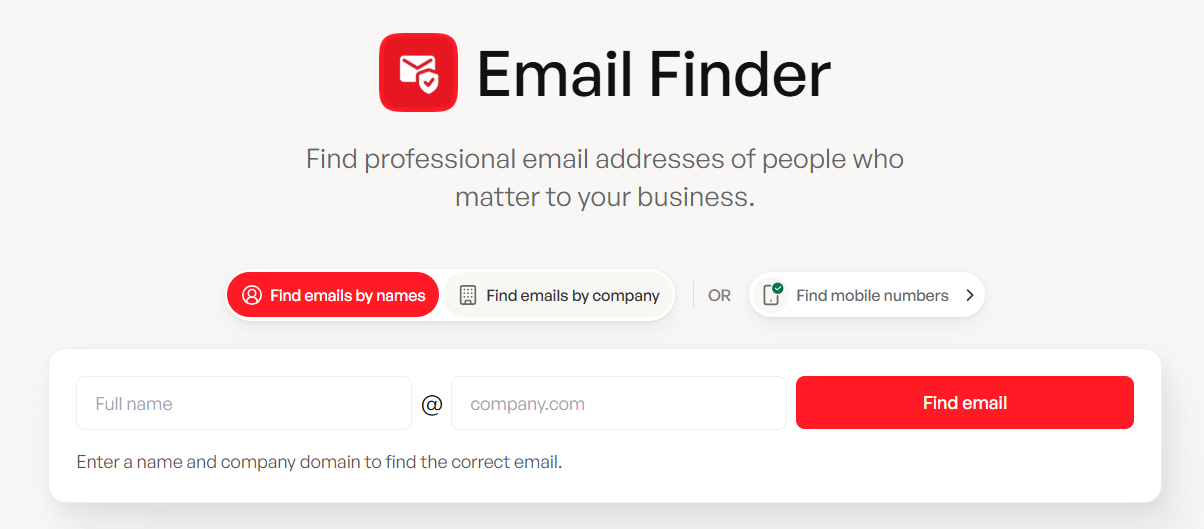
Use an email finder tool - search by name and company to pull a verified professional address. Prospeo's free tier includes 75 lookups per month with 98% accuracy, which is enough to validate whether your introduction emails actually land before you scale up.