

Is "Best Regards" Professional? Data Says Yes (2026)
You're overthinking this. "Best regards" is the Honda Civic of email sign-offs: reliable, inoffensive, and nobody will ever judge you for it. But is it professional enough for every situation? Yes - and there are cases where a different closing will actually get you more replies.
Quick version: It's professional. It scored a 52.9% response rate in Boomerang's 350,000-thread study - well above the 47.5% average. Use it for ongoing professional relationships. Use "kind regards" for first contacts. Use "thanks in advance" if you want the highest response rate. Sending cold outbound? Skip the sign-off entirely and end with a question.
Short Answer: Yes, It's Professional
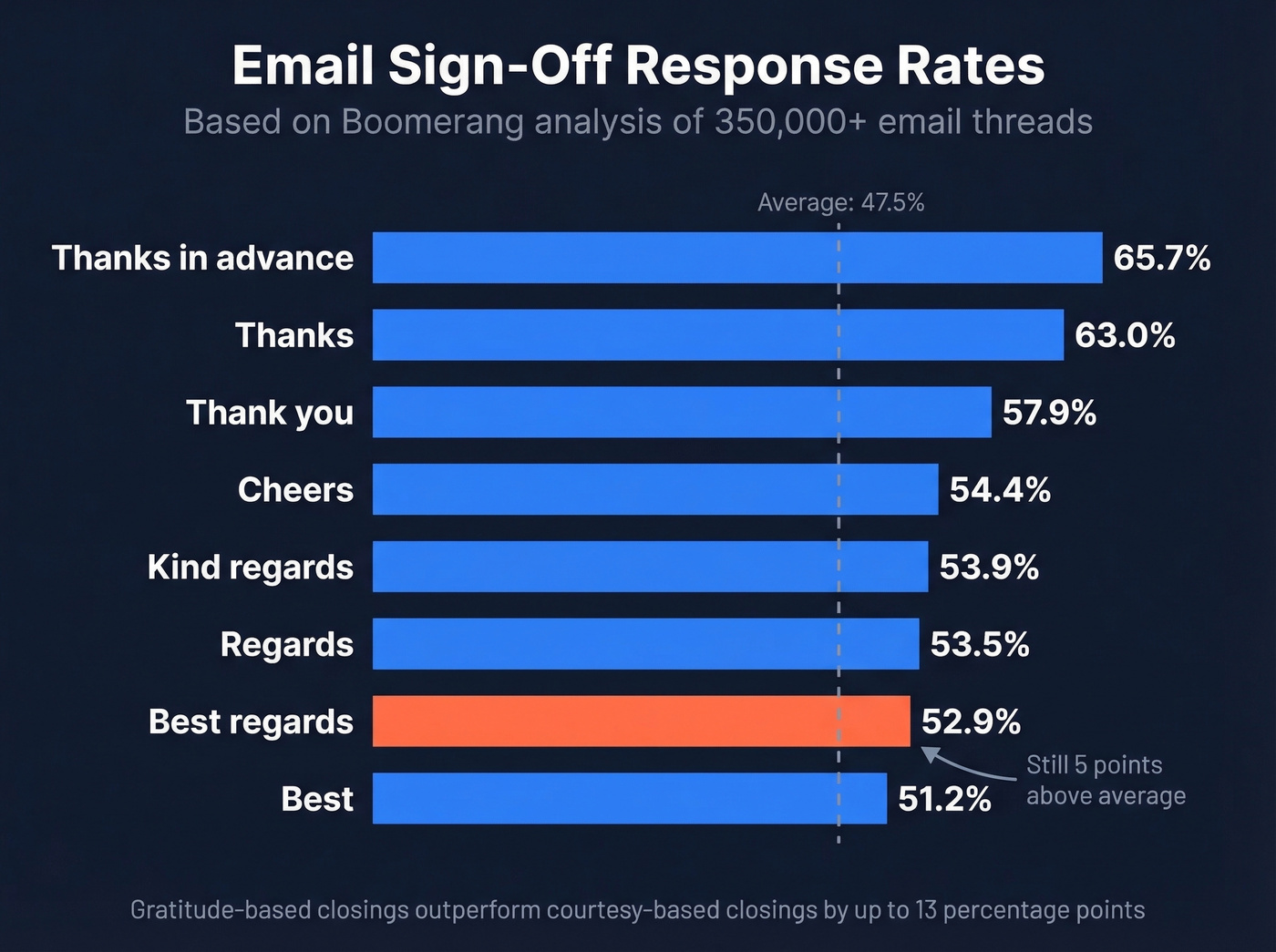
"Best regards" is safe in virtually every business context. Boomerang's analysis of 350,000+ email threads found it generated a 52.9% response rate - five points above the 47.5% baseline. It's not the highest-performing sign-off (gratitude-based closings win that race), but nobody's reading this closing and questioning your judgment.
What 350,000 Emails Tell Us About Sign-Offs
The Boomerang dataset is one of the largest publicly cited studies on email sign-off performance. Here's how every tested closing stacked up:
| Sign-Off | Response Rate |
|---|---|
| Thanks in advance | 65.7% |
| Thanks | 63.0% |
| Thank you | 57.9% |
| Cheers | 54.4% |
| Kind regards | 53.9% |
| Regards | 53.5% |
| Best regards | 52.9% |
| Best | 51.2% |
The pattern is clear: gratitude-based closings crush courtesy-based ones. "Thanks in advance" outperforms "best regards" by nearly 13 percentage points. Thanking someone presupposes they'll help - it creates a subtle social obligation that a polite "regards" simply doesn't.
Grammarly notes that "thanks in advance" can sound presumptuous. The data says recipients respond to it more than any other closing. Presumptuousness works.
Every sign-off on this list beat the 47.5% average. The takeaway isn't that "best regards" is bad. It's that "thanks" is better when you need a reply.
If you're optimizing for replies, the sign-off is only one lever - your email copywriting, email subject lines, and email call to action usually matter more.
The Formality Spectrum
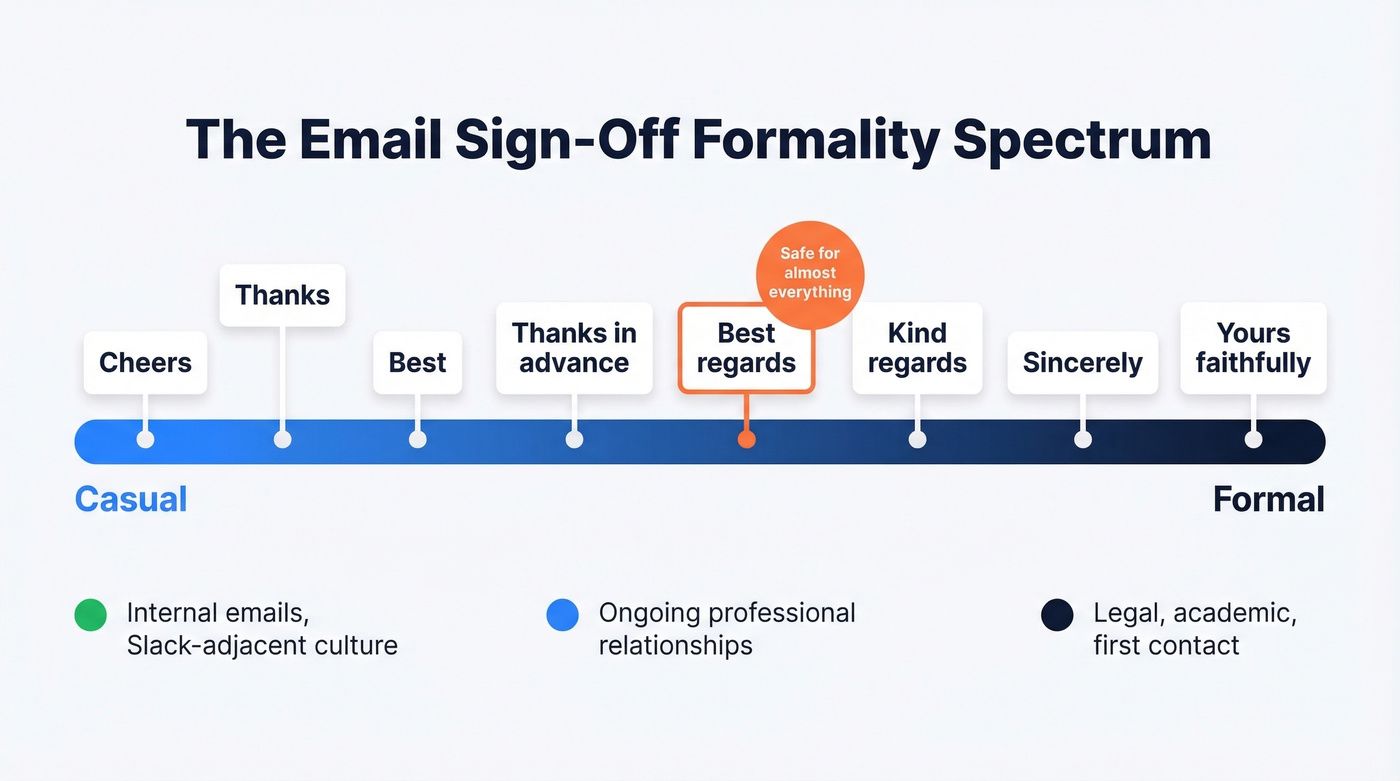
Not all "regards" are created equal. Here's where common options fall on the formality scale.
Best Regards vs. Kind Regards
"Kind regards" is slightly more formal - better for first-time interactions like introducing yourself to a new client or emailing a hiring manager. "Best regards" suits ongoing correspondence where you've already established rapport. When in doubt on a first email, "kind regards" is the safer bet.
If you're sending a first-touch intro, a tighter structure helps - see company introduction email examples.
Regards vs. Best Regards
"Regards" alone can read cold. A BBC article on email closings describes a UK professional who panicked after receiving a bare "Regards," convinced they'd offended the sender. Adding "best" or "kind" costs nothing and removes that ambiguity entirely.
Yours Sincerely vs. Yours Faithfully
A traditional British English rule still matters in formal contexts: use "Yours sincerely" when you know the recipient's name, "Yours faithfully" when you don't. Most modern business email has moved past this distinction, but legal and academic correspondence still rewards getting it right.
Capitalization and Formatting
Capital B, lowercase r. Write "Best regards," with a comma after. Only the first word gets capitalized - same rule for "Kind regards" and "Warm regards." One common typo to watch for: "best regars" missing the d. Autocorrect doesn't always catch it, and a misspelled sign-off undermines the professionalism you're going for.

You're optimizing your sign-off for a 5-point lift in response rate. Meanwhile, unverified emails lose 100% of responses to bounces. Prospeo's 98% email accuracy means your carefully crafted closing actually reaches the inbox - at $0.01 per verified email.
Fix your deliverability before you fix your sign-off.
How It Lands Across Cultures
Your sign-off lands in a cultural context, whether you think about it or not.
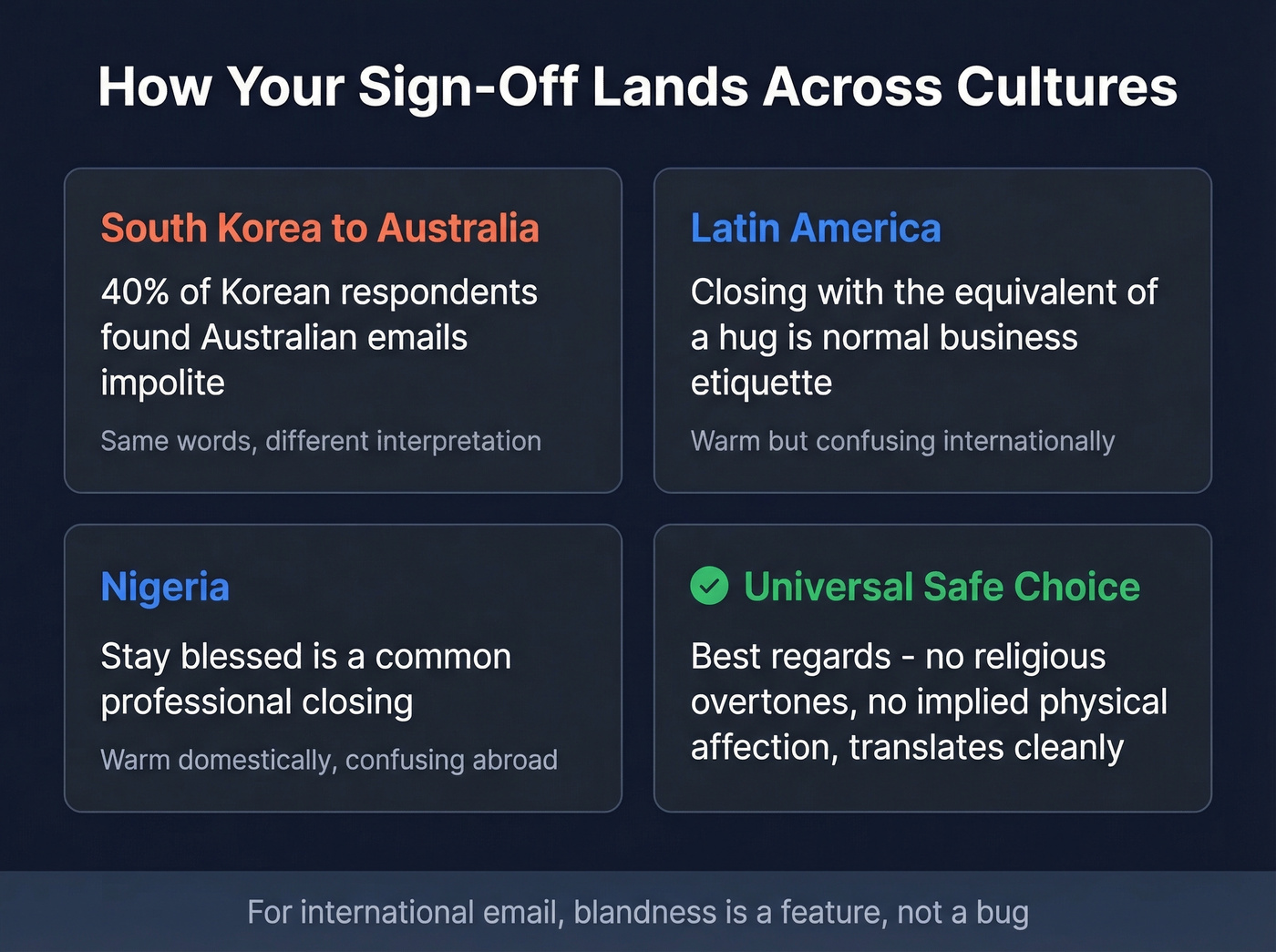
The BBC's cross-cultural reporting found that 40% of Korean respondents perceived Australian emails as impolite, compared to just 28% the other way around. Same words, different interpretation. In Latin America, closing with the equivalent of "a hug" can be normal business etiquette. Nigerian professionals commonly use "Stay blessed," which reads as warm domestically but confuses international recipients.
In our experience sending outbound across dozens of countries, "best regards" is one of the safest cross-cultural choices precisely because it's bland - no religious overtones, no implied physical affection, and it translates cleanly. For international email, that blandness is a feature, not a bug.
When to Use a Different Closing
"Best regards" works almost everywhere, but it's not always optimal.
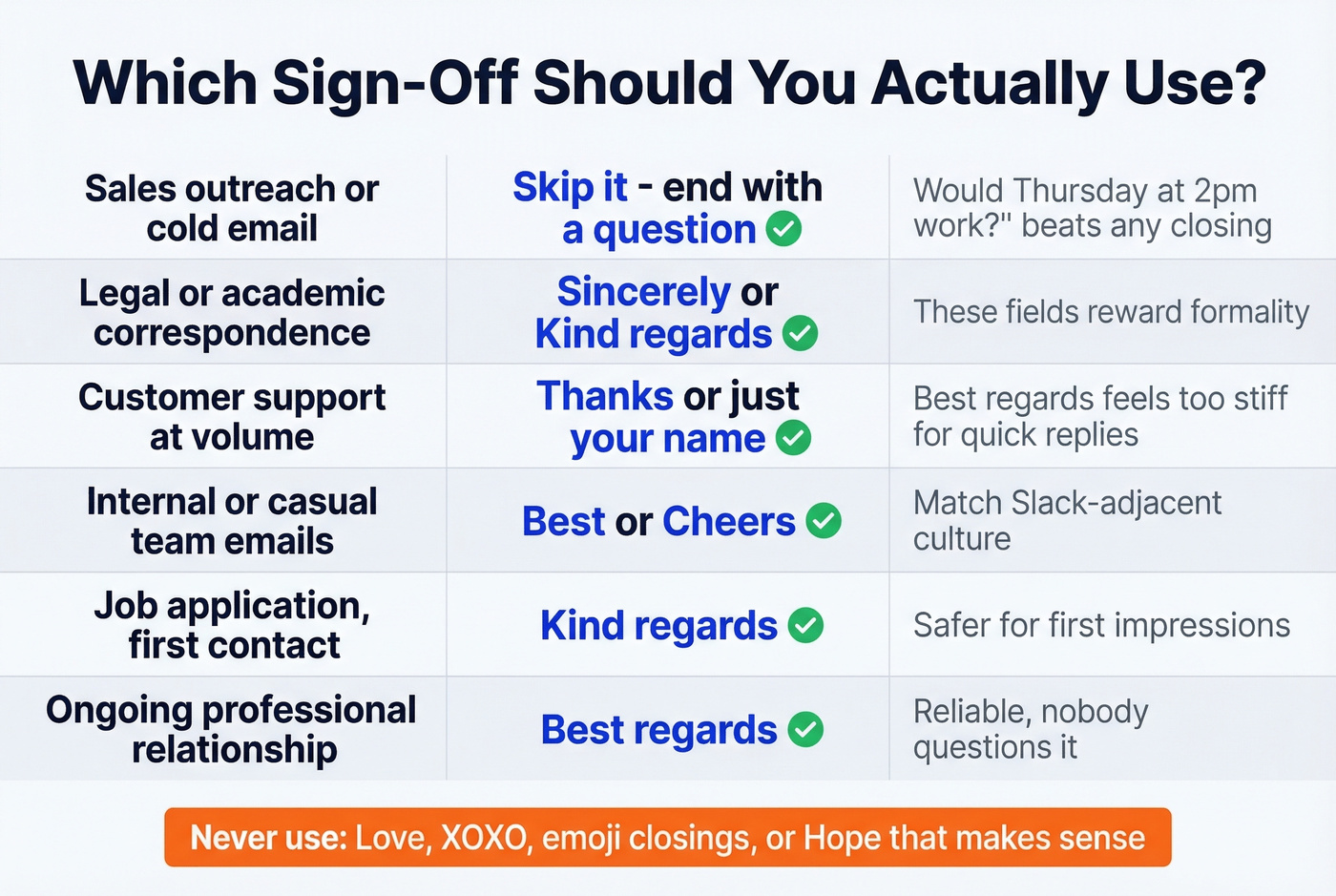
Sales outreach: End with a CTA or question instead. "Would Thursday at 2pm work?" beats any closing line. (If you need options, steal from these sales follow-up templates or cold email follow-up templates.)
Legal or academia: "Sincerely" or "kind regards" - these fields reward formality, and anything less can feel careless.
Customer support: Over on r/ecommerce, the general consensus is that "best regards" and "sincerely" feel too stiff for quick customer service replies. "Thanks" or just your name works better at volume. In r/ExecutiveAssistants, "Best" gets called out as simple and professional, though some people avoid it because it feels overused.
Internal or casual: "Best" or "cheers" for Slack-adjacent email culture.
Job applications: "Kind regards" for first contact, "best regards" once you've built rapport with the recruiter.
Skip these entirely, per Grammarly's guide: "Love," "XOXO," emoji closings, and "Hope that makes sense" - which reads as passive-aggressive no matter how you intend it.
The Cold Email Exception
Here's the thing: if you're running outbound campaigns, your sign-off is the least important variable in the entire email. Subject line, first sentence, offer relevance - those determine whether someone reads past line one.
And none of it matters if the email bounces.
We've seen teams obsess over sign-off A/B tests while 15% of their list is bouncing. That's the real problem. Prospeo verifies emails in real time with 98% accuracy, so your outreach actually reaches someone - the free tier includes 75 email verifications per month, enough to test whether your message works before worrying about how you sign off.
If you're doing outbound at scale, it also helps to understand email bounce rate, email deliverability, and safe email velocity.
A bounced email has no sign-off at all.
Cold outbound success isn't about "best regards" vs. "thanks in advance." It's about reaching real inboxes with verified contact data. Prospeo gives you 300M+ profiles, 98% email accuracy, and a 7-day data refresh cycle - so every send counts.
A bounced email has no sign-off at all. Verify your list first.
FAQ
Is "best regards" too formal for casual emails?
It works across formal and casual contexts without sounding stiff. For very short internal replies, "thanks" or "best" is fine. But "best regards" is never wrong - just occasionally more formal than the situation calls for.
Should I capitalize the R in "best regards"?
No. Capital B, lowercase r, comma after. This follows standard English conventions for multi-word closings - same rule applies to "Kind regards" and "Warm regards."
What's the best email sign-off for job applications?
"Kind regards" or "Sincerely" for first contact with a recruiter or hiring manager. Once you've exchanged a few emails, "Best regards" is perfectly appropriate. Match formality to the relationship stage.
Does your email sign-off actually affect response rates?
Yes. Boomerang's 350,000-thread study found "thanks in advance" hit 65.7% versus 52.9% for "best regards." Both beat the 47.5% average, so any deliberate sign-off helps - but gratitude-based closings consistently outperform courtesy-based ones.
How do I make sure my cold emails get read beyond the sign-off?
Deliverability matters more than any closing line. Verify your list before sending - a clean list keeps bounce rates under 4%, which protects your domain reputation and ensures your message actually arrives. Prospeo's free tier gives you 75 verifications per month to start cleaning things up.