

IT Decision Makers: Who They Are & How to Reach Them in 2026
You sent 200 cold emails to IT Directors last quarter. Zero meetings. Not because your product is bad - because you targeted the wrong people, used stale contact data, and led with a pitch instead of something useful.
The uncomfortable reality: IT buying committees now average 28 members. And 61% of B2B buyers prefer a completely rep-free buying experience. The old playbook - find the CIO's email, blast a demo request - is dead. The companies booking meetings with IT decision makers in 2026 are doing three things differently: mapping the full committee, leading with content instead of calendar links, and verifying every contact before the first send.
The Quick Version
- IT buying committees average 28 people. Stop targeting one CIO and start mapping the committee.
- 61% of B2B buyers prefer a rep-free experience. Lead with useful content, not demo requests.
- Bad data is the #1 reason ITDM outreach fails. Verify contacts before you send a single email.
What Is an IT Decision Maker?
An IT decision maker is any professional with the authority to evaluate, approve, or purchase technology solutions for their organization. That's the textbook definition. The practical one is messier.
In most companies, there's no single "IT buyer." There are decision makers who sign off, influencers who shape the shortlist, and end users whose opinions carry more weight than their titles suggest. A security architect who vetoes your product at the technical review stage is functionally a decision maker - even if their title says otherwise. For B2B sales and marketing teams, the term matters because it defines your targeting strategy. Get the ITDM map wrong and you'll spend months nurturing someone who can't actually approve a purchase order.
Common ITDM Job Titles
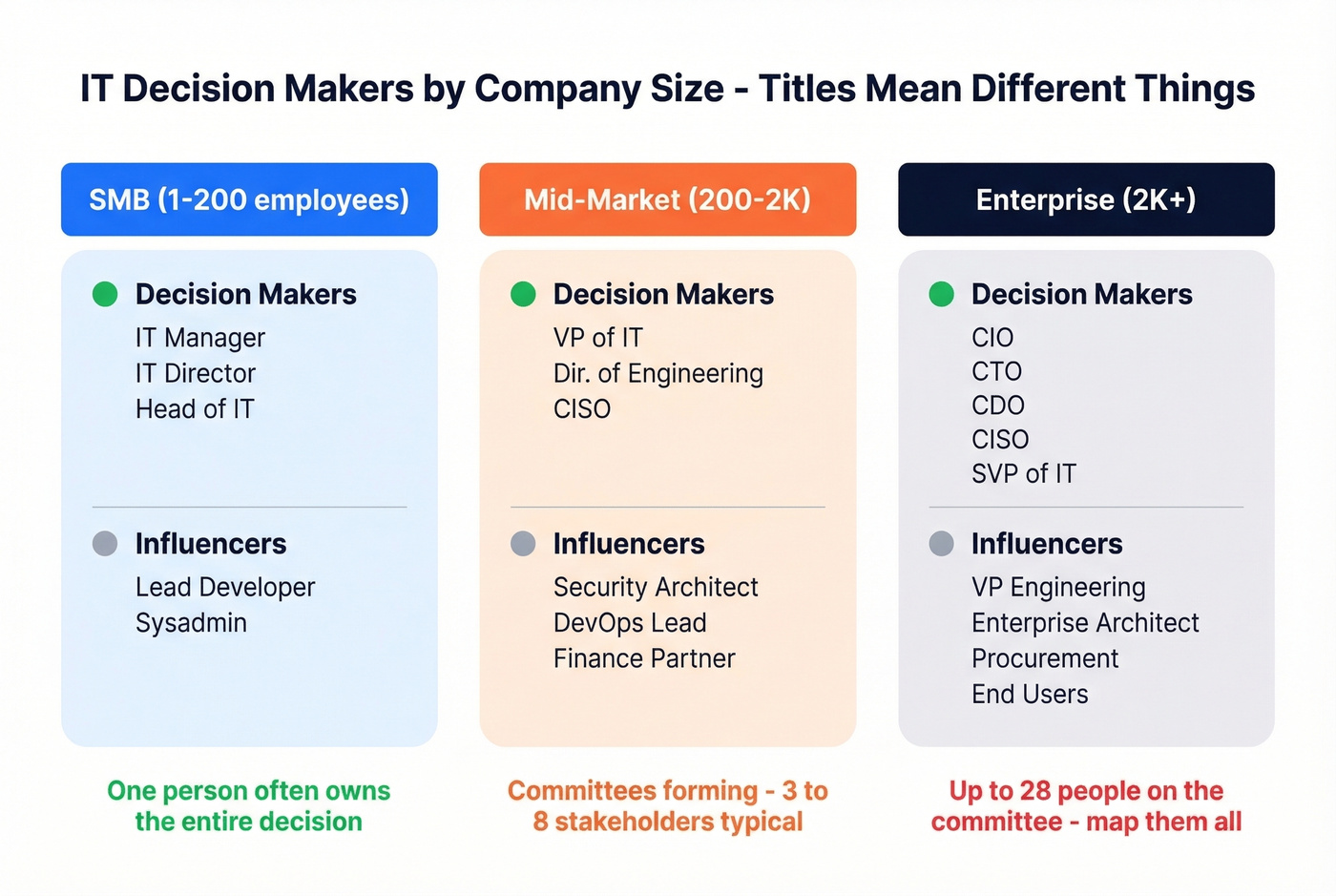
The biggest mistake in ITDM targeting is assuming titles mean the same thing across company sizes. An IT Manager at a 50-person company has more buying power than a Director at a 10,000-person company. Context is everything.
| Company Size | Decision Makers | Influencers |
|---|---|---|
| SMB (1-200) | IT Manager, IT Director, Head of IT | Lead Developer, Sysadmin |
| Mid-Market (200-2K) | VP of IT, Dir. of Engineering, CISO | Security Architect, DevOps Lead, Finance Partner |
| Enterprise (2K+) | CIO, CTO, CDO, CISO, SVP of IT | VP Engineering, Enterprise Architect, Procurement, End Users |
At SMBs, the IT Manager IS the decision maker - they own the budget, run the evaluation, and sign the contract. At enterprise, the CIO is one voice among 28. Larger orgs also layer in roles like Chief Data Officer and Chief Information Security Officer, each with effective veto power over purchases that touch their domain.
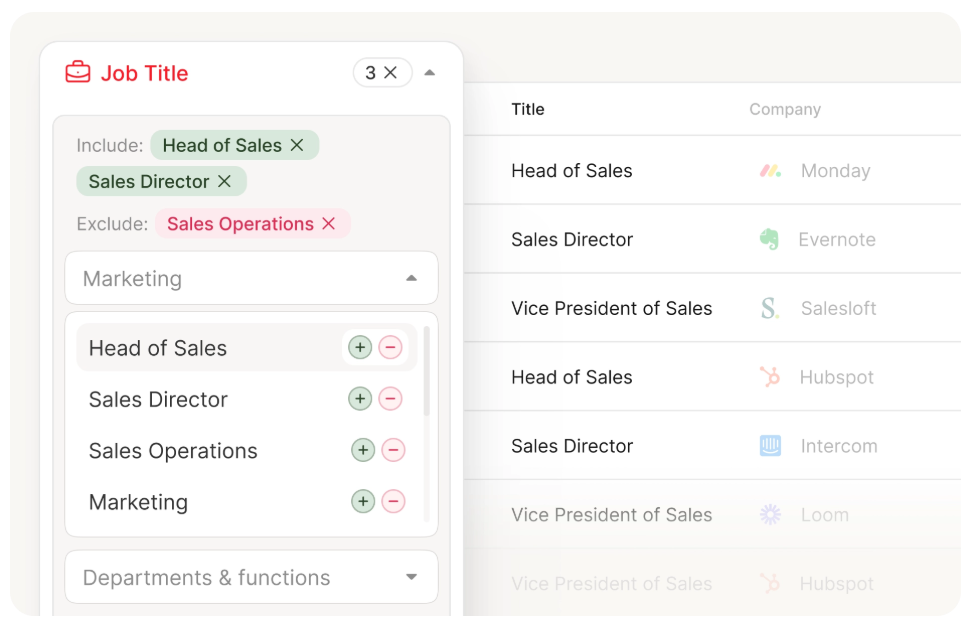
Don't forget the influencers. The DevOps lead who'll actually implement your tool, the finance partner controlling the budget line, the end users whose adoption determines renewal - these people shape the decision even if they never appear on a vendor call.
How IT Decision Makers Buy
The CIO-centric sales model is dead. Foundry's 2024 Role & Influence study - 938 respondents across multiple industries - found that buying committees have ballooned to an average of 28 members, up from 25 in 2023 and 20 in 2022.
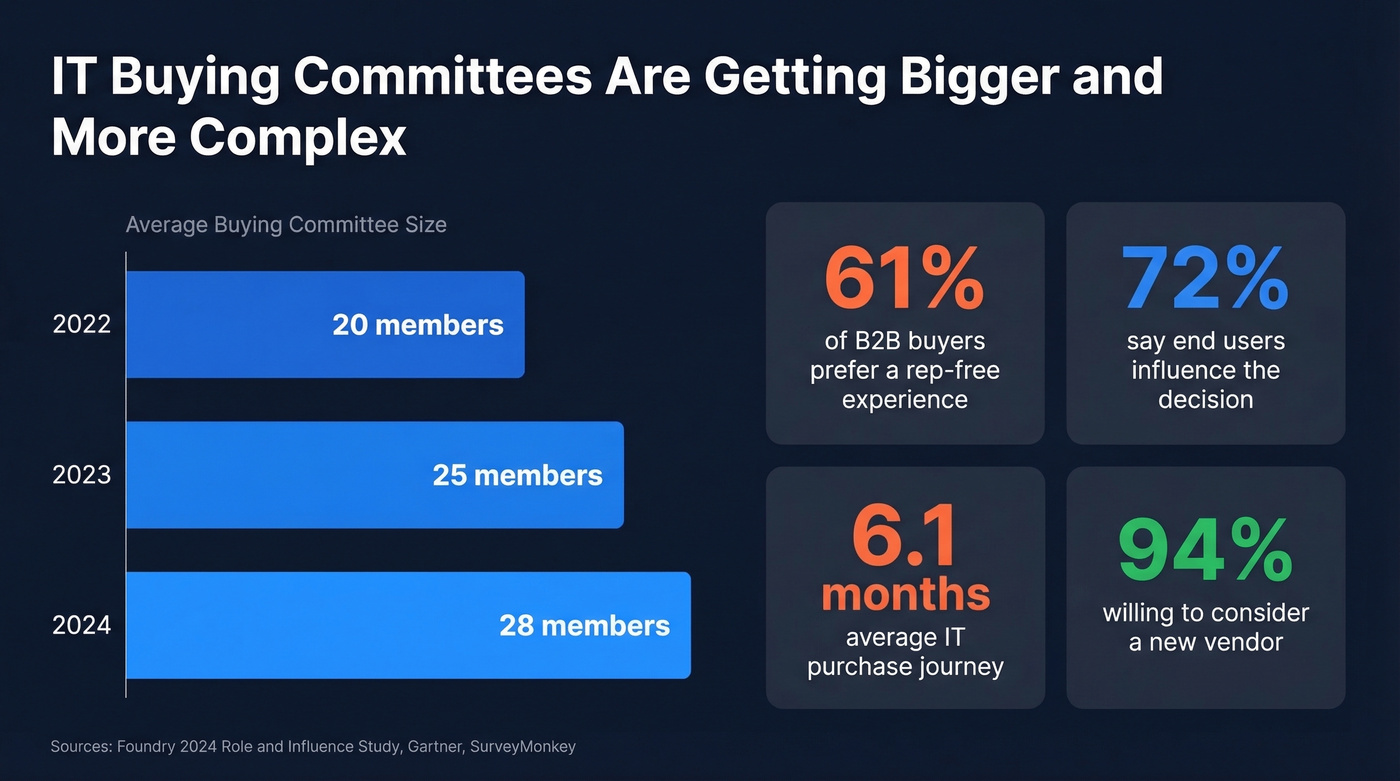
The split between committee-driven and single-decider purchases is nearly even: 52% committee vs 48% single decision maker. But that 48% skews heavily toward SMBs. If you're selling into mid-market or enterprise, assume a committee.
What makes these committees unpredictable is who actually holds influence. 72% of ITDMs say end users have a say in the decision. 32% say non-IT stakeholders - finance, operations, even legal - influence the purchase. And 42% report that some teams have autonomy to make their own technology purchases entirely, bypassing central IT. That last stat should terrify anyone running a top-down-only sales motion.
The average IT purchase journey takes 6.1 months. Deals stall most often at two stages: determining business need (37%) and evaluating products (37%). Your content and messaging need to serve both - helping prospects build the internal business case and then differentiate your solution during evaluation. 70% of ITDMs say stakeholder brand awareness makes internal sell-through easier, which means your B2B content marketing needs to reach the committee before your sales team does.
65% of respondents say the purchase process is growing more complex year over year. Target the committee, not the title.

IT buying committees average 28 people. Prospeo's 30+ search filters - including job title, department headcount, technographics, and buyer intent across 15,000 topics - let you map every decision maker and influencer on the committee, not just the CIO.
Stop emailing one CIO. Start reaching the full 28-person committee.
What ITDMs Care About in 2026
AI is the elephant in every room. 94% of IT leaders are actively integrating AI into their operations. But only 19% say demonstrating AI effectiveness is a top priority. That gap - everyone's buying AI, almost nobody's measuring whether it works - is the defining tension for ITDMs right now. IDC projects that 40% of organizations will miss their AI goals by 2026 due to implementation complexity and fragmented tooling. If you sell to ITDMs, your messaging better acknowledge this tension rather than adding to the hype.
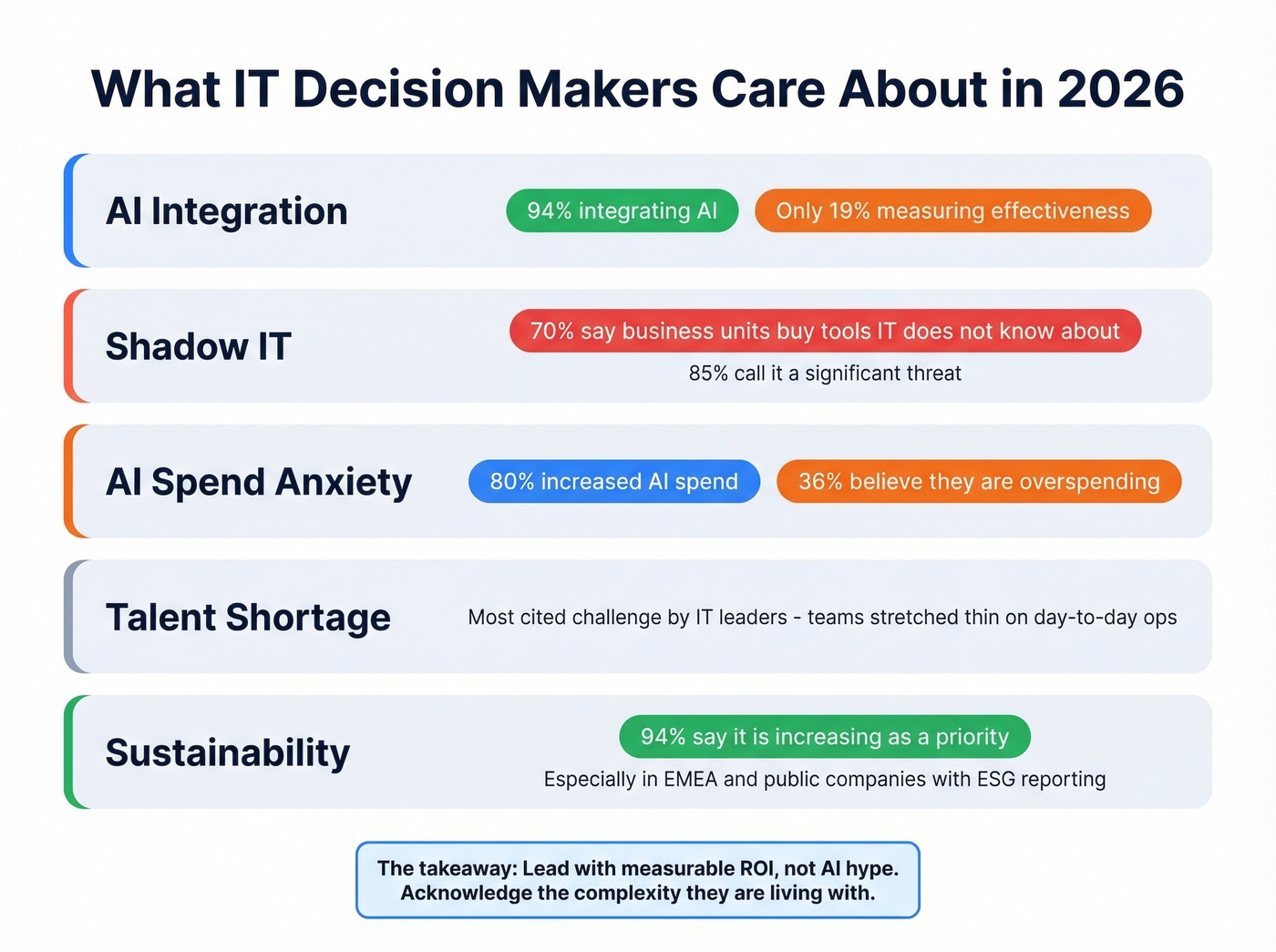
Shadow IT is keeping CIOs up at night. 70% of IT leaders believe business units purchase more cloud and SaaS applications than IT even knows about. 85% say these gaps pose a significant threat to their organization, a 6-point jump from the prior year. Every unsanctioned tool is a potential security hole, a compliance risk, and a budget leak.
The talent shortage isn't getting better. CIO.com's State of the CIO survey flagged staffing and skills shortages as the challenge most often cited by IT leaders. It's not just about hiring - it's about the strategic work that doesn't happen because existing teams are stretched thin managing day-to-day operations.
AI spend is rising, and so is buyer's remorse. 80% of IT leaders report increased AI application spend, but 36% already believe they're overspending. That creates a receptive audience for vendors who can demonstrate clear, measurable ROI rather than vague promises about "AI-powered" features. Show the math or lose the deal.
Sustainability is a tiebreaker. 94% of IT decision makers say sustainability is increasing as a priority. It's not the top buying criterion, but it breaks ties - especially in EMEA and for publicly traded companies with ESG reporting requirements.
ITDMs are more open to new vendors than you think. This is the stat that should keep every B2B seller prospecting: 94% of ITDMs are willing to consider a new vendor, and 83% are open to newer-to-market vendors. The top reasons? Cost savings (54%), flexibility (43%), and innovation (42%). The buying committee is complex, but the door is wide open if you show up with the right message.
How to Find IT Decision Makers
You've identified who to target, you understand how they buy, and you know what they care about. Now for the hard part: actually finding them.
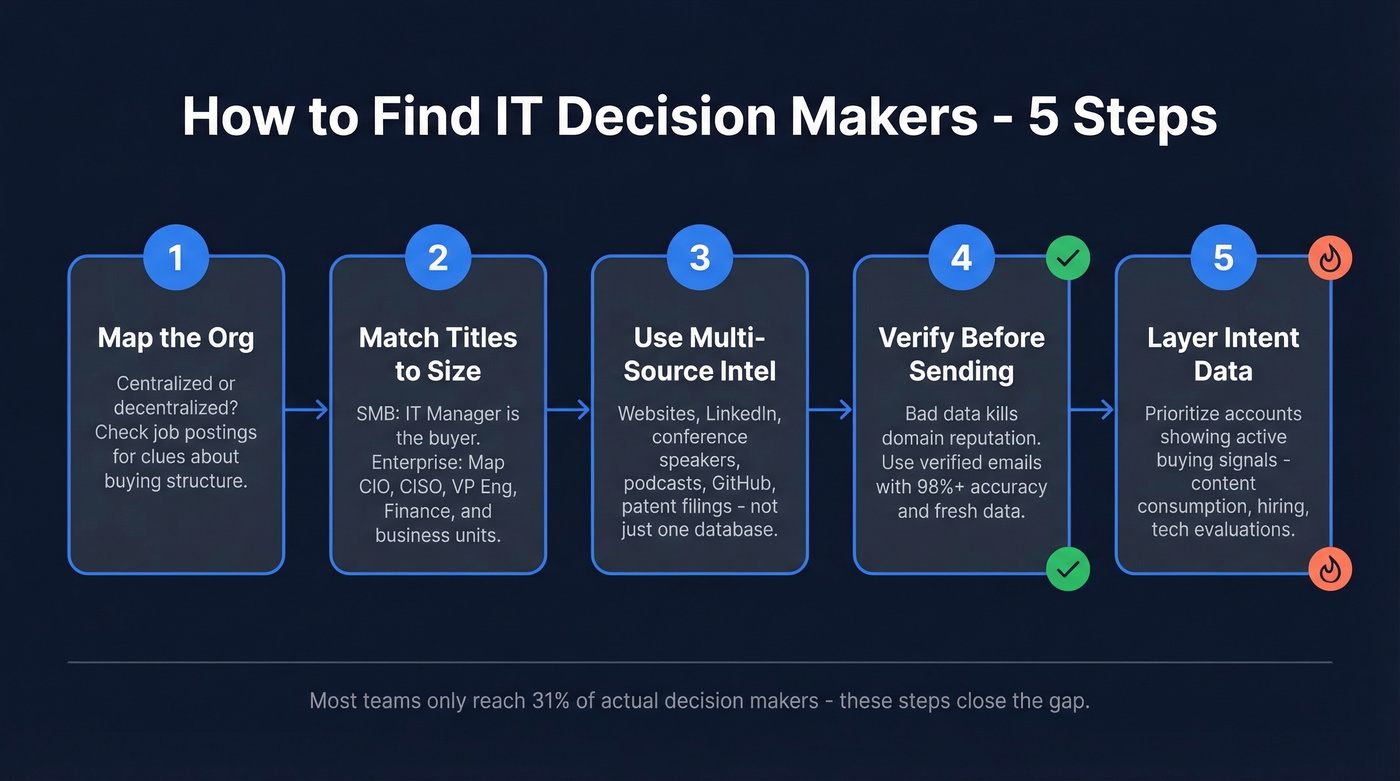
We've seen teams that reach only 31% of actual decision makers in target accounts. Over 50% of prospects identified through traditional methods lack real purchasing authority. The gap between "people you can find" and "people who can buy" is where most ITDM outreach falls apart.
Step 1: Map the org structure. Before you search for contacts, understand how the target company makes technology decisions. Is it centralized or decentralized? Company size, industry, and recent org changes all shape this. Job postings are a goldmine - if they're hiring a "Head of IT Procurement," the buying process is formalizing.
Step 2: Identify titles by company size. Use the table from the titles section above. Don't default to "CIO" for every account. At a 100-person SaaS company, the IT Manager or VP of Engineering is your buyer. At a Fortune 500, you need to map multiple stakeholders across IT, security, finance, and the business unit.
Step 3: Use multi-source intelligence. Go beyond a single database. Company websites, professional profiles, conference speaker lists, podcast guest appearances, patent filings, GitHub contributions - these all reveal who's actively involved in technology decisions. The IT architect who spoke at a major cloud conference last year is more influential than the Director who hasn't posted anything in two years.
Step 4: Verify contact data before outreach. This is where most teams burn time and domain reputation. You've built a beautiful target list - and then a chunk of emails bounce on the first sequence. Prospeo's B2B database covers 300M+ professional profiles and 143M+ verified emails at 98% accuracy, plus 125M+ verified mobile numbers. The 7-day data refresh cycle means you're not prospecting with month-old records. Filter by seniority, department, and technographics, then layer buyer intent data covering 15,000 topics to zero in on ITDMs who are actively in-market.

Step 5: Layer intent data to prioritize. Not every ITDM on your list is ready to buy. Intent signals - content consumption patterns, technology evaluation activity, hiring trends - help you focus outreach on accounts showing active buying behavior rather than spraying the entire TAM. (If you want a tighter system, start with lead scoring and identifying buying signals.)
How to Reach IT Decision Makers
Let's be honest about what doesn't work: the generic "15 minutes for a quick demo?" email. A Gartner survey of 632 B2B buyers found that 73% actively avoid suppliers who send irrelevant outreach. And 69% report inconsistencies between what a vendor's website says and what the seller actually tells them. That's a trust problem, and it starts with your first touch.
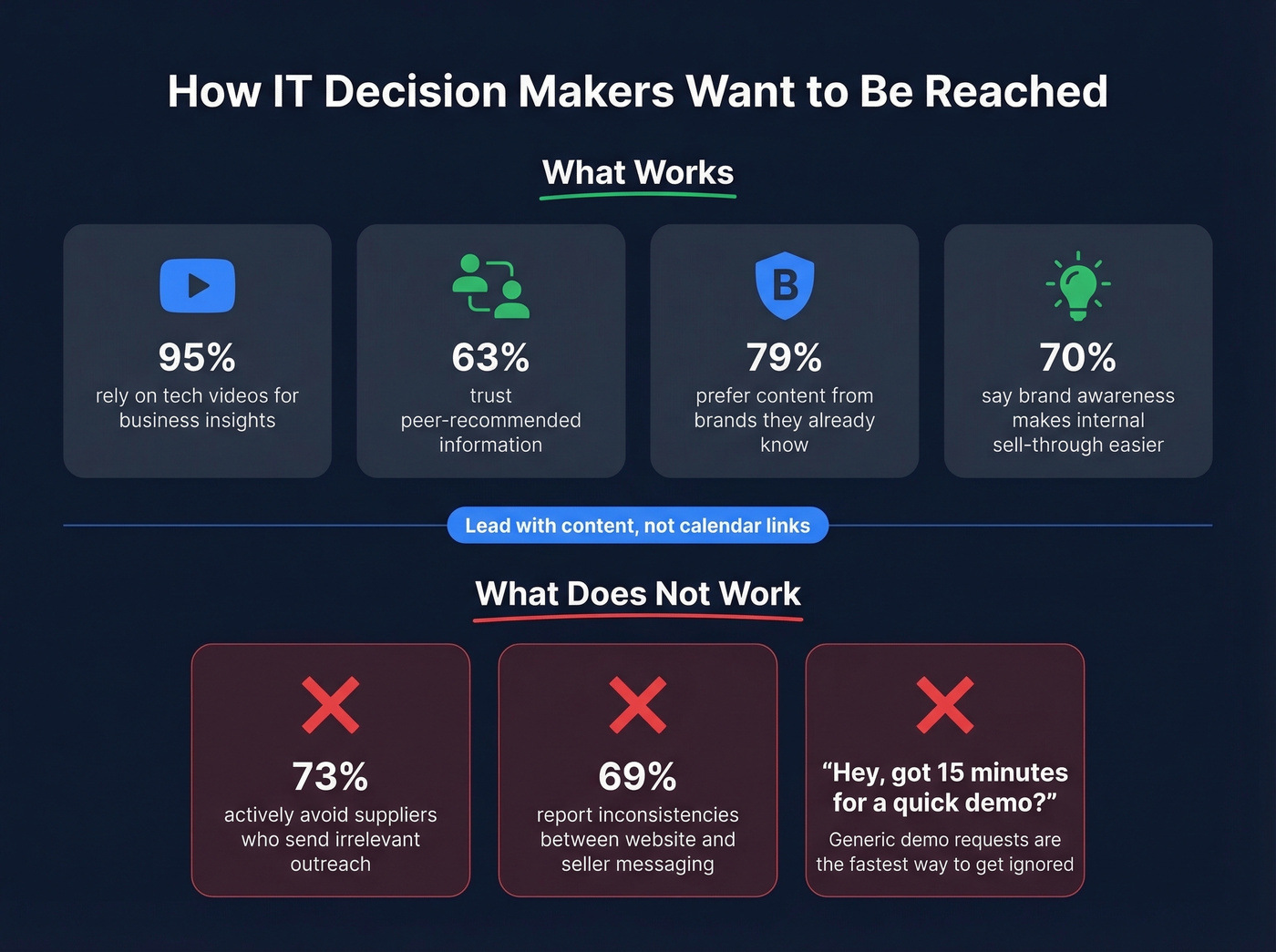
ITDMs don't want to talk to your SDR. They want to solve problems.
Video is the dominant channel. 95% of ITDMs rely on technology-related videos for business insights. That's not a nice-to-have - it's the primary content format. After video, peer recommendations carry outsized weight: 63% trust peer-recommended information, and 79% prefer content from brands they already know.
Single-threaded outreach doesn't work. With 28-member committees, reaching one person is reaching 3.6% of the buying group. In our experience, teams that multi-thread across 3-5 stakeholders per account see 2-3x the response rates of single-threaded campaigns. The CIO cares about strategic alignment and ROI. The CISO cares about risk and compliance. The VP of Engineering cares about implementation complexity and team adoption. Same product, three completely different angles.
Match content to the buying stage. This is where most ITDM outreach goes wrong - sending a case study to someone who hasn't even defined the problem yet.
| Buying Stage | Content Type | Best Channel |
|---|---|---|
| Determining need | Research reports, benchmark data, trend analysis | Video, webinars, organic search |
| Evaluating solutions | Architecture docs, integration guides, comparison content | Email, peer communities, vendor site |
| Building business case | ROI calculators, implementation timelines, reference calls | Direct outreach, sales engineering |
| Final approval | Security reviews, compliance docs, executive summaries | Stakeholder-specific email threads |
As one r/sales poster put it, IT leadership is "the hardest to get ahold of" in B2B sales - and cold calling is even less effective with remote and hybrid work. Content-led multi-threading beats volume-based cold outreach every time. If you're still iterating on the basics, start with sales prospecting techniques and a tighter B2B cold email sequence.
Most Teams Don't Need a Bigger List
Here's what nobody selling B2B data wants to tell you: if your average deal size is under $15k, you don't need to reach 28 committee members. You need to reach the 2-3 people who actually matter at your target company size. The 28-person committee stat is real, but it describes enterprise buying. If you sell to mid-market, your committee is 5-8 people. If you sell to SMBs, it's often one person with a credit card.
Scale your approach to the deal size, not to the scariest stat in the article.
Mistakes to Avoid
Treating "IT Director" as a universal target. At a 50-person company, the IT Director is the buyer. At a 5,000-person company, they might not even be on the committee. Always calibrate titles to company size.
Blasting generic outreach. 73% of buyers will actively avoid you. If your email could be sent to any IT leader at any company, it's not specific enough. Reference their tech stack, their industry challenges, or a recent initiative.
Relying on a single contact per account. With 28-member committees, single-threading is a losing strategy. Map at least 3-5 stakeholders across IT, security, finance, and the business unit.
Using stale data. The industry average data refresh cycle is around 6 weeks. In that time, people change jobs, get promoted, or leave. We've seen teams waste entire quarters prospecting with data that was stale before the first email went out. There's no reason for that in 2026. If deliverability is slipping, fix the root cause with an email deliverability guide and track your email bounce rate.
Ignoring end users and non-IT stakeholders. 72% of ITDMs say end users influence the decision. 32% say non-IT stakeholders do too. If you're only talking to the C-suite, you're missing the people who'll champion - or kill - your deal internally.
The #1 reason ITDM outreach fails is bad data. Prospeo delivers 98% email accuracy with a 7-day refresh cycle - not the 6-week industry average. That means verified emails and 125M+ direct dials for the IT Directors, CISOs, and DevOps leads who actually shape purchase decisions.
Verify every contact before your first send. At a penny per email.
FAQ
What does ITDM stand for?
ITDM stands for IT Decision Maker - any professional with authority to evaluate, approve, or purchase technology for their organization. The term is standard in B2B sales and marketing to describe target buyer personas for technology products and services.
How big is the average IT buying committee?
Foundry's 2024 study found buying committees average 28 members, up from 25 in 2023 and 20 in 2022, with an average of 26 influencers involved. For mid-market companies, expect 5-8 stakeholders; SMBs often have a single buyer.
How long does the IT purchase process take?
The average IT purchase journey takes 6.1 months. Deals most commonly stall at the business-need stage (37%) and the evaluation stage (37%), making those two phases the highest-priority windows for vendor engagement.
What content do IT decision makers consume?
95% of ITDMs rely on technology-related videos for business insights, making video the dominant channel. They consume about 7 pieces of content per purchase journey, with 63% trusting peer-recommended information and 79% preferring content from known brands.
How do I build a verified ITDM list quickly?
Map the org structure first, then identify relevant titles by company size. Use a B2B data platform with strong verification - filter by seniority, department, and buyer intent to prioritize accounts showing active purchasing signals. The key is verifying contacts before outreach, not after your bounce rate spikes.