

How to Know Your Prospect (Without Wasting Your Whole Day)
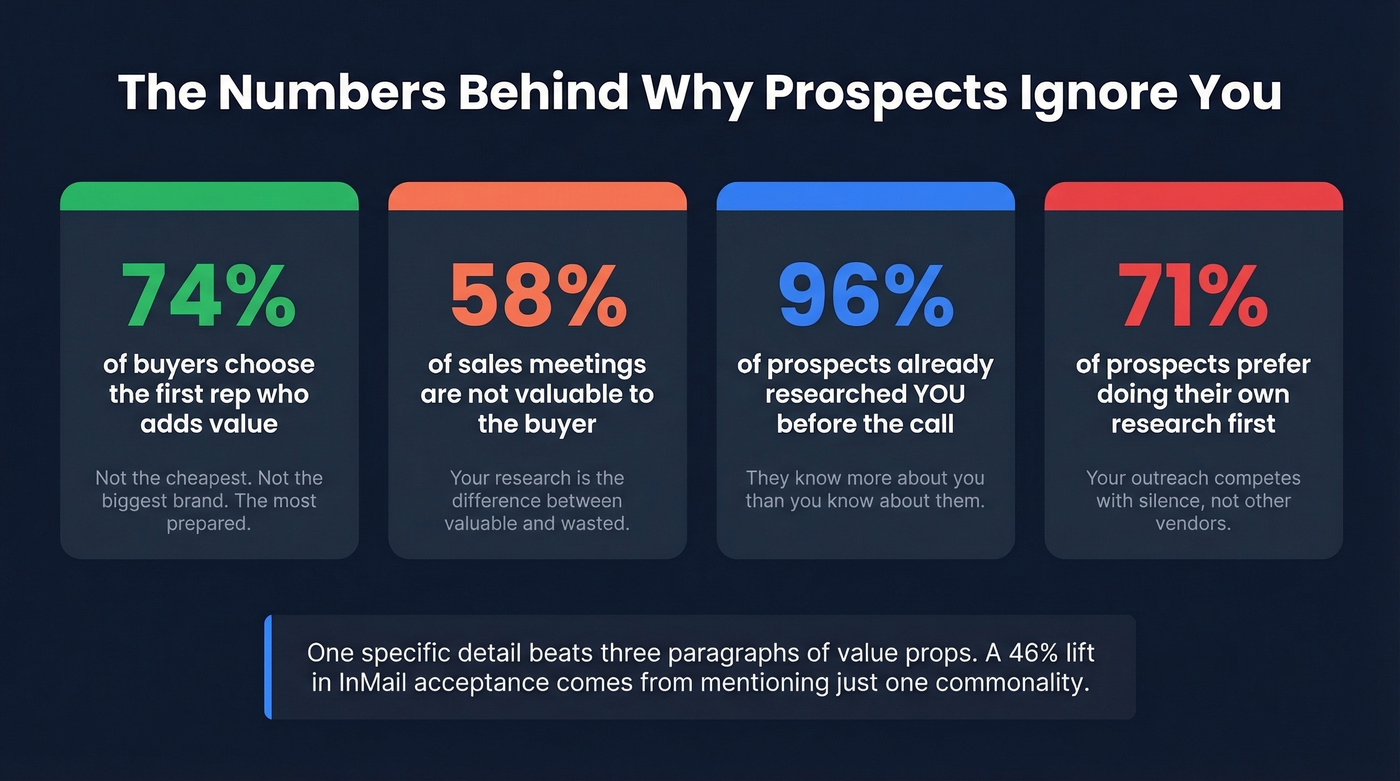
74% of buyers choose the first rep who adds value. Not the cheapest vendor, not the biggest brand - the first person who shows up prepared. Meanwhile, 58% of sales meetings aren't valuable to the buyer, and 96% of prospects have already researched you before you ever get on the phone. That gap between how much they know about you and how little you know your prospect is where deals die.
We've watched teams flip this dynamic entirely by adding structure to their research process. Here's how:
- Build a real ICP first - it tells you who deserves your research time. (If you need a starting point, use an Ideal Customer Profile Template.)
- Follow the 6-step checklist below and timebox it: 5 minutes for SMB, 10-15 for mid-market, up to 30 for enterprise.
- Verify contact data before you hit send. Good research on a bad email is wasted research (and it can hurt your email deliverability over time).
Start With Your ICP, Not a Vague Persona
Most reps skip straight to researching individual people. That's backwards. You need to know which companies deserve your time before you spend 15 minutes digging into someone's career history.
An ICP and a buyer persona aren't the same thing. Your ICP defines the company profile - industry, headcount, tech stack, budget signals. A persona describes the person inside that company you're actually talking to. Confuse the two and you'll waste hours researching prospects at companies that were never going to buy.
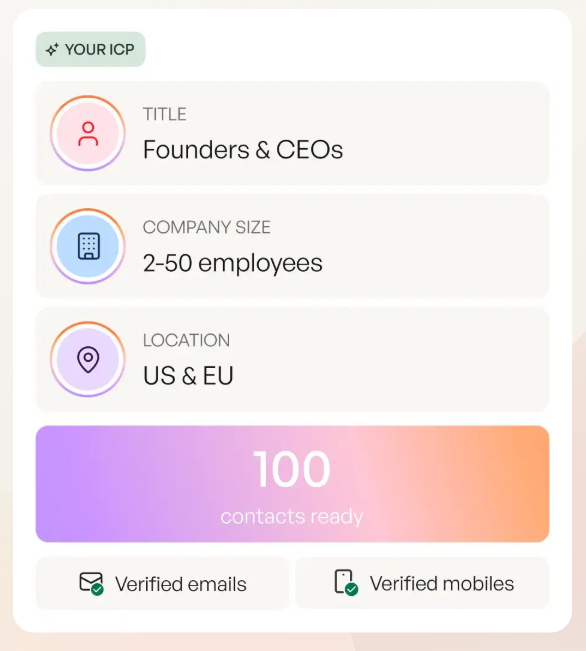
Here's what a sharp ICP looks like: fast-growing companies with 50-500 employees, 5+ disconnected tools, a dedicated ops team, losing 10+ hours a week to manual data entry. That's specific enough to filter with, broad enough to build pipeline.
Once you've got the ICP, run every prospect through what Forbes contributors call the "Three Fits" framework: Product-Customer Fit, Economics-Consumption Fit, and Problem-Value Fit. If a prospect doesn't pass at least two of three, move on.
The 6-Step Research Checklist
Timebox this. Five minutes for SMB, 10-15 for mid-market, up to 30 for enterprise. The goal is knowing enough to personalize - not writing a biography.
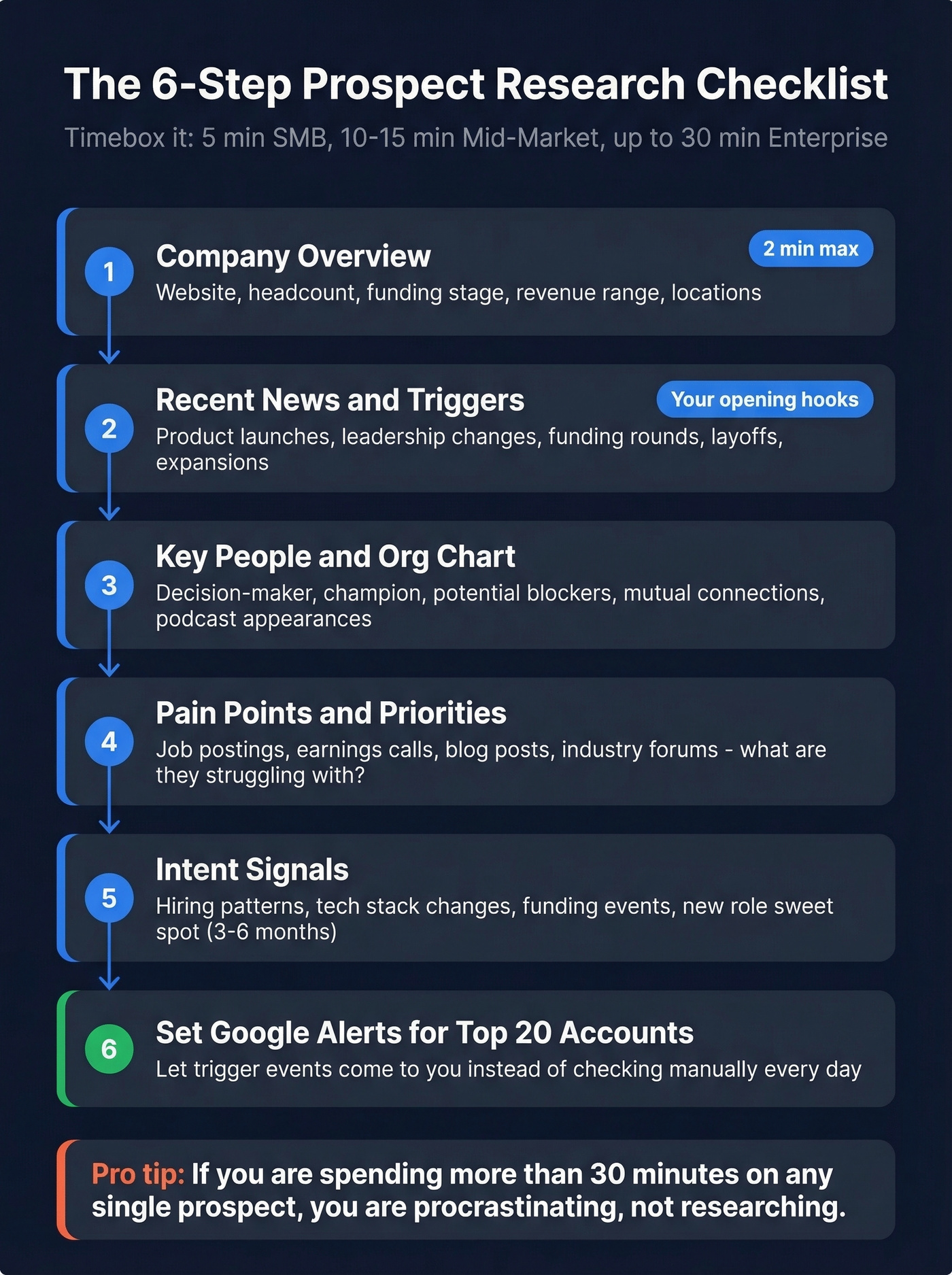
1. Company overview. Website, headcount, funding stage, revenue range, locations. Two minutes max.
2. Recent news and triggers. Google News the company name. Look for product launches, leadership changes, funding rounds, layoffs, or expansions. These are your opening hooks - something that happened to them, not something you want to sell them. Taking the time to learn about prospects before meeting them is what separates a relevant opener from a generic one (and it’s a core part of sales prospecting techniques that actually work).
3. Key people and org chart. Identify the decision-maker, the champion, and anyone who might block you. Check for mutual connections and note reporting structure. Then go one layer deeper: scan for podcast appearances, conference talks, or volunteer work. One rep on r/sales described landing a meeting by referencing a prospect's volunteer work running with visually impaired athletes - that kind of detail can't be faked, and prospects know it.
4. Pain points and priorities. What's the company publicly struggling with? Job postings are goldmines - if they're hiring three data engineers, they've got a data problem. Earnings calls, blog posts, and industry forums fill in the rest. The goal is understanding prospect pain points deeply enough that your outreach feels like a conversation, not a cold pitch (this is where personalized outreach wins).
5. Intent signals. Look for hiring patterns tied to your solution, tech stack changes, and funding events. Pay attention to the "Sweet Spot Window" - prospects 3-6 months into a new role are building their stack, and those at the 7-10 month mark are looking to optimize what isn't working. These signals also help you identify buying motives: whether someone's driven by growth pressure, cost reduction, or competitive urgency shapes how you frame your entire conversation (more on identifying buying signals).
After you've run through the checklist, set a Google Alert for your top 20 accounts so trigger events come to you instead of requiring daily manual checks.

You just built a research checklist. Don't waste it on bounced emails. Prospeo verifies every address through a 5-step process and refreshes data every 7 days - so the contact info matches the person you spent 15 minutes researching. 98% email accuracy at $0.01 per lead.
Good research deserves data that actually connects you to the prospect.
Use AI to Cut Research Time
If you've ever caught yourself manually opening five tabs for every single prospect - company website, news, social profiles, tech stack checker, CRM - you already know the problem. Reps who use AI for pre-call briefs cut that research time from 30 minutes to under 10. Here are two prompts worth saving.
Pre-call brief prompt:
You are a B2B sales research analyst. For [Company Name]:
1. Summarize their business model, recent news, and competitive position
2. Identify 3 likely challenges for a [Prospect's Title] at this company
3. Suggest 3 strategic discovery questions I should ask on our first call
Competitive displacement prompt:
[Company Name] is currently using [Competitor Product]. Based on common
reasons companies switch from [Competitor], what pain points should I
explore? Frame each as a discovery question, not a pitch.
That discovery question angle matters more than you'd think. Gong's research shows reps who ask 11-14 discovery questions see 74% higher success rates than those who wing it. Claude tends to be stronger for strategic question development, while ChatGPT pulls more current company news. Use both if you've got the time. (If you want a deeper framework, keep a bank of discovery questions ready.)
The real payoff is learning how to foresee prospect responses - when you've mapped their likely objections and priorities in advance, you can steer the conversation instead of reacting to it.
Reach Prospects With the Right Tools
| Tool | Best For | Starting Price |
|---|---|---|
| Prospeo | Verification + enrichment | Free / ~$0.01/email |
| Apollo | All-in-one prospecting | $49/mo |
| Clay | Workflow automation | $185/mo |
| Hunter | Email finding | $34/mo |
| ZoomInfo | Enterprise data + intent | ~$14,995/yr |
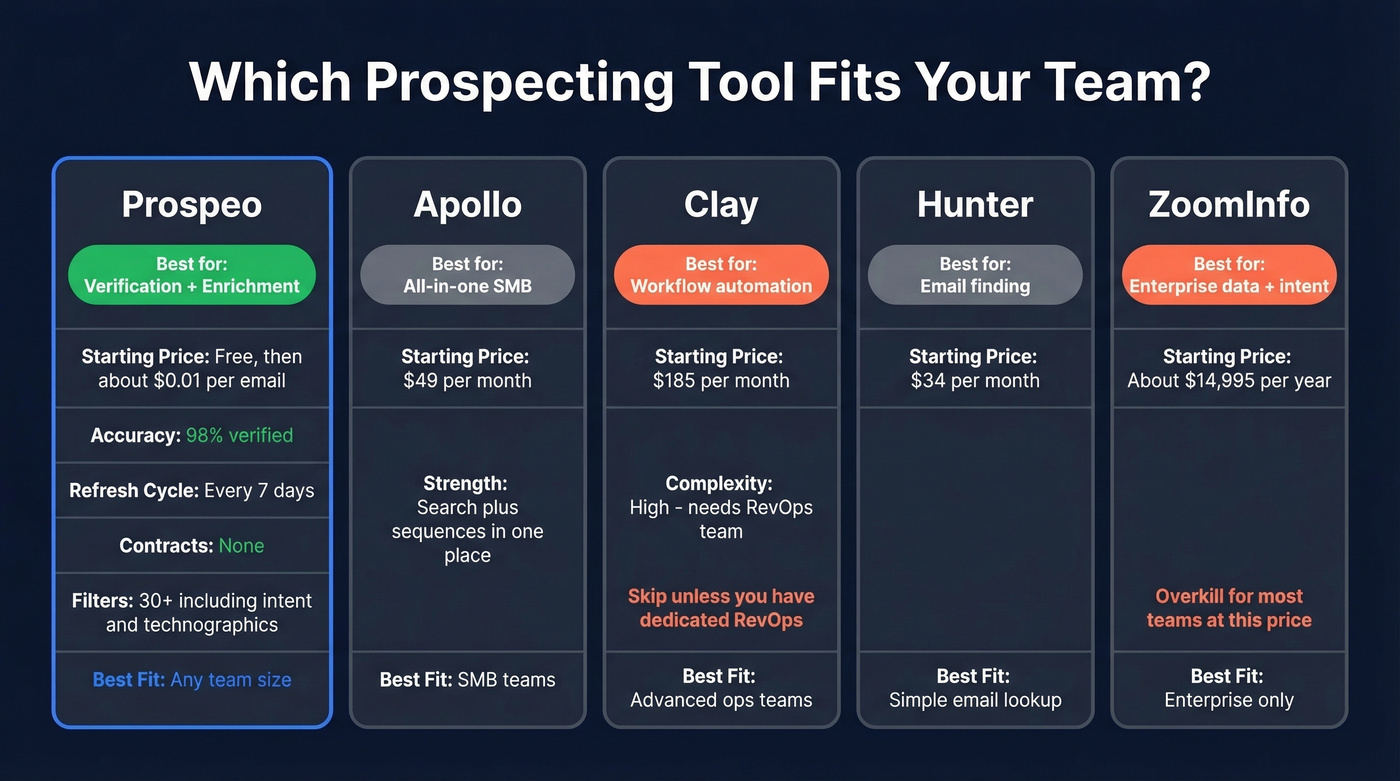
Prospeo delivers 98% verified email accuracy on a 7-day refresh cycle - without annual contracts or enterprise pricing. Its 30+ search filters, including buyer intent powered by Bombora and technographic signals, make it straightforward to go from ICP definition straight to verified contact data. Apollo's the best all-in-one for SMB teams that want search and sequences in one place.
Clay's powerful but complex. Skip it unless you've got a RevOps team building custom enrichment workflows. ZoomInfo makes sense if you need enterprise-grade coverage and intent data baked into your workflow, but for everyone else, it's overkill at that price point.
Mistakes That Kill Your Outreach
Here's the thing - 42% of reps say prospecting is the hardest part of their job. Most of that difficulty is self-inflicted.
Analysis paralysis. Reps substitute outbound activity with "research" because it feels productive and doesn't involve rejection. In our experience, the reps who timebox research consistently outperform the ones who "deep dive" every prospect. Block 1-1.5 hours per week for strategic account planning - not 30 minutes per individual lead.
Skipping verification. You spent 15 minutes building the perfect opener. It bounces. That's not bad luck - it's a broken process. Verify every email before it enters a sequence. Period. (If you’re seeing issues, track your email bounce rate and fix the source.)
Generic messaging after good research. LinkedIn's own data shows a 46% lift in InMail acceptance when you mention just one commonality - a shared connection, same school, same conference. One specific detail beats three paragraphs of value props. Lead with something you learned in steps 2-4 of the checklist. Then make sure your follow-up is just as specific with proven sales follow-up templates.
Let's be honest: 71% of prospects prefer doing their own research before talking to a rep. That means your outreach isn't competing with other vendors - it's competing with silence. The bar isn't "better pitch." The bar is "worth interrupting their self-directed research for." If your message doesn't contain an insight they couldn't find on their own, you've already lost.
Your ICP filters mean nothing if your tools can't action them. Prospeo's 30+ search filters - buyer intent, technographics, headcount growth, funding - turn your ICP definition into a verified prospect list in minutes, not hours. 300M+ profiles. No contracts.
Stop researching prospects you'll never reach. Start with verified data.
FAQ
How long should I spend researching a prospect?
Timebox by deal size: 5 minutes for SMB, 10-15 for mid-market, up to 30 for enterprise. The goal is knowing enough to personalize your opener and ask smart discovery questions - not writing a biography. If you're spending more than that, you're procrastinating.
What's the difference between an ICP and a buyer persona?
An ICP defines which companies are worth targeting - industry, size, tech stack, budget range. A buyer persona describes the person within those companies: their role, goals, and common objections. Build the ICP first, then layer personas on top.
How do I verify prospect contact data before outreach?
Use a real-time email verification tool with 98%+ accuracy and a short data refresh cycle. Prospeo verifies on a 7-day refresh and offers 75 free credits per month, so your carefully researched opener reaches the right inbox instead of bouncing.