

The Best Lead Gen CRM Software in 2026 (And the Data Layer Most Teams Skip)
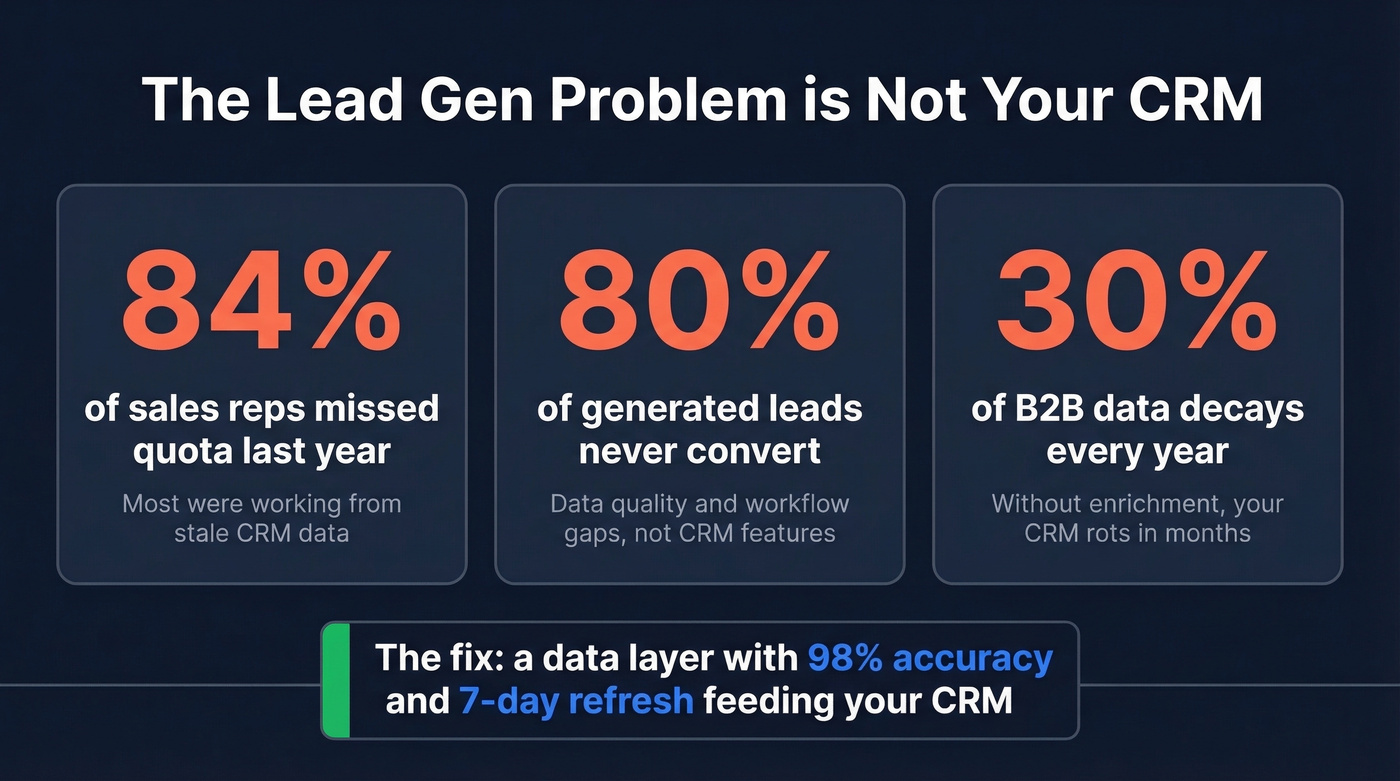
84% of sales reps missed quota last year. The uncomfortable truth behind that number: most of those reps were working out of a CRM that promised to "supercharge lead generation" but shipped with zero contact data inside it. Your CRM doesn't generate leads. It manages them. The gap between those two things is where pipeline goes to die.
Here's the thing - 91% of B2B marketers call lead generation their top priority, yet 80% of the leads they generate never convert. That's not a CRM problem. It's a data quality and workflow problem. The CRM is the hub, but it needs an engine feeding it verified, fresh contacts. Most teams skip that layer entirely, then wonder why reps prospect from stale lists and bounce emails north of 30%.
Below are the 7 best CRMs for lead generation in 2026, plus the data layer that makes any of them actually work.
Our Picks (TL;DR)
| Use Case | Pick | Why |
|---|---|---|
| Best free lead capture | HubSpot CRM | Free forms, chatbots, landing pages |
| Best data layer | Prospeo | 98% email accuracy, 7-day refresh |
| Best budget CRM | Zoho CRM | PCMag Editors' Choice, free for 3 users |
| Best fast setup | Freshsales | Live in a day, built-in phone, $9/user/mo |
| Best pipeline simplicity | Pipedrive | Visual pipeline, no bloat |
Hot take: If your average deal size is under $10K, you almost certainly don't need Salesforce-level tooling. Pair any mid-tier CRM from this list with a solid data layer and you'll outperform teams spending 5x more on their stack.
What Makes a CRM Good for Lead Gen
Not every CRM deserves the "lead generation" label. Most are glorified contact databases with a pipeline view bolted on.
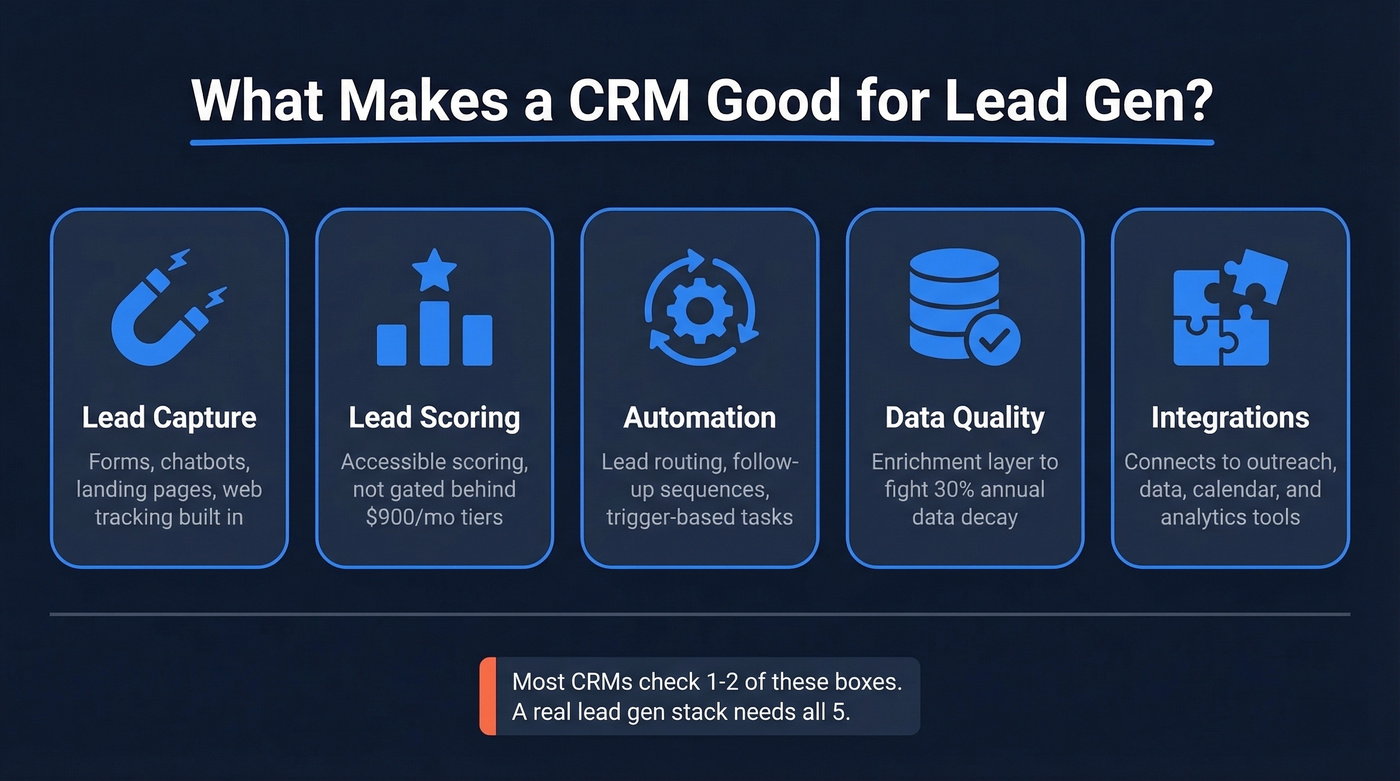
Lead capture built in. Forms, chatbots, landing pages, web tracking - a lead gen CRM should pull leads in without requiring a third-party tool for every inbound channel. If you need more options, start with free lead capture tools before you pay for another platform.
Lead scoring that's accessible. Many CRMs gate scoring behind expensive tiers. If you can't prioritize leads without paying $900/month, that's a problem. Tools like Clay ($185/month) and Apollo handle scoring outside the CRM - worth knowing if yours locks it behind enterprise pricing. (More on lead scoring setups here.)
Automation and workflows. Lead routing, follow-up sequences, task creation on trigger events. Manual lead management doesn't scale past 5 reps. If your reps are still writing every follow-up from scratch, keep a set of sales follow-up templates handy.
Enrichment and data quality. Most CRMs ship with zero contact data. They store what you put in, and that data decays at roughly 30% per year. You need an enrichment layer that keeps records fresh - see the best data enrichment services if you're comparing providers.
Integrations. Your CRM needs to talk to your outreach tool, your data source, your calendar, and your analytics. Closed ecosystems kill velocity. If you're wiring tools together, use a simple checklist like this connect outreach tool to CRM guide.
Pricing transparency. If you can't find the price on the website, expect a nasty surprise at renewal.

7 Best CRM Tools for Lead Generation in 2026
1. HubSpot CRM - Best Free Capture
Use this if you want the strongest free inbound lead capture on the market. HubSpot's free CRM includes forms, chatbots, landing pages, and automatic contact creation - no other free CRM matches that breadth for pulling leads in the door.
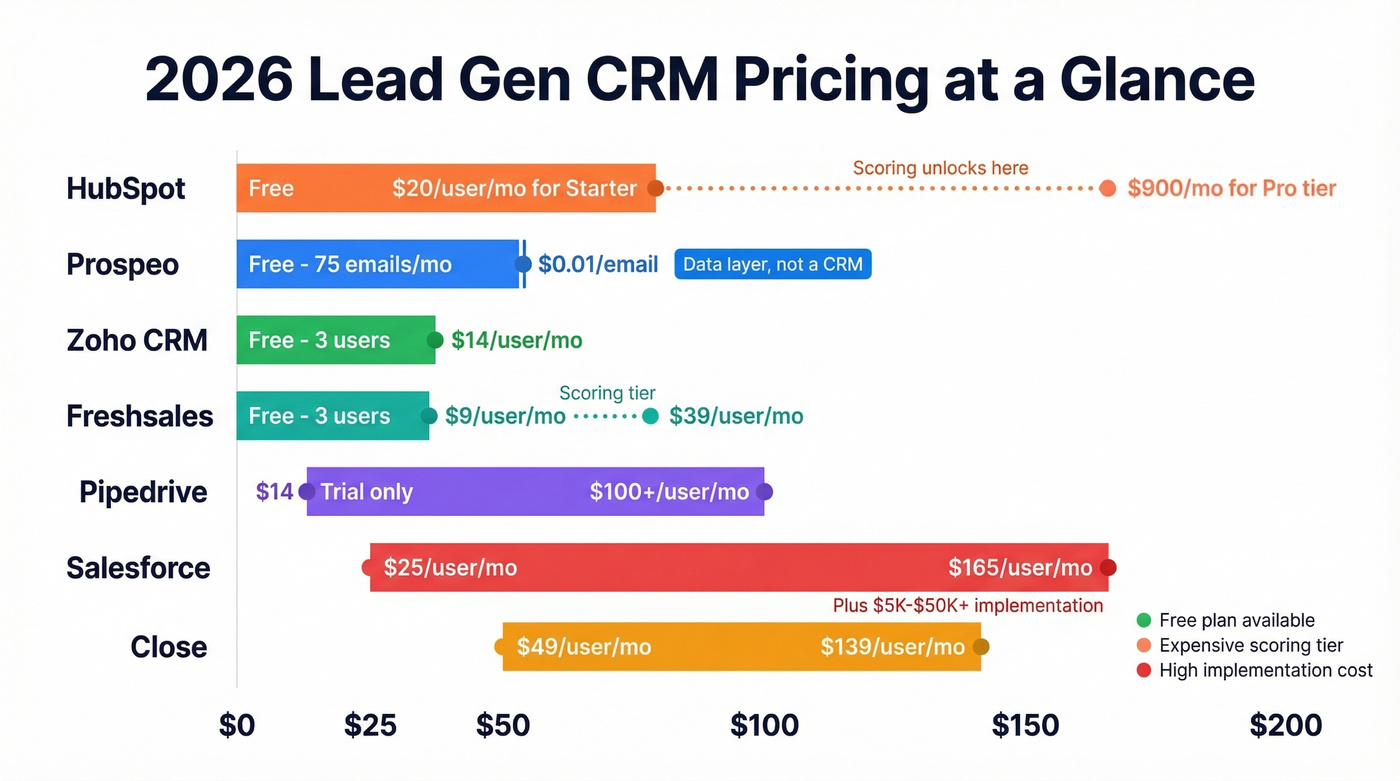
Skip this if you need automation, lead scoring, or customizable reporting without a massive price jump. HubSpot Starter runs $20/user/month, which is reasonable. But the moment you need real workflows, campaign management, or scoring, you're looking at Pro - and that's roughly $900/month. One Reddit user switching to Pipedrive described the jump as brutal, calling HubSpot "clunky" at that price point. Higher tiers also carry mandatory onboarding fees that can add thousands upfront.
The free tier is genuinely excellent for early-stage teams capturing inbound leads. Just go in with eyes open about where the paywall hits. If you're still evaluating options, here are more examples of a CRM with real pricing.
2. Prospeo - Best Data Layer for Any CRM
Let's be honest: we've tested dozens of data providers over the years, and the single biggest bottleneck in any lead gen CRM stack isn't the CRM itself - it's the quality of data flowing into it. That's where Prospeo fits.
Prospeo isn't a CRM. It's the data engine that makes your CRM useful. With 300M+ professional profiles, 98% email accuracy, and a 7-day data refresh cycle (the industry average is six weeks), it feeds your pipeline with contacts that actually connect. The enrichment API returns 50+ data points per contact at a 92% match rate, and it plugs natively into HubSpot, Salesforce, Instantly, Lemlist, Clay, and Zapier. If you're building lists from scratch, pair it with proven sales prospecting techniques.
The results speak for themselves. Snyk's team of 50 AEs saw bounce rates drop from 35-40% to under 5%, and AE-sourced pipeline jumped to 200+ new opportunities per month. Meritt tripled pipeline from $100K to $300K per week. Those aren't CRM upgrades - they're data upgrades. (If deliverability is a recurring issue, start with email bounce rate benchmarks and fixes.)
Free tier gives you 75 verified emails and 100 Chrome extension credits monthly. No contract, no sales call required.
3. Zoho CRM - Best Budget Option
PCMag gave Zoho CRM its Editors' Choice award with a 4.5/5 rating, calling out its "unbeatable price" and deep customization. The free plan supports up to 3 users, and Standard starts at just $14/user/month. For a bootstrapped team that needs lead management, pipeline tracking, and basic automation without bleeding cash, Zoho is the obvious pick.
Zia AI handles lead scoring, predictions, and workflow suggestions - features that competitors gate behind $100+ tiers. Custom modules, layouts, validation rules, and workflow automation are all accessible at reasonable price points, which is rare in this category.
The tradeoff is setup time. Zoho's learning curve is steeper than HubSpot or Pipedrive, advanced features like territory management live in higher tiers, and the UI takes getting used to. But for teams willing to invest that upfront effort, the value-to-cost ratio is unmatched.
4. Freshsales - Fastest Setup
Pros:
- Free for up to 3 users, Growth plan at $9/user/month
- Clean UI with built-in phone, email, and chat - live in a day
- G2 rating of 4.5/5 across 3,000+ reviews
- 21-day free trial, no credit card required
Cons:
- Lead scoring requires Pro ($39/user/month)
- Reporting is limited; teams regularly export to spreadsheets for anything complex
- Enrichment accuracy runs about 72% for US companies, which is mediocre
- Sequences are basic compared to dedicated outreach tools like Instantly or Outreach
Freshsales is the CRM you pick when you need reps productive by Friday. Just know you'll outgrow the reporting before you outgrow anything else.
5. Pipedrive - Simplest Pipeline
Pipedrive is the CRM that Reddit's r/CRM consistently recommends when someone posts about leaving HubSpot - and for good reason. The drag-and-drop pipeline is genuinely intuitive, plans run $14-$100+/user/month with transparent pricing, and lead scoring is available on paid tiers.
The catch: Pipedrive is a pipeline-first tool, not an inbound-first tool. No built-in forms, chatbots, or landing pages. No free plan - just a 14-day trial. You'll need to pair it with a data source and a capture tool to build a full lead gen stack. But if your team's motion is outbound-driven and you just need a clean CRM for sales leads, Pipedrive is the least annoying CRM you'll ever use.
6. Salesforce Sales Cloud - Enterprise Standard
Salesforce is the enterprise standard for a reason: Einstein AI, AppExchange ecosystem, and virtually unlimited customization. Starter Suite runs $25/user/month, Professional $80, and Enterprise $165.
But here's the honest math for smaller teams. Implementation costs range from $5K to $50K+. You'll need a dedicated admin. The platform's complexity means months before you're fully operational. We've seen startups buy Salesforce because it felt "serious," then spend more time configuring it than actually selling. PCMag rates it 4.0/5 - excellent, but not the best value below 20 reps. If you have 20+ reps and the budget for proper implementation, it's the right call. Everyone else should look at Zoho or Pipedrive first. If you want the full cost breakdown, see Salesforce pricing.
7. Close CRM - Built-In Calling
Close is purpose-built for phone-heavy outbound teams. Built-in calling, SMS, and power dialer mean reps never leave the CRM to make calls. Plans run $49-$139/user/month with no free tier.
If your team's primary motion is cold calling, Close eliminates the need for a separate dialer. Skip it if your team runs email-first outbound - you're paying a premium for a dialer you won't use.

84% of reps missed quota last year - most were prospecting from stale CRM data. Prospeo's 7-day refresh cycle and 98% email accuracy mean your CRM finally has contacts worth calling. Snyk dropped bounce rates from 40% to under 5% across 50 AEs.
Stop blaming your CRM. Fix the data feeding it.
Pricing Comparison
| Tool | Free Plan | Starting Paid | Scoring Tier | Best For |
|---|---|---|---|---|
| HubSpot | Yes | $20/user/mo | Pro (~$900/mo) | Free lead capture |
| Prospeo | Yes (75 emails/mo) | ~$0.01/email | N/A (data layer) | Data accuracy |
| Zoho CRM | 3 users | $14/user/mo | Standard+ (Zia) | Budget CRM |
| Freshsales | 3 users | $9/user/mo | Pro ($39/user/mo) | Fast setup |
| Pipedrive | No (14-day trial) | $14/user/mo | Paid tiers | Pipeline simplicity |
| Salesforce | No | $25/user/mo | Enterprise ($165) | Enterprise teams |
| Close | No | $49/user/mo | Available | Phone-heavy outbound |
How to Build Your Lead Gen Stack
Your CRM is the hub, not the engine. The engine is the stack around it.
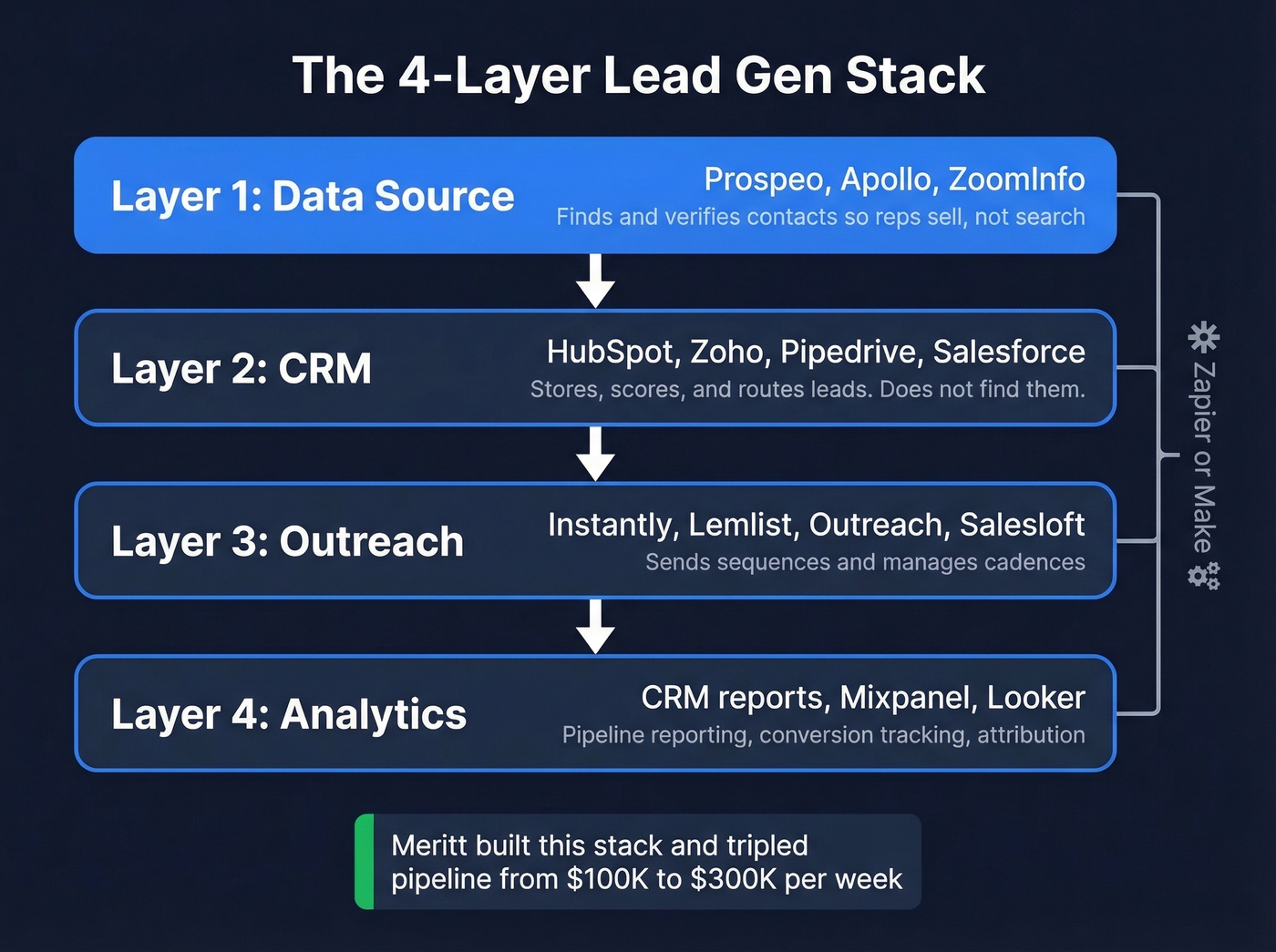
Layer 1: Data source. This is where leads originate. Without it, reps manually research prospects or work from purchased lists that bounce at 30%+. A dedicated data platform feeds your CRM with verified contacts so reps spend time selling, not searching. (If you're building outbound lists, start with a sales prospecting database.)
Layer 2: CRM. HubSpot, Zoho, Pipedrive - pick the one that matches your team size and budget. The CRM stores, scores, and routes leads. It doesn't find them.
Layer 3: Outreach. Instantly, Lemlist, Outreach, Salesloft - your sequencing tool sends the emails and manages the cadences. Most integrate natively with both your CRM and your data source.
Layer 4: Analytics. Pipeline reporting, conversion tracking, attribution. This lives partly in your CRM and partly in dedicated tools.
Connect the layers with native integrations where possible, or use Zapier (free tier available, paid from $19.99/month) or Make for custom workflows. No single tool does all four layers well. Teams that try to force their CRM to be the entire stack end up with mediocre data, basic outreach, and blind spots in analytics. To keep the system measurable, track lead generation metrics end-to-end.
Meritt's team built exactly this kind of stack and tripled pipeline from $100K to $300K per week. That's not magic - it's architecture.
Every CRM on this list stores contacts. None of them verify them. Prospeo enriches your CRM records with 50+ data points at a 92% match rate - for roughly $0.01 per email. Native integrations with HubSpot, Salesforce, Pipedrive via Zapier, and more.
Plug the data layer your lead gen CRM is missing.
3 Lead Gen Mistakes Your CRM Should Prevent
Treating all leads the same. As Beau Vasquez put it, "A one-size-fits-all process tends to be the place where a lot of things start to not work." Your CRM's lead scoring exists for a reason - use it. Segment by intent signals, engagement level, and firmographic fit. Teams that score and prioritize leads convert at dramatically higher rates than those running every lead through the same sequence.
Ignoring where leads drop off. Most teams obsess over the leads that convert and ignore the bucket of 100 leads on the floor that never made it past stage two. Your CRM's pipeline analytics should show you exactly where leads stall. If 40% of qualified leads die between demo and proposal, that's not a lead gen problem - it's a sales process problem your CRM data is screaming about. This is where lead generation CRM software earns its keep: surfacing the exact stage where deals go cold so you can fix the process, not just add more leads at the top.
Working in silos. Sales and marketing misalignment is the silent killer of lead gen ROI. When marketing defines an MQL differently than sales defines an SQL, leads fall through the cracks. Your CRM should be the shared source of truth - unified dashboards, agreed-upon lead definitions, shared pipeline visibility. Most deals require 5-12 touchpoints, and up to 50% of sales go to the first vendor to respond. Silos slow response time. Speed wins.
FAQ
What's the best free lead gen CRM?
HubSpot CRM offers the strongest free lead capture with built-in forms, chatbots, and landing pages that automatically create contacts. Zoho CRM and Freshsales also offer free plans for up to 3 users with basic pipeline tracking.
Do I need a separate tool for lead generation?
Yes - CRMs manage leads but don't find them. A dedicated data platform feeds verified contacts into your CRM so reps prospect from fresh, accurate records instead of stale imports. The CRM is the hub; the data source is the engine.
Which CRM has the best built-in lead scoring?
HubSpot (Pro tier, ~$900/month), Freshsales (Pro tier, $39/user/month with Freddy AI), and Salesforce (Enterprise, $165/user/month with Einstein) all offer scoring. Always check which plan unlocks it - it's rarely included in starter tiers.
How do I keep CRM data from going stale?
Use an enrichment tool with automated refresh cycles. Most CRMs store data as-is and never re-verify. Pair a data platform that refreshes records on a weekly cycle with CRM-native enrichment workflows to keep contacts current automatically.
Is Salesforce worth it for a small team?
Usually not. Starter Suite at $25/user/month is limited, and real lead gen features require Professional ($80) or Enterprise ($165) plus implementation costs of $5K-$50K+. Zoho CRM or Pipedrive deliver more value for teams under 20 reps without the admin overhead.