

Lead Gen Meaning: The Data-Backed Guide to Getting It Right
Lead generation is how you fill your pipeline with people who might actually buy. The concept is simple. The execution is where 37% of marketing budgets go to work - or go to waste, and the difference comes down to data quality, qualification rigor, and knowing which channels deserve your money.
What Is Lead Generation?
Lead generation is the process of identifying, attracting, and capturing potential customers who fit your ideal buyer profile, then converting that interest into a sales conversation. It spans inbound methods like content, SEO, and webinars that pull prospects toward you, alongside outbound methods like cold email, cold calls, and paid ads that push your message to them.
That's the textbook definition. In practice, you're building a list of people with some combination of need, budget, and timing - then giving your sales team a reason to call them.
The reason this gets complicated isn't the concept. It's the sheer number of channels, tools, and data sources involved. A modern B2B team might run SEO content for inbound, cold email sequences for outbound, intent data to prioritize accounts, and a CRM to track it all. Each piece needs to work together, and the weakest link - usually data quality - determines whether the whole system performs or just burns budget.
What You Need (Quick Version)
Before we get into frameworks and benchmarks, here's the starter stack that works:
- A CRM - HubSpot's free tier or Salesforce (entry plans start around $25/user/mo ) to track every lead and touchpoint
- A verified prospecting tool - Prospeo gives you 300M+ profiles with 98% email accuracy, starting free at 75 verified emails/month plus 100 Chrome extension credits/month
- An email platform - Mailchimp's free tier for nurture, or a cold email tool like Instantly for outbound
The average B2B cost per lead is $391.80. Every bad email, every unqualified lead, every bounced message burns real budget. Quality beats quantity from day one.
Lead Gen vs Demand Gen
These two terms get used interchangeably. That's a mistake. They solve different problems at different stages.
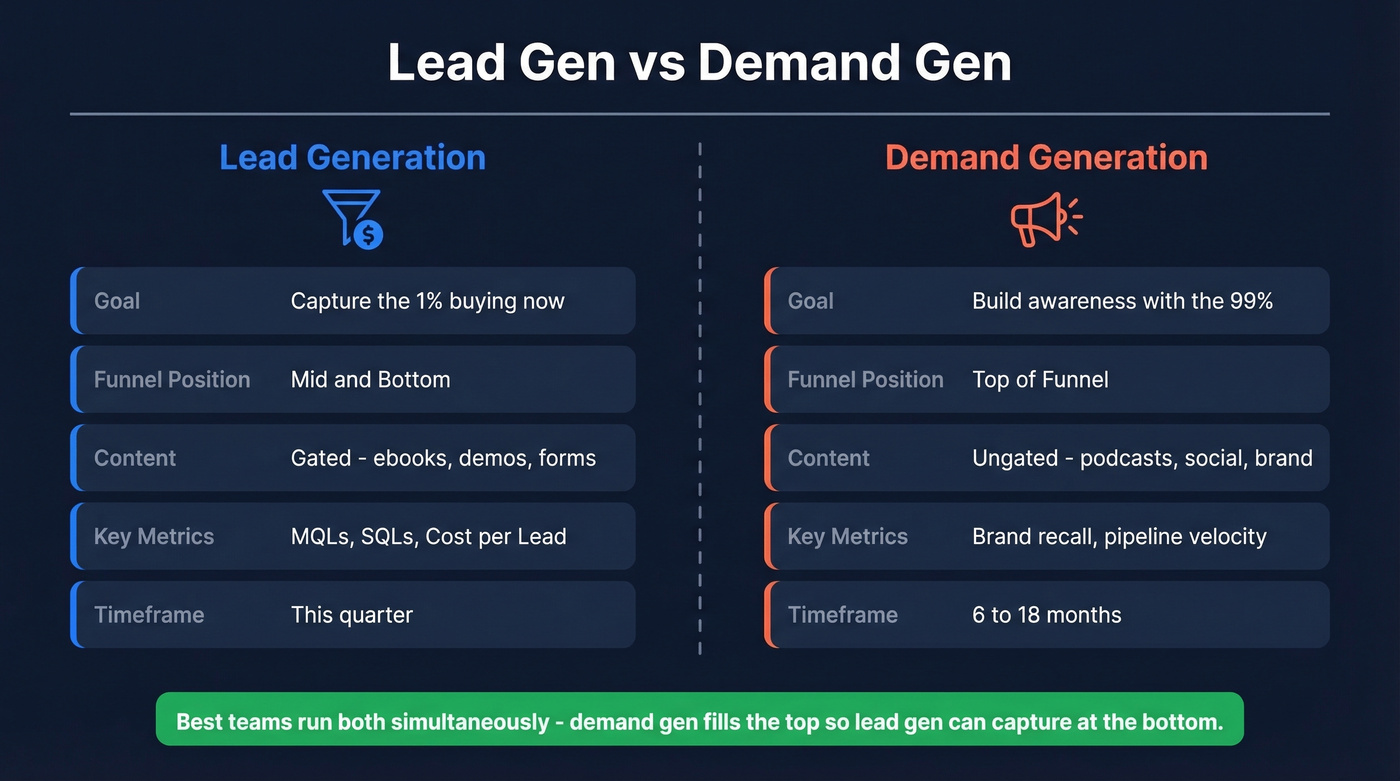
Demand generation builds awareness with the 99% of your market that isn't buying right now. Think ungated podcasts, thought leadership on social, brand campaigns - work that pays off in 6-18 months. Lead generation captures intent from the 1% who are actively in-market: gated ebooks, demo request forms, cold email sequences. Work that feeds pipeline this quarter.
The distinction matters because 92% of B2B buyers start research with at least one vendor already in mind. The vendor on the Day One shortlist wins 95% of the time. If you're only doing lead gen without demand gen, you're fishing in a pond where buyers already have a favorite. Only doing demand gen? You're building awareness but never converting it.
| Dimension | Lead Generation | Demand Generation |
|---|---|---|
| Goal | Capture in-market intent | Build future awareness |
| Funnel position | Mid/bottom | Top |
| Content type | Gated - ebooks, demos | Ungated - podcasts, social |
| Audience | The 1% actively buying | The 99% not buying yet |
| Key metric | MQLs, SQLs, CPL | Brand recall, pipeline velocity |
| Timeframe | Short-term pipeline | Long-term positioning |
The best teams run both simultaneously. Demand gen fills the top of the funnel so lead gen has something to capture at the bottom.
Why It Matters (With Numbers)
37% of marketing budgets go directly to lead generation - the single largest line item for most B2B marketing teams.
The average B2B buying cycle runs 10.1 months. First contact between buyer and seller doesn't happen until 61% of the journey is already complete. By the time a prospect fills out your demo form, they've already read your competitor's case studies, watched three webinar recordings, and formed an opinion. 41% of buyers have a preferred vendor before formal evaluation even starts, which means your system needs to capture these people early and nurture them intelligently - not add them to a generic drip sequence and hope for the best.
There's also a content saturation problem. 56% of buyers say there's too much content out there. Your lead magnet isn't competing with silence. It's competing with every other vendor's ebook, webinar, and "ultimate guide." The bar for earning a form fill keeps rising.
How Lead Generation Works
Inbound vs Outbound
Inbound attracts prospects through content, SEO, and social media - they find you. You publish a blog post that ranks for a buyer keyword, gate a high-value resource behind a form, and capture the lead when they download it. Slower to build, but it compounds over time, and the leads tend to be warmer because the prospect self-selected.
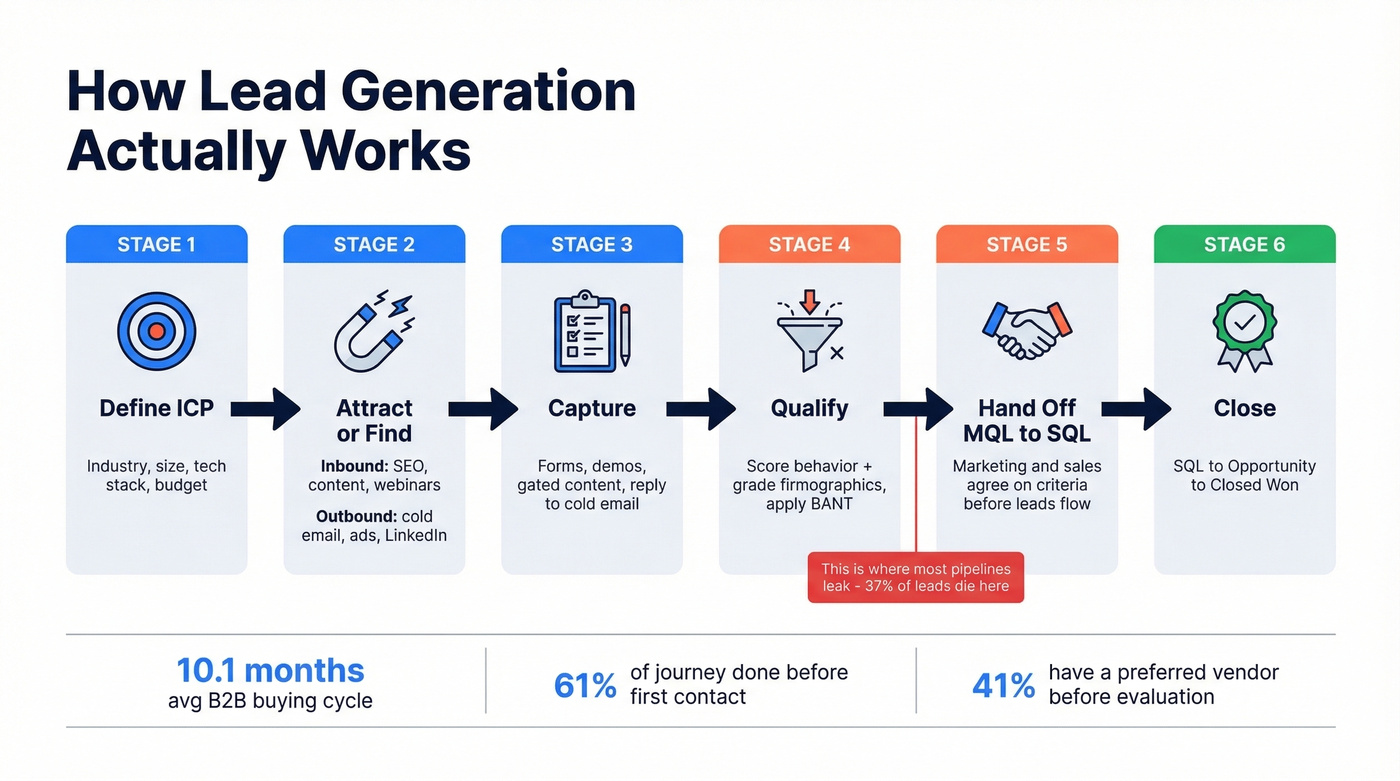
Outbound reaches prospects directly - you find them. Cold email, cold calls, paid ads targeting specific job titles or companies. It's faster to build pipeline but requires better data and more personalization to avoid being ignored. LinkedIn alone drives 80% of B2B social media leads, which is why so many outbound workflows start there.
Here's the thing: if you're a team under 10 reps with less than $5K/month in marketing budget, start with cold email. It's the single fastest way to validate a new market, test messaging, and book meetings without waiting six months for SEO to compound. Layer in inbound later.
Lead Types
Not all leads deserve the same attention.
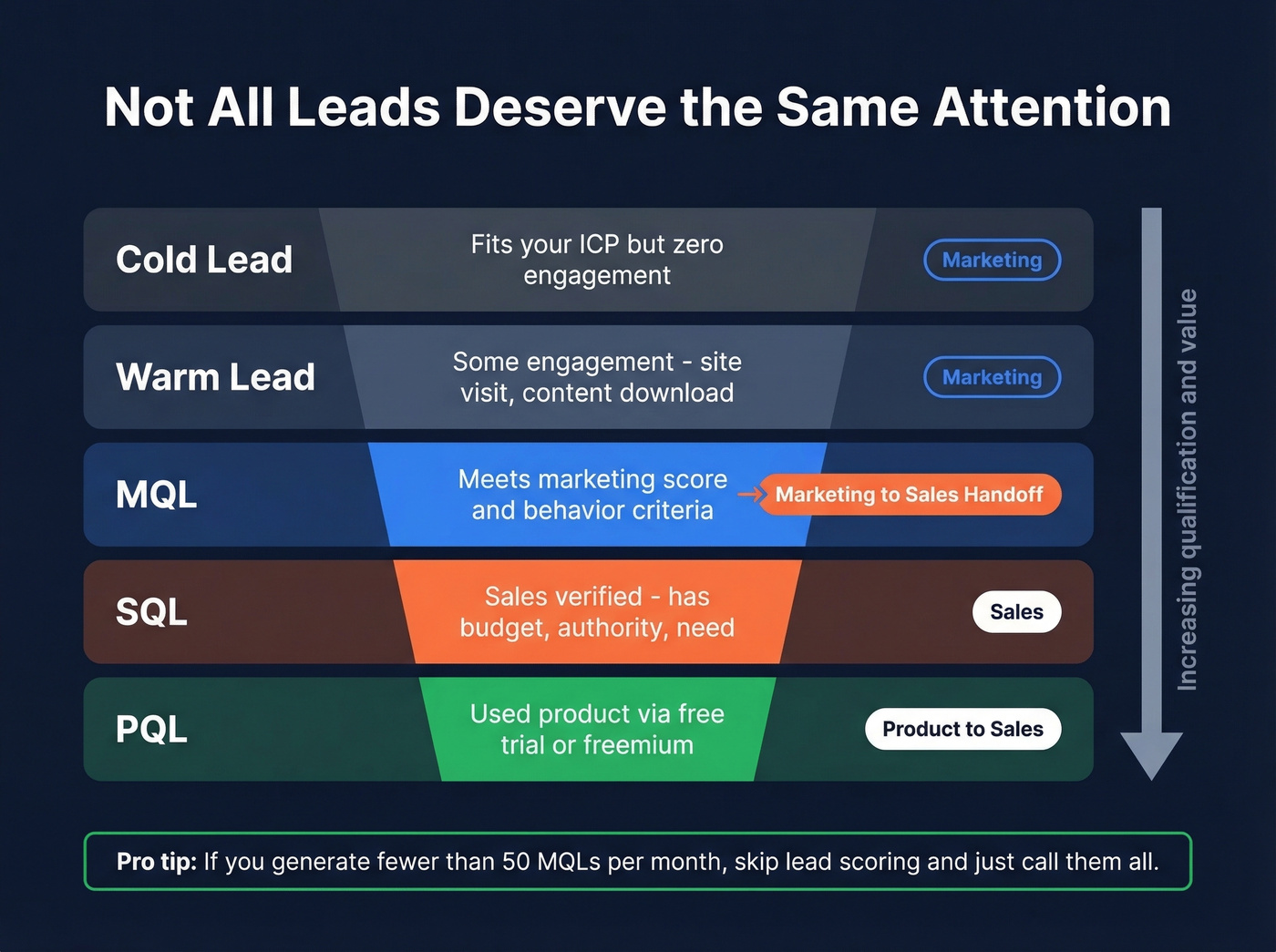
| Lead Type | Definition | Who Owns It |
|---|---|---|
| Cold lead | Fits ICP but no engagement | Marketing |
| Warm lead | Some engagement - site visit, content download | Marketing |
| MQL | Meets marketing criteria via score + behavior | Marketing -> Sales handoff |
| SQL | Sales-verified, has budget/authority/need | Sales |
| PQL | Used product via free trial or freemium | Product -> Sales |
The handoff from MQL to SQL is where most pipelines leak. Marketing says "we sent you 200 MQLs last month." Sales says "those weren't real leads." The fix is agreeing on qualification criteria before the leads start flowing.
How to Qualify Leads
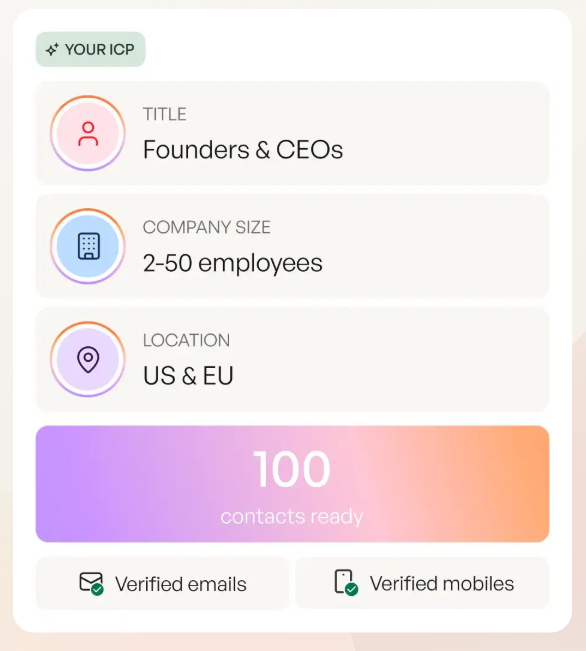
Start with your ICP - ideal customer profile. This is the firmographic and behavioral blueprint of your best customers: industry, company size, tech stack, growth stage, department headcount. If you don't have a written ICP, you don't have a lead gen strategy. You have a guessing game. If you need a starting point, use an ICP template and scoring rubric.
Once you have the ICP, apply a qualification framework. BANT is the classic: Budget, Authority, Need, Timing. But BANT was designed for an era when sellers controlled information. By the time you're asking BANT questions today, the prospect has already done their homework. That's why modern teams layer in lead scoring - behavioral signals like pricing page visits, webinar attendance, and email engagement - alongside lead grading for firmographic fit.
Skip lead scoring if you're generating fewer than 50 MQLs per month. At that volume, just call them all. Scoring adds complexity that only pays off at scale.
A worked example: VP of Sales at a 200-person SaaS company who attended your webinar and visited your pricing page twice = score 85, grade A. Marketing coordinator at a 15-person agency who downloaded one ebook = score 20, grade C. Both are "leads." Only one deserves a sales call.

The article says the average B2B cost per lead is $391.80 - and every bounced email burns that budget. Prospeo's 98% email accuracy and 5-step verification mean your pipeline runs on real contacts, not dead ends. At ~$0.01 per email, you cut lead costs by 90% compared to ZoomInfo.
Stop paying $391 per lead only to watch it bounce.
Benchmarks by Industry
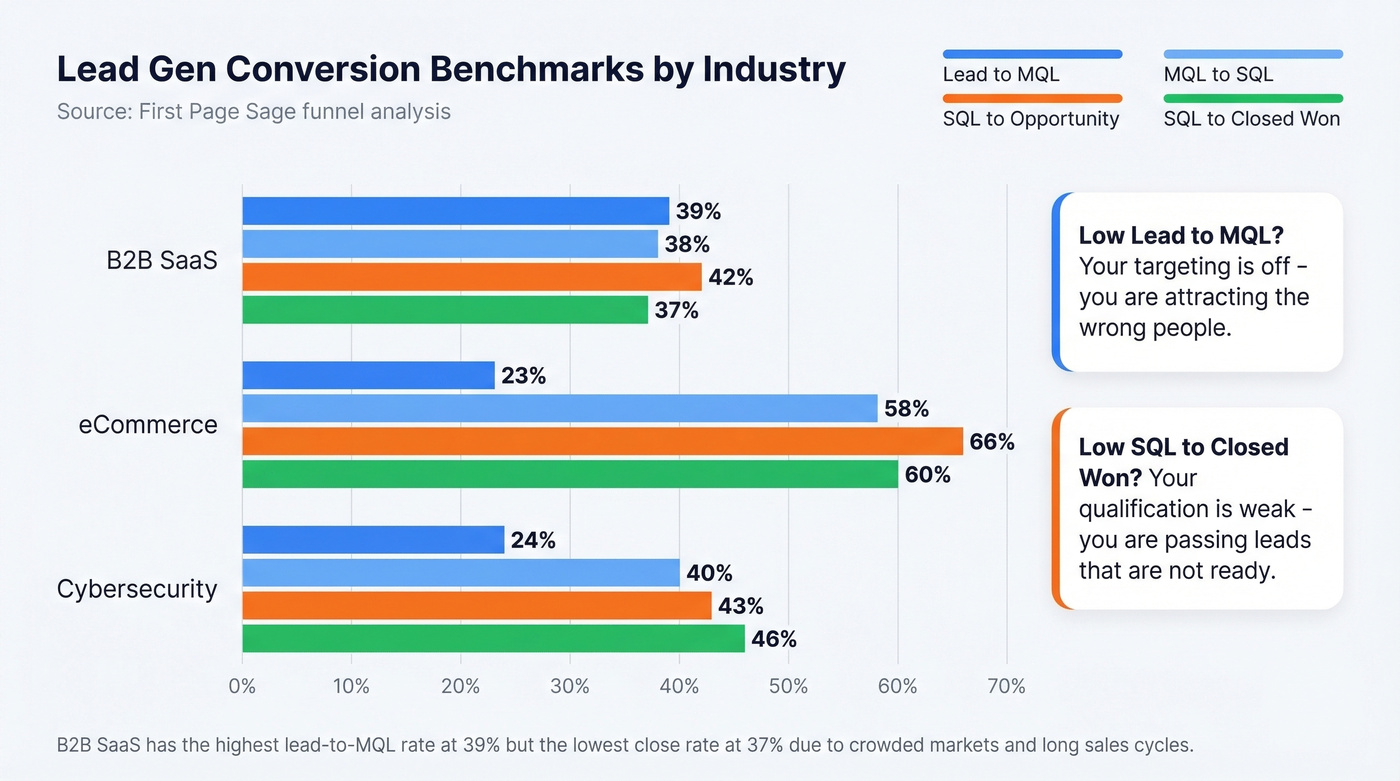
Benchmarks keep you honest. Without them, every conversion rate feels either terrible or amazing depending on your mood. Here's what "normal" looks like, based on First Page Sage's funnel analysis:
| Industry | Lead -> MQL | MQL -> SQL | SQL -> Opportunity | SQL -> Closed Won |
|---|---|---|---|---|
| B2B SaaS | 39% | 38% | 42% | 37% |
| eCommerce | 23% | 58% | 66% | 60% |
| Cybersecurity | 24% | 40% | 43% | 46% |
B2B SaaS has the highest lead-to-MQL conversion at 39% but the lowest close rate at 37%. That's the nature of a crowded market with long sales cycles. eCommerce converts fewer leads to MQLs but closes at 60% - once someone's qualified, they buy.
We've seen B2B SaaS teams push Lead->MQL rates above 50% when they nail ICP targeting. If your rate is significantly below your industry average, the problem is usually targeting - you're attracting the wrong people. If your SQL -> Closed Won rate is low, the problem is typically qualification - you're passing leads to sales that aren't ready. To sanity-check your numbers, compare against the average B2B lead conversion rate benchmarks.
Strategies That Actually Work
Content marketing and lead magnets remain the backbone of inbound. The key is specificity. A generic "State of B2B Sales" ebook converts worse than a "Cold Email Templates for Selling to CFOs" checklist. When 56% of buyers say there's too much content, a calculator, a template, or a benchmark report for their exact industry earns the form fill because it delivers immediate, tangible value rather than vague thought leadership.
Cold email is alive and well despite what the "cold email is dead" crowd says on Twitter. Average B2B cold email open rates run 27.7%, with a 5.1% response rate. Add one follow-up and that response rate jumps to 6.9% - a 49% increase from a single additional touch. If you're not following up, you're leaving half your replies on the table. If you want plug-and-play sequences, start with these sales follow-up templates.
SEO and organic content compound over time. It's the cheapest lead source long-term but takes 6-12 months to build momentum. The play is ranking for buyer-intent keywords - not just top-of-funnel informational queries - and gating the highest-value content. Paid ads deliver speed when you need it: Google Ads targeting high-intent keywords, LinkedIn ads targeting specific job titles and company sizes. The CPL is higher, but you control the volume. If SEO is a core channel for you, build a system for SEO sales leads and qualification.
Events and webinars generate some of the highest-quality leads because attendees self-select by investing time. But the follow-up is where most teams fail. We've seen teams generate 500 webinar registrants and then send one generic "thanks for attending" email. That's not a follow-up system. Build multi-touch sequences that reference what the attendee actually heard.
Social selling works when it's genuine and is terrible when it's automated. The "Hey [First Name], I noticed we're both in [Industry]..." messages have a near-zero response rate. Personalized engagement on posts, thoughtful comments, and direct outreach based on actual trigger events perform dramatically better. If you need a repeatable approach, use a personalized outreach playbook.
One benchmark that ties all of these together: deliverability above 95% is the baseline for any email-based channel. Below that, your sender reputation degrades, and every channel that touches email suffers. If you're troubleshooting, start with an email deliverability guide and fix the root causes.
Essential Tools
CRM
For teams under 10 reps, skip Salesforce. HubSpot's free CRM handles contact management, deal tracking, and basic reporting - everything you need until you outgrow it. Marketing Hub starts around $20/mo when you need automation. Salesforce Sales Cloud starts around $25/user/mo and scales to enterprise, but the learning curve is steep and configuration takes real time.
Prospecting & Email Verification
Prospeo covers 300M+ professional profiles with 98% email accuracy and 125M+ verified mobile numbers. Data refreshes every 7 days compared to the 6-week industry average - a meaningful difference when people change jobs constantly. At roughly $0.01 per email, it's 90% cheaper than ZoomInfo, and teams using it book 26% more meetings on average. The free tier gives you 75 verified emails per month plus 100 Chrome extension credits, no annual contracts, with native integrations into HubSpot, Salesforce, Smartlead, Instantly, and Lemlist.

Apollo is the other major self-serve option. Free tier available, paid plans from ~$49-99/mo per user. Larger database breadth, but email accuracy sits around 79% - expect more bounces and potential deliverability risk at scale.
Email Marketing & Automation
Mailchimp's free tier is enough for early-stage nurture campaigns. Paid plans start around $13/mo when you need automation workflows and A/B testing. Zapier ($19.99/mo billed annually) bridges the gaps between your CRM, email platform, and prospecting tools without custom code.
Landing Pages & Scheduling
Carrd (around $9/year) and Unbounce (around $74/mo) let you spin up conversion-focused pages without touching your main site. Calendly's free tier eliminates the back-and-forth for scheduling demos and drops qualified meetings directly on your calendar.
Mistakes That Kill Your Pipeline
Relying on purchased lists. The most common complaint from sales teams isn't "we don't have enough leads" - it's "we don't have enough good leads." Bulk-purchased contact lists are the worst offender: outdated, unverified, and shared across dozens of competitors. Build your own list with verified data. It takes more effort but produces dramatically better results. If you're considering it anyway, read is it illegal to buy email lists first.
Ignoring lead qualification. Sending every form fill straight to sales is a fast way to burn your SDR team out. Define your ICP, implement scoring and grading, and only pass leads that meet a minimum threshold.
No follow-up system. One email isn't a sequence. A single follow-up increases cold email response rates by 49%. The teams that win aren't the ones with the best first email - they're the ones with the best fifth touch.
Using unverified data. This is the silent killer. Bounce rates above 5% tell inbox providers you're not trustworthy, which tanks deliverability for your entire domain. We've seen sales teams go from 35-40% bounce rates to under 5% within weeks of switching to verified data sources - the consensus on r/sales is that bad data is the number one reason outbound campaigns fail before they even get a chance. If you're diagnosing issues, start with email bounce rate benchmarks and fixes.
You just learned that 61% of the buyer journey happens before first contact. That means your outbound needs to reach the right person, at the right company, with a valid email - on the first try. Prospeo gives you 300M+ profiles with 30+ filters including buyer intent, tech stack, and headcount growth so you land in the 1% who are actually in-market.
Reach in-market buyers before your competitors do.
Compliance: GDPR & CCPA
Data privacy isn't optional - and getting it wrong can cost more than your entire marketing budget.
GDPR requires a lawful basis for processing personal data when targeting EU contacts. For B2B outreach, that's typically legitimate interest, but you still need to document it. Consent must be freely given, specific, informed, and unambiguous. No pre-checked boxes.
CCPA gives California residents the right to know what data you've collected, opt out of its sale, request deletion, and restrict sharing. Your privacy policy needs to be clear, and you need to honor opt-out requests promptly.
Across both frameworks: collect only what you need, keep consent records, make unsubscribe easy and immediate, and sign Data Processing Agreements with every vendor that touches your prospect data.
FAQ
What does lead gen mean?
Lead gen means systematically attracting and capturing potential buyers so your sales team has a qualified pipeline to work. A "lead" is any person or company that's shown interest - by filling out a form, downloading content, or visiting your pricing page. Qualification frameworks like BANT and lead scoring determine which ones deserve immediate outreach.
How is lead gen different from demand gen?
Lead gen captures contact information from prospects actively in-market - gated content, demo forms, cold outreach. Demand gen builds brand awareness with the larger audience not yet ready to buy. Most high-performing B2B teams run both: demand gen fills the top of the funnel, lead gen converts at the bottom.
How much does B2B lead generation cost?
The average cost per lead across B2B channels is $391.80. Organic leads from SEO are cheapest long-term but take 6-12 months to build. Paid ads and events cost more per lead but deliver faster pipeline. Your actual CPL depends on industry, average deal size, and how tightly you qualify.
What's a good free tool for building prospect lists?
Prospeo's free tier includes 75 verified emails and 100 Chrome extension credits per month - enough to run a real outbound test. Apollo also offers a free plan with broader data but lower email accuracy (79% vs 98%), which means more bounces and potential deliverability risk.
What is lead scoring?
Lead scoring assigns points based on a prospect's actions - webinar attendance, pricing page visits, email engagement. Combined with lead grading for firmographic fit, it tells sales which leads to prioritize. Skip it if you're generating fewer than 50 MQLs per month; at that volume, just call them all.