

Lead Generation in 2026: What Works Now
Marketing hit their MQL target last quarter. Sales rejected 60% as unqualified. Pipeline is flat.
If that sounds familiar, you're living the 2026 lead gen crisis - and you're not alone. A Marketing Week survey of 450 B2B marketers found 37.7% are pressured to deliver MQLs regardless of quality, and another 26.7% say lead volume is their only success metric. Meanwhile, "lead-to-customer conversion" has become the second most important KPI for marketers this year according to HubSpot's State of Marketing Report - a sign the industry is finally waking up to the gap between what marketing measures and what actually drives revenue.
If you're still running last year's playbook, here's what changed.
The Short Version
- Your data is the bottleneck. Fix contact quality before touching strategy. Bad emails mean bounces, bounces mean domain damage, and domain damage means dead campaigns.
- SEO/content is the #1 B2B ROI channel. LinkedIn Ads cost 57% more per lead than Google. Allocate accordingly.
- If outbound stopped working, it's probably deliverability, not messaging. Gmail changed the rules. Most teams haven't caught up.
What Lead Generation Costs in 2026
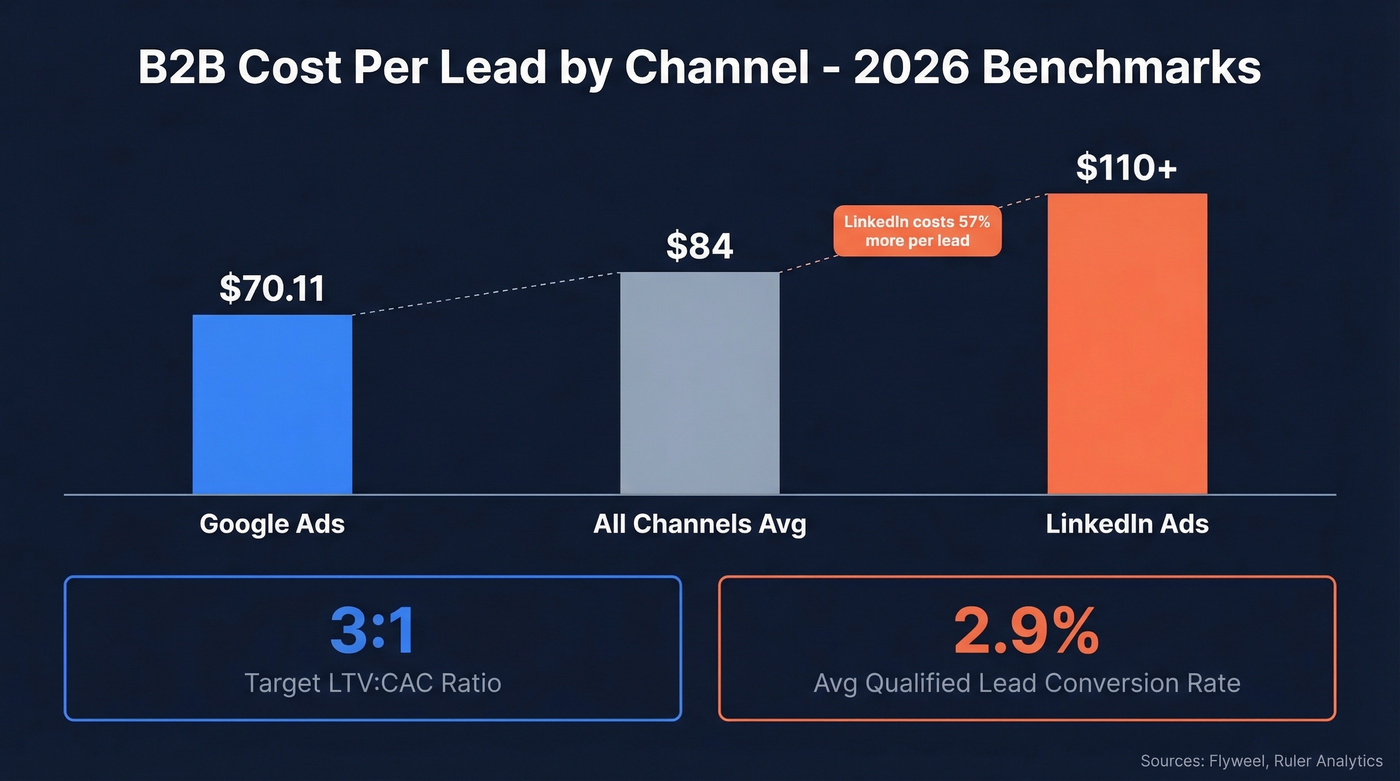
The average B2B cost per lead sits at $84 across channels. That average hides massive variation.
| Channel | Avg CPL | Notes |
|---|---|---|
| Google Ads | $70.11 | Lower CPL than LinkedIn in current benchmarks |
| LinkedIn Ads | $110+ | 57% pricier than Google |
| All channels avg | $84 | Legal/finance verticals run 200%+ higher |
Google Search comes in cheaper than LinkedIn on a per-lead basis. LinkedIn isn't bad - the targeting is unmatched for B2B - but you're paying a premium for it. Healthcare and tech verticals typically run $180-$250 per lead; legal and financial services push even higher.
The number that actually matters is your LTV:CAC ratio. The benchmark is 3:1 or higher. Anything below that means you're buying leads at a loss, no matter how cheap they look on a dashboard. With a 2.9% average qualified-lead conversion rate across 100M+ data points - breaking down to a 1.7% form conversion rate and a 1.2% call rate - most of your funnel is noise by design. That's not a bug. That's the math of B2B, and it helps explain why 67% of customers now prefer self-service over speaking to a rep.
Which Channels Drive ROI Right Now
HubSpot's data ranks B2B channel ROI with website/blog/SEO at the top, followed by paid social and social media shopping tools. Content and organic search still win because the compounding economics are unbeatable - a blog post that ranks keeps generating leads at zero marginal cost for years.
If you want a deeper breakdown of what’s shifting, see our lead gen trends analysis.
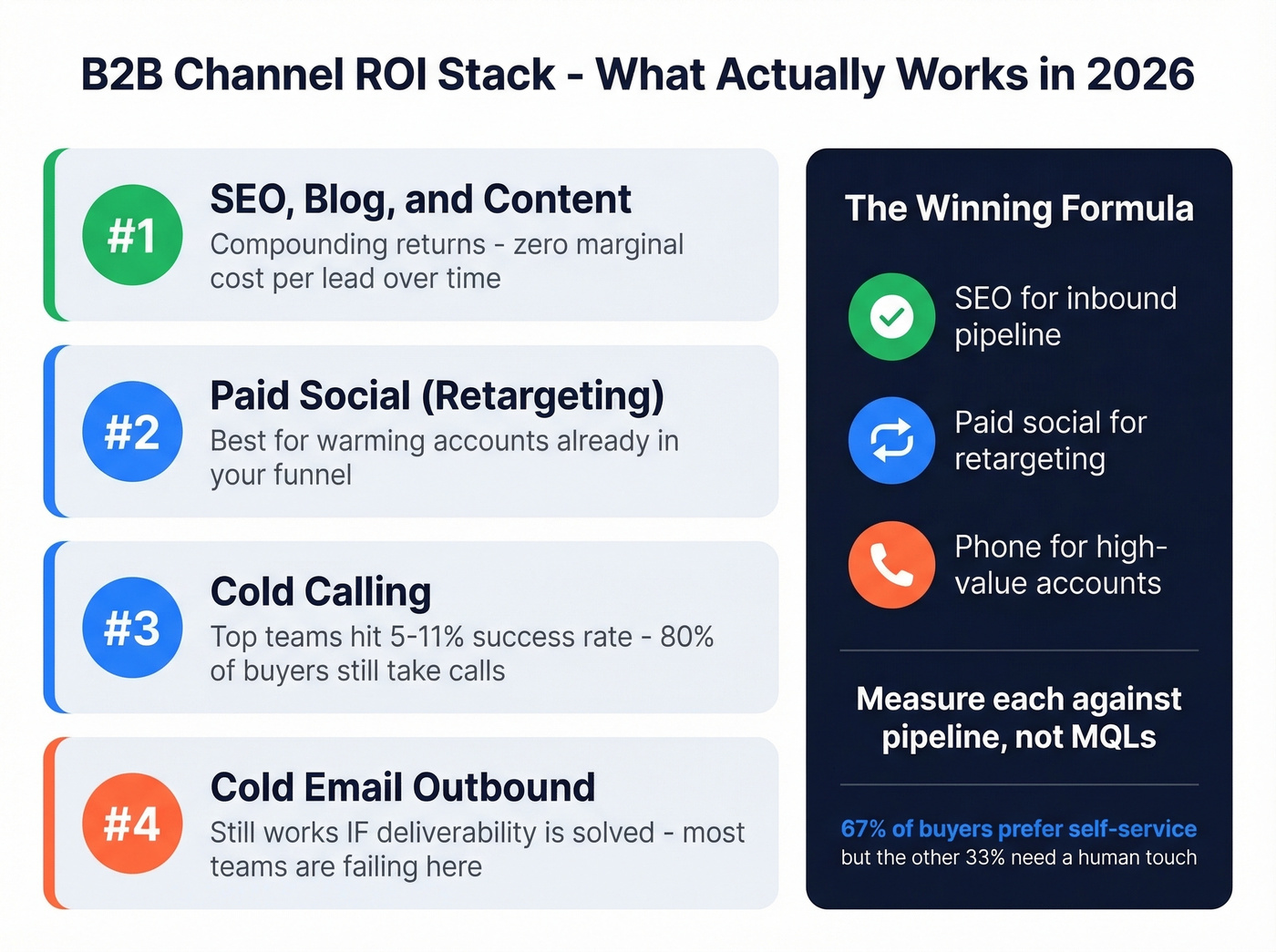
Here's the thing: cold calling is making a quiet comeback. The average cold call success rate is 2.3%, which sounds terrible until you realize high-performing teams hit 5-11%. Everyone else stopped calling. Inboxes are saturated, DMs are ignored, but 80% of buyers still take meetings with reps who reach out by phone. And 57% of C-suite executives prefer phone calls for complex purchasing decisions.
If you’re rebuilding your outbound motion, start with these sales prospecting techniques that still work.
People in r/LeadGeneration ask the same question constantly - what's actually working? The teams winning right now aren't picking one channel. They're layering SEO for inbound, paid social for retargeting, and phone for high-value accounts, then measuring each against pipeline, not MQLs. Account-based marketing already proved that focusing spend on a defined list of target accounts consistently outperforms spray-and-pray demand gen, and that principle has only sharpened heading into 2026. (If you’re formalizing this, use an Ideal Customer Profile template and scoring rubric.)
Hot take: If your average deal size is under $10k, you probably don't need ZoomInfo-level infrastructure. A verified email finder like Prospeo, a phone, and a disciplined cadence will outperform a $30k+/year platform that your reps use as a glorified search engine.

This article just showed you that $84/lead is the average CPL - but bad data makes every dollar wasted. Prospeo's 98% email accuracy and 7-day data refresh mean your outbound actually reaches real inboxes. At $0.01 per verified email, you spend less on data and more on channels that drive pipeline.
Stop paying $84 per lead only to bounce half of them.
The Deliverability Wall
If your outbound campaigns quietly died in late 2025, you're not imagining things. Gmail filtering changes began around November 2025, with stricter enforcement rolling into early 2026. A lot of bad sends don't bounce the way they used to - they silently land in spam, get delayed, or never appear at all.
For a full technical checklist, use this email deliverability guide.
The baseline requirements haven't changed, but enforcement has gotten ruthless:
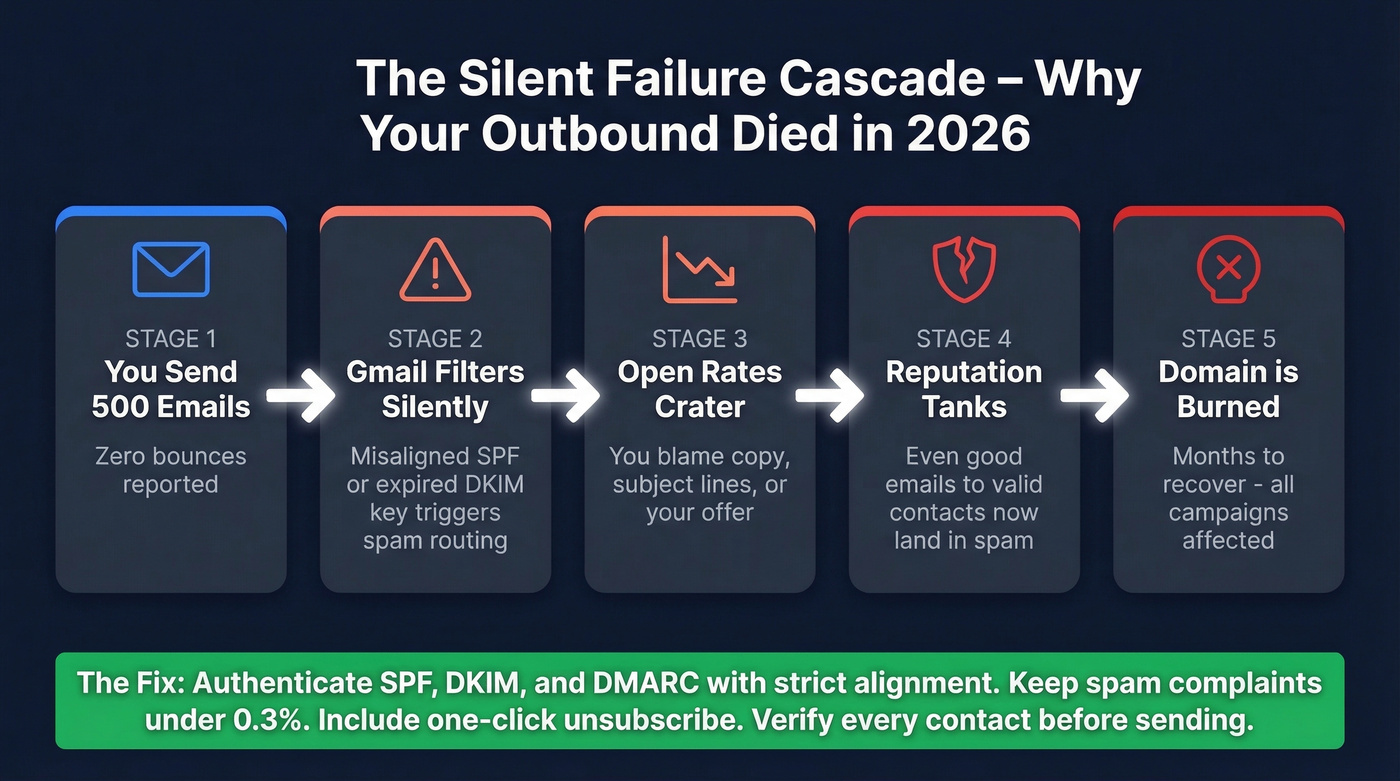
- SPF, DKIM, and DMARC must be authenticated, correctly aligned, and enforced. Having records isn't enough anymore. (If you’re troubleshooting alignment, see DMARC alignment.)
- Spam complaint rates must stay under 0.3%. One bad batch can torch months of domain warming.
- One-click unsubscribe must be present, and opt-outs honored within 2 days.
The "silent failure" behavior is what catches teams off guard. You send 500 emails, see zero bounces, and assume everything's fine. But your open rates crater because Gmail is quietly routing you to spam. We've seen teams blame their copy, their subject lines, their offer - when the real problem was a misaligned SPF record or an expired DKIM key.
If you’re seeing unexplained drops, start by checking your email bounce rate benchmarks and root causes.
Let's be honest: if your 2026 strategy doesn't address deliverability, it's not a real strategy. It's recycled advice from last year with a new date on it.
The Data Quality Multiplier
Bad data doesn't just waste money - it creates a cascading failure. Invalid emails bounce. Bounces damage your sender reputation. A damaged reputation means even your good emails land in spam. One dirty list can take months to recover from.
If you’re cleaning lists at scale, follow a proper spam trap removal process.
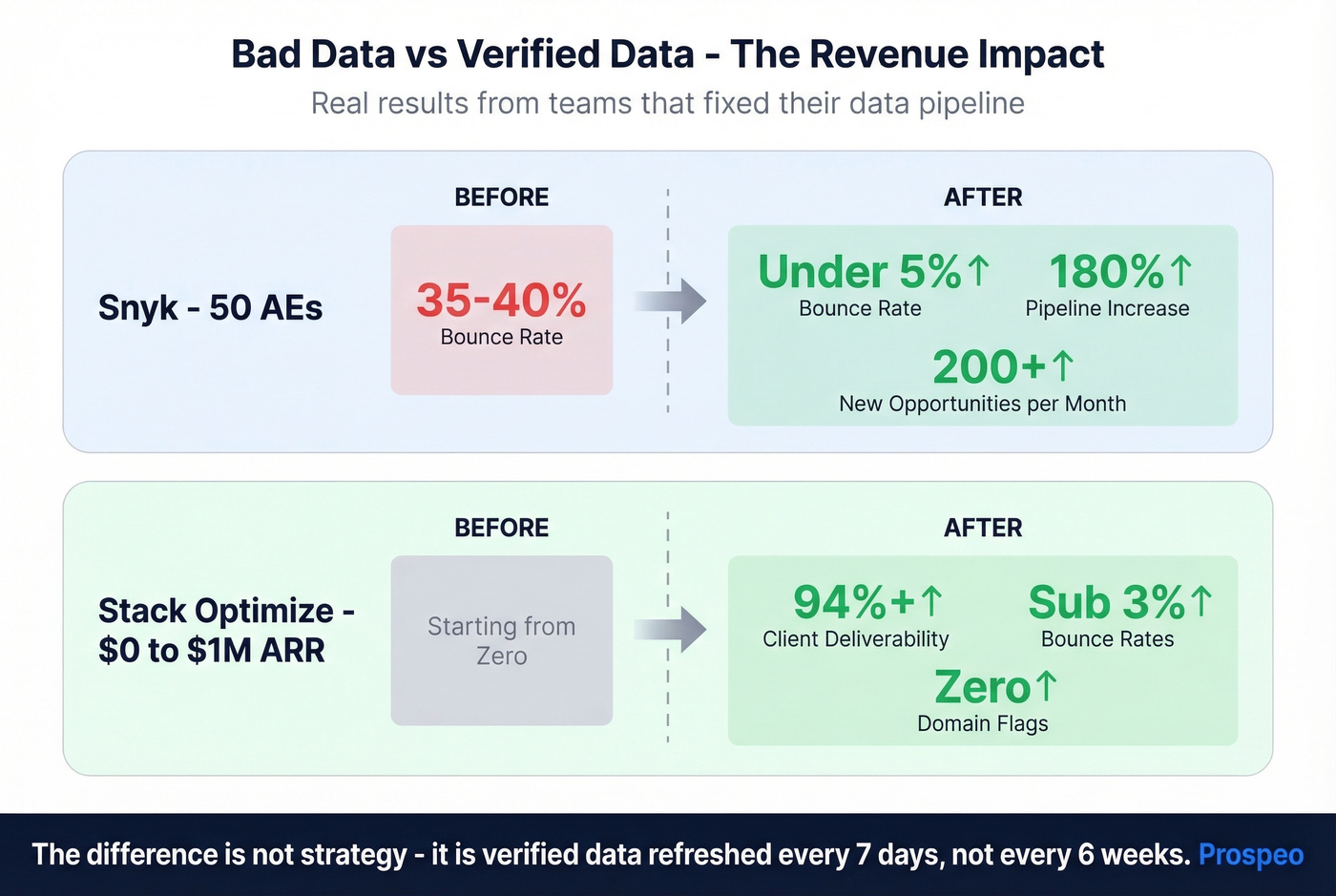
The proof points are stark. Snyk's sales team of 50 AEs was running bounce rates of 35-40% before they fixed their data pipeline. After switching to verified contacts, bounces dropped under 5%, AE-sourced pipeline jumped 180%, and they were generating 200+ new opportunities per month. Stack Optimize built from $0 to $1M ARR while maintaining 94%+ client deliverability, sub-3% bounce rates, and zero domain flags across every client campaign.
If you’re evaluating vendors, compare options in our guide to data enrichment services.
In our experience, the gap between "pretty good data" and "verified data" is the difference between domain health and domain death - especially for outbound agencies scaling client campaigns. A 5-step verification process that handles catch-all domains, spam traps, and honeypots isn't optional anymore. It's table stakes. And when your data refreshes weekly instead of every six weeks, you're not blasting contacts who changed jobs last month.
What to Fix This Quarter
Stop planning and start executing. Five highest-leverage fixes, in order:
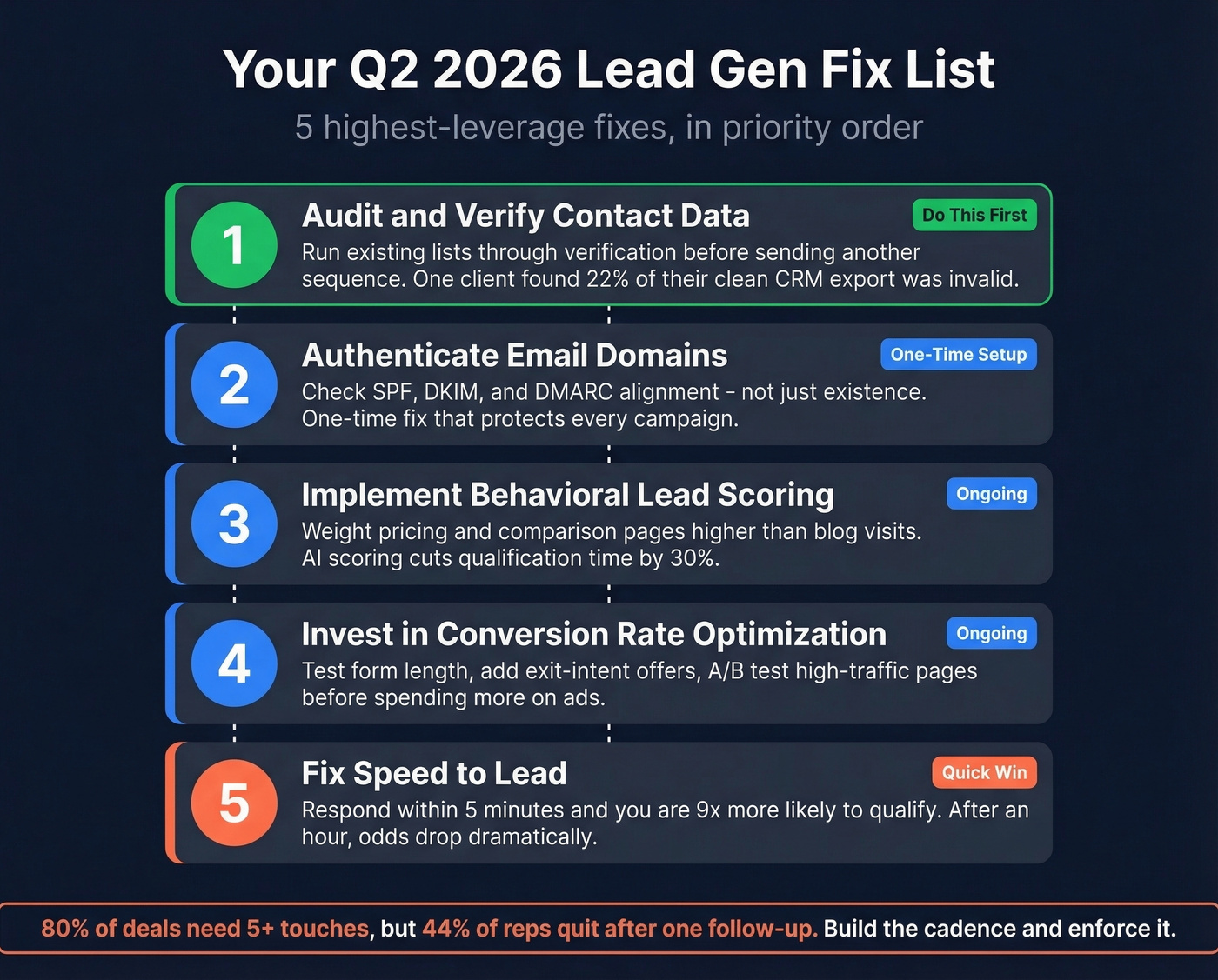
1. Audit and verify your contact data. Run your existing lists through verification before sending another sequence. Even a small test campaign will show you how much of your list is dead weight. We ran a client's "clean" CRM export through Prospeo's verification last month and found 22% of addresses were invalid - addresses that had been generating silent bounces for weeks.
2. Authenticate your email domains. Check SPF, DKIM, and DMARC alignment - not just existence. Use MXToolbox to confirm everything resolves correctly. This is a one-time fix that protects every campaign you run afterward.
3. Implement behavioral lead scoring. Weight high-intent pages - pricing, comparisons, integrations - higher than blog visits or whitepaper downloads. Chasing low-intent audiences can balloon your CPL from $40 to $300+. AI-powered scoring reduces qualification time by up to 30%, and AI agent workflows for research and prospecting are replacing manual SDR tasks at enterprise scale. (For a full framework, see our lead scoring guide.)
4. Invest in conversion rate optimization. CRO is the second most-used optimization technique among marketers (50% use it), yet most B2B teams treat their landing pages as an afterthought. Test form length, add exit-intent offers, and A/B test your highest-traffic pages before spending another dollar on ads.
5. Fix your speed-to-lead. Responding to inbound leads within 5 minutes makes you 9x more likely to qualify them. After an hour, the odds drop dramatically. If your routing takes longer than 5 minutes, that's your next project.
One more thing that isn't a "fix" but a discipline problem: 80% of deals require 5+ touches, and 44% of reps quit after one follow-up. Build the cadence into your sequences and enforce it. Skip this if you're already running multi-touch sequences with automated follow-ups - but if your reps are still doing one-and-done outreach, this is where the pipeline is leaking. (If you need copy you can deploy fast, use these sales follow-up templates.)
Snyk cut bounce rates from 35% to under 5% and added 200+ opportunities per month. Stack Optimize hit $1M ARR with zero domain flags. The difference wasn't strategy - it was verified data refreshed every 7 days, not every 6 weeks. Prospeo gives you the same 5-step verification with catch-all handling, spam-trap removal, and honeypot filtering.
Audit your list free - 75 verified emails, no credit card required.
FAQ
What's a good cost per lead in 2026?
The average B2B CPL is $84 across channels, with Google Ads at $70.11 and LinkedIn at $110+. The real benchmark is your LTV:CAC ratio - aim for 3:1 or higher. Anything below that means you're acquiring leads at a loss regardless of CPL.
Why did my outbound campaigns stop working?
Gmail and Yahoo now require SPF, DKIM, and DMARC authentication with strict alignment, and enforcement tightened sharply in early 2026. Emails don't always bounce - they silently land in spam. Check domain authentication and complaint rates before blaming your copy.
How do I improve lead quality without cutting volume?
Start with data verification to catch invalid emails before they damage your sender reputation. Then implement behavioral lead scoring weighted toward high-intent pages like pricing and comparisons - the 2.9% average qualified-lead conversion rate means most of your funnel is noise, and scoring helps you find the signal faster.