

Lead Generation in Australia: The No-BS Guide for 2026
You just got quoted $8,000 a month by a lead gen agency. Six-month minimum. No performance guarantees. Your total marketing budget is $12,000. Something doesn't add up - and you're right, it doesn't.
Lead generation in Australia sits at a crossroads. The B2B market is projected to hit US$974 billion by 2030, growing at 19.5% CAGR from a US$279 billion base. The opportunity is enormous, but the path to capturing it is littered with overpriced agencies, garbage data, and compliance landmines most businesses don't see coming.
Here's what makes this market different from running campaigns in the US or UK: the average B2B buying cycle runs 10.1 months, 41% of buyers already have a preferred vendor before formal evaluation begins, and the winning vendor lands on the shortlist on Day One 95% of the time. If you're not already in the conversation when a prospect starts evaluating, you've probably already lost. Lead gen isn't a campaign you turn on. It's a system you build.
What You Need (Quick Version)
- Budget over $6k/month and want hands-off? Hire a Clutch-verified agency with a 4.8+ rating and at least 15 reviews. Skip anyone who won't define "qualified lead" in the contract.
- Budget under $5k/month or want control? Build a DIY stack: a verified data platform for contacts, Smartlead or Instantly for outreach, HubSpot free CRM. Total cost under $200/month.
- Not sure yet? Read the cost comparison below. The numbers will make the decision obvious.
What Lead Generation Costs in Australia
Cost Per Qualified Lead by Industry
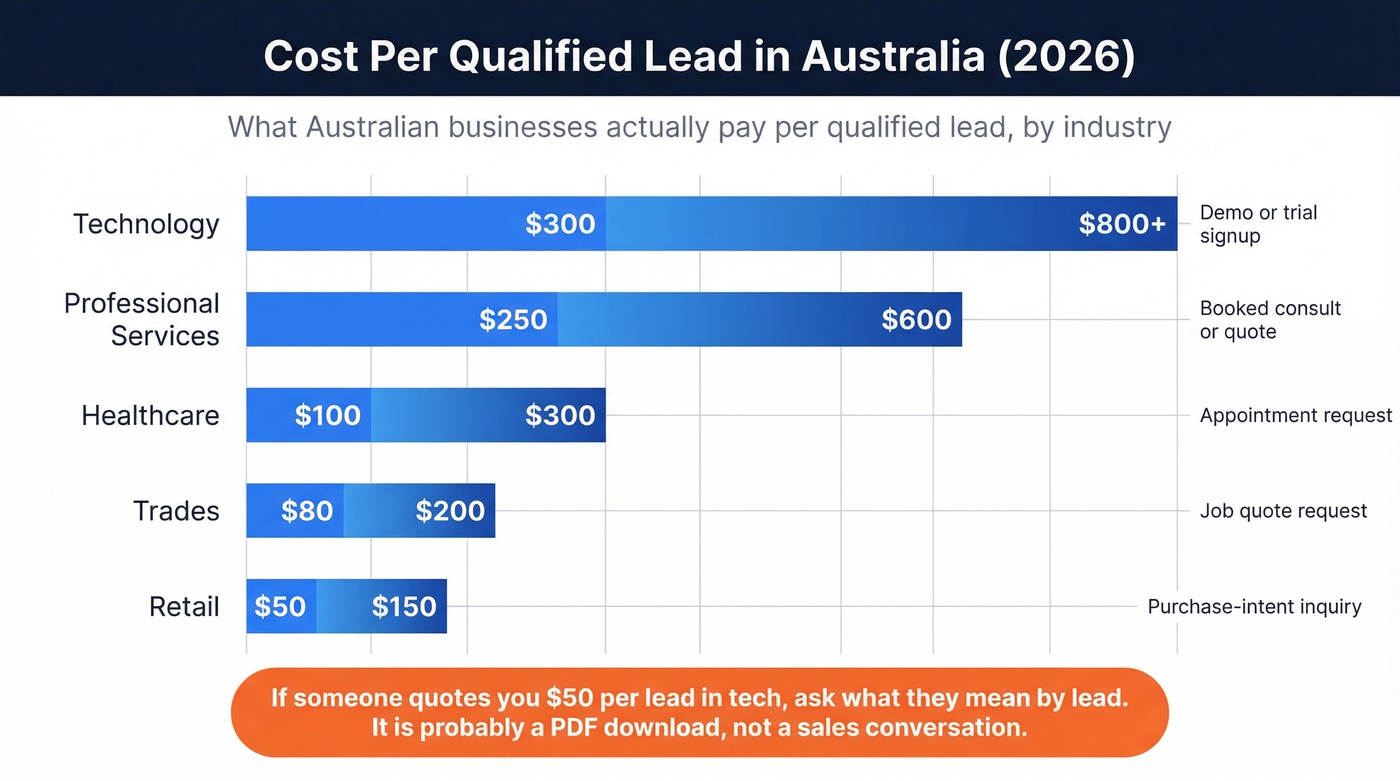
"Qualified" means someone who's shown genuine intent - a quote request, a booked consultation, a resource download. Not a raw form fill. Here's what you should expect to pay per qualified lead in 2026:
| Industry | CPL Range (AUD) | What "Qualified" Means |
|---|---|---|
| Professional Services | $250-$600 | Booked consult or quote |
| Healthcare | $100-$300 | Appointment request |
| Retail | $50-$150 | Purchase-intent inquiry |
| Trades | $80-$200 | Job quote request |
| Technology | $300-$800+ | Demo or trial signup |
These numbers are climbing. Declining organic reach, rising ad competition, and tighter privacy rules all push CPLs up year over year. If someone quotes you $50 per "lead" in tech, ask what they mean by "lead." It's probably a downloaded PDF, not a sales conversation.
Agency Pricing Models
Australian B2B lead gen agencies typically charge between $2,500 and $19,000+ per month:
| Model | Monthly Range | What You Get |
|---|---|---|
| Retainer (volume) | $2.5k-$5k | Outreach execution only |
| Retainer (hybrid) | $6k-$10k | Strategy + execution |
| Premium retainer | $11k-$19k+ | Full system build + ABM |
Many reviewed engagements on Clutch sit in the $10,000-$49,000 total project range.
Then there's pay-per-lead. On paper it sounds great - you only pay for results. In practice, it misaligns incentives badly. The agency optimises for volume, not conversion quality. You end up with 50 "leads" who never had buying intent, and the agency points to the contract and shrugs.
Pay-per-appointment can work, but only with strict qualification criteria, a replacement policy for no-shows, and monthly reporting baked into the contract. Without those guardrails, you're paying $150-$300 per meeting with people who thought they were signing up for a webinar.
Channels That Work in Australia
Not every channel works the same way here. AU-specific regulations and market dynamics change the playbook compared to APAC-wide strategies or markets like the UAE and India.
Cold email is highly effective for B2B, but the Spam Act 2003 requires consent, sender identification, and a working unsubscribe. You can't just scrape a list and blast it.
Cold calling is legal, but check the Do Not Call Register - it applies to business numbers too. The Do Not Call Register Act 2006 governs telemarketing calls and SMS to numbers on the register, and prior consent exempts you.
Google Ads are strong for capturing existing demand. In our experience, B2B keywords in AU markets run $5-$15 CPC, higher in competitive verticals like SaaS and financial services.
Content and SEO is a slow burn that compounds. Australian B2B buyers do their research - 92% start with at least one vendor already in mind. Your content needs to get you on that initial shortlist. (If you want the bigger picture, see lead generation trends.)
Events and conferences remain powerful in AU. The market is small enough that industry events create genuine relationship density you can't replicate digitally.
Referrals are underrated and underinvested. The tightest B2B networks in Australia run on referrals, especially in professional services.
ABM works well for enterprise targets in AU's concentrated market. When your total addressable market is 200 companies, account-based makes more sense than spray-and-pray. (Related: account-based selling best practices.)
Intent data is the emerging edge. Knowing which companies are actively researching your category lets you time outreach to the buying window instead of hoping you catch them. First contact typically happens at 61% of the buying journey - intent signals let you show up earlier. (More on this: identifying buying signals.)
Compliance Rules You Can't Ignore
Australian outbound compliance is stricter than most businesses realise - and notably different from the frameworks governing lead generation in India, Canadian lead generation under CASL, or UAE rules under the PDPL. Three laws govern the space, enforced by two different regulators.
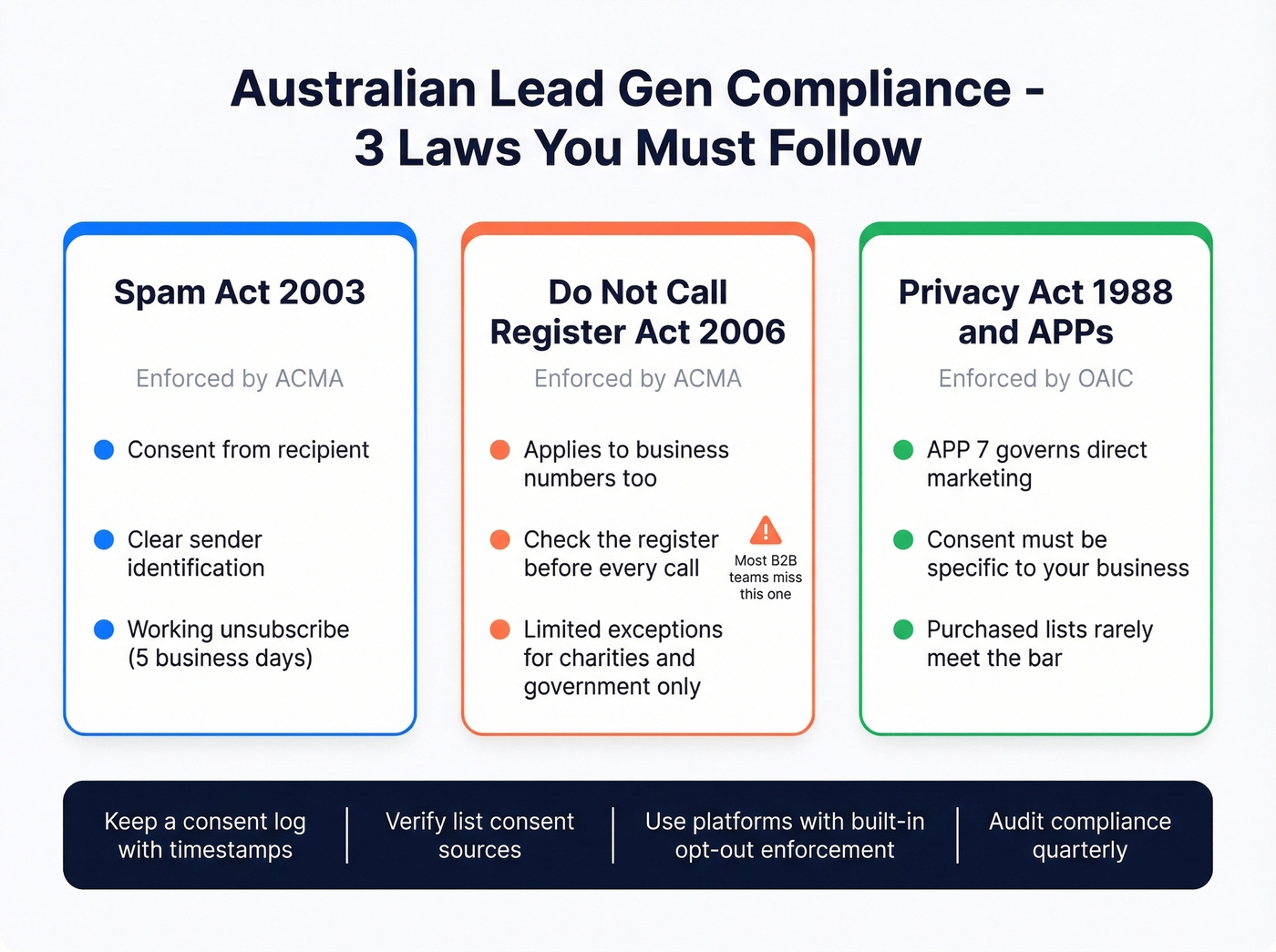
Spam Act 2003 covers all commercial electronic messages - email, SMS, and instant messaging. Every message needs consent from the recipient, clear sender identification, and a working unsubscribe mechanism. That unsubscribe must be honoured within five business days. ACMA enforces this, and penalties are real.
Do Not Call Register Act 2006 governs telemarketing. Here's the part most B2B teams miss:
Both individuals and businesses can list numbers on the DNC Register. It's not just a consumer protection - it applies to your cold calling list too. Limited exceptions exist for charities and government organisations, but standard B2B sales calls don't qualify. Check the register before you dial.
Privacy Act 1988 and the Australian Privacy Principles govern how you collect, store, and use personal information. APP 7 specifically addresses direct marketing. The OAIC enforces the Privacy Act, while ACMA handles the Spam Act and DNC Register. The Australian Consumer Law adds a supplementary layer, prohibiting misleading or deceptive conduct in any marketing activity.
Let's break down the practical steps to stay compliant. Keep a consent log for every contact with timestamp, source, opt-in text, and confirmation status. If you're buying or renting lists, understand the risk - you need to prove each person consented to receive marketing from your specific business, not just from whoever originally collected their data. That's a high bar, and most purchased lists don't clear it. (If you're unsure where the line is, read Is It Illegal to Buy Email Lists?.) Use a data platform with built-in compliance features like opt-out enforcement, GDPR alignment, and consent-aware data collection so you're not building compliance infrastructure from scratch.

Australian agencies charge $2,500-$19,000/month with no accuracy guarantees. Prospeo gives you 300M+ profiles with 98% verified emails, 125M+ mobile numbers, and Spam Act-safe unsubscribe-ready data - all for roughly $0.01 per lead. Build your AU target list with 30+ filters including buyer intent, technographics, and headcount growth.
Replace your $8K agency quote with a $200/month DIY stack that actually converts.
DIY vs Agency: The $47,400 Question
An agency owner on Reddit put it bluntly: for businesses spending under $5k/month on marketing, the agency model is broken. Management fees of $2k-$4k per month eat most of the budget before a single lead is generated.
Here's a hot take: most Australian SMBs spending under $10k/month on marketing should not hire a lead gen agency. The tools available today mean a single SDR with the right stack can outperform a mediocre agency - and you'll own the process when they leave. This applies whether you're searching for local providers or evaluating offshore options.
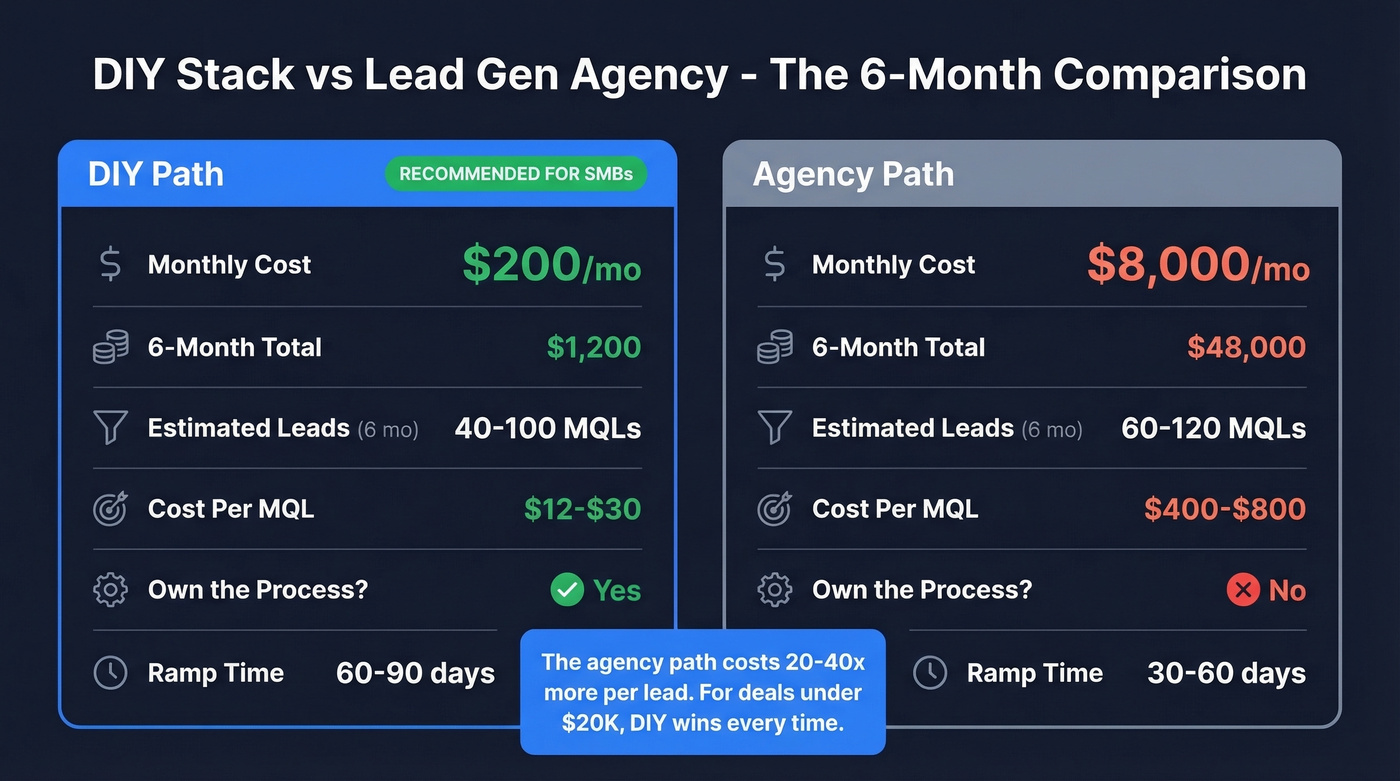
We've run the numbers on both paths:
| Agency Path | DIY Path | |
|---|---|---|
| Monthly cost | $8,000 retainer | ~$200 (data + outreach + CRM) |
| 6-month total | $48,000 | $1,200 |
| Estimated leads (6 mo) | 60-120 MQLs | 40-100 MQLs |
| Cost per MQL | $400-$800 | $12-$30 |
| You own the process? | No | Yes |
| Ramp time | 30-60 days | 60-90 days |
The agency path generates leads slightly faster and at higher volume. But at 20-40x the cost per lead, the math only works if your average contract value justifies it. For deals under $20k, DIY wins every time.
Go agency if: your monthly lead gen budget exceeds $6k, you don't have internal marketing talent, and you need pipeline within 90 days.
Go DIY if: your budget is under $5k/month, you have even one person who can dedicate 10-15 hours per week to outbound, or you want to understand your funnel before handing it to someone else. (If you're building the motion from scratch, start with a simple lead generation workflow.)
Building a DIY Lead Gen Stack
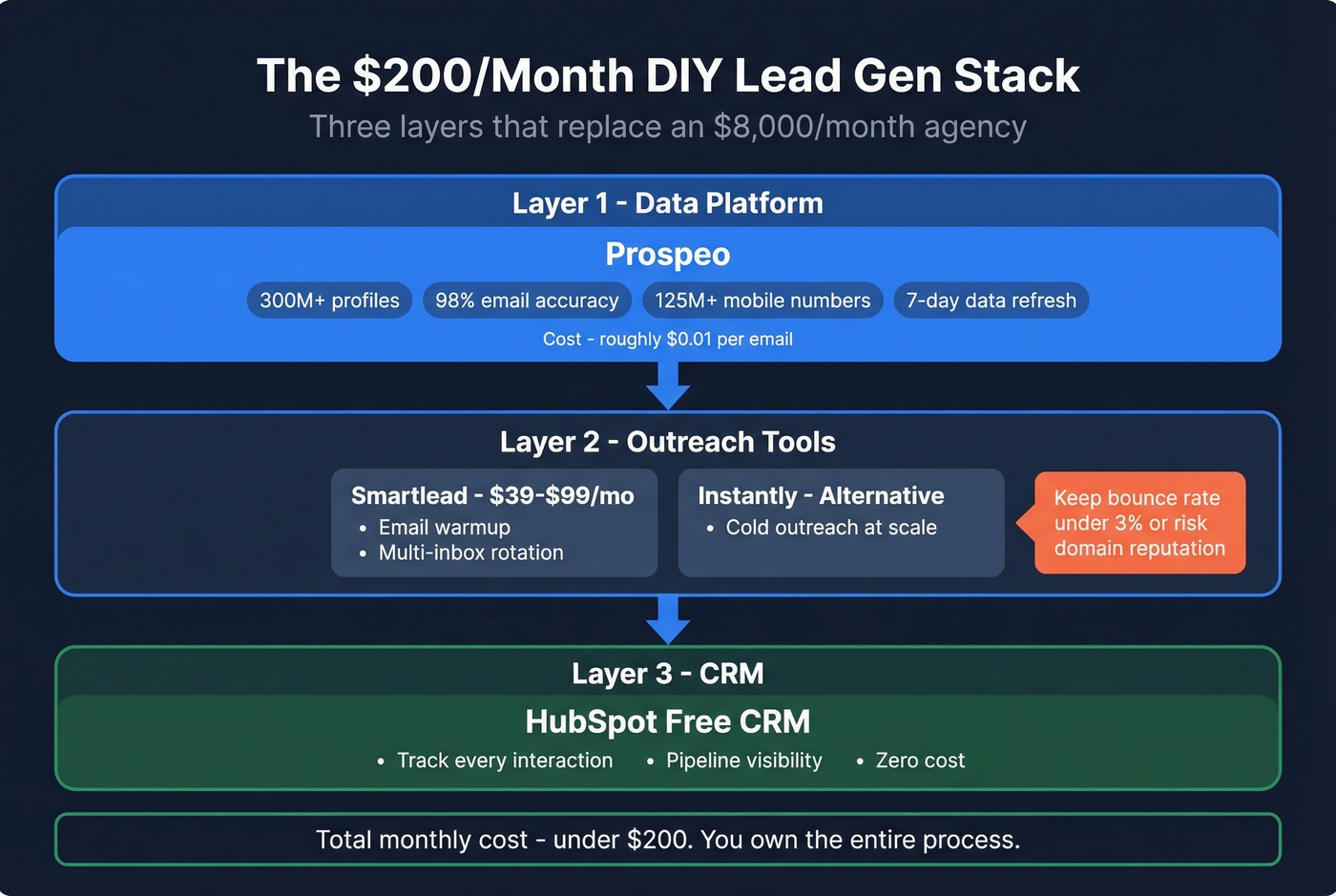
You need three layers: a data platform to find contacts, an outreach tool to reach them, and a CRM to track everything.
Look, I've seen this go wrong too many times. Your SDR sends 2,000 cold emails last month. 340 bounce. That's a 17% bounce rate - enough to tank your domain reputation and land every future email in spam. The data layer isn't optional. It's the foundation everything else sits on. (If you need the fix, see email bounce rate and the email deliverability guide.)
The Data Layer
Prospeo covers 300M+ professional profiles with 98% email accuracy and 125M+ verified mobile numbers. The database refreshes every seven days - job changes, company moves, and email deactivations happen constantly, and stale data is the #1 cause of bounced emails. For Australian prospecting specifically, you can filter by geography using 30+ search filters and layer buyer intent signals tracking 15,000 topics to find companies actively researching your category. (If you're comparing vendors, start with best sales prospecting databases.)

The pricing math is what makes DIY viable. At roughly $0.01 per email, your cost per contact is negligible compared to agency CPLs of $300-$800. Stack Optimize built from $0 to $1M ARR using this approach with client deliverability above 94% and bounce rates under 3% - zero domain flags across all clients. The free tier gives you 75 emails per month to test before committing, and there are no contracts.
Outreach Tools
Smartlead runs $39-$99/month and handles email warmup and multi-inbox rotation, which is critical for cold outreach at scale. Instantly offers similar functionality at comparable pricing. lemlist at $59-$99/month adds multichannel sequences beyond email. Pick one - they all integrate natively with major data platforms. (For more options, see outbound lead generation tools.)
CRM
HubSpot's free tier handles contact management, deal tracking, and basic reporting. It's more than enough until you're closing consistently and need workflow automation. Don't overcomplicate this layer early. (If you want to compare categories, see examples of a CRM.)
Intent data is the emerging edge in Australian B2B - and Prospeo tracks 15,000 topics via Bombora so you reach buyers before they hit that 61% mark. Layer intent signals with job role, company growth, and technographic filters to time your outreach to the buying window. Data refreshes every 7 days, not the 6-week industry average.
Stop guessing which Australian companies are in-market. Start knowing.
How to Evaluate an Agency
If you've decided an agency is the right move, here's how to avoid the bad ones.
Start with Clutch's Australian lead generation directory - 59 companies listed, with ratings updated in early 2026. Look for providers with a 4.8+ rating, at least 15 reviews, and "Verified" status. LevelUp Leads carries a 5.0 rating across 55 reviews at $25-$49/hr - that's the calibre of social proof you want.
Red flags to watch for:
- Same leads sold to multiple clients. The #1 complaint about lead gen agencies on Reddit. Ask directly whether leads are exclusive.
- Vague "qualified lead" definitions. If they can't define qualification criteria in the contract, they'll define them after the fact to hit their numbers.
- No published pricing. Opacity usually means they're charging whatever they think you'll pay.
- No-show appointments with no replacement policy. You're paying $150-$300 per meeting. If the prospect doesn't show, that cost shouldn't be yours.
Demand these in your contract: clear qualification criteria agreed upfront, a replacement or chargeback policy for no-shows, monthly reporting with full funnel visibility, and a 90-day exit clause. Any agency confident in their work will agree to these terms. Skip the ones that won't.
Conversion Benchmarks for Australian B2B
Generating leads means nothing if they don't convert. Here are typical funnel benchmarks for Australian SMEs:
| Funnel Stage | Conversion Rate |
|---|---|
| Visitors to MQL | 5-10% |
| MQL to SAL | 20-30% |
| SAL to SQL | 10-20% |
| SQL to Opportunity | 25-30% |
| Opportunity to Close | 20-40% |
Run the math on 1,000 website visitors converting at the midpoint of each range: roughly 75 MQLs, 19 SALs, 3 SQLs, and 1 closed deal. That's a 0.1% visitor-to-customer rate. Sounds brutal, but it's normal for B2B - and it's why quality matters infinitely more than volume. (If you want broader context, see average B2B lead conversion rate.)
The teams that outperform these benchmarks aren't generating more leads. They're generating better ones - targeting companies already in-market, reaching the right decision-makers, and timing outreach to the buying window. That's where intent data and verified contacts change the math entirely: you're reaching fewer people, but the right ones at the right time.
If your close rate on opportunities is below 20%, the problem probably isn't lead gen. It's your sales process, your pricing, or your product-market fit. Fix those before you spend more on top-of-funnel.
FAQ
How long before lead gen produces results in Australia?
Expect 3-6 months before you see meaningful pipeline impact. B2B buying cycles here average 10.1 months, and the winning vendor is on the buyer's shortlist from Day One 95% of the time. Outbound campaigns generate conversations faster, but converting those to revenue takes patience and consistent follow-up.
Is cold calling legal in Australia?
Yes, with restrictions. You must check the Do Not Call Register before dialling - it applies to business numbers, not just consumer lines. Prior consent from the contact exempts you from the register requirement. Charities and government organisations also get limited exemptions.
What's a good cost per lead?
Technology companies should expect $300-$800+ per qualified lead in Australia. Trades run $80-$200. Healthcare sits at $100-$300. Professional services land between $250-$600. These benchmarks reflect genuinely qualified leads - booked meetings or quote requests, not raw form fills.
Can I do lead gen myself without an agency?
Yes. A free-tier data platform paired with Smartlead at $39/month and HubSpot's free CRM gives you a complete stack for under $200/month. Stack Optimize used this exact approach to build from $0 to $1M ARR with bounce rates under 3%.
What's the minimum budget for outsourced lead gen?
Realistically, $6,000+ per month. Below $5k, agency management fees of $2k-$4k consume too much of the budget to leave meaningful spend for actual prospecting and outreach. At that level, a DIY approach delivers significantly better ROI.