

Lead Generation for Manufacturing: What Actually Works (and What It Costs)
Lead generation for manufacturing costs $553 per lead on average - and most of that money gets wasted on channels that don't convert and data that doesn't connect. Your best salesperson is buried in RFQs, cold-calling from a contact list that hasn't been updated since the Obama administration. Meanwhile, the marketing team just spent $25K on a trade show booth and came back with 200 business cards and zero qualified opportunities. That $553 blended CPL isn't a benchmark to aim for. It's a ceiling to break through.
The Short Version
If you're a manufacturer under $5M in revenue with a lean team, don't try to do everything. Focus on three things in this order:
Fix your website conversion. Manufacturing sites average a 2.2% conversion rate. If yours is a digital brochure with no clear CTAs, you're leaking every visitor you pay to attract.
Run Google Ads on your highest-margin services. Not everything you make - just the capabilities where you win on margin and have capacity.
Build a verified outbound list. Pull decision-makers by industry, job title, and company size, then push verified contacts straight into your CRM or sequencer. Prospeo handles this at $0.01 per verified email with a free tier - the cheapest high-impact move on this list.
That's it. Everything else is optimization on top of those three.
Why Manufacturing Lead Gen Is Its Own Animal
Manufacturing isn't SaaS. You can't run a product-led growth motion when you're selling custom-machined parts with 16-week lead times. The buying process is fundamentally different, and most lead gen advice ignores that reality completely.
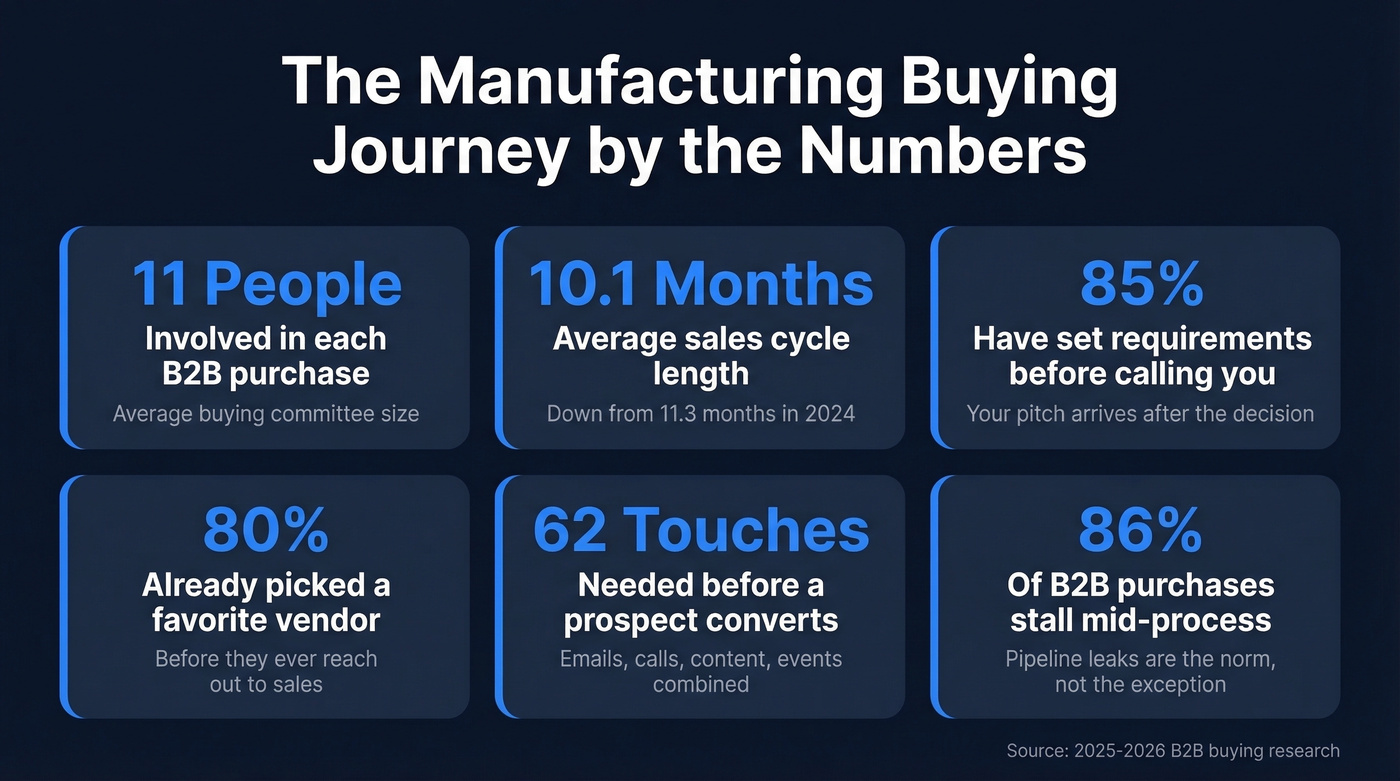
The baseline B2B buying journey involves 11 people, spans 11.5 months, and generates 800+ interactions before a deal closes. That cycle compressed to 10.1 months in 2025, down from 11.3 the year prior - which sounds like progress until you look at what's happening before first contact. Buyers historically didn't engage sales until 70% of the journey was complete. That number has improved to 61%, but the majority of the decision still happens before you get a call.
Here's the stat that should keep you up at night: 85% of buyers have mostly or completely set their requirements before contacting sales, and 80% have already picked a favorite vendor. By the time your phone rings, you're auditioning for a role that's already been cast.
Manufacturing buyers evaluate fewer vendors than other B2B segments - typically 3-4 instead of 4.6 - and they're more likely to initiate first contact themselves. They also rely less on external advisors, with only 56% seeking outside guidance. And 86% of B2B purchases stall somewhere in the process. Manufacturing outbound requires an average of 62 touches before a prospect converts - emails, calls, content interactions, and event touchpoints spread across 6-18 months. If your pipeline strategy doesn't account for that kind of timeline, you're building a funnel that leaks at every stage.
The Real Cost of Manufacturing Leads
Let's talk numbers. The manufacturing blended CPL is $553 - $691 for paid channels, $415 for organic. But those averages hide massive variation by channel.
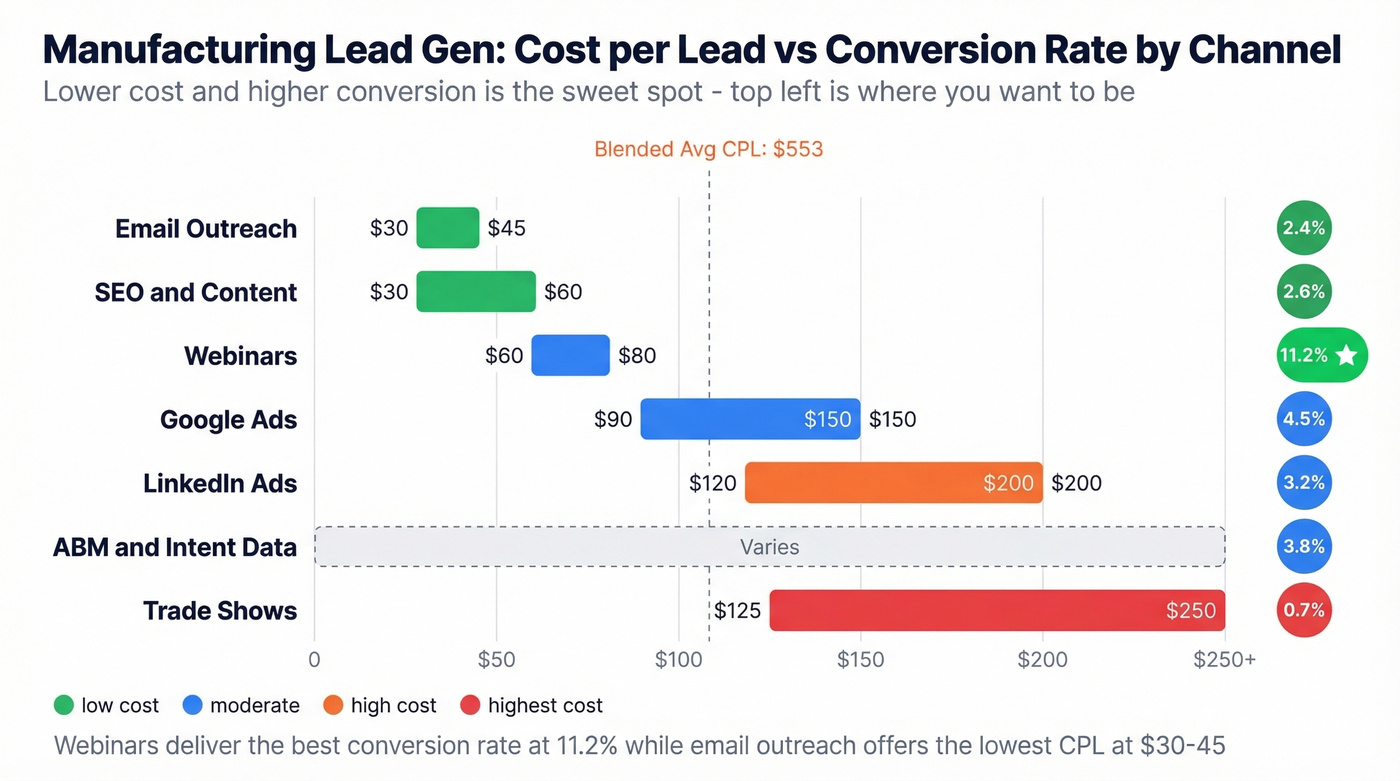
| Channel | Avg CPL | Conversion Rate | Best For |
|---|---|---|---|
| Email outreach | $30-45 | 2.4% | High-margin targets |
| SEO / content | $30-60 | 2.6% | Long-term pipeline |
| Webinars | $60-80 | 11.2% | Technical audiences |
| Google Ads | $90-150 | 4.5% | Immediate demand |
| LinkedIn Ads | $120-200 | 3.2% | Firmographic targeting |
| ABM / intent data | Varies | 3.8% | Enterprise accounts |
| Trade shows | $125-250 | 0.7% | Relationship-building |
The gap between email outreach at $30-45/lead and trade shows at $125-250 is enormous. The conversion rates tell an even starker story - webinars convert at 11.2%, while trade shows limp along at 0.7%.
Here's the budget reality: 52.3% of B2B firms increased marketing budgets heading into 2026, but the median increase was just 5%. Meanwhile, 55% of B2B firms delayed or canceled marketing projects due to economic uncertainty, which means the survivors are competing harder for the same pipeline. Channel selection isn't a nice-to-have. It's survival math.

Manufacturing CPL averages $553. Email outreach drops that to $30-45 - but only if your data connects. Prospeo gives you 300M+ profiles with 30+ filters to target procurement managers, plant directors, and engineers by industry, company size, and buyer intent. At $0.01 per verified email with 98% accuracy, it's the lowest-cost channel on this list.
Stop paying $553 per lead when verified contacts cost a penny.
7 Strategies That Work for Manufacturers
1. SEO and Technical Content
Manufacturing websites average a 2.2% conversion rate. That means 98 out of 100 visitors leave without doing anything. The problem usually isn't traffic - it's what they find when they arrive.
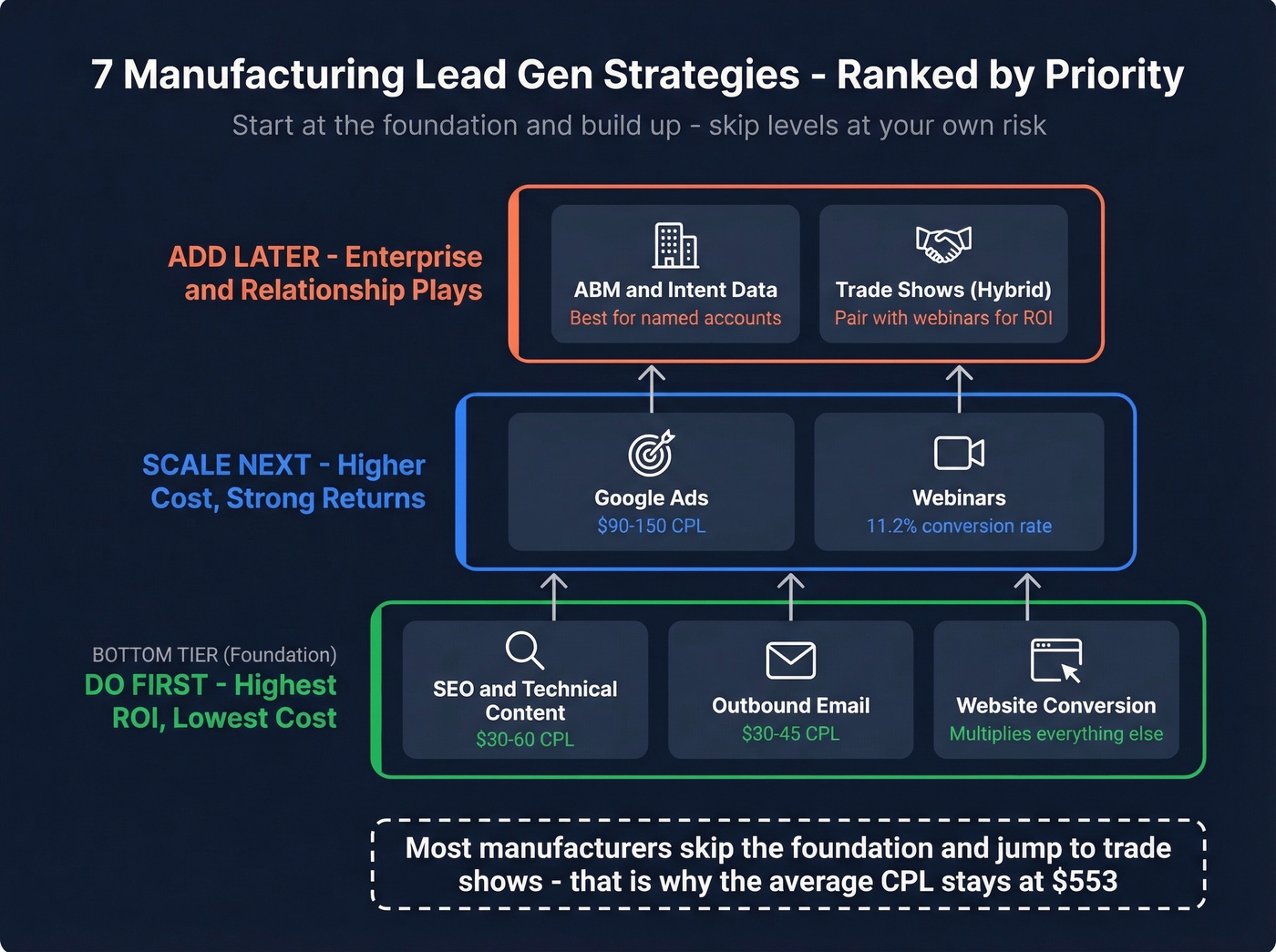
Stop publishing capability brochures and start publishing content that solves problems. A CNC shop writing "5 Signs Your Current Supplier Is Costing You Tolerance Failures" will outperform "About Our 5-Axis Machining Center" every time. Technical buyers search for problems, not product specs.
The emerging play here is GEO - generative engine optimization. AI Overviews are eating traditional search results in B2B, and manufacturers who structure content for AI-generated answers will capture visibility that competitors miss entirely. This means clear, factual, well-structured pages that answer specific technical questions. One tactic worth implementing now: add an llms.txt file to your site, essentially a robots.txt for AI engines that tells ChatGPT, Perplexity, and other LLMs what content to index and cite. Google's documentation on structured data is a good starting point for making your technical content machine-readable.
2. Outbound Email and Cold Calling
62 touches sounds exhausting, but outbound remains the highest-ROI channel for manufacturers targeting specific accounts. The key is data quality. Everything else - your messaging, your cadence, your call scripts - is downstream of whether you're reaching the right person at a valid email address.

Manufacturing buyers prefer straightforward, technical messaging. They don't want buzzword soup - they want "we cut lead times on aluminum extrusions from 12 weeks to 6 for companies running 10K+ units/year." Specificity wins.
The #1 outbound killer? Bounce rates. Every bounced email damages your domain reputation, which tanks deliverability for every subsequent campaign. We've seen teams burn through three email domains in six months because they were sending to unverified lists full of spam traps and dead addresses. Prospeo's 5-step verification process removes spam traps and honeypots before they ever hit your sequencer, delivering 98% email accuracy on a database that refreshes every 7 days. One proof point: Meritt dropped their bounce rate from 35% to under 4% and tripled pipeline from $100K to $300K/week after switching their data provider. (If you want the mechanics, start with email deliverability and email bounce rate.)
3. Google Ads and Paid Search
Google Ads work for manufacturers - but only when you're surgical about targeting. The Industrial Services search CPA runs $79.28, with display at $51.58. Those numbers are manageable if you're targeting your highest-margin capabilities.
Don't bid on "manufacturing" or "CNC machining." Bid on "precision CNC machining aerospace parts [your metro]" - the long-tail queries where intent is highest and competition is lowest. And match your ad spend to your capacity. If you can't take on new injection molding work for 6 months, don't advertise injection molding. Google's Keyword Planner can help you find those high-intent, low-competition terms specific to your capabilities.
4. Trade Shows + Webinar Hybrid
We've all lived the scenario: $25K trade show spend, 200 business cards collected, and 3 months later, zero closed deals. The 0.7% conversion rate for trade shows isn't a mystery - it's a follow-up problem.
Use trade shows for relationship-building, but pair them with webinars for scale. Webinar attendance increased 20% in 2025, and 88% of B2B marketers say webinars remain effective for pipeline building. A technical webinar on "Reducing Scrap Rates in High-Volume Stamping" will attract more qualified prospects than any booth ever could.
For trade shows, implement the 24-hour follow-up rule. Grade leads A/B/C on the floor, not back at the office a week later. A-leads get a call within 24 hours. B-leads get a personalized email sequence. C-leads go into nurture. (If you need copy, use these sales follow-up templates.)
5. Website Conversion Optimization
The "brochure website" problem is endemic in manufacturing. Product pages list specs and certifications but never answer the buyer's actual question: "Will this solve my problem, and what does it cost to find out?"
Rewrite product pages benefits-first. Replace "ISO 9001:2015 Certified" as your headline with "Zero-defect precision parts delivered in 4 weeks - backed by ISO 9001:2015." Add progressive forms that ask for project details instead of just name and email. Install a chatbot that can handle technical questions at 2 AM when your prospect in Germany is doing research. And make your RFQ form the most prominent CTA on every page, not buried in the footer. Gated ROI calculators or tolerance-checking tools convert 3-5x better than generic "contact us" forms because they deliver immediate value. (To tighten the full funnel, map this to a B2B sales funnel template.)
6. ABM and Intent Data
Account-based marketing delivers a 3.8% conversion rate - the highest of any channel in our benchmarks. For manufacturers targeting a defined set of enterprise accounts, ABM is the highest-leverage move you can make.
Intent data works by tracking research signals - when a target account starts searching for topics related to your capabilities, you know they're in-market before they ever visit your site. For a manufacturer selling into automotive OEMs, knowing which companies are actively researching "lightweighting" or "EV battery housing" before they issue an RFP is a massive advantage. Layer those intent signals with job role, company growth, and technographic filters to build a list of accounts that are both a good fit and actively buying. This kind of sales prioritization - ranking accounts by fit and buying urgency rather than gut feel - is what separates teams that hit quota from teams that spray and pray. (If you want a practical setup, start with intent based segmentation and lead scoring.)
7. Email Nurture Sequences
With a 10-month average sales cycle, nurture isn't optional - it's the connective tissue between first touch and closed deal. Business email benchmarks show a 31.35% open rate and 2.78% click rate, which means your emails are getting read. The question is whether they're worth reading.
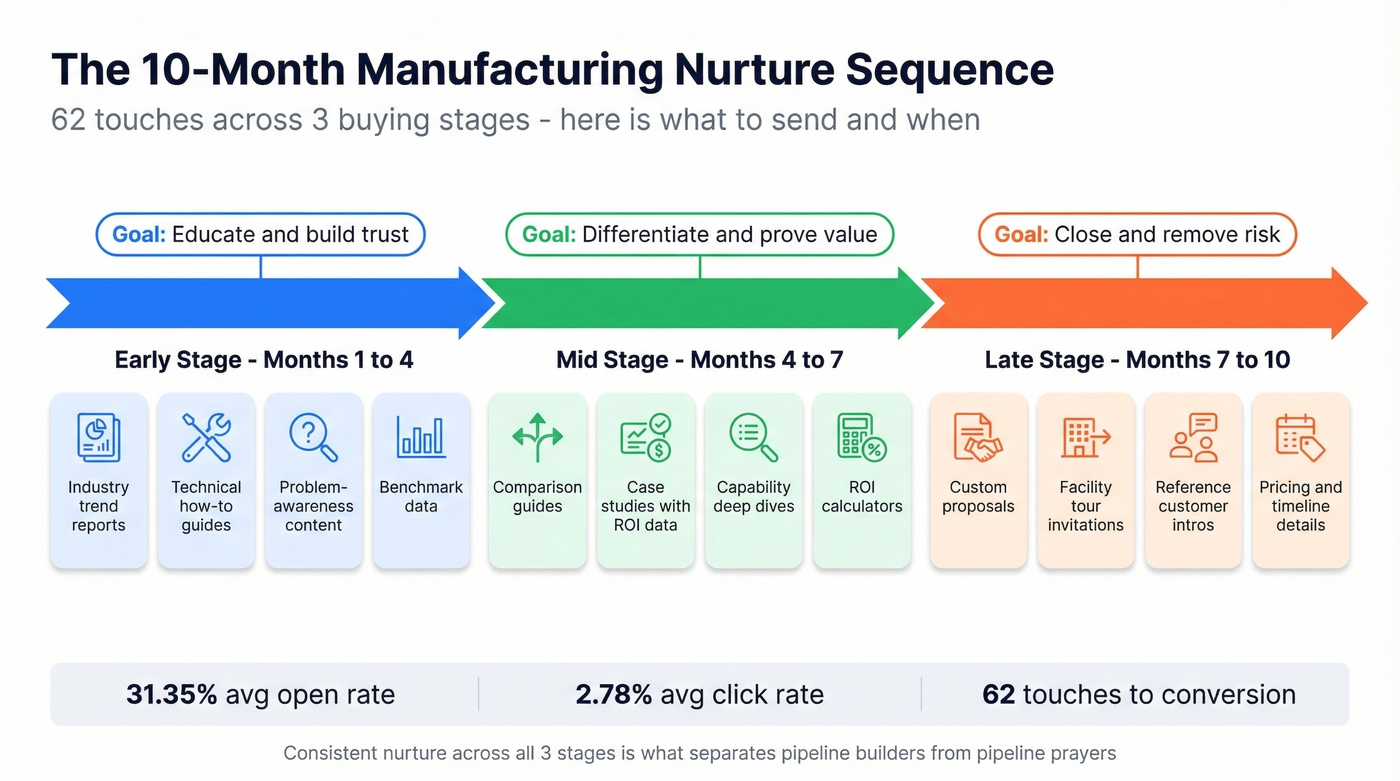
Build a 4-email arc for each buying stage. Early-stage leads get educational content - industry trends, technical guides, case studies. Mid-stage leads get comparison content and ROI calculators. Late-stage leads get social proof and direct outreach from sales. Segment by buying stage, not just industry or job title. A procurement manager who downloaded your tolerances whitepaper last week needs a different email than one who visited your pricing page yesterday. (For subject ideas, pull from these prospecting email subject lines.)
5 Mistakes That Kill Your Pipeline
A lot of manufacturers default to "matchmaking" tactics - directories, listings, and pay-to-play platforms - because it feels like the fastest path to buyers. The instinct is right, but the execution often turns into expensive placements with weak lead quality. Here are the five mistakes that prevent manufacturers from building their own outbound engine.
Brochure website syndrome. Your website lists every machine on the floor and every certification on the wall, but it never explains what problems you solve or what outcomes you deliver. Rewrite every product page to lead with the customer's problem and your measurable result.
Keywords too broad. Bidding on "metal fabrication" when you specialize in stainless steel food-grade enclosures in the Midwest. Target specific capabilities + geography + application instead. Long-tail keywords cost less and convert better.
Over-reliance on trade shows and referrals. Referrals are great until they dry up. Trade shows are great until you do the math. Build an inbound engine with SEO and content that generates leads while you sleep, and layer outbound on top.

No tracking or attribution. You're spending money across channels but can't tell which ones produce revenue. Install conversion tracking on every form and call-tracking number. Connect your CRM to your ad platforms. If you can't trace a closed deal back to the campaign that sourced it, you're flying blind - and you'll keep funding channels that don't work. HubSpot's attribution reporting guide is a solid place to start if you're on their CRM.
Ignoring the long sales cycle. You generate a lead, hand it to sales, and when it doesn't close in 30 days, everyone forgets about it. Build nurture sequences and retargeting campaigns that keep you visible across the full 6-18 month buying journey. The 62-touch reality means single-touch strategies are guaranteed to fail.
Recommended Tool Stack
You don't need a dozen tools. You need three that work together, plus a few specialists if your budget and team can handle them.
| Tool | Use Case | Pricing | Best For |
|---|---|---|---|
| Prospeo | Contact data + verification | Free tier; ~$0.01/email | Verified prospect lists without enterprise contracts |
| HubSpot | CRM + marketing automation | Free CRM; from $800/mo | Mid-size manufacturers with nurture needs |
| Apollo.io | Outbound sequences | Free tier; from $49/user/mo | Email sequence execution |
| Dealfront | Website visitor ID | From EUR99/mo | Anonymous visitor tracking |
| Clay | Data enrichment workflows | Free (100 credits); $149/mo | Custom enrichment flows |
| 6sense | Intent data + ABM | ~$30K-100K+/yr | Enterprise ABM programs |
Here's the thing: if your average contract value is under $50K, you don't need 6sense or a full ABM stack. Most manufacturers under $10M in revenue will get more pipeline from a verified contact list and a disciplined email cadence than from any enterprise platform. Start with HubSpot's free CRM, a data provider, and your existing email platform. Stack complexity kills manufacturing marketing teams that are already understaffed. Add tools only when you've maxed out what three can do. (If you're comparing options, see best outbound lead generation tools and best SDR tools.)
62 touches means nothing if half your emails bounce. Bad data burns domains, kills deliverability, and wastes every dollar downstream. Prospeo's 5-step verification removes spam traps and honeypots before they reach your sequencer - refreshed every 7 days, not every 6 weeks. Meritt cut bounce rates from 35% to under 4% and tripled weekly pipeline to $300K.
Protect your domain and triple pipeline with data that actually connects.
How to Measure Success
Track these five metrics with manufacturing-specific benchmarks:
Cost per lead: Target $75-553 depending on channel mix. If your blended CPL exceeds $553, you're overpaying relative to industry norms.
Website conversion rate: 2.2% is the manufacturing baseline. Aim for 3%+ with optimized CTAs and progressive forms.
Lead-to-customer rate: The manufacturing average is 8%. If you're below that, the problem is usually lead quality or nurture gaps, not sales execution. (To benchmark the rest of your funnel, use these funnel metrics.)
Pipeline velocity: How fast do leads move from MQL to opportunity to close? In manufacturing, "fast" means compressing from 10 months to 7-8.
Speed-to-lead: Responding to inbound leads within 5 minutes makes teams 100x more likely to connect than waiting an hour, and 21x more likely to convert them to an opportunity. Set a target of under 1 hour for A-leads, and hold the team accountable.
Build a cadence around these numbers. Weekly: review speed-to-lead metrics and inbound volume. Monthly: audit email deliverability and bounce rates. Quarterly: reassess your channel mix based on CPL trends and close rates. Most manufacturers measure annually if they measure at all - that's how bad channels survive for years.
FAQ
What's a good cost per lead for manufacturing?
The blended average is $553. Organic channels like SEO run $30-60 per lead, while paid channels like Google Search and LinkedIn Ads range $90-200. Webinars convert at 11.2% and ABM at 3.8%, making both strong options for qualified pipeline.
How long is the typical manufacturing sales cycle?
The average B2B manufacturing sales cycle runs about 10 months as of 2026, down from 11.3 months two years prior. Buyers complete 61% of the journey before contacting sales, making early visibility through content and outbound critical.
What's the best lead gen tool for small manufacturers?
A free-tier CRM like HubSpot paired with Prospeo for verified contact data covers prospecting at near-zero cost - 75 free emails per month with 98% accuracy. Add Apollo for automated sequencing once volume justifies it.
Do trade shows still work for manufacturing?
They work for relationships and brand visibility, but at 0.7% conversion they're one of the least efficient channels by the numbers. Grade leads on the floor and follow up within 24 hours to maximize ROI.
How many touches does it take to convert a manufacturing lead?
62 on average - emails, calls, content downloads, and event touchpoints spread across 6-18 months. This is why single-channel strategies fail and omnichannel persistence wins.