

How to Build a Lead Generation Funnel That Actually Converts in 2026
You generated 500 leads last month. Sales called 12 of them worth talking to. The other 488? Lost in a nurture sequence nobody reads, bounced off bad email addresses, or sitting in a CRM field marked "unresponsive."
Your lead generation funnel isn't broken - your data and follow-up are. Here's how to build one that actually moves pipeline, with the benchmarks nobody else publishes and the mistakes that silently kill conversion.
The Short Version
- Define your ICP and map the buyer journey before you build a single landing page. Skipping this step is why most funnels produce volume without quality.
- Start with 4 stages - Awareness, Capture, Nurture, Convert. Add complexity later.
- Prioritize follow-up speed and data quality over traffic volume. Responding within 5 minutes makes you 21x more likely to qualify a lead.
- Benchmark everything. B2B SaaS funnels average 39% Lead-to-MQL and 37% SQL-to-Closed Won. If you're below those numbers, this article shows you where the leak is.
Two stats frame the whole conversation: 96% of visitors aren't ready to buy on their first visit, and 74.6% of B2B sales take at least four months to close. A well-built funnel bridges that gap - turning strangers into prospects, prospects into qualified leads, and qualified leads into revenue. Without one, you're hoping people buy on the first touch. They won't.
What Is a Lead Generation Funnel?
A lead generation funnel is the structured path a stranger takes from first discovering your brand to becoming a qualified lead your sales team can work. It captures attention, builds trust, and filters out people who'll never buy - so reps spend time on the ones who will.
Don't confuse it with a sales funnel or a sales pipeline:
| Lead Gen Funnel | Sales Funnel | Sales Pipeline | |
|---|---|---|---|
| Scope | Stranger to qualified lead | Qualified lead to closed deal | Rep-level deal tracking |
| Owned by | Marketing (primarily) | Sales + Marketing | Sales |
| Stages | TOFU to MOFU to BOFU | Discovery to Close | Prospecting to Won |
| Key metric | MQLs generated | Win rate | Pipeline velocity |
A lead generation sales funnel and a pure sales funnel overlap in the middle stages, but they serve different teams and measure different outcomes. The TOFU/MOFU/BOFU framework still works as a mental model, but modern buyer journeys are messier than a clean funnel diagram suggests. 60% of consumers take 6+ actions before buying from a new brand. People loop back, skip stages, and re-enter at weird points. Your funnel needs to account for that - build for re-engagement, not just linear progression.
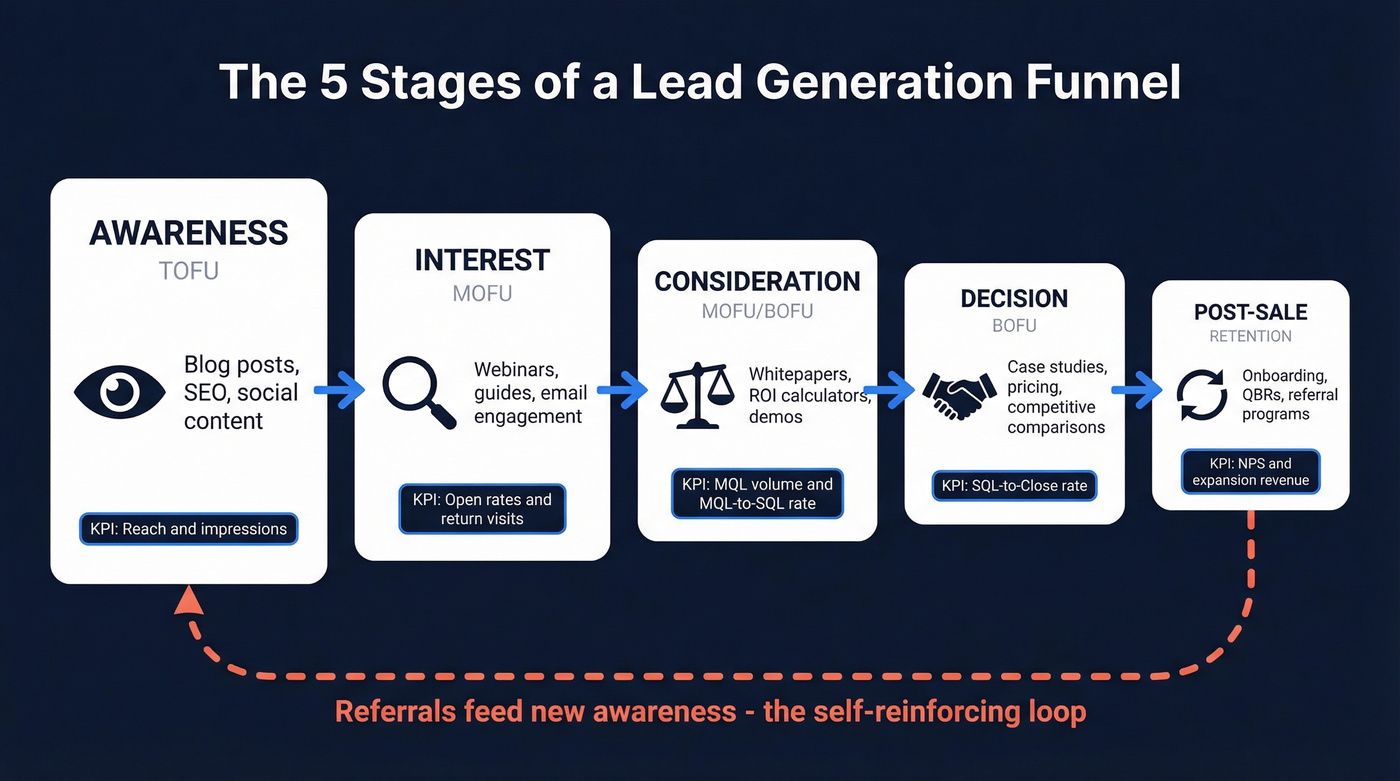
The 5 Stages (and What Happens at Each)
The AIDA model has been the backbone of funnel thinking for over a century - Elias St. Elmo Lewis invented it in 1898). Modern B2B funnels expand on it with a post-sale stage, because retention drives more revenue than acquisition for most companies.
Awareness (TOFU)
Strangers first encounter your brand. They don't know you, don't trust you, and aren't looking to buy. Your job is to be useful enough that they remember you exist.
Blog posts, social content, podcast appearances, and SEO-driven guides all work here. The KPI is reach - impressions, unique visitors, new contacts entering your database. Focus on matching content to the specific pain points your ICP is already searching for rather than casting a wide net with generic topics. A thousand visits from the wrong audience is worth less than fifty from the right one.
Interest (MOFU)
The prospect knows you exist and is exploring the problem space. Content shifts to educational depth - webinars, comparison guides, case studies. Track engagement metrics like email open rates, content downloads, and return visits. The goal is to move them from "aware" to "actively learning."
Consideration (MOFU/BOFU)
Now they're evaluating solutions. Gated content earns its keep here - whitepapers, ROI calculators, product demos. KPIs shift to MQL volume and MQL-to-SQL conversion rate. For B2B teams, this is also where you identify the buying group: multiple stakeholders within an account who collectively make the purchase decision.
Decision (BOFU)
The prospect is ready to choose. They need proof: customer stories, competitive comparisons, pricing transparency, and a frictionless path to talk to sales. The winning tactic is speed - get them to a rep while intent is hot.
Post-Sale (Retention)
Most funnel guides stop at "closed won." That's a mistake.
Onboarding sequences, QBRs, expansion campaigns, and referral programs all live here. Track NPS, expansion revenue, and referral-sourced pipeline. Satisfied customers feed new awareness through referrals and case studies, creating a self-reinforcing loop that makes every subsequent lead cheaper to acquire.
Funnel Benchmarks You Actually Need
Here's the thing: you've read 10 articles about TOFU/MOFU/BOFU and still don't know if your funnel is performing well. That's because nobody gives you the actual numbers. Let's fix that.
Stage-by-Stage Conversion Rates
| Industry | Lead-to-MQL | MQL-to-SQL | SQL-to-Opp | SQL-to-Closed |
|---|---|---|---|---|
| B2B SaaS | 39% | 38% | 42% | 37% |
| Cybersecurity | 24% | 40% | 43% | 46% |
| eCommerce | 23% | 58% | 66% | 60% |
| Cross-industry ranges | ~31% | 15-35% | 30-55% | 15-40% |
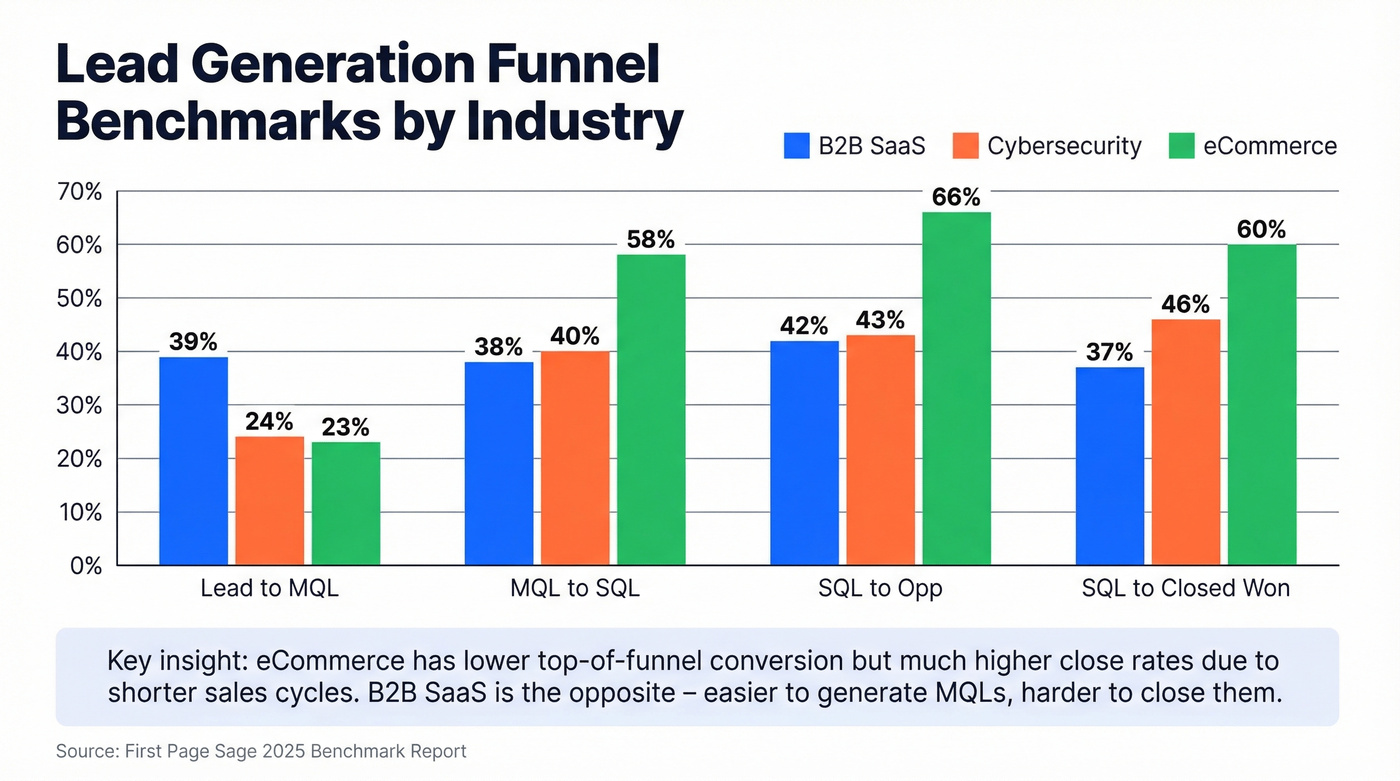
Industry-specific data comes from First Page Sage's benchmark report.
Notice that eCommerce has lower Lead-to-MQL but much higher close rates - shorter sales cycles mean less leakage in late stages. B2B SaaS has the opposite pattern: easier to generate MQLs, harder to close them.
CAC by ACV Band
| ACV Band | Typical CAC Range |
|---|---|
| SMB ($5k-$25k) | $1k-$4k |
| Mid-market ($25k-$100k) | $4k-$15k |
| Enterprise ($100k-$500k) | $15k-$50k |
| Enterprise+ ($500k+) | $50k-$150k |
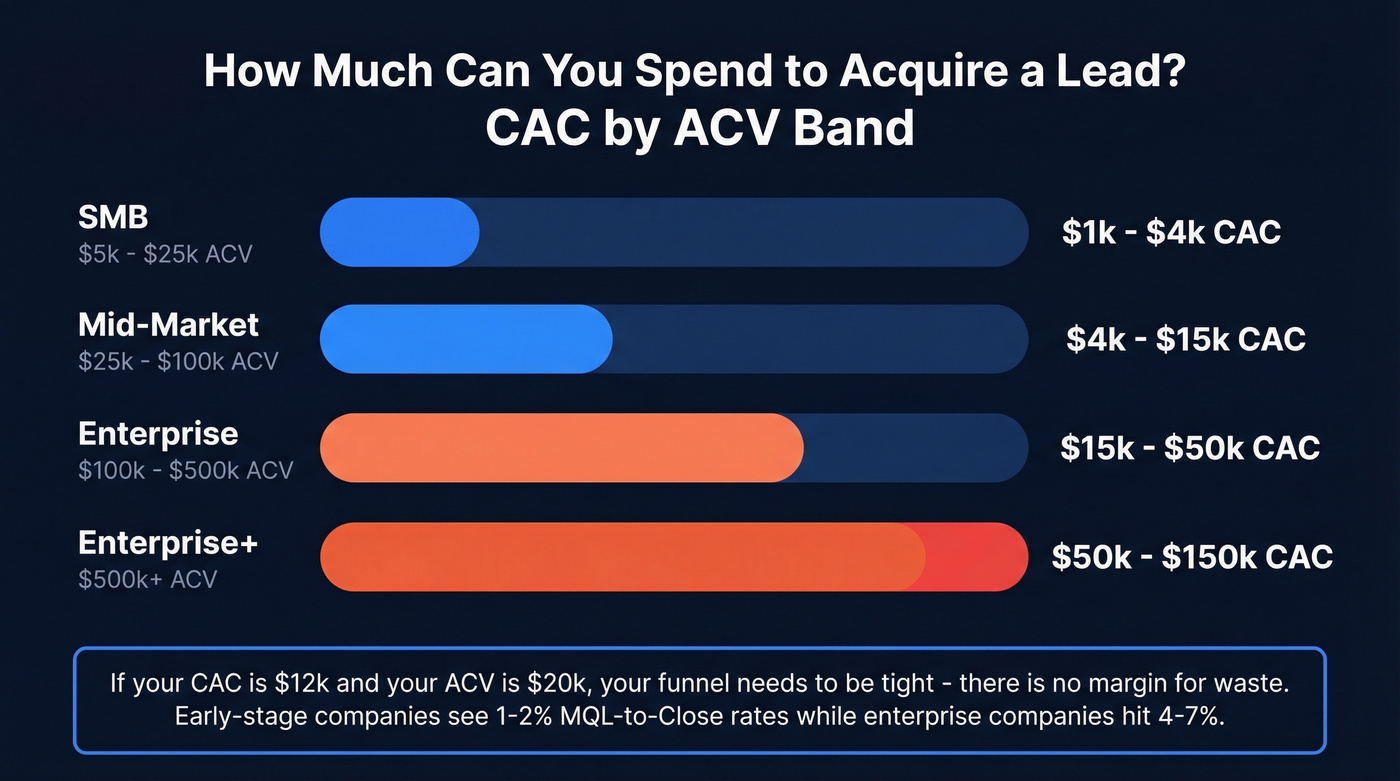
These ranges tell you how much you can afford to spend acquiring a lead at each stage. If your CAC is $12k and your ACV is $20k, your funnel needs to be tight - there's no margin for waste.
A few more benchmarks worth knowing: early-stage companies see 1-2% MQL-to-Close rates, while enterprise companies hit 4-7%. PLG models are their own animal - free trial-to-paid conversion runs 18-29%, while freemium-to-paid sits at just 3.4%. The median qualified-to-booked meeting rate across B2B SaaS is 62%.
Quick Funnel Health Diagnostic
Before you build anything new, answer these four questions to find your biggest leak:
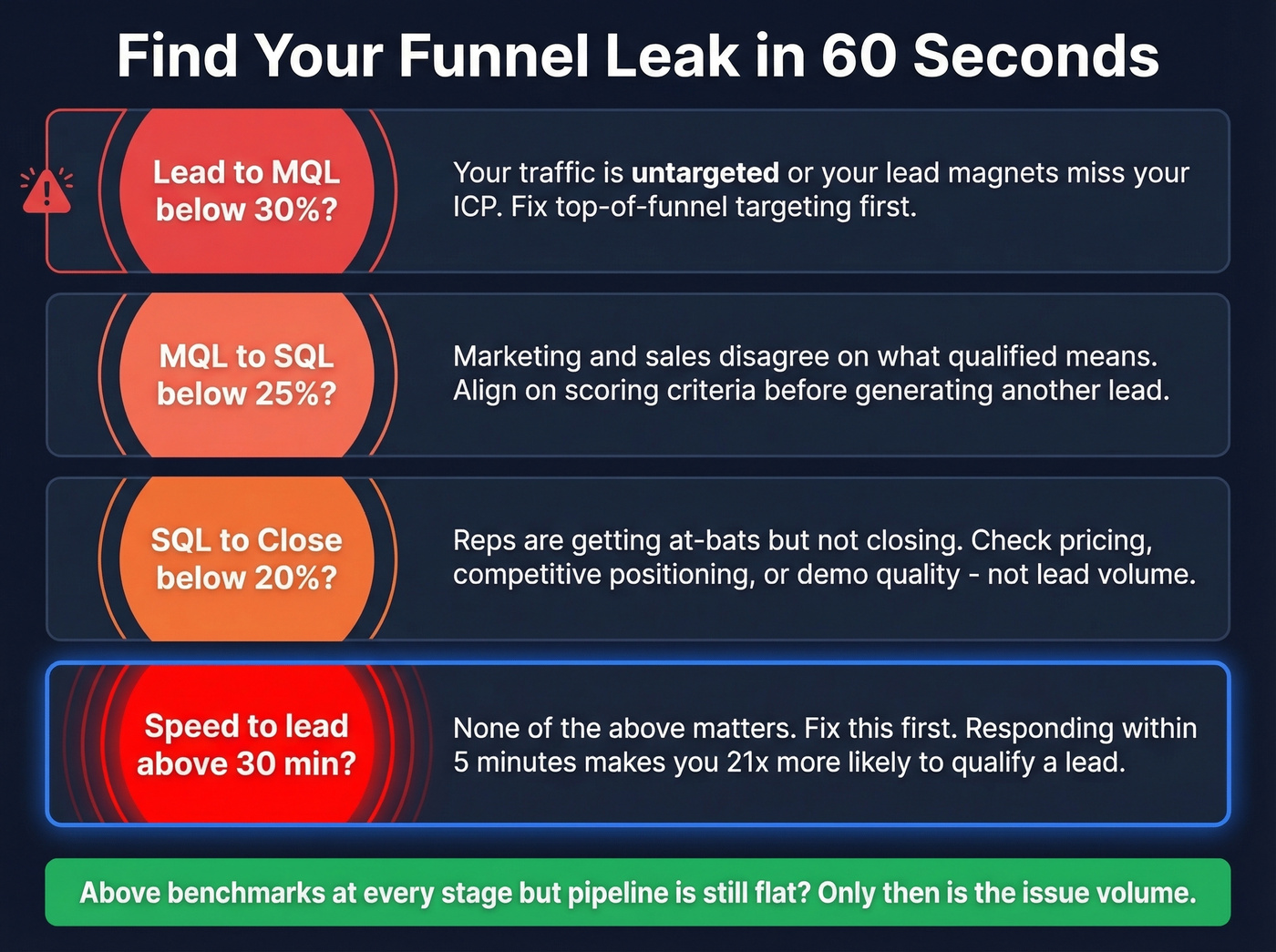
- Is your Lead-to-MQL rate below 30%? Your traffic is untargeted or your lead magnets don't match your ICP. Fix top-of-funnel targeting.
- Is your MQL-to-SQL rate below 25%? Marketing and sales disagree on what "qualified" means. Align on scoring criteria before generating another lead.
- Is your SQL-to-Close rate below 20%? Your reps are getting at-bats but not closing. The problem is usually pricing, competitive positioning, or demo quality - not lead volume.
- Is your speed-to-lead above 30 minutes? None of the above matters. Fix this first.
If you're above benchmarks at every stage and pipeline is still flat, the issue is volume. Only then should you pour more leads into the top.

488 out of 500 leads going nowhere? That's a data quality problem. Prospeo's 5-step verification delivers 98% email accuracy and a 7-day refresh cycle, so the leads entering your funnel actually reach real inboxes.
Stop feeding your funnel bad data. Start at $0.01 per verified email.
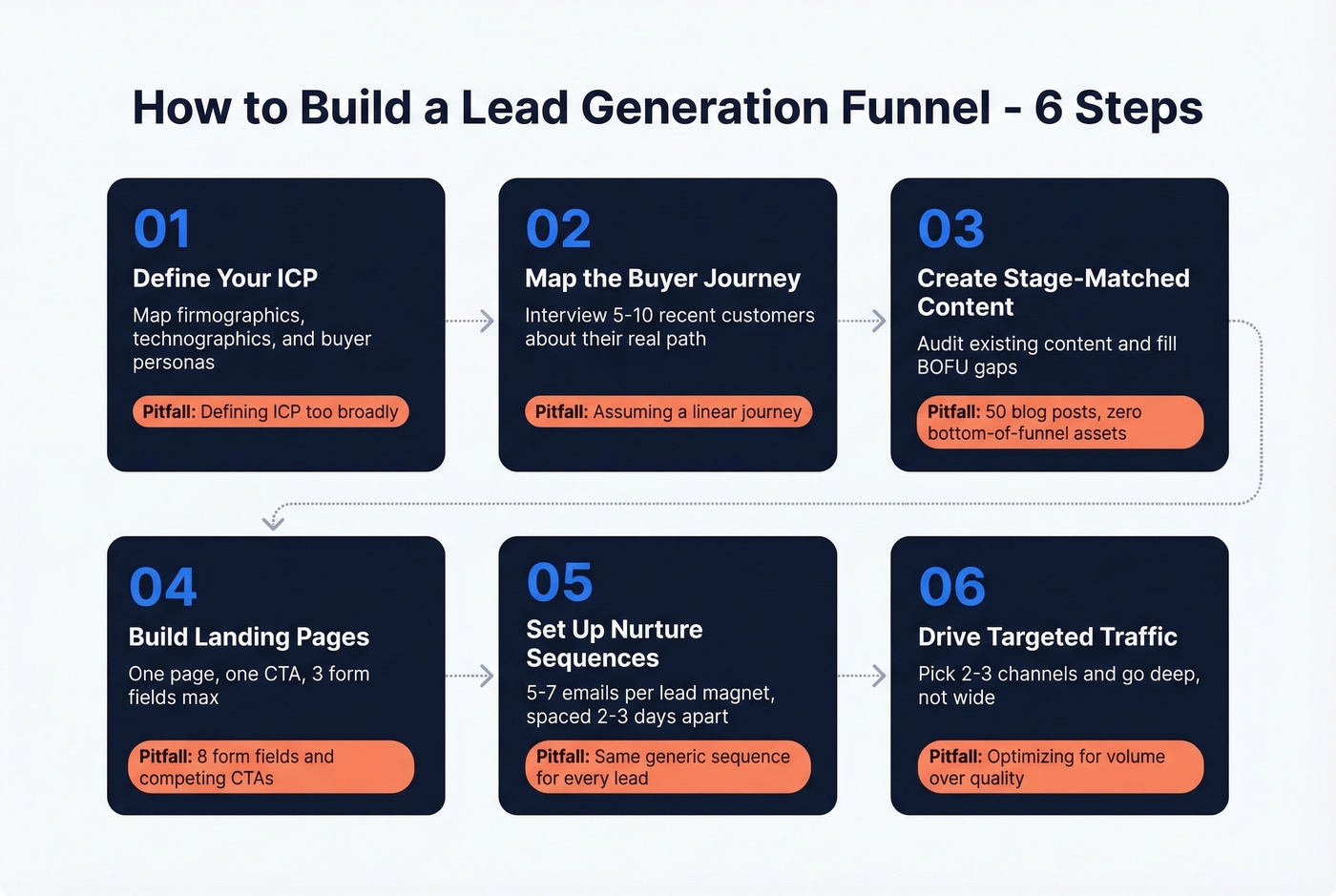
How to Build a Lead Generation Funnel
Each step includes what to do, one specific tactic, and the pitfall that'll waste your time if you ignore it.
Define Your ICP
Start with who you're selling to, not what you're selling. Map firmographic criteria like industry, headcount, and revenue. Layer in technographic signals - what tools they use - and buyer personas covering titles, pain points, and buying authority.
In our experience, this step gets skipped more than any other, and it's the single biggest reason funnels produce volume without quality. The pitfall: defining your ICP too broadly. "VP of Marketing at mid-market SaaS companies" is useful. "Marketing leaders" is not.
If you need a starting point, use an ICP template and scoring rubric.
Map the Buyer Journey
Interview 5-10 recent customers and ask them how they found you, what content they consumed, and what almost made them choose a competitor. You'll discover that the journey you imagined and the journey they actually took are wildly different. Build for loops and re-entry points, not a linear path.
Create Stage-Matched Content
87% of marketers create content tied to different journey stages, but most of them front-load TOFU and starve BOFU. Map your existing content to funnel stages and find the gaps. Blog posts feed awareness. Comparison guides and ROI calculators feed consideration. Case studies and pricing pages feed decision. The pitfall: producing 50 blog posts and zero bottom-of-funnel assets, then wondering why nobody books a demo.
Build Landing Pages and Magnets
Every piece of gated content needs a dedicated landing page with a single CTA. Not your homepage. A focused page with a headline, 3-4 bullet points of value, and a form.
Lead magnets that convert: templates, benchmarks, calculators, and original research. The pitfall: asking for 8 form fields when 3 would do. Every page should have one job - don't dilute it with competing CTAs or navigation links that pull visitors away from the conversion action.
Set Up Nurture Sequences
Build a 5-7 email drip for each major lead magnet. The first email delivers the asset. Emails 2-4 provide related value. Emails 5-7 introduce your product as the solution. Space them 2-3 days apart. The pitfall: sending the same generic sequence to every lead regardless of what they downloaded or where they are in the buying process.
If you're stuck, start with proven sales follow-up templates and adapt them by stage.
Drive Targeted Traffic
Pick 2-3 channels and go deep rather than spreading thin across 8. For most B2B teams, that's SEO + paid search + one social channel. For outbound-heavy teams, build your prospect list with verified contact data and export directly into your sequencer.
The pitfall: optimizing for traffic volume instead of traffic quality. Sending the right people into the funnel matters more than sending more people.
If you're rebuilding your outbound motion, borrow a few modern sales prospecting techniques that fit 2026 deliverability realities.
Why Lead Gen Funnels Fail
Most funnels don't fail because of low traffic. They fail because of what happens after someone raises their hand. One r/digital_marketing post put it bluntly: "More leads won't save bad follow-ups or unclear messaging."
Leads Get Ignored After Submit
Someone downloads your whitepaper at 2pm. They get an automated email at 2:01pm. Then nothing for 3 days. By then, they've talked to your competitor.
The average B2B funnel loses 79% of leads between first contact and closed deal. Most of that loss happens in this gap. Route high-intent leads to sales within 5 minutes. Automate instant follow-up for lower-intent actions.
Generic Nurturing
Sending the same 7-email sequence to a CMO who downloaded a pricing guide and an intern who grabbed a blog template wastes both their time. Build at least 3 nurture tracks: early-stage education, mid-stage evaluation, and late-stage conversion. Tag leads by behavior, not just demographics.
Garbage Contact Data
None of your funnel optimization matters if 30% of your emails bounce. Bad data doesn't just waste sends - it tanks your domain reputation, which means even your good emails start landing in spam. I've seen this pattern repeatedly: a team invests in content, landing pages, and sequences, then feeds the whole machine with unverified contact data and wonders why pipeline is flat.
The fix is verifying every email before it enters your system. Prospeo handles this with a 5-step verification process and a 7-day data refresh cycle, delivering 98% email accuracy. Snyk's team of 50 AEs dropped bounce rates from 35-40% to under 5% after switching, with AE-sourced pipeline up 180%.
If you're diagnosing deliverability, start with your email bounce rate and work backward to list hygiene.
Optimizing the Wrong Stage
You're staring at the dashboard. Every stage looks fine individually, but pipeline is flat. You're probably optimizing TOFU when the real bottleneck is MOFU or BOFU.
One r/sales thread nailed it: "We tripled our leads and pipeline didn't move an inch - turns out our demo-to-close rate was 4%." Work backwards from revenue. Identify the stage with the biggest drop-off relative to benchmarks, and focus there.
No Speed-to-Lead Discipline
Responding within 5 minutes makes you 21x more likely to qualify a lead than responding at 30 minutes. The median time between inquiry and first meeting? Five hours. Set up real-time alerts for high-intent actions. Measure and report on response time weekly.
How to Measure Your Funnel
Track stage-to-stage conversion rates weekly and compare against the benchmarks above. Core KPIs per stage: Awareness (traffic, impressions), Interest (engagement rate, subscribers), Consideration (MQLs, downloads), Decision (SQLs, opportunities), Close (win rate, revenue).
The harder question is attribution:
| Model | Best For | Limitation |
|---|---|---|
| First-touch | Measuring awareness | Ignores nurture |
| Last-touch | Measuring closers | Ignores discovery |
| Linear | Simple multi-touch | Oversimplifies |
| Time decay | Long sales cycles | Undervalues TOFU |
| Multi-touch | Complex B2B | Requires clean data |
We've found multi-touch attribution only works when your data is clean across every system. If your UTM parameters are inconsistent, your CRM has duplicate records, or your platforms don't share a common identifier, multi-touch gives you garbage. Data fragmentation is the silent killer of funnel measurement.
If you want a tighter KPI set, use a dedicated funnel metrics framework and report it weekly.
For modern tracking, consider server-side Conversion APIs to supplement client-side pixels. With cookie deprecation and browser privacy changes, server-side tracking is becoming the only reliable way to measure top-of-funnel ad performance.
B2B vs. B2C: How Funnels Differ
The mechanics are the same. The execution is completely different.
| Dimension | B2B | B2C |
|---|---|---|
| Sales cycle | 4-7+ months | Minutes to days |
| Decision makers | 3-10 stakeholders | Usually 1 |
| Content style | Data-driven, educational | Emotional, creative |
| Primary channels | Email, professional networks | Social, influencer, ads |
| Post-sale value | Expansion revenue, multi-year contracts | Repeat purchases, referrals |
77% of B2B buyers say their last purchase was very complex, and nearly half of B2B sales take 7+ months. That complexity means B2B funnels need more nurture stages, more content per stage, and tighter alignment between marketing and sales on what "qualified" actually means. Returning customers spend 67% more than new ones, which is why B2B retention - expansion campaigns, QBRs, referral programs - deserves as much funnel rigor as acquisition.
Let's be honest: if your average deal is under $15k, you probably don't need a 7-stage funnel with lead scoring, intent data, and a BDR team. A landing page, a 5-email sequence, and a Calendly link will outperform the enterprise playbook every time. Build for your deal size, not for what looks impressive on a slide deck.
Tools You Need to Run a Funnel
You don't need 15 tools. You need 4-5 that talk to each other. A landing page builder, an email platform, a CRM, a verified data source, and an analytics tool. Everything else is optional until you're past $1M in pipeline.
Landing pages: Unbounce runs ~$99-$149/mo and gives you solid A/B testing flexibility. Leadpages runs ~$49-$99/mo and is simpler if you just need clean templates. Skip both if you're comfortable building in your CMS - a well-designed WordPress page converts just as well.
Email automation: ActiveCampaign starts around ~$29/mo and is the best value for small teams that need real automation logic. HubSpot Marketing Hub Starter runs ~$20-$50/mo and makes sense if you're already in that ecosystem.
CRM: HubSpot's free CRM handles most early-stage teams. Salesforce starts around $25-$100/user/mo depending on edition, and is the move when you need custom objects or enterprise integrations. If you’re comparing options, here are real examples of a CRM with pricing.
Data and prospecting: For outbound-heavy funnels, data quality determines everything downstream. Prospeo covers 300M+ professional profiles with 98% email accuracy, and its 7-day data refresh cycle means you're not working stale records. The free tier gives you 75 verified emails per month to test, with paid plans running about $0.01 per email. If you need to enrich records after capture, consider dedicated data enrichment services.

Workflow automation: Zapier (from $19.99/mo) connects everything. Lead fills form, CRM record gets created, Slack notification fires, nurture sequence triggers - all without engineering time.
Analytics: Google Analytics 4 is free and handles funnel visualization, conversion tracking, and attribution modeling. Pair it with your CRM's built-in reporting for a complete picture.
If you're building on a budget, start with a stack of free lead generation tools and upgrade only when you hit bottlenecks.
Your SQL-to-Close rate tanks when reps dial dead numbers and bounce off bad emails. Prospeo gives you 125M+ verified mobiles with a 30% pickup rate and 143M+ verified emails - so every lead that hits BOFU is actually reachable.
Reach the 12 worth talking to - and make it 120 instead.
FAQ
What's the difference between a lead generation funnel and a sales funnel?
A lead generation funnel attracts strangers and converts them into qualified leads - primarily a marketing function. A sales funnel picks up from there, moving qualified leads through discovery, negotiation, and close. Together they cover the full journey from first touch to closed revenue.
How long does it take to build one?
A basic funnel - landing page, lead magnet, 5-email nurture, one traffic source - can launch in 2-4 weeks. Expect 2-3 months before conversion benchmarks stabilize. The timeline depends on how much existing content and data infrastructure you already have in place.
What's a good lead-to-customer conversion rate?
B2B SaaS averages 37% SQL-to-Closed Won as a stage benchmark. Early-stage companies see 1-2% MQL-to-Close; enterprise hits 4-7%. PLG models run 18-29% trial-to-paid.
Do I need a CRM to run a funnel?
Yes, once you're past roughly 50 leads per month. Without one, leads fall through cracks and you can't measure stage-to-stage conversion. HubSpot's free CRM handles this well for most early teams.
How do I keep funnel data accurate?
Verify contact data before it enters your CRM using a tool with catch-all handling, spam-trap removal, and honeypot filtering. Clean data in means clean metrics out, and your domain reputation stays intact. We've seen teams cut bounce rates from 35%+ to under 5% just by adding a verification step before import.