

How to Set Lead Generation Goals That Drive Revenue
Your VP of Sales just asked how many leads you need next quarter. You said "more." That's not a goal - it's a wish. And with 37% of marketing budgets going to lead generation, "more" is an expensive non-answer.
Setting clear lead generation goals is the difference between a predictable pipeline and a quarterly scramble. Teams without defined targets waste up to a third of their pipeline spend chasing volume that never converts.
The fix takes ten minutes. Start with your revenue number, work backward through deals to SQLs to leads, then gut-check against the CPL and conversion benchmarks below.
What Are Lead Generation Goals?
Lead generation goals define what your pipeline needs to produce - and at which stage. A raw lead is just a name. An MQL fits your ICP and has taken a meaningful action. An SQL has been vetted by sales and is ready for a real conversation.
Good goals come in five flavors. Volume goals set a raw lead count. Revenue goals tie pipeline to closed-won dollars. Quality goals target MQL-to-SQL conversion improvements. Awareness goals measure reach into new segments. Intelligence goals capture market data like technographic or intent signals. Revenue-tied volume goals are where most teams should start - the rest layer on once your funnel math is solid.
Calculate Your Lead Target
Reverse-funnel math works in three steps, using the MarketJoy framework:
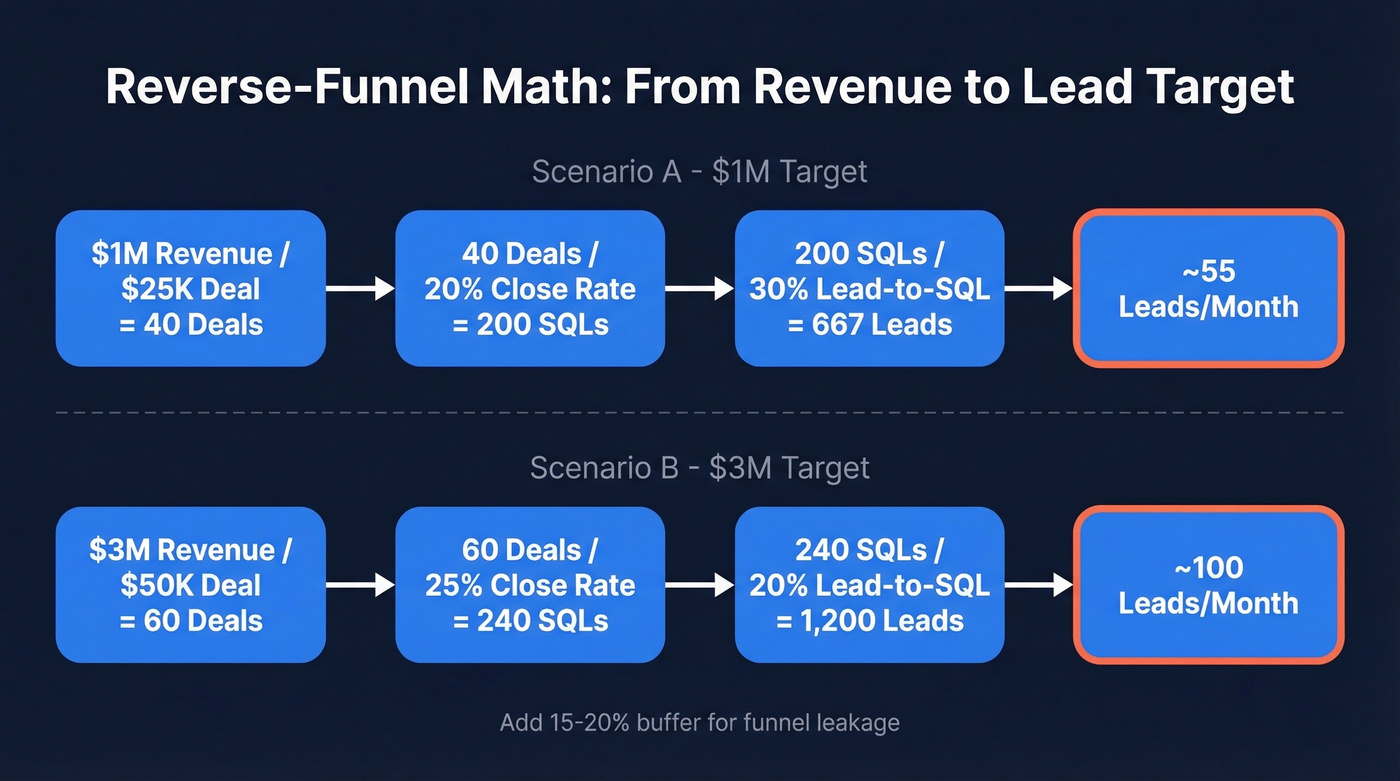
- Deals needed = Revenue target / Average deal size
- SQLs needed = Deals needed / Close rate
- Total leads needed = SQLs needed / Lead-to-SQL conversion rate
Scenario A - $1M target: $1,000,000 / $25,000 = 40 deals. At a 20% close rate, that's 200 SQLs. At a 30% lead-to-SQL rate, you need roughly 55 leads per month.
Scenario B - $3M target: $3,000,000 / $50,000 = 60 deals. At a 25% close rate, that's 240 SQLs. At a 20% lead-to-SQL rate, you need 100 leads per month.
The lead-to-SQL rates above (20-30%) represent the full journey from raw lead to sales-qualified. Within that journey, the MQL-to-SQL segment is the bottleneck that swings your numbers most. Here's what that segment looks like by industry, based on First Page Sage's 2019-2025 client data:
| Industry | MQL-to-SQL Rate |
|---|---|
| B2B SaaS | 13% |
| eCommerce | 23% |
| Business Insurance | 26% |
| Higher Education | 21% |
| Engineering | 11% |
Before you finalize, build in a 15-20% funnel leakage buffer for leads that go dark or decay. If you're working backward to traffic targets, visitor-to-lead conversion benchmarks sit around 2.5% for most B2B sites - so make sure your top-of-funnel traffic can actually support the lead volume you need.
Benchmarks for Realistic Targets
Your lead target means nothing without a CPL reality check. Remember, 37% of B2B marketing budgets go to lead gen - yet 55% of companies don't even know their customer acquisition cost. Here's what leads actually cost by industry, per First Page Sage:
| Industry | Paid CPL | Organic CPL | Blended |
|---|---|---|---|
| B2B SaaS | $310 | $164 | $237 |
| Financial Services | $761 | $555 | $653 |
| eCommerce | $98 | $83 | $91 |
| Real Estate | $480 | $416 | $448 |
| Legal Services | $784 | $516 | $649 |
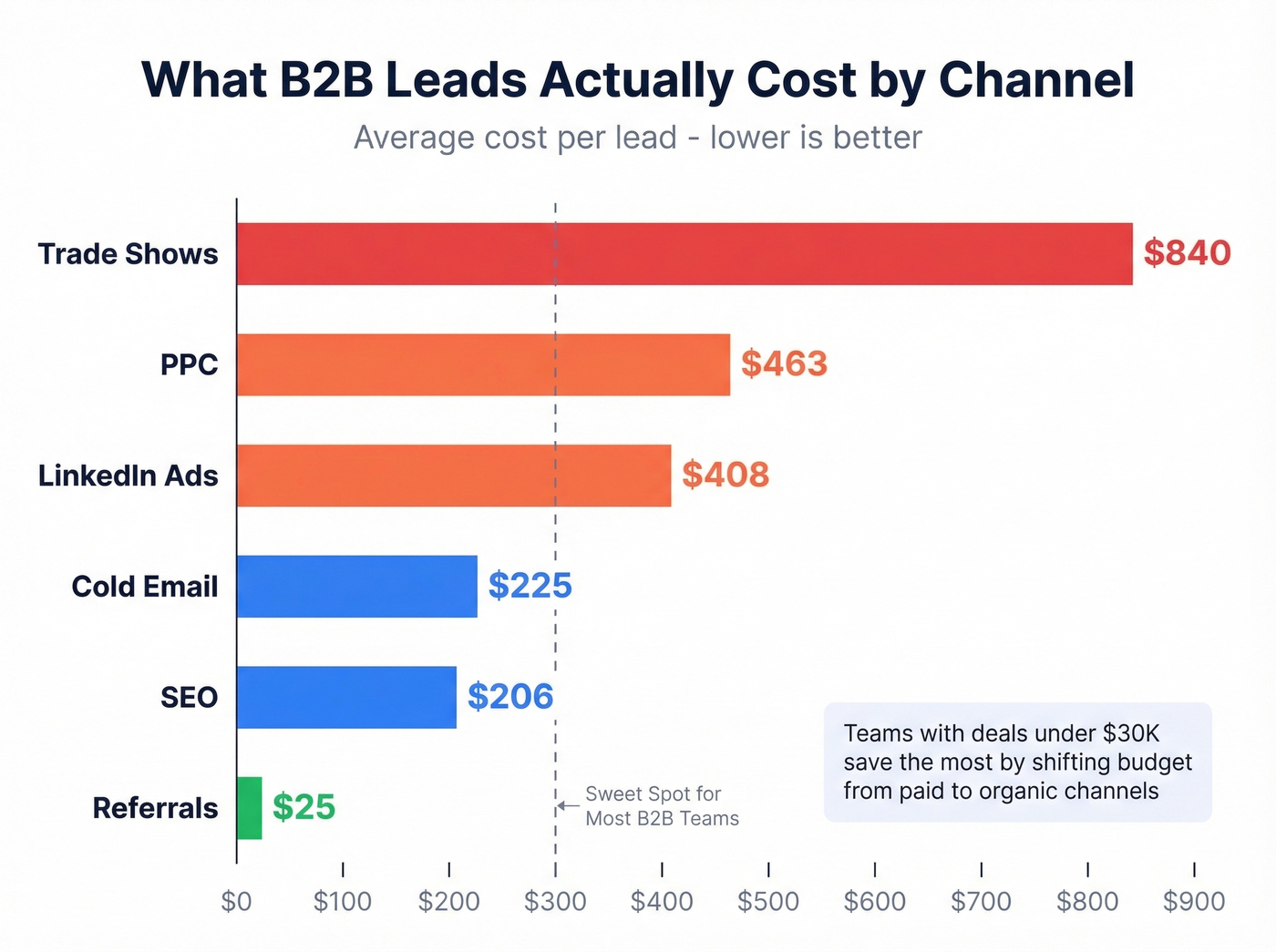
Channel choice matters just as much. These channel-level benchmarks from Sopro show the spread:
| Channel | Avg CPL |
|---|---|
| Trade shows | $840 |
| PPC | $463 |
| LinkedIn ads | $408 |
| Cold email | $225 |
| SEO | $206 |
| Referrals | $25 |
Here's the thing: most B2B teams with deals under $30K are wasting money on trade shows and PPC when cold email and SEO deliver leads at half the cost. We've seen teams cut blended CPL fast just by shifting a meaningful chunk of paid budget to organic channels. If your blended CPL is above your industry average, your channel mix is the problem - not your lead volume.
Knowing how to allocate your B2B budget across channels is the single highest-leverage decision you'll make this quarter.
If you need a tighter plan for your channel mix, start with a B2B lead generation strategy and map spend to stage-by-stage conversion.

Cold email is the second cheapest B2B channel at $225/lead - but only if your emails actually reach inboxes. Prospeo delivers 98% verified emails on a 7-day refresh cycle, keeping bounce rates under 4% so your CPL stays low and your funnel math holds.
Stop inflating your CPL with bounced emails.
SMART Goals for Lead Generation
Three goals that pass every SMART criterion:
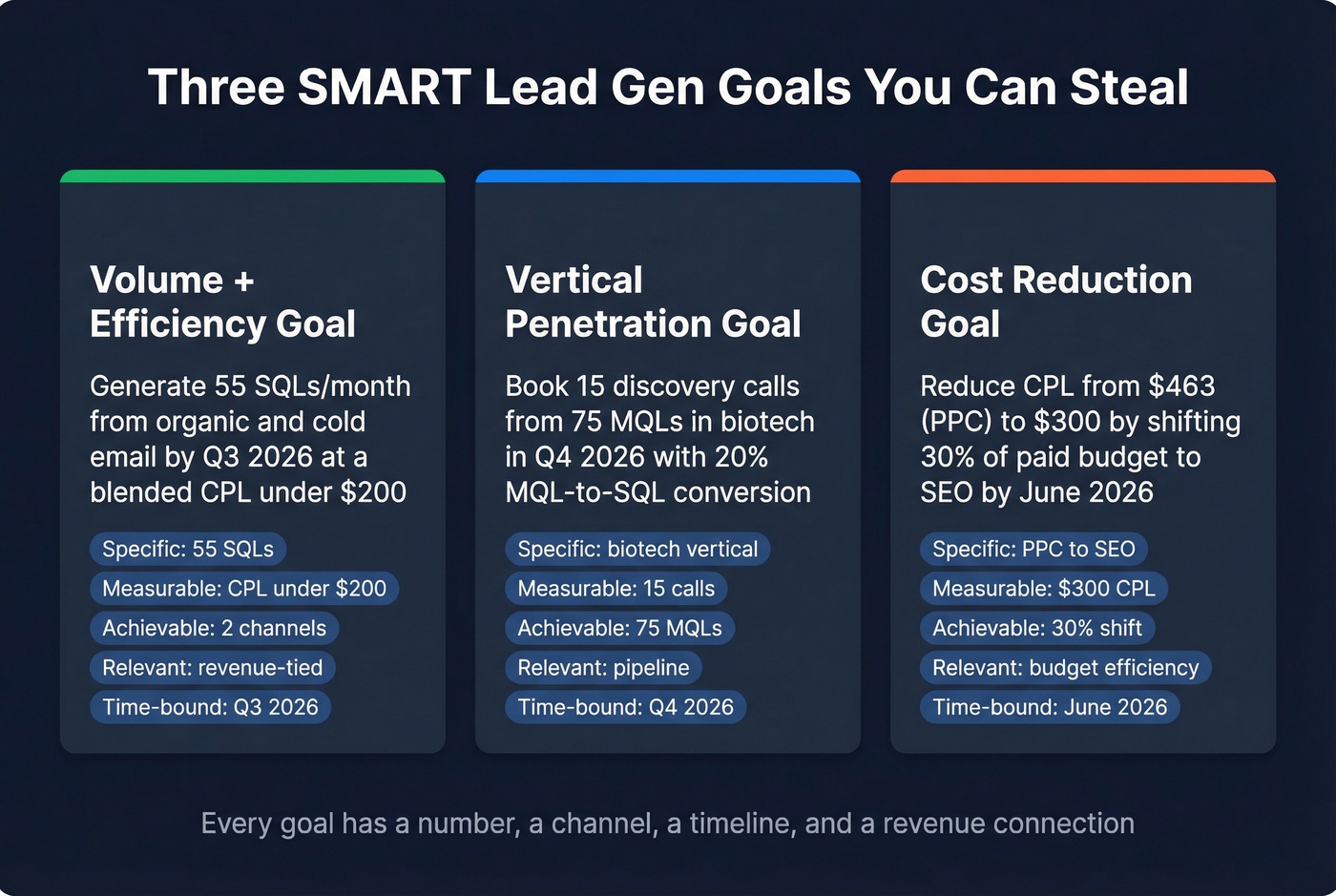
- Generate 55 SQLs/month from organic and cold email by Q3 2026, at a blended CPL under $200.
- Book 15 discovery calls from 75 MQLs in the biotech vertical in Q4 2026, with a 20% MQL-to-SQL conversion rate.
- Reduce CPL from $463 (PPC) to $300 by shifting 30% of paid budget to SEO by June 2026.
Each has a number, a channel, a timeline, and an implicit revenue connection. That's the bar you should hold every goal to. Framing targets this way forces you to connect every marketing activity to a revenue outcome instead of vanity metrics.
Five Reasons Your Lead Gen Isn't Working
1. Chasing volume without conversion math. Pipeline dies at the MQL-to-SQL handoff, not at the top of funnel. 200 leads converting at 15% beat 1,000 converting at 2%. This is the most common form of inefficient pipeline building - high spend, low yield.
If you keep missing targets, audit the full lead generation process before you add more volume.
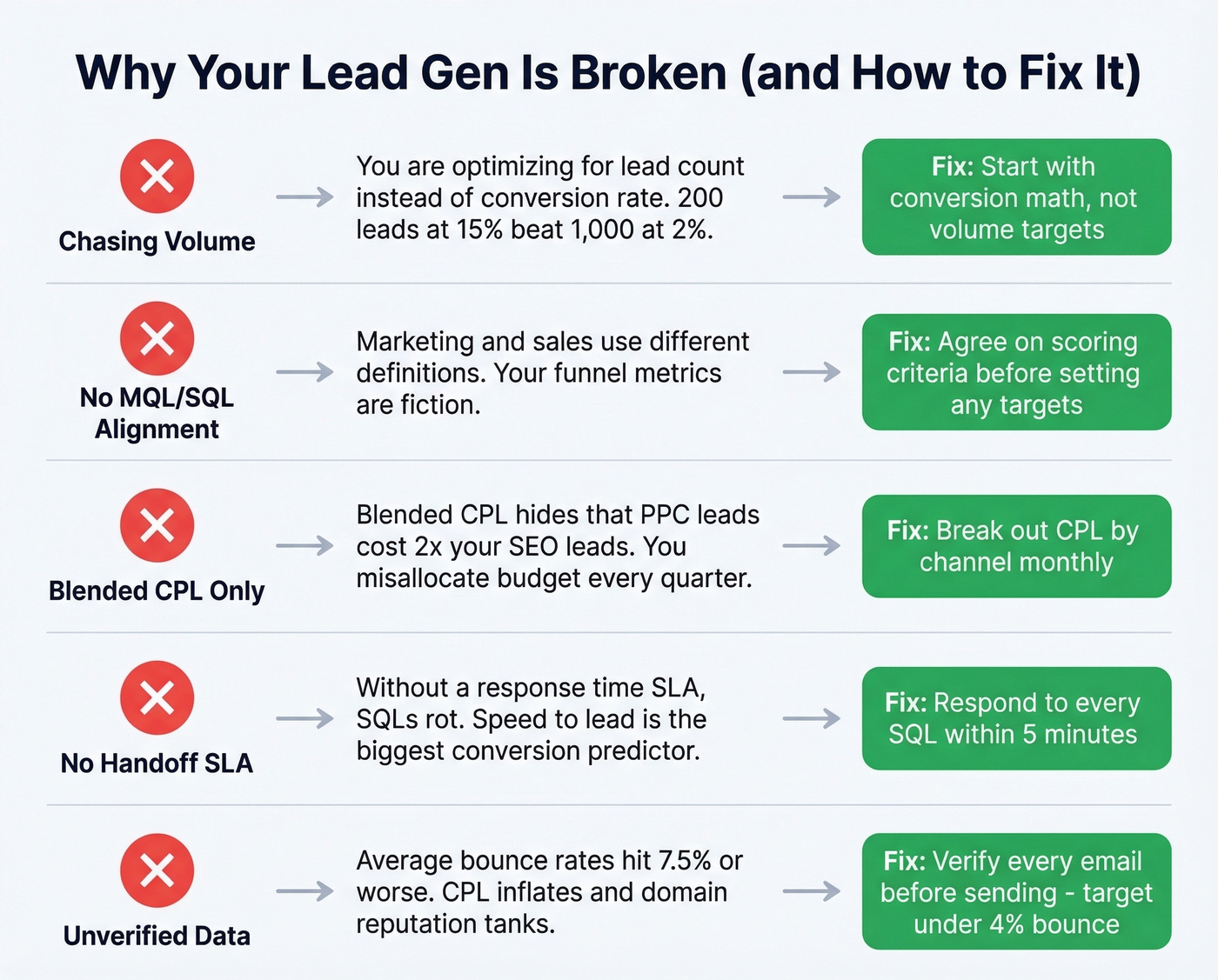
2. No shared MQL/SQL definitions. If marketing calls it an MQL and sales disagrees, your funnel metrics are fiction. Align on definitions before setting targets. We've watched teams argue about pipeline quality for months before realizing they were literally using different scoring criteria.
3. Ignoring channel-level CPL. Blended CPL hides the fact that your PPC leads cost about 2x your SEO leads. Break it out by channel or you'll misallocate budget every quarter. (If you want a quick framework, use these B2B lead generation KPIs to standardize reporting.)
4. No sales-marketing handoff SLA. Without a defined response time, SQLs rot. Make responding within 5 minutes your internal gold standard - inbound data consistently shows that response time is the single biggest predictor of whether an MQL converts.
5. Using unverified contact data. Average cold email bounce rates run 7.5%, and plenty of teams we've talked to report double that. When 15% of your emails bounce, CPL inflates and your domain reputation suffers, dragging down deliverability across every sequence. Skip this problem entirely by verifying emails before you send - tools like Prospeo verify at 98% accuracy on a 7-day refresh cycle, so your sequences actually land and your funnel math stays honest.
How to Optimize Active Campaigns
Once your goals and benchmarks are set, the real work is iterating on what's already running. Three levers matter most.
Conversion rate at each funnel stage. Even a 2-point improvement in MQL-to-SQL rate compounds into dozens of extra deals per year. Use your own CRM data to find the weakest handoff - don't guess, measure. Let's be honest: most teams we talk to haven't looked at stage-by-stage conversion in months. If you need a baseline, compare against a conversion rate lead generation benchmark.
Channel rebalancing. Review CPL by channel monthly. If one channel's cost creeps above benchmark, shift spend before the quarter ends. Don't wait for the QBR to discover you've been overspending on a channel that stopped performing in week three. For a deeper breakdown, see lead generation channels ranked by ROI.
Data hygiene. Verified contact lists reduce bounce rates and protect sender reputation, which directly improves deliverability and downstream conversions. A 5-step verification process with catch-all handling, spam-trap removal, and honeypot filtering keeps lists clean without manual scrubbing - and it's the kind of thing that pays for itself in the first campaign. If you're building lists at scale, follow a repeatable list building workflow.
Teams that optimize campaigns quarterly - not annually - consistently outperform peers on pipeline efficiency.
FAQ
How many leads do I need per month?
Use reverse-funnel math: divide your revenue target by average deal size, then by close rate, then by lead-to-SQL rate. A $1M target with $25K deals typically needs around 55 leads/month; a $3M target with $50K deals needs around 100.
What's a good MQL-to-SQL conversion rate?
Between 11-26% depending on industry. B2B SaaS averages 13%; eCommerce hits 23%. If you're below your industry benchmark, tighten MQL criteria and align definitions with sales before adding more volume.
How do I keep my CPL from spiraling?
Shift budget toward organic channels - SEO and cold email CPL runs about 40% lower than paid. Verify contact data before outreach to cut wasted spend. For small teams just getting started, Prospeo's free tier gives you 75 verified emails a month with no contract.
What lead generation KPIs should I track?
At minimum: total leads, MQLs, SQLs, MQL-to-SQL conversion rate, CPL by channel, and pipeline value. A KPIs template that maps each metric to a revenue outcome keeps reporting focused and actionable.
You just did the reverse-funnel math. Now you need contacts that convert. Prospeo gives you 300M+ profiles with 30+ filters - buyer intent, technographics, headcount growth - so every lead you pull already fits your ICP. At $0.01/email, hitting 100 leads/month costs less than one PPC click.
Hit your SQL targets without blowing your budget.