

The B2B Lead Generation Strategy Guide With Actual Numbers
92% of buyers already have a vendor in mind before they start "evaluating." The winning vendor sits on the Day One shortlist 95% of the time. And the average buying cycle runs 10.1 months from first touch to closed deal. So the real question behind every B2B lead generation strategy isn't "how do I generate more leads?" - it's "how do I get on the shortlist before the buyer even knows they're buying?"
Most lead gen advice skips this entirely. You get listicles of tactics with no numbers, no funnel math, and no honest conversation about what actually moves pipeline. Teams pour money into channels that look busy but don't convert, chase vanity metrics that impress nobody in the board room, and wonder why 79% of their marketing leads never turn into revenue. That's not a plan. It's a money pit.
Every recommendation here comes with a benchmark, a conversion rate, or a dollar figure you can run against your own numbers. If the math doesn't work, you'll know exactly where your funnel is leaking and what to fix first.
Before You Read Another Word
Run these three checks:
- If your email bounce rate is above 5%, stop adding channels. Fix your data. Everything downstream - sequences, cadences, ad spend - is wasted on bad contacts. (If you need benchmarks and fixes, see email bounce rate.)
- If you need pipeline this quarter, start with signal-based outbound. Building for next year? Invest in content and SEO now. Don't confuse the two timelines.
- Run the funnel math in Section 6 against your own numbers. The gap between your conversion rates and the benchmarks will tell you exactly where to focus.
B2B Lead Generation in 2026
The lead generation software market hit $7.4B in 2025 and is projected to reach $16.2B by 2034 at a 9.1% CAGR. That growth reflects a fundamental shift: buyers now engage across an average of 10 channels before making a purchase decision, up from five in 2016. The funnel is a polite fiction - buyers move laterally, backward, and skip stages entirely.
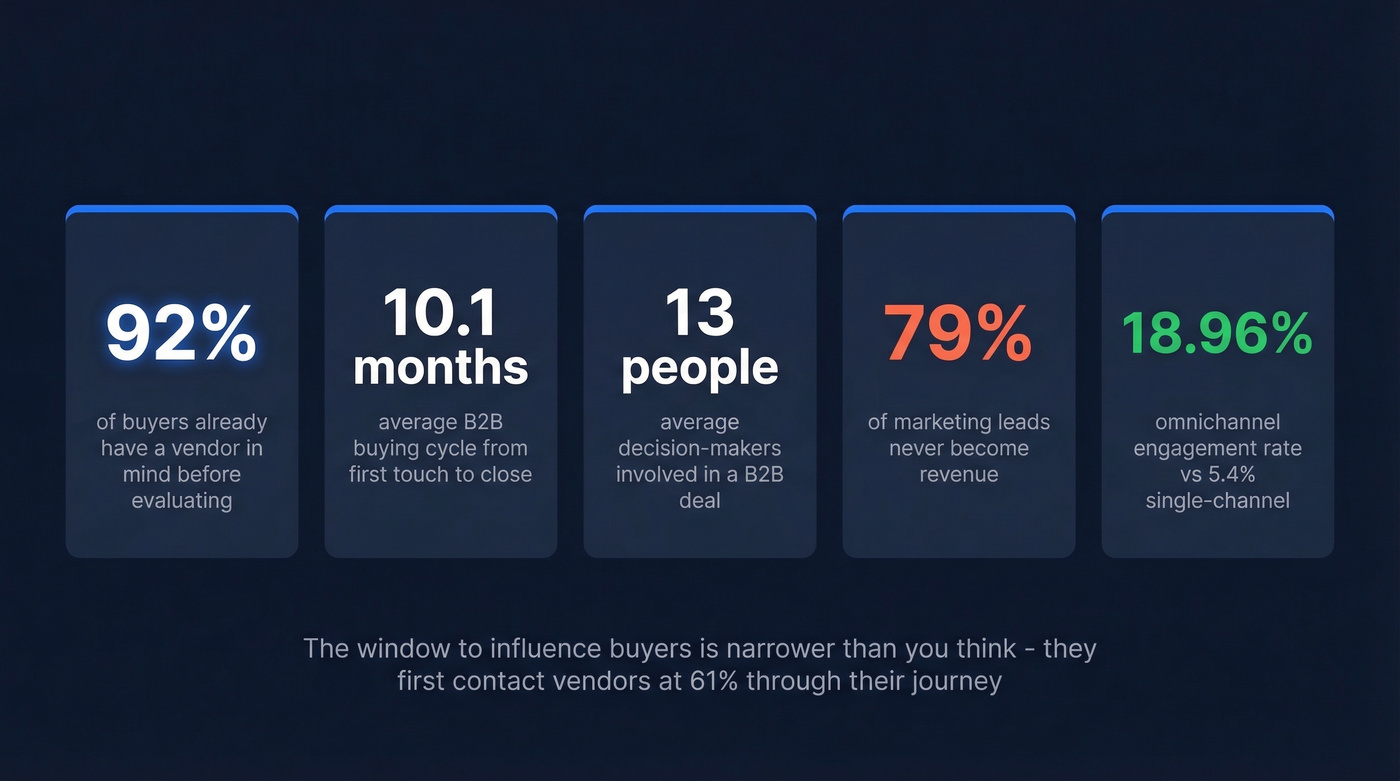
Here's the stat that should reshape how you think about timing: buyers' first contact with a vendor typically happens at 61% of the way through their buying journey. By the time someone fills out your demo form, the decision is mostly made. This is why 91% of marketers say lead gen is their top priority, yet 61% call it their greatest challenge - the window to influence is narrower than it looks.
Let's get the terminology straight. An MQL hits your scoring threshold through content engagement or form fills. An SQL has been vetted by SDRs and confirmed as worth pursuing. A SAL is an SQL that an AE has agreed to work. A PQL has used your product - free trial, freemium - and shown buying signals through behavior, not just demographics. (If your definitions are fuzzy, start with a clean lead status setup.)
The performance gap between single-channel and omnichannel approaches is staggering: 18.96% engagement rate for omnichannel vs. 5.4% for single-channel. That's nearly 4x. Teams still running email-only outbound are leaving pipeline on the table.
Build Your ICP First
Every lead gen program starts with the same question: who are you actually selling to? Not "mid-market SaaS companies" - that's a category, not an ICP. Gartner's enterprise persona framework breaks this into six characteristics, and it's the most useful structure we've found for operationalizing targeting. (If you need a starting point, use an ideal customer profile template.)
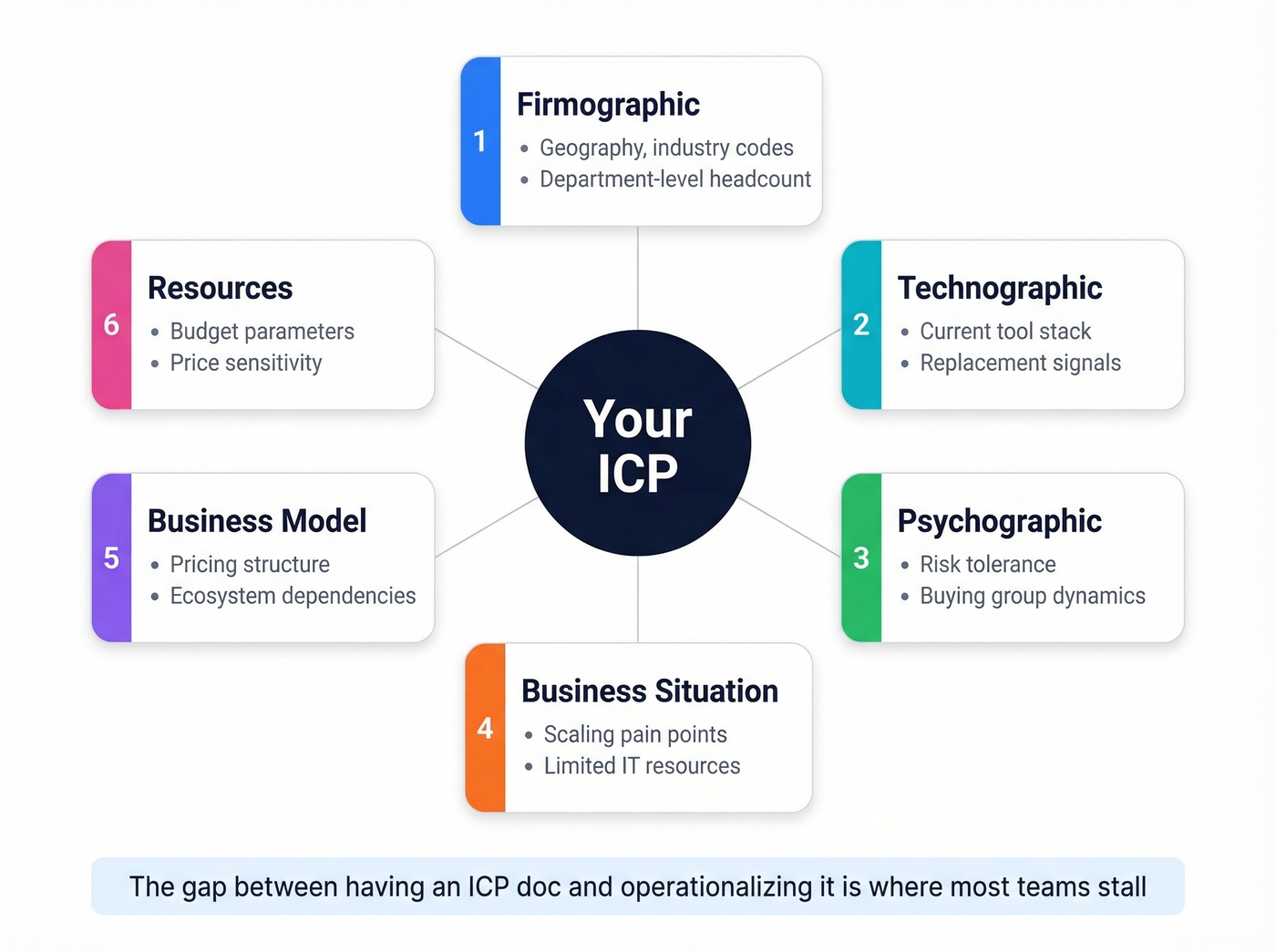
Firmographic attributes cover geography, industry codes, and employee counts in relevant departments - not just total headcount. Technographic signals tell you what tools they're already running and what they might replace. Psychographic factors include risk tolerance and buying group dynamics. Business situation captures needs like scaling pain or limited IT resources. Business model covers pricing structure and ecosystem dependencies. Resources means budget parameters and price sensitivity. (More on implementation: firmographic and technographic data.)
This matters more than ever because the average B2B deal now involves 13 decision-makers, and 80% of buyer interactions happen digitally. You're not selling to a person. You're selling to a committee that's doing most of its research without talking to you.
The gap between "having an ICP doc" and "operationalizing it" is where most teams stall. You need filters that match your framework: buyer intent signals, technographic data, job changes, headcount growth, department-level sizing, funding rounds. Without a translation layer that turns those criteria into a live, filterable prospect list, your ICP is just a slide deck. (If you want a system for this, see how to automate target account lists.)
Inbound Channels That Work
Inbound is a long game, and the conversion rates are lower than most marketers admit. Businesses sourcing more than 40% of leads from marketing show higher conversion rates - so the investment pays off, but only if you commit to it.
Content & SEO
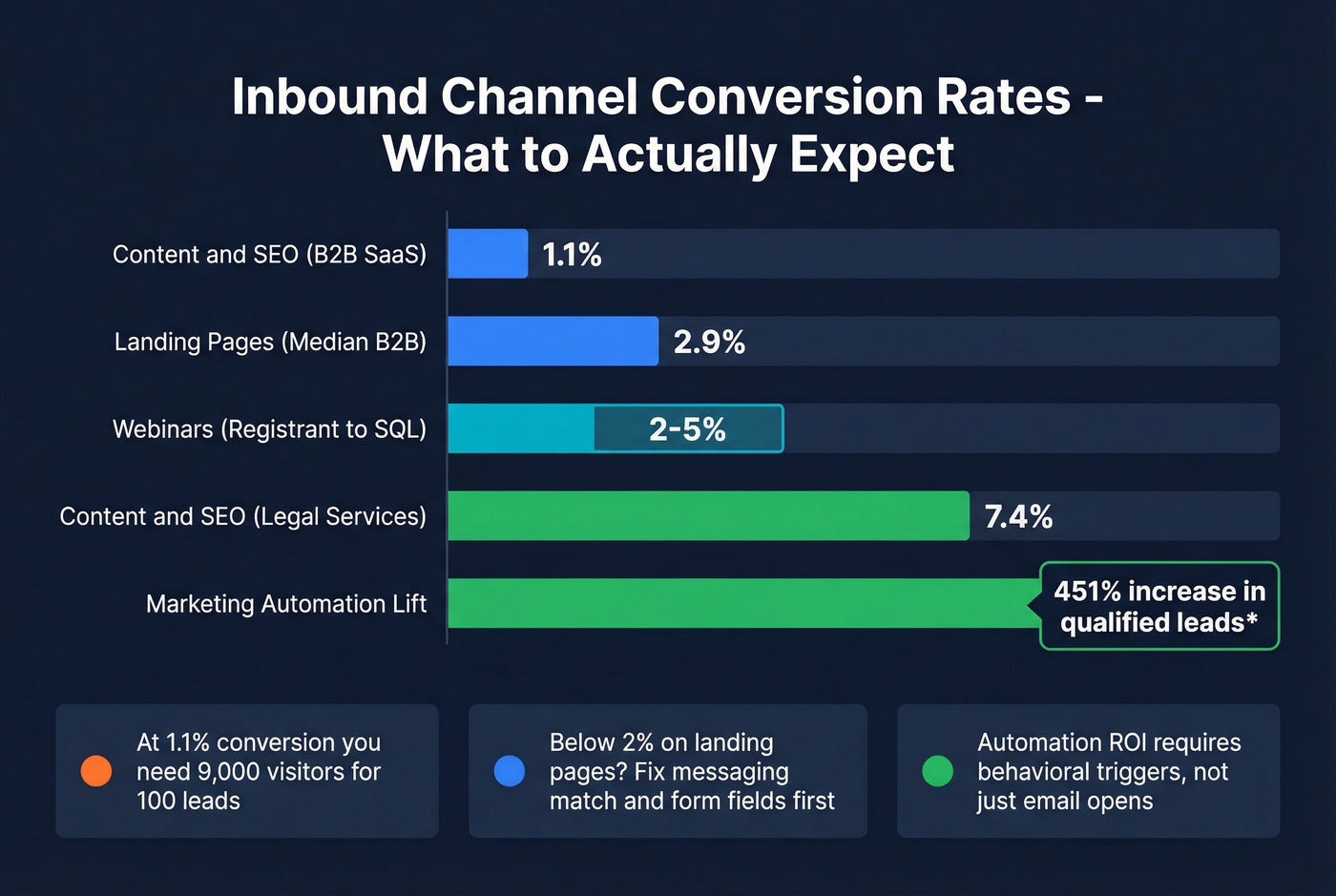
Content-driven SEO remains the highest-ROI inbound channel over a 12-month window, but the time-to-impact is 3-6 months minimum. Industry conversion benchmarks vary wildly. (If you’re building the engine, see what is B2B content marketing.)
| Industry | Visitor-to-Lead Rate |
|---|---|
| B2B SaaS | 1.1% |
| IT & Managed Services | 1.5% |
| Manufacturing | 2.2% |
| Staffing & Recruiting | 2.9% |
| Legal Services | 7.4% |
If you're in B2B SaaS, a 1.1% conversion rate means you need roughly 9,000 visitors to generate 100 leads. Plan your volume expectations accordingly.
Webinars & Lead Magnets
Webinars convert at 2-5% of registrants to SQLs in our experience, which makes them one of the better mid-funnel tactics. Use ungated content to build trust and organic traffic, then gate the high-value assets - benchmarks, templates, calculators - that signal genuine buying intent.
Landing Pages
The median B2B conversion rate sits around 2.9%, with a typical range of 2.0-5.0%. Below 2%? The problem is almost always mismatched messaging between the ad and the page, too many form fields, or a weak value proposition above the fold. Fix those before spending another dollar on traffic.
Marketing Automation
Properly implemented marketing automation drives a 451% increase in qualified leads, and 77% of marketers using it report higher conversion rates. "Properly implemented" is doing heavy lifting in that sentence, though. Real automation means behavioral triggers, lead scoring that reflects buying intent, and dynamic routing based on engagement signals - not just "opened 3 emails." (For a deeper scoring model, see lead scoring.)
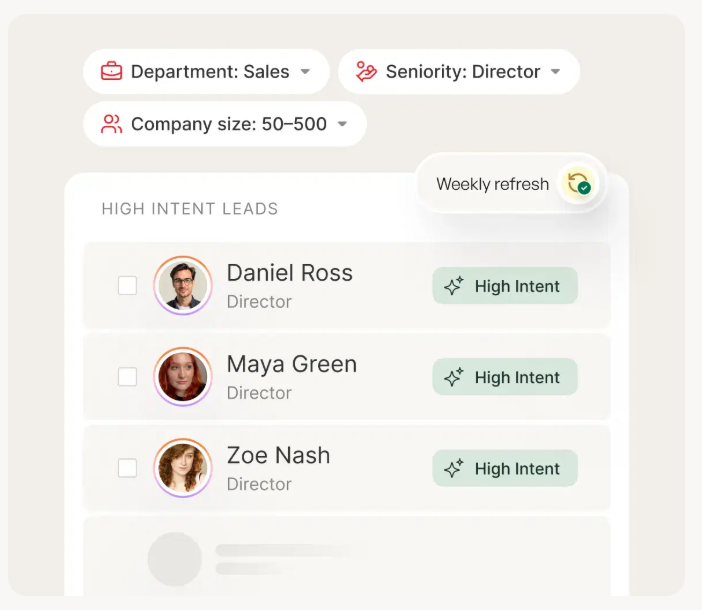

You just saw the math: 79% of marketing leads never convert, and most teams can't even operationalize their ICP. Prospeo gives you 30+ filters - buyer intent, technographics, job changes, headcount growth, funding - to turn your ICP slide deck into a live prospect list with 98% verified emails.
Stop planning your strategy around bad data. Start with 75 free leads.
Outbound Strategy for 2026
Outbound is where pipeline happens this quarter. Here are the channels that work, plus the data layer that makes or breaks all of them.
Signal-Based Cold Email
The old approach - blast 10,000 contacts with a generic template - is dead. Deliverability algorithms killed it, and buyers ignore it. The workflow producing results right now looks like this: (If you need a full build, use a B2B cold email sequence.)
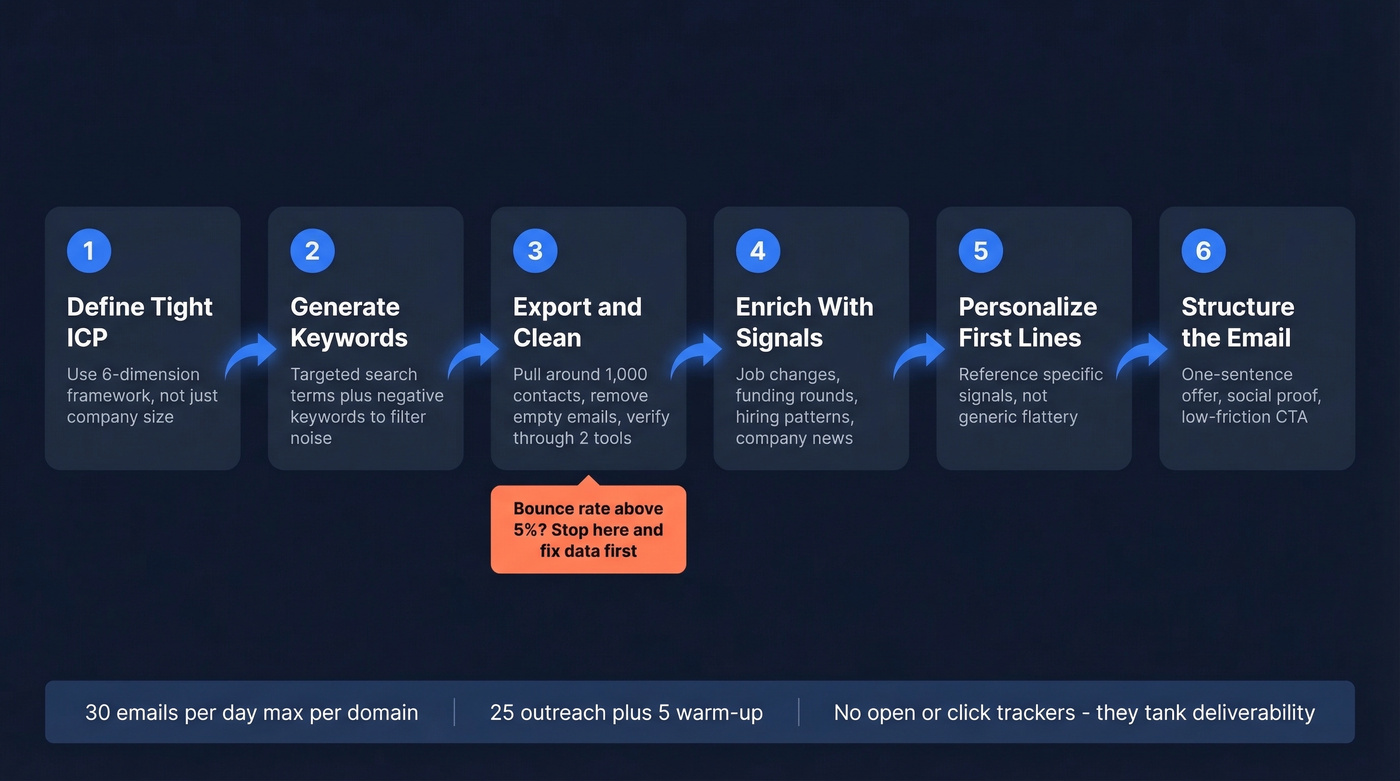
- Define a tight ICP using the framework above
- Generate targeted search keywords and negative keywords
- Export a filtered list of ~1,000 contacts, clean the data (remove empty emails, entries without websites, irrelevant industries), and verify through at least two verification tools
- Enrich with signals: recent job changes, funding rounds, company news, hiring patterns
- Write personalized first lines based on those signals
- Structure the email: offer in one sentence, social proof, low-friction CTA ("Are you the right person to talk about this?")
The warm-up math matters too. Sending 30 emails per day from a domain means 25 outreach emails plus 5 warm-up emails. Teams that ignore warm-up discipline burn domains within weeks. And don't use open or click trackers - they tank deliverability. (If you want safe limits, see email velocity.)
Cold Calling
Cold calling isn't dead. It's just harder. The average cold call success rate is 2.3%, but high-performing teams hit 5-11%. The gap comes down to data quality (are you calling real direct dials?), timing (speed-to-lead within 5 minutes makes you 9x more likely to qualify), and targeting (calling into accounts showing intent signals vs. cold lists). (If you need a repeatable process, see cold calling system.)
80% of buyers will take a meeting with a rep who reaches out by phone, and 57% of executives prefer phone calls for complex purchasing decisions. The channel works - most teams just execute it poorly. Use verified mobile numbers with real carrier data, avoid VoIP numbers that get flagged as spam, and cap your attempts at 7 calls per contact.
Social Selling & ABM
For enterprise deals with 13-person buying committees, you can't rely on a single channel or a single contact. ABM means multi-threading across the committee - reaching the economic buyer, the technical evaluator, the champion, and the blocker through coordinated outbound across email, phone, and professional networks. (For a tighter playbook, see account-based selling best practices.)
The tactical playbook: run coordinated email sequences to multiple stakeholders in the same account, layer in retargeting ads through platforms like Demandbase or 6sense for intent-driven targeting, and use direct mail for high-value enterprise accounts. Tools like HeyReach, frequently recommended on r/sales for automating multi-touch professional outreach, handle the multi-threading logistics. The omnichannel data backs this up - 18.96% engagement for multi-channel vs. 5.4% for single-channel.
Data Quality Is the Foundation
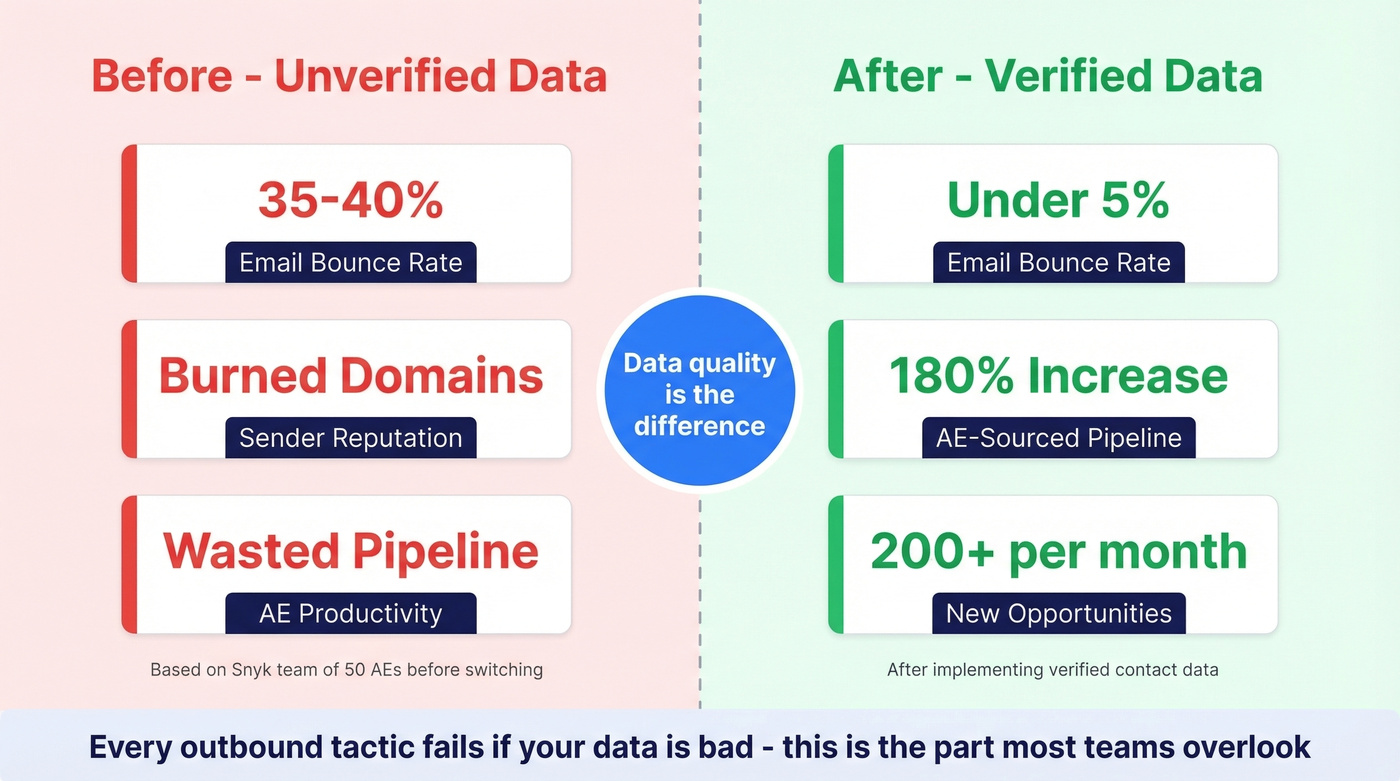
Here's the thing: every outbound tactic above fails if your data is bad. This is the part most teams overlook, and it's the part that matters most. (If you’re evaluating vendors, start with data enrichment services.)
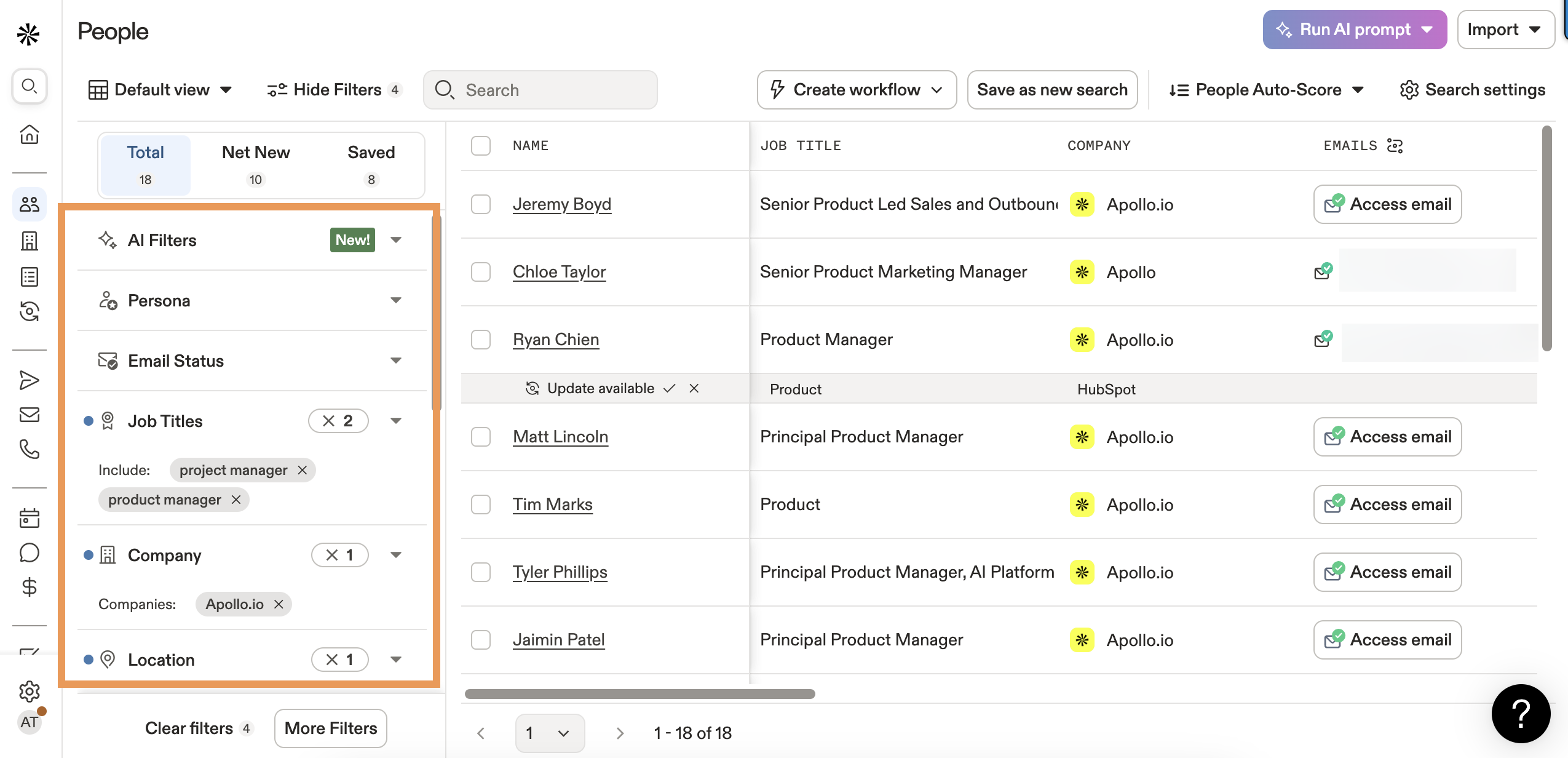
Apollo is powerful for list building and sequencing - the consensus on r/sales is that it's "crazy powerful when you know how to use it." But its contact data is community-sourced, meaning other users populate it, and Apollo doesn't independently verify records. We've seen teams export a list of 1,000 contacts from Apollo and hit around 20% bounce rates before external verification. That's a domain reputation killer. (If you need the deliverability fundamentals, see email deliverability guide.)
The proof is in the results. Snyk's 50-person AE team was running 35-40% bounce rates before switching. After moving to verified data, bounce rates dropped under 5%, AE-sourced pipeline jumped 180%, and they're generating 200+ new opportunities per month.

AI-Powered Lead Generation
Daily AI tool usage is up 233% in six months, and 89% of revenue organizations now use AI in some capacity. AI-automated customer interactions are projected to grow from 3.3 billion to 34 billion by 2027. The shift is real, but only about a third of B2B organizations have deployed agentic AI at scale.
The practical taxonomy emerging breaks AI agents into three categories. Listener Agents monitor calls and conversations for pain points, competitor mentions, and buying signals. Topic Agents generate content themes and messaging angles based on market data. Creator Agents draft assets - emails, ad copy, landing pages - from templates and signal data. (If you want a practical starting point, see generative AI lead generation.)
Let's be honest: most teams should ignore full agentic AI pipelines for now. Start with AI-assisted personalization - use LLMs to generate personalized first lines from enrichment signals like job changes, funding, and hiring patterns. Use automation platforms like Make.com to orchestrate the data flow between your database, enrichment tools, and sequencer. That's achievable today and produces measurable results. Full autonomous agent pipelines are coming, but the orchestration complexity will burn more teams than it helps in 2026.
The Funnel Math Nobody Shows You
Here's where strategy meets arithmetic. These are the stage-by-stage benchmarks that tell you whether your funnel is healthy or hemorrhaging: (If you want a tracking framework, see funnel metrics.)
| Funnel Stage | Benchmark Range | Where Most Funnels Leak |
|---|---|---|
| Lead to MQL | 35-45% | Poor scoring criteria |
| MQL to SQL | 15% | Biggest drop-off point |
| SQL to Opportunity | 25-30% | Weak discovery calls |
| Opportunity to Closed-Won | 6-9% | Pricing/competition |
| Overall Lead to Customer | 1.5-2.5% | Compounding losses |
Now let's run a worked example. Say you're a B2B SaaS company generating 10,000 website visitors per month at a 1.1% conversion rate. That gives you 110 leads. Apply the benchmarks: 110 leads x 40% = 44 MQLs, x 15% = 7 SQLs, x 27% = 2 opportunities, x 7.5% = 0.15 closed-won deals per month - roughly one new customer every 6-7 months.
If your ACV is $50K, that math might work. If you're closing $10-15K deals, it absolutely doesn't. This is why outbound exists - it lets you bypass the top of the funnel and go directly to qualified prospects. A strong B2B lead generation strategy accounts for both inbound volume and outbound acceleration working in parallel.
The MQL-to-SQL handoff at 15% is where most funnels bleed out. That's an 85% rejection rate, usually because marketing and sales don't agree on what "qualified" means. Fix that definition first. Everything else is optimization on a broken foundation.
The B2B Lead Gen Tool Stack
You don't need 15 tools. You need the right five or six, working together. (If you’re comparing options, see outbound lead generation tools.)
| Category | Tool | Starting Price | Best For |
|---|---|---|---|
| CRM | HubSpot | Free CRM; ~$800/mo+ paid | Marketing + sales alignment |
| Sales Engagement | Instantly | ~$30/mo | Cold email at scale |
| Sales Engagement | Smartlead | ~$39/mo | Multi-inbox sending |
| Enrichment | Clay | ~$149/mo | Waterfall enrichment |
| Intent Data | Bombora | ~$25K+/yr | In-market buyer signals |
| Data (Enterprise) | ZoomInfo | ~$15-40K/yr | Large orgs, US coverage |
Apollo remains powerful for list building and sequences, but treat it as a prospecting interface, not a verification source. Export from Apollo, verify elsewhere. Free tier available, paid plans from ~$49-99/mo per user.
ZoomInfo is enterprise-grade with the broadest US coverage, but at $15-40K/year it's overkill for teams under 50 reps. The feature bloat means you're paying for capabilities most teams never activate. HubSpot's free CRM is the obvious starting point for teams without one. Clay handles waterfall enrichment starting at ~$149/mo - powerful but complex. Skip it unless you're running multi-source enrichment across 3+ data providers.
Mistakes That Kill Your Pipeline
We've seen the same failures repeat across dozens of teams. These seven do the most damage.
Bad data with no verification. Every unverified email that bounces damages your domain reputation, which lowers deliverability on every subsequent send. It compounds. Meritt tripled pipeline from $100K to $300K per week after switching to verified data. The fix is cheap. The cost of ignoring it isn't.
Slow follow-up. Responding to an inbound lead within 5 minutes makes you 9x more likely to qualify them. After 30 minutes, the odds crater. Treat speed-to-lead as a revenue KPI, not an operational metric. (If you need copy you can deploy fast, see sales follow-up templates.)
Misaligned marketing/sales handoffs. If marketing and sales don't share a definition of "qualified," every MQL is a potential argument. Build shared SLAs with explicit criteria before scaling any channel.
Single-channel outbound. We keep coming back to this stat because it's that stark: 18.96% engagement for omnichannel vs. 5.4% for single-channel. If you're only sending emails, you're leaving 70%+ of potential engagement on the table.
Vanity metrics without funnel tracking. "We generated 5,000 leads" means nothing without stage-by-stage conversion data. Track the full funnel or you're flying blind.
Generic nurture sequences. Sending the same drip to every lead regardless of intent signals wastes everyone's time. Nurtured leads produce 47% higher order values - but only when the nurture is relevant to where the buyer actually is in their process.
Deliverability neglect. No warm-up discipline, sending from a primary domain, using tracking pixels - these mistakes compound fast. By the time you notice deliverability has dropped, the damage takes weeks to repair. I've watched teams burn through three domains in a quarter because nobody owned this metric.
FAQ
What's the difference between lead generation and demand generation?
Lead generation captures existing demand by converting known interest into contacts. Demand generation creates awareness before the buying cycle starts. With buyers' first vendor contact happening at 61% of the journey, you need demand gen to land on the mental shortlist and lead gen to convert when they're ready.
How long does it take to see results?
Outbound channels can produce qualified meetings within 1-2 weeks of launching verified, signal-based sequences. SEO and content take 3-6 months to compound. The average B2B buying cycle runs 10.1 months, so plan pipeline expectations accordingly.
What's a good cost per lead in B2B?
Healthcare and tech average $180-250 per lead through paid channels. Outbound with verified data can run $10-30 per qualified contact, making it the most cost-efficient channel for teams with strong targeting.
How do I know if my funnel is healthy?
Benchmark against these rates: Lead-to-MQL at 35-45%, MQL-to-SQL at 15%, SQL-to-Opportunity at 25-30%, Opportunity-to-Closed-Won at 6-9%. Any stage significantly below these ranges is your bottleneck. The MQL-to-SQL handoff is where most funnels bleed out.
What tools do I need to get started?
Three things: a data provider with built-in verification (Prospeo's free tier includes 75 emails/month), a CRM (HubSpot's free version works), and a sending tool (Instantly or Smartlead from ~$30/mo). Add enrichment and intent data as you scale past 1,000 outbound contacts per month.
Signal-based outbound only works when your contact data is accurate. A 35% bounce rate kills deliverability and wastes every dollar you spend on sequences. Prospeo refreshes 300M+ profiles every 7 days - not every 6 weeks - so your outbound hits real inboxes at $0.01 per verified email.
Get bounce rates under 4% like teams that switched to Prospeo.