

The Lead Management Process Guide You Can Actually Implement
You generated 500 leads last month. Sales says they're garbage. Marketing says sales never follows up. Both are right - and the lead management process sitting between them is broken.
The average B2B sales team takes 42 hours to respond to a new lead, and 38% of leads never get a response at all. That's not a lead quality problem. That's a process problem.
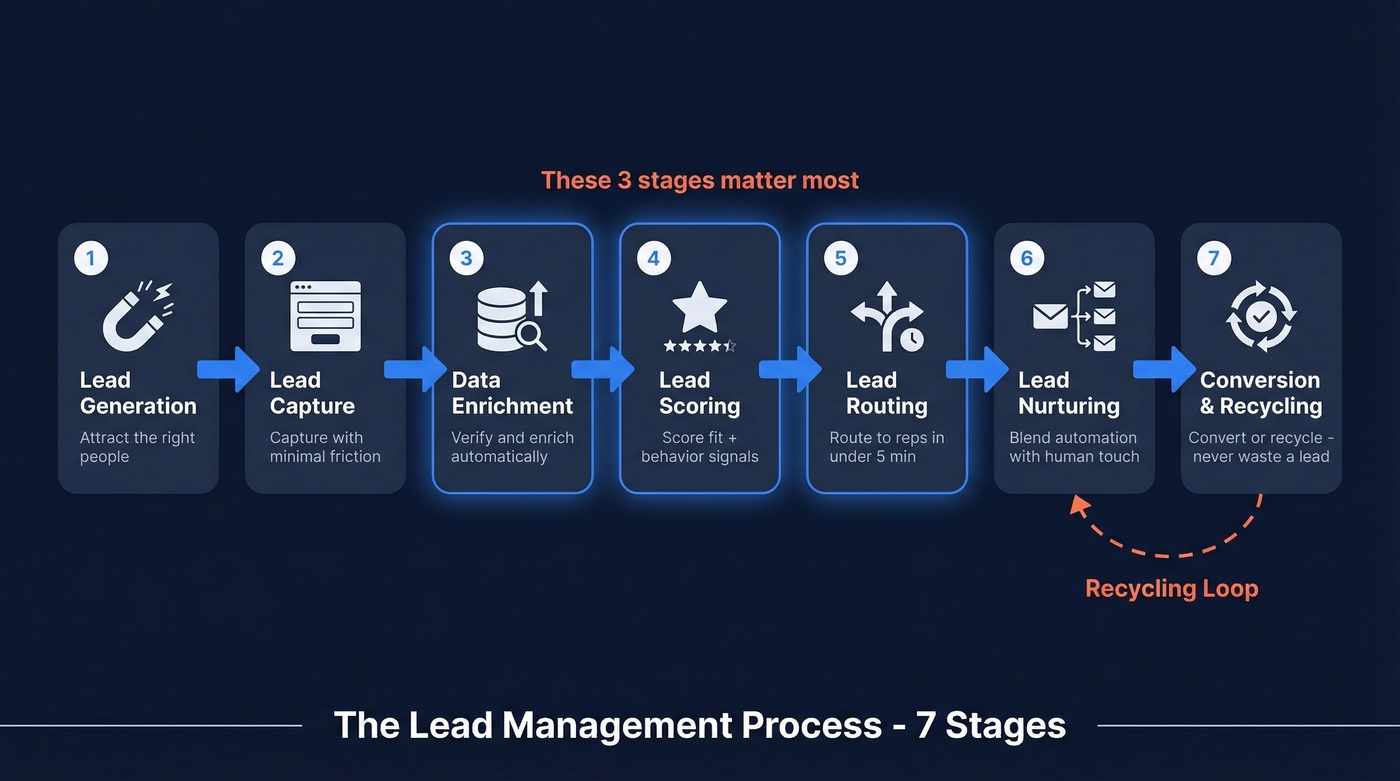
The quick version: There are 7 stages, but only 3 matter more than the rest - scoring, routing, and data quality. If your team responds to leads in hours instead of minutes, fix that first. Below you'll find a scoring template you can copy into your CRM today, 2026 benchmarks to measure yourself against, and the 5 mistakes that silently kill pipelines.
What Is Lead Management?
Lead management is the system that moves a stranger from "just browsing" to "closed-won" - capturing, qualifying, routing, and nurturing leads across a median B2B sales cycle of 2.1 months. It covers everything from the moment someone fills out a form to the moment they either buy or get recycled back into a nurture track.
Here's the thing: stop adding more stages. We've seen teams build 12-step workflows with elaborate branching logic, and their conversion rates are no better than teams running a clean 5-stage process. The problem isn't complexity - it's that you're failing at 3 stages. Get data quality, scoring, and speed-to-lead right, and your close rate will tell you the rest is working.
The 7 Stages of Sales Lead Management
Lead Generation
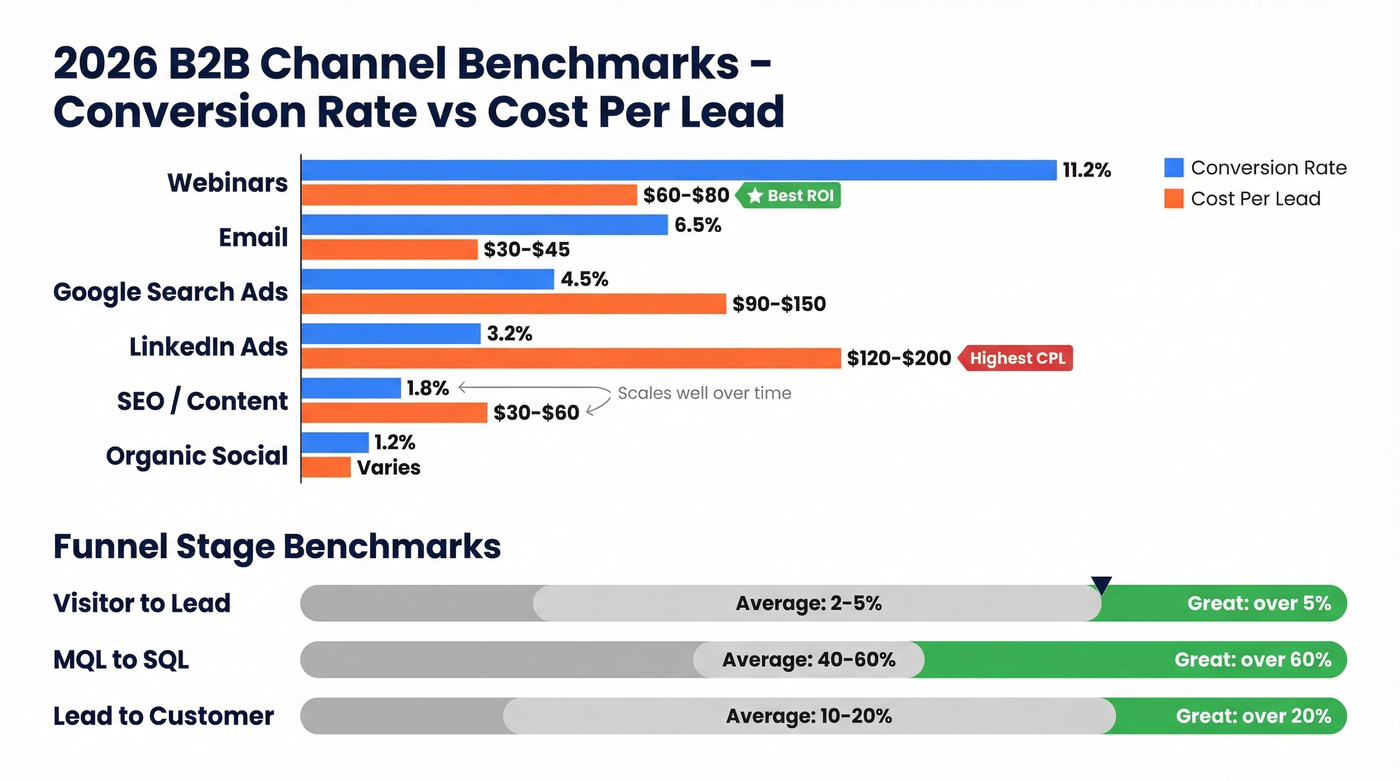
Not all channels are created equal. Webinars convert at 11.2% with a $60-$80 CPL, making them the highest-converting channel in B2B benchmarks. Email sits at 6.5% conversion for $30-$45 CPL. SEO runs 1.8% conversion but at $30-$60 CPL, so the unit economics can still work at scale.
The point isn't to pick one channel. It's to know which ones deserve more budget and which ones are vanity metrics.
Lead Capture
Every field you add to a form costs you conversions. Forms with 5 or fewer fields consistently outperform longer ones. Capture name, email, company, and one qualifying question. You can enrich the rest automatically - which brings us to the step most teams skip entirely.
Data Enrichment & Verification
Before you score or route anything, verify the data. A lead with a bad email, wrong title, or outdated company info wastes your sales team's time and tanks your sender reputation. Prospeo enriches CRM records with 50+ data points at a 98% email accuracy rate and runs on a 7-day refresh cycle, compared to a 6-week industry average. Meritt went from a 35% bounce rate to under 4% after switching their enrichment layer, connect rates tripled to 20-25%, and their pipeline grew from $100K to $300K per week.
Clean data isn't a nice-to-have. It's the foundation that makes every downstream step actually work. If you're evaluating vendors, start with a shortlist of data enrichment services so you can compare accuracy, refresh cycles, and pricing apples-to-apples.

Lead Scoring & Qualification
Only 27% of leads sent to sales are actually qualified. That means nearly three-quarters of the leads your reps receive shouldn't be in their queue yet. A scoring model fixes this - and we've built a full template in the next section. Assign points based on fit and behavior, set a threshold, and only pass leads that clear it. This single step is the backbone of any workflow that actually converts.
If you want a deeper breakdown of models, thresholds, and common scoring mistakes, use this lead scoring guide as a companion.
Lead Routing & Distribution
This is where speed-to-lead lives, and the decay curve is brutal. Within 5 minutes, you've got a 21% qualification rate. After 10 minutes, it drops to 14%. After 30 minutes, 1%. After an hour, less than 0.5%. Response times vary wildly by industry - healthcare averages 2 hours 5 minutes while telecom manages 16 minutes, and small companies average 48 minutes.
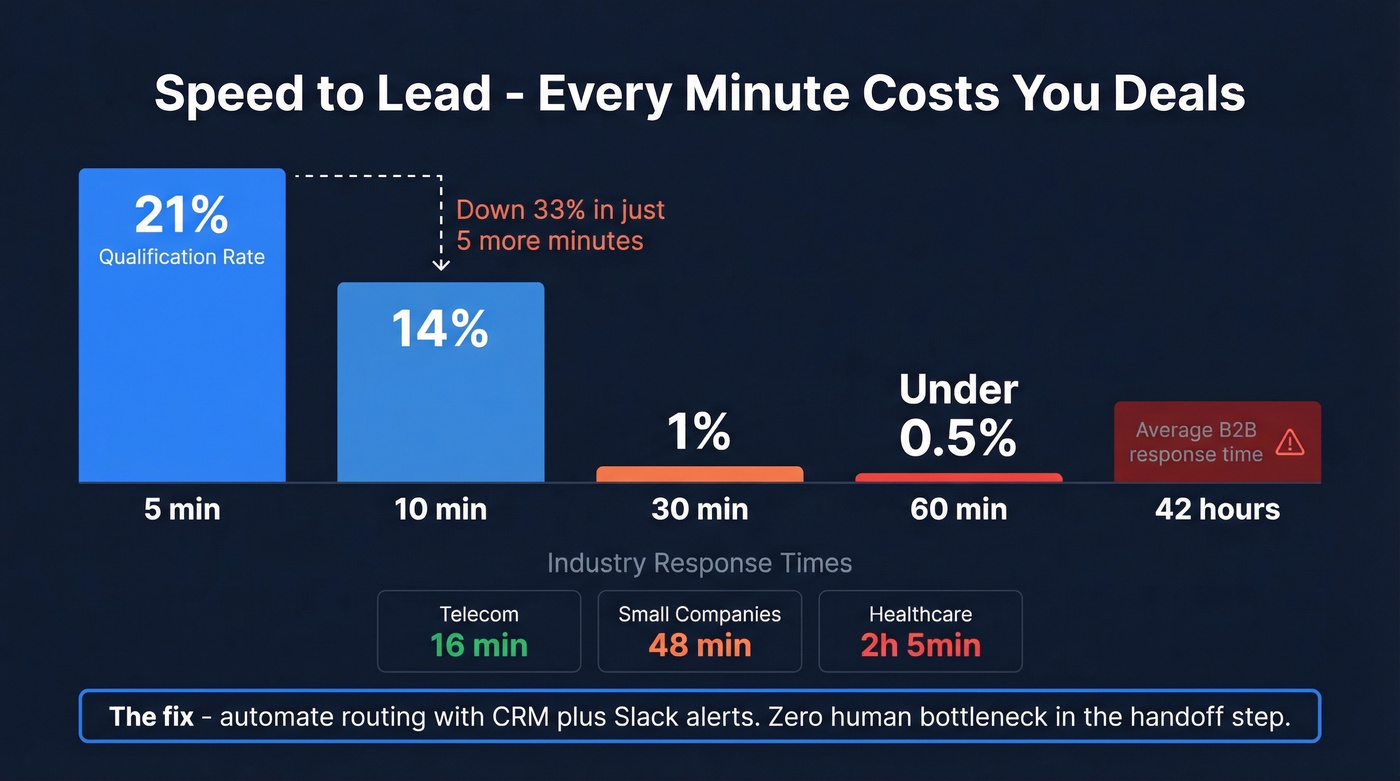
One agency owner on r/agency described the workflow that "moved conversions noticeably": when a cold email lead replies positively, Make.com triggers a CRM update, client notification, and Slack alert all within seconds. No human bottleneck in the routing step. That's the model to copy.
Lead Nurturing
The best nurture sequences blend automated touchpoints with timely, personal outreach from a real human. A rep who references a specific webinar the lead attended will always outperform a generic "just checking in" email. Automation handles drip sequences and retargeting well, but excessive automation without human contact erodes trust. Treat nurturing as a revenue activity, not a marketing afterthought.
When reps do go manual, having proven messaging helps - keep a set of sales follow-up templates ready so outreach stays consistent.
Conversion & Recycling
What happens to leads that don't convert? Most teams let them rot in a "closed-lost" bucket forever.
Smart teams build a recycling loop. Leads that didn't convert get tagged with a reason, dropped into a long-term nurture track, and re-scored when their behavior changes. A lead that wasn't ready in Q1 could be actively researching in Q3. If you don't have a recycling process, you're paying to acquire the same lead twice - and that's where lead-to-revenue thinking becomes real, because you're extracting lifetime value from every dollar spent on acquisition.
If you want a clean way to operationalize this in your CRM, set up explicit lead status definitions so "recycle" isn't a dead end.
How to Build a Lead Scoring Model
Only 44% of organizations use lead scoring, which means more than half are sending unqualified leads to sales and wondering why close rates are low. Companies that do use scoring see 138% ROI on lead generation versus 78% without it.
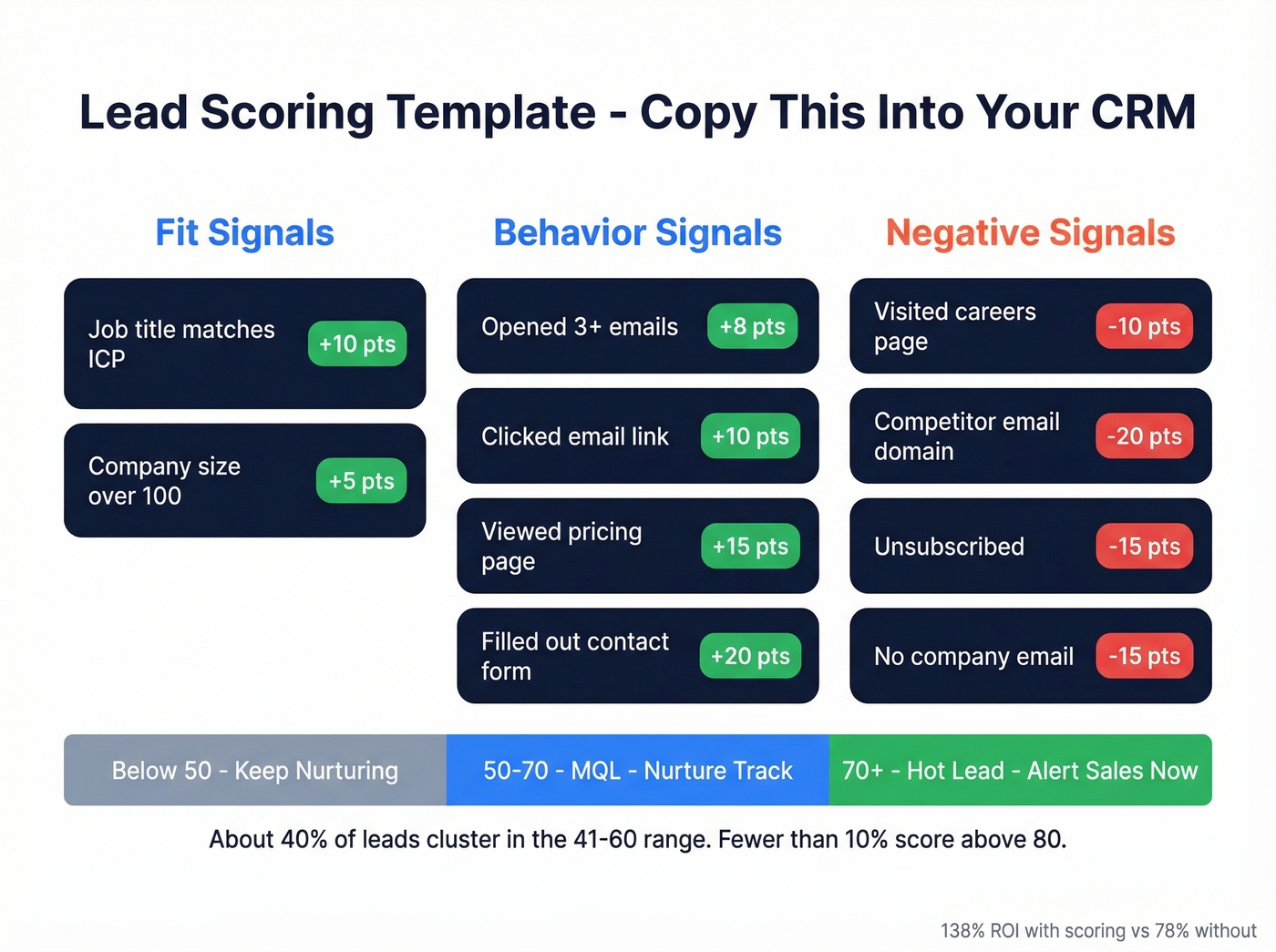
Drop this scoring matrix into HubSpot, Salesforce, or any CRM with custom fields:
| Signal | Points | Type |
|---|---|---|
| Job title matches ICP | +10 | Fit |
| Company size >100 | +5 | Fit |
| Opened 3+ emails | +8 | Behavior |
| Clicked email link | +10 | Behavior |
| Viewed pricing page | +15 | Behavior |
| Filled out contact form | +20 | Behavior |
| Visited careers page | -10 | Negative |
| Competitor email domain | -20 | Negative |
| Unsubscribed | -15 | Negative |
| No company email | -15 | Negative |
Set your thresholds. A score above 50 qualifies as an MQL and enters a nurture track with more direct messaging. A score above 70 triggers an immediate sales alert - that lead is hot and needs a human conversation within minutes, not hours.
About 40% of leads cluster in the 41-60 range. Roughly a third land between 61-80. Fewer than 10% score above 80 - those are your highest-intent prospects and should get same-day outreach.
For teams running Pardot or Marketo, separate scoring from grading. Pardot uses an A-F letter grade for demographic fit alongside a numeric score for behavior. This dual-axis approach prevents a highly engaged but poor-fit lead from clogging your sales queue, which is a problem we've seen burn teams that rely on a single score alone.
If you need a starting point for fit signals, build your rubric from an Ideal Customer Profile Template and map it directly into your scoring fields.

Your scoring model is useless if 35% of emails bounce. Prospeo enriches every lead with 50+ data points at 98% email accuracy - on a 7-day refresh cycle, not the 6-week industry average. Meritt cut their bounce rate from 35% to under 4% and tripled pipeline to $300K/week.
Clean data is the foundation. Start enriching leads for $0.01 each.
2026 Benchmarks to Measure Against
These channel benchmarks give you a baseline for what each source should deliver:
| Channel | Conversion Rate | CPL |
|---|---|---|
| 6.5% | $30-$45 | |
| LinkedIn Ads | 3.2% | $120-$200 |
| Google Search Ads | 4.5% | $90-$150 |
| SEO / Content | 1.8% | $30-$60 |
| Webinars | 11.2% | $60-$80 |
| Organic Social | 1.2% | Varies |
And here's how to benchmark your funnel stages:
| Funnel Stage | Great | Average |
|---|---|---|
| Visitor to Lead | >5% | 2-5% |
| MQL to SQL | >60% | 40-60% |
| Lead to Customer | >20% | 10-20% |
Industry context matters. SaaS companies convert at 5.1% with a 17% lead-to-customer rate. Professional services run 6.0% conversion and 20% lead-to-customer - the highest in B2B. Healthcare tech converts at 3.8% with a $100 CPL and 12% lead-to-customer rate, while financial services hits 4.5% conversion at $110 CPL with 15% lead-to-customer. Manufacturing lags at 2.7% conversion and 8% lead-to-customer. If you're benchmarking against generic "industry averages" without accounting for your vertical, you're measuring the wrong thing entirely.
To pressure-test your numbers, compare them to the latest average B2B lead conversion rate benchmarks.
5 Ways to Stop Killing Your Pipeline
Let's be honest: most teams don't need a better lead gen strategy. They need to stop hemorrhaging the leads they already have. If any of these sound familiar, your process has a leak - and fixing even one will move pipeline more than launching another campaign.
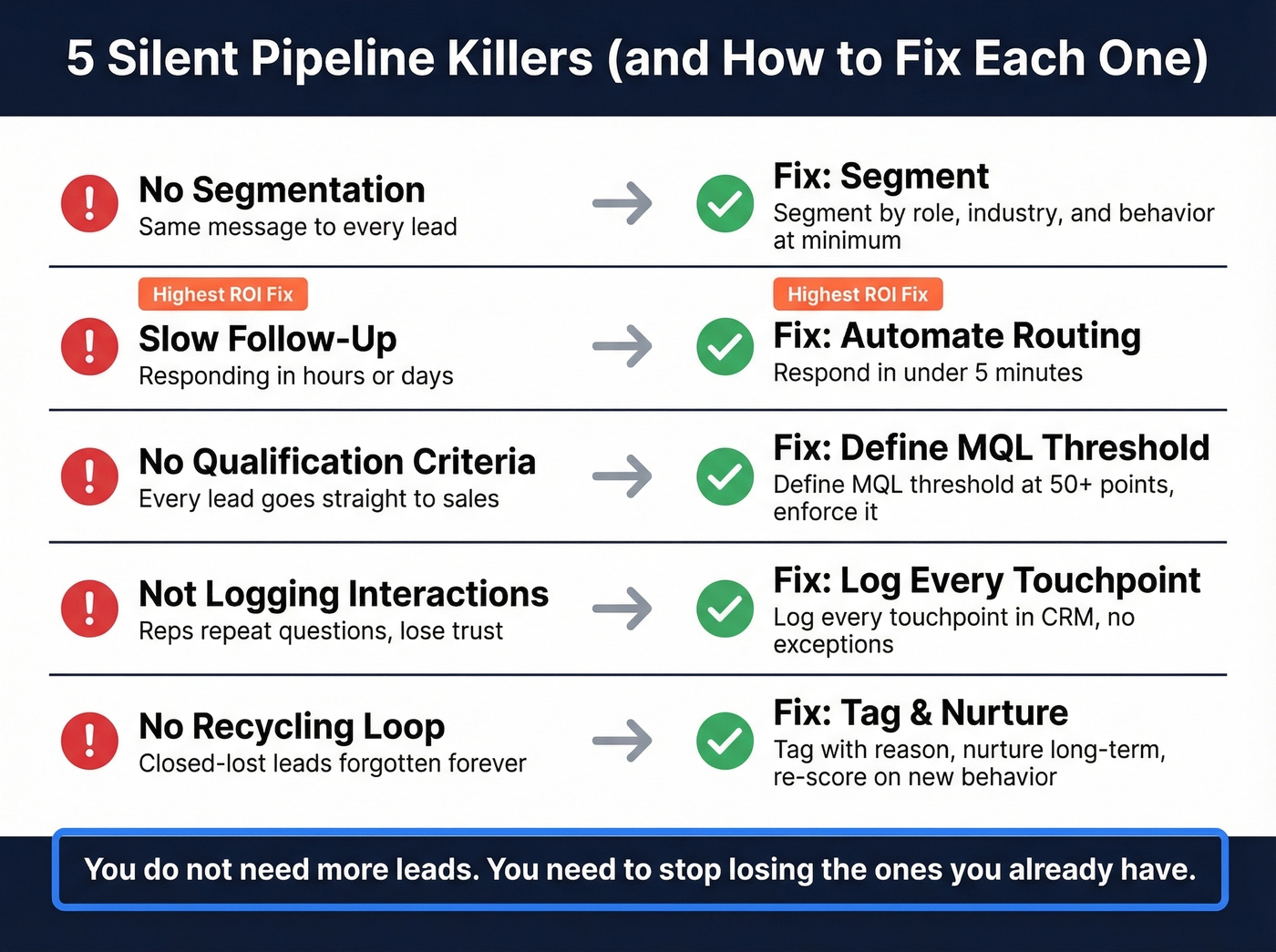
No segmentation. Treating all leads the same - same sequence, same cadence, same messaging - guarantees you'll bore high-intent buyers and overwhelm early-stage researchers. Segment by role, industry, and behavior at minimum.
Slow follow-up. This is the single highest-ROI fix for most teams. Responding in hours or days when the data says you need to respond in minutes. Automate your routing and alert system. I've watched teams double their SQL rate just by cutting response time from 4 hours to under 10 minutes - no new leads required, no new spend.
No qualification criteria. If every lead goes straight to sales, your reps waste time on people who were never going to buy. Define your MQL threshold and enforce it. Skip this if you enjoy watching your best closers chase tire-kickers.
Not logging interactions. When a lead talks to marketing, then an SDR, then an AE - and nobody knows what was already discussed - you look unprofessional and lose trust. Log everything in your CRM. No exceptions.
No recycling loop. The silent pipeline killer. Leads that didn't convert get dumped into "closed-lost" and forgotten. Tag them with a reason, drop them into a long-term nurture track, and re-score when their behavior changes. You already paid to acquire them.
If you’re seeing these issues repeatedly, it’s usually part of broader sales pipeline challenges that need process-level fixes.
Building Your Tech Stack
You don't need 12 tools. You need three layers. The marketing automation market is projected to hit $81B by 2030, so this infrastructure isn't optional anymore - but overspending on it is a real risk.
CRM. HubSpot's free tier handles contact management, deal tracking, and basic automation for small teams. Paid plans start around $20-$30/user/mo. Salesforce runs $25-$330/user/mo depending on the edition - it's the enterprise standard but overkill for teams under 20 reps. If you're still deciding, here are more examples of a CRM with real pricing.
Automation. Zapier starts at $19.99/mo and connects your forms, CRM, email tools, and Slack. Make.com starts around $9-$10/mo and offers more complex workflow logic for less money. Either one can power the speed-to-lead routing workflow that actually moves the needle.
Data enrichment. This is where most stacks have a gap. Prospeo fills it - self-serve, no contracts, integrates with Salesforce, HubSpot, Zapier, Make, and more. 98% email accuracy, 7-day refresh cycles, and a free tier with 75 verified emails per month. At roughly $0.01 per email on paid plans, it's a fraction of what enterprise enrichment platforms charge.
If you want to go deeper on the operational side, use lead enrichment to map what to enrich, when, and where it should live in your CRM.
As you scale, add scheduling tools like Calendly (around $10-$16/user/mo) and dedicated scoring. Use your CRM's native scoring first - enterprise-grade predictive scoring platforms run $2K-$10K+/mo, which most teams don't need until they're processing thousands of leads monthly.
Speed-to-lead dies when reps waste time on wrong numbers and dead emails. Prospeo gives your team 143M+ verified emails and 125M+ verified mobiles so routed leads actually connect. Snyk's 50 AEs dropped bounce rates from 40% to under 5% and grew AE-sourced pipeline 180%.
Stop routing leads into a black hole. Give reps data that connects.
FAQ
What's the difference between MQL and SQL?
An MQL hits your scoring threshold through actions like downloading content or visiting pricing pages - it's marketing-qualified based on engagement signals. An SQL is confirmed after a direct conversation validates budget, authority, need, and timeline. Define the handoff at a specific score (e.g., 70+) in a written SLA both teams sign off on.
How fast should you respond to a new lead?
Under 5 minutes. Qualification rates drop from 21% to under 1% after 30 minutes, and the average B2B team takes 42 hours. Automate alerts via Slack or CRM notifications so reps get pinged the moment a high-scoring lead comes in.
What tools do you need for lead management?
At minimum: a CRM (HubSpot or Salesforce), an automation layer (Zapier or Make.com), and a data enrichment platform to keep contact records accurate. That three-tool stack covers capture, routing, and data quality. Add scheduling and scoring tools as volume exceeds a few hundred leads per month.
How do you find and fix the biggest bottleneck?
Audit the three stages with the highest drop-off: data quality, scoring accuracy, and routing speed. Measure your current metrics against the 2026 benchmarks in this guide, identify the widest gap, and fix that first. Incremental improvement to one bottleneck outperforms a full-process overhaul every time.
The lead management process isn't complicated. It's just unforgiving. Nail data quality, scoring, and speed-to-lead - those three stages account for more pipeline impact than the other four combined. Start there, measure against the benchmarks above, and fix the leaks before you pour more leads into a broken funnel.