

The 12 Best Lead Management Software Tools for 2026
Most "best lead management software" guides recommend 16+ tools. You don't need 16. You need one CRM, maybe a data layer, and the discipline to actually use them. Here are 12 picks sorted by what matters - with real pricing, because "contact sales" isn't a recommendation.
Our Picks at a Glance
91% of companies with 10+ employees already use a CRM. The question isn't whether you need software for managing leads - it's whether you're using the right one.
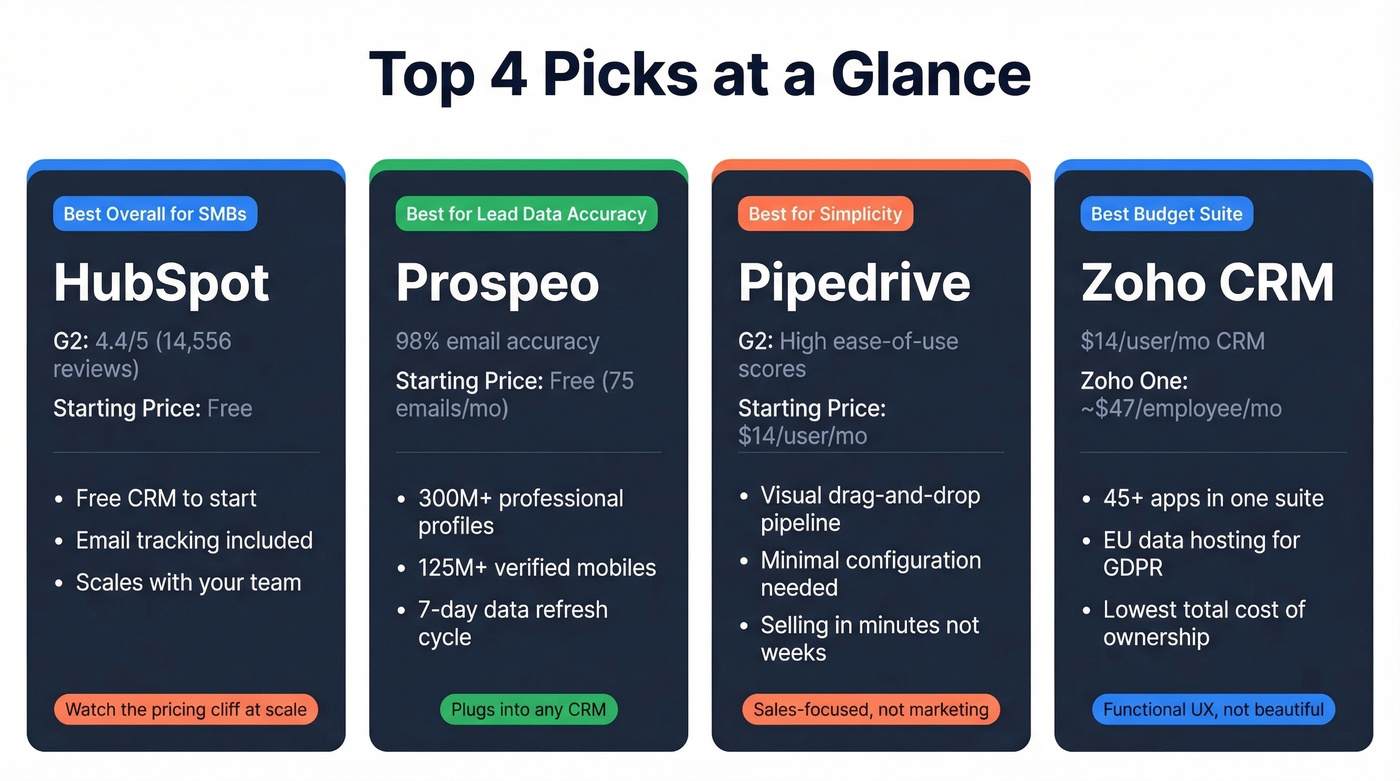
| Scenario | Pick | Why |
|---|---|---|
| Best overall for SMBs | HubSpot | Free to start, scales with you - just watch the pricing cliff |
| Best for lead data accuracy | Prospeo | 98% email accuracy, 125M+ verified mobiles, plugs into any CRM |
| Best for simplicity | Pipedrive | Visual pipeline, minimal config, selling in minutes |
| Best budget suite | Zoho CRM | $14/user/mo, or ~$47/employee/mo for 45+ apps |
Your pipeline is only as good as the data feeding it. A $3,600/mo CRM can't fix a 30% bounce rate.
What Is Lead Management Software?
Lead management software handles the upstream work before someone becomes a customer - the plumbing between "someone raised their hand" and "a rep is working a deal."
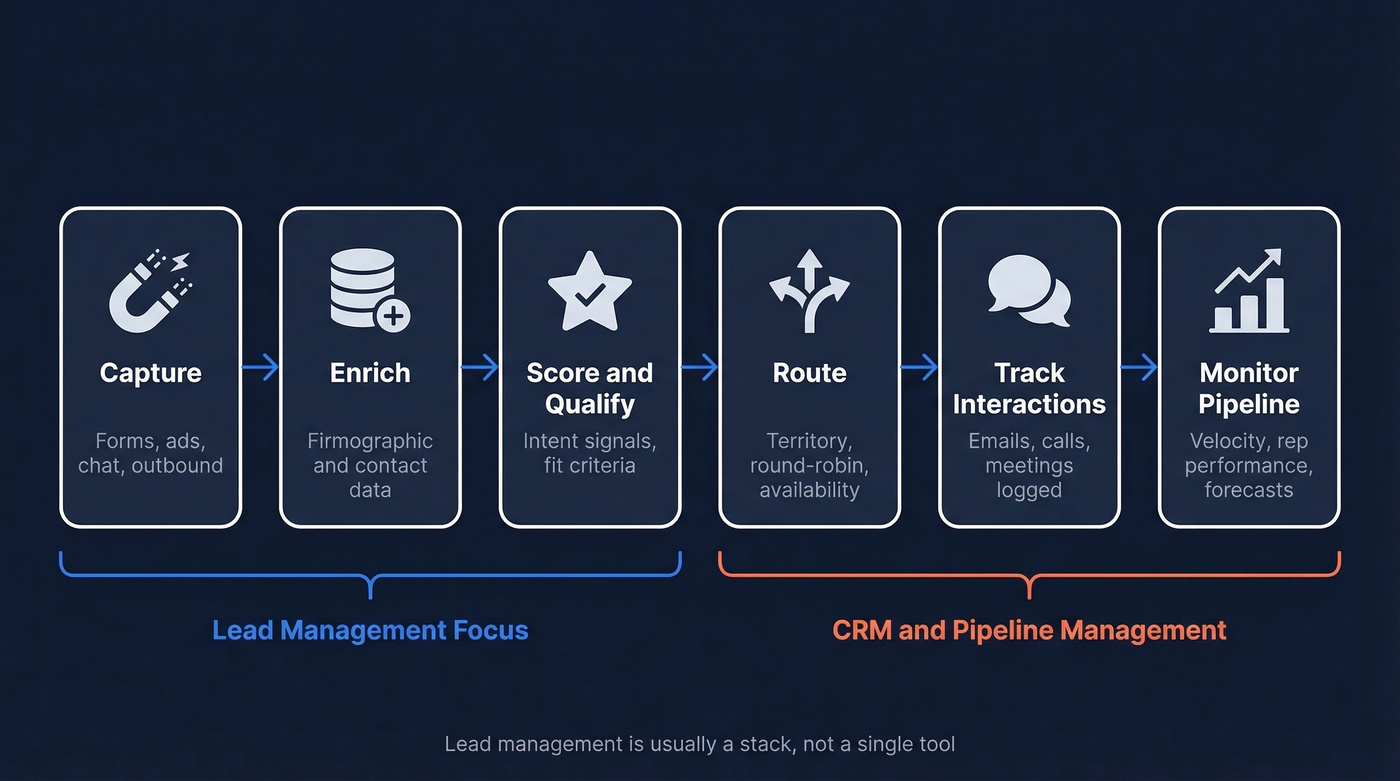
The workflow follows a predictable sequence: capture leads from forms, ads, chat, or outbound; enrich them with firmographic and contact data; score and qualify based on intent signals; route to the right rep via territory, round-robin, or availability rules; track every interaction; then monitor pipeline velocity and rep performance.
Here's the distinction that matters: a CRM is the home base - it stores customer data and relationship history. A lead management tool focuses on conversion efficiency, getting the right lead to the right rep at the right time. Pipeline management is downstream - revenue tracking and forecasting. Many CRMs bundle all three, but understanding what you actually need versus what you're paying for saves real money.
Lead management is usually a stack, not a single tool. Your CRM handles the pipeline. A data platform handles enrichment and verification. An automation layer handles routing and sequencing. The best setups pair two or three purpose-built tools rather than forcing one platform to do everything poorly. And data compliance - GDPR consent tracking, opt-out enforcement, data residency - is now a non-negotiable part of that stack, not an afterthought.
Why Lead Management Matters
The numbers aren't subtle. CRM usage increases sales by 29%, productivity by 34%, and forecast accuracy by 42%. The average ROI is $8.71 for every $1 spent. The global CRM market is projected to grow from $112.91B to $262.74B by 2032 - this category isn't slowing down.
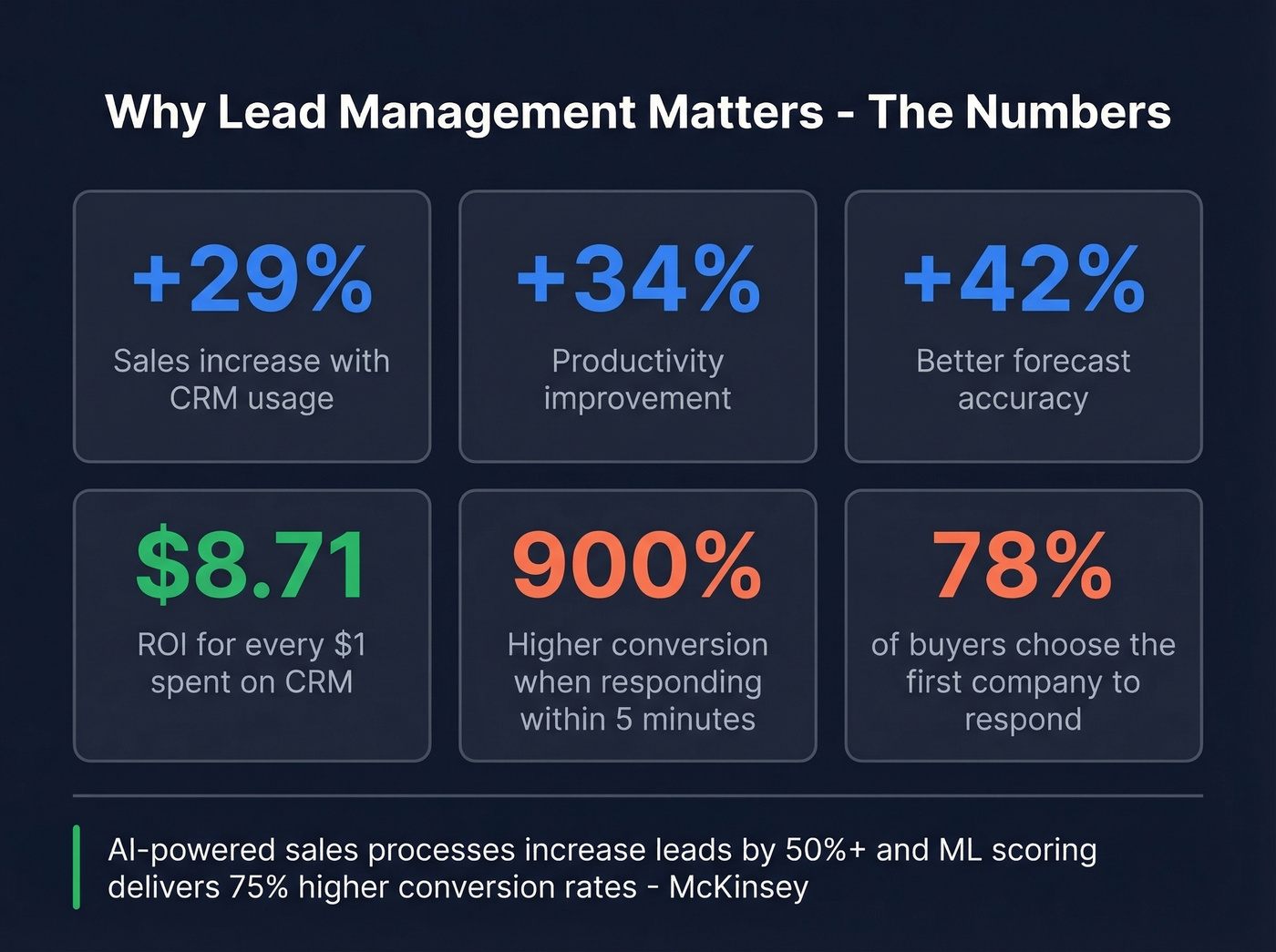
Speed-to-lead is the stat that should keep you up at night. Responding within 5 minutes increases your conversion chance by 900%. And 78% of buyers choose the first company to respond. If your leads sit in a spreadsheet for two days before someone calls, you've already lost.
AI is accelerating the gap between teams that automate and teams that don't. McKinsey research shows AI-powered sales processes increase leads and appointments by 50%+, while machine learning scoring models deliver 75% higher conversion rates than rule-based systems. That's not a nice-to-have. It's the difference between winning and watching your competitor close the deal.
How We Evaluated
We weighted six criteria across all 12 tools:
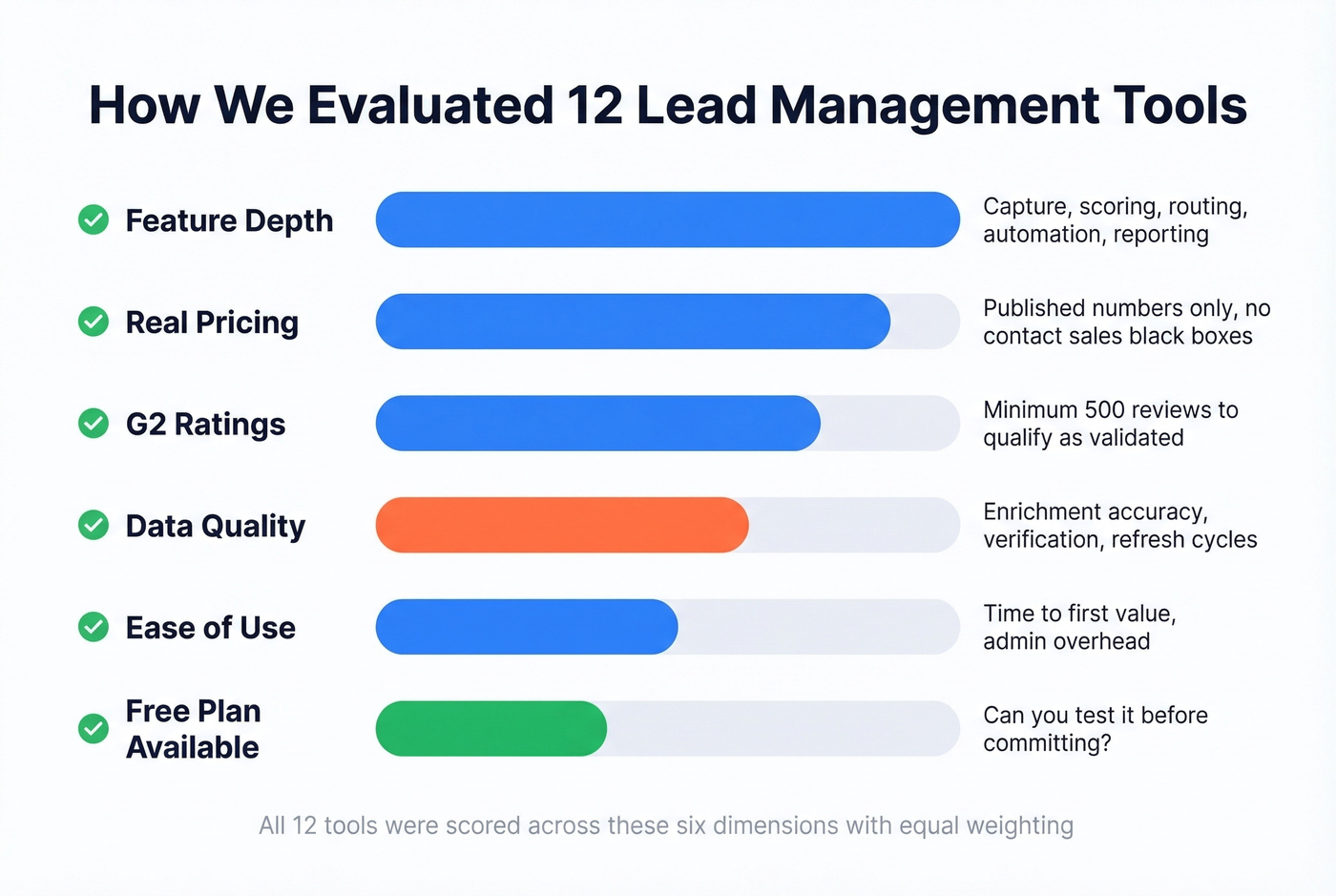
- Feature depth - capture, scoring, routing, automation, reporting
- Real pricing - published numbers, not "talk to sales" black boxes
- G2 ratings + review volume - minimum 500 reviews to qualify as validated
- Data quality - enrichment accuracy, verification, refresh cycles
- Ease of use - time to first value, admin overhead
- Free plan availability - can you actually test it before committing?

Lead management software tracks your pipeline. But 30% bounce rates destroy it. Prospeo feeds your CRM verified contacts - 300M+ profiles, 98% email accuracy, 7-day refresh - so every lead your reps work is real. At $0.01/email, fixing your data costs less than one lost deal.
Stop managing leads that bounce. Start with verified data.
The 12 Best Lead Management Systems
1. HubSpot
Best for: SMBs starting from zero | G2 (Marketing Hub): 4.4/5 (14,556 reviews) | Starting price: Free
Use this if you want a CRM that grows with you and don't mind paying more later. HubSpot's free tier gives you contact management, deal pipelines, and activity tracking - including email tracking - at no cost. For a 5-person team just getting organized, nothing else matches the free-to-value ratio.
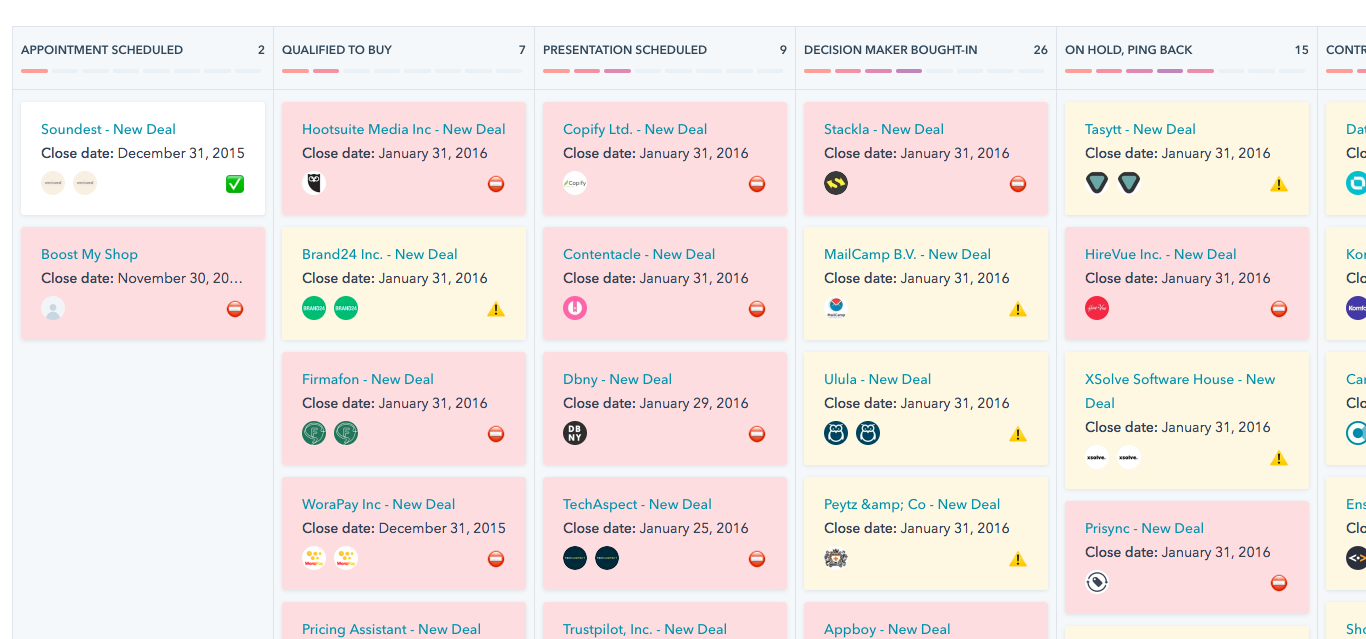
Skip this if you need predictive lead scoring without a massive budget. Rule-based scoring requires Professional ($890/mo for 3 seats). Predictive scoring? That's Enterprise - $3,600/mo with a 10-seat minimum and a $3,500 onboarding fee. We've seen teams sign up for the free plan, fall in love, and then get sticker shock when they need features that actually automate their process. G2 reviews consistently flag complexity and cost escalation as the platform scales.
HubSpot is the best on-ramp in the category. Just budget for the escalation before you're locked in.
2. Prospeo
Best for: Lead data accuracy | Starting price: Free (75 emails/mo)
Your CRM manages leads. Prospeo makes sure those leads are real.
Every tool on this list assumes your contact data is accurate. It usually isn't. Prospeo sits upstream of your CRM as the data quality layer - 300M+ professional profiles, 143M+ verified emails at 98% accuracy, and 125M+ verified mobile numbers. The 7-day data refresh cycle means you're not working stale records while competitors refresh every six weeks.

CRM and CSV enrichment returns 50+ data points per contact at a 92% API match rate, with an 83% enrichment match rate. Layer in intent data tracking 15,000 topics via Bombora, and you're not just managing leads - you're prioritizing the ones actively researching your category. Native integrations with Salesforce, HubSpot, Smartlead, Instantly, Lemlist, and Clay keep data flowing without manual exports.
The proof: Snyk's 50-person AE team dropped their bounce rate from 35-40% to under 5% after switching, generating 200+ new opportunities per month.

Snyk's 50 AEs cut bounce rates from 35% to under 5% and generated 200+ opportunities per month. The difference wasn't their CRM - it was the data layer upstream. Prospeo enriches your pipeline with 50+ data points per contact and intent signals across 15,000 topics.
Your lead management stack has a data gap. Close it today.
3. Pipedrive
Best for: Simplicity | Starting price: $14/user/mo

Use this if you want your team selling today, not configuring workflows for a month. Pipedrive's visual pipeline is one of the most intuitive in the category - drag deals between stages, see bottlenecks instantly, and get activity reminders that keep reps on track. As a standalone lead tracking tool, it's hard to beat for teams that value speed over feature depth.
Skip this if you need sophisticated marketing automation or predictive scoring. Pipedrive is a sales tool, not a marketing platform. For teams under 20 reps with a straightforward sales process, it's an obvious choice.
4. Zoho CRM
Best for: Budget-conscious teams needing a full suite | Starting price: $14/user/mo
Zoho is the lowest total cost of ownership play on this list.
The real value is Zoho One - about $47/employee/mo on annual billing gets you 45+ apps covering CRM, marketing, support, finance, and BI. For a 15-person company that needs more than just a CRM, nothing else touches that price point. EU data hosting via zoho.eu is a solid compliance bonus for GDPR-conscious teams.
The tradeoff is UX. Zoho's interface is functional, not beautiful. It does everything, but nothing feels as polished as HubSpot or Pipedrive. If your team values aesthetics and intuitive design, they'll grumble. If they value saving $500/mo on a software stack, they'll adapt.
5. Freshsales
Best for: AI features without enterprise pricing | Starting price: Free
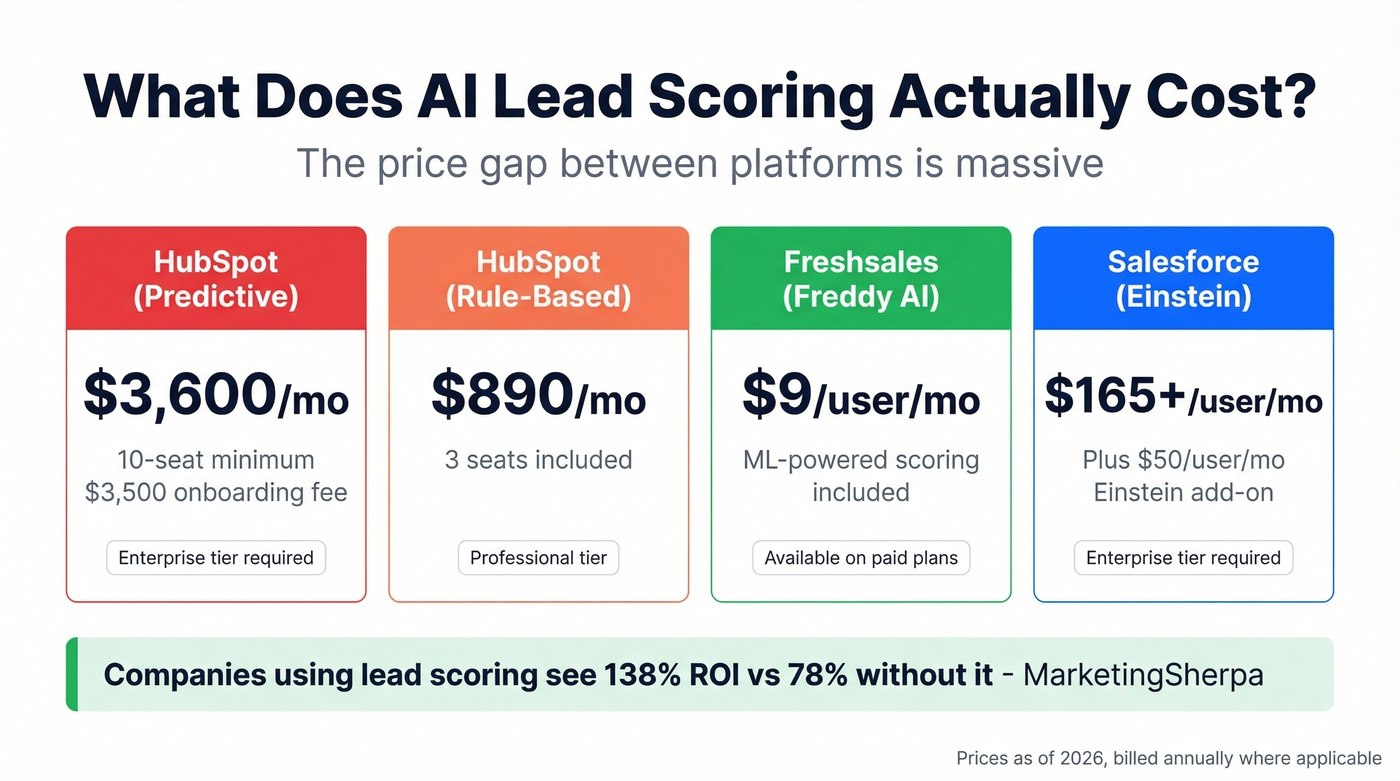
I watched a mid-size SaaS team switch from HubSpot Professional to Freshsales Pro last year. They went from paying $890/mo to a per-seat plan - and got AI lead scoring (Freddy AI) included at a tier where HubSpot gates predictive scoring behind $3,600/mo.
Free plan available. Paid plans start at $9/user/mo, and the 21-day trial is generous enough to test scoring models with real data. Companies using lead scoring see 138% ROI versus 78% without it. Freshsales puts ML-powered scoring within reach of teams that can't stomach enterprise pricing. Skip it if you need deep marketing automation - Freshsales is sales-first, and the marketing features feel bolted on.
6. Salesflare
Best for: Automated data capture | Starting price: $29/user/mo
If your small B2B team hates CRM data entry - and let's be honest, they do - Salesflare removes the friction. It auto-captures contact data from emails and calendar events, so reps spend time selling instead of typing. G2 sub-scores are exceptional: 9.5 on ease of use, 9.7 on support.
The Pro plan runs $49/user/month billed annually ($64 monthly), with a free trial up to 30 days. The limitation is customization - Salesflare won't match HubSpot or Salesforce for complex, multi-stage enterprise sales cycles. But for a 10-person team that needs a CRM that fills itself in, it's the anti-Salesforce. That's exactly the point.
7. Close
Best for: Inside sales teams | Starting price: $9/seat/mo
Close is built for teams that live on the phone. Built-in calling, SMS, and email sequences in one interface - no separate dialer needed. If outbound calling is core to your process, Close eliminates tool sprawl. If it's not, look elsewhere.
8. Salesforce
Best for: Enterprise with dedicated admins | G2 (Sales Cloud): 4.4/5 (25,480 reviews) | Starting price: $25/user/mo
Here's the thing about Salesforce: the Starter Suite at $25/user/mo looks reasonable. Then you need Einstein Lead Scoring, which requires Sales Cloud Enterprise ($165/user/mo) or higher, plus an Einstein for Sales add-on starting at $50/user/mo. Then you need someone to configure it - implementation runs $50K-$500K+. G2 reviews tell the same story: powerful platform, but complex, time-consuming to customize, and expensive to maintain.
Salesforce makes sense for 50+ rep organizations with a dedicated admin team. Einstein needs roughly 1,000 converted leads minimum to build a quality scoring model, which means smaller teams won't even get value from the AI they're paying for.
If your average deal size is under $25K and you have fewer than 30 reps, you almost certainly don't need Salesforce. The money you save on licensing and implementation will fund better data, better training, and better tools your reps will actually use.
9. ActiveCampaign
Best for: Marketing-heavy lead nurture | G2: 4.4/5 (14,606 reviews) | Starting price: $15/mo
The strongest email automation and lead scoring combination for marketing teams. Starter from $15/mo, Professional from $79/mo. If marketing drives most of your pipeline and you need sophisticated drip campaigns, conditional workflows, and engagement-based scoring, ActiveCampaign does it better than any CRM's built-in marketing tools. It's not a full CRM replacement - think of it as the nurture engine that feeds your pipeline.
10. Nutshell
Best for: Simple pipeline management | Starting price: $19/user/mo
A clean CRM for small teams with solid reporting. Automation is limited compared to the tools above, but if you need straightforward pipeline tracking without complexity, Nutshell delivers without the learning curve.
11. Capsule
Best for: Micro-teams and freelancers | Starting price: Free (2 users, 250 contacts)
Paid plans from $18/user/mo. Minimalist CRM for micro-teams or freelancers who need contact management without overhead. You'll outgrow it fast, but it's a clean starting point when HubSpot feels like too much. The 250-contact cap on the free tier is a real constraint, though - most teams hit it within weeks.
12. Vtiger
Best for: Budget flexibility | Starting price: $12/user/mo
Open-source roots give it strong value and flexibility. The interface feels dated, but for budget-constrained teams willing to tolerate some rough edges, the price-to-feature ratio is hard to beat.
Comparison Table
| Tool | Best For | Starting Price | G2 Rating | AI Scoring |
|---|---|---|---|---|
| HubSpot | SMB on-ramp | Free | 4.4/5 | Enterprise only ($3,600/mo) |
| Prospeo | Data accuracy layer | Free (75 emails) | 15,000+ companies | Intent data (15K topics) |
| Pipedrive | Simplicity | $14/user/mo | - | Pro+ tiers |
| Zoho CRM | Budget suite | $14/user/mo | - | Higher tiers |
| Freshsales | AI without enterprise tax | Free | - | Paid tiers |
| Salesflare | Auto data capture | $29/user/mo | - | No |
| Close | Inside sales | $9/seat/mo | - | No |
| Salesforce | Enterprise | $25/user/mo | 4.4/5 | Enterprise + add-on |
| ActiveCampaign | Marketing nurture | $15/mo | 4.4/5 | Professional+ |
| Nutshell | Simple pipeline | $19/user/mo | - | No |
| Capsule | Micro-teams | Free (2 users) | - | No |
| Vtiger | Budget flexibility | $12/user/mo | - | Paid tiers |
What You'll Actually Pay
The "starting at" prices on vendor websites tell maybe half the story.
Solo or micro-team (1-5 users): $0-$30/user/mo. HubSpot Free, Freshsales Free, Pipedrive, or Zoho all live here. You've got a functional lead management program at near-zero cost.
Small team (5-15 users): $15-$50/user/mo. This is where most SMBs land. Enough budget for a solid CRM plus a data enrichment layer on top.
Mid-market (15-50 users): $50-$175/user/mo. HubSpot Professional starts at $890/mo for 3 seats - roughly $297/seat, with each additional seat adding to the bill. Budget for implementation: HubSpot's onboarding fee is $3,500; Salesforce implementations run $50K-$500K+.
Enterprise (50+ users): $150-$650+/user/mo. Salesforce Enterprise ($165/user/mo) plus Einstein add-ons, or HubSpot Enterprise ($3,600/mo). If you're layering in ABM platforms like 6sense, expect $60K-$300K/year on top of your CRM. These are real numbers that rarely appear in "best software" guides.
Mistakes That Kill Conversion
Five patterns we see repeatedly in teams that can't figure out why their pipeline leaks:
No segmentation. Treating every lead the same guarantees you'll waste rep time on low-intent contacts while hot leads go cold. (If you need a framework, start with an ideal customer profile and score against it.)
Slow follow-up. The 5-minute benchmark exists for a reason: 78% of buyers choose the first responder. Set up automated routing and alerts, or accept the revenue hit. If your reps need help, keep sales follow-up templates on hand.
No qualification process. Without scoring or explicit criteria, reps chase whatever looks interesting. That's not a strategy - it's hope. A lightweight lead status system fixes more than you'd expect.
Not logging interactions. Every unlogged call is context your team loses forever. When a lead gets handed off or a rep leaves, that history disappears. We've watched entire deal contexts evaporate because a departing rep never logged a single note in the CRM.
Dirty data entering the system. If 30% of your emails bounce, your domain reputation tanks, your sequences underperform, and your metrics lie to you. Verify contact data before it enters your pipeline - the bounce-rate spiral damages sender reputation and wastes rep effort. (If deliverability is already slipping, start with an email deliverability guide and then work on how to improve sender reputation.) The consensus on r/sales is that bad data is the silent killer of outbound programs, and our experience backs that up completely.
FAQ
What's the difference between lead management software and a CRM?
A CRM stores customer data across the entire lifecycle - from first touch through renewal. Lead management software focuses upstream: capturing, enriching, scoring, routing, and converting leads before they become customers. Many CRMs include basic lead management features, but dedicated tools handle routing and scoring with more depth.
Do I need a dedicated tool or just a CRM?
For teams with fewer than 10 reps and a simple sales process, a CRM like HubSpot or Pipedrive covers the basics. Once you're dealing with multiple lead sources, complex routing, or high-volume outbound, add specialized tools - a data quality platform for enrichment, ActiveCampaign for nurture sequences - rather than forcing your CRM to do everything.
What's the best free option for small teams?
HubSpot Free CRM is the strongest free option for pipeline management and basic lead tracking. Freshsales also offers a free tier with built-in AI scoring. For data quality specifically, Prospeo's free plan includes 75 verified emails per month - enough to test enrichment accuracy before committing. Capsule covers 2 users and 250 contacts, but you'll hit those limits fast.
How do I choose the right lead management system?
Start with team size and sales motion. Under 10 reps with inbound-heavy flow: HubSpot or Pipedrive. Outbound-heavy teams: Close or Freshsales paired with a data enrichment layer. Budget-constrained teams needing a full suite: Zoho One at ~$47/employee/mo. Enterprise with 50+ reps and a dedicated admin: Salesforce. Match the tool to your process, not the other way around.