

Lead Qualification: Frameworks, Benchmarks, and the Process Top Teams Use in 2026
It's the last week of the quarter. Your CRM shows 200 "qualified" leads in the pipeline, your close rate is four percent, and the VP of Sales is already rewriting the forecast while marketing points at MQL volume like it's a trophy. Here's the uncomfortable truth: 79% of marketing-generated leads never convert to sales. The problem isn't lead generation. It's lead qualification.
The Short Version
Define your ICP first - everything downstream depends on it. Pick one framework (BANT for SMB, CHAMP for mid-market, MEDDIC for enterprise) and enforce it across every rep, no exceptions. Enrich your data before the first call so reps don't waste discovery on questions a database can answer. Follow up within 5 minutes on inbound leads - they're 21x more likely to enter the sales cycle. And measure SQL-to-Opportunity rate quarterly, not just MQL volume. If you want to qualify leads faster, automation and clean data aren't optional.
What Is Lead Qualification?
Lead qualification is the process of evaluating whether a prospect has the fit, readiness, and intent to become a customer - and whether sales should spend time on them. It's the filter between "someone downloaded a whitepaper" and "someone we should actually call."
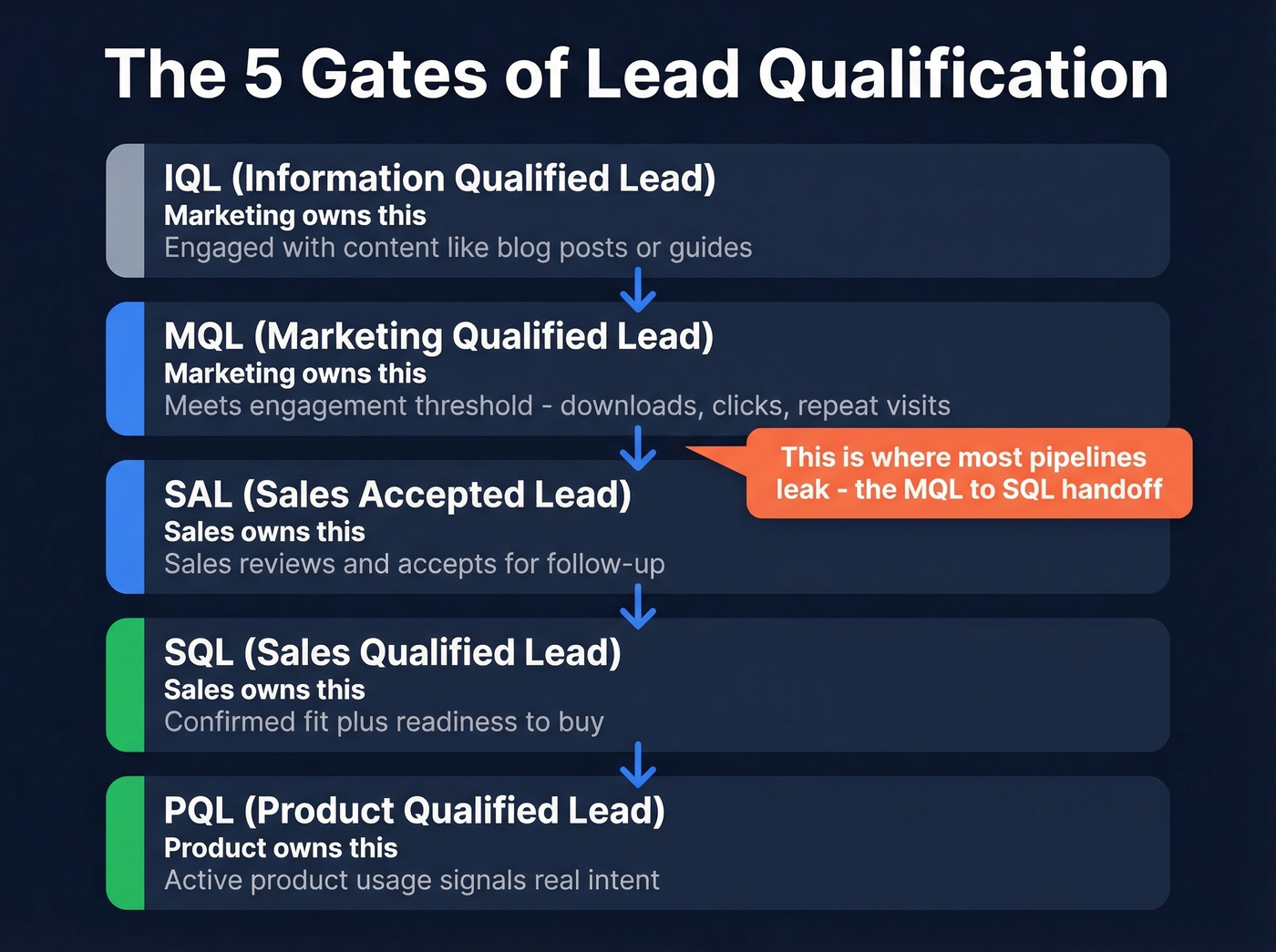
Qualification isn't a single moment. It's a series of gates:
| Acronym | Full Name | Who Owns It | What It Means |
|---|---|---|---|
| IQL | Information Qualified | Marketing | Engaged with content |
| MQL | Marketing Qualified | Marketing | Meets engagement threshold |
| SAL | Sales Accepted | Sales | Accepted for follow-up |
| SQL | Sales Qualified | Sales | Confirmed fit + readiness |
| PQL | Product Qualified | Product | Active usage signals intent |
A qualified lead is a prospect who's passed through at least one of these gates with confirmed fit and demonstrated intent - not just someone who filled out a form. The handoff from MQL to SQL is where most pipelines leak, and getting that transition right is what this guide is about.
Why Qualification Matters More Than Pipeline Volume
Only 25% of marketing leads actually qualify for direct sales engagement. Three out of four leads your SDRs are calling shouldn't be in the queue at all. Even Salesforce - the company that literally built the CRM category - converts less than 5% of its traffic into qualified leads. Volume isn't the game. Density is.
The math is brutal. The average lead-to-MQL conversion rate is 31%, and MQL-to-SQL sits at just 13%. For every 1,000 leads, you get roughly 310 MQLs and about 40 SQLs. If your MQL-to-SQL rate falls below that 13% benchmark, your qualification criteria are broken or your data is.
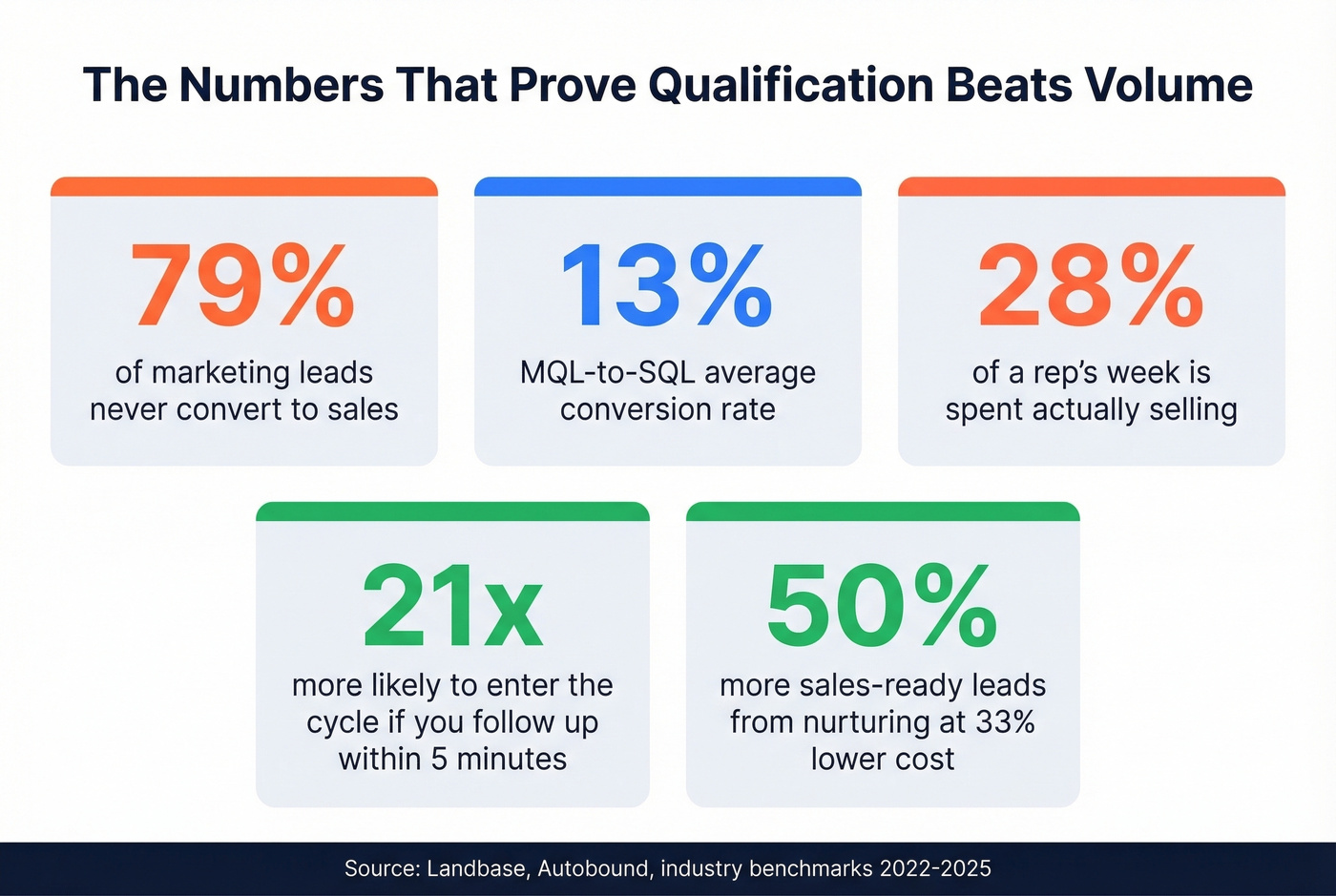
Reps spend only 28% of their week actually selling. The rest disappears into admin, research, internal meetings, and chasing leads that were never going to close. Tighter qualification doesn't just improve win rates - it gives reps more selling hours back. Marketing spends less nurturing dead ends, sales focuses on winnable deals, and leadership gets forecasts they can trust.
And the leads you disqualify today aren't wasted. Lead nurturing generates 50% more sales-ready leads at 33% lower cost. Route disqualified leads back to marketing instead of letting them rot in a rep's queue.
Benchmarks by Industry
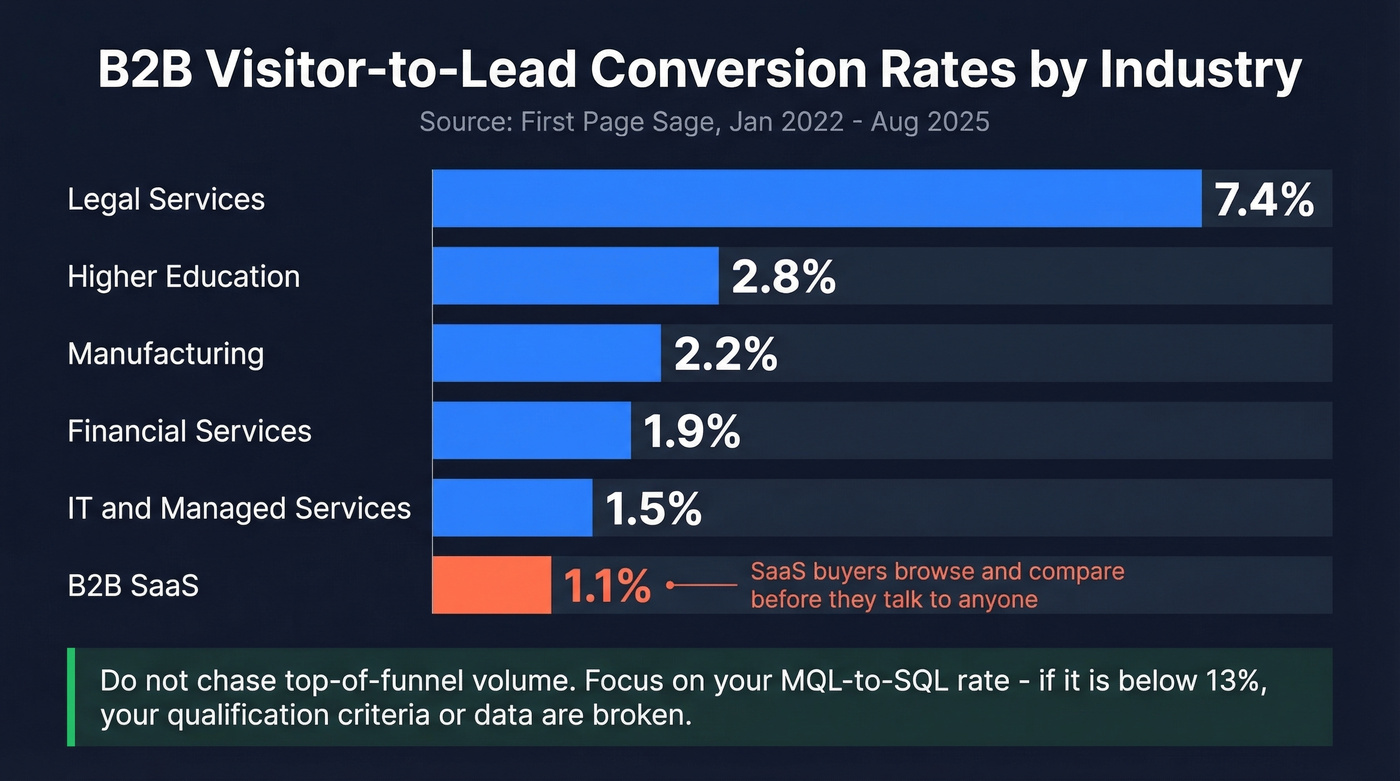
Before you can fix your funnel, you need to know what "normal" looks like. These visitor-to-lead conversion benchmarks come from a First Page Sage dataset spanning January 2022 through August 2025:
| Industry | Visitor-to-Lead Rate |
|---|---|
| B2B SaaS | 1.1% |
| IT & Managed Services | 1.5% |
| Financial Services | 1.9% |
| Manufacturing | 2.2% |
| Higher Education | 2.8% |
| Legal Services | 7.4% |
Legal services converting at 7.4% while SaaS sits at 1.1% isn't surprising - legal prospects often search with high urgency and specific intent. SaaS visitors browse and compare before they're ready to talk to anyone.
Don't chase a higher top-of-funnel number. Benchmark your conversion rates against your vertical and focus on the MQL-to-SQL transition. If yours is below 13%, you're either qualifying too loosely or working with bad data.
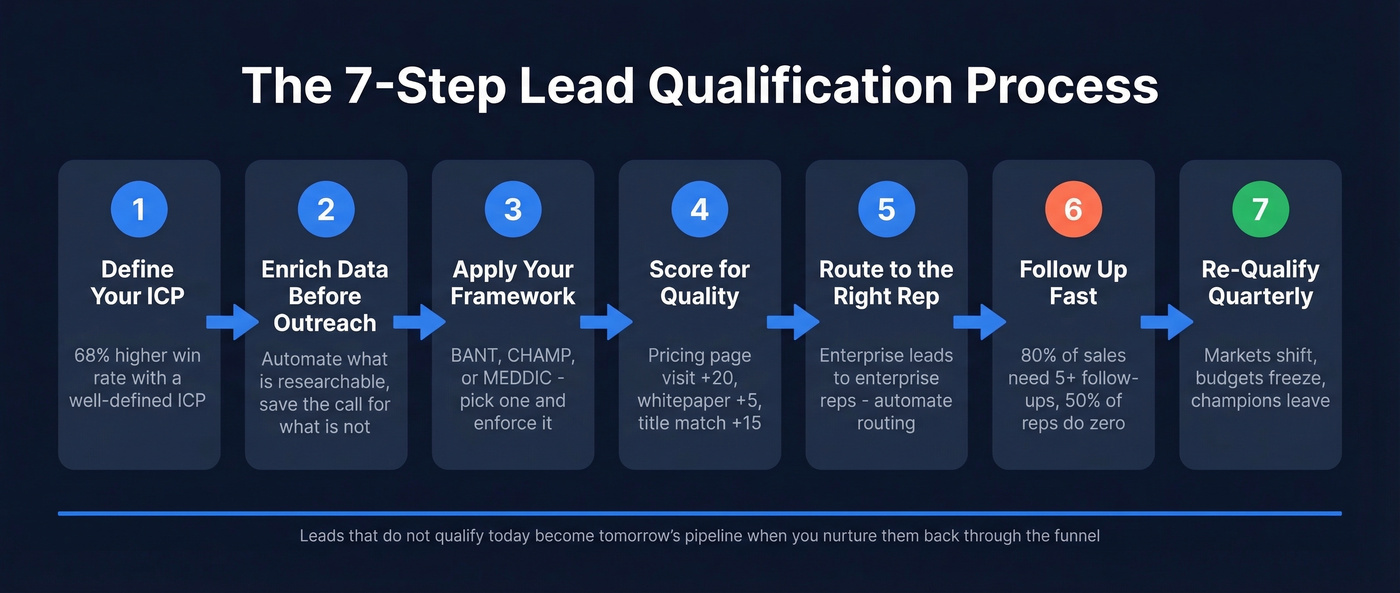
The Qualification Process in 7 Steps
1. Define Your ICP
Everything starts here. Companies with a well-defined ICP see a 68% higher win rate. Your ICP isn't "mid-market SaaS companies." It's "B2B SaaS companies with 50-500 employees, Series A through C, using Salesforce, with an outbound sales motion and a VP of Sales who reports to a CRO." The more specific, the faster reps can disqualify.
2. Enrich and Verify Data Before Outreach
Don't let reps burn discovery calls on questions a database can answer. Company size, headcount trends, tech stack, funding stage, hiring signals - all of this is available before anyone picks up the phone. Prospeo enriches CRM records with 50+ data points per contact at a 92% API match rate and 98% email accuracy, refreshing every 7 days instead of the industry-standard six weeks. Snyk's AE team saw bounce rates drop from 35-40% to under 5% after switching to enriched data with a weekly refresh.
Automate what's researchable. Save the call for what isn't.
3. Apply Your Framework
Pick BANT, CHAMP, or MEDDIC and run every lead through it. The framework matters less than consistency - a simple framework used by every rep beats a complex one used by two. Enforcement beats sophistication every time.
4. Score Leads for Quality
Combine firmographic data with behavioral signals. Firmographic fit - company size, industry, tech stack - tells you if they could buy. Behavioral signals - page visits, content downloads, email engagement, intent data - tell you if they want to.
Make it concrete: a prospect who visits your pricing page scores +20 points, a whitepaper download scores +5, and a job title match adds +15. The specific numbers matter less than the principle: weight intent signals higher than passive engagement.
5. Route to the Right Rep
An enterprise lead shouldn't land with an SMB SDR. Route by segment, geography, or vertical - whatever matches your team structure. Speed-to-lead drops when routing is manual, so automate it.
6. Follow Up Fast
80% of sales require at least 5 follow-ups. Nearly 50% of reps don't follow up at all. That's not a qualification problem - it's a discipline problem. Build follow-up cadences into your sequencer and hold reps accountable. If you need copy, use these sales follow-up templates.
7. Re-Qualify Quarterly
Markets shift. Budgets freeze. Champions leave. Review your SQL criteria every quarter, document why SQLs fail after acceptance, and feed that data back into your scoring model. The best qualification systems are living systems, and the leads that don't qualify today become tomorrow's pipeline when you nurture them back through the funnel.

Your reps spend 72% of their week not selling - and bad data makes it worse. Prospeo enriches CRM records with 50+ data points at a 92% match rate, so reps qualify leads before the first call, not during it. 98% email accuracy. 7-day refresh. $0.01 per lead.
Qualify faster when every lead arrives pre-enriched.
Which Framework Should You Use?
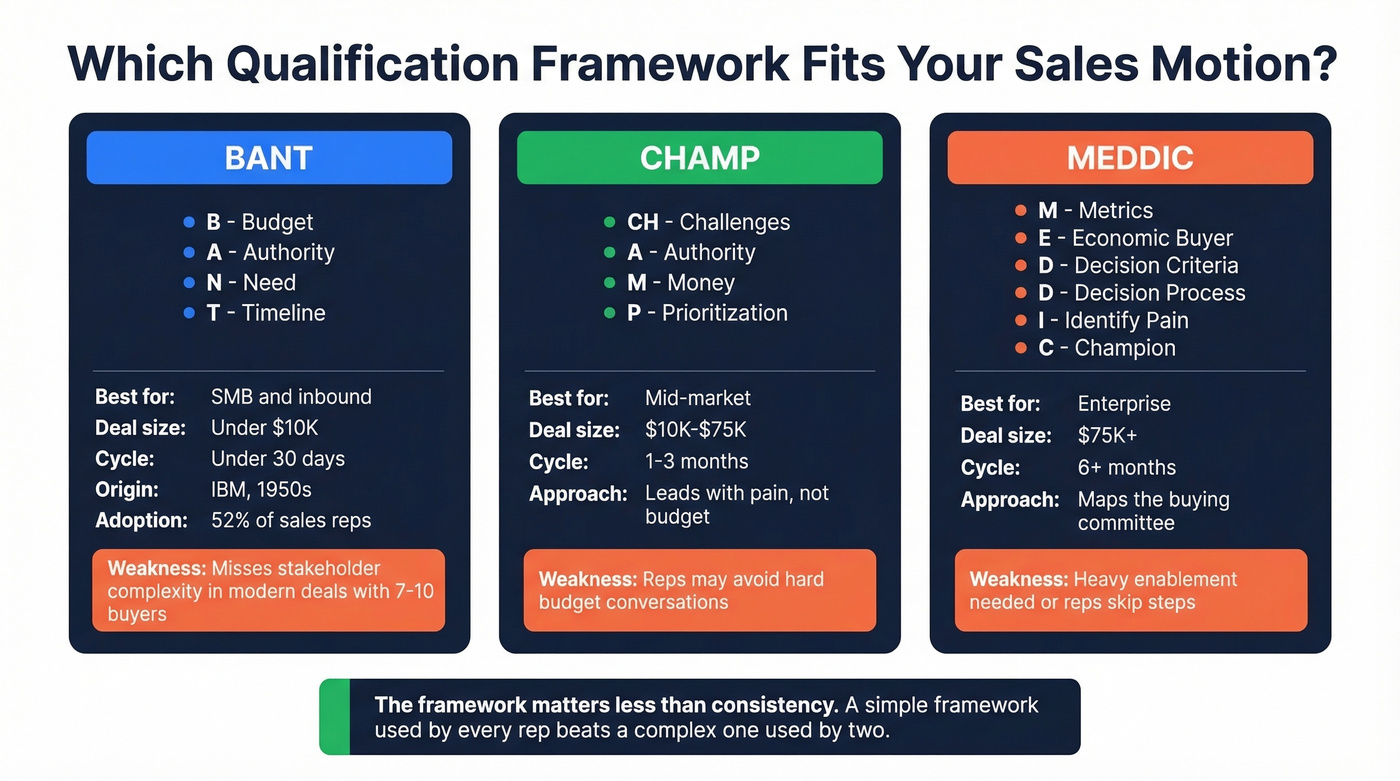
Let's be honest: the framework wars are mostly noise. What matters is picking one, training on it, and enforcing it. That said, different frameworks fit different sales motions.
| Framework | Best For | Deal Size | Cycle Length | Weakness |
|---|---|---|---|---|
| BANT | SMB, inbound | Sub-$10K | Under 30 days | Misses stakeholder complexity |
| CHAMP | Mid-market | $10-75K | 1-3 months | Can get too loose |
| MEDDIC | Enterprise | $75K+ | 6+ months | Requires heavy enablement |
BANT
IBM built BANT in the 1950s, and 52% of sales reps still trust it. Budget, Authority, Need, Timeline. It works for high-velocity motions where deals are transactional and cycles are short. The limitation is real, though: BANT assumes a single decision-maker, and modern B2B deals involve 7-10 people.
MEDDIC
Metrics, Economic Buyer, Decision Criteria, Decision Process, Identify Pain, Champion. MEDDIC is built for enterprise complexity - six-figure deals with 6+ month cycles where you need to map the buying committee and find a champion. The downside: it's heavy. Without proper enablement, reps either skip steps or fill in fields with garbage. If you're implementing it, start with these MEDDIC discovery questions.
CHAMP
Challenges, Authority, Money, Prioritization. CHAMP flips BANT by leading with pain instead of budget, which makes sense for consultative mid-market sales where you want to understand the problem before talking money. The risk is that reps use "discovery" as an excuse to avoid hard budget conversations.
Two other frameworks worth knowing but not building your process around: ANUM is essentially BANT reordered with urgency replacing timeline, and FAINT is designed for prospects who don't have a formal budget yet. Both are niche.
Lead vs. Opportunity Qualification
One distinction teams constantly blur: qualifying a lead determines whether a prospect deserves sales attention, while opportunity qualification evaluates whether an active deal is worth continued investment. They happen at different pipeline stages and require different criteria. A lead can be qualified but still become a dead opportunity if the deal dynamics - competitive landscape, internal politics, shifting priorities - don't line up. Treat them as separate gates.
The Criterion Nobody Talks About
One sales practitioner on r/GrowthHacking who's used the same qualification matrix for 20 years puts it bluntly: disqualification is the most important sales activity. His framework includes a criterion most teams skip - competitive alignment. Before investing in a deal, honestly assess whether your product's strengths match what the prospect needs most. If your competitor is stronger in their top-priority area, disqualify early. You'll lose that deal anyway; the only question is how much time you burn first.
This connects to a related contrarian insight: don't overweight existing relationships. A strong product-requirement fit beats a warm relationship with a poor-fit prospect every time. Reps hate hearing this, but the data backs it up.
If your average contract value is under five figures, you don't need MEDDIC. You need BANT, a clean database, and reps who can disqualify in under 3 minutes. We've seen teams agonize over BANT vs. MEDDIC for months while their reps freelance every call with no framework at all. Pick one. Train on it. Enforce it.
20 Qualifying Questions for Every Call
Before you ask a single question, do your pre-call research. Don't ask about company size, headcount, or tech stack - that information is available in your enrichment data. Save the call for things only the prospect can tell you.
Pain and Goals
- What's the biggest challenge with your current approach to [problem area]?
- What are the consequences if you don't solve this?
- What motivated you to search for a solution now?
- Walk me through your current process for [relevant workflow].
- What does success look like 12 months from now?
Decision Process
- How does your company make decisions on tools like this?
- What's your evaluation process - and where are you in it?
- Have you tried to solve this before? What happened?
- What would need to be true for you to move forward this quarter?
Stakeholders
- Who else is involved in evaluating solutions like this?
- What role do you play in the decision-making process?
- Is there anyone who'd block this purchase?
- Who signs the contract?
Budget and Timeline
- Do you have budget allocated for this, or would it need approval?
- What's a realistic timeline for making a decision?
- What's driving the timeline - is there a deadline or trigger event?
- What's the expected investment for a project of this kind?
Competition
- What other solutions are you evaluating?
- Which features are must-have vs. nice-to-have?
- What would make you choose us over the alternatives?
The best qualifiers aren't the ones who ask all 20 questions. They're the ones who know which 5-7 matter most for this specific prospect and dig deep on those.
5 Mistakes That Kill Your Pipeline
Prospecting With Stale Data
Nothing kills productivity like outdated records. You research a prospect, craft a personalized opener, reach out - and find out they left the company three months ago. The fix: run your database through an enrichment tool with a fast refresh cycle. In our experience, weekly refreshes catch the job changes and restructurings that make six-week-old data unreliable. If you're evaluating vendors, start with these data enrichment services.
Chasing Volume Over Quality
A bloated pipeline feels productive. It isn't. When reps chase MQL volume instead of SQL quality, cycles lengthen, win rates drop, and forecasting becomes fiction. Measure SQL-to-Opportunity rate, not MQL count. This single metric shift changes behavior faster than any training program.
Inconsistent Criteria Across Reps
If one rep qualifies on budget and another qualifies on "they seemed interested," your pipeline is unpredictable. Standardize your framework, build it into your CRM as required fields, and audit it monthly. This is also where a clean lead status setup prevents chaos.
Ignoring Buyer Intent Signals
Site visits, content downloads, event attendance, job postings, technographic changes - these are all signals that a prospect is in-market. Teams that layer intent data into their scoring models catch ready buyers before competitors do. Skip this if you're selling sub-$5K deals with short cycles, but for anything mid-market and above, intent data is table stakes. If you want a scoring model that actually holds up, see identifying buying signals.
Slow Follow-Up
Skipping discovery reduces demo effectiveness by 73%. Delaying follow-up by even an hour cuts your qualification odds dramatically. Build automated routing and cadence triggers so high-intent leads get a response in minutes, not days.
Snyk dropped bounce rates from 35-40% to under 5% and generated 200+ new opportunities per month - because their 50 AEs finally had data they could trust. When your ICP criteria run against 300M+ verified profiles with intent signals across 15,000 topics, qualification stops being guesswork.
Turn your ICP definition into a qualified pipeline today.
AI and Automation in 2026
89% of revenue organizations now use AI-powered tools, up from 34% in 2023. Gartner predicts that by 2027, 60%+ of B2B sales teams will use ML-derived intent scoring as a core qualification component. AI-driven scoring already improves accuracy by roughly 40% over manual methods.
What does this cost in practice?
| Tool | What It Does | Price |
|---|---|---|
| HubSpot Enterprise | Predictive scoring | ~$3,200/mo |
| Salesforce Einstein | AI lead scoring | $50/user/mo |
| Apollo | Database + scoring | $59-149/user/mo |
| Warmly | Intent + routing | From $10K/yr |
The pattern we've seen: teams start with their CRM's native scoring, layer in enrichment data, and add intent signals as they mature. You don't need to buy everything at once. Start with clean data and a consistent framework, then automate the scoring. For a deeper build, use this lead scoring guide.
How to Measure Success
SQL count is a vanity metric. Three KPIs actually matter.
SQL-to-Opportunity conversion rate tells you whether your qualification criteria are calibrated correctly. If less than 40% of SQLs become opportunities, your bar is too low.
Pipeline value per SQL measures the quality of what's getting through. A team generating 50 SQLs worth $500K total is outperforming a team generating 200 SQLs worth $400K - and their reps aren't burning out chasing dead ends.
Revenue attribution back to SQLs closes the loop. Track which SQLs became closed-won deals and reverse-engineer what made them qualify. That feedback loop, reviewed quarterly, is how you continuously sharpen your criteria.
Those 200 "qualified" leads from the opening scenario? With the right qualification criteria, you'd have 40 real ones and a forecast the VP actually believes.
FAQ
What's the difference between MQL and SQL?
An MQL meets marketing's engagement criteria - downloads, page visits, form fills. An SQL has been vetted by sales for confirmed fit, budget, and buying readiness. The average MQL-to-SQL conversion rate is just 13%, meaning most MQLs aren't ready for a sales conversation. This gap is where marketing and sales alignment either works or falls apart.
Which framework is best for qualifying leads?
Use BANT for high-velocity SMB deals under five figures, CHAMP for mid-market consultative sales, and MEDDIC for enterprise deals with 7-10 decision-makers. Consistency across your team matters more than which framework you pick.
How fast should you follow up with a new lead?
Within 5 minutes if possible. Leads contacted in the first 5 minutes are 21x more likely to enter the sales cycle than those contacted after 30 minutes. Automate routing and cadence triggers so speed-to-lead doesn't depend on a rep checking their inbox.
What tools help automate qualification?
CRMs with predictive scoring like HubSpot Enterprise and Salesforce Einstein, enrichment platforms like Prospeo for verified contact data and intent signals, and routing tools like Chili Piper or Default for speed-to-lead automation. Start with clean, enriched data - no scoring model works well on stale records.
How do you disqualify a lead effectively?
Apply negative scoring criteria: wrong industry, company too small, no budget authority, no urgency, or a use case your product doesn't serve. The best qualifiers are actually the best disqualifiers - they protect the pipeline by keeping unfit prospects out, not by letting everyone in. Document every disqualification reason and review patterns quarterly to tighten your ICP.