

Best Lead Qualification Tools for Every Pipeline Stage
You pull 500 leads from a webinar. Your scoring model ranks them. Your reps start dialing. Then 70 emails bounce, 40 contacts have the wrong title, and the "hot" accounts turn out to be students downloading your whitepaper for a class project. You just scored ghosts.
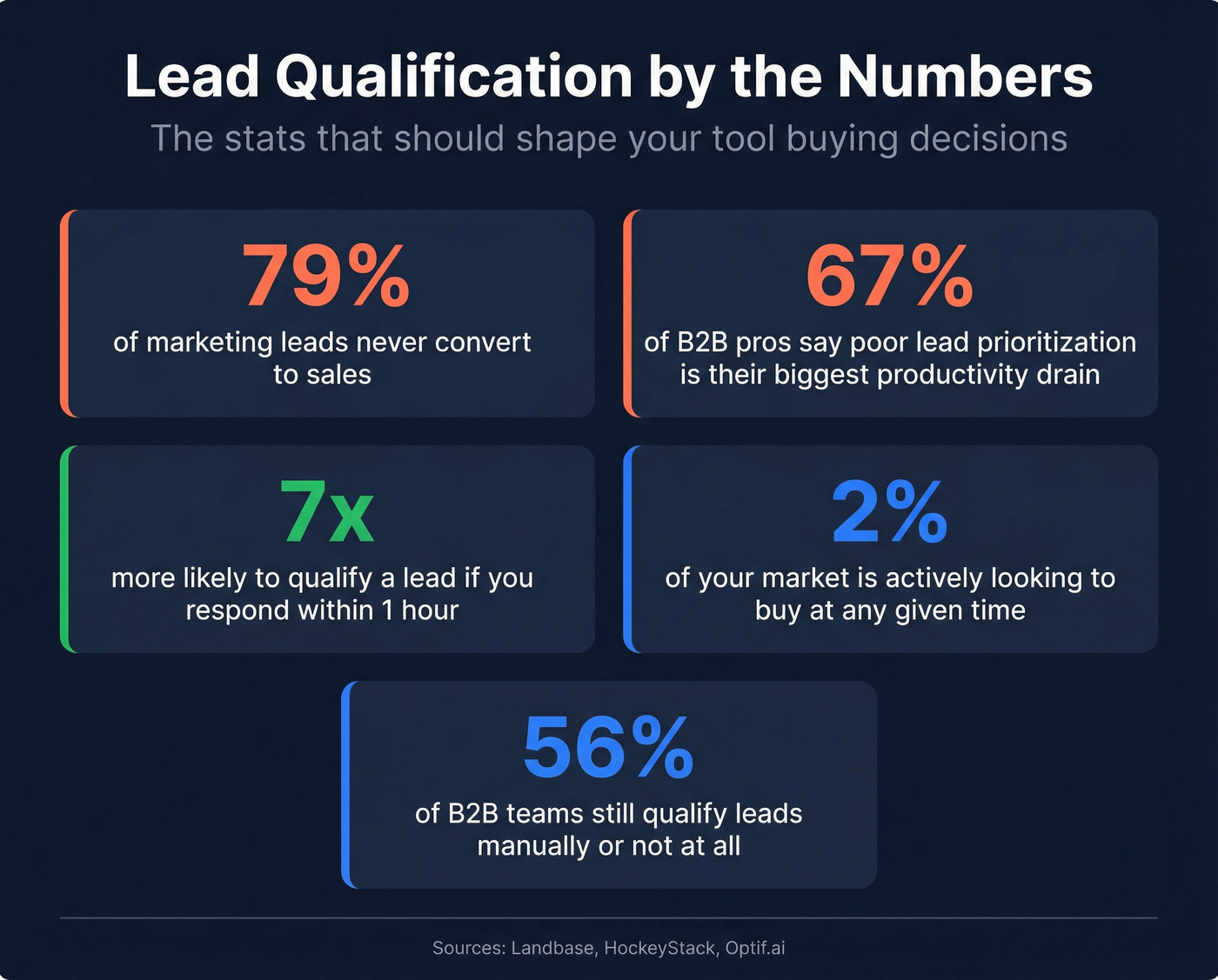
That's the problem most lead qualification tools don't solve. It's not a scoring problem - it's a data problem wrapped in a scoring problem wrapped in a routing problem. 79% of marketing-generated leads never convert to sales, and 67% of B2B professionals say poor lead prioritization is their biggest productivity drain. The predictive scoring market has ballooned to $5.6B because everyone's trying to fix prioritization with algorithms while ignoring the garbage data feeding those algorithms.
You don't need one tool. You need a stack of 2-3 that work together - one to clean and enrich your data, one to score it, and one to route the winners to the right rep at the right time.
Our Top Picks
| Tool | Best For | Starting Price | One-Line Verdict |
|---|---|---|---|
| Prospeo | Enrichment foundation | Free (75 emails/mo) | Fix the data before you score it |
| HubSpot Sales Hub | All-in-one scoring + CRM | ~$20/user/mo | Best single platform for teams under 20 |
| Chili Piper | Inbound routing | $30/user/mo + platform fee | Speed-to-lead king, but watch the fees |
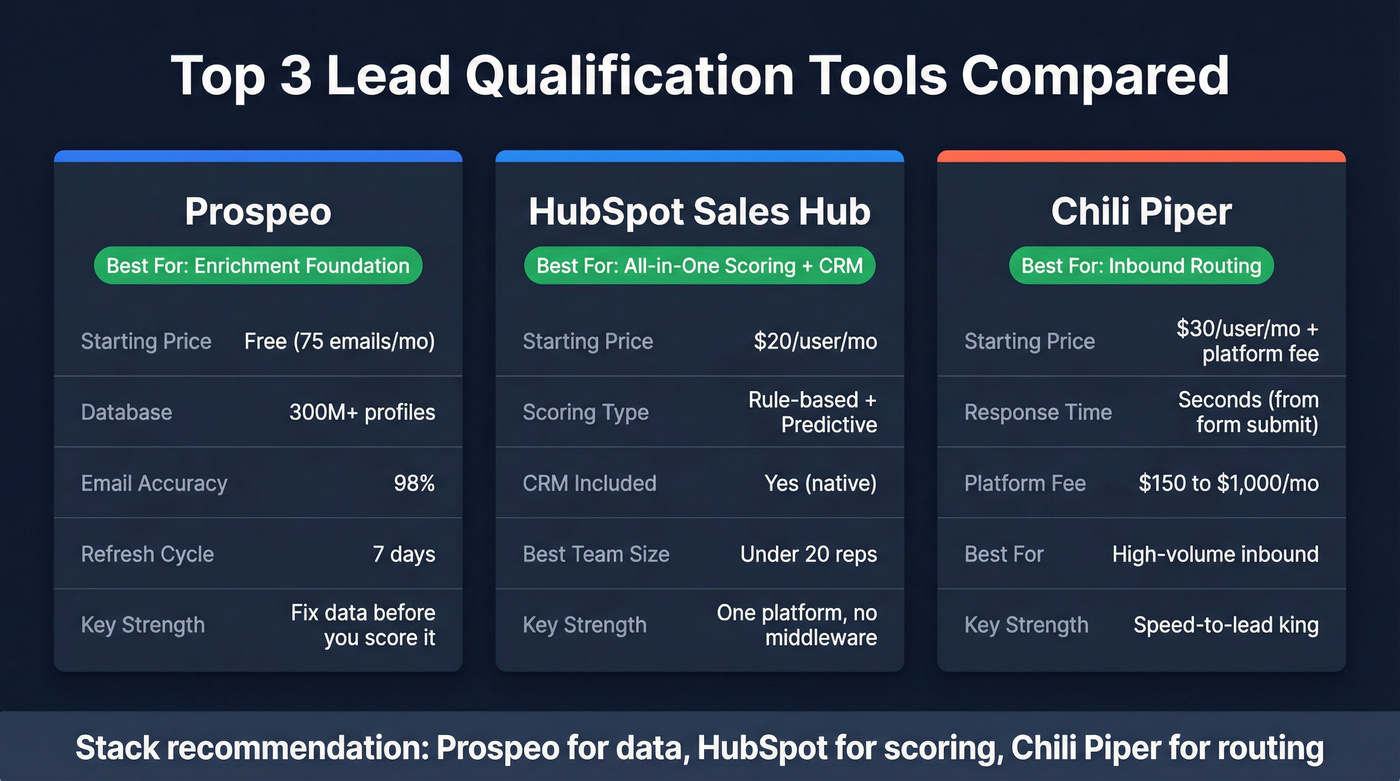
Here's the contrarian thesis: most teams buy a scoring tool first and an enrichment tool second. That's backwards. If your contact data is stale or wrong, even the best scoring model is just confidently ranking bad leads. Start with data quality, then layer scoring and routing on top.
What These Tools Actually Do
Lead qualification software automates the process of deciding which leads deserve a rep's time and which don't. That's it. Everything else - the AI, the predictive models, the intent signals - plumbing to make that decision faster and more accurate.
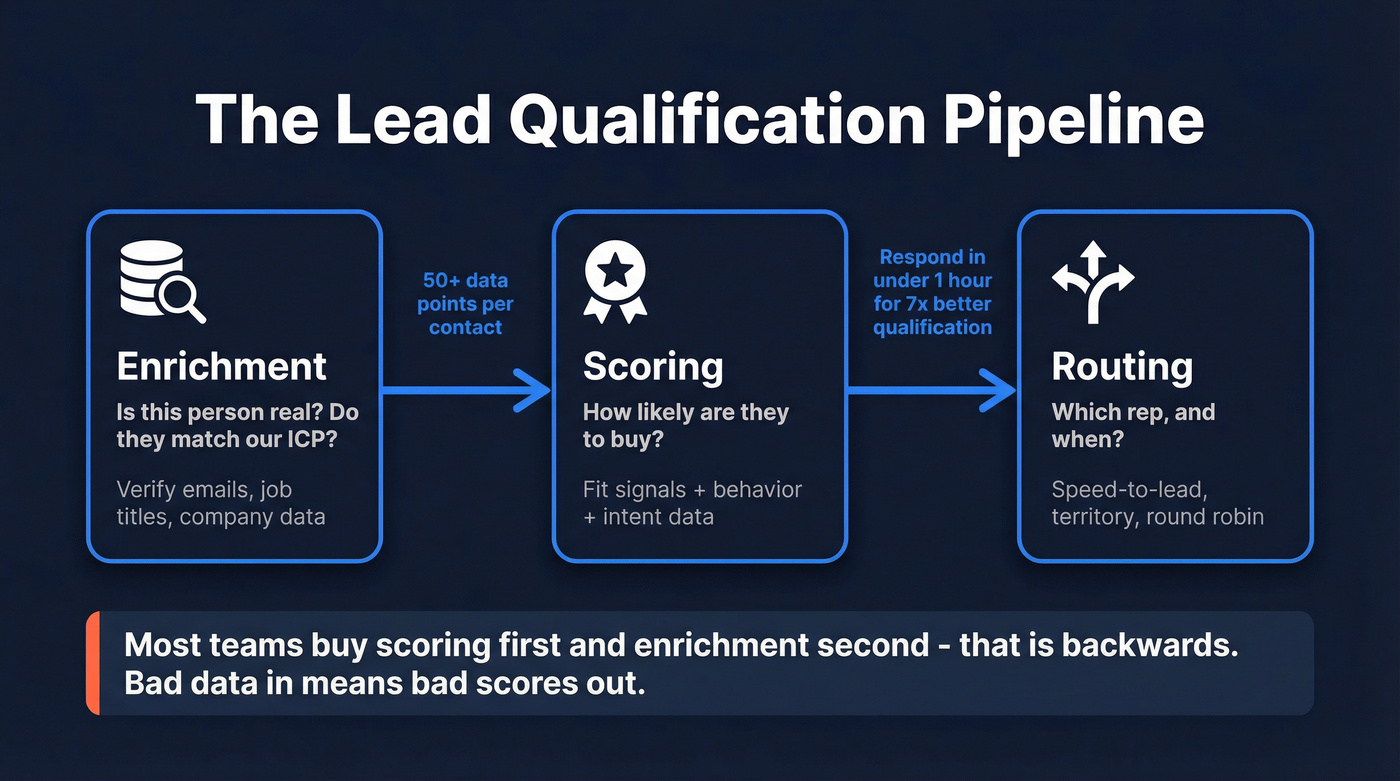
The manual version is BANT or MEDDIC frameworks, where reps ask discovery questions and mentally sort prospects. The automated version uses firmographic and technographic data, behavioral signals, engagement history, and intent signals to do the same thing before a rep ever picks up the phone. The pipeline flows from enrichment (is this person real and do they match our ICP?) to scoring (how likely are they to buy?) to routing (which rep should talk to them, and when?).
Only 44% of companies use lead scoring at all. More than half of B2B teams are still qualifying leads manually - or worse, not qualifying them at all.
Six Categories of Lead Handling Tools
No single tool covers all six. Here's what each does so you can jump to the section you need.
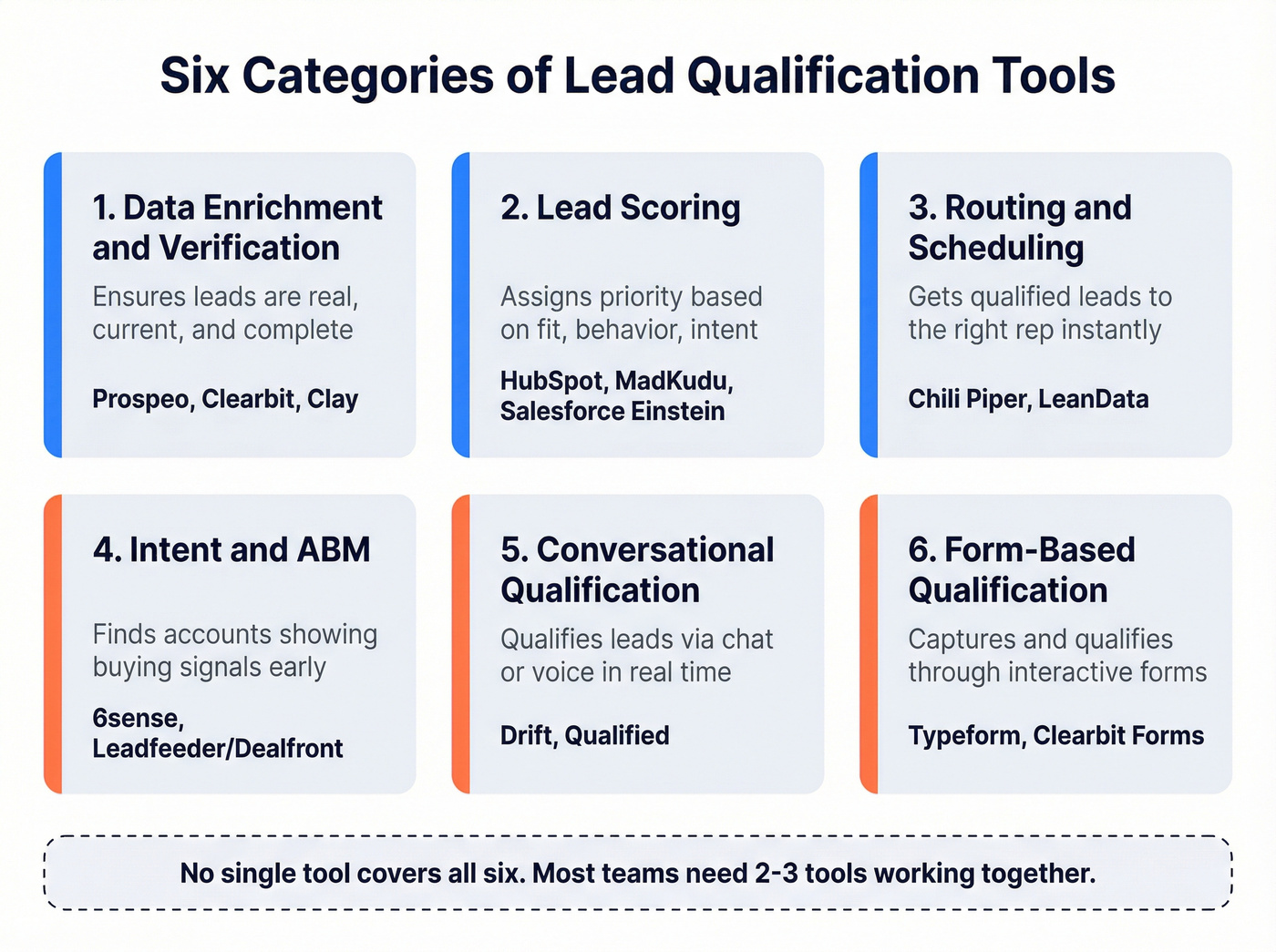
- Data enrichment & verification - Ensures leads are real, current, and complete before anything else happens
- Lead scoring - Assigns priority based on fit, behavior, and intent signals
- Routing & scheduling - Gets qualified leads to the right rep instantly
- Intent & ABM - Identifies accounts showing buying signals before they fill out a form
- Conversational qualification - Uses chat or voice to qualify leads in real time
- Form-based qualification - Captures and qualifies leads through interactive forms
Best Tools by Category
Data Enrichment & Verification
This is the foundation layer. Every scoring model, every routing rule, every intent signal is only as good as the contact data underneath it.
Prospeo
Prospeo is the enrichment layer we'd put underneath any qualification stack. The database covers 300M+ professional profiles with 143M+ verified emails and 125M+ verified mobile numbers, all refreshed on a 7-day cycle. That refresh cadence matters more than most teams realize - the industry average is six weeks, which means by the time you're scoring a lead, their job title might already be wrong (see B2B contact data decay).
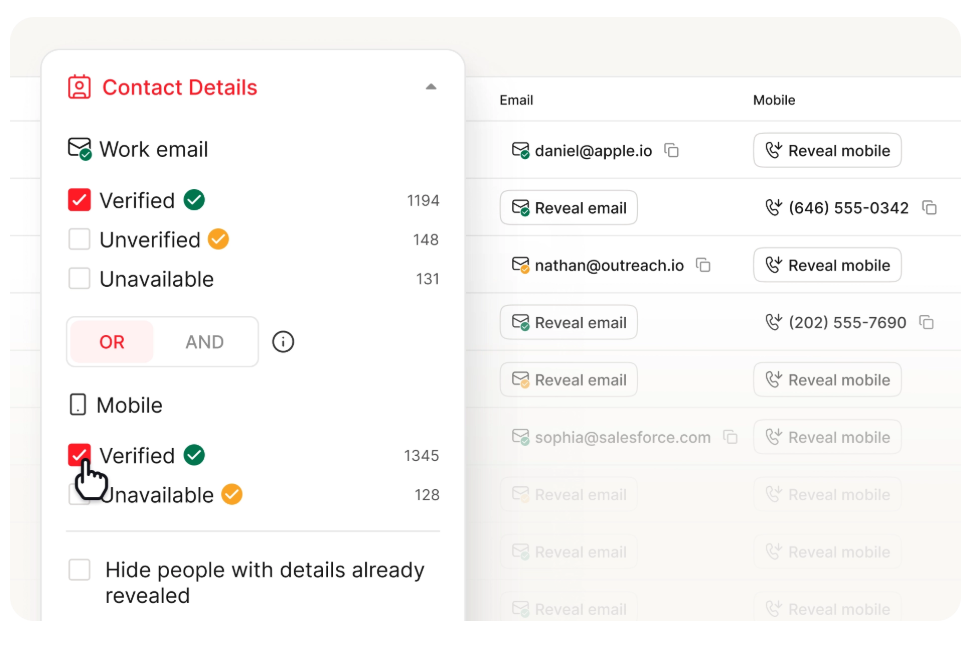
Email accuracy runs 98%. Enrichment returns 50+ data points per contact, with a 92% API match rate. You can search using 30+ filters including buyer intent powered by Bombora across 15,000 topics, technographics, job changes, headcount growth, and funding signals. Native integrations push directly into Salesforce, HubSpot, Clay, Lemlist, and Zapier.
The Snyk proof point tells the story: their team of 50 AEs was running bounce rates of 35-40%. After switching, bounce rates dropped under 5%, AE-sourced pipeline jumped 180%, and the team generated 200+ new opportunities per month. That's what happens when your reps stop scoring ghosts.
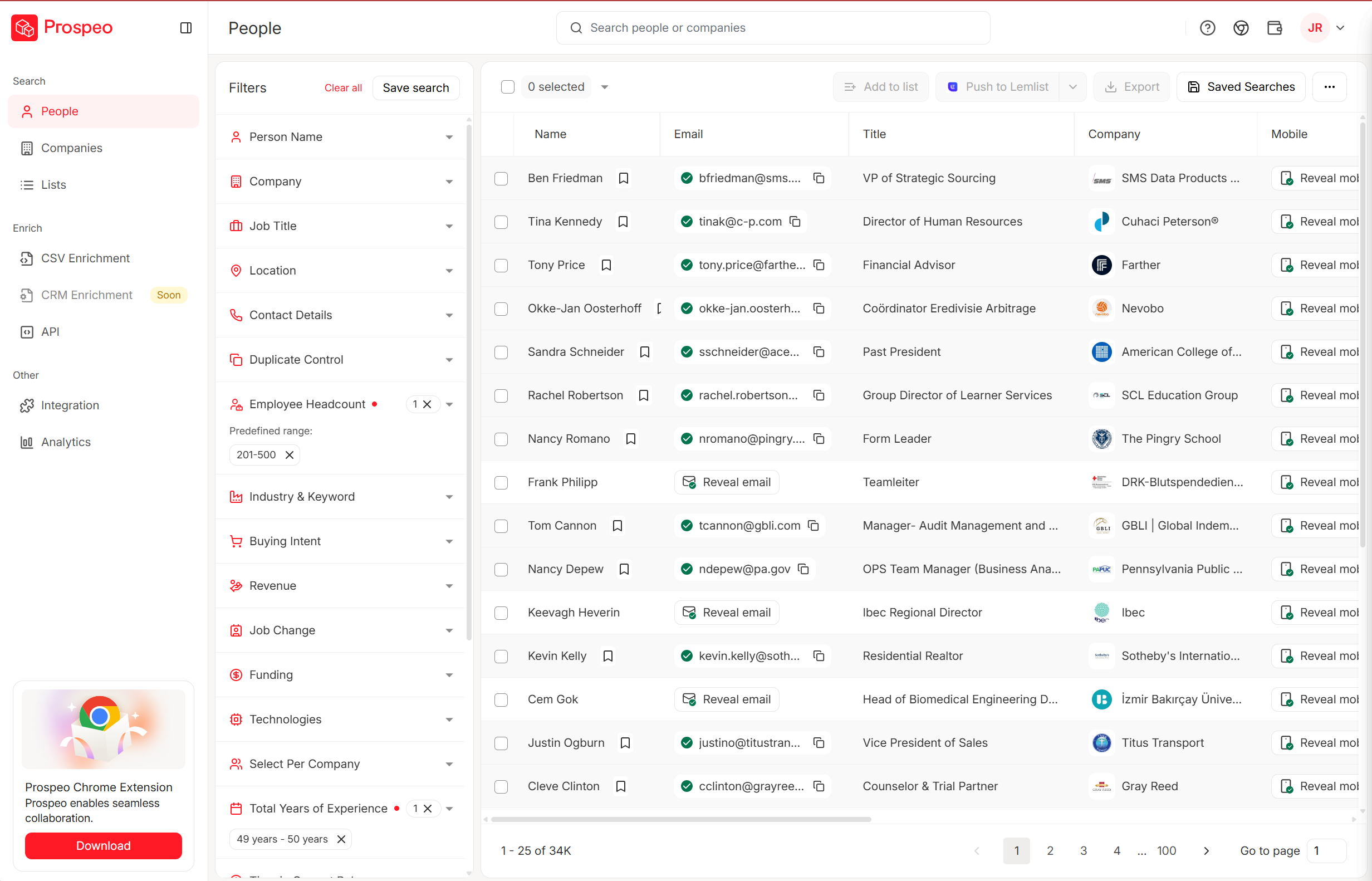
Use this if you want the cleanest possible data feeding your scoring models without paying ZoomInfo prices. Free tier gives you 75 emails/month to test.
Skip this if you need an all-in-one platform with built-in scoring and routing - pair it with HubSpot or Chili Piper for that.
Clearbit
Clearbit handles real-time enrichment with strong firmographic and technographic data, and its HubSpot native integration is genuinely tight. If your entire GTM stack runs through HubSpot, Clearbit slots in without any middleware. Enrichment happens on form submission, so leads get scored with complete data from the moment they enter your CRM. Pricing typically lands around $12K-$24K/year on annual contracts, putting it squarely in mid-market territory. A solid choice for teams already committed to the HubSpot ecosystem who want enrichment without managing another vendor relationship.
Clay
Clay isn't a data source - it's an orchestration layer that runs waterfall enrichment across 75+ providers. You build custom workflows that try Provider A, fall back to Provider B, and enrich from Provider C, all in sequence. Free tier available, paid plans from $149/mo. The tradeoff: Clay requires real setup time and technical comfort. It's a tool for builders, not plug-and-play buyers.
Sales Lead Scoring
HubSpot Sales Hub
HubSpot is the obvious starting point for teams under 20 reps who want scoring, CRM, and basic routing in one system. The free CRM gets you started, but lead scoring lives on higher-tier plans (Professional/Enterprise). You get both rule-based scoring - assign points for job title, company size, email opens - and predictive scoring that uses HubSpot's ML models to surface high-intent leads.
The all-in-one advantage is real. Your marketing team builds scoring rules in the same platform where sales sees the scores, and routing happens without any integration middleware. That eliminates the "why did this lead get scored this way?" confusion that plagues multi-tool stacks.
The tradeoff: HubSpot's predictive scoring is good enough for most teams, but it's not as sophisticated as dedicated tools like MadKudu. If you're a PLG company trying to score product-qualified leads based on in-app behavior, HubSpot's models won't cut it. The recurring theme across G2 reviews is that HubSpot's scoring works great until you outgrow it - and most teams know when they've hit that ceiling.
Use this if you want one platform for scoring + CRM + basic routing and your team is under 20 reps.
Skip this if you need predictive scoring based on product usage signals, or you're already deep in Salesforce.
MadKudu
MadKudu is the predictive scoring tool for PLG companies. It ingests product usage data, firmographic signals, and behavioral patterns to score leads - particularly product-qualified leads that traditional scoring models miss entirely. If you're trying to figure out which free-tier users are most likely to convert to paid, MadKudu is purpose-built for that problem. Predictive AI scoring accuracy runs 75-90% vs 55-65% for rule-based models. Pricing is custom, typically $1,500-$3,000/mo. Integrates with Salesforce and HubSpot. Best for B2B SaaS companies with a self-serve motion and enough volume to train the models.
Salesforce Einstein
If you're already deep in Salesforce, Einstein lead scoring is available on Sales Cloud tiers and Einstein add-ons. The scoring uses your historical Salesforce data to predict conversion likelihood, which means it gets better as your CRM gets cleaner.
The catch: Einstein requires high-volume, clean historical data to train effectively. If your Salesforce instance is a mess of duplicate records and incomplete fields, Einstein will just confidently score garbage. Clean your data first - then turn on the AI.
Routing & Scheduling
Chili Piper
Chili Piper solves the speed-to-lead problem better than anything else we've tested. Responding within one hour makes you 7x more likely to qualify a lead - Chili Piper's Concierge product gets that response time down to seconds by routing inbound leads and booking meetings instantly from the form submission.

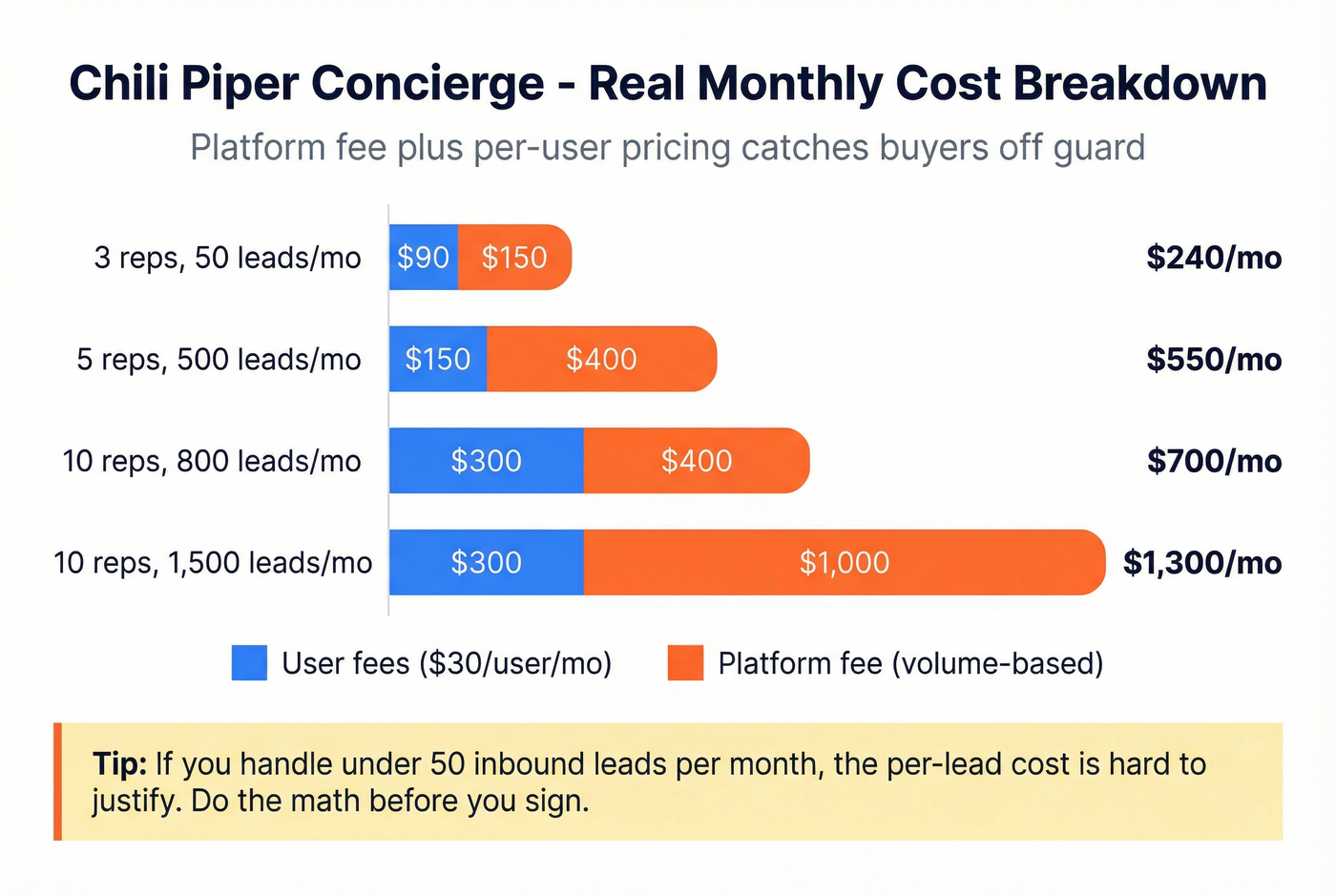
The platform fee model catches buyers off guard. Concierge runs $30/user/mo on monthly billing ($45/user/mo on annual) plus a platform fee based on your inbound lead volume: $150/mo for up to 100 leads, $400/mo for 101-1,000, and $1,000/mo for 1,000+. For a 5-rep team handling 500 inbound leads per month, you're looking at roughly $550/mo total. Distro (round-robin routing) is $30/user/mo plus $150/mo platform fee - more reasonable for teams that just need distribution logic.
Use this if you're a high-volume inbound team where speed-to-lead directly impacts conversion. The ROI math works fast.
Skip this if you're a small team with under 50 inbound leads per month - the platform fee makes the per-lead cost hard to justify.
LeanData
LeanData is the Salesforce-native routing engine for teams with complex assignment rules. It uses a visual flow builder to handle account matching, territory management, and multi-step routing logic that would take dozens of Salesforce workflow rules to replicate. Pricing typically runs $2,000-$5,000/mo on custom contracts. The right choice for mid-market Salesforce teams with overlapping territories, named accounts, and partner routing requirements. If you're on HubSpot, look elsewhere.
Intent & ABM
Only about 2% of your market is actively looking to buy at any given time. Intent tools help you find that 2%.
6sense
Let's be honest about 6sense: most teams don't need it. It's a full ABM platform with intent data, predictive scoring, and account identification - priced accordingly at $25K-$100K+/year, with mid-market deals typically landing around $60K+. For enterprise teams with 50+ reps and dedicated ABM programs, 6sense delivers genuine value by identifying in-market accounts before they ever hit your website.
For everyone else, it's overkill. The consensus on r/sales and across G2 reviews is that teams sign 6sense contracts and then realize they don't have the headcount to act on the signals. If you're not sure you need a six-figure ABM platform, you don't.
Leadfeeder / Dealfront
Leadfeeder (now part of Dealfront) identifies companies visiting your website and turns anonymous traffic into qualified accounts. Free tier available, paid plans start around EUR99/mo. It won't tell you who visited, but it'll tell you which company - and that's often enough to trigger outreach. Best for teams that want a lightweight intent signal without committing to a full ABM platform.
Conversational Qualification
Drift (SalesLoft)
Salesloft acquired Drift in early 2024, and post-acquisition pricing has settled into three tiers: Premium at $2,500-$3,500/mo, Advanced at $5,000-$8,000/mo, and Enterprise at $10,000+/mo. Implementation fees run an additional $2,000-$10,000.
The product itself is strong - routing flexibility, ABM capabilities, Salesforce integration depth, and meeting booking automation all get consistent praise. The question is whether a $2,500/mo chatbot delivers enough ROI to justify itself. For high-traffic websites with complex routing needs, the answer is usually yes. For a Series A company getting 200 visitors a day, probably not.
Use this if you have high website traffic, complex routing needs, and the budget to match.
Skip this if your monthly website traffic is under 10,000 visits - the math won't work.
Synthflow
Synthflow brings AI voice qualification at a fraction of Drift's cost, starting from $29/mo. It's newer and less battle-tested, but for teams that want conversational qualification without committing $2,500+/mo, it's worth a pilot. Best for outbound teams experimenting with AI-driven phone qualification.
Form-Based Qualification
Perspective
Perspective builds interactive, mobile-first qualification forms that feel more like a conversation than a traditional web form. Pricing runs $62-$391/user/mo depending on the tier. Best for teams with high mobile traffic where standard forms have poor completion rates.
GetLeadForms
GetLeadForms focuses on reducing fake and invalid form submissions with features like drop-off capture and OTP phone verification. Roughly 25% of inbound leads are invalid - GetLeadForms tackles that directly. Starter plan at $47/mo. Best for teams drowning in junk form submissions.

Snyk's 50 AEs had 35-40% bounce rates - their scoring models were confidently ranking bad leads. After switching to Prospeo's 98% accurate emails and 7-day refresh cycle, bounces dropped under 5% and pipeline jumped 180%.
Stop scoring ghosts. Enrich your leads with data that's actually current.
Every scoring rule and routing workflow in your stack depends on clean contact data. Prospeo enriches leads with 50+ data points at a 92% match rate - including buyer intent across 15,000 topics - for roughly $0.01 per email.
Build your qualification stack on a foundation that doesn't rot every six weeks.
Pricing Comparison
Most vendors won't publish pricing because they're optimizing for sales conversations, not your buying experience. For a 15-person team, expect to spend $1,200-$2,500/month on scoring and routing alone - before enrichment. Here's what you'll actually pay.
| Tool | Category | Starting Price | Free Tier? |
|---|---|---|---|
| Prospeo | Enrichment | ~$0.01/email (credits, no contract) | Yes (75 emails/mo) |
| Clearbit | Enrichment | ~$12K/year (annual contract) | No |
| Clay | Enrichment orchestration | $149/mo | Yes |
| HubSpot Sales Hub | Scoring + CRM | ~$20/user/mo | Yes (CRM only) |
| MadKudu | Predictive scoring | ~$1,500/mo (custom) | No |
| Salesforce Einstein | Scoring | Varies by edition + add-ons | No |
| Chili Piper | Routing | $30/user/mo + platform fee | No |
| LeanData | Routing | ~$2,000/mo (custom) | No |
| 6sense | Intent/ABM | ~$25K/year (annual) | No |
| Leadfeeder | Intent | EUR99/mo | Yes |
| Drift (Salesloft) | Conversational | ~$2,500/mo | No |
How to Build Your Stack
You don't need all 12 tools. You need the right 2-3 for your stage and budget. The risk with any multi-tool stack is finger-pointing when something breaks - make sure one person owns the integration layer.
Hot take: If your average deal size is under $10K, you probably don't need anything beyond enrichment and a CRM with basic scoring. The ROI on a $60K/year ABM platform doesn't pencil out when your contracts close at $8K.
Solo / SMB ($0-$200/mo): Prospeo's free tier for enrichment and verification plus HubSpot's free CRM for basic contact management and manual scoring. Total cost: $0. You're qualifying leads manually, but at least you're qualifying real people.
Growth team ($200-$1,500/mo): A paid enrichment plan, HubSpot Sales Hub (Professional tier for scoring), and Chili Piper Concierge for inbound routing. This is the stack where automated qualification starts paying for itself - leads get enriched on entry, scored automatically, and routed to the right rep in seconds.
Mid-market ($1,500-$5,000/mo): Add MadKudu for predictive scoring if you're PLG, Chili Piper for routing, and Leadfeeder for website intent signals. This stack gives you both inbound and outbound qualification coverage with predictive models that learn from your conversion data.
Enterprise ($5,000+/mo): 6sense for ABM and intent, LeanData for complex Salesforce routing, Drift for conversational qualification on high-traffic pages, and an enrichment API to keep the underlying contact data fresh across all systems. At this level, budget 10-15 hours/month of RevOps time just for integration maintenance - field mapping changes, API version updates, and routing rule audits add up fast.
If I had $500/mo and needed to qualify leads tomorrow, I'd spend it on a paid enrichment plan and one HubSpot Sales Hub seat with scoring. Clean data plus automated scoring covers 80% of the qualification problem.
Key Benchmarks to Know
The average MQL-to-SQL conversion rate is roughly 13%. Below 10%? Either your scoring model is broken or your data quality needs work. Usually both.
Lead-to-MQL conversion averages 31% across industries, with B2B SaaS at 39% and client referrals at 56%. That referral number tells you something important: warm leads convert at nearly double the rate of cold ones, which is why intent data matters so much for outbound.
Speed kills - in a good way. Responding within one hour makes you 7x more likely to have a meaningful qualification conversation. But only 25% of marketing leads actually qualify for direct sales engagement, which means 75% of your leads need nurturing, not a phone call. Strong nurturing programs generate 50% more sales-ready leads at 33% lower cost.
Predictive scoring models deliver 75-90% accuracy compared to 55-65% for rule-based systems. That gap alone justifies the investment for teams with enough data volume to train the models properly.
When to Stop Qualifying
Disqualification is qualification. If a lead has no budget authority, hasn't engaged in 30+ days, or is locked into a competitor contract with 18 months remaining, stop scoring them and move on. The fastest way to improve your MQL-to-SQL rate isn't better scoring - it's removing the leads that never had a chance. Set disqualification rules with the same rigor you set scoring rules (see negative lead scoring).
FAQ
What's the difference between lead scoring and lead qualification?
Lead scoring is one component of qualification, not the whole thing. Qualification includes enrichment (is this lead real?), scoring (how likely are they to buy?), routing (who should talk to them?), and engagement timing. A tool that only scores without verifying data quality is just ranking noise.
Do I need a separate tool if I use HubSpot?
HubSpot covers scoring and basic routing natively, which is enough for many teams. But enrichment and intent data require additional tools - HubSpot can't verify whether an email address is valid or detect in-market buying signals. Pair it with a dedicated enrichment layer and optionally an intent provider.
What's a good MQL-to-SQL conversion rate?
The cross-industry average is roughly 13%. If you're consistently below 10%, your scoring model needs recalibration or your underlying data quality is dragging results down. Start by auditing how many MQLs have accurate, verified contact information.
How do I keep my scoring model accurate over time?
Audit quarterly. Scoring models decay as your market, ICP, and product evolve. Watch for conversion rate drops and rising false-positive rates. The single biggest factor in model accuracy is data freshness - a 7-day refresh cycle catches job changes and company updates that a 6-week cycle misses entirely.
What's the most affordable way to start qualifying leads?
Prospeo's free tier (75 verified emails/month) plus HubSpot's free CRM. Total cost: $0. You get clean, verified contact data and a system to organize and manually score leads. It isn't automated, but it's a real qualification workflow that costs nothing to start.