

Lead to MQL Conversion Rate: 2026 Benchmarks by Channel
Your CMO asks what a good lead to MQL conversion rate looks like. You pull up three reports and get three different numbers. First Page Sage says 31%. Older HubSpot benchmarks are widely cited at 22.5%. Other roundups land somewhere in the 25%-35% range. The answer depends almost entirely on how you define "MQL" and which channel you're measuring.
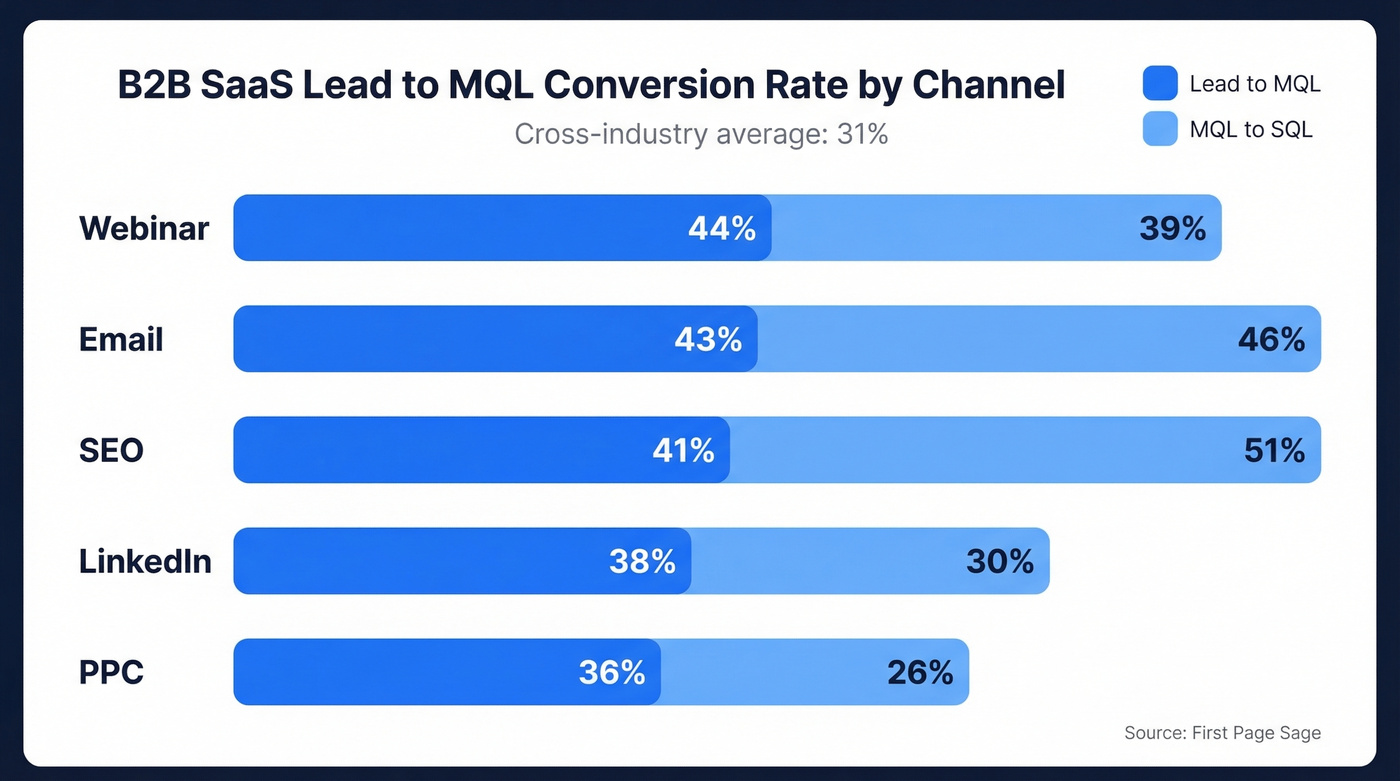
The cross-industry average is 31%, but it varies wildly by channel and by how strict your MQL definition is. In B2B SaaS specifically, benchmarks by channel look like SEO at 41%, email at 43%, and PPC at 36%. Three things matter more than any benchmark: align your MQL definition with sales, segment by channel instead of reporting blended averages, and clean your data so scoring models actually work.
The Numbers You Came For
The most cited cross-industry lead to MQL conversion rate is 31%, drawn from First Page Sage's multi-year client dataset. For full-funnel context, Ruler Analytics reports an average visitor-to-qualified-lead rate of 2.9% across 100M+ data points - a reminder that most funnel leakage happens before a lead even exists.
| Funnel Stage | Average Rate |
|---|---|
| Visitor → Lead | 2.9% |
| Lead → MQL | 31% |
| MQL → SQL | 13% (B2B SaaS) |
Definitions drive these numbers. The dataset above counts an MQL as someone who's indicated purchase intent and can afford the product. If your team counts every whitepaper download as an MQL, your rate will look higher - and your sales team will hate you for it.
Benchmarks by Channel
This is the table that actually matters. Blended averages hide the fact that some channels produce dramatically better-qualified leads than others. Here's the B2B SaaS breakdown:
| Channel | Lead → MQL | MQL → SQL |
|---|---|---|
| SEO | 41% | 51% |
| 43% | 46% | |
| Webinar | 44% | 39% |
| 38% | 30% | |
| PPC | 36% | 26% |
The pattern is clear: organic and email leads don't just convert to MQL at higher rates - they convert downstream at higher rates too. SEO leads hit 51% MQL-to-SQL versus PPC's 26%. That quality gap compounds through every funnel stage.
We've seen teams overweight paid acquisition, then wonder why their MQL rate is half the benchmark. Channel mix isn't a marketing problem. It's a revenue problem.
Full-Funnel Context
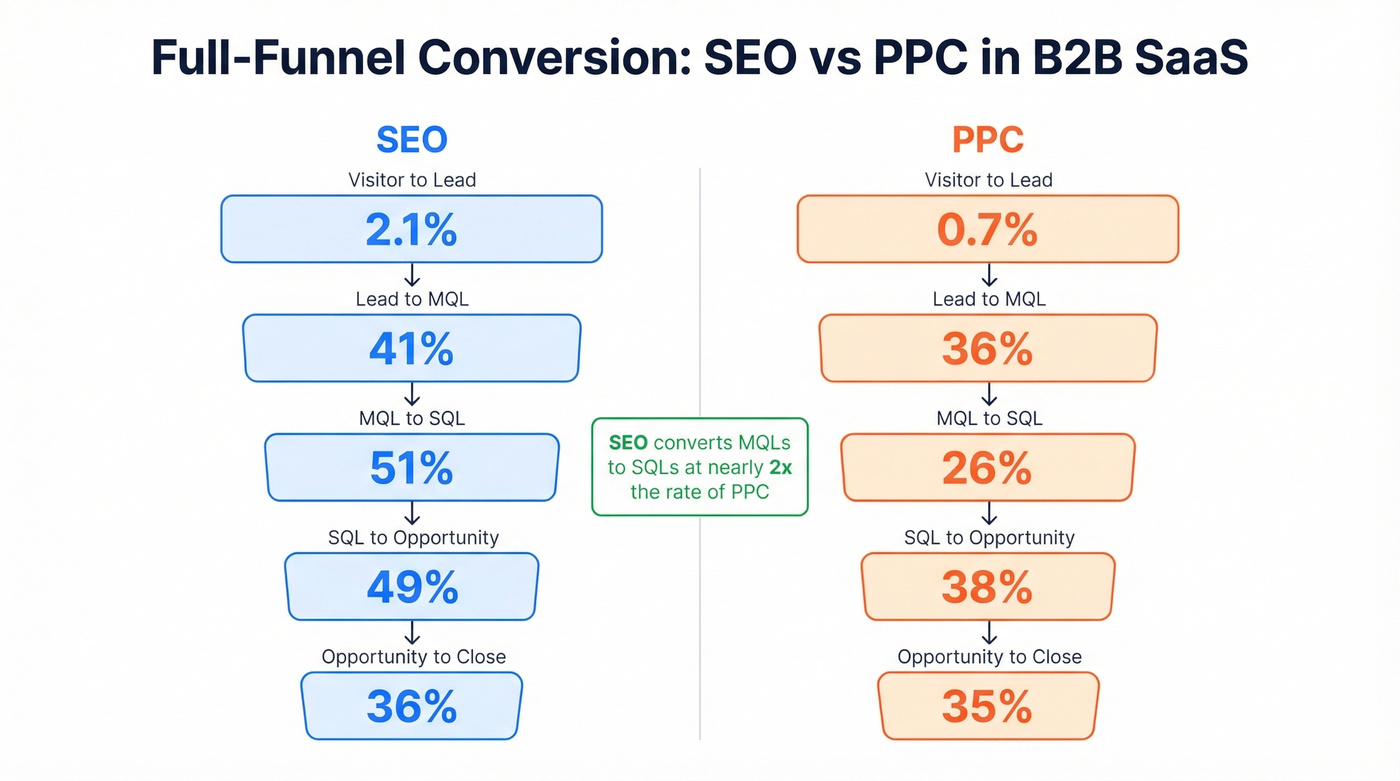
A lead-to-MQL rate means nothing if those MQLs die two stages later. Here's the complete picture for B2B SaaS.
Organic & Nurture Channels
| Stage | SEO | Webinar | |
|---|---|---|---|
| Visitor → Lead | 2.1% | 1.3% | 0.9% |
| Lead → MQL | 41% | 43% | 44% |
| MQL → SQL | 51% | 46% | 39% |
| SQL → Opp | 49% | 48% | 42% |
| Opp → Close | 36% | 32% | 40% |
Paid & Social Channels
| Stage | PPC | |
|---|---|---|
| Visitor → Lead | 0.7% | 2.2% |
| Lead → MQL | 36% | 38% |
| MQL → SQL | 26% | 30% |
| SQL → Opp | 38% | 41% |
| Opp → Close | 35% | 39% |
Within SaaS, rates vary by sub-vertical too. Cybersecurity leads convert to MQL at 44% but only 38% MQL→SQL, while CRM SaaS hits 36% Lead→MQL but 42% MQL→SQL. Fintech sits at 38% and 42% respectively. Your sub-industry benchmark matters more than the SaaS average.
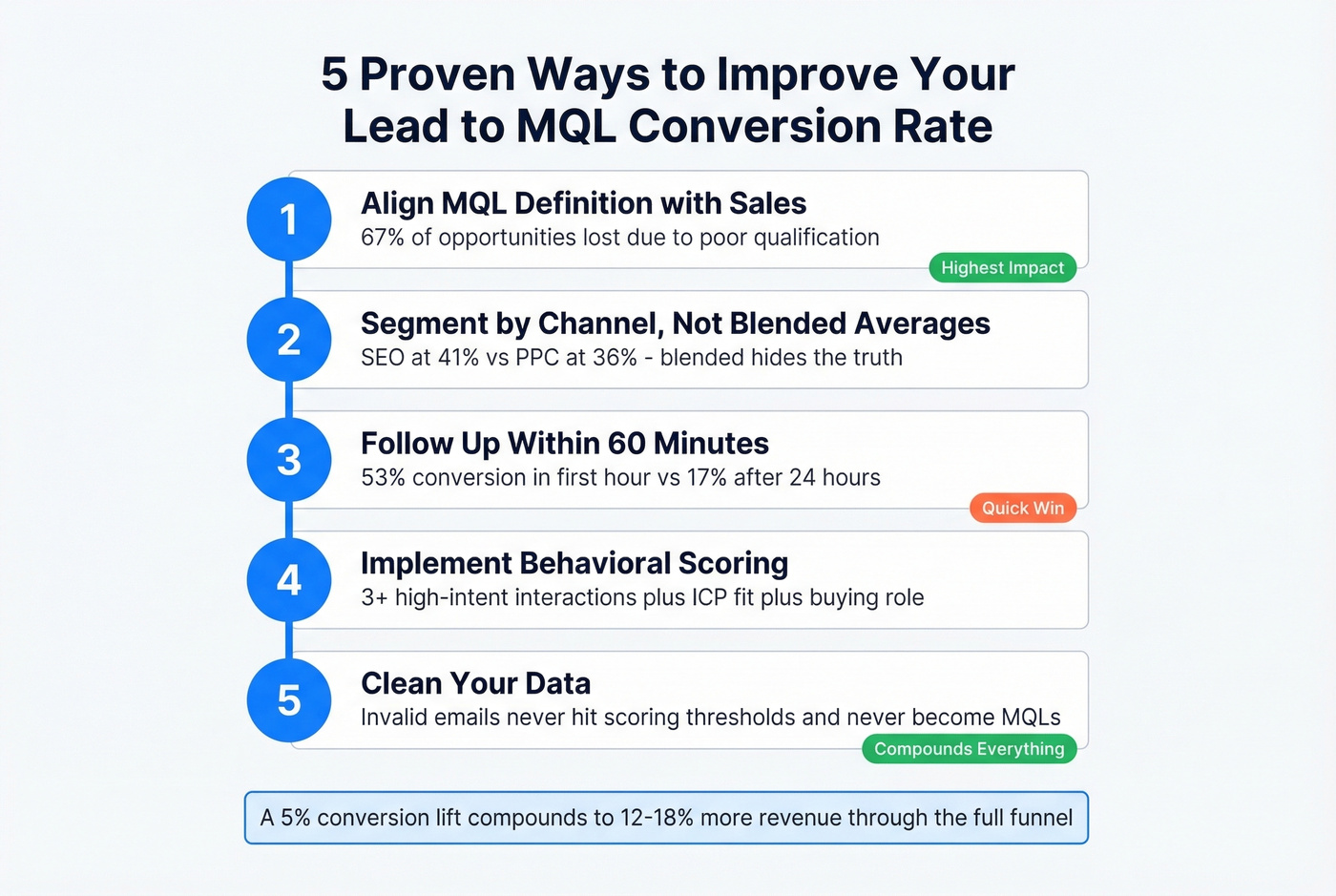
A 5% boost in conversion rates can drive 12-18% more revenue when it compounds through the funnel. Small improvements at the top echo loudly at the bottom.

A 5% conversion lift compounds to 12-18% more revenue - but only if your leads are real. Invalid emails never hit scoring thresholds, never enter nurture sequences, and never become MQLs. Prospeo's 98% email accuracy and 7-day data refresh keep your scoring models working on reality, not stale records.
Stop benchmarking against dirty data. Start with leads that actually convert.
Why Benchmarks Conflict
Here's the thing: every benchmark study defines MQL differently. Some require "indicated intent + can afford." Others use lead scoring thresholds, form fills, or content downloads. A team that counts every gated PDF download as an MQL will report a 50%+ rate. A team requiring a demo request plus ICP fit might see 15%.
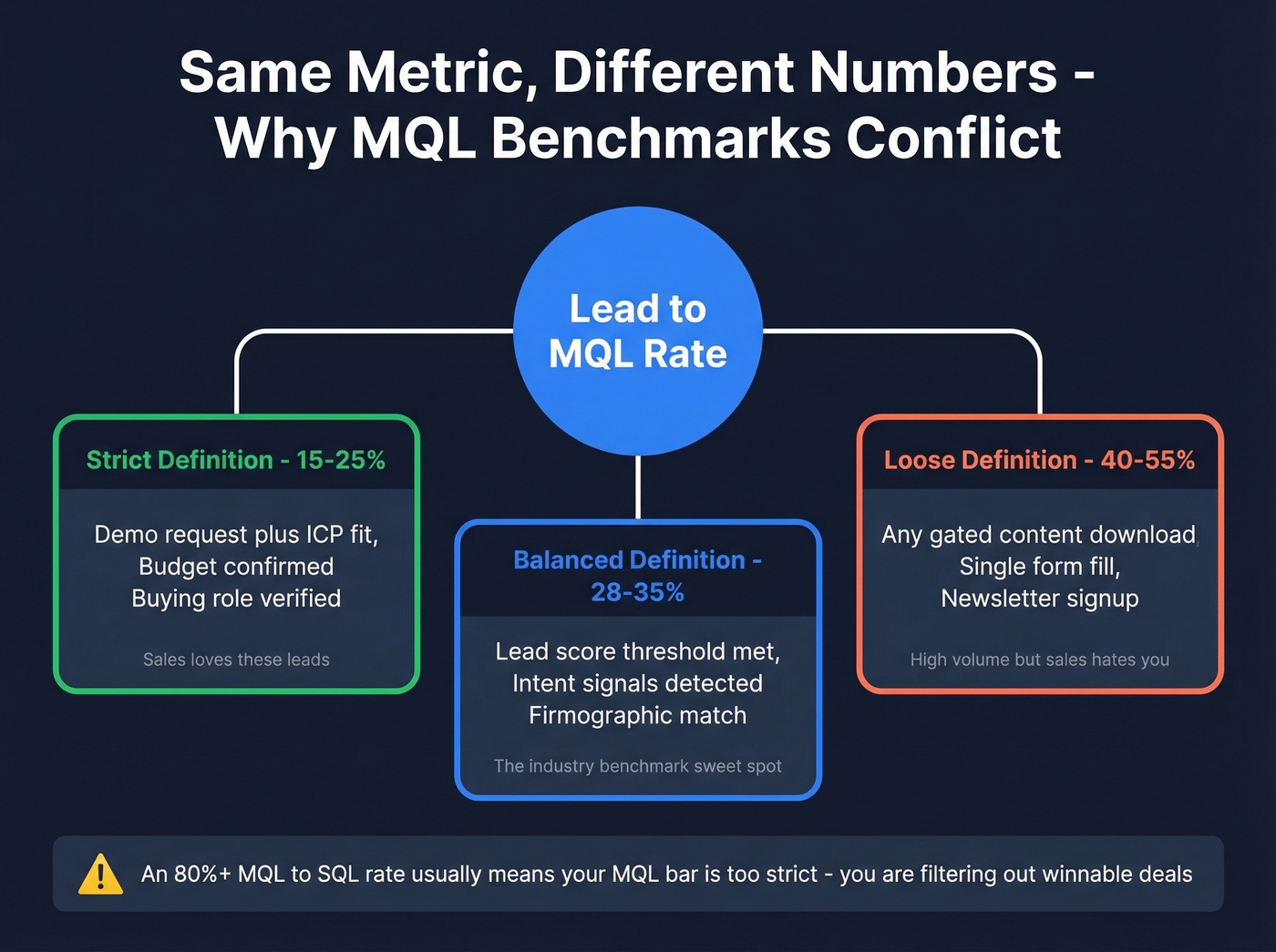
An unusually high MQL→SQL rate - say 80%+ - often signals your MQL bar is too strict. You're filtering out winnable deals before sales ever sees them.
The practitioner reality is even messier. On r/PPC, teams running $25k/month in paid spend report sub-10% MQL-to-SQL rates because their MQL bar is too low. On r/b2bmarketing, the recurring complaint is that marketing says leads are fine while sales says they're garbage. The benchmark isn't the problem - the definition is.
How to Improve Your MQL Conversion Rate
Align Your MQL Definition with Sales
67% of sales opportunities are lost due to poor lead qualification. If marketing and sales disagree on what "qualified" means, your conversion rate is meaningless. Sit in a room together. Define MQL criteria, document them, and revisit quarterly. Skip this step and nothing else on this list matters.
Segment by Channel
Stop reporting blended averages. When your CMO sees "28% lead-to-MQL," that number hides the fact that SEO converts at 41% and PPC at 36%. Channel-level reporting exposes where to invest more and where to cut - and it's the fastest way to make your next board deck actually useful.
Speed Up Follow-Up
Companies that follow up within the first hour see 53% conversion rates versus 17% after 24 hours (https://www.data-mania.com/blog/mql-to-sql-conversion-rate-benchmarks-2025/). Set SLAs. If a lead requests a demo at 2 PM and nobody calls until tomorrow, you've already lost to the competitor who responded in 12 minutes.
Implement Behavioral Scoring
The most common mistake we see: optimizing for lead volume over lead quality, which floods the pipeline with prospects who never convert. Behavioral scoring fixes this. Track pricing page visits, demo requests, and repeat engagement - not just form fills. A lead becomes SQL-ready after 3+ high-intent interactions combined with ICP fit and buying role confirmation. HubSpot's own team saw a 30% increase in SQLs after implementing AI-driven lead scoring, which tells you the approach works even at scale.
If you want the deeper framework, start with a dedicated lead scoring model and then layer in identifying buying signals so your scoring reflects real intent, not vanity engagement.
Clean Your Data
Bad data quietly tanks your marketing qualified lead conversion rate. Leads with invalid emails never receive nurture sequences, never hit scoring thresholds, and never become MQLs. They sit in your CRM as dead weight, dragging your rates down and making every benchmark comparison look worse than it should.
This is where data hygiene tools earn their keep. Prospeo's bulk verification catches bad addresses before they enter workflows, and its 7-day refresh cycle keeps contact records current so scoring models reflect reality instead of stale data. With an 83% enrichment match rate returning 50+ data points per contact, you can auto-score on firmographic and technographic criteria rather than guessing.
For teams comparing vendors, a quick scan of data enrichment services can help you pick the right workflow.
Your lead-to-MQL rate tanks when contacts sit in your CRM with bad emails and missing firmographics. Prospeo enriches leads with 50+ data points at an 83% match rate - giving your behavioral scoring models the technographic, intent, and firmographic signals they need to qualify accurately.
Enrich every lead with 50+ data points at $0.01 each. No contracts.
How to Track This in Your CRM
HubSpot: Qualify MQLs by updating Lifecycle Stage via workflow triggers - lead score thresholds, form submissions, or property updates. Build conversion reports through Reports → Journey Reports and select your lifecycle stages. Calculated conversion-rate fields require Operations Hub Enterprise; the workaround is creating helper properties for deal-created and closed-won ratios using built-in contact lifecycle funnel reports.
Salesforce: Use stage-stamping with timestamp fields on the lead/contact object, then build cohort reports by month. Dedupe rules are critical - Salesforce allows multiple leads with the same email, which inflates your numbers if you aren't careful. If you're standardizing definitions across teams, a simple lead status taxonomy prevents reporting drift.
Is MQL Still Relevant in 2026?
MQL originated from the SiriusDecisions Demand Waterfall in the early 2000s. It stuck because it's easy to explain and easy to report - not because it's perfectly defined. The modern consensus is to use MQL as an internal leading indicator rather than your primary dashboard metric. Track it, but report on pipeline velocity and revenue impact.
Let's be honest: if your average deal size is under $10k, you probably don't need a sophisticated MQL framework at all. A simple "hand-raiser" model - demo requests and pricing page visits - will outperform any lead scoring matrix your ops team spends three months building. Save the complexity for enterprise deals where the sales cycle justifies it.
In our experience, teams that nail three fundamentals - align definitions, segment by channel, clean their data - see their lead to MQL conversion rate climb within a single quarter. Get those right and the benchmarks take care of themselves.
FAQ
What's a good B2B lead to MQL conversion rate?
The cross-industry average is 31%, but channel matters more than the blended number. SEO leads convert at 41%, email at 43%, and PPC at 36%. If your blended rate exceeds 35%, you're outperforming most B2B SaaS teams. Always compare against your specific sub-vertical - cybersecurity, CRM, and fintech each have distinct benchmarks.
What's the difference between MQL and SQL?
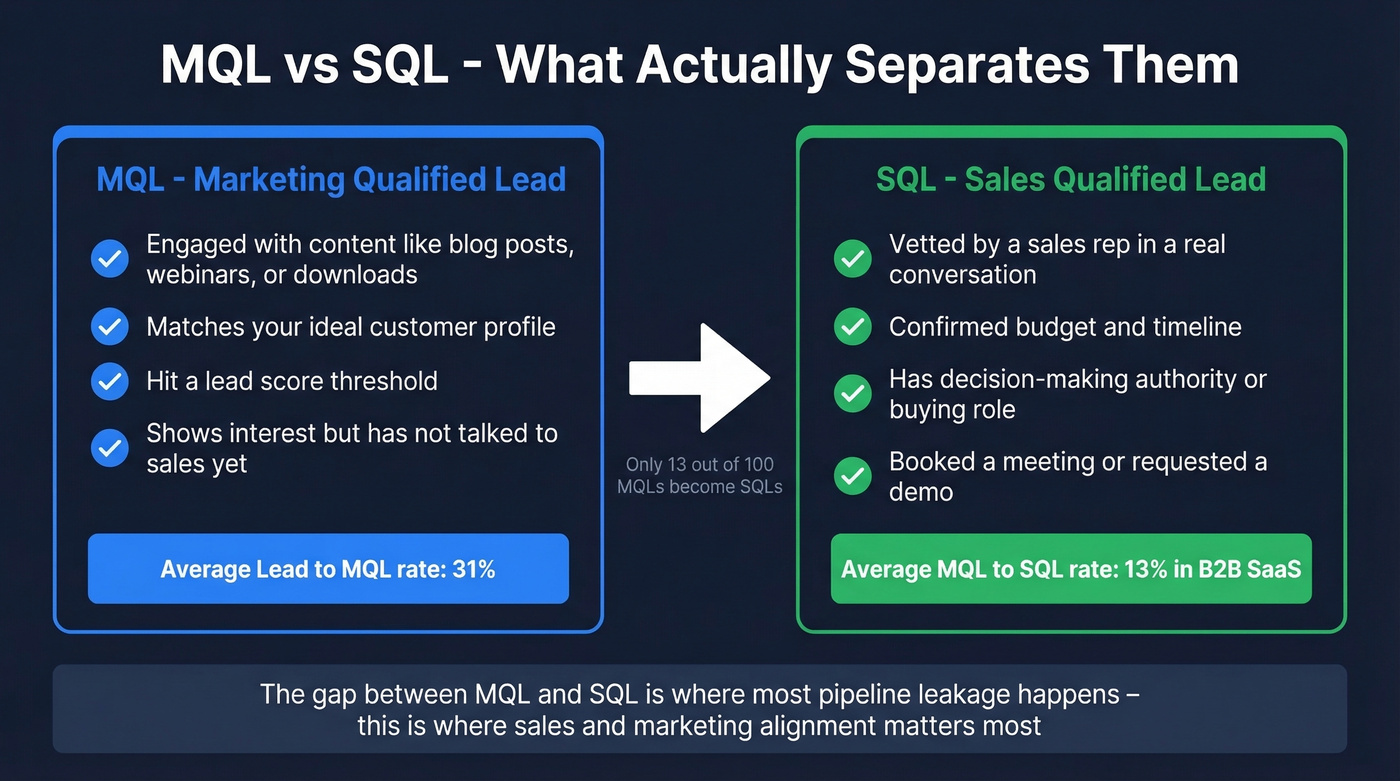
An MQL has shown interest and fits your target market - they've engaged with content and match your ICP. An SQL has been vetted by sales, confirmed budget and timeline, and booked a meeting. The average MQL-to-SQL conversion rate is 13% for B2B SaaS, though it ranges from 26% (PPC) to 51% (SEO) depending on channel.
How do you calculate lead-to-MQL conversion rate?
Divide the number of MQLs by total leads, then multiply by 100. Example: 310 MQLs from 1,000 leads = 31%. Always segment by channel and cohort by month for meaningful trends - blended averages hide which sources actually drive qualified pipeline.
How does data quality affect MQL conversion rates?
Leads with invalid emails never receive nurture sequences and never hit scoring thresholds - they're invisible to your funnel. Bulk verification at 98% accuracy catches bad addresses before they enter workflows, and a weekly refresh cycle keeps contact records current so scoring models reflect reality, not stale data.