

How to Generate Leads on Demand (Without Getting Burned)
Your VP of Sales just told the team they need 200 qualified leads per month, starting next quarter. You nod, open a browser, and find nothing but course pitches, agency landing pages, and one branded system claiming $54M in revenue from a funnel template. Nobody's explaining how to actually build a repeatable system. That's what this piece does.
What You Need (Quick Version)
"Leads on demand" isn't a button you press - it's a system you build. You need intent data to find in-market buyers, verified contact data so your outreach actually lands, and multichannel sequences because single-channel is dead. Budget $500-$2,000/month on tools, expect 3-6 months before the pipeline becomes predictable, and never pay an agency on retainer without lead-quality guarantees.
What the Phrase Actually Means
DigitalMarketer turned the phrase into a licensed system - $8,226,870.55 in ad spend across three companies over 36 months, producing 378,650 leads and $54,360,000 in revenue. Those are real numbers, but they describe a specific paid-funnel methodology, not a universal truth.
The distinction that matters: "leads on demand" as a product is someone else's system you buy into. As an operating model, it's a sales pipeline you own - one that produces predictable output because you've wired together the right data, channels, and measurement loops. The second version scales. The first version makes the seller rich.
Here's the thing nobody on the SERP will tell you: if your average deal size is under $10K, you probably don't need a $50K/year data platform or a $300K intent suite. A $500/month stack built right will outperform a bloated enterprise setup that nobody actually uses. "On demand" is the output of a well-built system, not the starting point. You get there by spending 3-6 months building infrastructure that compounds.
Why Most On-Demand Lead Gen Fails
The math is brutal before you even start. 95% of your total addressable market is out-of-market at any given time. Only 5% are actively buying. Of that 5%, 92% already have at least one vendor in mind when they begin researching, 41% have a preferred vendor before formal evaluation even starts, and the winning vendor is on the Day One shortlist 95% of the time.
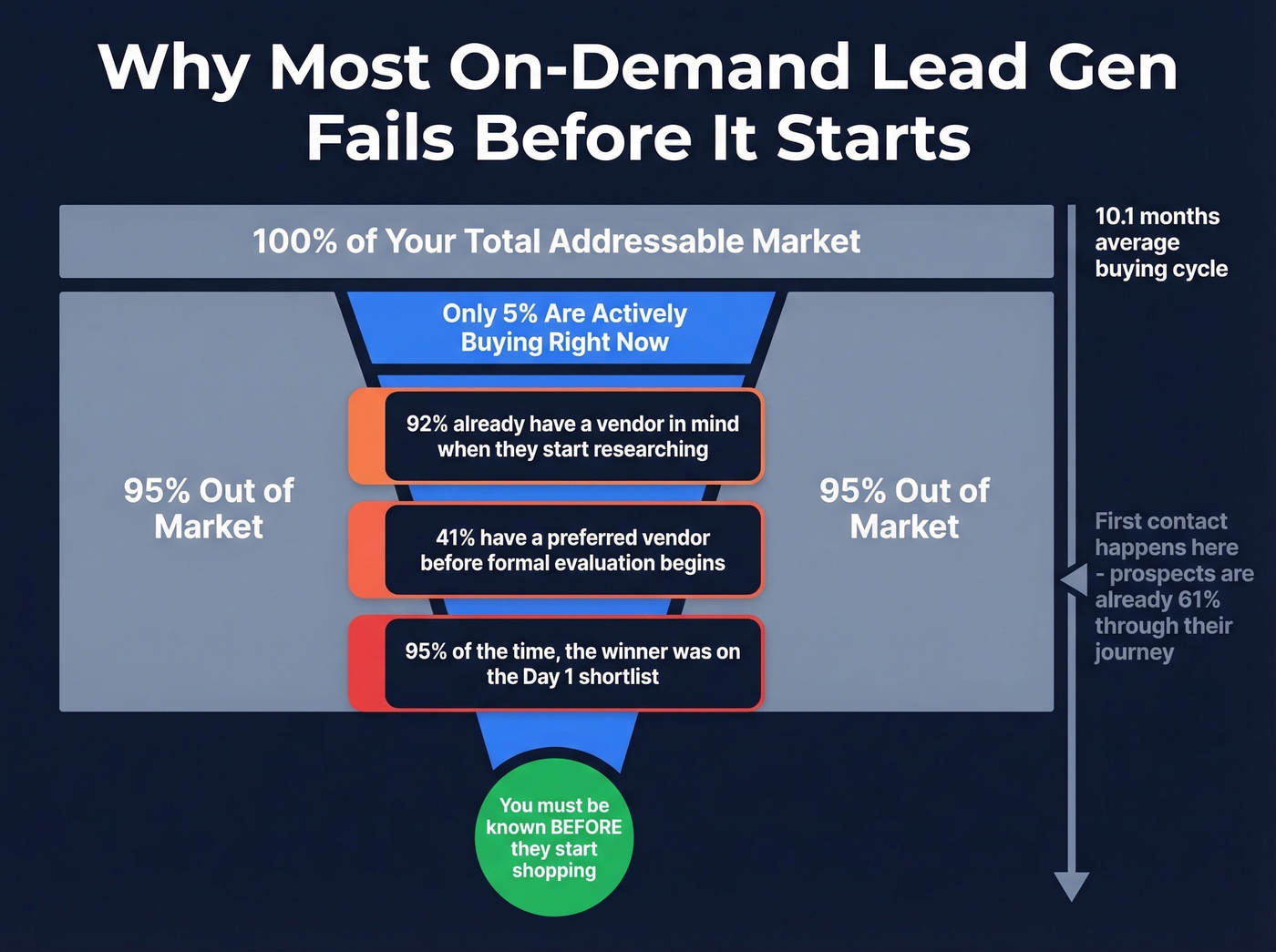
If you're not already in a prospect's consideration set before they start shopping, you've almost certainly lost. The average B2B buying cycle runs 10.1 months, and first contact doesn't happen until prospects are 61% through their journey. You're not closing anyone next week who didn't already know you existed last quarter.
Layer on the channel dynamics and it gets worse. In 2025, email-only campaigns delivered 29% fewer leads YoY. It now takes 12-15 touchpoints before a prospect engages. McKinsey's rule of thirds holds: roughly one-third of buyers prefer in-person interactions, one-third prefer remote, and one-third want digital self-serve. Meanwhile, 84% of reps missed quota last year.
Single-channel, single-touch outreach isn't just underperforming - it's structurally broken.
The teams that generate predictable pipeline aren't doing one thing well. They're doing five things adequately, wired together into a system.
The DICAM Framework: 5 Parts That Work
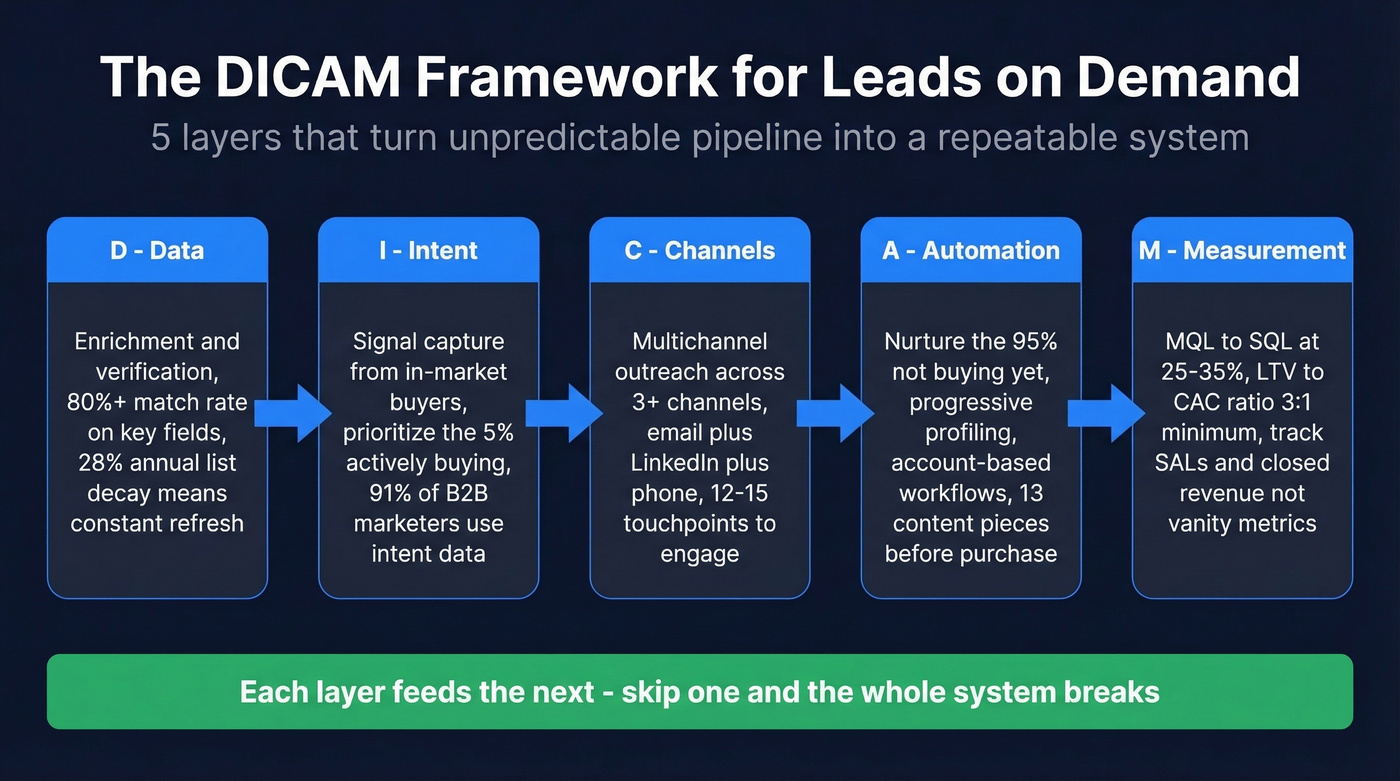
We call it DICAM - Data, Intent, Channels, Automation, Measurement. Each layer feeds the next, and skipping one breaks the whole thing.
Intent Data & Signal Capture
91% of B2B marketers now use intent data to prioritize accounts, but only 24% report exceptional ROI. The gap isn't the data - it's operationalization. Teams buy intent signals and dump them into a spreadsheet that nobody acts on.
The intent data market is estimated at $4.49B in 2026, projected to hit $20.89B by 2035. The underlying logic is sound: why spray 10,000 cold emails when you can identify the 300 accounts actively researching your category?
Data Enrichment & Verification
None of the intent data matters if your contact records are garbage. Email lists decay roughly 28% per year. If you're running outbound on a list you built six months ago, a quarter of it is already dead.
The benchmark: 80%+ enrichment rate on key fields - industry, revenue, company size, direct contact info. Anything below that and your reps are spending more time researching than selling. If you need a vendor shortlist, start with these data enrichment services.
The proof point that sticks with us: Snyk had 50 AEs prospecting 4-6 hours per week with bounce rates running 35-40%. After deploying Prospeo, bounces dropped under 5%, AE-sourced pipeline jumped 180%, and they were generating 200+ new opportunities per month. That's not a marginal improvement - that's a structural fix. With 300M+ professional profiles, 143M+ verified emails at 98% accuracy on a 7-day refresh cycle, the data quality gap between a purpose-built verification tool and a legacy database is enormous. At roughly $0.01 per email versus ZoomInfo's roughly $1 per lead, the economics aren't even close.
Multichannel Outreach
73% of buyers still prefer email as a communication channel, but email alone won't get you there. Buyers use roughly 10 channels throughout their journey, and your demand generation efforts need to meet them across at least three.
Authenticate SPF, DKIM, and DMARC before sending a single cold email. Keep copy concise - 100-120 words per email, not the 400-word essays that marketing teams love. Run 3-touch sequences over 1-2 weeks rather than 8-touch marathons that annoy everyone. If you want a proven structure, use a B2B cold email sequence and tighten your prospecting email subject lines.
For tools, Instantly, Lemlist, and Smartlead all sit in the $30-$99/month range and handle email sequencing well. Pair any of them with a Chrome extension to find verified contacts while prospecting on any website, then push them straight into your sequences.
Automation & Nurturing
The 95% of your market that isn't buying today still needs to know you exist when they start shopping in 6 months. Buyers consume roughly 13 content pieces before making a purchase decision, which means your nurture tracks need to deliver value long before a sales conversation happens.
Progressive profiling - gradually collecting more data as prospects engage - beats gating everything behind a 12-field form. With third-party cookies disappearing, first-party data activation matters more than ever. 71% of companies now run ABM, which means your nurture tracks need to be account-aware, not just contact-aware. HubSpot's free CRM handles basic pipeline tracking, with Marketing Hub starting around $800/month for automation. For workflow glue, Zapier ($19.99/month) or Clay connects everything. To keep the handoffs clean, map your lead generation workflow and standardize lead scoring.
Measurement & Optimization
If you're measuring MQLs and calling it a day, you're measuring the wrong thing. The consensus on r/sales and r/LeadGeneration is blunt: agency directors want percentage converting to SALs and closed/won revenue, not vanity metrics.
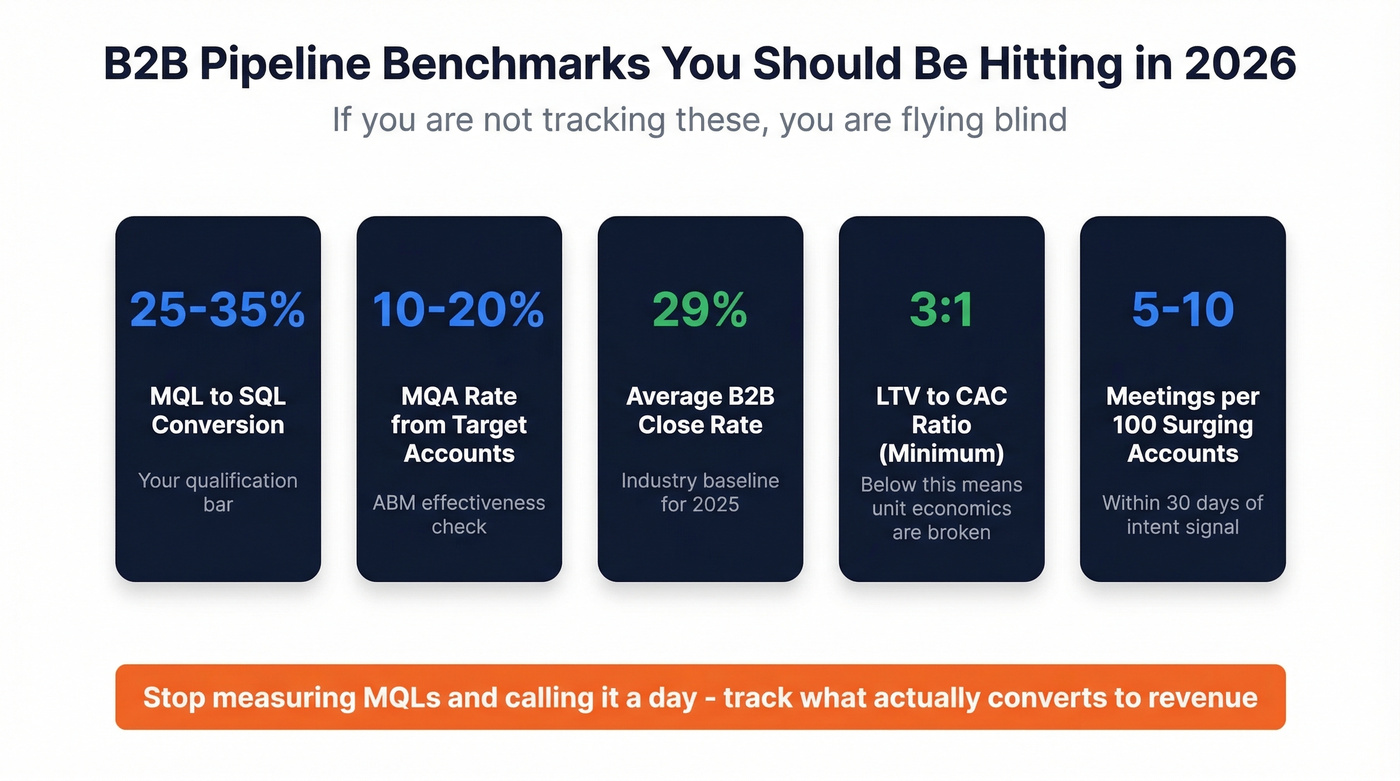
Track these benchmarks to stay honest:
- MQL-to-SQL conversion: 25-35%
- MQA rate from target accounts: 10-20%
- Average B2B close rate: 29%
- LTV:CAC ratio: 3:1 minimum
- 5-10 meetings per 100 surging accounts in 30 days (intent-based outbound)
If your LTV:CAC is below 3:1, you don't have a lead gen problem - you have a unit economics problem. Fix that before scaling anything. For a tighter KPI set, use these lead generation metrics and monitor pipeline health.

You just read that 28% of email lists decay annually and single-channel outreach is structurally broken. Prospeo's 7-day data refresh cycle means your contact data never goes stale - 300M+ profiles, 143M+ verified emails at 98% accuracy, and 125M+ mobile numbers. At $0.01 per email, you can build the always-fresh data layer that makes leads on demand actually work.
Snyk's 50 AEs cut bounce rates from 40% to under 5%. Your turn.
What It Actually Costs in 2026
The average B2B CPL in 2025 ran $84 across channels. Google Ads averaged $70.11 per lead. LinkedIn ran $110+. But those averages hide enormous variance by industry. If you need a baseline for conversion math, see the average B2B lead conversion rate.
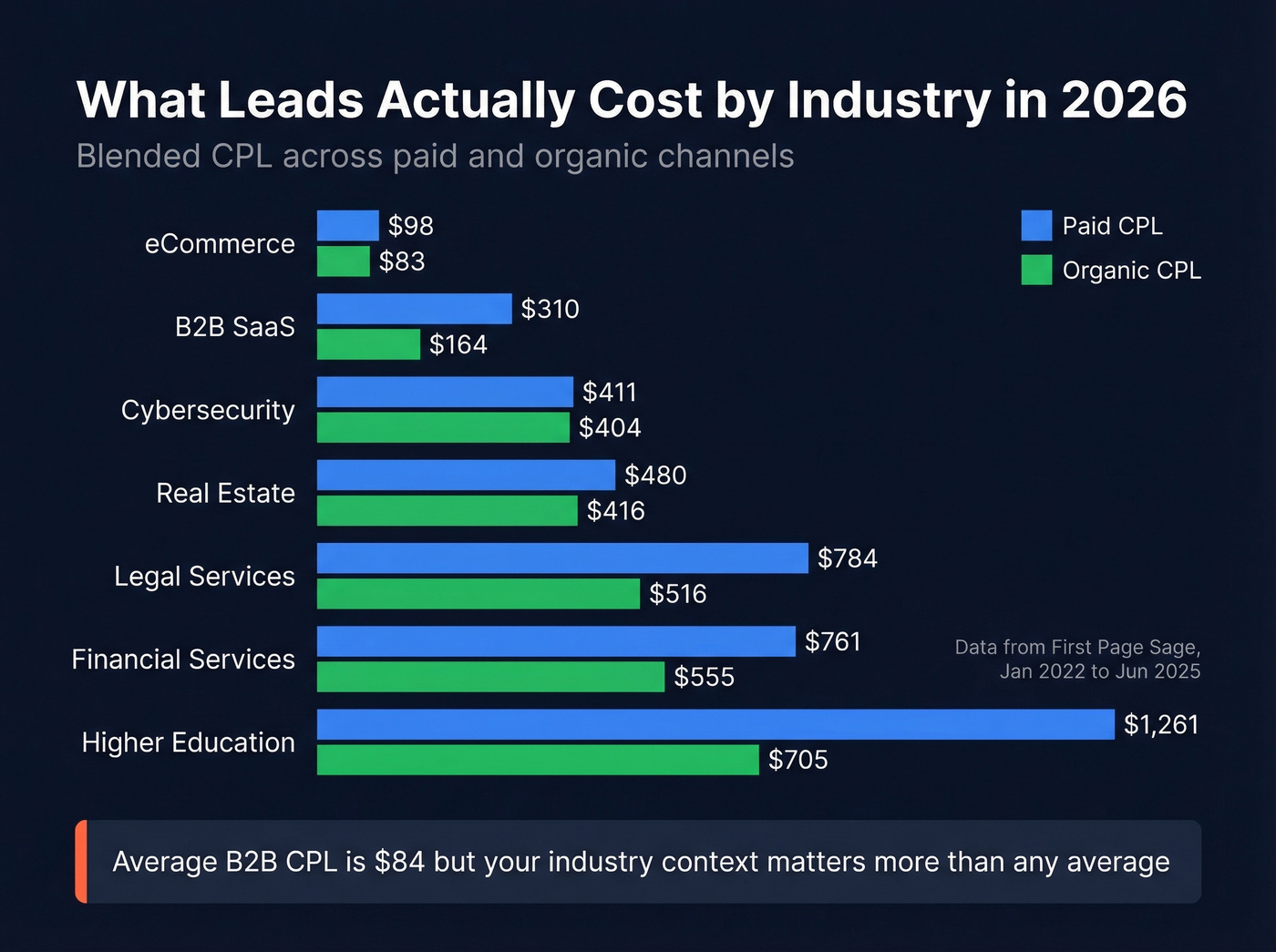
| Industry | Paid CPL | Organic CPL | Blended CPL |
|---|---|---|---|
| eCommerce | $98 | $83 | $91 |
| B2B SaaS | $310 | $164 | $237 |
| Cybersecurity | $411 | $404 | $406 |
| Real Estate | $480 | $416 | $448 |
| Legal Services | $784 | $516 | $649 |
| Financial Services | $761 | $555 | $653 |
| Higher Education | $1,261 | $705 | $982 |
Data from First Page Sage CPL report, collected Jan 2022-Jun 2025.
If you're selling cybersecurity solutions, a $400 CPL isn't a failure - it's the market rate. If you're in eCommerce and paying $400 per lead, something's broken.
For tool budgets specifically, an SMB team should expect $500-$2,000/month for a functional stack. The smart budget split follows the create-demand/capture-demand framework: 60-70% toward awareness and brand building for the 95% who aren't buying yet, 30-40% toward capturing the 5% who are actively in-market. Most teams invert this ratio and wonder why their pipeline is lumpy.
The $500/Month Starter Stack
You don't need $50K/year in tooling to start generating leads predictably.
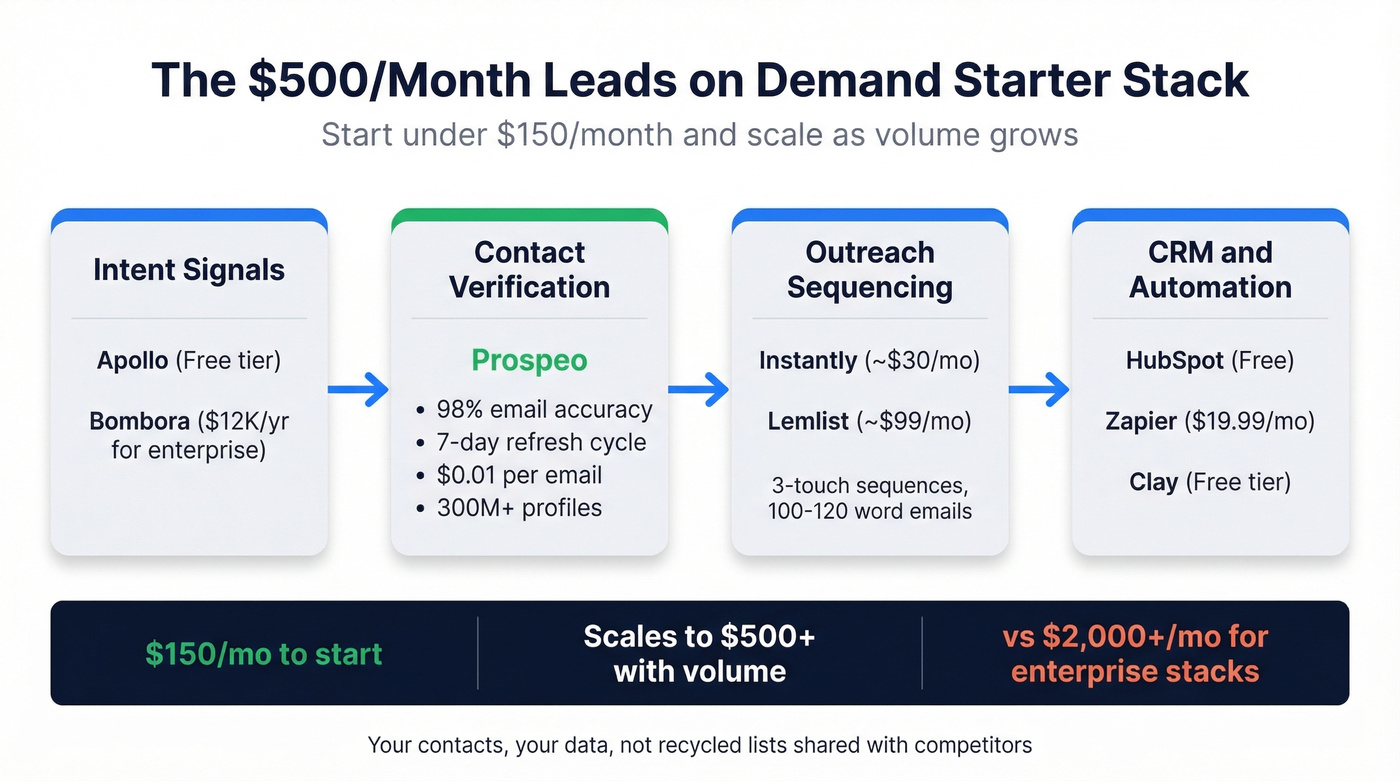
| Layer | Tool | Starting Price |
|---|---|---|
| Intent Data | Apollo / Bombora | Free / $12K/yr |
| Outreach Sequencing | Instantly or Lemlist | ~$30-$99/mo |
| CRM & Pipeline | HubSpot | Free |
| Automation | Zapier or Clay | Free / $19.99/mo |
Start with Apollo's free tier for basic intent signals, layer in verified contact data, sequence through Instantly or Lemlist, and track everything in HubSpot. Total cost: under $150/month to start, scaling to $500+ as volume grows. This stack gives you exclusive lead generation capabilities - contacts verified and sourced by your own team, not recycled lists shared across dozens of competitors. If you’re building the outbound motion from scratch, pull from these sales prospecting techniques and keep a shortlist of free lead generation tools.
The DICAM framework only works when every layer connects. Prospeo covers three of five - intent data tracking 15,000 Bombora topics, verified contact enrichment at 92% match rates, and native integrations with Instantly, Lemlist, Smartlead, HubSpot, and Clay. One platform replaces the $2,000/month stack you're duct-taping together.
Replace your bloated tool stack with one platform that actually delivers.
Pitfalls That Kill the System
Let's be honest - most failures aren't strategic. They're operational.
Demand performance-based compensation from any agency. Percentage converting to SALs and closed/won revenue - that's the only metric that matters. If they won't tie fees to outcomes, walk away.
Skip any provider who takes your deposit and does vague work for 60 days before disappearing. The pattern on r/LeadGeneration is depressingly consistent - providers promise results, collect payment, and deliver nothing actionable.
Verify your ICP data before launching any sequence. A single campaign on a dirty list can tank your domain reputation for months. We've watched teams burn through three sending domains in a quarter because they skipped this step. If you need a checklist, start with an email deliverability guide and track your email bounce rate.
Don't assume "clicks" equals "leads." One practitioner on r/PPC reported running Google Demand Gen for real estate - tons of clicks, zero leads. Campaign setup and funnel alignment matter more than ad spend.
Measure revenue metrics from day one, even if the numbers are small. Build the attribution muscle early. We've seen teams get budget pulled because they couldn't connect $20K in monthly spend to a single closed deal - not because the spend wasn't working, but because they couldn't prove it was.
Leads on Demand FAQ
How long before pipeline becomes predictable?
Expect 3-6 months before your system produces consistent output. The average B2B buying cycle runs 10.1 months, so patience is literally built into the math. Quick wins happen in month one; compounding results show up around month four.
What's a realistic B2B cost per lead?
The average B2B CPL is $84 across channels, but industry variance is massive. eCommerce averages $91 blended, B2B SaaS runs $237, and financial services hits $653. Benchmark against your specific vertical, not the overall average.
Should I build in-house or hire an agency?
Build in-house if you can - owning your data and processes gives you exclusive lead generation no competitor can replicate. For teams that outsource, demand performance-based compensation tied to SAL conversion and closed revenue. Any agency that won't agree to outcome-based terms is telling you something about their confidence.
What's the single most important tool?
Data enrichment and verification. If your emails bounce at 30%+ and your phone numbers are dead, nothing downstream - sequences, nurture, scoring - produces results. A free tier with 75 verified emails/month is enough to validate whether your ICP targeting works before scaling spend.
Can paid ads alone deliver predictable leads?
No. Only 5% of your market is actively buying at any given time. Paid ads capture existing demand, which is critical but insufficient. You also need to create demand through content, outreach, and brand so you're on the shortlist when the other 95% start shopping.