

Every Sales Technique Worth Knowing in 2026
You've read ten "list of sales techniques" articles that blur frameworks, skills, and closing tricks into one generic pile. No wonder nothing sticks. A Korn Ferry study found teams using a consistent methodology see 15% higher win rates and 21% better quota attainment. The gap isn't knowledge - it's picking the right technique for the right deal.
Here's our hot take: most sales teams don't need more techniques. They need fewer, better-chosen ones and accurate contact data to actually execute them. Learn SPIN for discovery, MEDDIC for qualification, and Challenger for differentiation. That covers 90% of B2B deals.
Process vs. Methodology vs. Technique
Let's get the vocabulary straight before we go any further.
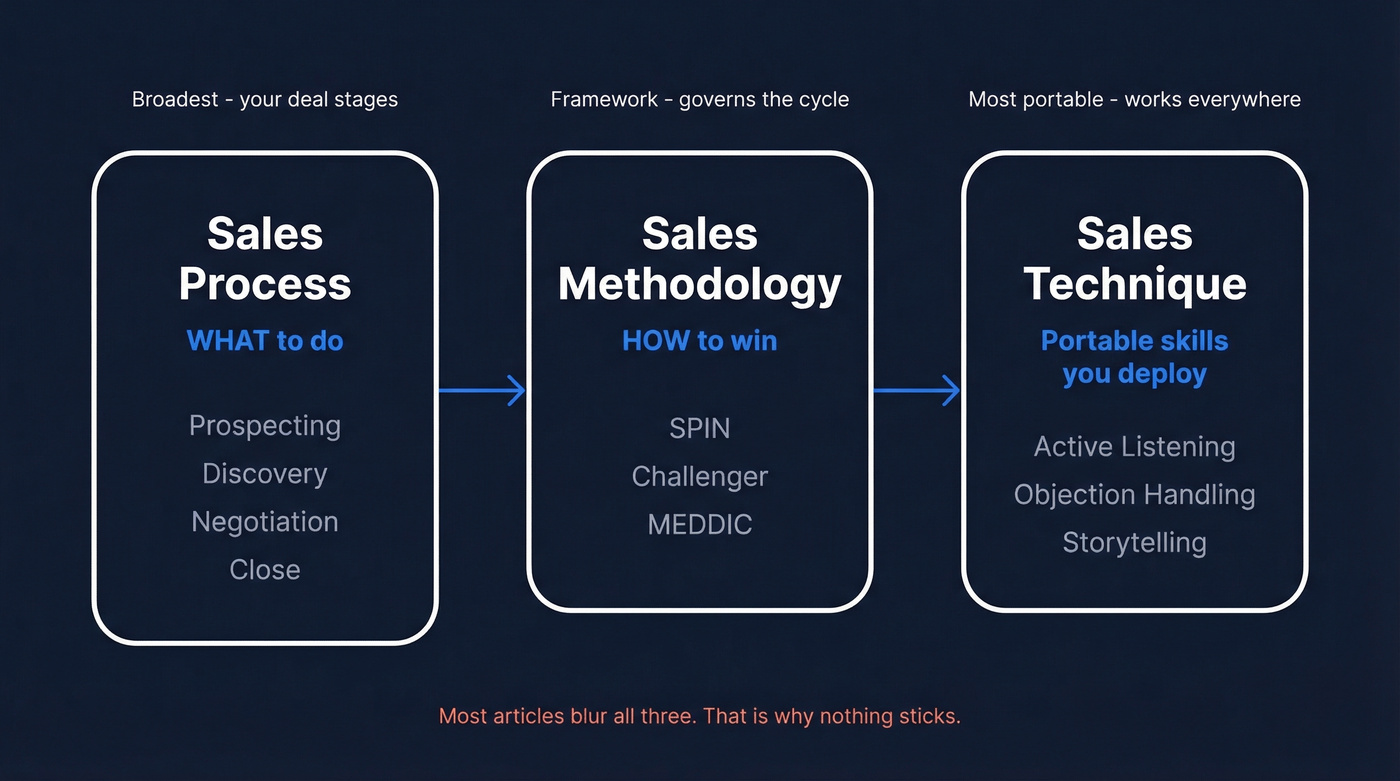
A sales process is what to do - the stages a deal moves through from prospecting to close. A sales methodology is how to win within that process (SPIN, Challenger, MEDDIC). A sales technique is a portable skill you deploy inside any methodology: active listening, objection handling, storytelling. Most articles blur all three. We won't.
B2B Sales Methodologies
SPIN Selling
Neil Rackham built SPIN from analysis of 35,000+ sales calls, structuring discovery around Situation, Problem, Implication, and Need-payoff questions. SPIN practitioners achieve 57% higher prospect talk time in discovery - which matters because the person asking questions controls the conversation. It's the gold standard for complex discovery where the buyer doesn't yet grasp the full scope of their problem.
If your average deal involves more than three stakeholders and a cycle longer than 30 days, SPIN belongs in your toolkit. Skip it for transactional, one-call-close deals where a quick qualification framework like BANT does the job faster.
Challenger Sale
We've watched teams transform their win rates by switching from "be helpful" to Challenger's insight-led teaching approach. Instead of responding to buyer needs, Challenger reps reshape them using constructive tension. It's uncomfortable at first. But it dominates in competitive markets where differentiation is the primary battle, because it forces the rep to lead the conversation rather than react to it.
The catch? Challenger requires deep industry knowledge. You can't teach a buyer something new if you don't know more than they do. Reps who half-commit end up sounding arrogant instead of insightful.
MEDDIC / MEDDPICC
73% of SaaS companies selling above $100K ARR use some version of MEDDIC. Full adoption yields +18% win rates and +24% larger deal sizes. The framework maps Metrics, Economic buyer, Decision criteria, Decision process, Identify pain, and Champion - giving you a qualification checklist that actually predicts close probability.
Skip it, and you'll waste a third of your pipeline on unwinnable deals. We've seen this firsthand: teams that bolt MEDDPICC onto their CRM as mandatory fields before advancing a deal stage cut their "dead on arrival" pipeline by nearly half within a quarter.
Sandler, Consultative, and Value Selling
These three share DNA but differ in emphasis.
Sandler flips the dynamic - the rep acts as consultant, using upfront contracts to set mutual expectations. Consultative/Solution Selling is the default mid-market approach: diagnose before you prescribe, but don't confuse "consultative" with "passive." Value Selling weaves ROI quantification into every touchpoint, not just the proposal.
Pick Sandler for relationship-heavy deals, consultative for 30-90 day mid-market cycles, and value selling when your product isn't obviously different from competitors. All three rely on reading the room, adapting your message to the individual buyer, and building trust through genuine dialogue rather than scripted pitches.
SNAP Selling and Account-Based Selling
SNAP - Simple, iNvaluable, Aligned, Priority - exists for time-starved SMB buyers who won't sit through a 45-minute discovery call. Keep it short, prove value fast.
Account-Based Selling runs the opposite direction: identify target accounts, gather deep intel, execute tailored engagement, close. ABS pairs best with ABM marketing motions and high-ACV enterprise targets. If your average contract value is below $50K, the research investment probably isn't worth it.
Which Methodology Fits Your Deal?
| Framework | Deal Size | Cycle | Stakeholders | Best For |
|---|---|---|---|---|
| BANT | <$25K | <60 days | 1-3 | Transactional |
| SPIN | $25K-$250K+ | 30-120 days | 3-8 | Complex discovery |
| MEDDIC | $100K+ | 60-180 days | 5-12 | Enterprise qual |
| Challenger | $50K+ | 60-120 days | 3-8 | Competitive deals |
| Sandler | $25K-$150K | 30-90 days | 2-6 | Relationship sales |
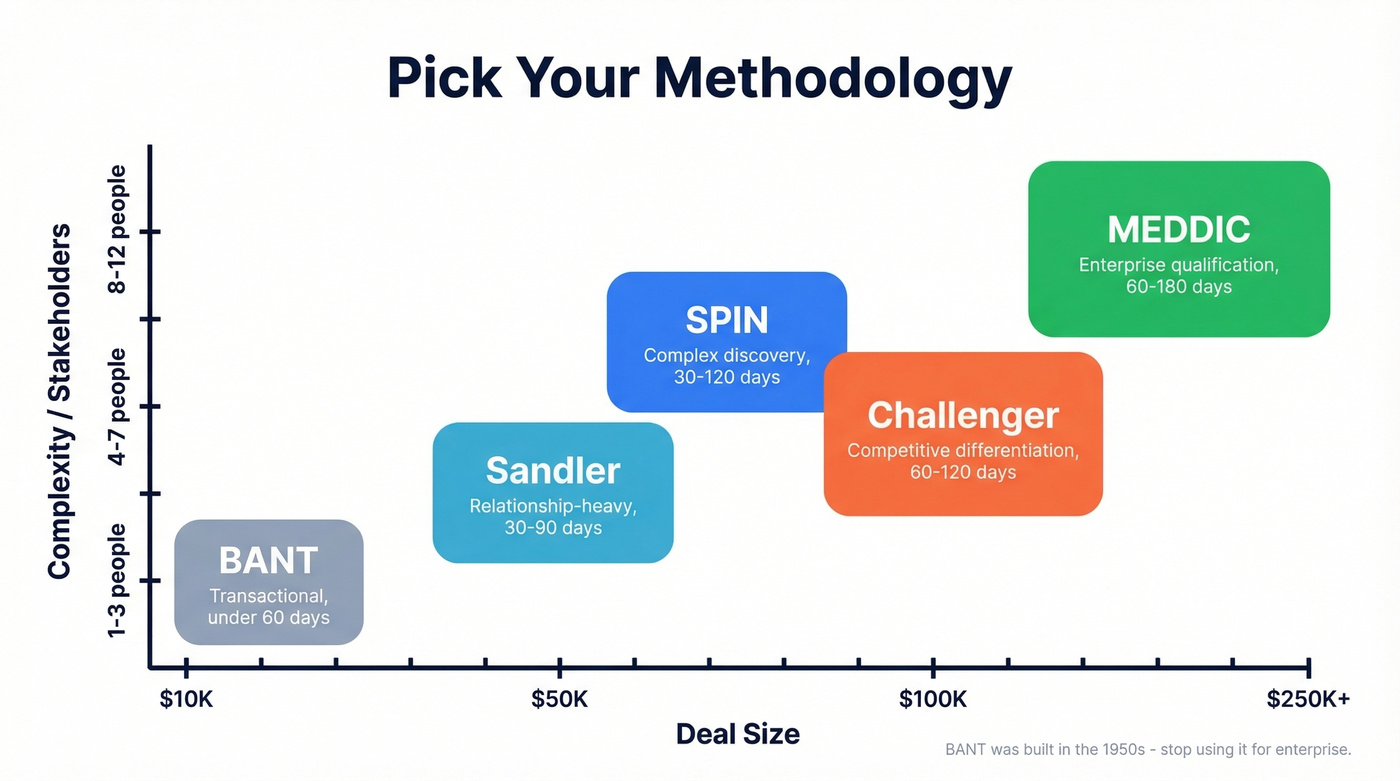
A note on BANT: IBM created it in the 1950s. It's fine for transactional deals with 1-3 decision-makers. Stop using it for enterprise - buying committees have expanded to 8-12 stakeholders, and BANT can't map that complexity. This list focuses on B2B corporate selling techniques. For retail and B2C, upselling, cross-selling, and loss-leader strategies are a different playbook entirely.

SPIN, Challenger, and MEDDIC only work when you reach the actual decision-maker. Prospeo gives you 98% verified emails and 125M+ direct dials so your discovery calls happen with real buyers, not gatekeepers.
Stop perfecting your technique on the wrong contacts.
Portable Techniques That Work Inside Any Framework
These aren't methodologies. They're skills that transfer everywhere.
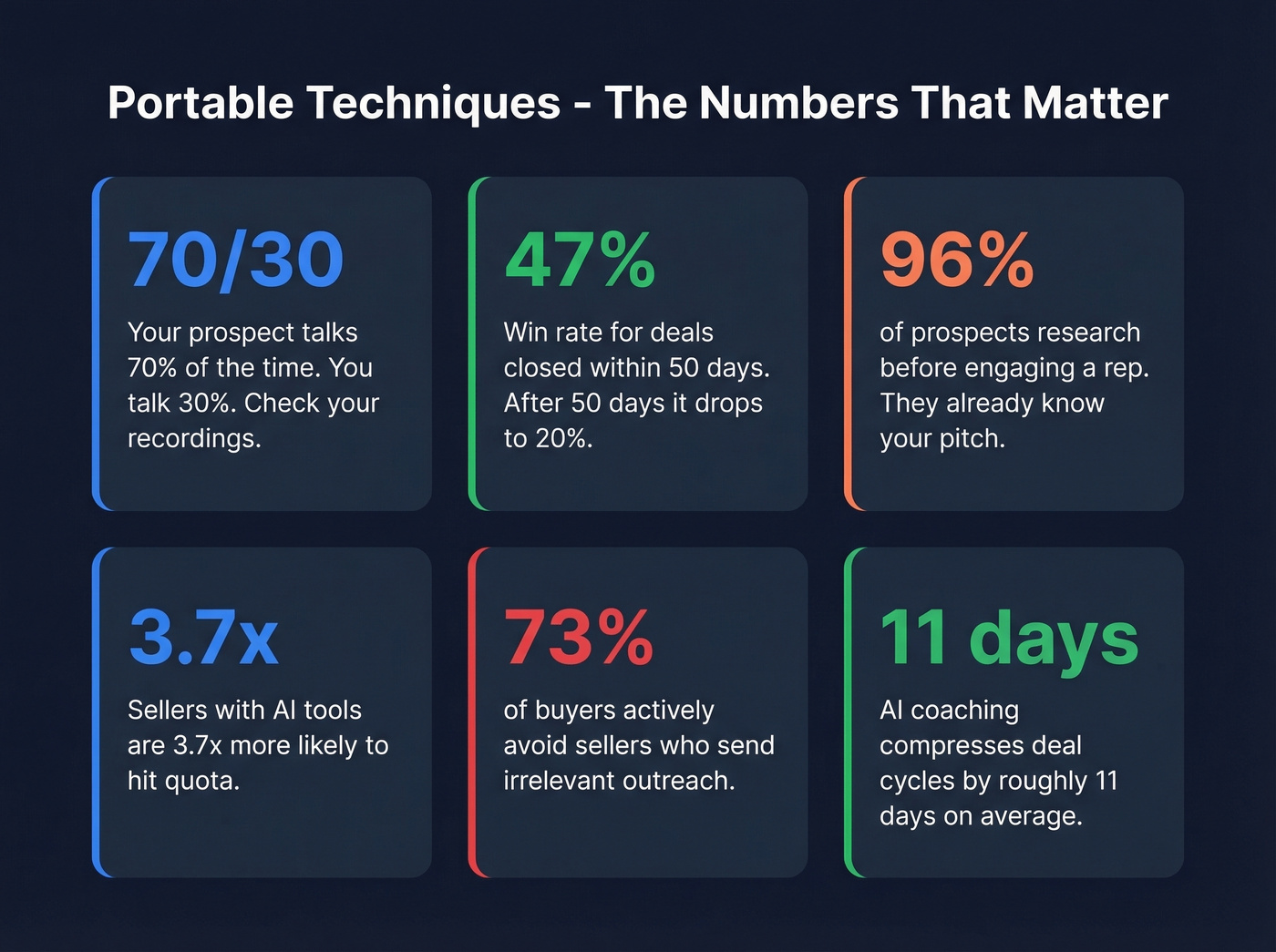
Active listening and the 70-30 rule. Your prospect should talk 70% of the time. If you're talking more than that in discovery, you're pitching, not learning. Record your next three calls and check the ratio - most reps are shocked at how much airtime they're hogging.
Storytelling with contrast. Before/after framing makes ROI tangible. "Before us, your team spent 15 hours building lists. After, it takes 2." That's not a feature pitch. That's a story the buyer retells internally to justify the purchase.
Objection handling. Isolate the objection, reframe it, confirm you've addressed it. One clean response beats three defensive ones. The consensus on r/sales is that most reps over-handle objections - they keep talking past the point where the buyer already said "okay, that makes sense." (If you want a system for this, start with how to reduce sales objection rate.)
Social selling and personalization. 96% of prospects research before engaging a rep, and 73% actively avoid sellers who send irrelevant outreach. Personalization isn't optional anymore - it's the single selling tip that experienced reps wish they'd internalized earlier in their careers.
Clear next-step commitments. Deals closed within 50 days show a 47% win rate. After 50 days, it drops to 20%. Every call should end with a specific, calendared next step. Document the agreed action in writing before you hang up, so neither side can reinterpret the commitment later. (For follow-through, keep a few sales follow-up templates ready.)
AI-assisted selling. This is the 2026 addition most lists miss. Sellers with AI tools are 3.7x more likely to meet quota, and AI coaching compresses deal cycles by roughly 11 days. 45% of teams now use hybrid AI-SDR models for top-of-funnel. If you're not experimenting here, you're already behind. (See also: generative AI sales tools.)
Sales Closing Techniques
The assumptive close proceeds as if the decision is made: "Should we start with the 10-seat plan or the 25?" The sharp angle close trades a concession for commitment: "If I get that discount approved, can we sign this week?" The summary close recaps every agreed-upon value point, then asks for the business.
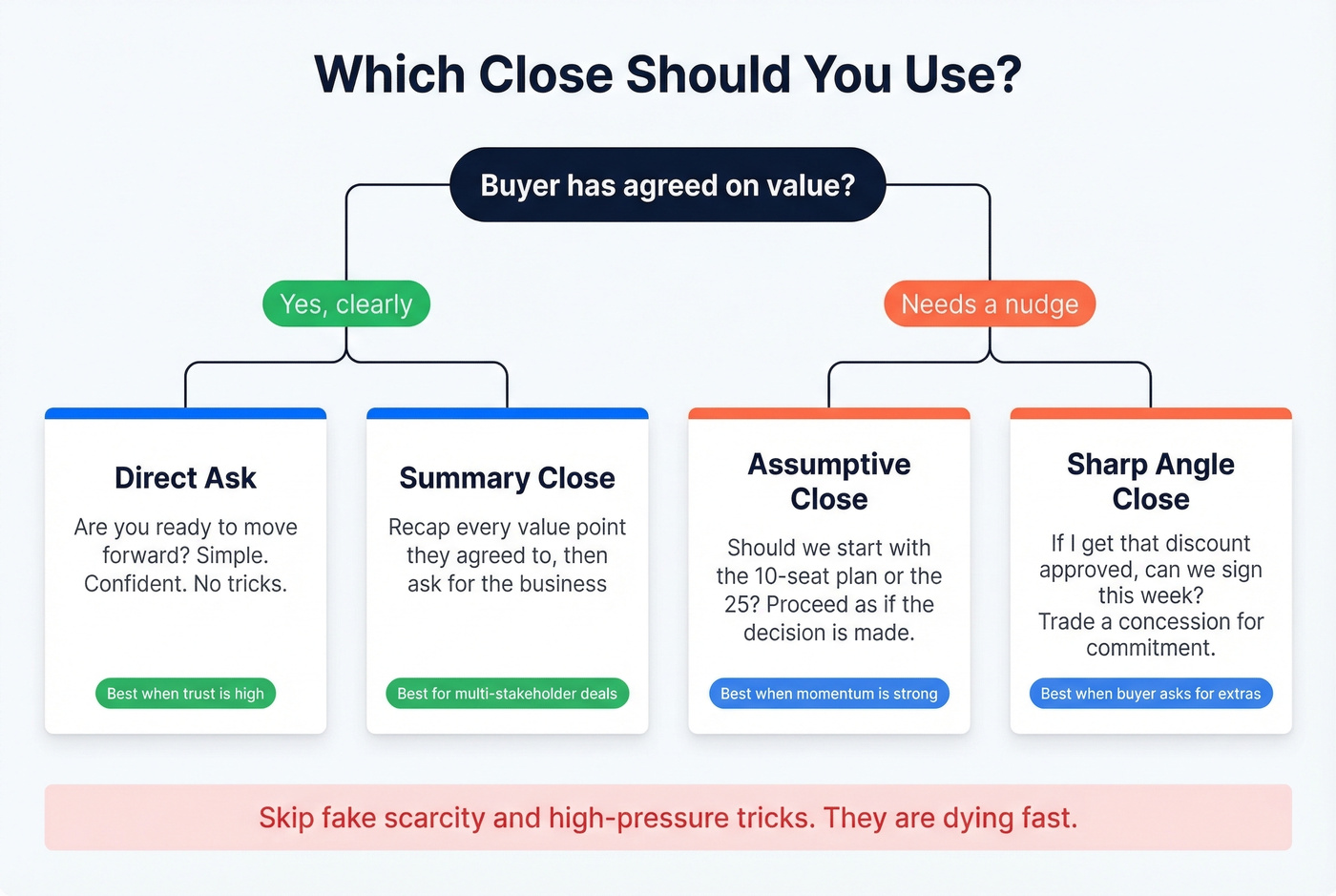
And sometimes the direct ask - "Are you ready to move forward?" - is the strongest move of all. (If you want a full sequence, use these steps to close a sale.)
High-pressure closes are dying. If your strategy relies on fake scarcity or psychological tricks, read the next section.
What Doesn't Work Anymore
Look - 73% of B2B buyers actively avoid sellers who send irrelevant outreach. 69% of cold email senders report performance declining year over year due to spam filtering and AI-content fatigue. Reps who rely on manipulation techniques - bait-and-switch urgency, scripted rebuttals that ignore what the prospect actually said, spray-and-pray sequences - get ghosted faster than ever.
The same applies to mass-blast messages and templated InMails. They trigger the same buyer fatigue that killed generic cold email. If your "technique" is volume without relevance, it's not a technique. It's spam with extra steps. (If you're doing outbound, start with sales prospecting techniques that don't burn your domain.)
The Technique Nobody Lists: Clean Data
Your reps already spend 60% of their time on non-selling tasks. Bad contact data makes it worse. Run a 200-contact sequence with 14% bounces, and your domain reputation tanks. Now every email lands in spam, and no selling technique on earth fixes that. (If you're seeing this, check your email bounce rate benchmarks and causes.)
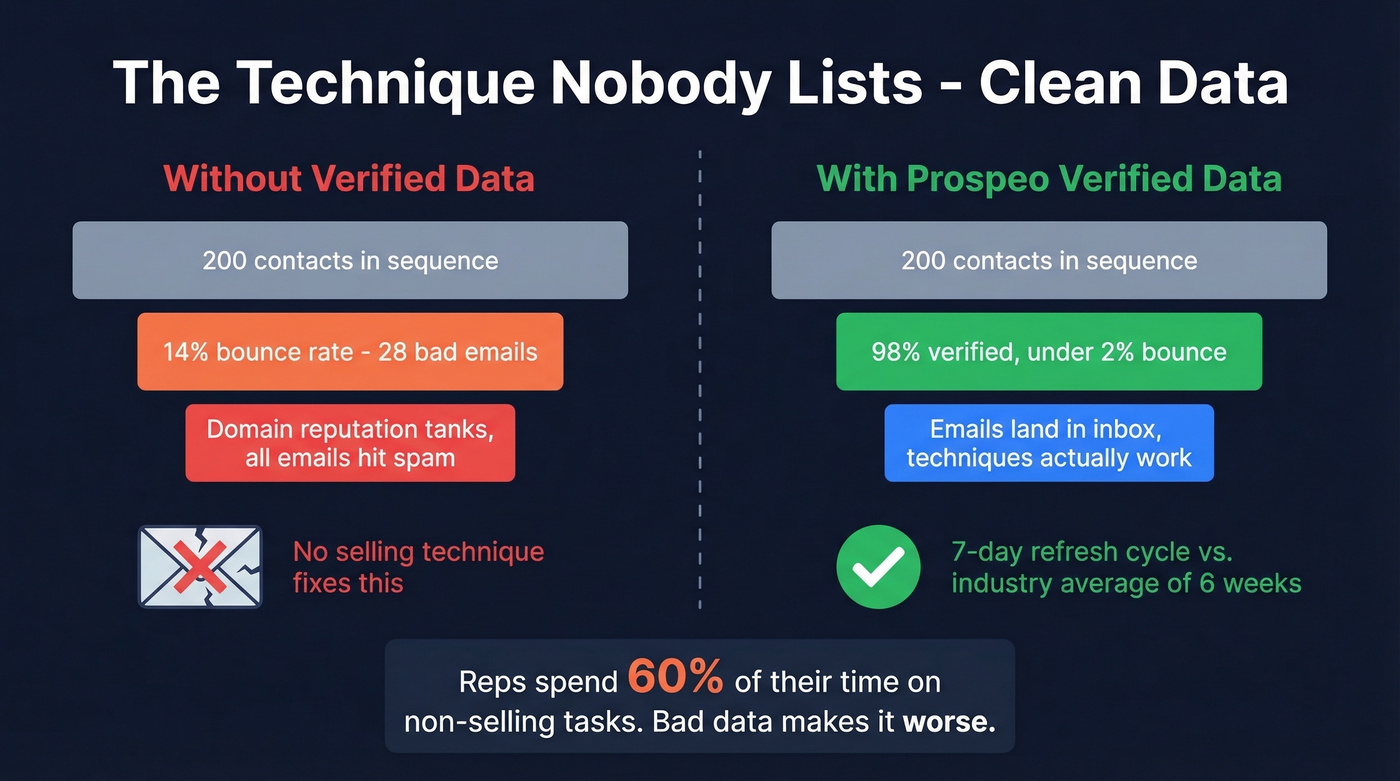
Every methodology above assumes you can reach the person you're selling to. Before you invest in MEDDIC training or Challenger workshops, make sure the contacts your team is calling are real. Prospeo refreshes records on a 7-day cycle and verifies emails in real time - the industry average is six weeks - and the free tier gives you 75 verified emails per month plus 100 Chrome extension credits to test before committing. (If you're comparing vendors, start with data enrichment services.)

Personalization and social selling need accurate data underneath. Prospeo's 300M+ profiles with 30+ filters - including buyer intent and job changes - let you build hyper-targeted lists in minutes, not the 15 hours your team wastes today.
Cut list-building from hours to minutes at $0.01 per verified email.
FAQ
What's the difference between a sales technique and a sales methodology?
A methodology is a complete framework governing your entire deal cycle - SPIN, MEDDIC, Challenger. A technique is a portable skill like active listening, objection handling, or storytelling that works inside any methodology. Think of methodology as the playbook and techniques as individual plays.
Which selling technique works best for B2B enterprise deals?
Combine MEDDIC for qualification with Challenger for differentiation. This pairing covers complex buying committees of 8-12 stakeholders. For mid-market deals under $50K with shorter cycles, consultative selling plus BANT handles most situations. Match the approach to your deal size and cycle length.
How do I make sure outreach reaches decision-makers?
Start with verified contact data - bad emails kill domain reputation and make every technique useless. Prospeo verifies emails in real time with 98% accuracy across 300M+ professional profiles, so your multi-threading and personalization efforts land with the right person instead of bouncing.