

Manual Outreach: When It Works and How to Do It (2026)
You spent 15 minutes researching a prospect, writing a personalized email, and crafting a subject line that didn't sound like spam. It bounced. That's not an outreach problem - it's a data problem, and it's the fastest way to kill a manual outreach strategy before it starts.
The "personalized outreach is dead" crowd is selling automation software. The "hand-crafted emails are king" crowd is selling agency services. The actual numbers are clearer than either side admits.
What Manual Outreach Actually Means
Manual outreach is any one-to-one communication where a human researches the recipient, writes or meaningfully customizes the message, and sends it individually. It spans two worlds: sales teams prospecting high-value accounts and SEO teams pitching for backlinks. Both share the same core constraint - it's slow, it's expensive per touch, and it only pays off when the targeting and data are right.
The Short Version
This approach works best when you're sending roughly 40-80 highly personalized touches per day, or fewer. The average cold email reply rate sits at 3.43%, the top quartile hits 5.5%+, and elite performers reach 10.7%+. Here's the thing: the biggest killer isn't your copy - it's bad data. Start with verified contacts, keep emails under 80 words, and plan 4-7 touchpoints. If you need a few hundred touches daily, automate the first message and go manual on follow-ups.
Outreach Benchmarks for 2026
These come from large datasets - Instantly's cold email benchmark report covering billions of interactions and Belkins' LinkedIn outreach study analyzing 20M+ attempts.
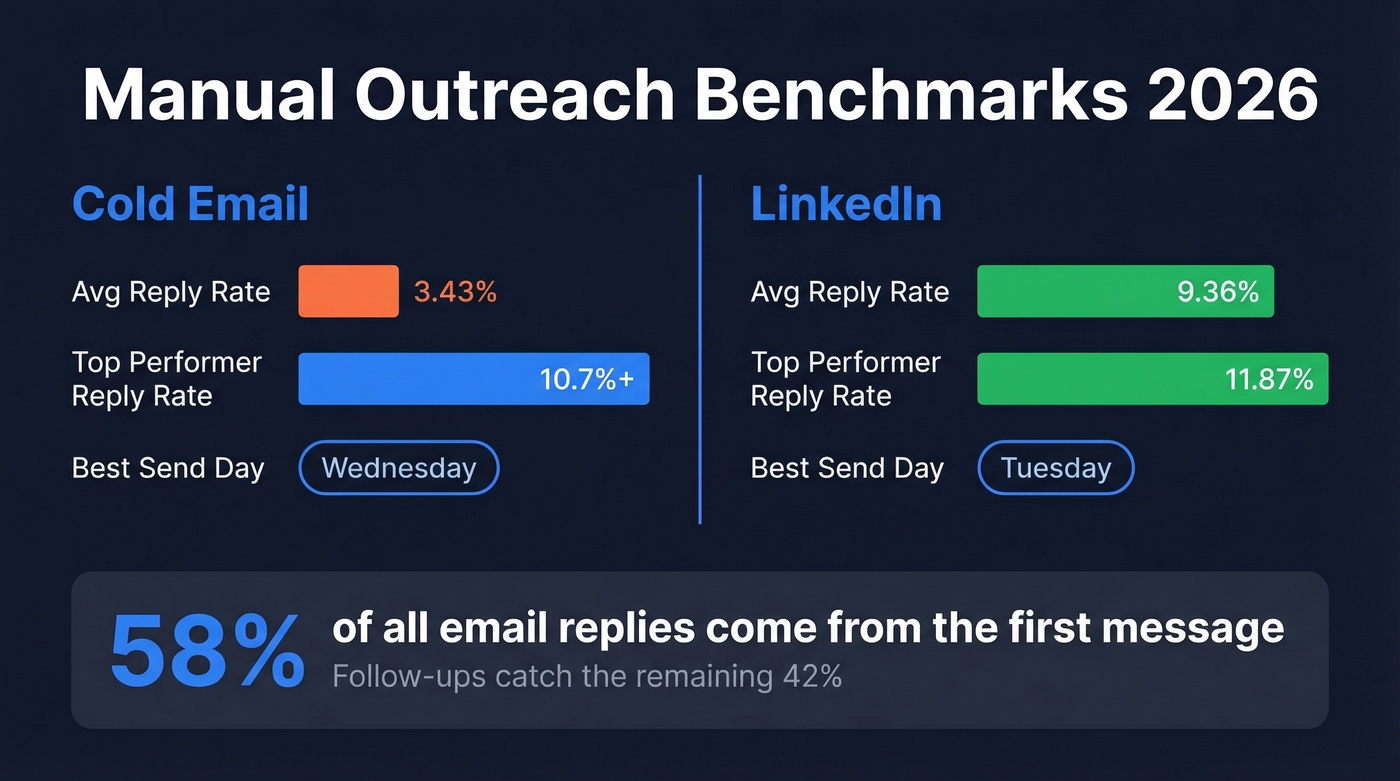
| Metric | Cold Email | |
|---|---|---|
| Avg reply rate | 3.43% | 9.36% (with message) |
| Top performer reply | 10.7%+ | 11.87% (DM + visits) |
| Best send day | Tue-Wed (Wed highest) | Tuesday |
| Acceptance baseline | - | 26.4% |
LinkedIn reply rates run 2-3x higher than cold email. But 58% of all email replies come from the first message, which means your opener carries most of the weight and follow-ups catch the remaining 42%.

Industry matters too. Legal and professional services see 10.42% response rates while software/SaaS sits at 4.77%. Calibrate accordingly.
Emails under 80 words outperform longer ones. Tuesday and Wednesday are peak days. And campaigns with 4-7 touchpoints hit the sweet spot - beyond seven, diminishing returns kick in hard.
When It's Worth the Time
Go manual when you're targeting a manageable list and each account is genuinely high-value. ABM, enterprise deals, strategic partnerships - these justify the time investment. Same goes for early-stage founders whose personal voice is the differentiator.
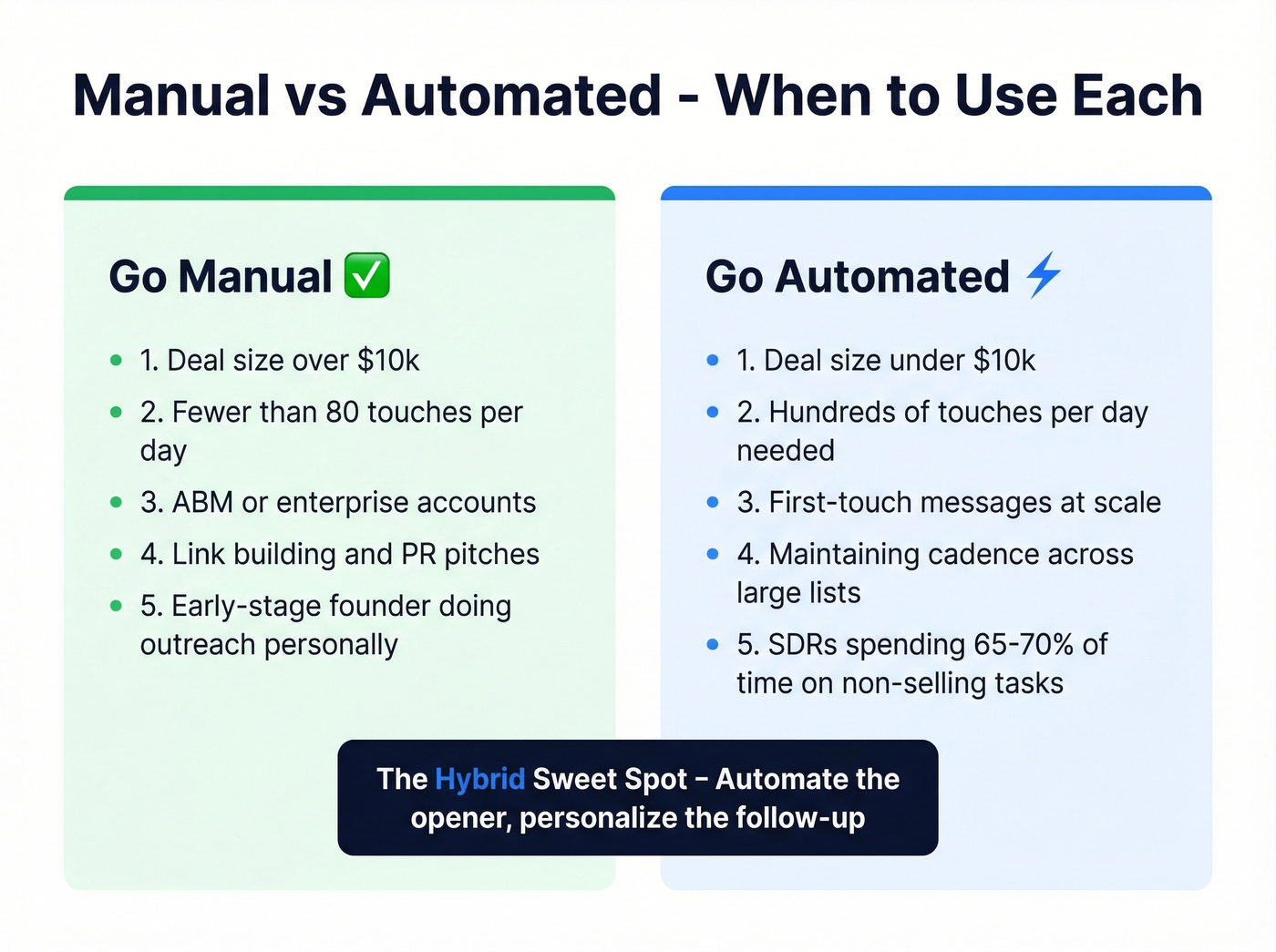
Link-building outreach is the other clear case. Automated link pitches get deleted on sight because editors can smell templates from the subject line alone. Focus on pitching linkable content formats like original research, visual assets, or free tools, and prioritize topically relevant, authoritative sites over mass domain lists.
On LinkedIn, manual follow-ups hit 3.91% reply rates vs 3.48% for AI-generated ones. But the flip side is interesting: AI-assisted first messages on LinkedIn actually outperform manual ones (4.19% vs 2.60%). That's the hybrid model in a nutshell - automate the opener, personalize the follow-up.
Automate when you need a few hundred touches per day. SDRs spend 65-70% of their time on non-selling tasks. At that ratio, you're paying for a writer, not a seller. Automation handles first-touch messages at scale and keeps cadence consistent across large lists without dropped follow-ups.
Let's be honest: if your average deal size is under $10k, you probably don't need fully personalized one-to-one emails. The hybrid model will outperform pure manual at that price point every time.

You just read that 42% of replies come from follow-ups - but none of that matters if your first email bounces. Prospeo verifies every contact at 98% accuracy on a 7-day refresh cycle, so the 5-15 minutes you spend personalizing each message actually land in an inbox. At ~$0.01/email, one saved bounce pays for a hundred verified contacts.
Stop wasting hand-crafted emails on dead addresses.
How to Get Replies
Source from engagement, not database dumps. One practitioner on r/coldemail generated 34 sales conversations in 45 days by targeting post commenters and likers instead of exporting 20k leads from a database. Engagement-based prospecting means your targets already care about the topic - you're not cold, you're warm-adjacent.
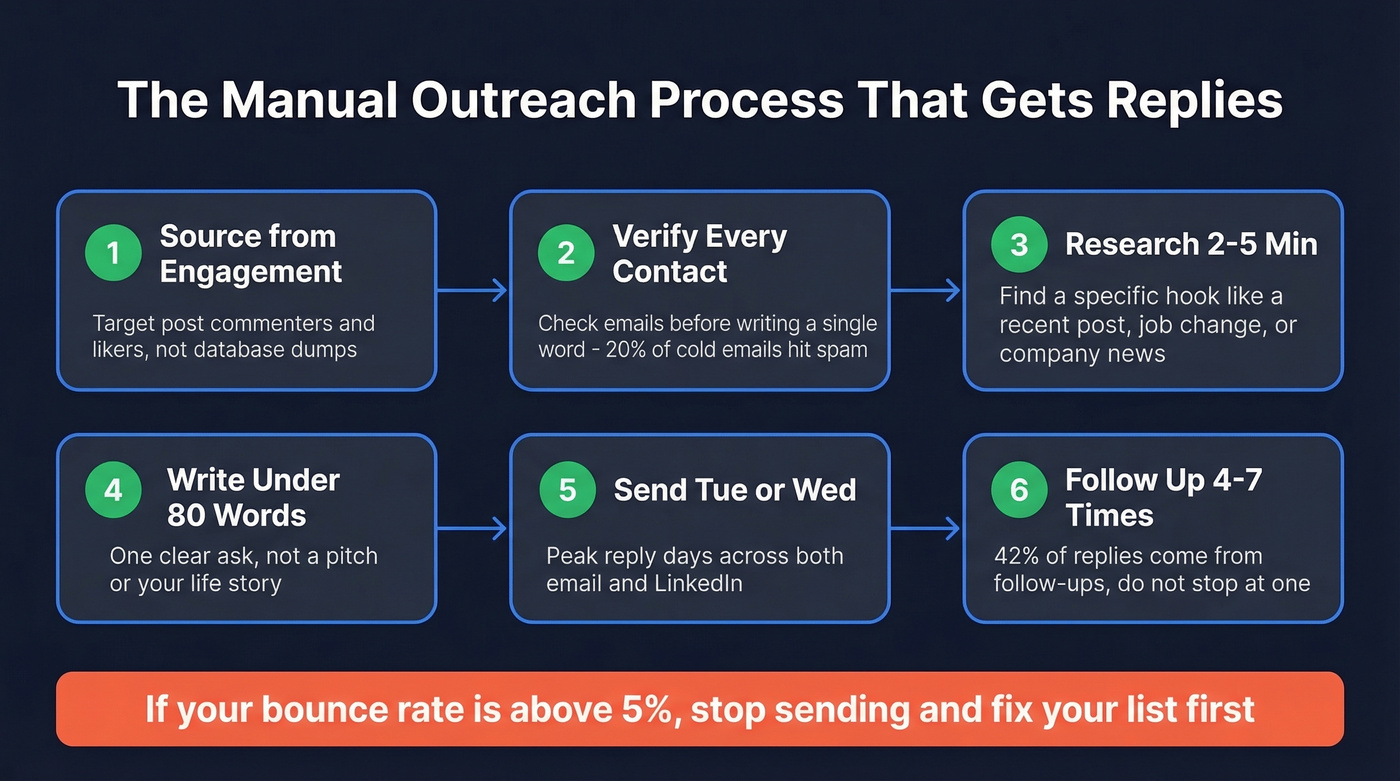
Verify every contact before writing a word. A bounce wastes the 10-20 minutes you spent researching and writing. Roughly 20% of cold emails get flagged as spam. Clean data is the difference between inbox and junk folder. If you're troubleshooting bounces, start with your bounce rate and work backward.
Research for 2-5 minutes. Find a specific hook: a recent post, a company announcement, a job change. Advanced personalization can double cold email response rates. Generic "I love your company!" lines are worse than no personalization at all - we've seen this firsthand across dozens of campaigns.
Write under 80 words with one clear ask. Not a pitch. Not your life story. One question or one specific value prop. If you're stuck, borrow proven email copywriting patterns and adapt them to the account.
Use low-friction connection notes on LinkedIn. A short, non-salesy connection note pulls roughly 30-35% acceptance rates, far above the 26.4% baseline. Save the pitch for the follow-up message.
Follow up 4-7 times. 42% of replies come from follow-ups. One-and-done is the most common mistake we see. Send on Tuesday or Wednesday for peak reply rates across both channels. For ready-to-send sequences, use these cold email follow-up templates.
Mistakes That Kill Response Rates
Before you send: Targeting too broad, using unverified data, no clear goal for the email, skipping research entirely. Tighten your targeting with an Ideal Customer Profile before you write anything.
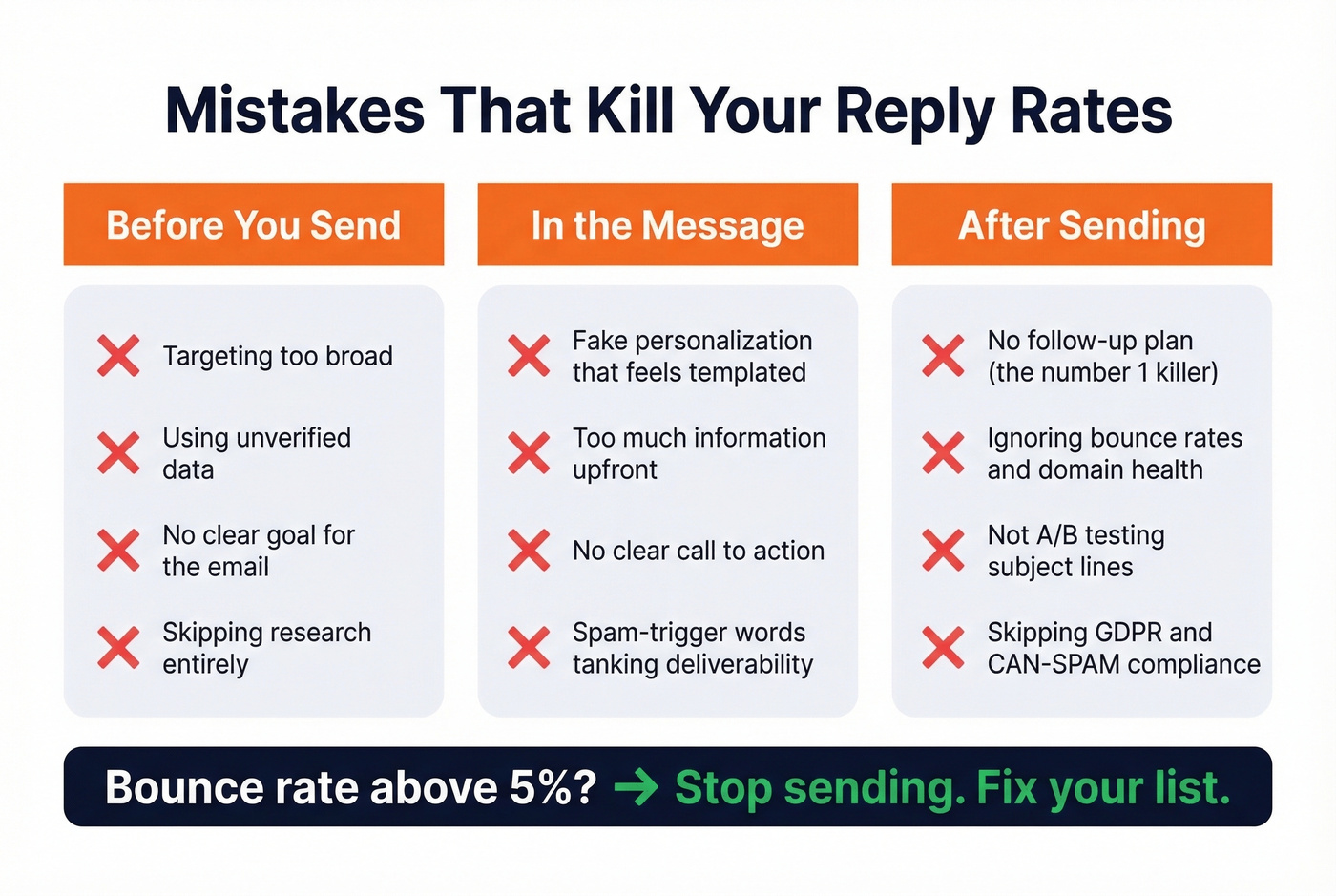
In the message: Fake personalization that's obviously templated, too much information upfront, no clear CTA, spam-trigger words that tank deliverability. If you're getting opens but no replies, revisit your email call to action.
After sending: No follow-up plan - the number one killer. Ignoring bounce rates and what they're doing to your domain. Not A/B testing subject lines. Skipping GDPR/CAN-SPAM compliance. If you're scaling, track email velocity so you don't spike sending limits.
If your bounce rate is above 5%, stop sending and fix your list. You're burning time and deliverability simultaneously.
Why Data Quality Makes or Breaks It
Personalized outreach is time-expensive by definition. At 5-15 minutes per prospect, every bounce is a double loss: you waste the time and you damage your sender reputation. An SDR sending 50 emails per day with a 10% bounce rate is throwing away five carefully crafted messages and slowly torching their domain.
This is where verification tools earn their keep. Prospeo runs 98% email accuracy on a 7-day data refresh cycle - the industry average is six weeks. Stack Optimize built to $1M ARR on that data foundation: client deliverability runs 94%+, bounce rates stay under 3%, and they've had zero domain flags across all clients. If you're diagnosing inboxing issues, start with an email deliverability guide and then improve your sender reputation.
Manual outreach only scales when your data is clean. Stack Optimize built to $1M ARR sending 4x the volume with under 3% bounce rates and zero domain flags - all on Prospeo data. With 300M+ profiles, 30+ search filters, and 98% email accuracy, you spend your time writing, not recovering from bounces.
Protect your domain and your time - verify before you write.
Tools for Manual Outreach
The stack is simple: data layer, sending tool, CRM.
| Tool | Role | Starting Price |
|---|---|---|
| Prospeo | Verification + data | Free, ~$0.01/email |
| GMass | Gmail-native sending | $25/mo |
| Apollo | Prospecting + sequences | Free, $59/user/mo |
| Instantly | Cold email at scale | $30-$100+/mo |
GMass is the simplest option if you live in Gmail and want mail merge with sequences - nothing more, nothing less. Apollo gives you a free plan with 100 credits per month and built-in sequencing, making it the obvious starting point for teams that want prospecting and sending in one place without juggling multiple tools. Instantly is built for volume with strong analytics.
Skip Apollo if you already have a solid data source and just need a sending tool. Skip Instantly if you're sending under 100 emails a day - it's overkill for low-volume manual work. If you're comparing stacks, start with a shortlist of SDR tools and pick what matches your workflow.
FAQ
Is manual outreach still effective in 2026?
Yes. Top performers hit 10.7%+ reply rates on cold email and 11.87% on LinkedIn. It's a precision tool for high-value accounts, not a volume play. Hybrid approaches - automated first touch, manual follow-up - often deliver the best ROI for teams that can't go fully manual.
How many personalized emails can one person send daily?
Realistically 40-80, spending 5-15 minutes per prospect on research and writing. Beyond that threshold, quality drops noticeably. Teams needing higher volume should automate the first touch and reserve manual effort for warm follow-ups and replies.
What's the best way to verify contacts before reaching out?
Use a real-time verification tool before writing a single message. A 5-step verification process that catches invalid addresses, spam traps, and honeypots at 98%+ accuracy will save you from wasting 10-20 minutes of research on a bounce - and protect your domain reputation in the process.