

Marketing Databases: Every Type, Tool, and Price You Need to Know
Poor data quality costs organizations $12.9M per year on average. That's lost productivity, misallocated budgets, missed sales - all because someone trusted the wrong database or let the right one rot. The term "marketing databases" gets thrown around loosely, and half the resources out there are university library guides while the other half mash five completely different product categories under one label.
Here's what's actually below: every type of marketing database, the best tools in each category with real pricing, and a framework for picking the right one.
What You Need (Quick Version)
- Need market research and industry reports? Statista or IBISWorld. Statista for breadth, IBISWorld for deep industry analysis.
- Need to unify customer data across channels? A CDP like Segment, or your existing CRM if you're under 50 employees.
The sales intelligence market alone is a $4.85B industry growing 11.3% annually. There's no shortage of tools. The challenge is picking the right category first, then the right tool within it.
What Is a Marketing Database?
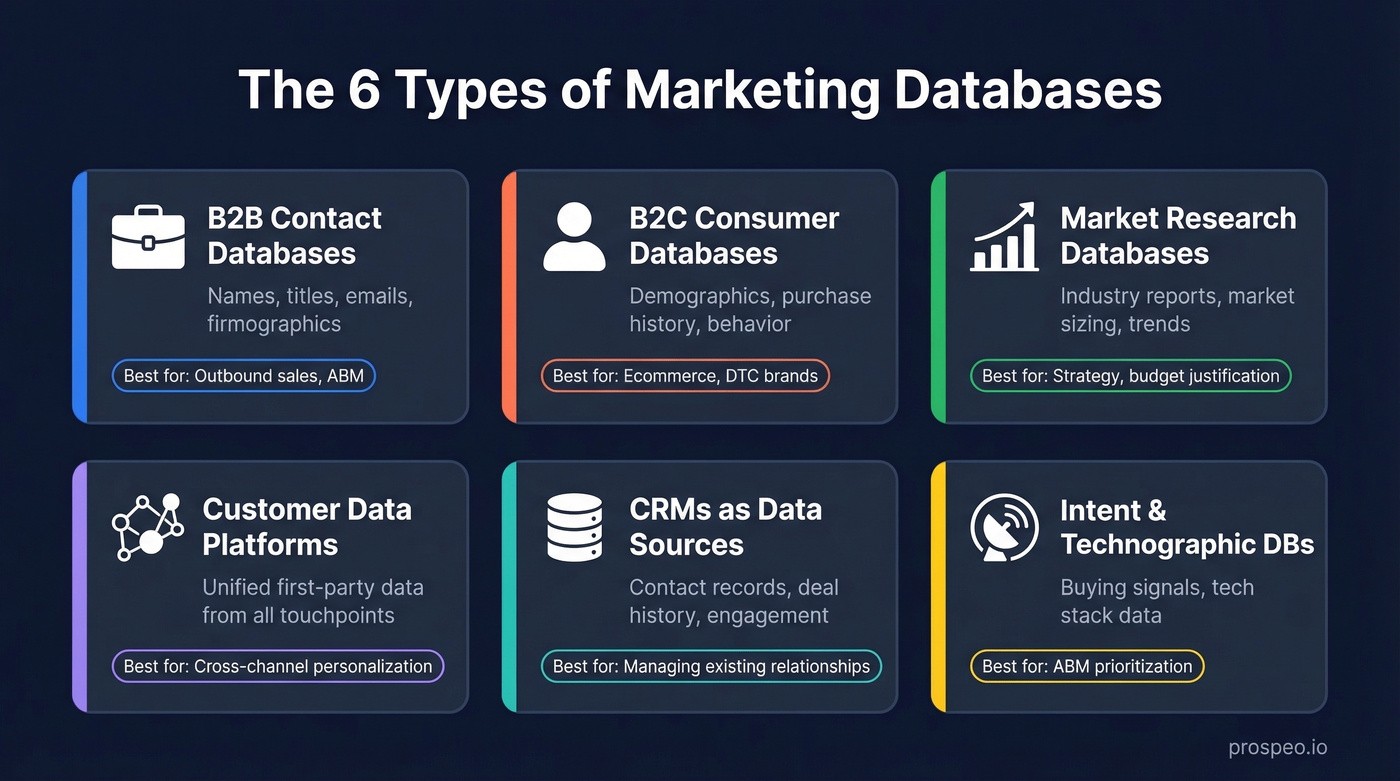
A marketing database is any structured collection of data used to target, personalize, and measure marketing efforts. That definition covers at least five distinct product categories, which is why the term causes so much confusion.
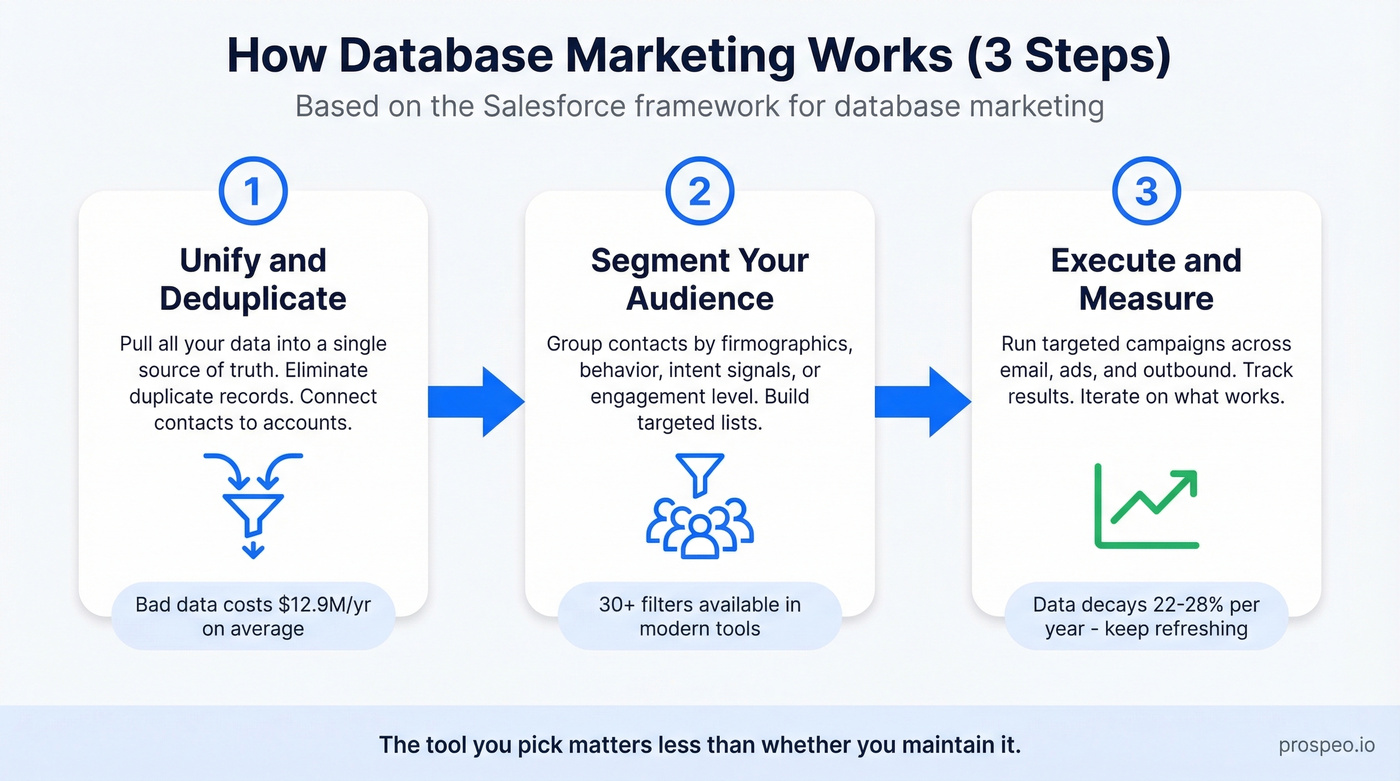
Salesforce's framework for database marketing boils down to three steps: unify your data into a single source and eliminate duplicates, segment that data by audience characteristics, then execute targeted campaigns and measure results. Every tool in this space exists to serve one or more of those steps.
Two things matter across all of them. First, compliance. GDPR and CCPA aren't optional, and the penalties for mishandling personal data are real. Second, freshness - B2B data decays at roughly 22.5-28% per year depending on industry. The tool you pick matters less than whether you maintain it.
Types of Marketing Databases
B2B Contact Databases
These store professional profiles - names, titles, business emails, direct dials, company firmographics - and they're built for outbound sales and ABM. Tools like ZoomInfo, Apollo, and Cognism live here. If your team runs outbound sequences or builds targeted account lists, a B2B contact database is the foundation. (If you're comparing vendors, start with our breakdown of sales prospecting databases.)
B2C Consumer Databases
Consumer databases track individuals by demographics (age, location, income), behavioral data (purchase history, browsing patterns), and psychographics (interests, preferences). They're structurally flatter than B2B databases: one record per person rather than hierarchical account-contact relationships. Best for ecommerce, retail, and direct-to-consumer brands running high-volume campaigns.
Market Research Databases
Statista, Mintel, Euromonitor, and IBISWorld fall here. These aren't contact lists. They're repositories of industry reports, market sizing data, consumer surveys, and trend analysis - best for strategy teams, analysts, and marketers who need data to justify budgets or size new markets. (For sizing, it helps to align on TAM, SAM, and SOM first.)
Customer Data Platforms (CDPs)
CDPs like Segment and Treasure Data unify first-party data from every touchpoint - website, app, email, support - into a single customer profile. They don't provide new contacts; they organize the ones you already have. Best for mid-market and enterprise teams with data scattered across 10+ tools.
CRMs as Data Sources
Your CRM is already a marketing database. Salesforce, HubSpot, and Pipedrive store contact records, deal history, and engagement data. Breeze Intelligence is part of HubSpot's product lineup, and it's one example of how CRMs and data tools increasingly overlap. The core difference: CRMs manage existing relationships, while dedicated contact databases help you find new ones. (If you want a quick landscape view, see these examples of a CRM.)
Intent & Technographic Databases
These layer behavioral signals on top of contact data. Intent databases like Bombora and G2 Buyer Intent track which companies are actively researching topics related to your product. Technographic databases like BuiltWith and HG Insights tell you what software a company already uses. ABM teams that want to prioritize accounts showing buying signals live in this category. (For a practical framework, use intent based segmentation.)
Data Marketplaces
AWS Data Exchange and Snowflake Marketplace let you buy and integrate third-party datasets directly into your data warehouse. Best for enterprise data teams building custom pipelines rather than using off-the-shelf tools.
B2B vs B2C: Key Differences
The structural differences between B2B and B2C data go deeper than the fields they store.
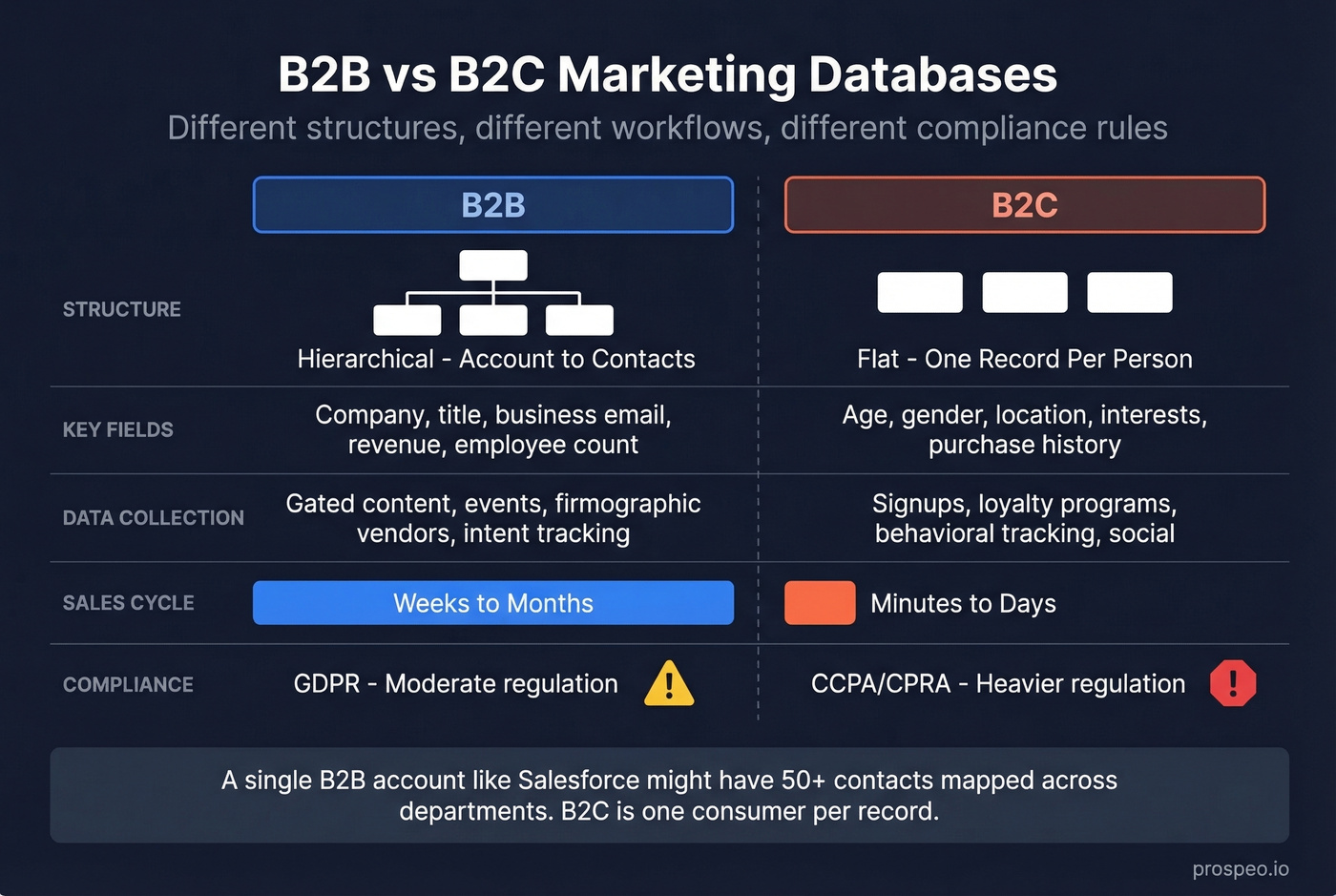
| Dimension | B2B | B2C |
|---|---|---|
| Key fields | Company, title, business email, revenue, employee count, industry | Age, gender, location, interests, purchase history, income bracket |
| Structure | Hierarchical (account -> contacts) | Flat (one record per person) |
| Collection | Gated content, events, firmographic vendors | Signups, loyalty programs, behavioral tracking |
| Sales cycle | Weeks to months | Minutes to days |
| Compliance | GDPR, moderate regulation | CCPA/CPRA, heavier regulation |
The biggest practical difference is how you build and maintain each type. B2B data comes from gated content downloads, conference badge scans, firmographic vendors, and intent tracking - a single account like Salesforce might have 50 contacts mapped across departments. B2C data flows in from ecommerce signups, loyalty programs, and social interactions, with one consumer per record. On the compliance side, B2C databases face heavier regulation under CCPA and CPRA because they deal with individual consumer data at scale.

B2B data decays 22-28% per year - and most databases refresh every 6 weeks. Prospeo refreshes every 7 days across 300M+ profiles, so the marketing database powering your outbound never goes stale. 98% email accuracy, 125M+ verified mobiles, 30+ filters including intent and technographics.
Stop paying enterprise prices for data that's already decaying.
CDP vs CRM vs DMP
These three acronyms get confused constantly.
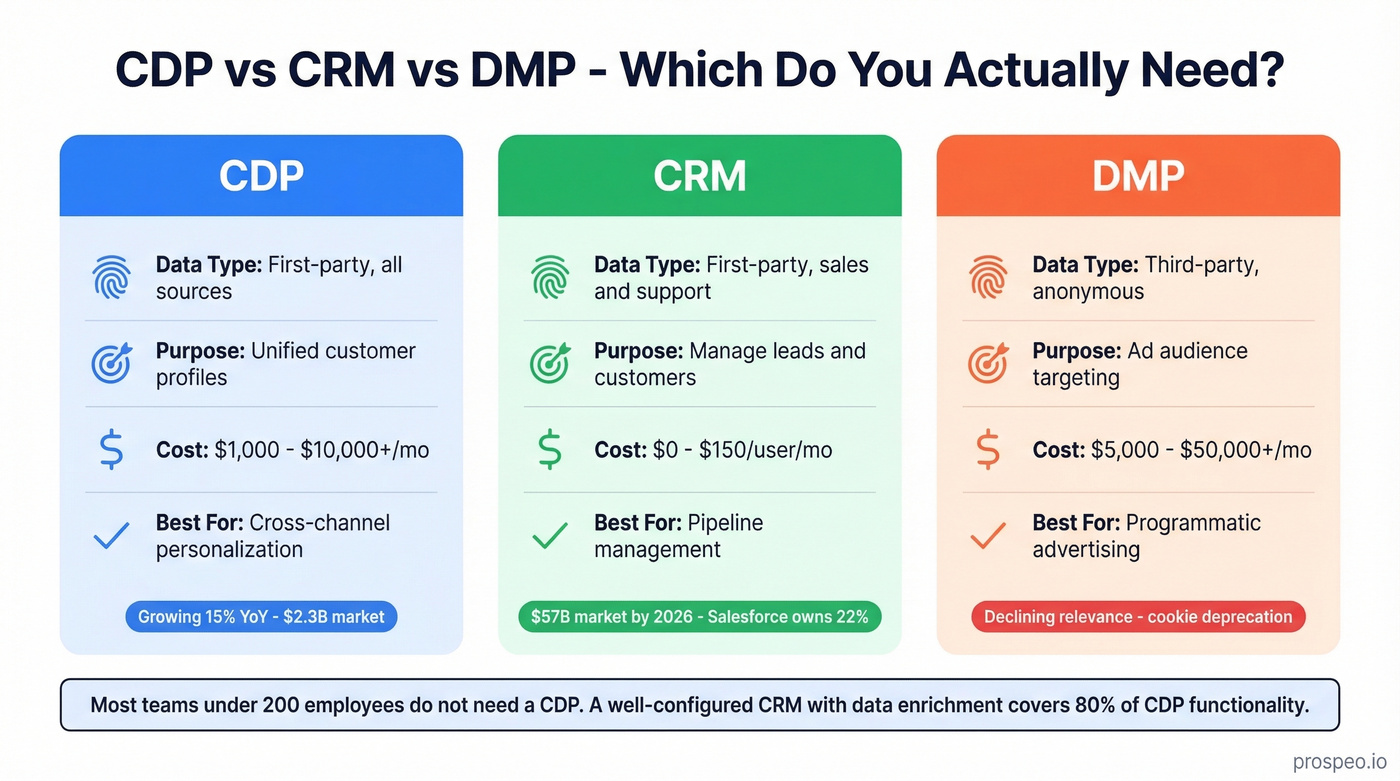
| CDP | CRM | DMP | |
|---|---|---|---|
| Data type | First-party, all sources | First-party, sales/support | Third-party, anonymous |
| Purpose | Unified customer profiles | Manage leads & customers | Ad audience targeting |
| Typical cost | $1,000-$10,000+/mo | $0-$150/user/mo | $5,000-$50,000+/mo |
| Best for | Cross-channel personalization | Pipeline management | Programmatic advertising |
A DMP pulls anonymous, third-party data for ad targeting. With cookie deprecation accelerating, DMPs are losing relevance fast - skip this category unless you're running large-scale programmatic campaigns. A CDP collects first-party data from every touchpoint and builds unified customer profiles; the CDP market was $2.3B in 2023 and growing 15% year-over-year. A CRM manages relationships with existing leads and customers in a market expected to reach $57B by 2026, with Salesforce holding roughly 22% share.
Let's be honest: most teams under 200 employees don't need a CDP. Your CRM, properly configured with a data enrichment layer, covers 80% of what a CDP does. Save the CDP budget for when you genuinely have data fragmentation across five or more systems. (If you're adding enrichment, start with these data enrichment services.)
Best B2B Marketing Databases (2026)
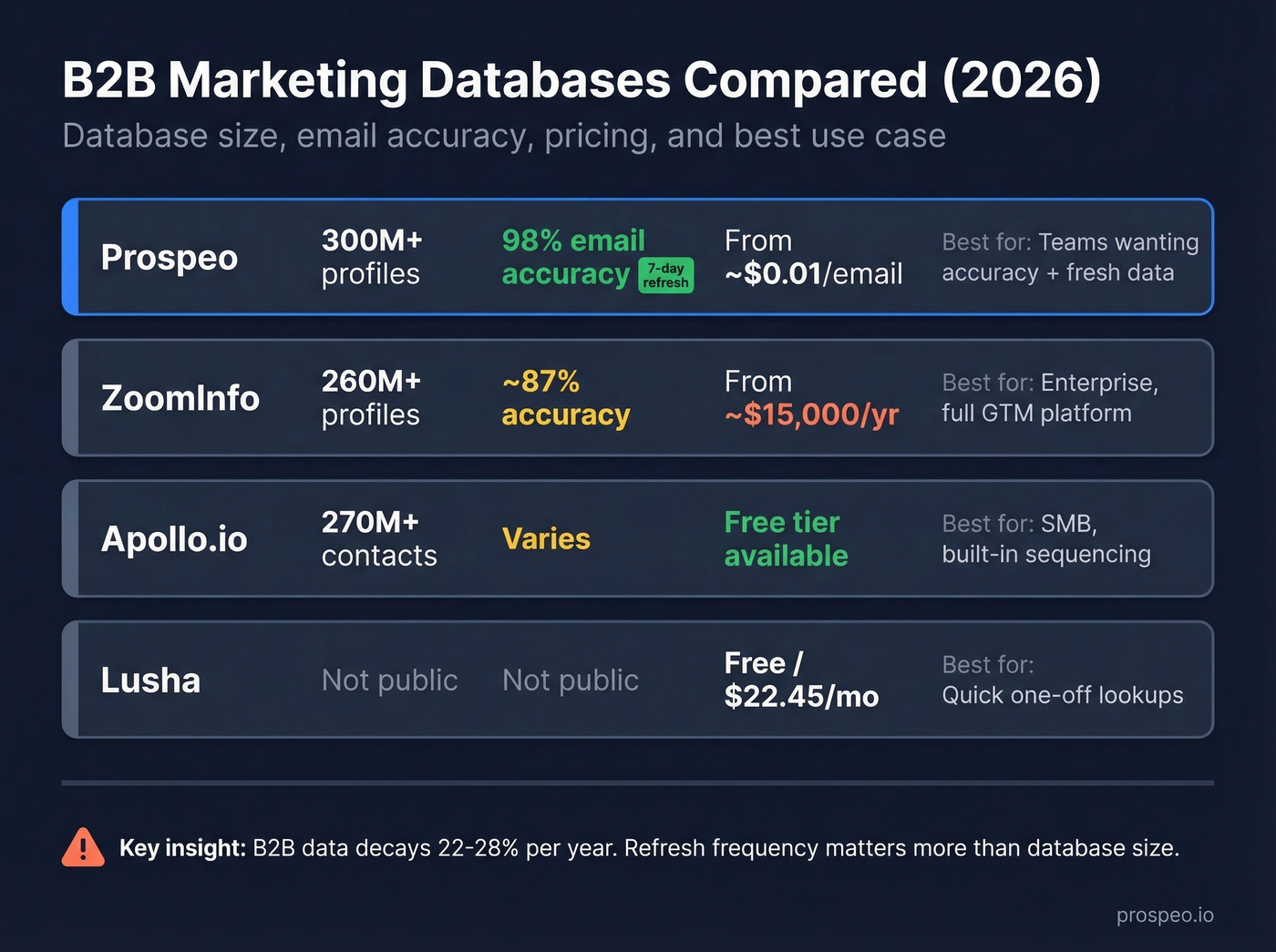
This is the category most people mean when they search for marketing databases. Here's how the top tools compare:
| Tool | Database Size | Email Accuracy | Starting Price | Best For |
|---|---|---|---|---|
| ZoomInfo | 260M+ profiles | ~87% | ~$15,000/yr | Enterprise, intent data |
| Apollo.io | 270M+ contacts | Varies | Free | SMB, built-in sequencing |
| Lusha | Not public | Not public | Free / $22.45/mo | Quick contact lookups |
| Cognism | Not public | Not public | ~$1,000-$3,000/mo | EMEA-focused teams |

Prospeo
Prospeo's database covers 300M+ professional profiles with 143M+ verified emails and 125M+ verified mobile numbers, with a 30% mobile pickup rate. The 98% email accuracy rate shows up in real results - Snyk's 50-person AE team dropped their bounce rate from 35-40% to under 5% after switching, and Meritt tripled their pipeline from $100K to $300K per week.
Data gets refreshed every 7 days, compared to the 6-week industry average. The 30+ search filters cover firmographics, buyer intent across 15,000 topics powered by Bombora, technographics, job changes, headcount growth, and funding signals. (If you're operationalizing those signals, use this guide to identifying buying signals.)
Pricing is transparent and self-serve: roughly $0.01 per email, with a free tier offering 75 emails and 100 Chrome extension credits per month. No annual contracts, no sales calls required. We've seen teams that were burned by ZoomInfo's pricing opacity switch to Prospeo specifically because there's zero friction in getting started - you just sign up and go.
ZoomInfo
ZoomInfo is the enterprise default - 260M+ professional profiles, 100M+ company profiles, and a broad US-focused dataset. The Elite tier bundles intent data, engagement tools, and workflow automation into a genuine GTM platform.
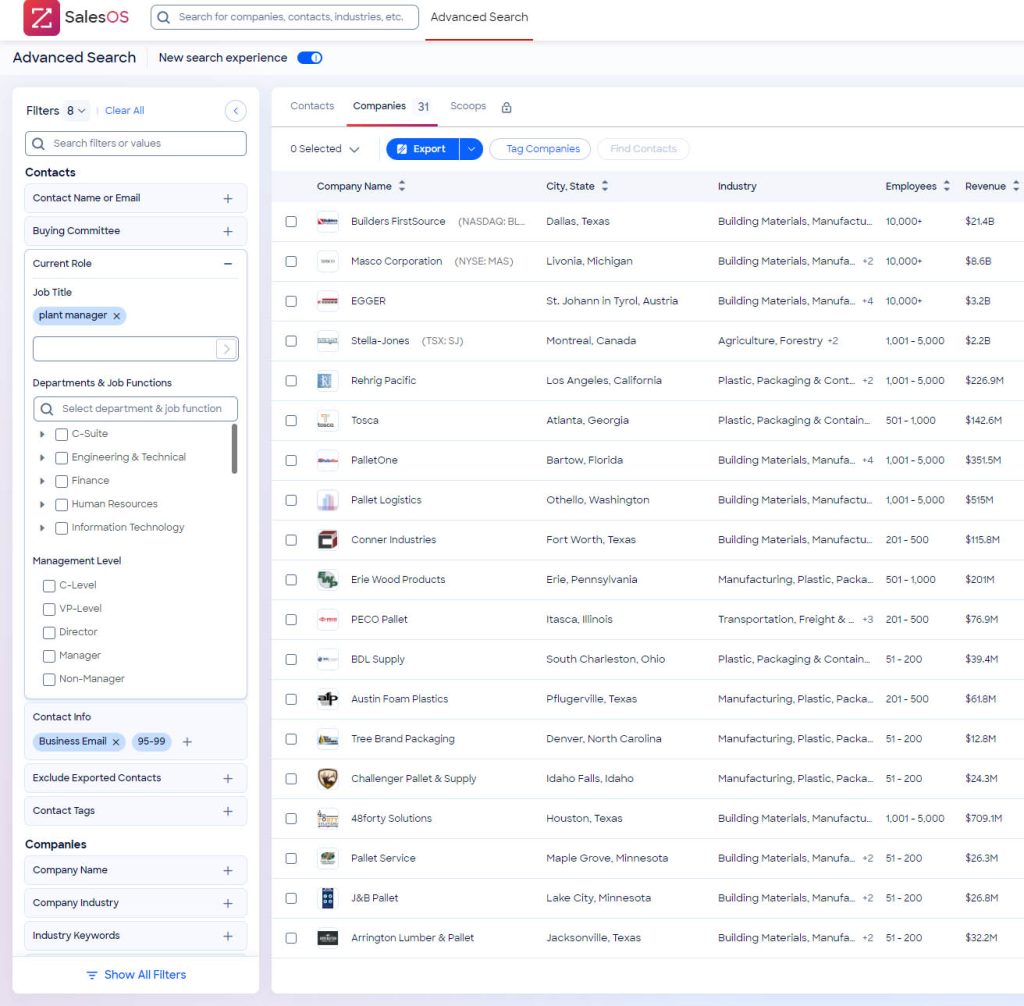
The problem is cost. Professional plans start around $14,995-$18,000/year. Advanced runs $24,995-$28,000/year. Elite pushes past $39,995-$45,000+/year. Renewals typically increase 10-20%, and the consensus on r/sales is that ZoomInfo pricing is brutal for small teams.
If you're a 500-person sales org running outbound, ABM, and intent from one platform, ZoomInfo earns its price. For everyone else, you're paying for modules you'll never activate.
Apollo.io
Apollo is the obvious starting point for SMB teams that want a free database with built-in sequencing. The 270M+ contact database is the largest free-tier offering in the category, and the platform includes email sequences and a dialer.
Paid plans run $49 (Basic), $79 (Professional), and $119 (Organization) per user per month on annual billing. Credits expire at the end of each billing cycle - a detail that catches teams off guard.
The tradeoff is accuracy. Teams often see higher bounce rates when they rely on unverified contacts at scale. Pair Apollo with a dedicated verification layer and it becomes significantly more useful. (If you're troubleshooting bounces, see our email bounce rate guide.)
Lusha
Lusha is built around its browser extension - find a prospect on a company website, click, get the contact info. It's the fastest workflow for individual reps who need one-off lookups rather than bulk list building. Free tier available, Pro at $22.45/user/month, Premium at $52.45/user/month on annual billing. Skip it if you need to build lists of 500+ contacts at a time.
Cognism
Cognism's strength is European data. If you're selling into EMEA, their GDPR-first approach and phone-verified mobile numbers (Diamond Data) give them an edge over US-centric platforms. Custom pricing, typically $1,000-$3,000/month for small teams. Where Cognism wins over ZoomInfo: EMEA compliance and mobile verification. Where ZoomInfo still wins: US database depth and workflow breadth.
Other Notable Tools
Dun & Bradstreet - Legacy firmographic data starting at $49/month for 300 credits. Best for credit risk assessment and company verification, not prospecting.
Crunchbase - Startup and funding data starting at $49/month on annual billing. Use it alongside a contact database for targeting VC-backed companies, not instead of one.
BuiltWith - Technographic database showing what software any website runs, starting at $295/month on annual billing. If you sell to Shopify stores or companies running Marketo, this is how you find them.
Data Axle - B2B and B2C business data with strong coverage of small and local businesses, starting at $99/month. Best for direct mail campaigns and local business targeting where the major B2B platforms have gaps. (If direct mail is part of your mix, see direct mail for lead generation.)
People Data Labs - API-first and developer-focused, with usage-based pricing typically $0.01-$0.10 per record depending on volume. Skip it if you want a point-and-click interface; choose it if you're building custom data pipelines.
You just read that poor data quality costs $12.9M per year. Prospeo's 5-step verification and proprietary email infrastructure deliver 98% accuracy at ~$0.01 per email - 90% cheaper than ZoomInfo. Teams using Prospeo book 26% more meetings because the contacts actually connect.
Build your marketing database on data that's verified this week, not last quarter.
Best Market Research Databases (2026)
Market research databases are a completely different category from contact databases. You're buying reports, statistics, and industry analysis - not prospect lists.
| Tool | Starting Price | Coverage | Best For |
|---|---|---|---|
| Statista | ~$100/mo | Broadest cross-industry | Quick stats, presentations |
| Mintel | ~$10,000-$50,000/yr | Consumer goods & trends | CPG brand strategy |
| Euromonitor | ~$10,000-$50,000/yr | Global market sizing | International expansion |
| IBISWorld | ~$1,000-$10,000/yr | US industry deep-dives | Industry risk analysis |
| Gartner | ~$30,000-$100,000/yr | Enterprise tech | IT/tech strategy |
Statista pulls 16.3M visits per month for a reason - it's the broadest cross-industry statistics platform available. Paid access starts around $100/month, with market forecasts and projections pushing closer to $490/month. For teams on a budget, Our World in Data offers free access to a narrower but solid dataset under Creative Commons licensing.
Mintel goes deep on consumer behavior, purchase drivers, and emerging trends, particularly for CPG and retail. Enterprise pricing runs $10,000-$50,000+/year depending on reports and seats.
Euromonitor's Passport platform is the go-to for global market sizing and country-level data. If you're evaluating international expansion or need TAM estimates for non-US markets, this is where you start. Pricing is enterprise-level: $10,000-$50,000+/year.
IBISWorld provides deep industry reports with risk analysis and market forecasts for specific NAICS codes, covering over 700 U.S. industries. Pricing ranges from $1,000 to $10,000+/year depending on the number of industries covered.
Gartner is the enterprise tech research standard - Magic Quadrants, Hype Cycles, and analyst access. Full access runs $30,000-$100,000+/year. Unless you're making six-figure technology purchasing decisions, the ROI is hard to justify.
Why Marketing Databases Go Stale
B2B data decays at roughly 22.5-28% per year - about 2.1% per month. In high-turnover industries like tech and staffing, that number climbs to 30-40%. By the time you've built a "perfect" list, a quarter of it is already degrading.
Different fields decay at different rates, which should inform how often you re-verify each one:
| Field | Annual Decay | Refresh Cadence |
|---|---|---|
| Work email | 20-30% | Monthly |
| Job title | 15-25% | Quarterly |
| Direct phone | 15-20% | Quarterly |
| Company info | 10-15% | Semi-annually |
| Mobile number | 5-10% | Semi-annually |
The downstream impact is brutal. 91% of CRM data is incomplete, and sales reps lose an estimated 500 hours per year validating and correcting contact information. That's 12 full work weeks spent on data hygiene instead of selling.
Our baseline recommendation: quarterly re-enrichment for your full database, with monthly verification for high-value target accounts. Tools with weekly refresh cycles handle much of this automatically - the difference between catching a job change in week one versus discovering it after your sequence already bounced.
Look, if your average deal size is under $10K, you probably don't need a $15K+ data platform. A self-serve tool with high accuracy and a verification layer will outperform an enterprise suite you're only using at 20% capacity. Spend the savings on better copy and more reps. (If you're scaling outbound, start with these sales prospecting techniques.)
How to Choose the Right Tool
Start with what you're trying to do, not which tool has the most features.
Prospecting vs. research vs. unification. Prospecting requires a B2B contact database. Market sizing requires a research platform. Unifying customer data requires a CDP or well-configured CRM. Don't buy a contact database when you need market research - we've seen teams waste five figures on the wrong category because they didn't clarify the use case first.
Team size and budget. Solo founders and small teams should start with free tiers and self-serve tools. Enterprise teams with $30K+ budgets can evaluate ZoomInfo or Cognism. Research databases scale differently - Statista at $100/month serves one analyst; Gartner at $50K+ serves a strategy department.
Accuracy over size. Most teams need contacts first, firmographics second, and market research occasionally. When you're running cold email at scale, a 5% bounce rate difference compounds into thousands of wasted sends and domain reputation damage. Verification matters more than database size. (If you're protecting deliverability, use an email deliverability guide before you scale volume.)
Email campaign fit. If your primary use case is feeding an outreach campaign with verified contacts, prioritize tools that offer real-time verification and CRM integrations over raw database size. A smaller list of verified emails will always outperform a massive list full of bounces.
FAQ
What's the difference between a marketing database and a CRM?
A marketing database is any structured data source used for targeting and campaigns - it can be a contact database, research platform, or CDP. A CRM specifically manages relationships with existing leads and customers. Your CRM is one type of marketing database, but not all marketing databases are CRMs.
How much does a B2B contact database cost?
Free tiers exist at several providers, including Prospeo (75 verified emails/month) and Apollo. Mid-range tools run $22-$120 per user per month. Enterprise platforms like ZoomInfo start at $15,000/year and scale past $45,000. Budget $50-$150/month per rep for solid coverage.
How often should I clean my database?
Quarterly at minimum. B2B data decays 22.5-28% annually, so a database left untouched for 12 months loses roughly a quarter of its accuracy. High-value accounts deserve monthly verification. Automate where possible - manual data hygiene doesn't scale.
Are free marketing databases worth using?
Yes, with caveats. Apollo's free tier is genuinely useful for early-stage prospecting, and Prospeo offers 75 verified emails per month at no cost. Don't expect free data to match paid accuracy across the board, but for getting started, free tiers beat buying a list from a random vendor every time.
Which tool has the most accurate email data?
Prospeo leads with 98% email accuracy, backed by a proprietary 5-step verification process and a 7-day data refresh cycle. That's measurably higher than the 60-80% usable accuracy most teams see from unverified contact databases. The free tier lets you test this yourself before committing.