

Marketing Email Subject Lines: What 5.5 Million Emails Actually Tell Us
It's Tuesday morning. You've spent three hours on the email body - the offer, the CTA, the design. Then you glance at the clock, type "Quick Update" in the subject line, and hit send. That marketing email subject line took ten seconds. It'll determine whether 100% of your work gets seen or buried.
A Belkins study of 5.5 million cold emails gives us one of the largest datasets on what actually moves open rates. Here's what it found - and what most "best practices" guides get dead wrong.
The Three Rules (Quick Version)
Before we go deeper, three rules backed by the data:
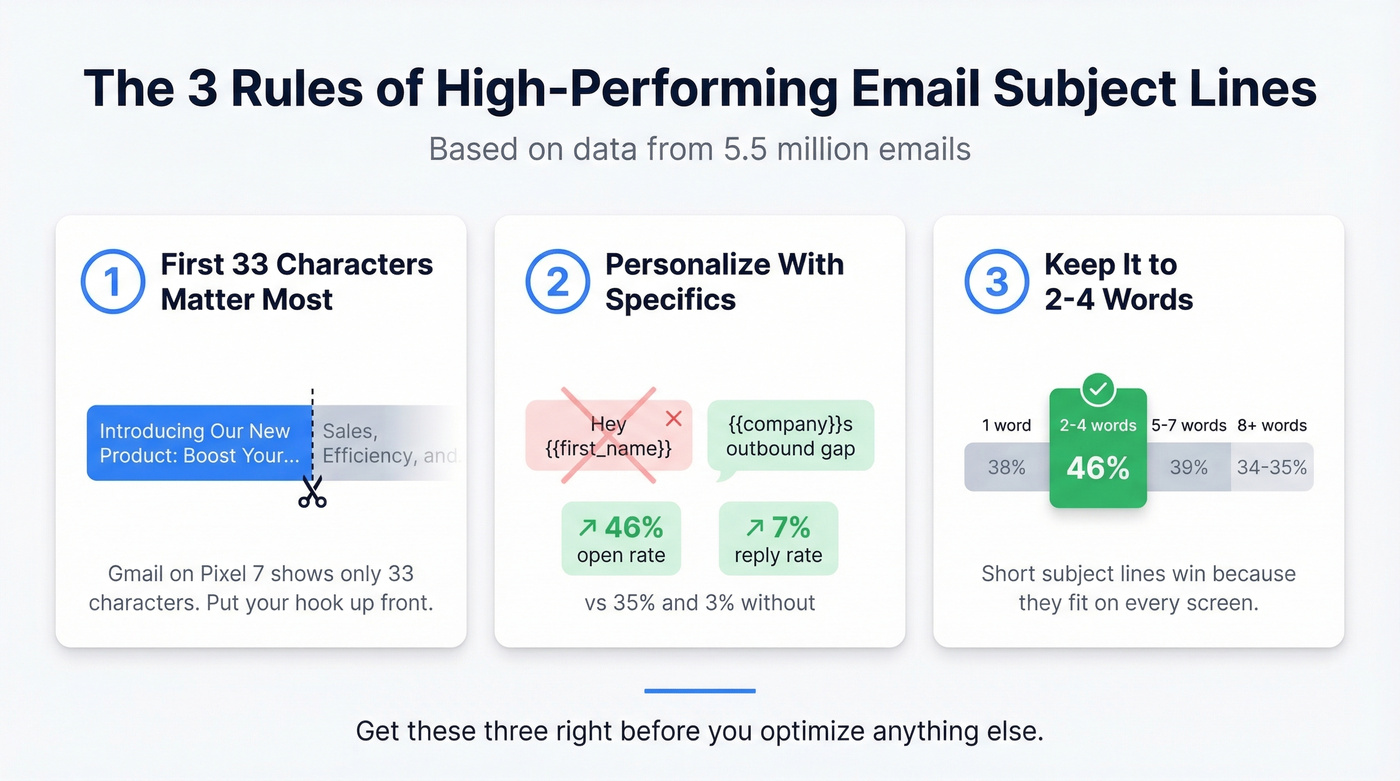
- Put your core message in the first 33 characters. That's all Gmail shows on most mobile devices. Everything after gets truncated.
- Personalize with a company name or pain point. Personalized subject lines hit a 46% open rate vs. 35% without - a 31% lift. Reply rates more than double (7% vs. 3%).
- Keep it to 2-4 words if you can. That word count hit the highest open rate in the dataset: 46%.
What's a Good Open Rate?
Most teams obsess over open rates without knowing what "good" looks like. Here's where Mailchimp's benchmark data lands across industries:
| Industry | Open Rate | Click Rate |
|---|---|---|
| E-Commerce | 29.81% | 1.74% |
| Education | 35.64% | 3.02% |
| Nonprofit | 40.04% | 3.27% |
| Business & Finance | 31.35% | 2.78% |
| All Users | 35.63% | 2.62% |
Above 35% on permission-based email? You're in solid shape. Below 25%, something's broken - likely list quality or deliverability, not just your subject line.
One caveat worth knowing: Apple Mail Privacy Protection pre-loads tracking pixels, which inflates open rates for a significant chunk of your list. Click-through rate can't be faked, and it's the better signal for whether your email campaign subject line attracted the right audience - not just any audience. (If you're still optimizing around opens, see our guide to the best email open tracker and what to measure instead.)
Subject Line Length: The Real Limit
Here's the thing most guides get wrong: they tell you "keep it under 60 characters" and move on. That advice is dangerously outdated because it assumes your audience reads email on a desktop. They don't. Over half of all email opens happen on mobile, and mobile clients are ruthless with truncation.
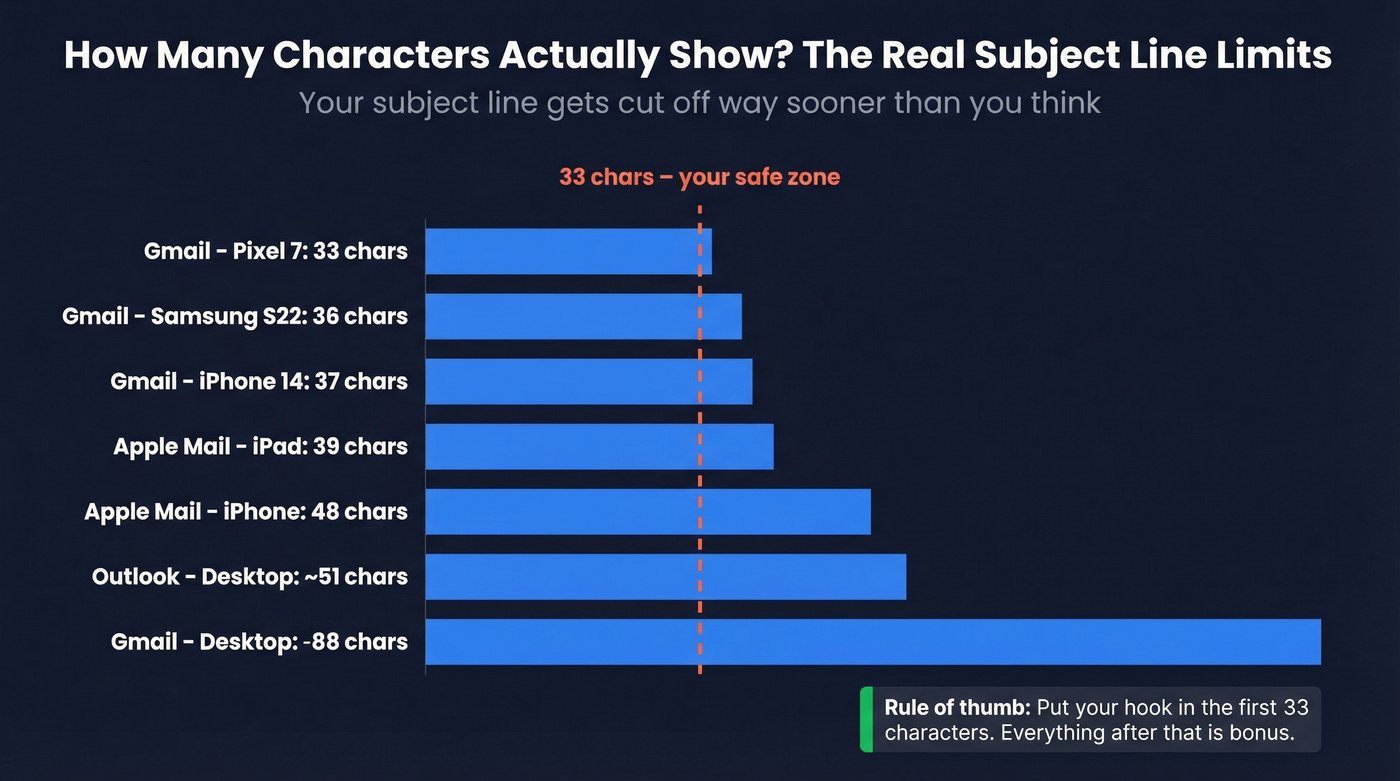
EmailToolTester ran hands-on tests across the most common device and client combinations:
| Device / Client | Visible Characters |
|---|---|
| Gmail - Pixel 7 | 33 |
| Gmail - Samsung S22 | 36 |
| Gmail - iPhone 14 | 37 |
| Apple Mail - iPad | 39 |
| Apple Mail - iPhone | 48 |
| Outlook - Desktop | ~51 |
| Gmail - Desktop | ~88 |
The tightest constraint is 33 characters. That's your real limit if you want every recipient to see your full subject line. Anything beyond 33 characters is a gamble - it might display, it might not, depending on the device in your recipient's pocket.
In our experience, the 33-character rule is the single most underused tactic in email marketing. This doesn't mean every subject line must be exactly 33 characters. It means your core message - the hook, the value, the reason to open - needs to land within those first 33 characters. Treat everything after that as bonus text that may or may not appear.
You're not writing for desktop clients. You're writing for the phone in someone's hand at 8:47 AM while they're scanning 40 unread messages.
Don't Forget the Preheader
Your preheader picks up where the subject line ends. On Gmail mobile, you get about 37-39 characters. On Apple Mail (iPhone), you've got up to 99. Either way, the preheader is your second headline.
What the Data Says Works
Personalization Lifts Opens 31%
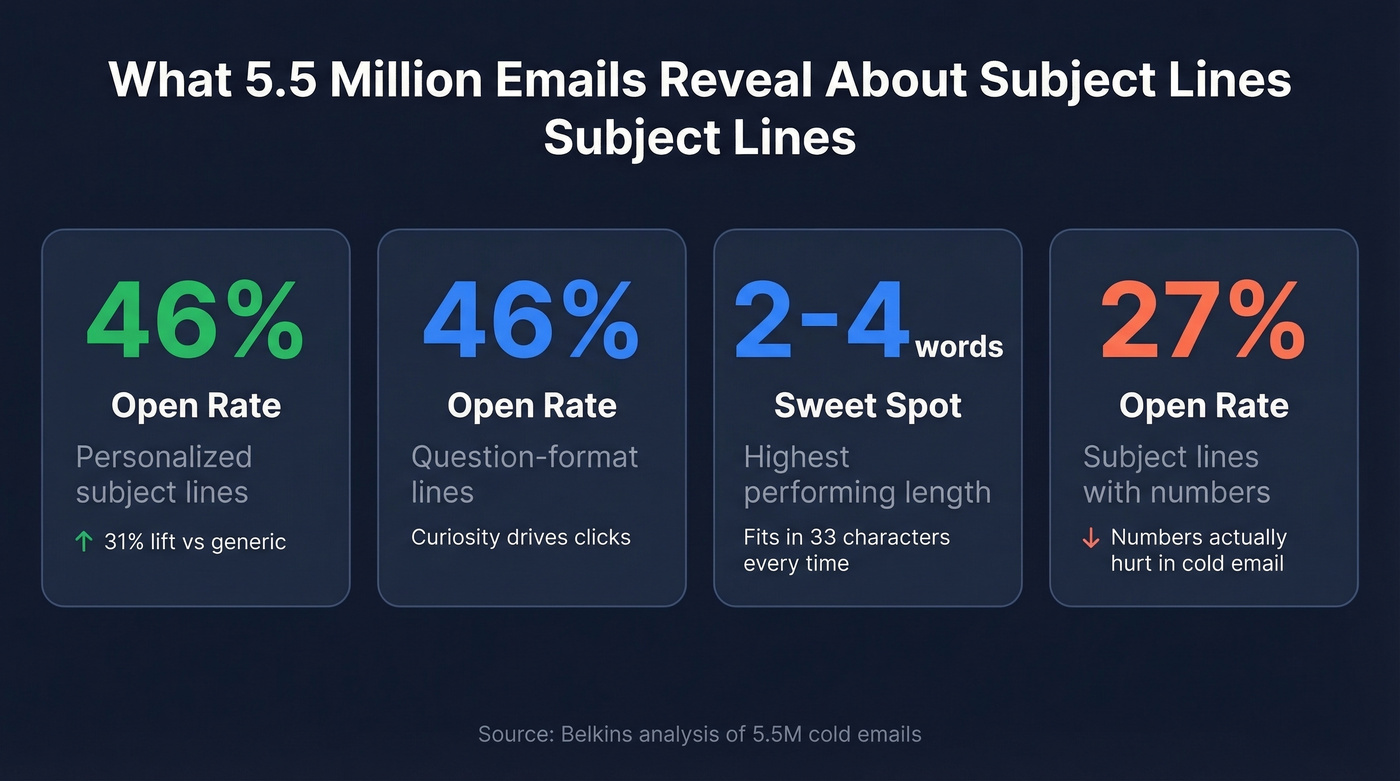
Personalized subject lines hit a 46% open rate vs. 35% without - and the reply rate gap is even wider at 7% vs. 3%. That's a 133% lift in replies.
But "personalization" doesn't mean slapping {{first_name}} at the front. Everyone does that now, and recipients have learned to ignore it. Real personalization means referencing something specific: the recipient's company name, a pain point relevant to their role, a recent trigger event like a funding round or a new hire. (If you want more patterns, borrow from these email subject line formulas.)
Before: "Hey John, check this out" After: "Scaling the SDR team at Acme?"
The second version proves you've done your homework. The first proves you have a merge tag.
Questions Create Curiosity
Question-form subject lines matched personalization at 46% open rate. A question creates a curiosity gap and implies a conversation rather than a broadcast. "Still running outbound manually?" feels like something a colleague would ask. "Automate Your Outbound Today" feels like an ad.
Keep It Short: 2-4 Words
The 5.5M-email dataset found 2-4 word subject lines performed best at 46% open rate. Performance drops noticeably beyond 7 words (39%), and by 9-10 words you're down to 34-35%. Single-word subject lines landed at 38% - better than long ones, but not as strong as the 2-4 word sweet spot.
This aligns perfectly with the truncation data. Two to four words almost always fit within 33 characters.
Your Sender Name Matters More Than You Think
Here's something most subject line guides ignore entirely: the "From" field. Recipients decide whether to open based on who sent the email before they even read the subject line. A recognizable sender name - a real person's name, not "marketing@company.com" - builds the trust that makes your subject line work.
If your sender name looks like a robot, the best subject lines in the world won't save you. And if your average deal value is under $15K, you'll get more lift from fixing your sender name and list quality than from A/B testing subject lines. The fundamentals matter more than the polish. (For the bigger system, see our B2B marketing email playbook.)
What Doesn't Work
Numbers in Subject Lines
Every generic email marketing guide tells you to "use numbers for specificity." The data disagrees. Subject lines with numbers hit a 27% open rate vs. 28% without. Numbers didn't help - they slightly hurt.
This makes sense for cold email specifically. Numbers in subject lines often signal a promotional message - "5 Ways to..." or "30% Off..." - and recipients have been trained to skip those patterns. For newsletters and ecommerce, numbers still perform. But for cold outreach, the data is clear: skip them.
ALL CAPS and Spam Triggers
ALL CAPS subject lines showed a 30% open rate in the Belkins data - which looks decent until you factor in deliverability. A VerticalResponse analysis found that ALL CAPS combined with excessive punctuation increases spam scores by 40-60%. You might get opens from the people who see it, but fewer people will see it because ISPs are routing you to spam.
Specific words and phrases that trigger spam filters include "Cash," "Free," "ACT NOW," "Full refund," "No obligation," and "Winner." These aren't guaranteed spam folder sentences, but they raise your spam score when combined with other signals like a new domain or low engagement history. For a longer list, see our guide on words to avoid in email subject lines.
Fake "Re:" and "Fwd:" prefixes are even worse. They're deceptive, they violate CAN-SPAM's prohibition on misleading subject headers, and they erode trust the moment someone opens and realizes there's no prior thread.
Vague Openers
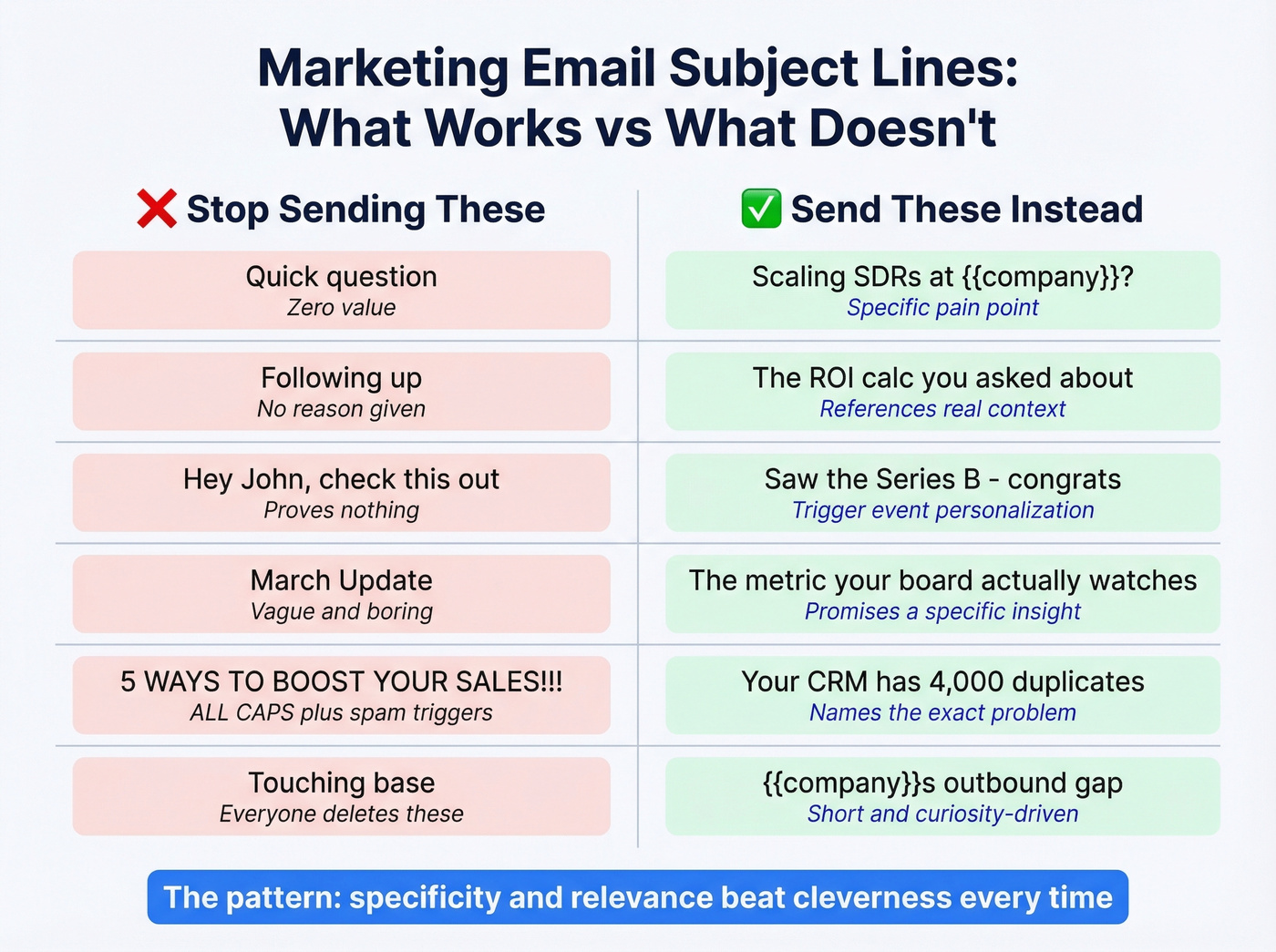
"Quick question." "Touching base." "Following up." These subject lines convey zero value and train recipients to delete on sight. They're the email equivalent of a cold caller saying "How are you today?" - everyone knows what's coming next. (If you’re tempted to use it, here are better options than a touching base email.)
The consensus on r/Emailmarketing and r/coldemail is pretty damning - "Quick question" and "Touching base" are the most-mocked subject lines among practitioners. If you're following up, say why. (More options: following up on my previous email.)
Before: "Following up" After: "The ROI calc you asked about"

Personalized subject lines lift opens 31% - but only if your emails actually reach real inboxes. Prospeo's 5-step verification delivers 98% email accuracy, so your carefully crafted subject lines land where they belong.
Stop perfecting subject lines for emails that bounce.
Write Subject Lines and Preheaders Together
Most marketers write the subject line, then forget the preheader exists - or worse, let it auto-populate with "View this email in your browser." That's wasted real estate.
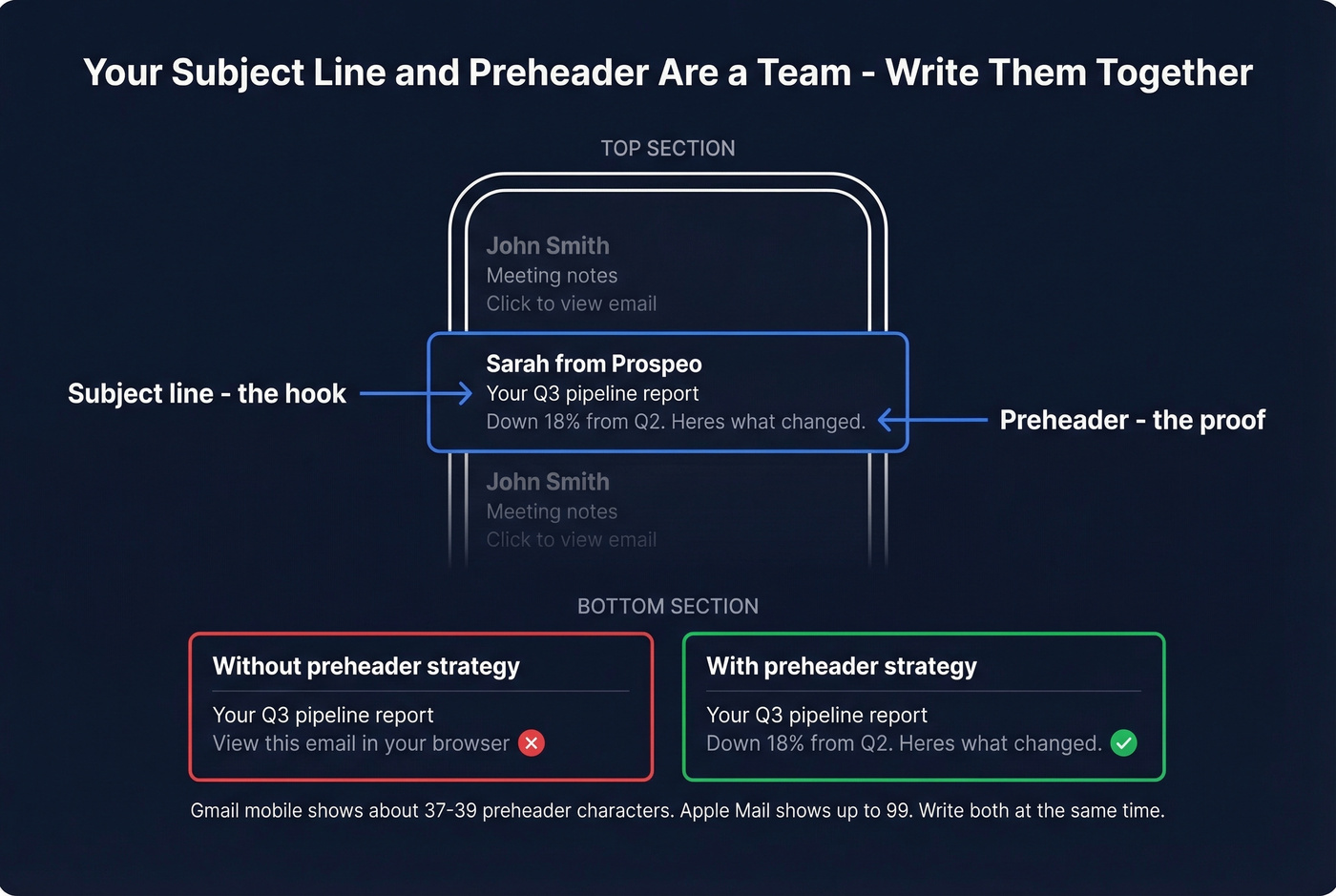
Think of them as a coordinated system. The subject line hooks attention. The preheader delivers the supporting detail.
Subject line alone: "Your Q3 pipeline report" As a pair: "Your Q3 pipeline report" + "Down 18% from Q2. Here's what changed."
Gmail mobile gives you about 37-39 preheader characters; Apple Mail gives you up to 99. Write both at the same time. If you're spending 10 minutes on a subject line, spend 3 more on the preheader. It's the highest-leverage 3 minutes in your email workflow.
50+ Catchy Subject Lines for Email Marketing
Variables in {{brackets}} are merge tags - your ESP replaces them with real data. (If you want more plug-and-play options, start with these subject line templates.)
Cold Email
Brevity and personalization dominate here. These patterns consistently hit 40%+ open rates in the Belkins data.
- "Scaling SDRs at {{company}}?"
- "{{company}}'s outbound gap"
- "Saw the Series B - congrats"
- "Quick math on {{company}}'s pipeline"
- "Wrong person?"
- "One question about {{pain_point}}"
These patterns work - but only if you're reaching real inboxes. We've seen teams craft perfect subject lines and still get 8% open rates because 30% of their list was bouncing. Verify your contact data before writing a single subject line. (Related: B2B cold emailing infrastructure.)
Newsletter
Curiosity and value preview keep subscribers opening week after week.
- "The metric your board actually watches"
- "We were wrong about intent data"
- "3 min read: Q3 benchmarks are in"
- "This campaign made $412K. Here's the teardown"
- "What nobody tells you about ABM"
- "The email that got a 61% reply rate"
Promise a specific insight or story. Vague newsletters like "March Update" get archived unread.
Ecommerce
With an industry average open rate of 29.81%, ecommerce subject lines need to work harder. Urgency and specificity win.
- "Your cart's getting lonely"
- "Back in stock - won't last"
- "24 hours: 30% off everything"
- "We saved your size"
- "This sold out in 4 hours last time"
- "Free shipping ends at midnight"
Trigger FOMO or remove friction. Abandoned cart emails should feel like a helpful nudge, not a desperate plea. Levi's nails this with subject lines like "Forget something?" - casual, specific, zero pressure.
B2B / SaaS
Pain points and specificity outperform feature announcements every time. Strong B2B subject lines name the problem the recipient is already trying to solve. (More examples: B2B email subject lines.)
- "{{company}} is losing deals to [competitor]"
- "Your CRM has 4,000 duplicates"
- "Cut rep ramp time in half"
- "The pipeline leak nobody's tracking"
- "Why {{company}}'s bounce rate matters"
- "60% of your list is dead"
Name the problem. B2B buyers open emails that articulate a pain they're already feeling.
Re-engagement
Win-back campaigns need to acknowledge the gap without guilt-tripping.
- "Things have changed since you left"
- "We built what you asked for"
- "Miss us? (We missed you)"
- "Your account still has $50 credit"
- "One last thing before we go"
Give a reason to come back. "We miss you" alone isn't enough - pair it with something new or valuable. (More ideas: re-engagement email subject lines.)
Event / Webinar
Urgency and exclusivity drive registrations.
- "50 seats left - Thursday's workshop"
- "You're invited (seriously, just you)"
- "Live teardown: our best-performing sequence"
- "Tomorrow: the data nobody's sharing"
- "Last chance: Friday's session is full"
Scarcity works when it's real. Fake urgency on an evergreen webinar destroys trust.
A/B Testing That Actually Works
We've seen teams waste weeks testing subject lines on lists too small to produce meaningful results. Here's the framework that actually works. (For a deeper methodology, use these email A/B testing best practices.)
Split 20% of your list into two equal groups. Send variant A to one, variant B to the other. The winner goes to the remaining 80%. Test one variable at a time - subject line length OR personalization OR question format, not all three. Otherwise you don't know what moved the needle.
Wait 2-4 hours before picking a winner. Opens trickle in, and calling it after 30 minutes biases toward early openers. MailerLite's data shows open rates peak between 8 AM and 11 AM - test during these windows for the cleanest signal.
You need volume. A few hundred recipients per variant won't give you stable results. Aim for thousands per variant before trusting the data. If your list is under 2,000 contacts, skip A/B testing subject lines entirely. Focus on the fundamentals - personalization, brevity, relevance - and save testing for when you've got the numbers.
Bad List? Your Subject Line Won't Save You
This is the part most guides skip, and it's the part that matters most.
Here's the chain: bad contact data leads to high bounce rates, which damage sender reputation, which tells ISPs to route you to spam, which means your marketing email subject line never gets seen. You could write the perfect subject line and it won't matter if 20% of your list bounces. ISPs like Gmail and Outlook watch bounce rates, spam complaints, and engagement signals to decide whether your domain is trustworthy. A bounce rate above 5% is a red flag. Above 10%, you're in serious trouble. (If you need a process, start with an email scrubber before your next send.)

Before you send that next campaign, verify your list. Prospeo's 5-step email verification catches invalid addresses, spam traps, and catch-all domains before they damage your sender reputation. One B2B team saw their bounce rate drop from 35% to under 4% after switching, and their pipeline tripled.
The data is clear: list quality matters more than subject line polish. Prospeo refreshes 300M+ profiles every 7 days - not every 6 weeks - so you're never emailing stale contacts. Teams using Prospeo see bounce rates drop below 4%.
Fix your list before you fix your subject lines.
AI Subject Line Tools: Worth It?
Most ESPs now include AI-powered subject line generators - HubSpot, Mailchimp, Klaviyo, and others have all added the feature. The value isn't that AI writes better subject lines than you. It's that AI generates 20 variants in 10 seconds, giving you more options to test.
AI-generated subject lines lift open rates by roughly 10-20% when used for rapid iteration and A/B testing. The lift comes from volume and variety, not from some magical insight into human psychology.
Use AI to brainstorm. Use your judgment to pick. And use your data to validate. The tool that generates the subject line matters far less than the list it's sent to and the relevance of the message behind it.
FAQ
What's the ideal marketing email subject line length?
Two to four words perform best, hitting a 46% open rate in a 5.5M-email study. Keep your core message within 33 characters - that's the tightest mobile truncation limit across major email clients. Anything beyond that risks getting cut off on Gmail's mobile app.
Do emojis help email subject lines?
Emojis don't consistently lift open rates in large-scale studies. They increase visual standout in a crowded inbox, but certain emojis trigger spam filters depending on the recipient's client. Test them with your audience, but personalization and brevity have far stronger data behind them.
How do I keep emails out of the spam folder?
Avoid ALL CAPS, excessive punctuation, fake Re:/Fwd: prefixes, and trigger words like "Cash," "Free," and "ACT NOW." The biggest factor is list quality - high bounce rates tank domain reputation faster than any subject line trick. Free tools like Google Postmaster help you monitor sender reputation, and verifying your list before every send is non-negotiable.
Should I personalize every subject line?
Yes, when possible. Personalized subject lines hit 46% open rates vs. 35% without in the 5.5M-email study. Use company name, pain point, or a recent trigger event - not just the recipient's first name. Real personalization references something specific to the recipient's situation.
What are some catchy subject lines for email marketing?
The best performers combine brevity with relevance. For cold email: "Scaling SDRs at {{company}}?" or "{{company}}'s outbound gap." For ecommerce: "Your cart's getting lonely" or "Back in stock - won't last." For B2B SaaS, name a specific pain point: "Your CRM has 4,000 duplicates." The common thread is they promise value in four words or fewer.