

Stop Sending "Touching Base" Emails - Here's What Works in 2026
It's two weeks after the demo. The prospect hasn't replied. You open a new compose window, type "Hi Sarah, just wanted to touch base," stare at it for ten seconds, and delete the whole thing.
Good instinct. The classic touching base email is doing more damage than silence, and the data backs it up.
The problem isn't following up - it's following up with nothing to say. Let's fix that.
The Short Version
- Drop "touching base" and "just checking in" entirely. A GetResponse survey of 1,000 U.S. workers ranked "touch base" the #3 most hated office phrase. HubSpot flags it as mostly meaningless.
- Use short, personalized, question-format subject lines. A study of 5.5 million B2B emails found this combination hits 46% open rates vs. 35% for generic lines - a 31% lift. (If you need ideas, steal from these subject lines.)
- Cap cold sequences at 4 total emails. That's 1 initial + up to 3 follow-ups. Space them on a graduated cadence (2, 4, 7, then 14+ days), and verify every email address before sending.
Why "Touch Base" Emails Fail
The phrase doesn't just sound lazy - people actively resent it. That GetResponse survey ranked it behind only "synergy" and "moving forward" for workplace jargon people want gone. A Glassdoor UK survey found "touch base" was the single most annoying office phrase two years running, flagged by 24% of employees.
But annoyance isn't the real killer. Ambiguity is. A Notta study analyzing 5,000+ Reddit comments on corporate buzzwords put "touch base" in its top 10 most annoying phrases, largely because it communicates nothing actionable. When you write "just wanted to touch base," the recipient's brain translates it to "I have no specific reason to email you." That's not a follow-up. That's noise. HubSpot puts it bluntly: it doesn't hook curiosity, doesn't offer value, and doesn't give the reader a reason to respond.
If you still catch yourself writing it, use this quick replacement guide for just checking in.
Subject Lines That Actually Get Opened
The Belkins study of 5.5 million emails gives us four clear rules:
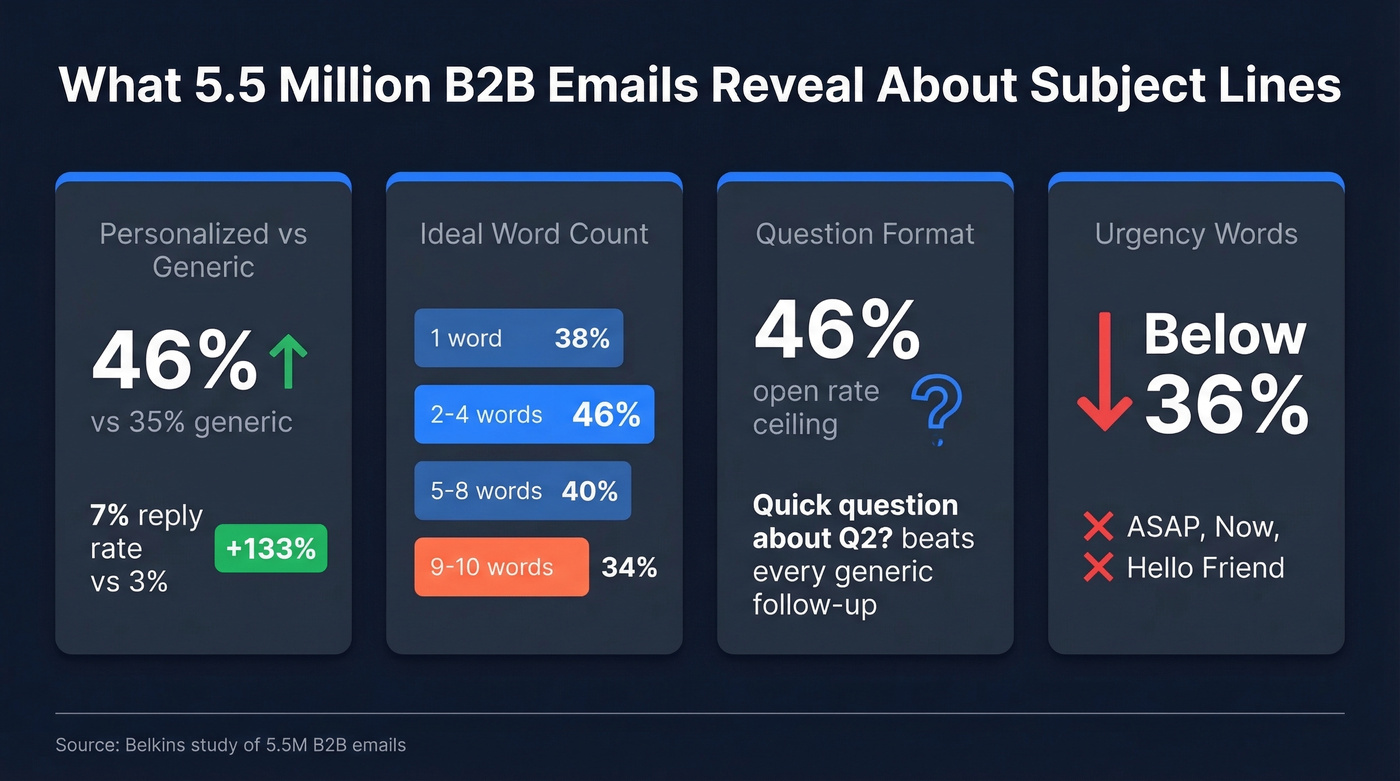
Personalize. Subject lines with a name, company, or specific reference hit 46% open rates vs. 35% without. Reply rates jump from 3% to 7% - a 133% increase.
Keep it to 2-4 words. That sweet spot delivers 46% opens. One-word subjects drop to 38%. By 9-10 words, you're down to 34-35%.
Ask a question. Question-format subjects match that 46% open rate ceiling. "Quick question about Q2?" beats a generic follow-up subject every time.
Kill the urgency words. "ASAP," "now," and other hype language drag opens below 36%. Same goes for generic greetings like "Hello, friend." If it sounds like marketing spam, it performs like marketing spam.
If you want more data-backed patterns, see our guide to subject lines that get opened.

Great subject lines don't matter if you're emailing dead inboxes. Prospeo's 5-step verification delivers 98% email accuracy - so every follow-up in your sequence actually lands. At $0.01 per verified email, bad data stops killing your cadence.
Stop crafting perfect follow-ups for addresses that don't exist.
When to Send Your Follow-Up
Timing matters almost as much as the message. Here's the graduated spacing we've found works best:
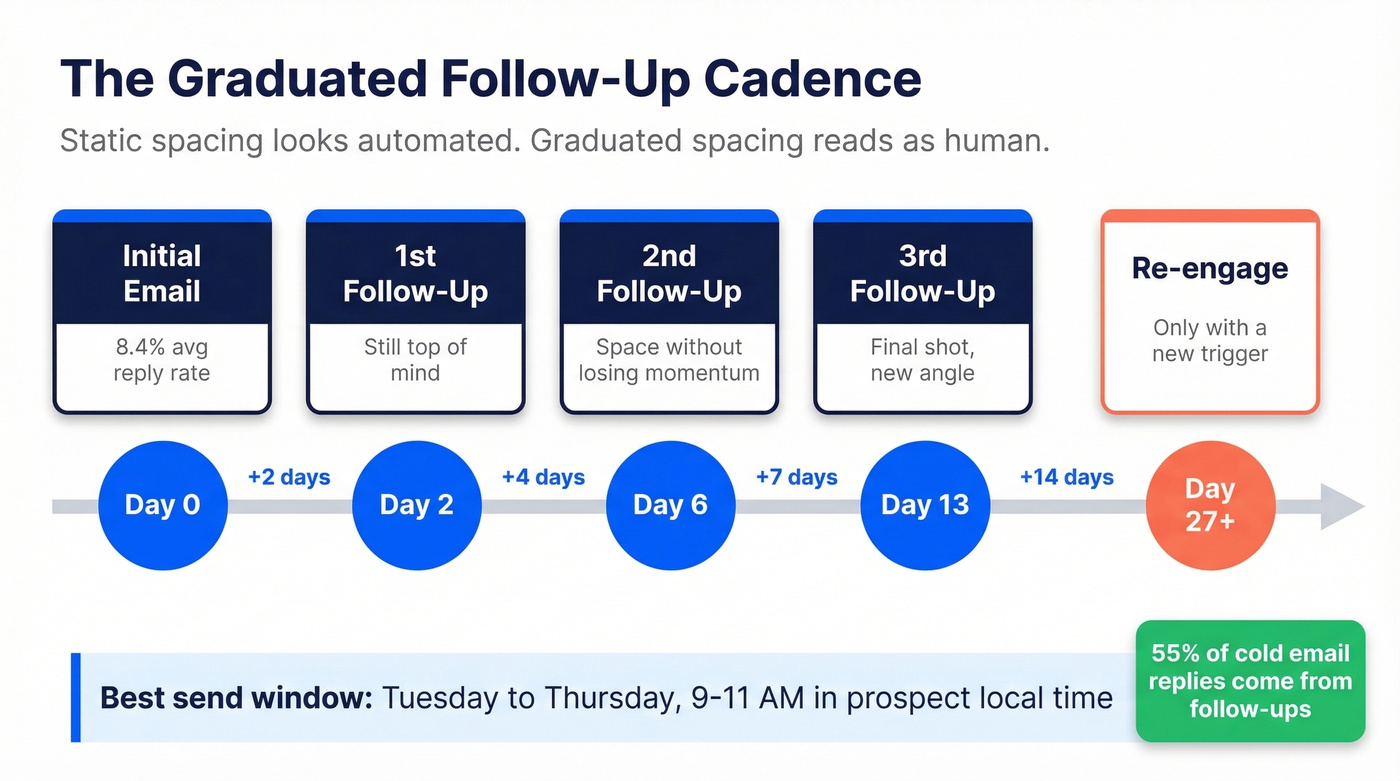
| Follow-Up | Days After Previous | Why |
|---|---|---|
| 1st | 2 days | Still top of mind |
| 2nd | 4 days | Space without losing momentum |
| 3rd | 7 days | Final shot, new angle |
| Re-engage | 14+ days | Only with a new trigger |
Send Tuesday through Thursday, 9-11 AM in the prospect's local time. Static spacing - every two days like clockwork - looks automated and hurts deliverability. Graduated spacing reads as human because it mirrors how people actually behave.
If you want a deeper breakdown by day/time and audience, use this best time to send cold emails guide.
Here's the thing: 55% of all cold email replies come from follow-ups, not the initial send. The follow-up isn't optional. But if you're building a sequence, verify every address first - no point crafting the perfect cadence for an inbox that doesn't exist.
For inbound leads (someone downloaded your whitepaper, requested a demo), respond near-immediately. For cold outbound, that 2-day initial gap is the floor. After three follow-ups with no reply, switch channels entirely. A phone call or a short video message breaks the pattern and signals genuine interest in a way that email number five never will.
If you're building multi-step outreach, this B2B cold email sequence playbook helps you structure it end-to-end.
How Many Follow-Ups Is Too Many?
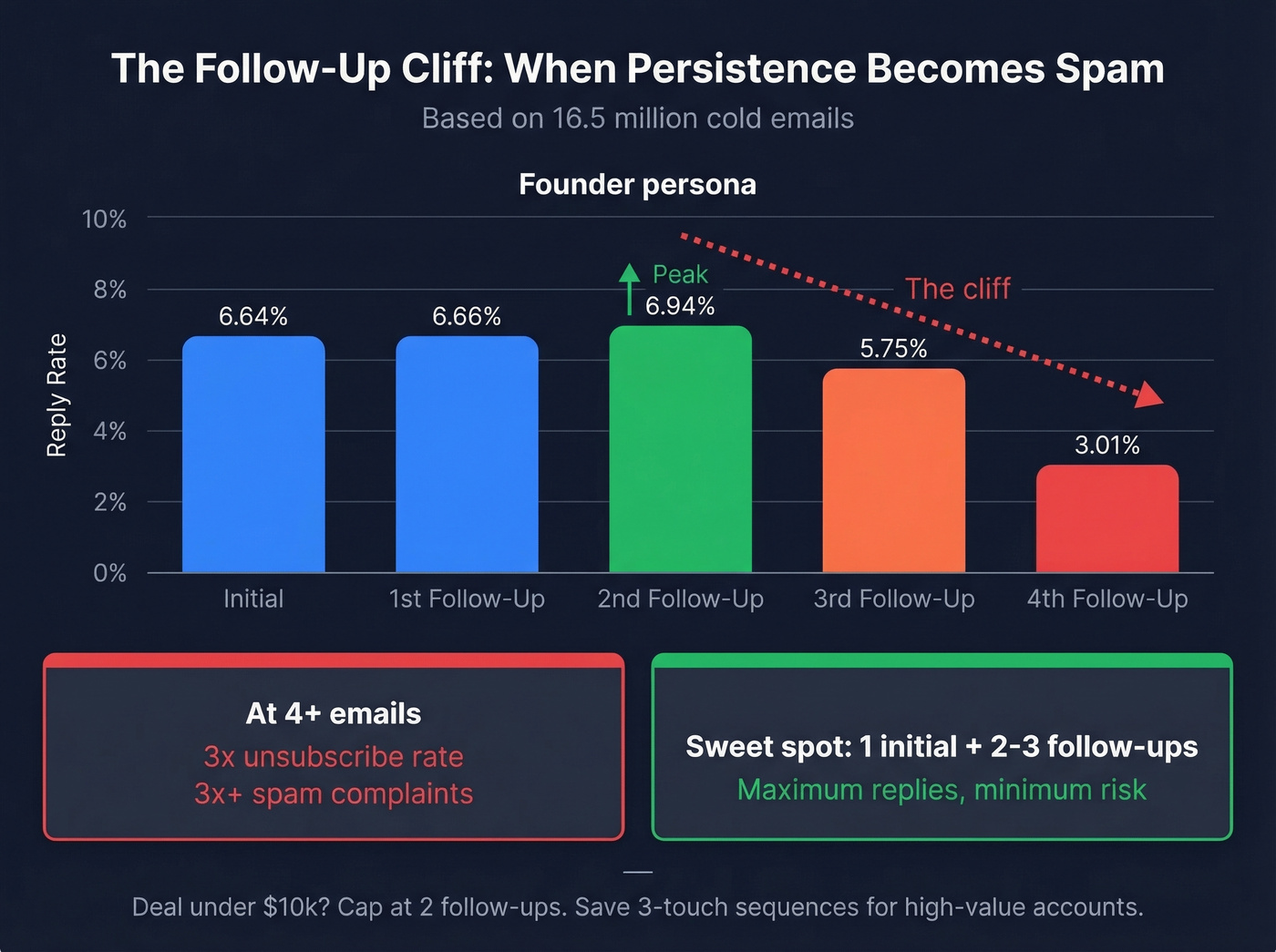
A study analyzing 16.5 million cold emails makes the math clear. A single email pulls an 8.4% reply rate. Each additional follow-up erodes that number, and at 4+ emails in a sequence, unsubscribe rates triple and spam complaints more than triple.
Enterprise prospects at 1,000+ employee companies ghost quickly and punish persistence. The average businessperson's inbox sees more than 120 emails every day, so your follow-up has to earn its spot.
The founder-persona data tells a different story. Reply rates tick up from the initial email (6.64%) through the first follow-up (6.66%) to the second (6.94%), then fall off a cliff - 5.75% on the third, 3.01% on the fourth. Three follow-ups maximum. After that, you're not persistent. You're spam.
If your average deal closes under $10k, you probably don't need more than two follow-ups. The math on time-per-deal just doesn't work. Save the three-touch sequences for accounts that actually move the needle.
For more benchmarks and fixes, see follow-up email reply rate.
7 Templates That Replace "Touching Base"
Need a circling back email that actually earns replies? Here are seven, organized by scenario.
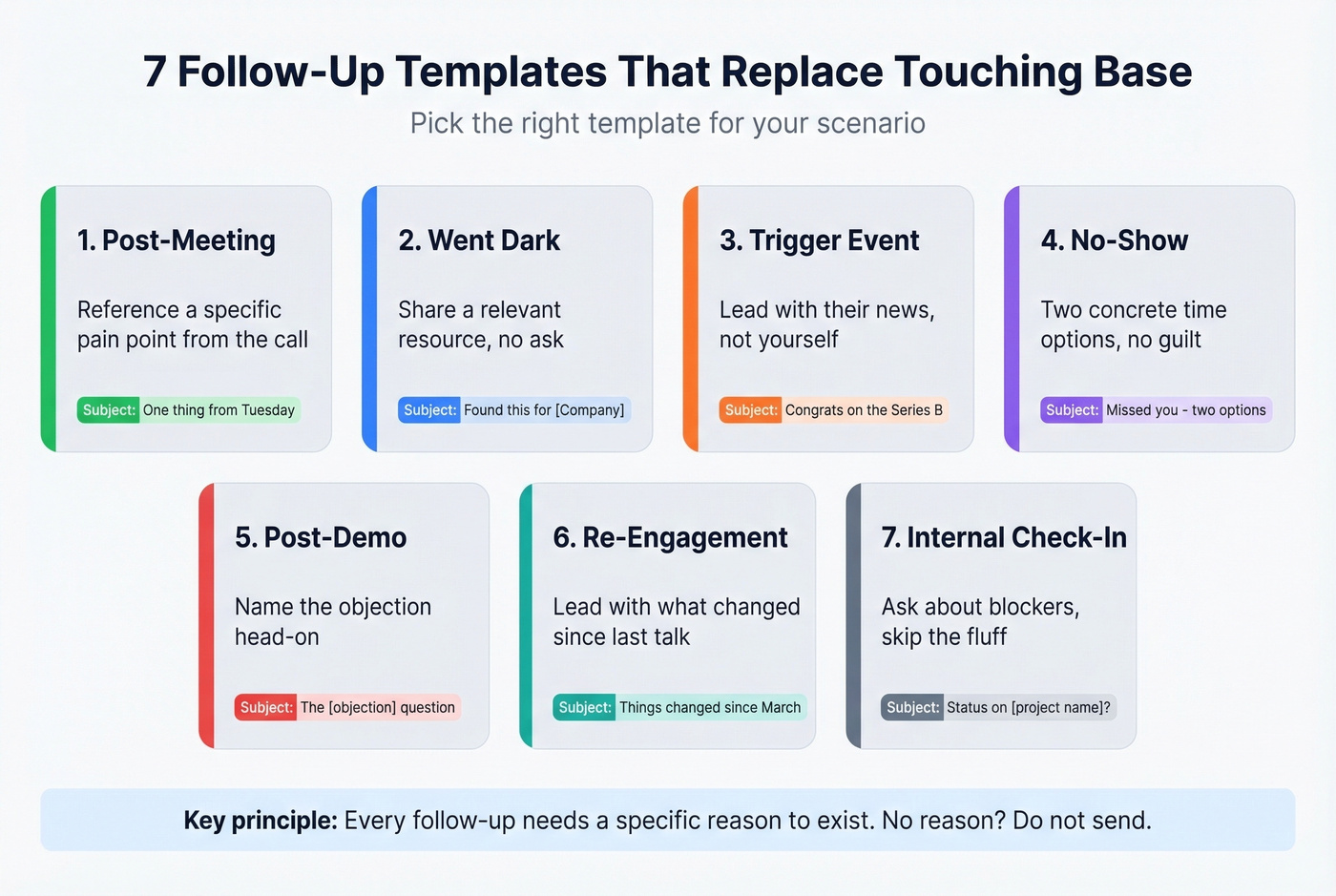
1. Post-Meeting Follow-Up
Subject: One thing from Tuesday
Hey [Name], you mentioned [specific pain point] during our call. I pulled together [resource/data point] that addresses exactly that - worth a look before your team meeting Friday?
2. Prospect Went Dark
Subject: Found this for [Company]
[Name], came across [article/case study/benchmark] relevant to the [initiative] you mentioned. Link below.
3. Trigger Event
A lazy follow-up after a funding round looks like this: "Hi Sarah, just wanted to touch base and see how things are going!" Nobody replies to that.
Subject: Congrats on the Series B
[Name], saw the news - congrats. We've helped three companies at a similar stage solve [specific problem]. Happy to share what worked.
This works for funding, new hires, product launches, or any public trigger. Lead with the event, not with yourself.
4. No-Show Recovery
Subject: Missed you - two options
Would Thursday at 2 PM or Friday at 10 AM work better? If neither, just name a time.
Short. No guilt trip. Two concrete options reduce friction.
5. Post-Demo Nudge
Subject: The [objection] question
[Name], I'm guessing the [pricing/integration/timeline] piece is the sticking point. Here's how [similar company] handled it: [one-sentence summary]. Want me to walk your team through that specifically?
This one names the elephant in the room. Most follow-ups dance around the objection - this addresses it head-on, which earns respect even if the answer is no.
6. Re-Engagement After Months
Subject: Things changed since March
We spoke back in Q1 when timing wasn't right. Since then we've [shipped feature/published result/signed competitor]. Worth a fresh 15 minutes?
This is stronger than a following-up-on-our-conversation email that rehashes old ground. Lead with what's new.
7. Internal Check-In (Non-Sales)
Subject: Status on [project name]?
Quick one - where does [project/deliverable] stand before the Friday standup? Any blockers I should know about? Happy to jump on a call if easier.
Skip this template for external prospects. It's designed for cross-team communication where "touching base" is most tempting and least useful.
If you want more plug-and-play options, grab these sales follow-up templates.
Verify Before You Send
We've watched teams craft three perfectly sequenced follow-ups to a VP, only to have the address bounce on attempt two. That's not just a wasted sequence - it's sender reputation damage that affects every email you send afterward. Prospeo verifies emails with 98% accuracy across 300M+ professional profiles, refreshing data every 7 days. The free tier gives you 75 email verifications a month, enough to clean your next outbound list before a single follow-up goes out.
If you're troubleshooting bounces and inboxing, start with email deliverability and then tighten your sender reputation.
55% of cold email replies come from follow-ups - but only if you're reaching real people. Prospeo gives you 143M+ verified emails refreshed every 7 days, so your graduated cadence hits live inboxes, not bounces that torch your domain reputation.
Verify before you follow up. 75 free emails to start.
FAQ
Is a "touching base" email unprofessional?
Not technically, but it's widely disliked. A survey of 1,000 U.S. workers ranked it the #3 most hated office phrase. Replace it with a specific reason for reaching out - a resource, a question, or a trigger event.
How many follow-up emails should I send?
Cap cold outreach at 4 total emails (1 initial + 3 follow-ups). An analysis of 16.5 million emails found that 4+ messages in a sequence triples unsubscribes and spam complaints. Space them 2, 4, then 7 days apart, with a 14+ day re-engage only on a new trigger.
What's the best subject line for a follow-up email?
Short (2-4 words), personalized, and phrased as a question. This combination hits 46% open rates across 5.5 million emails studied. Avoid jargon like "touching base" or urgency words like "ASAP" - both drag opens below 36%.
How do I make sure my follow-ups actually reach the inbox?
Verify every email address before sending. Bounced messages damage your sender reputation and tank deliverability for future campaigns. Tools like Prospeo let you verify addresses at 98% accuracy before your sequence fires, so you're not burning reputation on dead inboxes.