

B2B Marketing Email in 2026: Fix Deliverability First, Then Optimize Everything Else
Your open rates dropped 15% this quarter. You've been A/B testing subject lines for weeks, tweaking send times by the hour, rewriting CTAs that were already fine. Your copywriter is demoralized. Your marketing ops lead is blaming the ESP. But the real problem isn't your copy, your timing, or your platform - it's that Microsoft tightened inbox rules and your emails aren't landing where they used to. With 4.8B email users and roughly 392B emails sent daily, the channel isn't shrinking. The bar for getting through just got higher.
Stop optimizing the message until you've fixed the plumbing.
What to Fix Before Anything Else
Before frameworks and tools, here are the three things that move the needle fastest:
- Authenticate your domain. SPF, DKIM, and DMARC - set to quarantine or reject, not monitor-only. Microsoft's Office365 inbox placement collapsed 26.73 points year-over-year, and only 7.6% of domains actually enforce DMARC. Without proper authentication, you're fighting with one hand tied behind your back. (If you want a deeper technical breakdown, use our email deliverability guide.)
- Verify your list before every campaign. Bounce rates above 2% actively damage sender reputation. Run verification on a regular cycle - not once a quarter, before every send. If you’re troubleshooting, start with email bounce rate benchmarks and fixes.
- Switch from batch campaigns to automated flows. Flows convert at around 13x the rate of campaigns across 183K+ brands. If you're still blasting your entire list on Tuesdays at 10am, you're leaving money on the table.
2026 Benchmarks Worth Knowing
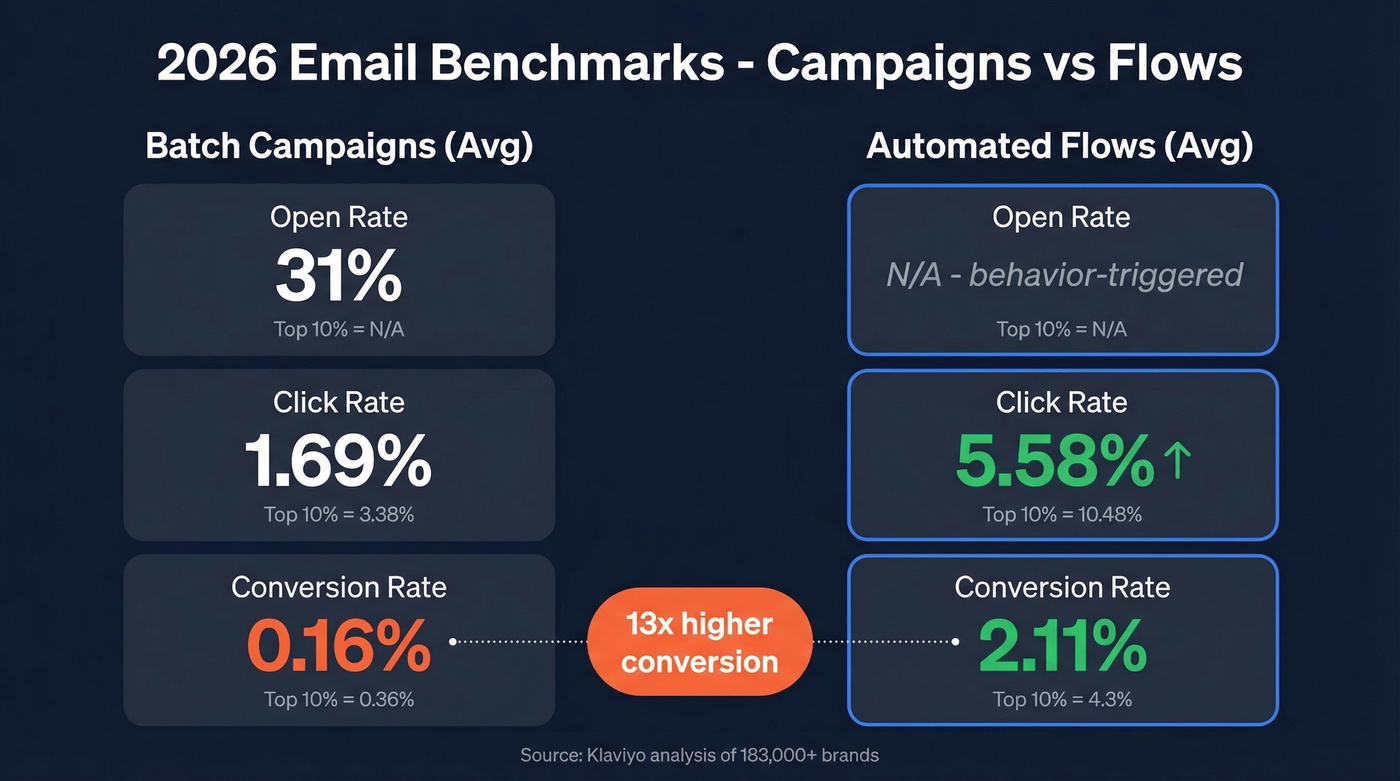
Let's ground this in real numbers. Klaviyo analyzed data from 183,000+ brands to produce their 2026 benchmarks, and the gap between campaigns and automated flows is staggering.
| Metric | Campaigns (Avg) | Campaigns (Top 10%) | Automated Flows (Avg) | Automated Flows (Top 10%) |
|---|---|---|---|---|
| Open rate | 31% | 45.1% | Not broken out separately | - |
| Click rate | 1.69% | 3.38% | 5.58% | 10.48% |
| Conversion rate | 0.16% | 0.36% | 2.11% | 4.3% |
Klaviyo doesn't report flow open rates as a separate metric, likely because behavior-triggered emails have fundamentally different open dynamics than batch sends.
For B2B specifically, Mailchimp's benchmark data puts Business & Finance at 31.35% open rate and 2.78% click rate - directionally consistent. FirstPageSage pegs conversion rates at around 2.4%, which aligns closely with the flow conversion data above.
The conversion gap is what matters here. Average campaigns convert at 0.16%. Average flows convert at 2.11%. That's not a marginal improvement - it's a fundamentally different channel when you trigger emails based on behavior instead of blasting a calendar schedule. One important nuance: open rates are inflated by Apple Mail Privacy Protection, which pre-loads tracking pixels. Click rate is the more reliable engagement metric in 2026 (and if you want to standardize reporting, use a consistent click rate formula).
The Deliverability Crisis Nobody Talks About
Here's the thing: a 98.16% delivery rate sounds great until you realize "delivered" doesn't mean "inboxed." It means the server accepted the email. Where it actually lands - inbox, promotions tab, or spam - is a different story entirely, and it's the most overlooked aspect of B2B email outreach.
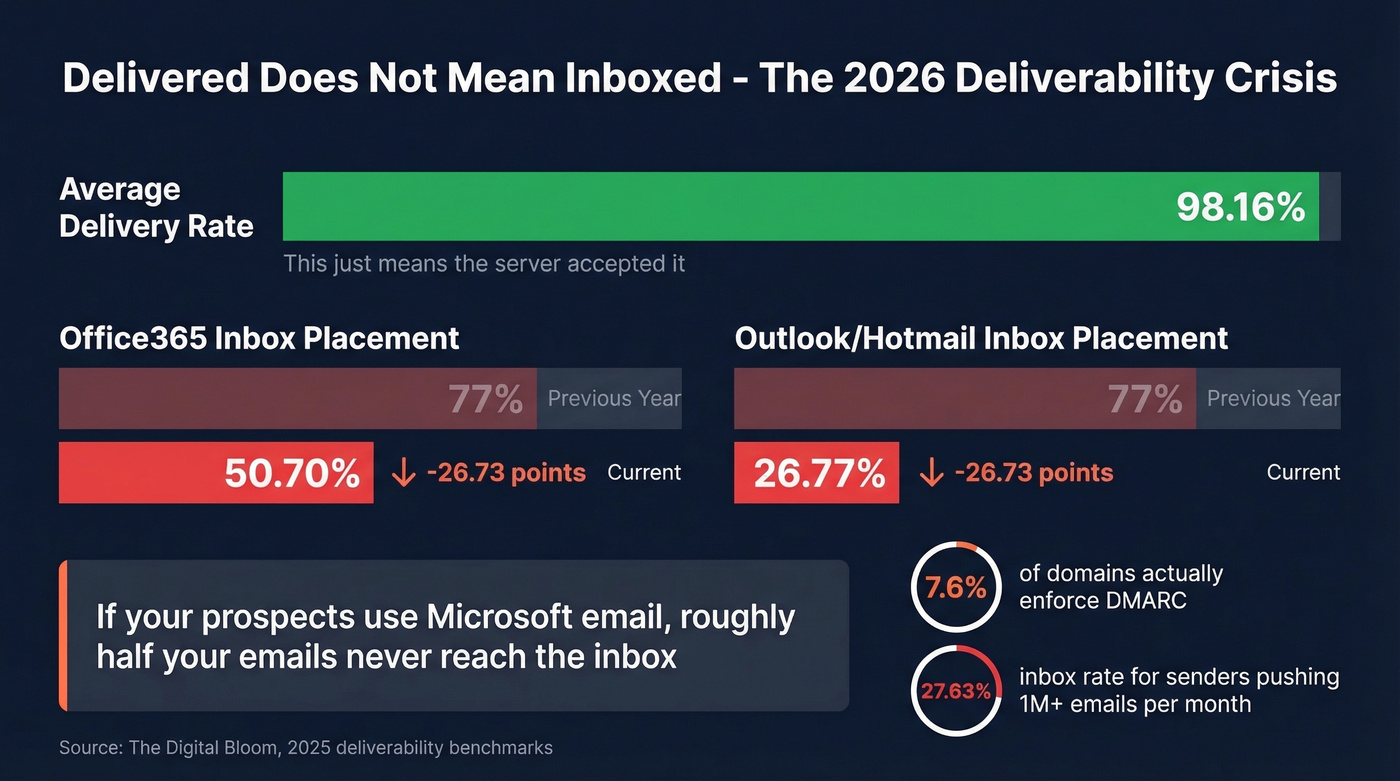
The numbers are brutal. Office365 inbox placement dropped to 50.70% - down 26.73 percentage points year-over-year. Outlook/Hotmail inbox placement fell to 26.77%. If your prospects are on Microsoft email (and most B2B buyers are), roughly half your emails are going somewhere other than the inbox.
What changed? Google and Yahoo enforced authentication requirements in February 2024. Microsoft followed in May 2025 with its own bulk sender rules. And only 7.6% of domains actually enforce DMARC at quarantine or reject level. The rest are either missing it entirely or running it in monitor-only mode, which does nothing for inbox placement. (If you’re implementing policy correctly, DMARC alignment is the detail most teams miss.)
Authentication gets you through the door. Clean data keeps you there. Bounce rates above 2% signal to inbox providers that you're not maintaining your list, and they'll throttle you accordingly. We've audited dozens of outbound programs, and dirty data is the silent killer behind most deliverability problems. Stack Optimize built from $0 to $1M ARR running client campaigns with Prospeo's 5-step verification - catch-all handling, spam-trap removal, honeypot filtering - maintaining 94%+ inbox performance and under 3% bounce rates with zero domain flags across all clients. If you’re cleaning lists at scale, follow a dedicated spam trap removal process.

Senders pushing 1M+ emails per month saw inbox placement drop to roughly 27.63% - down over 22 points year-over-year. Volume without reputation is a death sentence in 2026.
Authentication Checklist
Get these right before you worry about subject lines or send times:
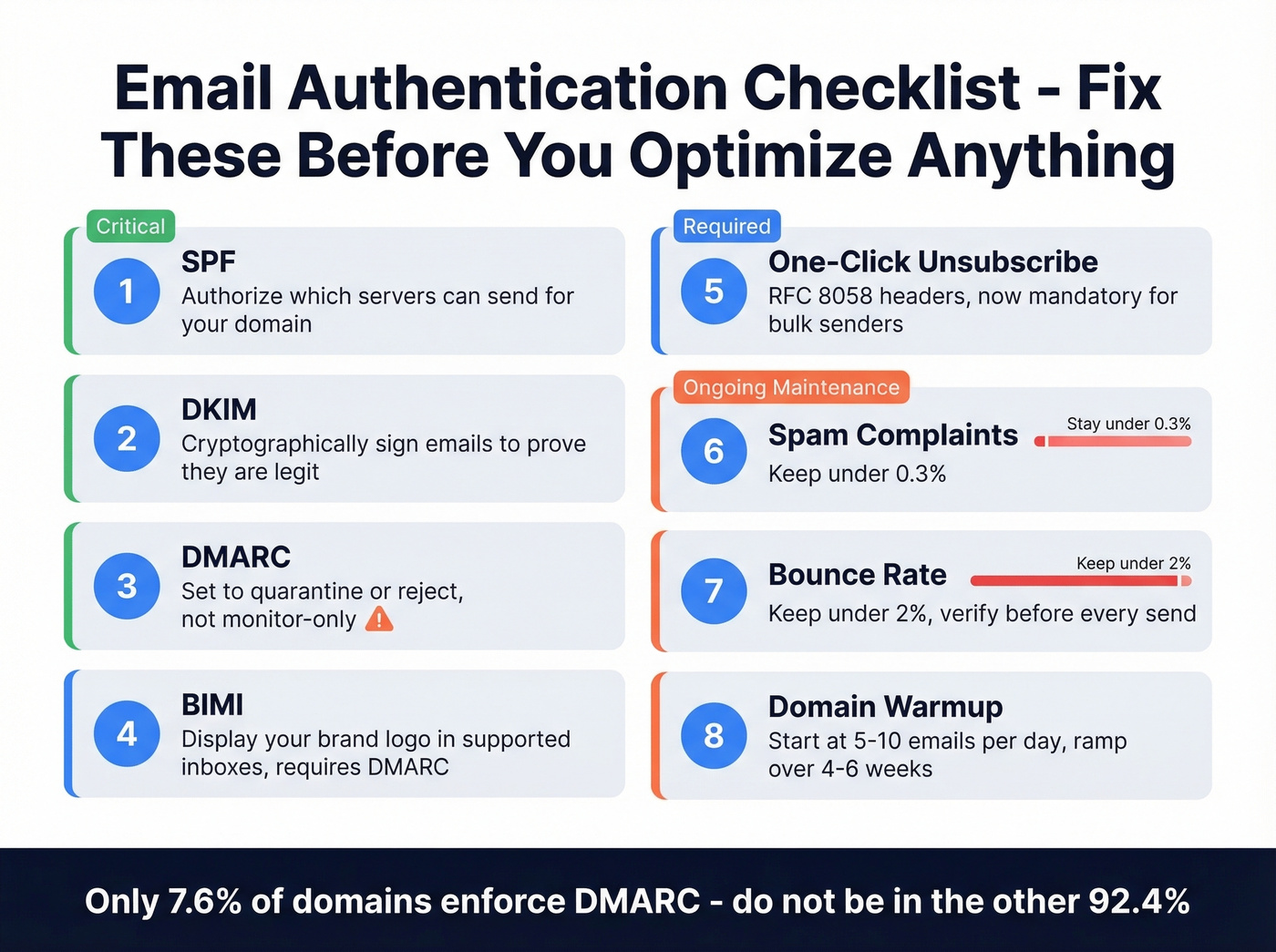
- SPF - Authorize which servers can send on behalf of your domain (use these SPF Record Examples to avoid syntax mistakes)
- DKIM - Cryptographically sign your emails so providers can verify they haven't been tampered with (here’s how to verify DKIM is working)
- DMARC - Set to p=quarantine or p=reject (not p=none, that's just monitoring)
- BIMI - Requires DMARC enforcement; displays your brand logo in supported inboxes
- One-click unsubscribe - RFC 8058 List-Unsubscribe headers are now mandatory for bulk senders
- Spam complaints - Stay under 0.3%. Above that, providers actively suppress your mail
- Bounce rate - Keep under 2%. Verify lists before every send
- Domain warmup - New domains start at 5-10 emails/day, ramping over 4-6 weeks. Don't rush this (use a safe email velocity ramp)

Your campaigns convert 13x better as flows - but only if emails actually reach the inbox. Prospeo's 5-step verification catches spam traps, honeypots, and catch-all domains before they tank your sender reputation. At 98% email accuracy and a 7-day data refresh cycle, your list stays clean between every send - not just once a quarter.
Fix the plumbing first. Verify your list before the next send.
Where Email Fits in Your 2026 GTM
95% of your potential buyers aren't ready to buy today. That stat, widely cited from LinkedIn Marketing Solutions, reframes what B2B email should actually do. It's not a standalone blast channel. It's the warm outbound layer in a broader system.
The modern framework looks like this: create demand through content and brand, detect intent signals from buyers who are engaging, then run warm outbound - email, phone, DMs - to the highest-intent prospects. Email sits at the end of that chain, not the beginning. (If you’re building the system end-to-end, start with account-based selling best practices.)
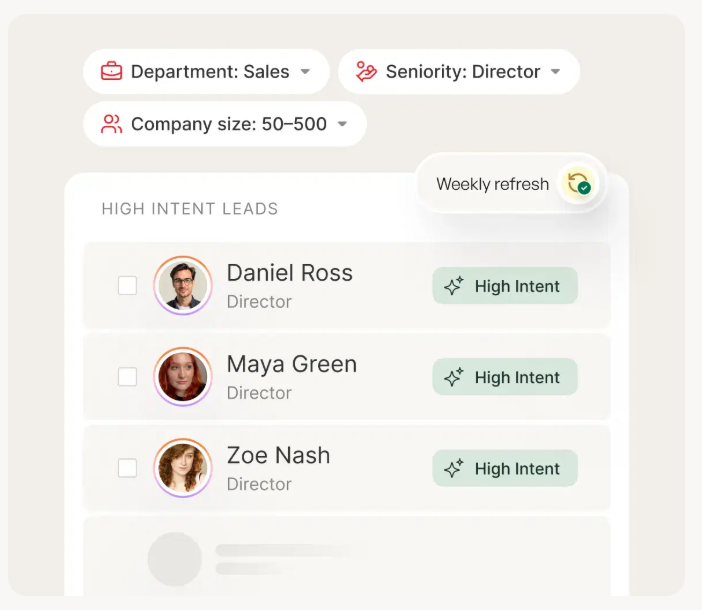
Here's our hot take: most B2B teams don't have a messaging problem. They have a targeting problem. They're sending well-crafted emails to people who couldn't care less. If your average deal size is under $10K, you probably don't need a 12-step nurture sequence - you need a tighter list of people who are actually in-market right now. Intent data that tracks what accounts are actively researching matters more than your seventh subject line variant. (To operationalize this, use intent based segmentation.)
95% of buyers aren't ready today - so stop blasting and start targeting. Prospeo tracks 15,000 intent topics via Bombora, layered with job changes, headcount growth, and technographic filters. Build lists of accounts actively researching your category, then send emails that land in inboxes with 98% verified accuracy.
Send fewer emails to better prospects. Book 35% more meetings than Apollo users.
The Buying Center Approach
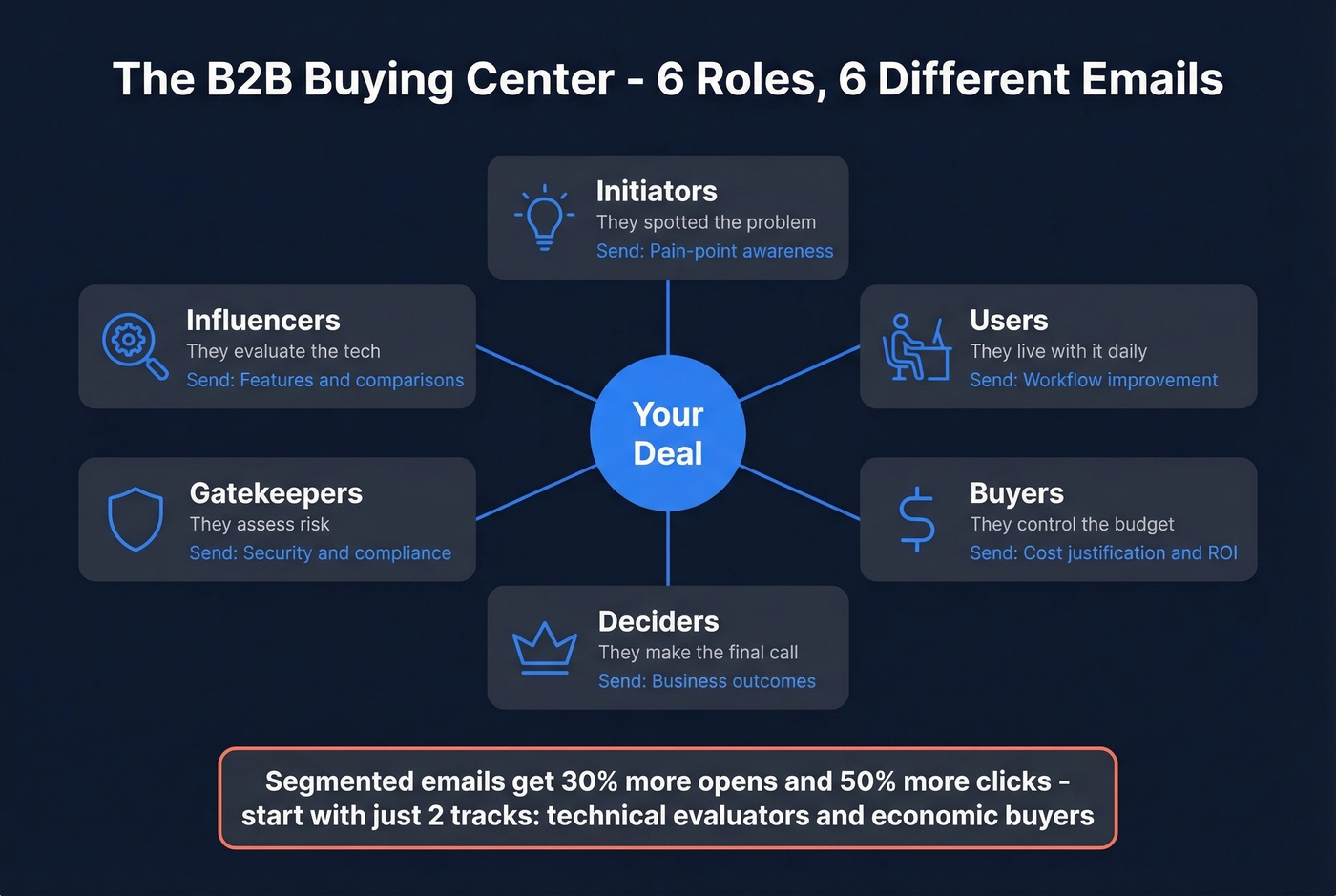
B2B purchases aren't made by one person. Zapier's framework identifies six roles in a typical buying center, and each one needs different messaging:
| Role | What They Care About | Email Content Angle |
|---|---|---|
| Initiators | The problem exists | Pain-point awareness |
| Users | Day-to-day impact | Workflow improvement |
| Buyers | Budget and ROI | Cost justification |
| Deciders | Strategic alignment | Business outcomes |
| Gatekeepers | Risk and compliance | Security, integration |
| Influencers | Technical fit | Features, comparisons |
Sending the same email to all six roles is the fastest way to get ignored. The VP of Engineering doesn't care about your ROI calculator. The CFO doesn't care about your API documentation. If you need a simple way to structure this split, map messaging to technical buyer vs economic buyer.
Segmented emails generate 30% more opens and 50% more clickthroughs compared to one-size-fits-all blasts. That's the difference between a campaign that generates pipeline and one that generates unsubscribes. We've seen teams triple their reply rates just by splitting their sequences into two tracks: one for technical evaluators and one for economic buyers. You don't need six perfectly tailored sequences on day one. Start with two.
Writing Emails That Get Read
The average office worker receives 120+ emails per day. You're competing with every vendor, every internal thread, every newsletter.
Subject lines should be 6-10 words, specific, and curiosity-driven without being clickbait. Personalization tokens help, but only if they feel natural. "Quick question about [Company]'s outbound stack" works. "{First_name}, I have an AMAZING opportunity" doesn't. (If you need a swipe file, use these email subject line examples.)
Preheader text is the most wasted real estate in email. Most platforms default to "View this email in your browser." Write 40-90 characters that complement your subject line and give readers a reason to open. Gmail shows up to 90 characters; Apple Mail shows around 140. Write for the shorter limit.
Body copy needs to be scannable - short paragraphs, one idea per paragraph, conversational tone. If your email reads like a press release, it's getting archived. The average B2B reply rate is 5.1%, so you're writing for the 5%, not the 95%. For more structure, see our guide to emails that get responses.
A PAS Framework Example
Instead of listing four frameworks and leaving you to figure them out, here's a concrete cold email using Problem-Agitate-Solution:
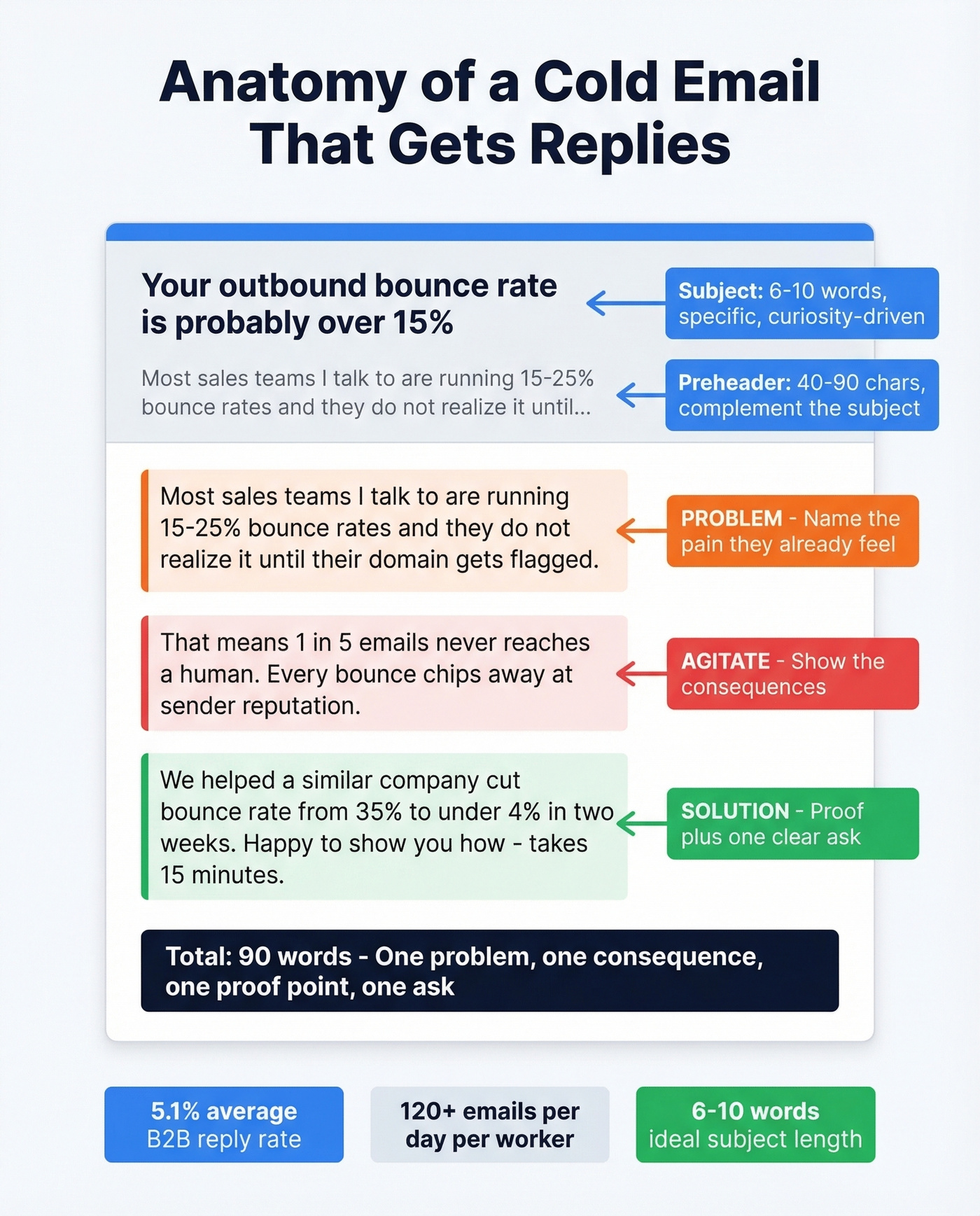
Subject: Your outbound bounce rate is probably over 15%
Hi [Name],
Most sales teams I talk to at [industry] companies are running 15-25% bounce rates on their outbound sequences - and they don't realize it until their domain gets flagged.
That means 1 in 5 of your emails never reaches a human. Worse, every bounce chips away at your sender reputation, dragging down deliverability for the emails that are going to valid addresses.
We helped [similar company] cut their bounce rate from 35% to under 4% in two weeks. Happy to show you how - takes 15 minutes.
[Your name]
That's 90 words. One problem, one consequence, one proof point, one ask. AIDA works better for product-led pitches. BAB is strong for transformation stories. Pick one framework per sequence and commit to it - don't Frankenstein three into one email.
Production and Design Heuristics
These numbers save you from the "looks fine on my screen" trap:
- CTA buttons: minimum 44x44px tap target (Apple's HIG standard). Use a contrasting color with at least 4.5:1 contrast ratio against the background.
- Image width: 600px max for the email body. Always include alt text - 40%+ of B2B recipients have images blocked by default, and screen readers depend on it.
- Body copy: under 125 words for cold outreach, under 300 for newsletters. Single-column layout only.
- File size: keep total email weight under 100KB. Heavy emails get clipped in Gmail at 102KB.
- Never use image-only CTAs. If images are blocked, your call to action disappears entirely. Always use a styled HTML button with live text.
Mistakes That Kill Performance
No segmentation. Blasting your entire list like it's 2010 costs you 30% of your opens and 50% of your clicks. The r/EmailWhisperers community flags this as the most persistent mistake they see - teams invest in automation but skip the segmentation that makes automation worthwhile.
Dirty data. Snyk's sales team of 50 AEs was running 35-40% bounce rates before they implemented proper verification. After cleaning their data pipeline, bounce rates dropped under 5%, AE-sourced pipeline jumped 180%, and the team generated 200+ new opportunities per month. Bad data doesn't just waste sends - it actively poisons your sender reputation.
Over-sending. Frequency fatigue is real. Reddit practitioners consistently call out brands that email 4-5 times per week with marginal content. Stay under 0.3% spam complaint rate or inbox providers will throttle you.
Product-heavy messaging. Nobody opens an email to read your feature list. Lead with the problem you solve, not the product you sell. In our experience, emails that open with a customer pain point outperform product-led emails by 2-3x on reply rate.
Broken mobile layouts. Tiny text, unresponsive templates, CTAs you can't tap without zooming. Over half of B2B emails are opened on phones. If your email doesn't render on mobile, it doesn't exist for half your audience.
Automation without personalization. Setting up a 12-step drip sequence doesn't mean you've personalized anything. If every email reads like it was written for "Dear {First_Name} at {Company}," you've automated spam. That's worse than no automation at all, because now you're annoying people at scale.
Compliance: CAN-SPAM, GDPR, PECR
Cold email is legal. Spam isn't. The distinction matters, and it's simpler than most compliance guides make it sound.
| CAN-SPAM (US) | GDPR (EU) | PECR (UK) | |
|---|---|---|---|
| Model | Opt-out | Consent / Legit interest | Consent / Soft opt-in |
| Max penalty | $53,088/email | EUR 20M or 4% revenue | GBP 500K |
| Cold email? | Yes (with opt-out) | Yes (legitimate interest) | Limited (B2B soft opt-in) |
| Key requirement | Physical address + unsub | Relevant to role + DPA | Prior relationship preferred |
Under CAN-SPAM, you can email anyone as long as you include a physical address, don't use deceptive headers, and honor unsubscribe requests within 10 days. It's an opt-out model.
GDPR is stricter but still allows cold B2B outreach under legitimate interest - the email needs to be relevant to the recipient's professional role and not "unexpected and disruptive." Role-based emails like info@company.com may fall outside personal data scope, but individual business emails (john@company.com) are covered. Regular list cleaning isn't just good practice under GDPR - it's a compliance requirement under the accuracy principle.
PECR in the UK allows a "soft opt-in" for B2B contacts where there's an existing relationship. Pure cold outreach to individuals is more restricted than under CAN-SPAM.
Best Tools for 2026
Your ESP sends the emails. But it can't fix bad data upstream. Here's how the stack breaks down:
| Tool | Best For | Starting Price | Key Differentiator |
|---|---|---|---|
| Prospeo | Email verification + B2B data | Free (75 emails/mo) | 98% accuracy, pairs with any ESP |
| ActiveCampaign | Deep automation | $19/mo | Most powerful workflow builder |
| Brevo | Small team value | $9/mo | Best free tier for starters |
| HubSpot | CRM-native marketing | $20/mo | Tight CRM integration |
| GetResponse | Landing pages + webinars | $19/mo | Built-in webinar hosting |
| MailerLite | Simple and clean | $25/mo | Fastest setup time |
| Mailchimp | Easy drag-and-drop | $13/mo | Easiest editor for beginners |
ActiveCampaign: Powerful, But Not Quick to Learn
ActiveCampaign has the deepest automation builder in this price range. CRM included, behavioral triggers, conditional logic - it's genuinely powerful. Reddit users on r/MarketingAutomation consistently praise the automations but warn that onboarding takes weeks, not days. In our testing, it took about 10 days before a new team member could build a multi-step flow without help. Pricing also scales aggressively with contact count - budget $49+/mo as your list grows. Skip this one if you need to ship campaigns this week.
Best Value: Brevo at $9/mo
Brevo is the tool we recommend to teams under 10K contacts who want to stop overthinking their stack. The free tier is generous, deliverability reputation is solid, and it covers email, SMS, and chat. Templates and the editor feel basic compared to ActiveCampaign, but for small teams that need to ship campaigns now, it's hard to beat.
HubSpot: Great Handoff, Steep Price
HubSpot makes sense if you're already in the HubSpot CRM ecosystem. The marketing-to-sales handoff works well out of the box. But the full feature set gets expensive quickly - expect $800-$3,000+/mo once you need advanced automation, reporting, and multiple seats. If you're not already on HubSpot CRM, don't start here just for email.
GetResponse bundles landing pages and webinar hosting alongside email, which is useful for lead gen-heavy teams. MailerLite is clean, simple, and does the basics well - the fastest path from signup to first send. Mailchimp remains the easiest editor for beginners, though its automation capabilities are shallow compared to ActiveCampaign or HubSpot.
FAQ
Is B2B marketing email still effective in 2026?
Yes - email generates roughly $36 per $1 spent according to DMA/Litmus research, making it the highest-ROI channel available. With 4.8B global users, the channel isn't dying. Teams that authenticate, segment, and verify their lists are seeing stronger results than ever.
What's a good open rate for B2B emails?
Around 31% is the 2026 average across the 183K-brand dataset, with top 10% hitting 45%+. Open rates are inflated by Apple MPP, so click rate - 1.69% average, 3.38% for top performers - is the more reliable engagement metric to track.
How often should I email my B2B list?
One to two times per week for newsletters and promotional content. Automated flows trigger based on behavior, not a fixed schedule, so they don't contribute to frequency fatigue the same way. Stay under 0.3% spam complaint rate - that's the threshold where providers throttle.
Can I legally send cold B2B emails?
In the US, yes - CAN-SPAM is an opt-out model requiring an unsubscribe option and physical address. In the EU, GDPR allows cold outreach under legitimate interest if the email is relevant to the recipient's professional role. Always include a one-click unsubscribe header.
How do I keep B2B emails out of spam?
Authenticate your domain with SPF, DKIM, and DMARC (set to quarantine or reject). Keep bounce rates under 2% by verifying your list before every send. Warm up new domains gradually over 4-6 weeks and pause if complaints exceed 0.3%.
Fix deliverability first. Verify your data. Then - and only then - worry about subject lines, send times, and CTA button colors. Every B2B marketing email strategy lives or dies on the foundation underneath it. Get the plumbing right, and the optimization actually has room to work.