

The Data-Backed Guide to Marketing for B2B in 2026
Your outbound team sent 5,000 emails last month. 800 bounced. Your content team published 16 blog posts nobody read. And your CMO just asked for a "2026 marketing plan with projected CPL by channel." Meanwhile, 86% of B2B purchases stall and 81% of buyers end up dissatisfied with the vendor they chose. The gap between how companies approach marketing for B2B and how buyers actually buy has never been wider.
Most guides on this topic are written for a single industry. This one gives you cross-industry benchmarks so you can see where your vertical actually stands - plus the buyer behavior data, channel economics, and practitioner playbook you need to build a plan that survives contact with reality.
The Short Version
B2B buying has fundamentally changed. 83% of buyers define requirements before talking to sales, so your marketing has to do the selling before a rep ever gets involved. The highest-ROI strategies in 2026 are SEO and content marketing, verified email outreach, and ABM for enterprise accounts. Do two or three well instead of ten poorly. Below: real CPL benchmarks by industry, the buyer behavior stats nobody else publishes, and a prioritized playbook.
What B2B Marketing Actually Is
B2B marketing is the practice of selling products or services to other businesses rather than individual consumers. That's the textbook answer. The real answer is more interesting: it's the discipline of convincing a committee of skeptical professionals - who've already done their own research - that your solution solves a problem worth their budget and political capital. Marketing for B2B means navigating organizational politics as much as purchase decisions.
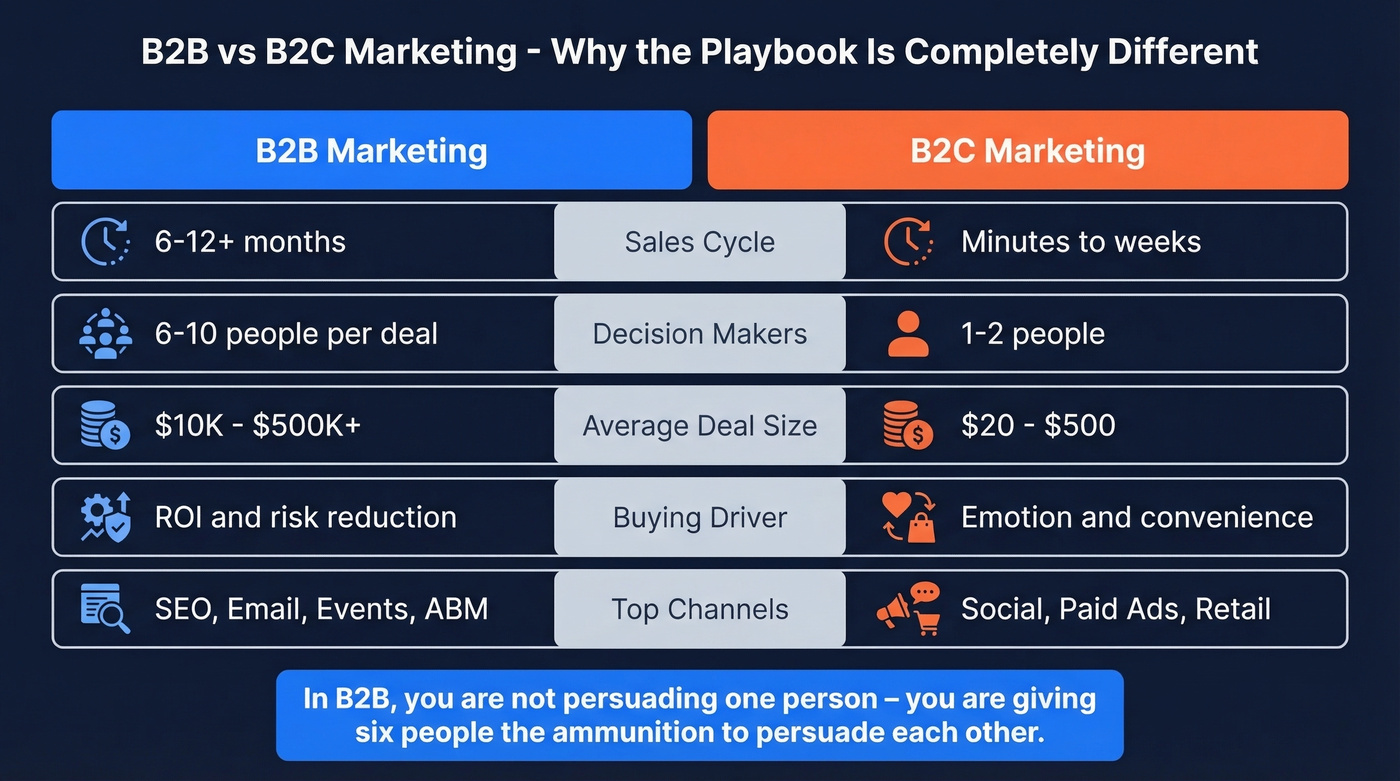
The distinction from B2C isn't just "longer sales cycles." It's a fundamentally different buying psychology.
| Dimension | B2B | B2C |
|---|---|---|
| Sales cycle | 6-12+ months | Minutes to weeks |
| Decision-makers | 6-10 per deal | 1-2 |
| Avg deal size | $10K-$500K+ | $20-$500 |
| Buying driver | ROI, risk reduction | Emotion, convenience |
| Primary channels | SEO, email, events, ABM | Social, paid, retail |
The committee dynamic changes everything. You're not persuading one person - you're giving six people the ammunition to persuade each other. That's why B2B gravitates toward case studies, ROI calculators, and comparison pages rather than lifestyle branding. Your buyer personas need to account for every stakeholder role on that committee, because the CFO cares about different things than the end user.
How B2B Buyers Actually Buy in 2026
Forget the neat funnel diagrams. B2B buying in 2026 is non-linear, committee-driven, and increasingly happening before your sales team even knows a deal exists.
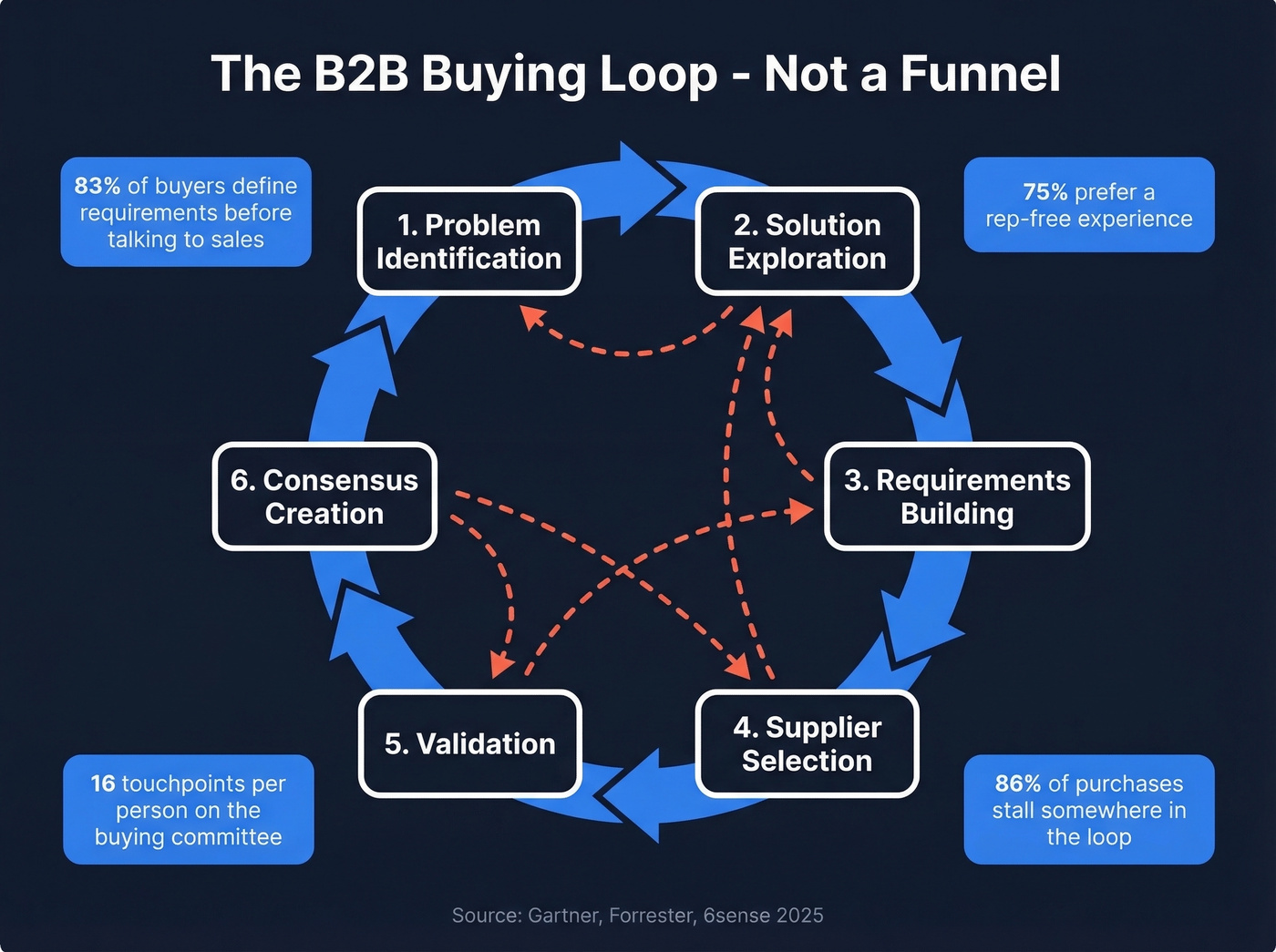
75% of B2B buyers prefer a rep-free sales experience. That doesn't mean reps are irrelevant - Gartner found buyers are 1.8x more likely to complete a high-quality deal when they use supplier digital tools in partnership with a rep. But the first 60-70% of the buying journey happens without you in the room.
6sense's 2025 research sharpens the picture further: average sales cycles compressed from 11.3 months to 10.1 months year-over-year, driven by economic pressure. First contact moved from 69% to 61% of the journey, pulling outreach forward roughly six to seven weeks.
Buyers mostly or fully define requirements 83% of the time before speaking with sales. And here's the stat that should reshape your content strategy: 94% of buyers use LLMs during their buying process. If your company doesn't show up when a buyer asks ChatGPT or Perplexity "best solutions for [your category]," you'll never enter the consideration set. We'll come back to this in the AI section.
The buying journey itself isn't a funnel - it's a loop. Gartner describes buyers cycling across six buying jobs: problem identification, solution exploration, requirements building, supplier selection, validation, and consensus creation. They revisit each at least once. A buyer validates your solution, loops back to requirements building after a stakeholder raises a new concern, then re-enters supplier selection. Your marketing has to support every stage simultaneously, not just the top of a funnel.
Forrester adds urgency: 86% of B2B purchases stall somewhere in this loop, and 81% of buyers end up dissatisfied with their final choice. The winning vendor averages 16 interactions per person on the buying committee. That's not 16 emails - it's 16 meaningful touchpoints across content, conversations, demos, and peer validation.
Here's the thing: most B2B marketing is still built for a linear funnel that hasn't existed for years. The companies winning in 2026 are the ones designing for the loop.
Core B2B Marketing Strategies, Ranked
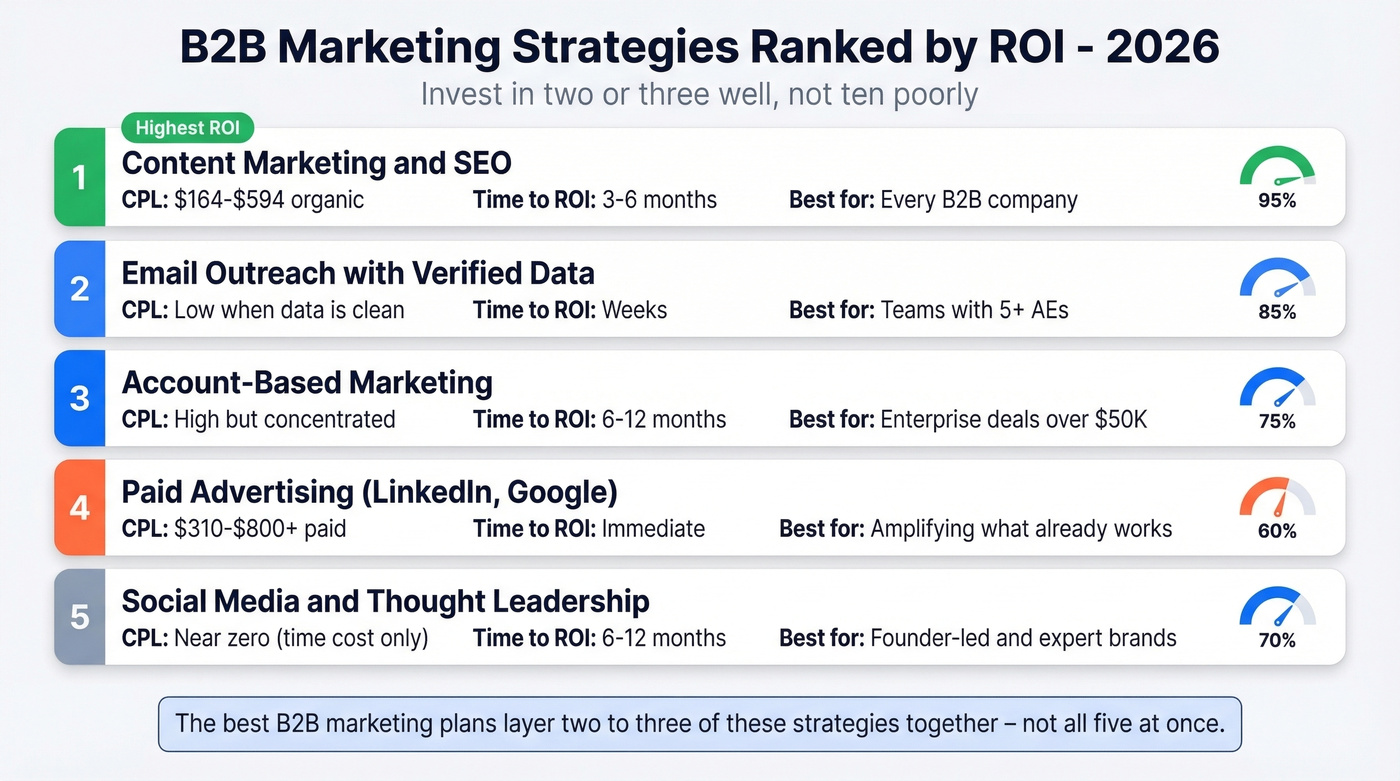
Not all strategies deserve equal investment. Here's what actually drives pipeline, with real cost data.
Content Marketing & SEO
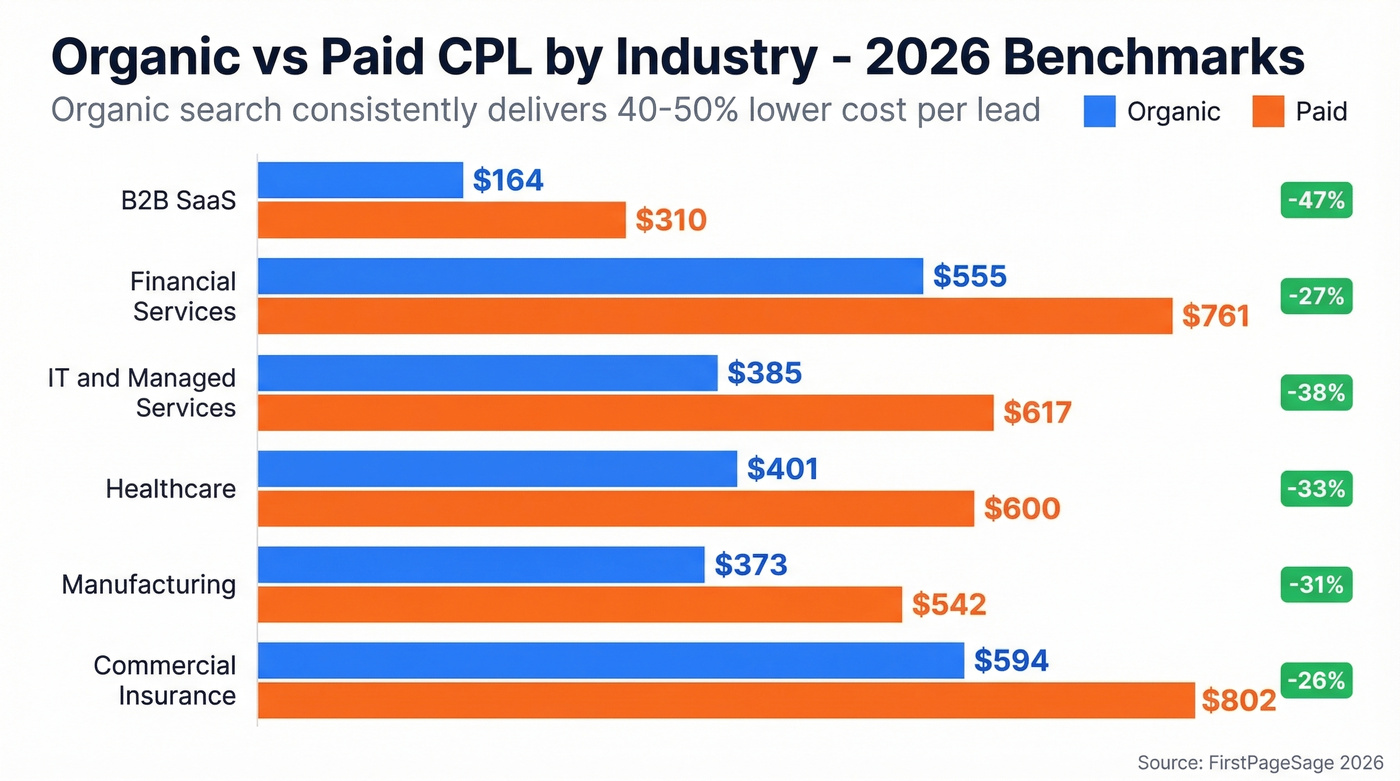
This is the highest-ROI channel in B2B. Full stop. FirstPageSage's 2026 data shows organic CPL running 40-50% lower than paid across nearly every industry. B2B SaaS organic CPL is $164 versus $310 paid. Financial Services: $555 organic versus $761 paid. The gap compounds over time because content keeps generating leads after you stop paying for it.
The playbook has evolved, though. Publishing four posts a week that say nothing is worse than one that actually helps someone decide. The shift toward AI answer engines means your content needs to be structured, definition-first, and packed with original data. We've seen pages that rank #1 on Google get zero visibility in AI-generated answers because they're written as clever narratives rather than clear, structured resources.
Invest here first. Build a content engine around the questions your buyers ask at each stage of their looping journey, then optimize for both traditional search and generative engine optimization. For most teams figuring out how to market B2B effectively, this is the best starting point.
Email Outreach With Verified Data
Email remains one of the highest-leverage outbound channels - when it works. The problem isn't email as a strategy. The problem is data quality destroying deliverability before your message ever reaches an inbox.
Here's a scenario we see constantly: a team sends 5,000 emails, 800 bounce, their domain reputation tanks, and suddenly even their good emails land in spam. The root cause isn't the copy or the sequencing tool. It's the data.
Data quality isn't a tool feature - it's the foundation your entire outbound program sits on. Prospeo's 98% email accuracy and 7-day data refresh cycle exist specifically to solve this problem, and the difference is measurable: Snyk's team went from a 35-40% bounce rate to under 5% after switching, generating 200+ new opportunities per month across 50 AEs. That's not a marginal improvement; it's the difference between a functioning outbound program and a broken one.
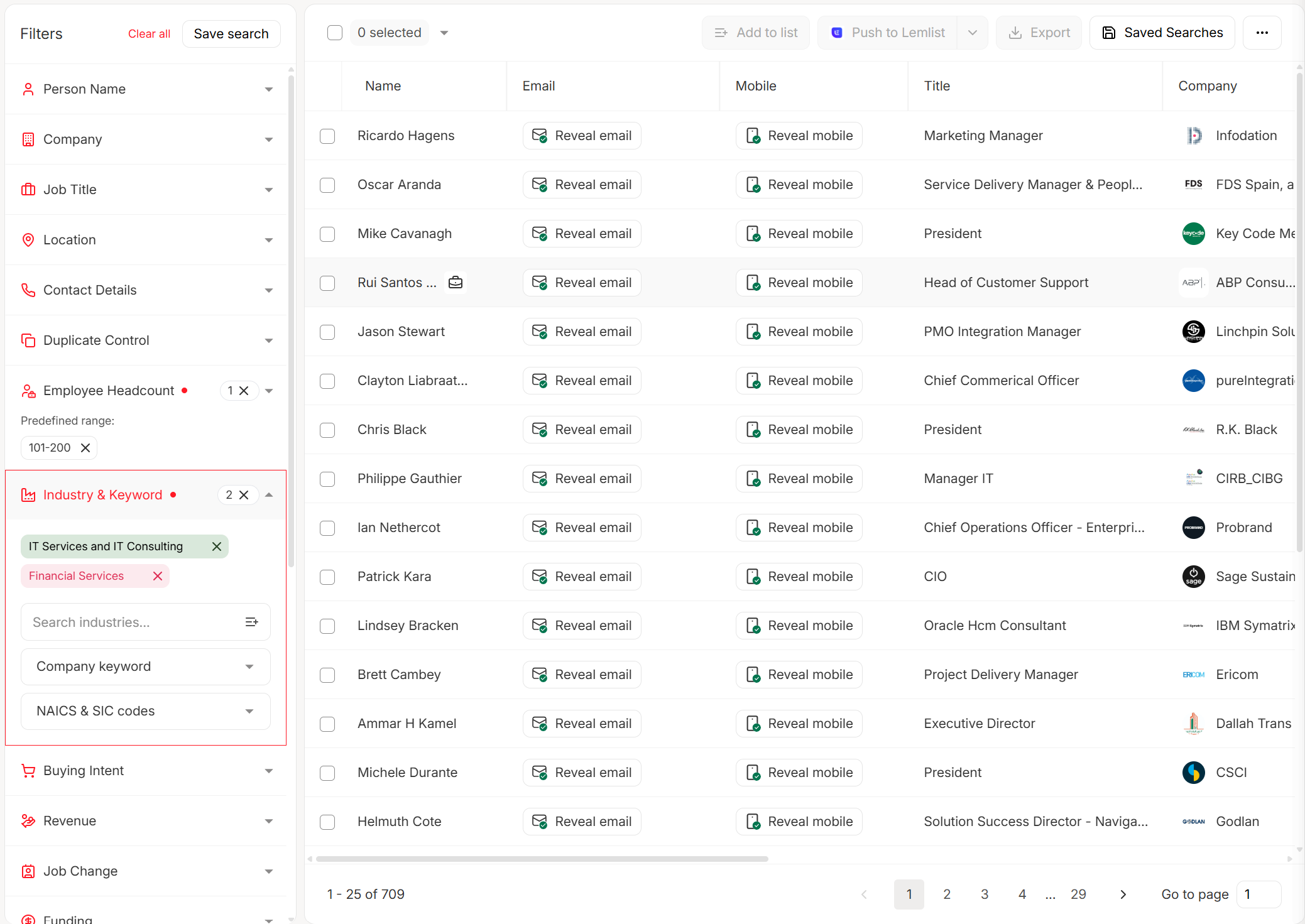
Before you optimize subject lines or A/B test CTAs, verify your list. Everything downstream depends on it - especially your email deliverability.
Account-Based Marketing
ABM is the right strategy for enterprise deals - and the most commonly botched one. Most companies implement ABM as "slightly more targeted email blasts," which misses the entire point.
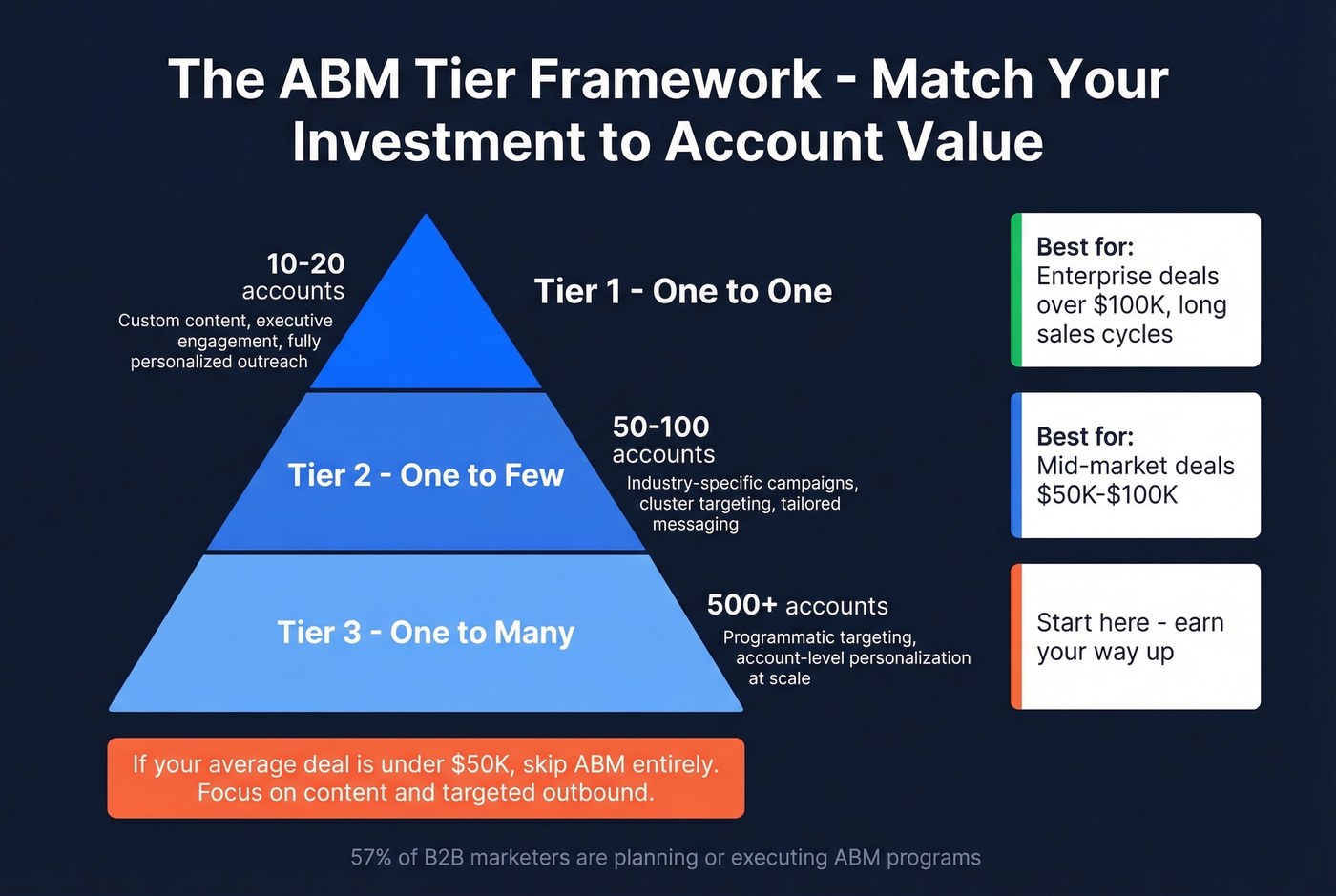
Real ABM operates in tiers. Tier 1 is true one-to-one: custom content, personalized outreach, executive engagement for your top 10-20 accounts. Tier 2 is one-to-few: industry-specific campaigns targeting clusters of 50-100 similar accounts. Tier 3 is one-to-many: programmatic targeting at scale with account-level personalization. Most teams should start at Tier 3 and earn their way up.
The key insight is that ABM targets buying committees, not individuals. A single account might have six to ten stakeholders who all need different messages - and mapping those committees accurately is the step most teams skip. 57% of B2B marketers are planning or executing ABM programs, with 52% reporting positive ROI. The ones who fail are usually the ones who skipped account selection and committee mapping.
If your average deal size is under $50K, skip ABM entirely. The overhead of account-specific content and multi-threaded outreach doesn't pencil out. Put that energy into content and targeted outbound instead. ABM is a precision instrument, not a Swiss Army knife - treat it like account-based selling.
Paid Advertising
LinkedIn captures 22.9% of all US B2B digital ad spending - nearly a quarter of every B2B ad dollar in the country. Social overall accounts for 46.3% of B2B digital ad spend. These aren't small allocations.
LinkedIn's targeting is unmatched for B2B: job title, company size, industry, seniority. But expect CPCs of $5-15, which means your unit economics need to support $50-150+ cost per click-through before conversion rates even enter the equation. For teams selling deals under five figures, LinkedIn paid is hard to justify.
Google Search captures active demand - people already searching for solutions. It's the complement to LinkedIn's awareness play. Mobile overtook desktop for B2B digital ads in 2024 for the first time, so if your landing pages aren't mobile-optimized, you're burning budget.
Let's be honest: paid is a multiplier, not a foundation. Build organic first, then amplify what's working with paid.
Social Media & Thought Leadership
A recurring theme in r/b2bmarketing threads is clear: sharing insights publicly - on professional networks, niche forums, communities - compounds over time. It's not about going viral. It's about consistently showing up where your buyers hang out until you become the person they think of when the problem arises.
LinkedIn is the primary B2B social channel for reaching professional decision-makers. The practitioners who win here aren't posting corporate announcements. They're sharing real lessons, frameworks, and opinions that demonstrate expertise. This is lightweight thought leadership that costs nothing but time and compounds like content marketing. If your executives aren't active on LinkedIn, you're leaving one of the cheapest awareness channels on the table.
The Practitioner Playbook
Vendor advice tends toward "use our platform for everything." Practitioner advice is different. Here's the four-pillar framework that keeps surfacing in conversations on r/b2bmarketing and in the teams we've watched build pipeline consistently.
A prerequisite before any of this works: marketing and sales alignment. If your SDRs don't trust the leads marketing sends, and marketing doesn't know what objections sales hears daily, no framework will save you. Get in the same room weekly. Share data. Agree on definitions of MQL and SQL. Then execute.
Pillar 1: Content for passive buyers. Most of your market isn't buying right now. Stay top-of-mind through thought leadership, in-depth content, and expert newsletters so that when they do enter a buying cycle, you're already in the consideration set.
Pillar 2: Capture active demand fast. When someone raises their hand - fills out a form, requests a demo, engages with bottom-funnel content - respond within hours, not days. Taking 48 hours to reply to an inbound lead is functionally the same as ignoring it.
Pillar 3: Warm outreach. Social selling, ABM for larger accounts, warm emails to prospects showing intent signals. These are people who are ready but won't self-initiate. Meet them where they are.
Pillar 4: Intent signal infrastructure. Combine engagement metrics, website visitor data, product analytics, and external intent tools to identify who's in-market before they tell you. Lead scoring models that weight these signals help your team prioritize the right accounts. This is where the compounding happens - each pillar feeds the others. (If you need a practical model, start with a simple lead scoring framework.)
The boring fundamentals that actually work: Talk to prospects daily. Send targeted messages instead of mass blasts - relevance beats volume every time. Share insights publicly. Follow up multiple times; the best conversations often happen on the second or third touch. None of this is glamorous. All of it compounds.

86% of B2B purchases stall - and bad data makes it worse. When 800 of your 5,000 emails bounce, your domain reputation tanks and your entire outbound marketing program collapses. Prospeo's 98% email accuracy and 7-day data refresh cycle keep your campaigns hitting real inboxes, not spam folders.
Stop marketing into the void. Start reaching verified buyers.
B2B Marketing Benchmarks
Your CMO just asked for a 2026 plan with projected CPL by channel. Here's the data you need.
Cost Per Lead by Industry
Data from FirstPageSage's 2026 report, covering data collected between January 2022 and June 2025:
| Industry | Paid CPL | Organic CPL | Blended CPL |
|---|---|---|---|
| B2B SaaS | $310 | $164 | $237 |
| Cybersecurity | $411 | $404 | $406 |
| IT & Managed Services | $617 | $385 | $503 |
| Financial Services | $761 | $555 | $653 |
| Higher Education | $1,261 | $705 | $982 |
The organic advantage is stark in most industries. B2B SaaS gets leads for roughly half the cost through organic versus paid. The exception is cybersecurity, where organic and paid CPL are nearly identical - likely because the buyer journey is more research-intensive and competitive across both channels.
Customer Acquisition Cost
HubSpot's benchmark data, which draws on FirstPageSage research, shows CAC by industry: B2B SaaS averages $239 combined ($205 organic, $341 inorganic), cybersecurity runs $387, and financial services hits $784. The widely accepted benchmark is a 3:1 LTV:CAC ratio - if your lifetime value doesn't clear three times your acquisition cost, your unit economics are broken. (If you need a clean definition and formulas, see cost to acquire customer.)
Where the Money's Going
Worldwide B2B digital ad spend is projected to hit $48.15 billion by 2026, up from $38.67 billion in 2024. The market is getting more competitive and more expensive every quarter.
| Metric | 2024 | 2026 (Projected) |
|---|---|---|
| Worldwide B2B digital ad spend | $38.67B | $48.15B |
| US B2B digital ad spend | ~$18.5B | $23.05B |
| US digital share of total B2B ad spend | ~44% | 48% |
US B2B digital ad spending alone reaches $23.05 billion in 2026, representing 48% of total B2B ad spend. Every channel is getting more crowded, which makes organic efficiency and data quality more important, not less.
AI in B2B Marketing - Real vs. Hype
96% of B2B marketers report using AI in their roles. 47% rank it as the number one trend they're excited about. 45% cite efficiency as the main benefit.
The more revealing stat: 18% cite incomplete or scattered data as their single biggest barrier to confident AI-powered decisions. AI is only as good as the data feeding it. A personalization engine running on stale contact data doesn't produce personalized outreach - it produces confidently wrong outreach. Only 23% of marketers are using AI specifically for personalization, which suggests most teams haven't solved the data quality prerequisite yet.
On the buyer side, 94% are using LLMs during their buying process. 89% purchase solutions with AI features. 62% needed sellers to clarify AI capabilities, and 58% engaged vendors earlier specifically to ask AI-related questions. If your product has AI features, make them prominent in your marketing. If it doesn't, be prepared to explain why.
Generative Engine Optimization
The shift toward AI answer engines is creating a new optimization discipline. TrustRadius found that 72% of buyers have encountered AI Overviews in search, and 90% click through to at least one cited source. Being the cited source matters more than ever.
We've observed four patterns from testing across B2B SaaS and services: ranking on Google alone doesn't guarantee AI visibility. Definition-first content gets reused more often by LLMs. Structured pages outperform clever copywriting. And original data - benchmarks, surveys, proprietary research - dramatically increases the likelihood of being referenced in AI-generated answers.
This doesn't replace SEO. It layers on top of it. The companies investing in structured, data-rich content are building visibility across both traditional search and the AI interfaces that increasingly mediate B2B discovery.
Intent Data - What's Changed
Traditional intent data had three problems: delayed signals, lack of context, and generic targeting. You'd get a list of companies "showing intent" for your category, but by the time you acted on it, the signal was weeks old and the targeting was too broad to be useful.
The 2026 shift moves from static intent keywords toward real-time buyer signals - live website interactions, engagement patterns, and behavioral triggers that indicate active evaluation. First-party data from your own website visits, email engagement, and product interactions is becoming the foundation, supplemented by AI-powered predictive insights that estimate likelihood to convert, buying stage, and next best action.
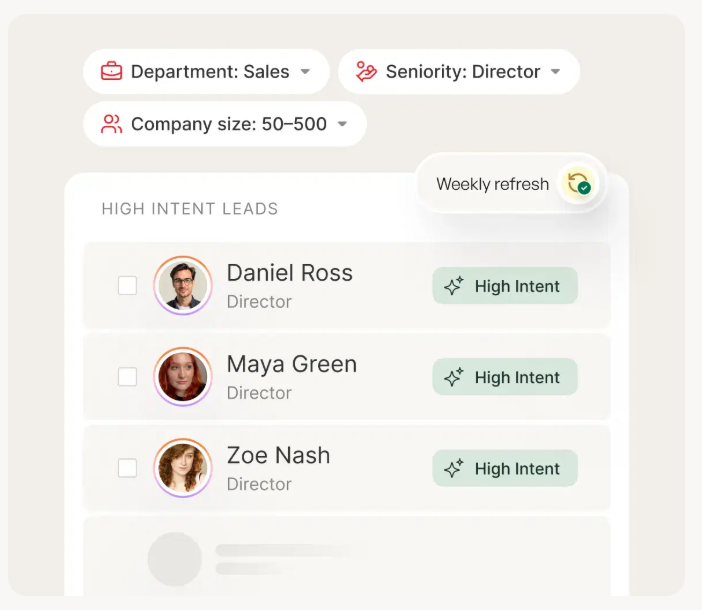
The most interesting development is "dark intent" - unstructured signals from private communities, AI conversational research, and dark social channels where buyers discuss solutions without leaving a trackable footprint. A buyer discussing your category in a private Slack community or asking Claude for vendor comparisons leaves no trackable signal, but they're further along than someone who just downloaded your whitepaper. Account-level intent profiles that consolidate signals from multiple stakeholders are replacing individual-level lead scoring. Bombora, which powers intent tracking across 15,000 topics at enterprise pricing typically starting around $25K+/year, remains the infrastructure layer most platforms build on. Tools like Prospeo layer Bombora's intent data with contact-level filters so you can act on those signals without a separate enterprise contract.
New KPIs are emerging: intent-to-opportunity velocity measures how fast an intent signal converts to pipeline, preemptive engagement rate tracks how often you reach buyers before they reach you, and ROI from dark intent sources captures value from previously invisible channels. These are still maturing, but they signal where measurement is headed.
Measuring Results
Only 38% of CEOs report having the right data and insights to achieve their commercial goals. If you can't measure your marketing, your budget gets cut. Here's the framework.
| Funnel Stage | KPIs | What Good Looks Like |
|---|---|---|
| Awareness | Traffic, impressions, share of voice | Growing MoM; SOV > market share |
| Consideration | MQLs, engagement rate, CPL | CPL at/below industry benchmarks |
| Decision | SQLs, pipeline value, win rate | Response < 4 hrs; win rate 20%+ |
| Retention | NRR, expansion revenue, NPS | NRR > 110%; NPS > 40 |
The mistake most teams make is measuring only the top of this table. Traffic and impressions feel good but don't pay salaries. Pipeline value and win rate do. Start from the bottom - what does closed revenue need to look like? - and work backward to the activity metrics that drive it.
Speed-to-lead deserves special attention. The 48-hour response threshold isn't a best practice - it's a failure threshold. Teams that respond to inbound within an hour convert at dramatically higher rates than those that wait even a few hours.
Mistakes That Kill Pipeline
Five patterns we see destroy B2B marketing programs:
Mass blasts over targeted outreach. Sending 10,000 generic emails feels productive. It's not. It damages your domain reputation and trains your market to ignore you. Relevance beats volume every single time. (If you need a safer system, start with cold email marketing.)
Slow response to inbound. If someone fills out your demo form and doesn't hear back for two days, they've already talked to your competitor. Treat inbound leads like they're perishable - because they are.
Ignoring data quality. Every dollar you spend on sequences, ads, and content is wasted if it's built on bad contact data. Bounce rates above 5% aren't just an email problem - they're a pipeline problem. I've watched teams blame their copy, their sequencing tool, even their SDRs, when the real culprit was a 15% bounce rate rotting their sender reputation from the inside. (If you want the benchmarks and fixes, see email bounce rate.)
No measurement framework. If you can't connect marketing activity to revenue, you're operating on faith. Faith doesn't survive budget season. (A simple starting point: funnel metrics.)
Trying to do everything at once. The guides that list 15 strategies are giving you a menu, not a plan. Pick the two or three channels where your buyers actually spend time, go deep, and resist the temptation to spread thin. A dominant presence on two channels beats a mediocre presence on eight.
B2B buyers complete 60-70% of their journey before talking to sales. When they're finally ready, your outreach needs to land. Prospeo gives you 300M+ profiles with 30+ filters - buyer intent, technographics, job changes - so your marketing hits the right people at the right stage of their buying loop.
Target in-market buyers with data that refreshes every 7 days.
B2B Marketing FAQ
What's the difference between B2B and B2C marketing?
B2B targets buying committees of six to ten stakeholders with sales cycles averaging 10+ months and ROI-driven decision-making. B2C targets individuals with shorter cycles and emotional triggers. 6sense pegged the 2025 average B2B sales cycle at 10.1 months - roughly 40x longer than a typical consumer purchase.
How much does a B2B lead cost?
B2B SaaS blended CPL is $237; financial services runs $653; cybersecurity averages $406. Organic leads cost 40-50% less than paid across most industries per FirstPageSage's 2026 report. Use these benchmarks to pressure-test your own channel mix.
What's the best marketing for B2B in 2026?
SEO and content marketing deliver the lowest CPL and compound over time. For paid, LinkedIn offers the best targeting but expect $5-15 CPCs. The real answer: pick two or three channels and go deep rather than spreading across ten. Combine organic content that captures demand with verified outbound that creates it.
How do you build a prospect list without bad data?
Use a verified data platform with a short refresh cycle. Prospeo refreshes every seven days and verifies emails before you pay, delivering 98% accuracy across 143M+ verified addresses. Bounce rates above 5% damage sender reputation and waste every downstream dollar.
Is ABM worth it for small companies?
ABM works best for companies targeting enterprise accounts with $50K+ deal sizes. For SMBs with smaller average contracts, content marketing plus targeted outbound is usually higher ROI. Start ABM when you can name your top 50 accounts and resource account-specific content for each.