

Marketing Intelligence Is a Discipline, Not a Dashboard - Here's How to Do It Right
Three dashboards. Three different numbers for the same metric. That's not a tool problem - it's a marketing intelligence problem.
Your CMO asks which number is right, and nobody in the room answers with confidence. Meanwhile, a product marketer on a Reddit thread is asking what separates "real CI work" from just Googling competitors and skimming press releases. Both situations point to the same gap: most teams collect data without building the discipline to turn it into decisions.
So what is it, exactly? Marketing intelligence is the ongoing practice of collecting, synthesizing, and acting on internal performance data and external market signals to improve GTM outcomes. It wraps competitive tracking, customer insights, and campaign analytics into a single decision-making layer. And most teams are doing it wrong - not because they lack tools, but because they treat intelligence as a dashboard instead of a discipline.
Over 64% of B2B marketing leaders don't trust their organization's marketing measurement for decision-making. That's a Forrester number, and it tracks with what we see in practice. If your team can't trust the data, every downstream decision - budget allocation, channel mix, messaging - is a guess.
If you're building an MI stack from scratch, you need three things: data unification across channels, competitive monitoring that's systematic rather than ad-hoc, and verified contact data with accurate emails, mobiles, and intent signals powering outbound and ABM.
MI vs. BI vs. CI vs. Market Research
These four terms get used interchangeably, and that's where programs fall apart. They're related but distinct disciplines with different scopes, data sources, and outputs.
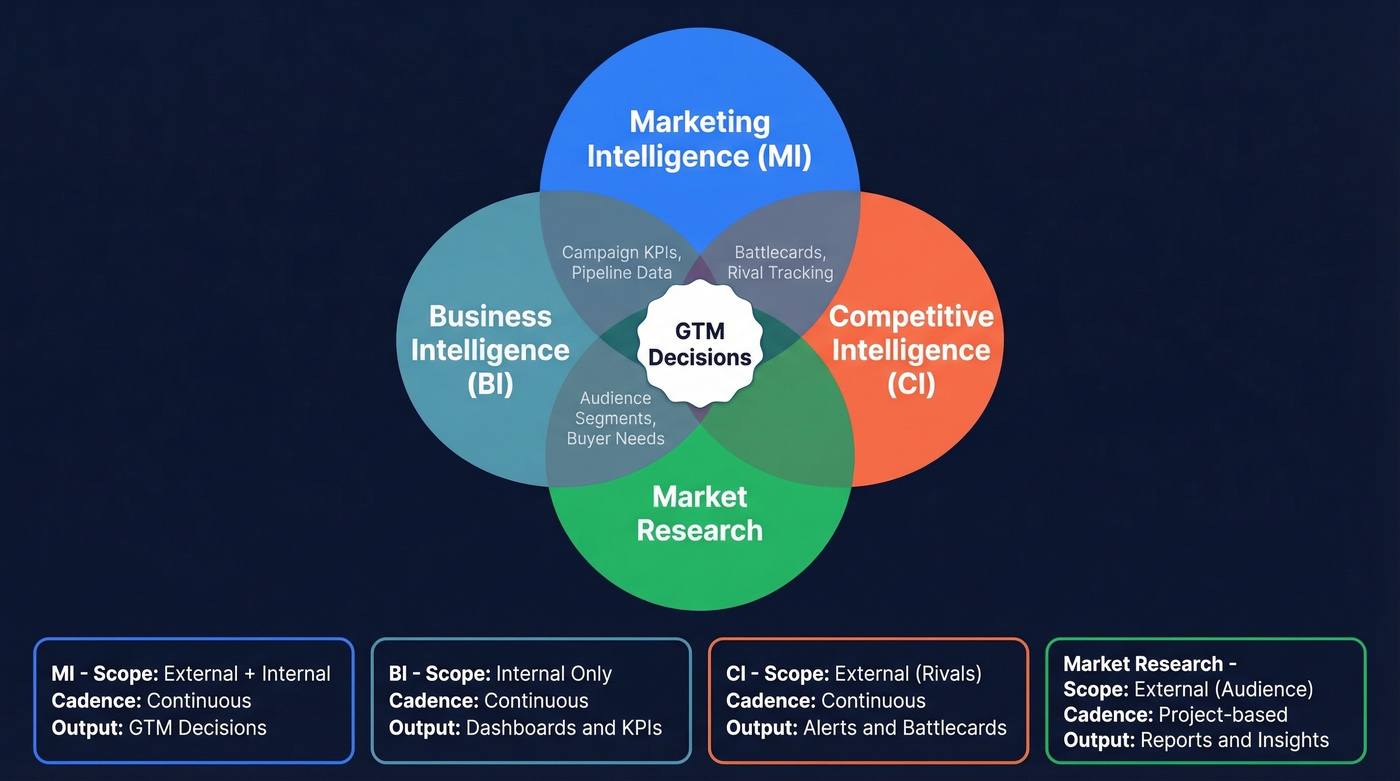
| Marketing Intel | Business Intel | Competitive Intel | Market Research | |
|---|---|---|---|---|
| Scope | External + internal | Internal only | External (rivals) | External (audience) |
| Data | Multi-source blend | CRM, ERP, finance | Competitor signals | Surveys, interviews |
| Cadence | Continuous | Continuous | Continuous | Project-based |
| Output | GTM decisions | Dashboards, KPIs | Battlecards, alerts | Reports, insights |
Business intelligence looks inward - your sales pipeline, your revenue, your ops metrics. Marketing intelligence synthesizes external forces with internal performance. Market research answers a specific question at a point in time. Competitive intelligence tracks rivals continuously. MI wraps all of these into a decision-making discipline.
Some frameworks collapse this into four types. We think performance intelligence - your own campaign and channel data - deserves its own category because it's the foundation everything else builds on.
Why It Matters More in 2026
Marketing budgets are under pressure. Gartner's data shows budgets sitting at 7.7% of company revenue, with the martech share dropping to 23.8% from 25.4% the prior year. Teams are spending less on tools while being asked to do more with the tools they keep.
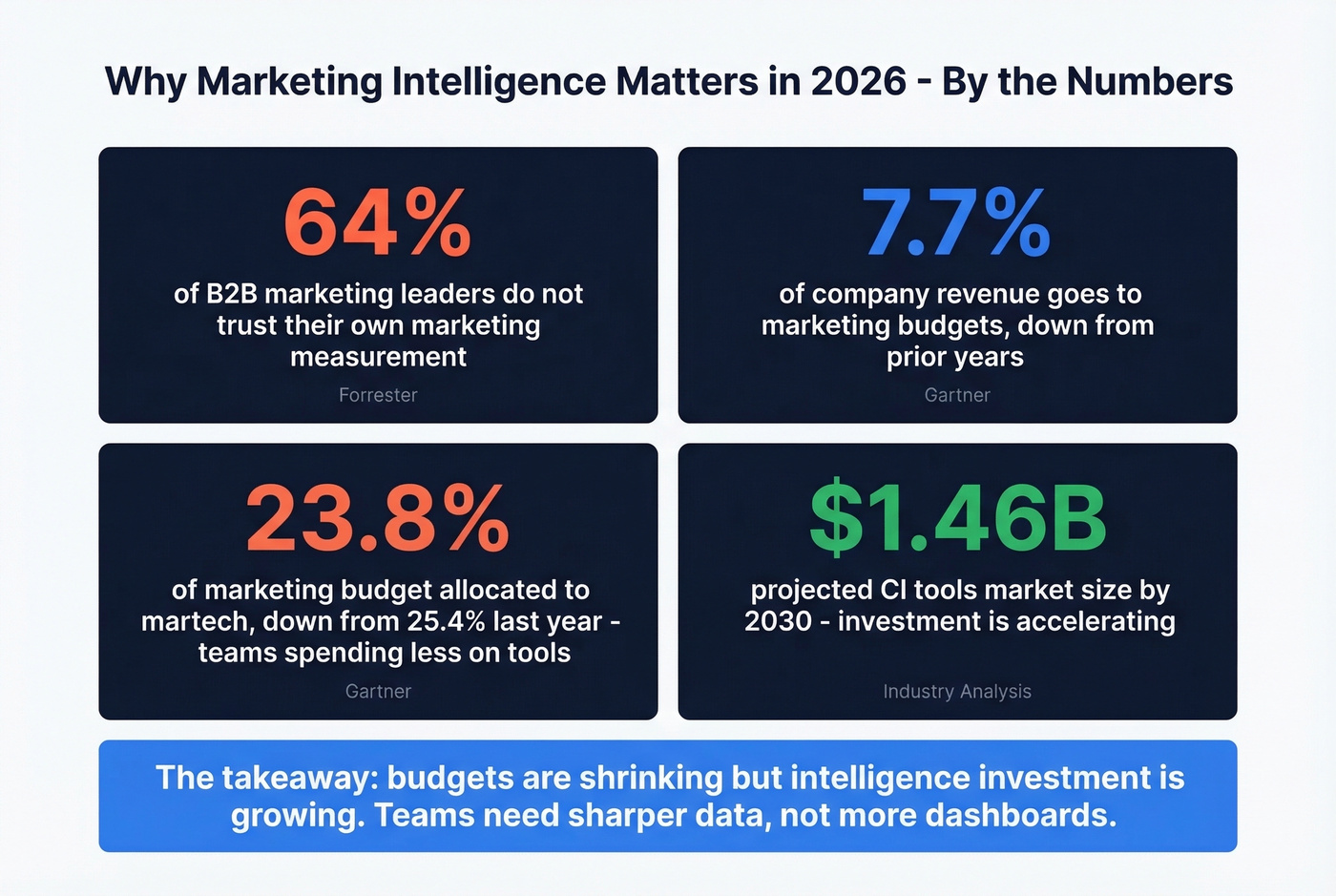
That squeeze makes intelligence - not just data collection - essential. When you can't throw money at coverage gaps, you need sharper targeting, faster competitive response, and cleaner data flowing into every campaign. The CI tools market alone is projected to hit $1.46B by 2030, which tells you where the investment is heading.
Here's the thing: when nearly two-thirds of B2B marketing leaders don't trust their own numbers, the problem isn't a missing dashboard. It's that nobody's built the synthesis layer between data sources, competitive context, and decision-making. That synthesis layer is what separates data-rich organizations from intelligence-driven ones.
Most teams don't need more tools. They need one person whose job is to look at the data they already have and write a weekly "so what" brief. A single analyst doing synthesis beats a ten-person team drowning in unread dashboards every time.
MI Maturity: Where Does Your Team Sit?
Not every team needs a full-blown intelligence program on day one. Most organizations move through four stages:
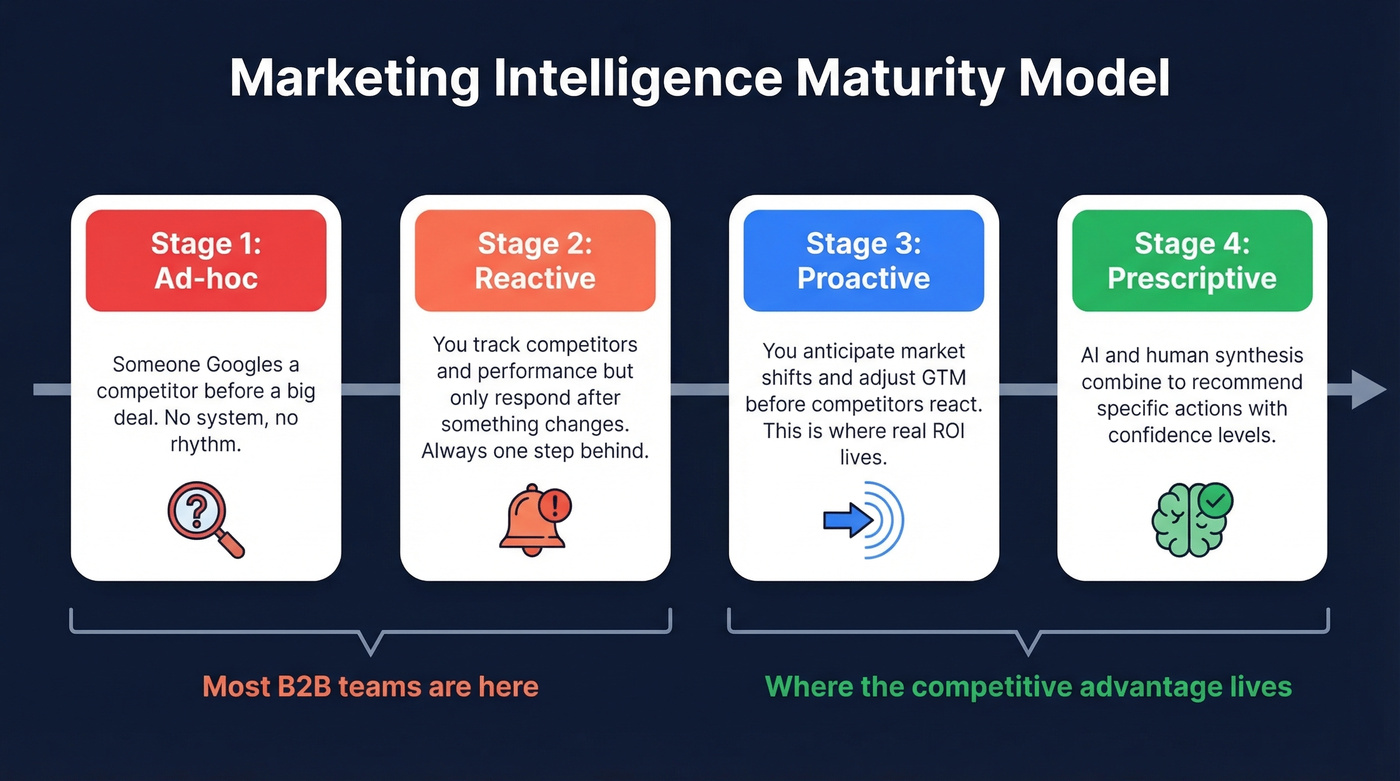
- Ad-hoc - Intelligence happens when someone remembers to Google a competitor before a deal.
- Reactive - You track competitors and performance, but only respond after something changes.
- Proactive - You anticipate market shifts and adjust GTM before competitors react.
- Prescriptive - AI and human synthesis combine to recommend specific actions with confidence intervals.
Most B2B teams sit at stage one or two. Getting to stage three is where the real ROI lives.
The Five Types of Marketing Intelligence
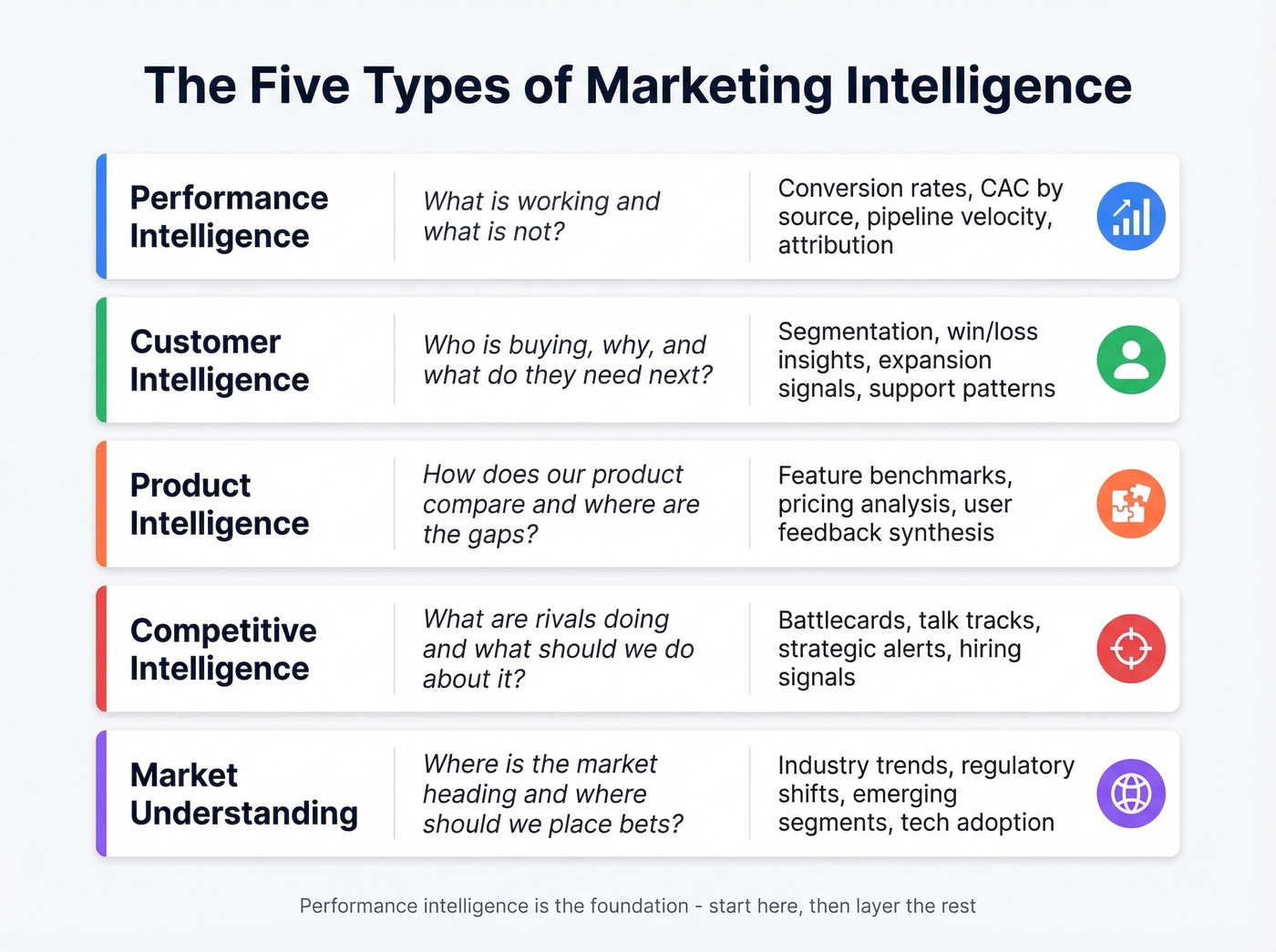
Not all intelligence serves the same purpose. A mature MI program covers five types, each answering a different strategic question.
Performance Intelligence
What's working and what isn't? Campaign and channel analytics - conversion rates, CAC by source, pipeline velocity, attribution. It's the type most teams already have some version of, even if it's fragmented across platforms. (If you want a clean baseline, start with funnel metrics before you add more tools.)
Customer Intelligence
Who's buying, why, and what do they need next? This pulls from CRM data, support tickets, win/loss interviews, and product usage patterns. It feeds segmentation, messaging, and expansion plays.
Product Intelligence
How does our product compare, and where are the gaps? Feature benchmarking, pricing analysis, and user feedback synthesis. Product marketers live here, but it often stays siloed in their heads instead of flowing into GTM assets.
Competitive Intelligence
What are rivals doing, and what should we do about it? Systematic tracking of competitor pricing, positioning, hiring, product launches, and partnerships. The output should be battlecards, talk tracks, and strategic alerts - not a folder of screenshots nobody opens. (If you need a practical starting point, use a competitive intelligence strategy to define signals and cadence.)
The consensus on r/productmarketing is telling: what PMMs actually need is ongoing monitoring that feeds directly into battlecards and sales enablement, not a quarterly slide deck that's outdated before it ships.
Market Understanding
Where is the market heading, and where should we place bets? Industry trends, regulatory shifts, emerging segments, and technology adoption curves. It's the least urgent on any given day and the most important over any given year.

Your MI program is only as good as the data feeding it. Prospeo gives you 300M+ verified profiles, 15,000 Bombora intent topics, and 30+ filters - so your intelligence layer actually connects to real buyers, not stale records refreshed every six weeks.
Stop synthesizing signals that point to dead-end contacts.
Building an MI System That Works
Before you buy anything, understand that a marketing intelligence system is the combination of people, processes, and technology that turns raw signals into repeatable GTM decisions. The tools below are components - the system is how you connect them.
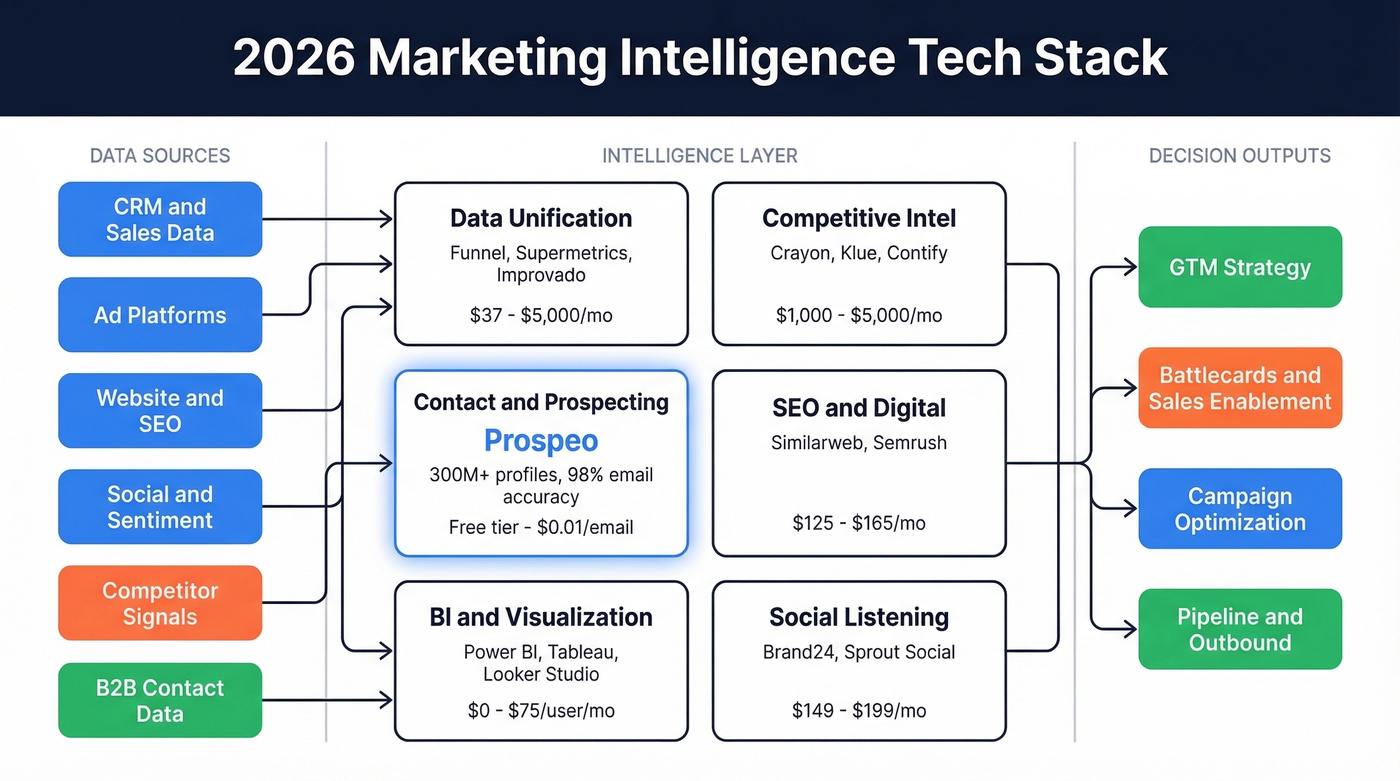
Data Unification & Analytics
Funnel connects 600+ connectors and processes $80B+ in ad spend across 2,500+ customers. The AI-powered "Data Chat" feature lets you query marketing performance conversationally. Free entry plan available; paid plans typically run ~$500-2,000+/mo depending on data volume.
Supermetrics starts at $37/mo and does one thing well: pulling marketing data into spreadsheets, Looker Studio, or your data warehouse. The budget pick for teams that don't need a full unification platform yet.
Improvado targets agencies and multi-brand organizations at ~$1,000-5,000/mo. If you're managing marketing data across ten client accounts or five brand portfolios, it's built for that complexity.
Competitive Intelligence
Crayon is the enterprise-grade option, tracking website changes, pricing shifts, and job postings, then feeding them into automated alerts. Custom pricing around ~$2,000-5,000/mo. Worth it if CI is a core function, not a side project.
Klue is the PMM's favorite - strong battlecard workflows, win/loss integration, and a UI product marketers actually enjoy using. Around ~$1,500-4,000/mo. The right pick if your primary MI output is sales enablement content. (To make those outputs actually usable, ship them as sales battle cards, not slide decks.)
Contify runs AI-powered news and signal monitoring at ~$1,000-3,000/mo. Good for teams that need ongoing competitor monitoring without full battlecard infrastructure.
B2B Contact & Prospecting Intelligence
This is where we've spent the most time testing, and it's where bad data does the most damage. Your competitive insights and campaign analytics are worthless if the contacts you're reaching out to bounce or go to voicemail. (If you're evaluating vendors, start with a shortlist of data enrichment services and compare refresh cycles.)
Prospeo covers 300M+ professional profiles with 98% verified email accuracy. The 125M+ verified mobile numbers deliver a 30% pickup rate - about 2.5x what most teams see with legacy data providers. A 7-day data refresh cycle keeps records current while the industry average sits at six weeks.

Beyond basic firmographics, the 30+ search filters include buyer intent data powered by 15,000 topics, technographics, job changes, headcount growth, and funding signals. Native integrations with Salesforce, HubSpot, Smartlead, Instantly, Lemlist, Clay, Zapier, and Make mean verified contacts flow directly into your sequences and CRM without manual exports. (If you're building lists in Clay, this Clay list building workflow is a solid reference.) Snyk's 50-person AE team dropped bounce rates from 35-40% to under 5% and generated 200+ new opportunities per month after switching. Free tier gives you 75 emails/month plus 100 Chrome extension credits/month; credit-based pricing runs about $0.01/email with no contracts.
Digital & SEO Intelligence
Similarweb starts at $125/mo and benchmarks competitor website traffic, referral sources, and audience overlap. Essential for understanding where rivals get their traffic.
Semrush at $165/mo tracks keyword rankings, content gaps, and backlink profiles. Most marketing teams already have a seat somewhere - it's the default for content and SEO intelligence.
BI & Visualization
Power BI starts at $14/user/mo for teams in the Microsoft ecosystem. Tableau at $75/user/mo remains the gold standard for advanced visualization. Looker Studio offers a free tier with Pro at $9/user/project/mo, making it the default for Google-centric teams.
Social Listening & Sentiment
Brand24 starts at $149/mo for real-time social and web monitoring. Sprout Social at $199/seat/mo combines social management with analytics - skip it if you only need listening, but it's solid if you're managing social channels too.
Pricing at a Glance
| Tool | Category | Starting Price | Best For |
|---|---|---|---|
| Prospeo | B2B Contact Intel | Free / ~$0.01/email | Emails, mobiles, intent |
| Funnel | Data Unification | Free / ~$500+/mo | Cross-channel data |
| Supermetrics | Data Pipelines | $37/mo | Budget data extraction |
| Improvado | Data Unification | ~$1,000+/mo | Agencies, multi-brand |
| Crayon | Competitive Intel | ~$2,000+/mo | Enterprise CI monitoring |
| Klue | Competitive Intel | ~$1,500+/mo | PMM battlecards |
| Contify | Competitive Intel | ~$1,000+/mo | AI news monitoring |
| Similarweb | Digital Intel | $125/mo | Traffic benchmarking |
| Semrush | SEO/Content Intel | $165/mo | Keyword & content tracking |
| Power BI | BI/Visualization | $14/user/mo | Budget BI |
| Tableau | BI/Visualization | $75/user/mo | Advanced visualization |
| Brand24 | Social Listening | $149/mo | Real-time mentions |
| Sprout Social | Social Mgmt | $199/seat/mo | Social analytics |
Five Mistakes That Kill MI Programs
1. Confusing Data Collection With Intelligence
Pulling data into a warehouse isn't intelligence. Intelligence happens when someone synthesizes that data with competitive context and market signals to produce a recommendation. If your "MI program" is just a Looker dashboard nobody opens, you've built a data pipeline, not an intelligence function.
Fix: Assign one person to write a weekly synthesis brief - three paragraphs covering what changed, why it matters, and what the team should do about it. (To keep it tied to revenue, map each brief to pipeline health metrics.)
2. Relying on Generic Public Sources
Press releases and competitor websites are table stakes. The teams that win are monitoring patent filings, hiring patterns, job posting language, and pricing page changes. If your competitive intel comes from the same sources your competitors can see, you don't have an advantage.
Fix: Subscribe to at least one signal source your competitors aren't watching - job board scraping, patent databases, or review site monitoring.
3. Using Outdated Data
75% of procurement professionals can't update their data in real time. The same problem plagues MI programs. When your contact database refreshes every six weeks, you're emailing people who changed jobs a month ago and calling numbers that are already disconnected.
Fix: Audit your data sources' refresh cycles. If any critical source updates less than monthly, replace it. (If email performance is already slipping, start with email bounce rate diagnostics.)
4. Over-Automating Without Human Synthesis
AI can surface patterns and anomalies faster than any analyst. But the "so what?" still requires a human who understands the business context. We've seen teams automate their entire CI workflow and end up with a Slack channel full of alerts that nobody reads. Automation handles collection; humans handle interpretation.
Fix: For every automated alert, require a human to tag it as "action needed," "monitor," or "noise" within 48 hours.
5. Failing to Operationalize Insights
This is the most common failure mode, and it's the one that frustrates us the most. Intelligence stays in a slide deck. If your competitive insights don't ship as battlecards, updated talk tracks, revised ad copy, or adjusted sequences, you've produced research - not intelligence. The output of MI should be GTM assets, not reports.
Fix: Every intelligence brief should end with a specific deliverable and owner - "Update the Acme battlecard by Friday" beats "interesting finding" every time. (If you need a repeatable way to turn insights into enablement, build a lightweight marketing enablement process.)
Most teams stall at stage two because their competitive and customer intelligence never reaches outbound. Prospeo bridges that gap - 98% email accuracy, 125M+ verified mobiles, and intent data across 15,000 topics turn your "so what" briefs into pipeline.
Move from reactive dashboards to prescriptive outbound at $0.01 per lead.
AI and the Future of MI
65% of CMOs believe AI will dramatically transform their role within the next two years. Another 82% say their company's identity will need to significantly change to keep pace. McKinsey estimates GenAI could unlock $0.8-$1.2T in annual value across sales and marketing functions, with a 5-15% productivity lift for marketing teams specifically.
But here's the sobering counterpoint: only 5% of marketing leaders who treat GenAI as just another tool - rather than embedding it into workflows - report significant business gains. The gap between "we use AI" and "AI drives our decisions" is enormous, and it maps directly to the intelligence maturity of the organization.
The teams seeing real results embed AI into intelligence workflows, not just content generation. Crabtree & Evelyn used AI-driven media optimization to achieve a 30% ROAS improvement in under two months with flat media spend. Unilever reported a 30% reduction in content costs and 50% faster campaign turnaround by integrating AI into their creative and distribution pipeline.
AI doesn't replace marketing intelligence. It accelerates it. The discipline - defining what signals matter, synthesizing them into decisions, operationalizing those decisions into GTM assets - still requires human judgment. AI just makes the collection and pattern-recognition layers dramatically faster.
Measuring Your MI Program
Two KPIs matter more than any others.
First, time-to-insight: how many days pass between a market signal appearing and your team acting on it? If a competitor drops pricing on Monday and your sales team doesn't know until the following quarter's battlecard refresh, your MI program is decorative.
Second, insight adoption rate: what percentage of intelligence deliverables actually change a GTM asset or decision? We track this internally by tagging every brief with a follow-up action and checking completion within two weeks. If fewer than half your briefs produce a tangible change, you're generating reports, not intelligence.
FAQ
What is marketing intelligence?
Marketing intelligence is the continuous process of gathering, analyzing, and acting on internal performance data and external market signals - competitor moves, buyer intent, industry trends - to drive smarter GTM decisions. Unlike one-off research projects, it's an always-on discipline that synthesizes multiple data sources into actionable recommendations.
How does it differ from marketing analytics?
Analytics measures what happened - clicks, conversions, revenue. Marketing intelligence layers analytics with external signals like competitor pricing changes and buyer intent data to explain why it happened and prescribe what to do next. Analytics is one input; MI is the synthesis layer.
How much do MI tools cost?
Most mid-market teams spend $500-3,000/mo across two to three tools covering data unification, competitive monitoring, and contact intelligence. Entry points range from free tiers (GA4, Looker Studio, Prospeo's 75 emails/month) to $10,000+/mo for enterprise platforms.
Can small teams build an MI program?
Yes. Start with free tools like GA4 and Looker Studio, add one competitive monitoring habit - even a weekly 30-minute review - and layer in verified contact data for outbound. The discipline of weekly synthesis matters far more than the budget.
How often should MI data be refreshed?
Campaign metrics need daily updates. Competitive intelligence should refresh weekly. Contact data requires a 7-day refresh minimum - stale emails and outdated job titles destroy outbound performance and attribution accuracy faster than almost anything else.