

The MEDDPICC Qualification Framework: A Practitioner's Guide
Your VP just announced MEDDPICC. Half the team is Googling it. The other half survived BANT, Sandler, and Challenger already, and this feels like another acronym destined for empty CRM fields.
Here's the thing: the MEDDPICC qualification framework is different, and there's data to back it up. Deel saw a 33% win-rate improvement after reinforcing it in real time - not by hanging a poster on the sales floor.
What You Need (Quick Version)
- MEDDPICC is built for complex deals - think >$50K with 90+ day cycles. For transactional deals closing in under 30 days, use BANT.
- The framework works when it's embedded in deal reviews, not when it's a CRM checkbox exercise. Deel's CRM fill rate jumped from 1.1% to 73% once they reinforced it in real time.
- Paper Process is the most underrated letter. Procurement and legal can add 30-90 days if you discover them late. Front-load your MSA during discovery.
What MEDDPICC Stands For
MEDDIC originated at PTC in the 1990s and is commonly credited to John McMahon, with Dick Dunkel and Jack Napoli helping document and spread it internally through training and onboarding. MEDDPICC is the expanded variant that adds Paper Process and Competition to reflect how enterprise deals actually close - through procurement gauntlets and competitive bake-offs. Today, MEDDPICC is a federally registered trademark owned by Darius Lahoutifard (MEDDIC Academy).
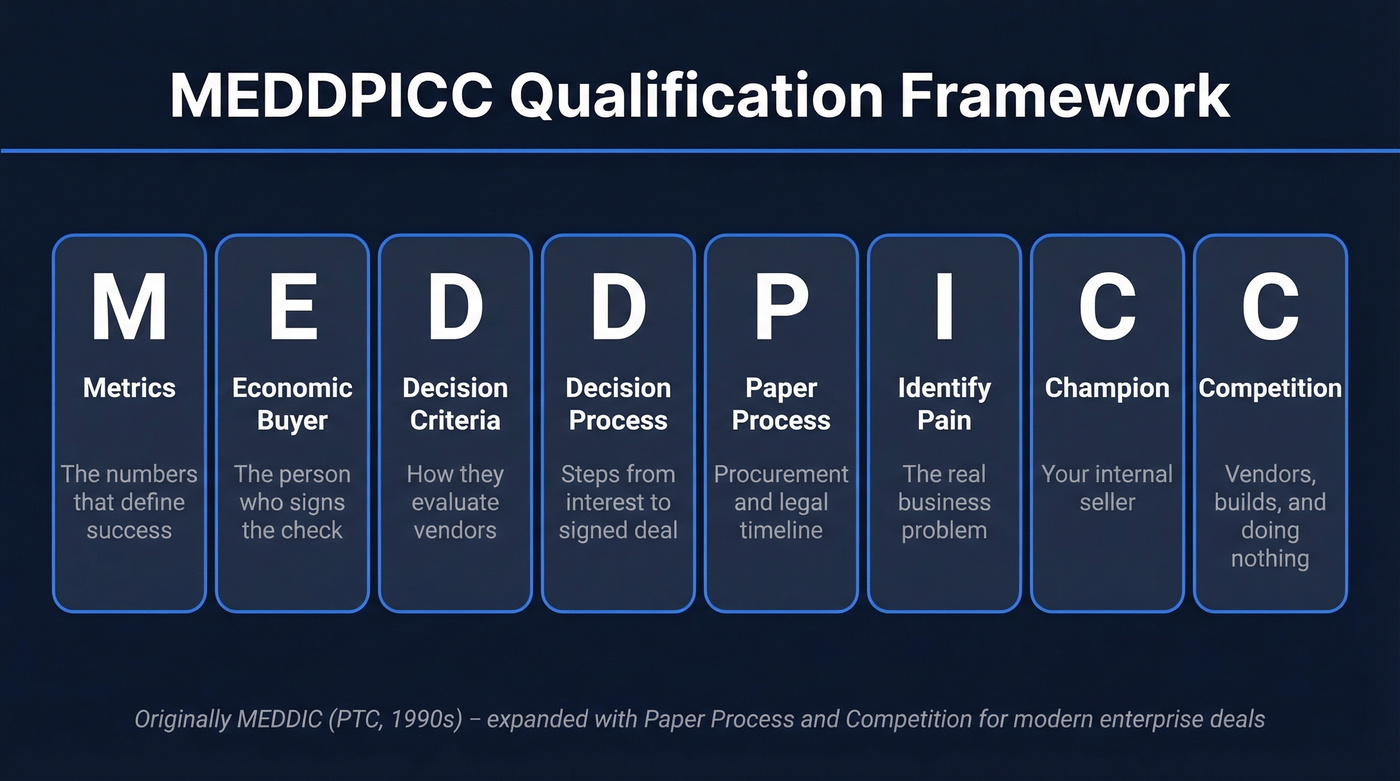
The eight letters: Metrics, Economic Buyer, Decision Criteria, Decision Process, Paper Process, Identify Pain, Champion, Competition.
The 8 Components (with Teeth)
A question bank is a refresher, not a script. If your reps can't explain why they're asking a discovery question, your qualification training already failed. Understand the purpose of each component, then ask questions that fit the conversation.
Metrics & Economic Buyer
Metrics are the quantifiable outcomes your buyer needs to achieve. Think of them in tiers: company-level (revenue growth), department-level (pipeline velocity), and personal - a VP's bonus tied to reducing churn from 8% to 5%, saving $2M ARR. Personal metrics drive urgency more than any corporate OKR.
Ask: "What does success look like in numbers, and how will you measure ROI at 6 months?"
Economic Buyer is the person who can sign the check without asking permission. In enterprise deals, buying committees often involve 7-10 stakeholders. Your champion's manager isn't necessarily the economic buyer - it's whoever controls the budget line. Ask: "Who has final sign-off on budget allocation for this initiative?" (If you need a deeper breakdown, see Economic Buyer.)
Multi-threading into a 10-person committee means you need verified contact data for each stakeholder. Prospeo's 300M+ profiles with 98% email accuracy make that step straightforward instead of a guessing game - especially if you’re building an account-based motion.
Decision Criteria & Decision Process
Decision Criteria are the formal and informal standards the buyer uses to evaluate vendors - technical requirements, integration needs, compliance certifications. Get the full list early so you can shape it. Ask: "What are your must-haves vs. nice-to-haves, and how are you weighting technical fit vs. price?" (More prompts: discovery questions.)
Decision Process is the sequence of steps between "we like this" and "we've signed." We've watched deals stall for months because reps never mapped the full approval chain. Build a checklist early: technical evaluation, security review, executive presentation, board approval, procurement. Ask: "Walk me through what happens after your team selects a vendor." This is also where pipeline health starts to show up (or fall apart).
Paper Process & Identify Pain
Thirty to ninety days. That's how much time procurement and legal can add if you discover them late in the cycle. Paper Process is the most underrated letter in the framework, and it's the one that kills forecasting accuracy.
The fix is simple: send your standard MSA and security documentation during discovery, not after the verbal "yes." Ask about vendor security reviews early and offer to start them immediately.
Identify Pain is the business problem driving the initiative - not the feature request. A prospect asking for "better reporting" might actually be losing deals because reps can't see pipeline accurately. Ask: "What happens if you don't solve this in the next 6 months?" If you want a tighter set of prompts, use MEDDIC discovery questions.
Champion & Competition
Let's be honest: most "champions" aren't champions. We've seen deals die because the so-called champion was actually just a friendly contact with no internal influence. A real Champion has power, influence, and a personal reason to see your deal close. They sell internally when you're not in the room.
Test this: "Would you be willing to present our business case to the executive team?" If they hesitate, you have a guide, not a champion. (Related: what is team selling.)
Competition includes other vendors, internal builds, and the most dangerous competitor of all: doing nothing. Ask: "What would make you decide to keep the status quo?" If you’re formalizing this, build sales battle cards so reps don’t wing it.
Quick Example: $200K ERP Deal
Here's how the methodology maps to a real deal. Metrics: CFO needs to cut close time from 12 days to 5. Economic Buyer: CFO (controls the budget line). Decision Criteria: SOC 2 compliance, Salesforce integration, sub-5-second load times. Decision Process: technical eval, security review, CFO presentation, board sign-off. Paper Process: 6-week procurement cycle, started during discovery. Pain: month-end close requires 3 FTEs of manual reconciliation. Champion: Controller whose team does the manual work. Competition: incumbent ERP plus "do nothing."
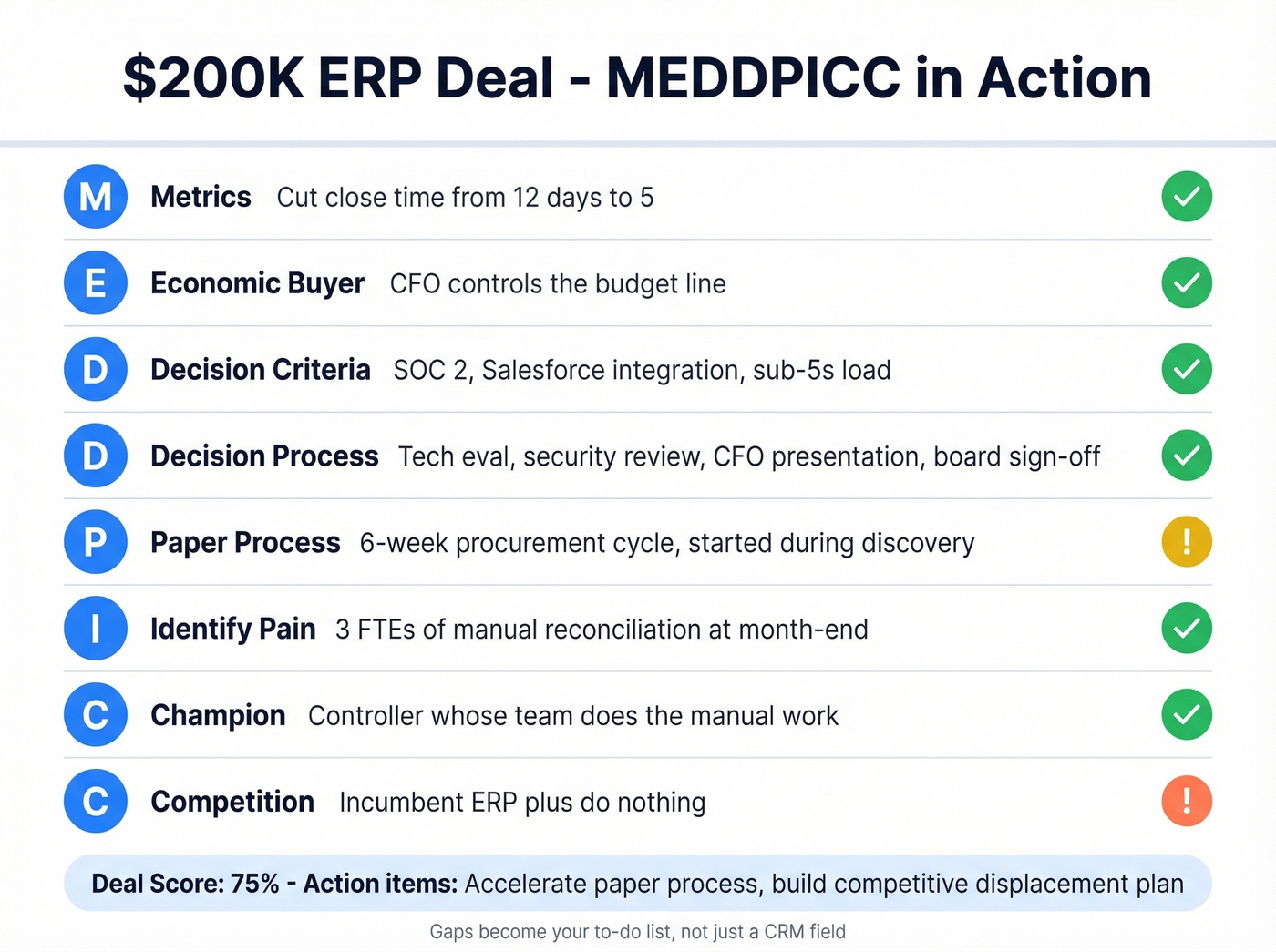
Score this deal at each stage and the gaps become your action items.

Multi-threading a 10-person buying committee means nothing if half your emails bounce. Prospeo's 300M+ profiles with 98% verified email accuracy and 125M+ direct dials let you reach every stakeholder in your MEDDPICC map - Economic Buyer, Champion, and the procurement contact you haven't identified yet.
Stop qualifying deals you can't actually reach. Get verified contact data for every stakeholder.
When This Framework Earns Its Overhead
Using MEDDPICC on a $5K transactional deal is like running a full medical workup for a paper cut. Match the framework to the complexity.
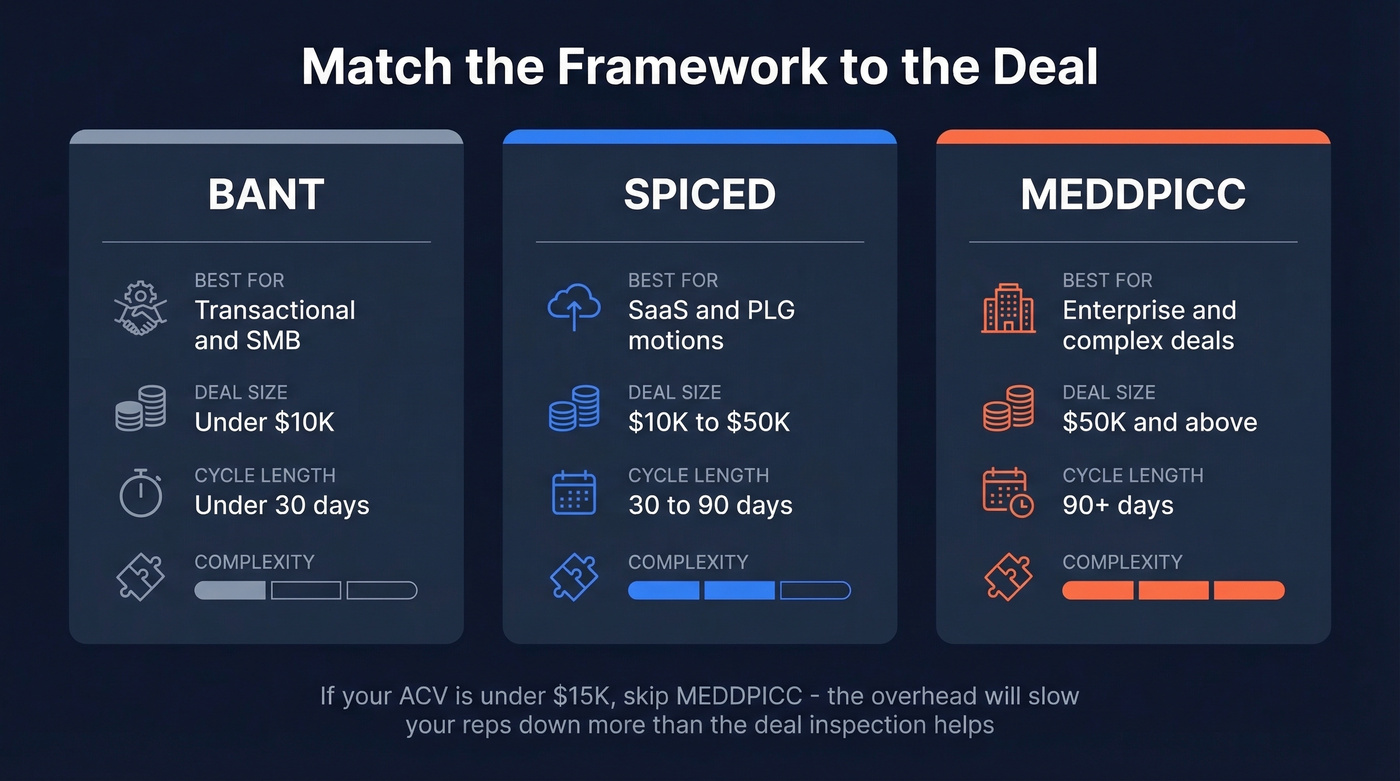
| Framework | Best For | Deal Size | Cycle Length |
|---|---|---|---|
| BANT | Transactional / SMB | <$10K | <30 days |
| SPICED | SaaS / PLG | $10K-$50K | 30-90 days |
| MEDDPICC | Enterprise / complex | >$50K | >90 days |
If your average contract value is under $15K, skip MEDDPICC. The overhead will slow your reps down more than the deal inspection helps. BANT or SPICED will get you there faster. Enterprise deal qualification earns its keep when there's a procurement team, a buying committee, and real money on the line - especially in enterprise B2B sales.
How to Score a Deal
Your top rep says the deal is "basically closed." You pull up the scorecard: 60%. No confirmed Paper Process. That deal isn't closing this quarter.
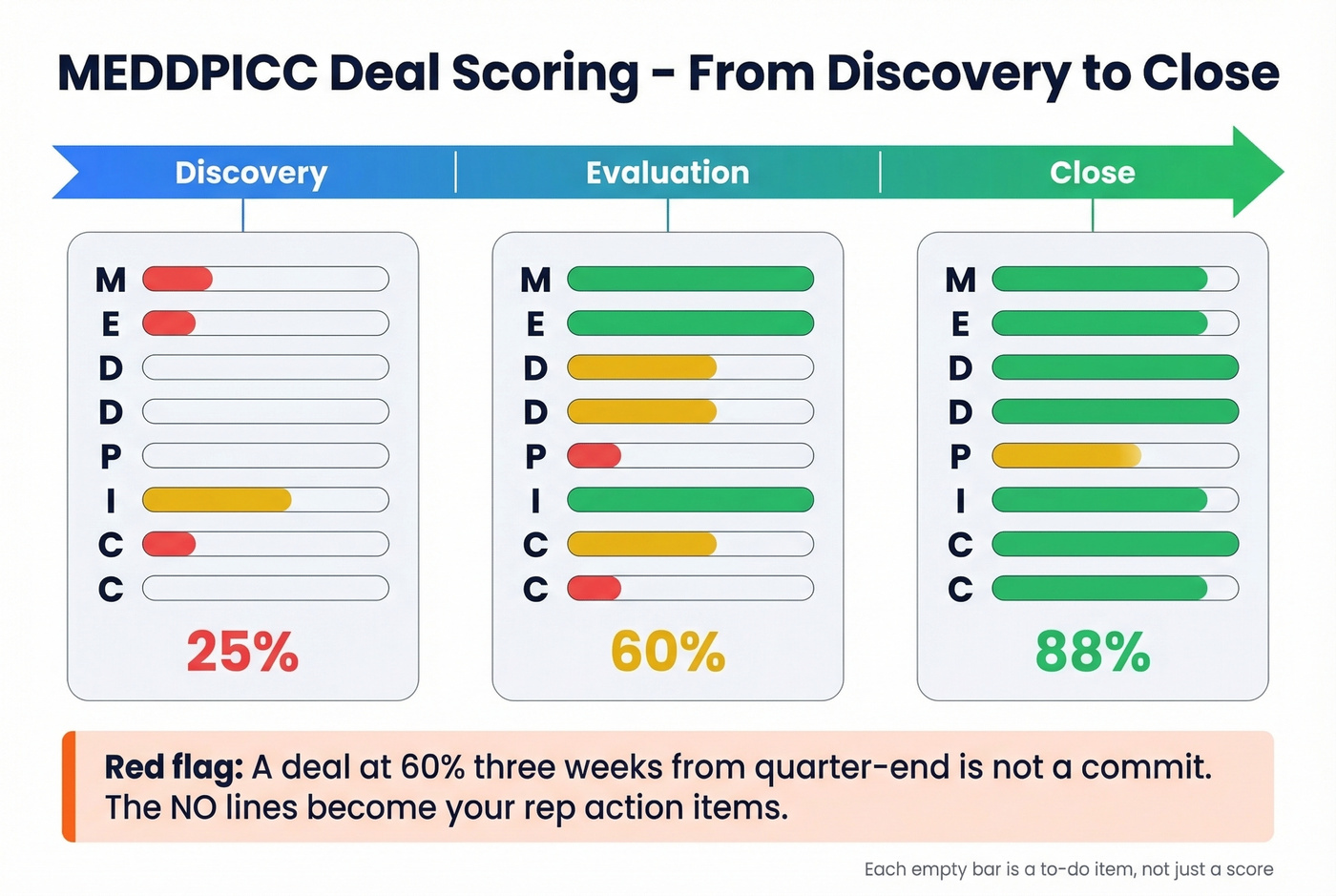
The MEDDIC Academy scorecard flips each component from NO to YES as you progress. Early in the cycle, a weak Paper Process score is fine. But a deal sitting at 60% three weeks from quarter-end is a red flag for your forecast, not a commit. If you’re tightening this operationally, pair it with sales forecasting solutions.
The NO lines become the rep's to-do list - that's the operational power. It turns deal inspection from a gut feeling into a pipeline hygiene discipline that improves sales velocity across the team.
Why Most Teams Get It Wrong
The #1 complaint on r/sales? MEDDPICC becomes a CRM exercise - fields filled to make managers happy, not to advance deals. Reps treat it like paperwork. Managers check boxes in pipeline reviews. Nobody uses it to actually decide the state of a deal.
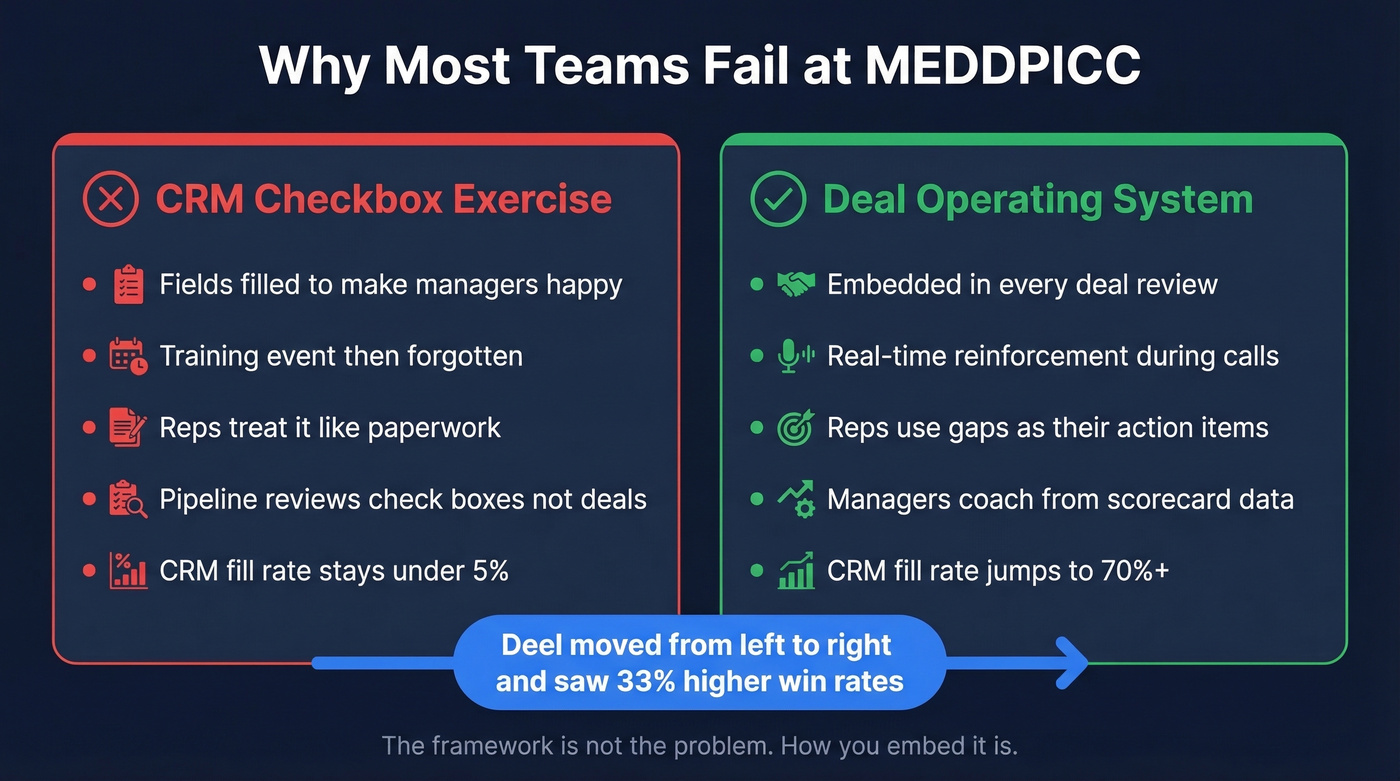
In our experience, the teams that fail treat it as a training event, not an operating system. What makes the MEDDPICC qualification framework different from every other methodology is that it forces you to qualify the process - procurement, competition, internal champions - not just the opportunity. But that only works if it's embedded in daily deal reviews, as Deel's CRM fill rate jump proved when they moved from training decks to real-time reinforcement. (If you’re diagnosing broader issues, start with sales pipeline challenges.)
Training and Certification
MEDDIC Academy is the registered trademark owner and the only official certification provider:
| Module | Price |
|---|---|
| Intro to MEDDPICC | Free |
| Full MEDDPICC | $297 |
| Advanced MEDDPICC | $597 |
| MEDDPICC for Managers | $1,173 |
| MEDDPICC for Trainers | $3,970 |
For enterprise-wide rollouts with custom coaching, firms like Force Management typically run $100K-$500K+ depending on team size and engagement depth.
Your MEDDPICC scorecard flags the gaps. Prospeo fills them. Need the CFO's direct line to confirm they're the Economic Buyer? Need procurement's email to front-load your MSA? 125M+ verified mobiles with a 30% pickup rate and emails at $0.01 each - built for the multi-threaded outreach enterprise deals demand.
Turn every red flag on your scorecard into a conversation. Start for free.
FAQ
What's the difference between MEDDIC and MEDDPICC?
MEDDPICC adds Paper Process and Competition to the original six-letter MEDDIC framework. Use the expanded version when deals involve procurement gates and competitive evaluations - typically $50K+ with 90+ day cycles. For simpler enterprise sales without heavy procurement, MEDDIC still works.
Does MEDDPICC actually improve win rates?
Yes. Deel reported a 33% win-rate improvement after embedding reinforcement into live deal workflows. The key variable isn't the framework itself - it's whether teams use it in deal reviews or let it rot in a CRM.
How do I find contact data for the buying committee?
Once you've mapped stakeholders through discovery, you need a fast way to get verified emails and direct dials for economic buyers and champions. A B2B data platform with broad coverage and high accuracy - like Prospeo's 300M+ profiles with a 7-day refresh cycle - keeps your outreach from bouncing while you're trying to multi-thread into the account.